Oh Oh Oh Ozempic For Our Oh Oh Oh Obese Cats? It’s Close To Reality

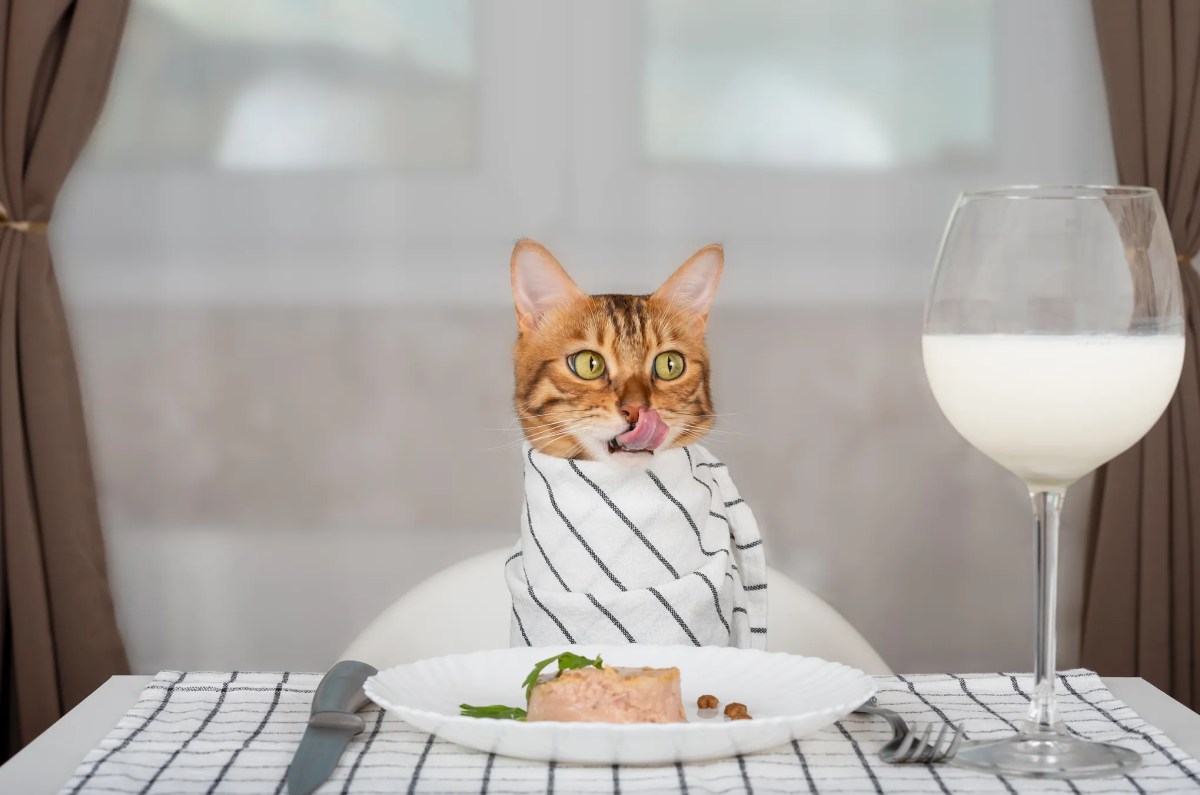
In apocalyptic news for house cats everywhere, a pharmaceutical company is kicking off a trial of a GLP-1 drug for felines.

If cats could read newspapers, chances are they’d be gripped by a cold terror right about now, wondering if they’re among the unfortunates to have their yums curtailed by the same weight loss drugs their humans have been gobbling.

As the New York Times reports, a biopharma company headquartered in San Francisco, Okava Pharmaceuticals, is about to begin a trial to determine if GLP-1 drugs can help our chonksters slim down. More than 60 percent of American pets are packing extra pounds, the Times notes, while consequences like diabetes are shortening the lifespans and reducing quality of life for felines and canines.

“It is our belief that the condition of obesity, the condition of being overweight, is by far the number one most significant preventative health challenge in all of veterinary medicine,” Okava founder and CEO Michael Klotsman told the paper.

The upcoming study will include 50 cats. Most will receive a GPL-1 medication while a control group — about one third of the cats — will be given a placebo.

Since cats aren’t exactly known for being cooperative when it comes to taking oral medicine and weekly injections at a veterinary office are impractical, Okava has developed a system with a patch about the size of a microchip that will dispense the weight loss drugs over six months before a tiny cartridge needs to be replaced.

If all goes well with the trial, Okava will seek FDA approval and address other obstacles like convincing caretakers that their little pals can benefit from the feline version of Ozempic, Mounjaro and Wegovy.

That may be easier said than done considering our relationships with our furry friends and the role food plays in things like training, bonding and every day life

For lots of cat caretakers “their main way that they interact with and show their love to their pet often revolves around food,” Dr. Maryanne Murphy, a veterinary nutritionist at the University of Tennessee, told the Times.

How could the dynamic between cat and human change if the flow of yums is reduced to meals only? Will training — for everything from walking on a harness, to entering a carrier and fun tricks like high fives — still work if the reward is just a bit of encouragement or a scratch behind the ear?

An earlier weight loss drug developed for dogs, Slentrol, did not catch on because, as one veterinarian noted, “the main way [people] interacted with their pet was by feeding them, and seeing their excitement and happiness when they were eating the food.”

There’s also the not-so-small matter of cost. GLP-1 drugs are in high demand, and they’re expensive. One in eight Americans has taken Ozempic or one of its competitors. At times, the demand has threatened availability for diabetics, for whom the drugs were developed in the first place.

If the trials are successful and the GLP-1 drugs for pets gain FDA approval — which would require a series of much larger scale, more rigorous studies — the company hopes to offer them to consumers at a cost of about $100 per month per pet.

Even if this iteration of the drug fails, it’s unlikely to derail the larger effort. Vets have been prescribing tiny doses of the human version to cats with diabetes, and perhaps most telling of all, pet obesity continues to rise despite years of efforts by the veterinarian community to get people to play with their pets more and feed them less.

As Dr. Ernie Ward, a veterarian and founder of the Association for Pet Obesity Prevention, told the paper: “We haven’t moved the needle.”


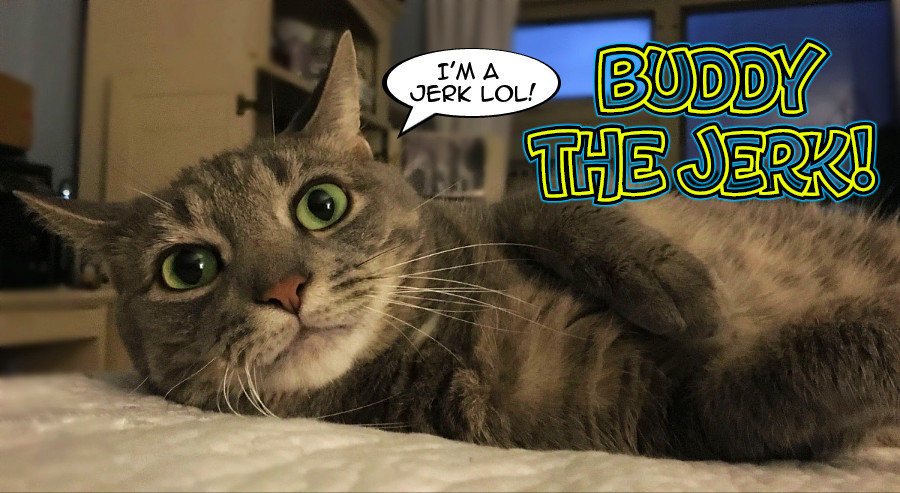
And now we check in with our correspondent, Buddy the Cat. Buddy, what do you think about the possibility of GLP-1 for your species and the end of the proverbial gravy train?

Buddy? Bud? Are we having technical difficulties?

I’m sorry, ladies and gentlemen, we can’t find Buddy the Cat. We’ll resume this segment if and when we manage to locate him.

It’s Never Easy With Bud

Little man’s got acne and won’t let me use a hot compress. Will a topical cream work?

The gross picture you’re looking at is the underside of Bud’s chin.

I knew he’d gotten acne again, but was surprised to see it’s this bad.

So I turned to Google, read a bunch of stuff, and watched a video in which a veterinarian had her arm around calm cat, who allowed her to rub its chin with a warm compress and witch hazel.

These veterinarians with their calm cats! You never see them with a cat like Bud, and I know there’s no magic to their approach because I’ve warned vet techs about him before and have seen them still come away with scratches.

Buddy’s selfie, triggered by the little guy himself when I was trying to get a clear shot of his acne so I could assess how bad it is.

I don’t have any witch hazel, but figured a warm compress could help. I should have known better. He won’t let me do it, just like he won’t let me trim his claws, brush him for more than two seconds at a time, or do just about anything else for his benefit.

When it’s his idea, of course, I can rub his chin until his heart’s content, as well as the top of his head, his cheeks and around his ears. But at all other times? Terrible! Unacceptable!

He is such a pain in the ass. A Pain In The Bud, you might even say. I love him very much and he’s generally a good boy, but what a pain in the ass.

I already have stainless steel bowls for him, so unfortunately this may be my fault for either not cleaning them well enough or not running them through the dishwasher enough to kill off all potential bacteria with heat as well as soap. Normally I wash them by hand with soap between meals/water refilling, and once a week in the dishwasher, but it looks like I’m going to have to be a lot more thorough and really scrub the hell out of them.

In the meantime, can anyone recommend a good topical cream? Bud won’t let me apply anything with a warm cloth or even a soft tissue, but I think I may be able to distract him and apply a topical cream with a Q tip. Then hopefully he’ll realize I’m only trying to help and allow me to apply it.

People Think This Nebula Resembles A Smiling Cat, PLUS: What Kind Of Music Soothes Felines?

Your cat’s taste in music may or may not align with your own.

Before we get into today’s cat news, I received an email asking why there hasn’t been much Buddy on the site lately.

Fear not, friends of Buddy! The little guy is down in the Amazon visiting his jaguar pals, but he’ll be home in time for the most important holiday of the year, Turkey day. He wouldn’t miss it for the world!

Buddy with a jaguar buddy in the Amazon, where there’s a special felid conference on new napping techniques.

A smiling cat?!

A story on Space.com says people see a “smiling cat” in images of a nebula, although we’re not so sure.

The nebula in question is Sh2-284, or Sharpless 284. It spans about 150 light years and sits about 15,000 light years from our star system near the edge of the Milky Way, in an outer spiral arm.

From a certain orientation, there may be suggestions of cat-like ears and eyes, although if there is a smile, it’s crooked and deranged-looking. Maybe the cat’s on pain pills from the vet?

There’s an opportunity here, since the nebula doesn’t have a nickname. The Buddy Nebula has a nice ring to it!

Here’s an image from NASA:

This spectacular picture of the Sh2-284 nebula has been captured in great detail by the VLT Survey Telescope at ESO’s Paranal Observatory. Sh2-284 is a star formation region, and at its centre there is a cluster of young stars, dubbed Dolidze 25. The radiation from this cluster is powerful enough to ionise the hydrogen gas in the nebula’s cloud. It is this ionisation that produces its bright orange and red colours. This image is part of the VST Photometric Hα Survey of the Southern Galactic Plane and Bulge, led by Janet Drew at the University of Hertfordshire in the UK.

And here’s an annotated image from astrophotographer Jim Thommes that shows us what we’re looking at and the immediate galactic neighborhood:

In Star Trek there’s always a convenient nebula nearby when the Enterprise — or Voyager, Titan or Discovery — needs to “hide” from some well-armed belligerent, and science fiction in general creates the impression that they’re like space swamps.

In reality nebulas are regions where the interstellar medium — the space between stars — is filled with gas, cosmic dust and inert matter. Some are stellar nurseries — places where stars are “born” — and some are the remnants of dead stars and the planets that orbited them.

They can seem to glow red, orange, green or blue depending on the elements present. Some of them reflect starlight while others are like filters, with the gases and dust lending their color to the nebulae structure.

Cats are pretty well-represented in the cosmos, from a human perspective. From the cat’s paw nebula to the Cheshire Cat galaxies, to the Lynx, Leo and Leo Minor constellations, astronomers have seen cats in the sky for millennia.

Does music help cats relax?

Although the research is limited, some studies have indicated certain genres of music can help our little buddies chill out. And if research into the canine response to music is any indication, we should expect to see more evidence for cats enjoying tunes.

When it comes to what kind of music is most effective, studies point to classical music with a slow tempo, as well as reggae and soft rock “with simple rhythms, slower tempos and no heavy percussion,” according to a new story from the BBC.

Just listening to some meowsic!

A 2016 study looked at the effect of music on 12 female cats who were recovering from spay surgery. The research team played “three different genres of music: classical music (CM), ‘Adagio For Strings (Opus 11)’ by Samuel Barber; pop music (PM), ‘Torn’ by Natalie Imbruglia; and heavy metal (HM), ‘Thunderstruck’ by AC/DC.”

The team measured heart rate, breathing rate and pupil dilation, concluding that classical music was most effective, followed by the Imbruglia song and AC/DC last. (Maybe next time they can slide The Tony Danza Tapdance Extravaganza in there for some extra fun.)

Anecdotally, Bud did not respond well to composer David Teie’s Music for Cats, but he hangs out and nods along to funk, classic 90s New York hip hop, retrowave, nu-disco, reggae and certain kinds of rock, which is almost certainly because he grew up hearing that stuff with me.

So maybe there’s a nature vs nurture element to feline musical preferences, although I wouldn’t hold out hope for cats who enjoy the Tony Danza Tapdance Extravaganza. Some things are best left alone.

Do You Speak Cat? This Quiz Tests Knowledge Of Real Feline Language

Studies show most of us are pretty bad at interpreting our cats’ moods. A research team in Australia wants to change that.

Cats are constantly telling us how they feel, but many of us aren’t listening.

We’re not talking about chirping, trilling and meowing, although those are some of the ways our cats try to communicate with us.

While they might seem protective of their own thoughts and feelings, cats are actually transparent, and they can’t lie.* Their tails, ears, whiskers, facial expressions and body language all broadcast a cat’s mood.

The question is, are we picking up that broadcast?

In The Conversation, the University of Adelaide’s Julia Henning introduces us to a quiz she designed to answer that question, and invites us to take it.

The goal: to correctly assess each cat’s mood. What I liked most was that we’re asked to evaluate videos — clear, well-lit high resolution clips — instead of the low resolution stills that are often used for quizzes like this.

Sir Talks-a-lot

Henning has been studying the human-cat communication issue because when we misread cats, there’s a good chance we’re stressing them out. Henning and her team published the results of a study in September in which 368 participants from Australia were asked to evaluate a series of clips human-feline interaction.

It turns out they didn’t do so well at reading the signs that a cat is agitated, stressed or doesn’t want to play.

“For videos of cats who weren’t playing and were showing subtle negative cues (such as sudden tension in the body or avoiding touch), participants only recognised the negative cues about as well as chance (48.7%),” the authors of the study wrote.

Even when study participants correctly read a cat’s ears, tail, whiskers and body language, some of them indicated they’d do things that would unknowingly make a cat more agitated and stressed. A classic example is trying to pet a cat’s belly and misinterpreting their derpy way of trying to block you as a playful gesture.

Did you know? Approximately 96% of Buddy’s communication is related to yums.

In the paper, which was published in Frontiers in Ethology, Henning and her colleagues lay out the case for making sure we — the people who take care of cats — are sensitive to what our little buddies are feeling.

It’s not just about strengthening the bond, although that’s an important part. It’s about reducing stress and miscommunication, and increasing quality of life.

Cats are incredibly sensitive to our actions and moods because we are the most important living beings in their lives. We feed and house them, and we’re their pals. If we’re constantly subjecting them to play they don’t like or overstimulating them, they get stressed, and stressed cats can become depressed, sick or resentful cats.

If we want to make sure our buddies live their best lives, we have to understand what they’re trying to tell us.

(*) Except when it comes to food. When food is involved, these innocent, cute little furry creatures become master manipulators and can convince anyone they’re starving.

Note: The first version of this story linked to the study page twice when the first link should have pointed to the quiz. It’s fixed now, and email subscribers can follow the link through this version of the story. Apologies for the error.

Header image credit: cottonbro studio/Pexels

Actress Shares Why She’s A ‘Crazy Cat Lady,’ PLUS: Waymo Denies Responsibility For SF Cat’s Death

Waymo says KitKat “darted under our vehicle as it was pulling away” in the accident that killed the popular bodega cat.

Last week when we wrote about a San Francisco cat hit by an autonomous taxi, the Google subsidiary that produces the cabs hadn’t responded to media requests for comment.

Now Waymo has confirmed one of its driverless taxis did strike KitKat late on the night of Oct. 27, but claims the nine-year-old tabby got in the car’s way as it began to move. Here’s Waymo’s statement:

“The trust and the safety of the communities we serve is our highest priority. We reviewed this, and while our vehicle was stopped to pick up passengers, a nearby cat darted under our vehicle as it was pulling away. We send our deepest sympathies to the cat’s owner and the community who knew and loved him, and we will be making a donation to a local animal rights organization in his honor.”

People in the neighborhood where KitKat was a fixture are not happy with the response. Per Mission Local: “Waymo did not reply to a request to review the video, and did not say how much it would donate or what group would receive the gift.”

Mission Local noted witnesses gave slightly different accounts of the collision, saying KitKit was in front of the taxi for several seconds before it began moving.

As testament to how well-known and beloved KitKat was, there’s now a considerably sized memorial to him in front of the store he called home, with flowers, candles, drawings of KitKit and even cans of cat foot left on the spot. The San Francisco Chronicle has photos of the memorial.

KitKat featured prominently on Instagram, where photos show him hanging out with customers, patrolling the sidewalk in front of the store, and curling up for naps on the counter. Credit: https://www.instagram.com/randasmarket/

The paper also quotes a local who explained the outpouring of grief: “If you’re not a 16th Street regular this can seem silly, but this cat meant so much to this community. If you knew KitKat, you’d understand.”

KitKat’s death has soured more people on Waymo, with the Chronicle noting it “struck an emotional nerve in a neighborhood already wary of driverless cars weaving through its crowded streets.”

Waymo, a subsidiary of Alphabet Inc. (Google’s parent company), operates driverless fleets in San Francisco, Los Angeles, Phoenix, Austin (TX) and Atlanta, with plans to offer automated taxi service in Washington, D.C., and Miami.

“When they show up in your yard and they need you, we can’t look away.”

As someone who avoids medical dramas like the plague, I’m not familiar with Wendi McLendon-Covey’s work, but I’m sure many PITB readers will know the St. Denis Medical star. In an interview, McLendon-Covey talks about rescuing cats, earning their trust, and getting satisfaction from knowing she’s improving one life at a time.

The actress with one of her feline friends. Credit: https://www.instagram.com/wendimclendoncovey/

Most recently she’s been earning trust with a stray she calls Harvey, saying it’s “taken me forever to bond with him” and she still has work to do before he trusts her enough to go indoors.

Cats, she said, are “cuddly, they’re cute, they’re hilarious. They all have their different personalities and they have their little meetings and their little way of talking to each other, and it’s just fascinating to watch. So that’s a hot Friday night for me, is just throwing treats to the cats.”

You can read the rest of the interview here.