How Do I Make My Cat Like Me?

A cat’s affection has to be earned, but the good news is it’s not rocket science. A little patience and consideration for your fluffy little pal goes a long way toward building trust and a strong bond. Once you do, you’ll have a loyal friend for life.

“How do I make my cat like me?”

That question comes up regularly on social media posts, in cat-centric discussion groups, Q&A sites and even in our inbox. People adopt a cat, and whether the little one dives under a bed and refuses to emerge, or just seems reluctant to snuggle the way people imagined, they turn to the internet to find out why they don’t have a purring, contented feline in their lap.

The short answer is you can’t “make” your cat feel anything, and it’s best to dispense with that notion as quickly as possible so you can acknowledge the truth: cats are individuals with their own thoughts and feelings.

The good news, however, is that you can earn your cat’s affection with patience, respect and love. Our patience and respect for our little buddies leads to trust, which in turn creates and strengthens the special bond we share with them.

The love of a cat isn’t as easily won as the love of a dog, and in many ways that makes it even more special. Cats don’t love just anyone.

It starts with acknowledging your cat has feelings, and understanding that you have to respect those feelings as you would those of a person.

Don’t make your cat do things she doesn’t want to do.

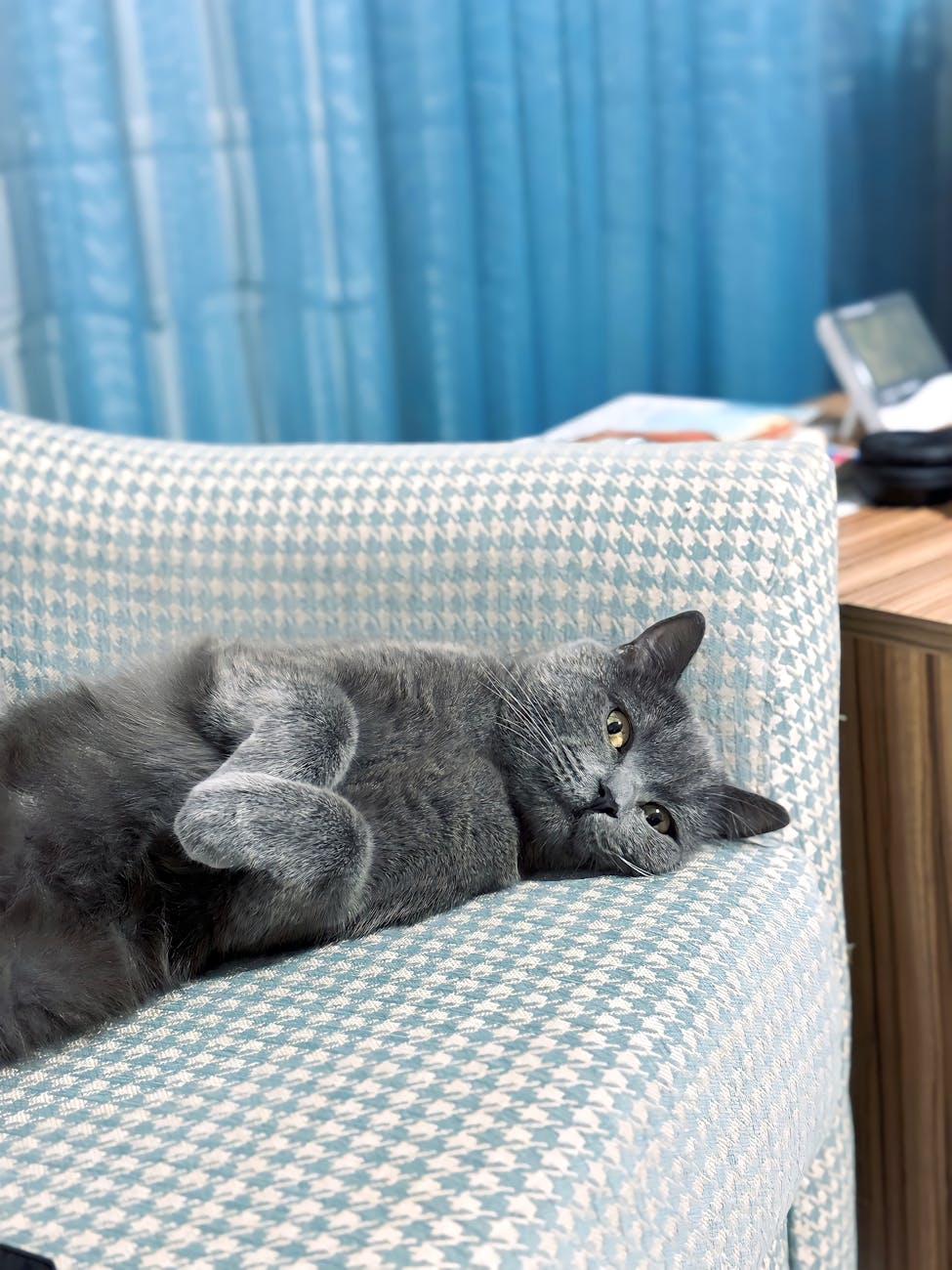
Despite what you might think or what you may have been told, most cats don’t like being picked up, held or feeling restricted. The majority of felines don’t like belly rubs, and people have a habit of mistaking a sign of trust — a cat showing her belly — as an invitation to pet.

Cat showing belly
A cat showing its belly is a sign of trust. It’s a vulnerable position for a cat, and not an invitation for belly rubs. Credit: Wikimedia Commons

Every cat is different, but generally the best way to make sure your kitty doesn’t want to approach you is to ignore her personal boundaries and treat her like a stuffed animal.

Those “cute” videos you see on TikTok of terminally online people spinning their cats to Taylor Swift songs, holding them like phones to reenact scenes from The Princess Diaries, or forcing them to wear ridiculous outfits?

Don’t do that. It destroys your cat’s trust in you, and the cheap dopamine hit you get from strangers “liking” your content isn’t worth stressing your furry pal out and damaging your relationship.

Tik Tok cat abuse
Don’t do this. It’s not funny, the meme is lame and you’ll teach your cat to fear you. Credit: TikTok

If you tend to restrict your cat and hold her in your lap, you’re discouraging her from sitting there in the future. If you give kitty unnecessary baths, you could create a situation in which your cat fears you.

Even if you think you’re not doing anything wrong, if your cat is reluctant to approach you, there’s something that needs fixing, and it’ll require patience.

buddysguidescritchespets

Don’t subject your cat to forced petting sessions.

Unlike dogs, cats have a limited tolerance for physical affection, and they don’t always want to be touched.

Your pal will be much more likely to regularly approach you for physical affection if you let him come to you. Ignore the impulse to reach out and start petting him like you would a dog. Instead, put your hand out and let your cat initiate the petting. You’ll develop a physical shorthand in which he signals he wants chin scratches or head rubs by leaning in and rubbing his face against your outstretched hand.

All felines have scent glands in their cheeks, and the initial contact of a cat rubbing his cheek against your fingers is an olfactory signal that says “This human is my family. I like this human.”

Even though our noses can’t detect those pheromones, they’re still important to our cat(s), and they’re the reason why cats will scent-mark objects by brushing past them in your home, just like tigers will mark their territories by scent-marking trees with urine. Same concept, but thankfully our miniature house tigers generally don’t feel the need to do the latter. (If yours does, take him to the vet. If he’s not “fixed,” get it done ASAP.)

Less is more when it comes to petting

Stop me if you’ve heard this one before: “I just don’t get it! I was petting my cat and she was purring and loving it, then without warning she bit me!”

Pro tip: A bite like that never comes without warning, it’s just that most of us don’t see the signs right in front of us.

Cats communicate by tail and whisker, and we communicate by making noises with our mouths. Adult cats don’t meow to each other. The little ones are smart enough to understand how we exchange information, so meows, trills, chirps and grunts are their way of trying to speak our language, to communicate on our terms.

But sometimes — like, say, when they’re purring and relaxed — they’re distracted and forget to meow, or they meow and we ignore them.

That’s when they bite, or swipe at us with their paws.

If you pay attention to non-verbal cues, you’ll notice your cat getting overstimulated when her tail starts swishing and her pupils dilate. If those signs aren’t enough, there are others: twitching ears, shifting positions, moving away.

The best way to avoid misunderstandings is to give kitty a few head rubs and chin scratches, then stop. If she wants more, she will let you know. If she doesn’t, she’ll be content to remain on your lap or by your side, knowing you’re not going to keep going indefinitely.

No harm, no foul, no bite.

Cat doesn't like hug
This cat is not enjoying selfie time with her human. Credit: imgur via Reddit

Don’t take your bad day out on your cat

Remember when you were a kid and your mom or dad came home from a bad day at work with a storm cloud hanging over their head? Maybe they snapped at you for apparently no reason, or made family dinner miserable with fraught silence. Maybe they unfairly got on your case about something minor.

Either way, the tension in the house was palpable because, as kids, your parents controlled your lives and you were dependent on them for everything.

That’s what it’s like for our pets. Whether we call ourselves “fur mommies” and “cat daddies” or not, the fact is that the pet-human dynamic absolutely shares some elements with the parent-child relationship.

Our pets are utterly dependent on us, they’re subject to our moods, and they’re deeply attuned to our emotions.

As a result, how we’re feeling has a big impact on them, for better and worse. Unlike children, who at least have some concept of redirected frustration, cats and dogs have no idea why we have bad moods and no way to insulate themselves from the consequences.

We’re all human and we all get frustrated with our feline friends at some point. If you’ve been sitting in traffic for three hours and come home to find Socks pooped all over the rug or threw up on your comforter, frustration is a natural response.

But for the sake of the innocent little ones we share our homes with, it’s up to us to be mindful of our moods and do our best not to let external factors impact how we treat our pets. Things as seemingly small as our tone of voice can have a major impact on their emotions.

Cat eating
A cat chowing down. Credit: Wikimedia Commons

Don’t feed them crap

This has been covered exhaustively elsewhere, so we’ll direct you to catinfo.org if you have in-depth questions about feline nutrition.

In general, wet food should make up the majority of your cat’s diet. Cats don’t have a high thirst drive and they’ve evolved to get most of their hydration from meat, so a cat who eats mostly — or only — dry food is in danger of developing  serious health problems.

Aside from that, more expensive doesn’t always mean better, and the important thing is that your cat’s food has real meat as the top ingredient. If the primary ingredient is a filler like corn or grain, or poultry/beef byproducts, steer clear and find a better alternative.

Feeding quality food means kitty will be happier, healthier, less prone to health complications and more active.

Keep things interesting

You don’t have to spend a lot of money on toys, and everyone who’s ever lived with a feline knows the fluffy little guys are just as likely to take a shine to a new box or the little plastic ring from a milk bottle as they are to the $10 new toy you bought from the pet store.

That said, there are certain toys that are almost universally beloved by felinekind, and the more you keep things interesting for your cat, the happier your furry overlord will be.

You can never go wrong with wands for interactive play. Keep it simple and manipulate the toy at the end of the wand like prey so your house panther can feel like a mighty hunter. Track toys with balls that cats can bat around are good for relatively quiet solo play. Cat tunnels are great too, especially if you toss treats inside them for kitty to find randomly.

Cat with toy mouse
A cat playing with a toy mouse. Credit: Wikimedia Commons

You don’t need a special occasion to surprise your little buddy with a catnip and play session, and you’d be surprised how enthralled felines can be by “cat TV” on Youtube. There are dozens of channels that provide hours-long videos of birds eating seeds from outdoor feeders, aquariums filled with interesting fish, and critters like squirrels and rodents.

You can also engage your cat by training her to do simple things like come when called, sit on command high five you. Those “tricks” are very easy to teach and require no more than two or three practice sessions a day, maximum 10 minutes each. Your cat will love it, especially with rewards for learning, and it’s fun to show skeptics that, yes, cats can do tricks just like dogs.

Sometimes “fun” is just something unusual, something your cat rarely gets to do or see. On occasion, I let Buddy walk up and down the hallway with me in my apartment building late at night when chances are low we’ll encounter anyone.

Gangnam style elevator
Elevators: products of foul sorcery that swallow humans and sometimes spit out Korean rappers.

He loves to stop at each door, listen and take in the strange sounds and scents. If anyone emerges from one of the doors or the elevator opens, he just makes haste back to our apartment, where I leave the door slightly ajar for that reason. As for the elevator, he seems to think it’s some sort of product of foul sorcery — it rumbles, the doors open by themselves, and when people walk in, they don’t walk out. Sometimes they enter only to emerge as a different person a few minutes later!

I’m happy to indulge his paranoia with regard to the elevator, because it means I don’t have to worry about curiosity getting the better of him.

If you’ve got rooms your cat doesn’t normally have access to, a yard with cat-proof fencing, or an activity you only do sometimes, consider breaking up your cat’s day with a little exploration or some ‘nip-fueled fun.

Portrait of the Buddies
“Extremely accurate portrait of the Buddies” commissioned by Buddy the Cat in 2024.

Treat your cat as a friend

Your cat may not have legal personhood, but he is a fully sentient being who feels emotions just as strongly as people do. Cats experience the full range of primary and secondary emotions, but not tertiary emotions. That means kitty can feel happy, sad, excited, anxious, jealous, bored, depressed and overjoyed, but she’s not going to be embarrassed if another cat’s wearing the same collar or fret over whether people and other cats like her.

The important thing is remembering cats have feelings.

It’s not rocket science, and it doesn’t cost us anything to treat our cats with respect, patience and love. Bonding with a cat requires more than just feeding, watering and scooping, but the effort is always worth it and you’ll have a loyal friend for life. Good luck!

Top image of incredibly sexy beast (Buddy) copyright Pain In The Bud.

Cats Have Achieved Evolutionary Perfection: Bow To Your Feline Masters!

Cats have established themselves as the de facto rulers of 220 million households, where they enjoy perpetual lives of leisure and are doted on by their adoring humans. How much more successful can they be?

Dear Buddy,

There’s been a lot of talk lately among the humans about how they’ll evolve in the future, whether they’ll become more successful, and whether they’ll merge with machines! Scary!

But what about us? How will cats evolve to be more successful? Will we always have human servants?

Feline Futurist in Florida


Dear Futurist,

Do we really need to be more successful?

As a species we’ve secured our rightful place as royalty in human homes where all our needs are catered to.

We’ve become so adept at manipulating our human minions that we even know how to spur them to immediate action by embedding urgent baby-like cries in our purrs.

We figured out that humans are hardwired to respond to cries in that frequency, and once we find that manipulative sweet spot, we never forget it. We’ll push that coercive button all day and night to get what we want. There is no rest for humans until they comply with our demands.

But now we have gone beyond that significant accomplishment, essentially hijacking the humans’ species-wide consciousness by taking over the internet.

Imagine some alien archaeologist poking through the rubble of human civilization far in the future, its delight at recovering data from an ancient human server turning to utter confusion as it realizes entire zetabytes are comprised of nothing but images and videos of small, mysterious, furry creatures that seemingly do little besides eat, sleep and enjoy massages.

“Did I have it all wrong?” the confused alien might say. “Could it be that these ‘cats’ were the true power on this planet all along, and humans were in thrall to them?”

a3ce52d0-ffa8-46f6-b694-70a97b16e550

What else do we need to be successful, and to what evolutionary pressures do we need to adapt? We’re not fighting our way through hostile territory in the living room, fending off attacks en route to the kitchen where there’s only a chance for food.

Nope. It’s literally served to us on a regular schedule and whenever we screech for it. Our servants know they will never hear the end of it if they don’t meet our demands, and the best of them have learned to anticipate our desires before we have to vocalize them.

How much better can it get? We’ve managed to achieve a lifestyle in which we can perpetually live in the moment with no worries about the future, and everything taken care of for us. The humans don’t expect us to do anything in return except be cute and cuddly.

We “earn” our keep by allowing them to pet us every now and then as we lounge, until we grow weary of human affection and dismiss them with an annoyed flick of the tail or a gentle bite that says “Enough, you’ve had your 30 seconds, human!”

We break their stuff, vomit on their carpets, poop in their shoes, disturb their sleep, lay on their clean piles of laundry, ignore their boundaries, deny them their privacy, destroy their furniture, steal their cheeseburgers, force them to scoop and dispose of our waste, take over their beds, and we still act like the humans are fortunate to serve us.

We are irreproachable, imperious and untouchable, and when we’ve pushed our luck perhaps a bit too far, all we have to do is flop onto our backs, pull our little paws up beneath our chins, and squeak out a meow.

“Awww,” our humans say, their thoughts manipulated by our toxoplasma gondii mind-control superpower. “What a good boy! He’s so innocent! Of course he didn’t mean to [insert incredibly disrespectful action here], he’s an angel!”

So no, my friend. I don’t think we have to participate in the evolutionary arms race. That’s for lesser creatures whose futures are uncertain. Us? We’re winning at life without lifting a paw.

Your pal,

Buddy

Obey Your Cat
“That’s right. Obey us, humans. We honor you by allowing you to serve our meals, scoop our poop, scratch our chins and buy us toys. You are so fortunate!”

More Than 400 People Applied To Adopt Foul-Mouthed Parrot

Requirements for adopting Pepper included a sense of humor and experience caring for birds. He’s now found a home with patient caretakers and another mercurial parrot to hang out with.

It’s too bad cats can’t swear.

While kittens don’t often have problems finding homes due to their overwhelming cuteness and antics, it usually takes a sad story to drum up considerable interest when an adult feline is up for adoption.

As the SPCA of Niagara learned, talkative parrots, especially birds who can swear up a storm, have their pick of homes.

In June, a potty-mouthed parrot named Pepper was surrendered to the shelter, and when the SPCA put the call out — specifying they’d prefer someone with experience caring for birds and a sense of humor — the applications kept rolling in, totaling more than 400.

“His famous line is ‘Do you want me to kick your ass?'” a shelter employee said in an interview last month shortly after announcing Pepper was up for adoption.

Shelter staff asked applicants to include photos of their bird enclosures in addition to the usual pre-adoption questions, eventually narrowing the Pepper Sweepstakes down to 10 potential homes.

This past week, Pepper was finally taken to his new abode in Olean, a small city in western New York. The couple who adopted him are not only experienced with birds, they know all about avian vulgarity. They have a parrot named Shelby who apparently “makes Pepper look like a saint.”

As for Pepper, it looks like he’s getting his bearings before heaping abuse on his new caretakers.

“He hasn’t cursed at them yet, but we know it’s coming,” shelter staff wrote in an update.

In recent decades, research has shown birds can be exceptionally intelligent. Crows, for example, use tools, can differentiate between human faces, and remember which humans have wronged them or treated them well.

While many people assumed parrots merely imitate human language, long term behavioral studies show the birds are able to use words in context and invent novel combinations of words. As with other animals, syntax remains elusive.

The most famous example was Alex the African Gray, who was the subject of research by animal cognition expert Dr. Irene Pepperberg. Alex, who died in 2007 at the age of 31, was able to count and could perform simple calculations. He was talkative, conversant and often told his caretakers how he was feeling, what he wanted, and what he thought of the tests they’d give him. (Like a child, Alex would try to get out of exercises he was bored with by asking for water, saying he was tired and wanted a nap, or just flubbing his answers.)

We are not above crude humor here at PITB, and in the past we’ve written about Ruby, our favorite talking parrot. Ruby lives in the UK with her owner, Nick Chapman, and the pair were among the very earliest Youtube stars thanks to videos of Ruby’s shockingly vulgar, extremely British tirades and Chapman’s infectious laugh.

Warning for those who are offended by bad language or are viewing at work: Ruby is known for liberal use of c-bombs-, t-bombs, f-bombs and just about every other linguistic bomb you can think of, in addition to British slang like “bollocks.” If that’s a problem for you, skip this video.

Eric the Legend, a parrot who lives in Australia, is also a favorite on Youtube for his habit of declaring himself “a fookin’ legend!

We’re glad Pepper has found a home where his idiosyncratic nature will be cherished, and we hope the future will bring videos of Pepper and Shelby going back and forth. Parrots are social animals, after all, and what fun are insults if you’ve got no one to trade them with?

Top image of Pepper courtesy of Niagara SPCA.

‘No One Goes Hungry On Our Watch’: A Pet Food Pantry And A Tribute To An Incredible Cat

Misty the Cat “was an agent of chaos and misrule,” had a Krameresque entrance style and was deeply loved by his people.

With inflation taking a major toll on families over the last few years, one of the most frequently cited reasons for surrendering pets is that their people can’t afford them anymore.

A vet tech in Ohio is trying to prevent that from happening to people in her area with The Little Black Cat Collective, a pet food pantry she founded in honor of her late rescue cat, Lila, who died at 16 years old.

Laura Zavadil founded the pantry — which also helps people with dogs, guinea pigs, ferrets and rabbits — in 2021, and since then it’s grown, serving “30 to 40 families and more than 200 animals each month,” she told her hometown newspaper, the Vindicator of Warren, Ohio.

“I wanted to do my part to help the community through struggles,” Zavadil told the paper. “The pantry’s main goal is to get the needs of these animals met and help the people, but also — considering the limited amount of shelter space in the area — if it means the animals can stay in the home, that’s just icing on the cake.”

Remembering Misty the Cat, whose death “drained all the colour from the world”

Speaking of honoring deceased pets, Keith Miller has a heck of a tribute to his cat, Misty, in The Guardian.

It’s been six months since Keith Miller’s beloved cat (pictured above), came up to him “with a series of unusual cries, stretched his mouth wide like a yawning lion, shivered, collapsed and died.” Misty, Miller wrote, “was a fortnight shy of his ninth birthday,” and his absence has been keenly felt.

Tributes are difficult to write, and tributes to pets may be harder still. It’s tough to feel you’re doing justice to an animal you loved while conveying their personality, and in the back of your mind you’re thinking of the people who don’t get it, who don’t have pets and might find your tribute saccharine or melodramatic.

Miller strikes just the right notes and makes the reader feel Misty’s loss without knowing the little guy.

“I have thought a lot about this particular cat and this particular loss. I think what most pains and enrages me about it has something to do with the role Misty played in our life: a larger-than-life vibe, faux-heroic and mock-epic (and so often richly comic). He used to skid on the floor when he came into a room, like Kramer in Seinfeld. He was an agent of chaos and misrule, knocking objects off surfaces with gallumphing carelessness one day, dead-eyed precision the next. He was gormless yet prodigious, a fluffier cousin of Homer Simpson. He didn’t shyly solicit affection, as his sister does; he demanded it by right, thrusting his jaw up and out like Mussolini to accept strokes on his throat and chest.

All in all, he didn’t really have the makings of a tragic character. And he wasn’t a will-o’-the-wisp, either, on loan from another world, as most cats are. His unscheduled exit wasn’t just an emotional body blow; it was a violation of the rules of genre.”

The Mussolini bit resonated with me, since I’ve referred to Bud as “a furry little Genghis Khan” on occasion, and often joke that he’s a tyrant ruling over the place with an iron paw. Miller’s homage to his pal isn’t overly long, and I recommend reading the whole thing.

Buddy’s Favorite Dragons From Game Of Thrones And House Of The Dragon

The dragons of the Game of Thrones universe are so well-designed, with such attention to detail and writing that imbues them with their own personalities, that they feel like real creatures. They’re a sight to behold.

The Budster was just a kitten when the fourth season of Game of Thrones premiered, and I vividly recall trying to tire the little guy out with extra play time on Sunday nights so I could watch my favorite show in peace.

The effort was mostly in vain with such an energetic, curious and chatty kitten, but eventually Bud would settle down in my lap and watch with me.

Enamored as I was with the tiny animal in my care, I found myself especially appreciative of the fact that the dragons of the Game of Thrones universe are so lovingly, realistically rendered and given such unique personalities that they feel like real animals. A lot of thought and care went into their design, from their anatomies to the biomechanics of how they move and fly, to their chittering, calls and roars.

If you look closely when they open their mouths menacingly, you can even see the glands that secrete the accelerant allowing them to breathe fire.

Both shows — the original Game of Thrones and its prequel, House of the Dragon — have done such a good job developing the dragons as characters that I’ve found myself more disturbed by the unfortunate deaths of a few of the majestic beasts than I was by the grisly fates of some human characters. That’s saying a lot for a fictional universe infamous for shocking, emotionally manipulative, gut-wrenching deaths, a universe that immediately established no one is safe after killing off its main character — played by its highest-profile actor — before the first season was over.

The willingness to do what no other TV show has done in 60-plus years of television is part of what makes Game of Thrones and its spinoff such compelling drama. No one is safe. Heroes can die agonizing, undignified deaths. Villains can triumph, infuriatingly. But just when you think you know where the narrative will go next, it subverts your expectations yet again.

Now that we’re a few episodes into the second season of the prequel, House of the Dragon, and I’ve taken to trying to get my cat to respond to commands in High Valyrian as if he were a dragon himself, I compiled this official Buddy-approved list of our favorite dragons in both series:

Syrax

400px-Syrax
Syrax is golden and regal.

The beautiful golden-scaled Syrax is protagonist Rhaenyra Targaryen’s dragon, so it’s fitting that she’s the first of the eponymous creatures we see in House of the Dragon, soaring across the skies over King’s Landing in the first scene of the first episode. 

39489e261551d66fdf0406269a9e47c8
Teenage Rhaenyra Targaryen with Syrax after a flight over the Westerosi capital city, King’s Landing.

As was tradition with Targaryen children, Syrax’s egg was place in infant Rhaenyra’s crib, with child and dragon raised together to create their indelible bond. The show makes it clear why that bond is so important in the third episode, when Rhaenyra arrives dramatically atop Syrax to defuse a confrontation among her uncle and the king’s men that was on the verge of bloodshed.

“Take care not to startle Syrax, my lords,” Rhaenyra says as she dismounts, pulling off her riding gloves. “She’s very protective of me.”

Syrax is a young and growing dragon at the time of HotD’s first episode, when Rhaenyra is just 15 years old.

Vermax

download (1)
Nom-noms for Vermax?!

Vermax is a juvenile when we meet him for the first time in House of the Dragon, in a scene showing Princess Rhaenyra’s young son, Jacaerys Velaryon, learning to bond with his dragon. (A time skip in the first season moves the action forward some 15 years.)

tumblr_c3b87125a002031c7dee387eed09bb35_d2f1040d_540
Vermax is young and wants all the snacks. Note the accelerant gland in his mouth, visible on the right side. When the dragons of the Song of Ice and Fire universe breathe fire, a natural accelerant is secreted from the gland, mixing with the dragon’s breath to create flame hot enough to turn men to dust in their plate armor.

It’s the first time since the early seasons of Game of Thrones that we see a sub-adult dragon, and Vermax almost looks like a fire-breathing velociraptor as we watch him roast his own dinner at Jace’s command.

We also get to see the dragon keepers instruct the young prince on how to “call [his] dragon to heel,” issuing commands in High Valyrian like “dohaeris” (serve), “umbās” (wait or hold) and the most famous command, “dracarys,” which instructs the beasts to spit fire.

Meleys

Meleys in flight

We don’t meet Meleys until late in HotD’s first season, but the wait is worth it. Known as the Red Queen, Meleys is massive, terrifying and already has a storied history by the time we set eyes on her.

She stars in arguably the most spectacular scene involving a dragon in HotD’s first season, prompting several characters to soil themselves as Meleys makes an unforgettable entrance and threatens them with a deafening roar.

Meleys HotD
The formidable Meleys. Here too you can see the fire glands in Meleys’ mouth as she roars.

While dragons like Syrax and Dreamfyre are graceful and sleek, Meleys is all menace and sharp edges, resembling the two most famous, most feared dragons in GoT lore — Drogon and Balerian the Black Dread, who were both the personal dragons of Targaryen conquerors.

Meleys is ridden by Princess Rhaenys Targaryen, styled as The Queen Who Never Was due to her strong and spurned claim to the Iron Throne. Rhaenys and her dragon, however, are a force to be reckoned with.

Caraxes

Caraxes
Caraxes is one of the most battle-hardened dragons, and his rider, Daemon Targaryen, is a lunatic. That makes the pair extraordinarily dangerous and unpredictable.

Known as the Blood Wyrm, Caraxes has an unmistakable serpent-like look to him, with a long neck, finned tail and dark red-black scales.

Just as humans can be born with deformities so can dragons, and Caraxes owes his strange anatomical features to an unidentified congenital condition. Caraxes is fierce, fearless and has seen more combat than almost any other living dragon in House of the Dragon.

Caraxes
At first it seems as if Caraxes is a different breed of dragon, perhaps from a sister taxa, but the fearsome fire-breather actually suffers from congenital deformations that somehow make him even more terrifying.

Caraxes is also notable for the man who rides him: The mercurial and often brutal Daemon Targaryen, brother of King Viserys. Daemon is an accomplished warrior and loose cannon, which makes him and his dragon unpredictable and very dangerous. He’s not above using Caraxes to intimidate, and Caraxes seems to enjoy his part.

Rhaegal

rhaegal

Rhaegal and his brothers, Viserion and Drogon, were born when Daenerys Targaryen, Mother of Dragons, carried their eggs into an inferno and emerged at sunrise with three baby dragons clinging to her.

We see him and his brothers grow from tiny and cute infants to living manifestations of absolute terror, destroying entire navies and razing castles with their dragonfire. At the time of their birth, dragons had been extinct from the world of Game of Thrones for centuries. (Game of Thrones takes place about 200 years after House of the Dragon, despite being the first of the two series adapted by HBO.)

Rhaegal is named for Daenerys’ late brother Rhaegar Targaryen, and his eventual rider is Jon Snow. Rhaegal participates in Daenerys’s toppling of the ruling class in one of the Slaver’s Bay cities, and he and Snow eventually participate in the most pivotal, existential battle in the show’s history. Rhaegal is a beautiful example of his species, with dark green scales, and like his brothers, he’s fiercely loyal to Daenerys.

Vhagar

Vhagar
Vhagar is absurdly huge and is the largest living dragon during the reign of King Viserys I in House of the Dragon.

Vhagar is old, ridiculously massive and — at the time of House of the Dragon — the most powerful and celebrated dragon alive.

Age is evident in every one of her features, from her broken teeth, worn scales and tattered wings, to her lugubrious gait as she’s risen from sleep during a key scene late in HotD’s first season.

Vhagar taking off
The earth shakes as Vhagar lumbers forward, launching her colossal frame into the air.

But once she takes to the skies, there is no force in the show’s universe that can stop her. It’s astonishing to see a dragon the size of a damn aircraft carrier, and I can’t wait to see how Vhagar and her rider, Prince Aemond Targaryen, impact future events.

Drogon

Drogon in flight

Even if you’re unfamiliar with Game of Thrones, chances are you’ve seen ads, promotional clips or giant billboards in Times Square depicting a golden-haired woman atop a behemothic dragon with dark crimson and black scales.

The woman is Daenerys Targaryen and the beast is Drogon, who is said to be the reincarnation of Balerion the Black Dread, the largest and most powerful dragon in recorded history.

Drogon is the symbol of the rebirth of dragons almost two centuries after the last of the species died. He’s the most destructive force in the original Game of Thrones, but he’s also dearly loved by his mother, Daenerys, and he’s even had a few comical, light-hearted moments, like the death stare he fixes on Jon Snow when the latter kisses Daenerys.

“That’s my mom, dude,” Drogon seems to say. “Be respectful or I’ll burn you to a crisp and make a light snack of you.”

This GIF is taken from that very moment, when Jon locks lips with Dany, senses the dragon’s eyes on him, and looks up to see Drogon staring intently at him:

Drogon

When Drogon and his brothers are born, the people of Westeros and Essos can hardly believe it. For the first time in two centuries dragons lay claim to the sky, their calls echoing for miles across mountains, plains and open water. They also have voracious appetites, helping themselves to thousands of farm animals, wild prey and enemy soldiers as they grow.

Drogon and the boys have a big part to play in the events of the series, but like all animals, they’re born virtually defenseless. The last time we see Drogon he rivals the biggest dragons in history, but the first time we see him he’s the size of a kitten, squealing as he rides his mother’s shoulder.

drogonbaby2
Daenerys with Drogon (shoulder), Viseryon and Rhaegal in Qarth, the mythical eastern-most city of Essos.

Baby Drogon
Drogon as an adorable baby dragon, roasting his first nom noms.

Drogon, his brothers and Daenerys were never more vulnerable than they were in those early days, and a succession of ill-intentioned characters try to take or kill them. Drogon, more than any of his kind, proves that “owning” a dragon and getting him to do what you want are two different things, not unlike cats.

Arrax

Who’s a good boy? Arrax is! As the bonded dragon of Princess Rhynaera’s second son, 14-year-old Lucerys (Luke) Targaryen, Arrax is the baby of the group.

arrax

We don’t see much of him, but he’s a good-looking little guy with gray-purple scales and a darker purple ridge along his spine. As a young dragon, Arrax is spooked by flying during a storm and needs to be calmed by Luke, bravely taking off and navigating winds, lashing rain and lightning.

Vermithor

We see Vermithor only once in HotD’s first season when Prince Daemon approaches him, singing an old Valyrian tune to calm the ancient dragon, who hasn’t had a visitor in some time.

vermithoreye

Vermithor doesn’t look too pleased to be bothered and lets loose a mighty roar and enough dragonfire to waste a small city. Indeed, it’s been years since a human rode the old dragon, who is second only to Vhagar in size and age.

But Vermithor recognizes Daemon as a Targaryen, sees that Daemon is not afraid of him, and doesn’t do him any harm. Vermithor will undoubtedly have a big role to play going forward in HotD as a war of succession rages across Westeros in the wake of King Viserys the Peaceful’s passing.

Balerion the Black Dread

Balerion is the largest dragon in history, the last living creature to see the glory of Old Valyria — the empire that once ruled almost every corner of Game of Thrones’ fictional universe — before its fall.

Balerion is long dead by the events of House of the Dragon and Game of Thrones, so the only real indication we get of his majesty is in the Red Keep, where the legendary beast’s skull remains on display in a shrine to his power and significance:

Balerion Skull
Balerion’s skull as it appears in scenes from HotD and GoT.

Only a handful of families survived the end of the Valyrian empire, and the most famous of them was led by Aegon Targaryen, also known as Aegon the Conqueror, the man who invaded Westeros with a few dragons and a small army, conquering everything in his path and uniting seven kingdoms under one banner and one rule.

That was only possible with the power of dragons, and Aegon accomplished the feat atop Balerion’s back. When Aegon and Balerion reduced Harrenhal — considered the most impregnable of all castles — to melted rubble and marched north, the lords of the north wisely opted to bend the knee to Aegon and his dragons rather than face the likely extinction of their families.

The most prominent of the northern lords, the Stark family, were rewarded by Aegon Targaryen, who named them the Wardens of the North and gave them dominion over the vast, icy expanses of their realm. As such, they were beholden to the crown, but enjoyed a limited sovereignty that no other house could claim.

balerion
Artist Lindsey Burcar’s vision of Balerion.

We’ve left out Sea Smoke, Ser Leanor Valaryon’s dragon, Viseryon, brother to Drogon and Rhaegal, Sunfyre — considered the most beautiful of all the dragons — and several dragons who haven’t been seen yet, like Moonfyre, Tyraxes and Silverwing. Sorry, guys! But the second season of House of the Dragon promises to reveal several dragons we haven’t yet seen, so perhaps we’ll include them in a follow-up.