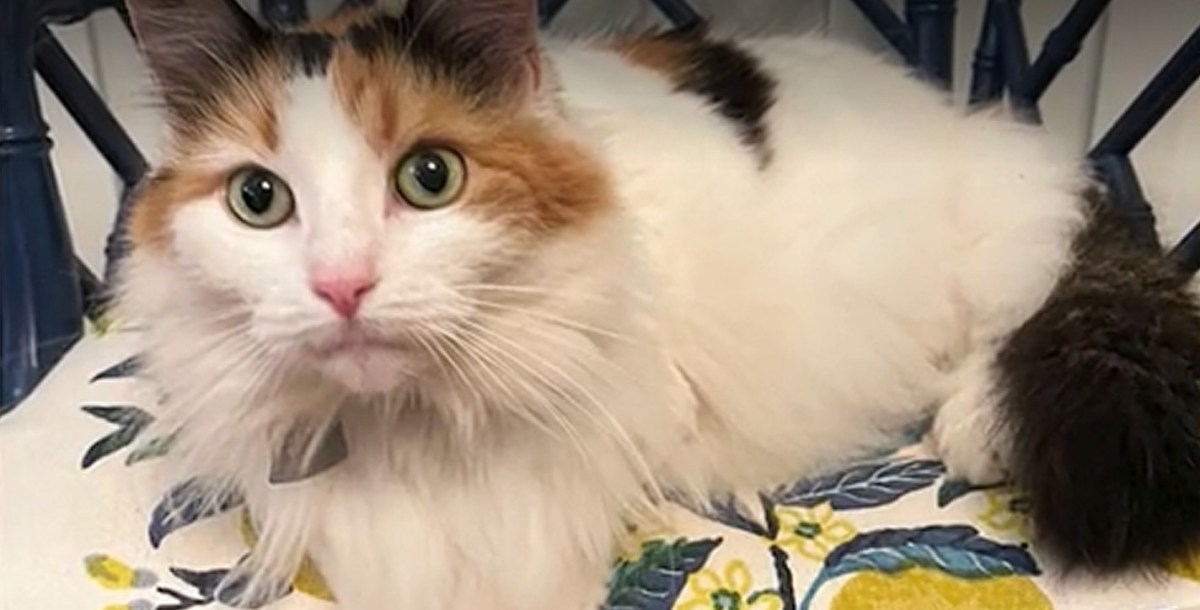
What’s With The Stories Claiming Men Don’t Bond With Or Listen To Their Feline Buddies?

There’s a disconnect between the usually careful language of research studies and the exaggerated claims of news articles.

The headlines over the past few weeks have all been variations on the same riff: cats meow more frequently to male caregivers because we don’t know how to bond with the little stinkers, we disregard their feelings, and we ignore their pleas.

Others are more blunt in their assessment, like a story from YourTango that stated women “bond deeply” with cats, whereas we men are merely “manipulated” by them.

“Other studies have found that women are much better at giving their cats more attention, understanding their cats’ emotions, and are more likely to mimic their cats’ vocalization, too,” the YourTango story claims. “Whereas for men, the same cannot be said. Considering they tend to give affection more sparingly than women, it’s no wonder that the dynamic is different.”

Just picture it: women levitating above the rest of us, sharing their amazing Female Affection with the poor, emotionally starved pet felines who belong to men. If we’re trying to get rid of the “crazy cat lady” stereotype and spread the idea that cats are great companions for every kind of person, this probably isn’t helping.

“I am NOT a loudmeowth!”

So what’s the source of these claims?

Apparently a study out of Turkey that involved just 31 cats and their humans. All of the human participants were Turkish, and just 13 of them were male. All were recruited online. (And for some parts of the study, like the analysis of greetings by owner gender, only 26 participants were included because the other five did not submit complete data, including the ages of their cats.)

It’s important to make a distinction between what the study’s authors claim and what the media reports, because they’re almost always two different things.

“Science” doesn’t “say” anything. Science is a method for investigating things we don’t understand. It’s not an entity, it has no opinions, and the only clear conclusion from such a small study is that we need more data.
Hogwash! Balderdash! Codswallop!

The research team from the University of Ankara counted more meows directed at the 13 male caregivers in their study compared to the 18 female caregivers. In their paper, the team acknowledged their sample size was too small to draw any conclusions, and lacked the demographic diversity to rule out innumerable potential reasons why those 13 cats meowed more frequently than the 18 cats cared for by women.

Even with a more robust sample size including men of different ages, social classes, and nationalities, correlation is not causation, and it may be that the apparent difference in feline vocalizations disappears with a larger study group that more accurately reflects universal demographics.

Indeed, the study’s authors state clearly that feline greeting behavior is “a complex, multidimensional phenomenon that defies straightforward explanation.” (Emphasis ours.)

The conclusion, as always, is that we need more data, which is one reason why studies must be repeatable.

That nuance doesn’t make it into listicles or stories optimized for maximum shareability on Facebook, so instead we get headlines that present studies as the last word instead of the first tentative steps to understanding a phenomenon.

In case it wasn’t obvious, there is no data to support the claim that men “give attention more sparingly” than women, or that women are better at reading feline emotions. We don’t even have baselines or criteria for those claims. How do we objectively measure “better” when it comes to reading cats, especially when every cat and human bonded pair have their own pidgin “language”? What’s the “right” amount of attention?

Buddy the Cat, a gray tabby cat, with a synthwave background.
“Brrrrrrrruuuuppp!”

As the loyal servant of an infamously talkative cat, I’m not sure gender makes any difference. Bud’s vocal tendencies were already present from kittenhood, and I simply nurtured them by engaging in conversations with him, giving him loads of attention and doting on him.

Often our conversations go like this:

Bud: “Mreeeoww! Mow mow! Brrrrrt a bruppph!”

Me: “I know, little dude. You told me, remember?”

Bud: “Brrrrrr! Brrrruppp! Yerp!”

Me: “Yes, but they’ve tried that already. It’s not just about tokamak design, it’s…”

Bud: “Merrrrrp! Mow mow!”

Me: “No, it’s about plasma containment. No containment, no reaction, no energy gain!”

Bud: “Brrrrr! Mrrrowww! Brupbrupbrrrruppp!”

Me: “Yeah, well that’s just, like, your opinion, man.”

I really do talk about science and science fiction with my cat, since he seems to respond to it. Of course it’s gotta be at least partially due to my tone, but strangely if I talk to him about other abstract things, he acts like I’m bothering him with so much human nonsense.

Regardless, Buddy and I object to the claim that a talkative cat is a disengaged or neglected cat. It’s not that he talks a lot, it’s that he never stops!

How Four Wildcats Co-Exist In The Jungles Of Guatemala

Jaguars, pumas, ocelots and margays are able to thrive in the same jungles, a unique arrangement that sheds light on how each species lives.

The jungles of Guatemala are teeming with life.

The guttural calls of howler monkeys haunt the rainforest from above, where scarlet macaws hop branches in flashes of red, yellow and blue.

On the forest floor opossums, peccaries, and oversize rodents called pacas move through dense brush, occasionally picked out by the few shafts of light able to break through the canopy. Ocellated turkeys plumed in iridescent copper and emerald advertise themselves to potential mates with thumping sounds, while spider monkeys perch on the weathered stones of long-forgotten Mayan cities that were swallowed by the jungle centuries ago.

As in most tropics, the apex predators are cats — four different species, to be exact. Jaguars sit at the top, unchallenged. Pumas, close in size if not ferocity, also find sustenance in the rainforest alongside ocelots and margays.

Margays are smaller than house cats and resemble tiny ocelots. They’re outstanding climbers, expert hunters, and spend most of their time in trees. Unlike most cat species, which are crepuscular, margays are nocturnal. Credit: Clement Bardot/Wikimedia Commons

How do four medium carnivorous species exist side by side?

By dividing time, space and items on the menu, according to a new study.

Ocelots are extremely adaptable: they’re excellent climbers and swimmers, and can thrive in various environments. Credit: Victor Landaeta/Pexels

The felids hunt at different levels of the jungle at different times of day, and while there’s overlap between prey, each species has its own distinct diet, according to a research team from Oregon State University. Their paper, Niche partitioning among neotropical felids, was published earlier this month in the Journal of Animal Ecology.

As the big kids on the block, jaguars primarily eat peccaries (pig-like ungulates that weigh up to 88 pounds), armadillos, deer and, sadly, ocelots. Apparently membership in Club Felid does not grant the smaller wildcats a pass. Ocelots top out at about 35 pounds, while the largest jaguars weigh in at about 350 pounds, making the smaller cats easy prey.

Pumas opportunistically prey on peccaries and brocket deer, but the majority of their diet is composed of monkeys, both spider and howler. Ocelots and margays naturally go for smaller prey, sticking mostly to rodents and opossums.

As the largest and most powerful cats in the western hemisphere, jaguars are the apex predators of their environment. Credit: Atlantic Ambience/Pexels

While jaguars hunt on the ground and have a well-documented habit of slipping into the water to prey on caiman and crocodiles, pumas, ocelots and margays take advantage of their climbing abilities and lighter frames to reach arboreal prey. That allows pumas, for example, to snag monkeys and arboreal opossum species from the canopy, so they don’t have to compete with jaguars.

The team verified the “spatial, temporal, and dietary niche partitioning” within the Maya Biosphere Reserve by using ground camera traps, arboreal camera traps and fecal samples, which allowed them to confirm the prey each species has been consuming.

Interestingly, margays are the pickiest — or perhaps most limited — of the bunch, preying on only seven species, while the other three cats regularly hunt between 20 and 27 different kinds of animals.

The information gleaned from the study not only helps researchers understand how these species interact with their environment, but also can help guide conservation decisions to safeguard them against extinction.

Pumas, also known as cougars and mountain lions, are adaptable and elusive. Credit: Catherine Harding Wiltshire/Pexels

https://news.oregonstate.edu/news/vertical-hunting-helps-wild-cats-coexist-guatemala%E2%80%99s-forests-study-finds

A Week After An Amazon Driver Stole A Woman’s Cat, Neither The Company Nor Police Have Any Answers

Amazon says it has identified the driver who stole a California woman’s cat and is working with local police, but they still haven’t recovered the beloved pet.

You’d think it would be relatively trivial to reunite a woman with her cat after an Amazon delivery driver stole the kitty on Dec. 11.

After all, the victim’s own Amazon Ring camera system captured video of the driver walking away with Piper the cat after dropping off a package. Amazon knows precisely who the driver is, where he lives and how to contact him, because he’s a contractor for the company.

And it’s difficult to imagine how it would stretch the resources of the Lakewood (California) Sheriff’s Department to send a deputy out to arrest the guy and retrieve the cat.

The driver picks Piper up by the scruff of her neck, which could cause serious injury in an adult cat.

This wasn’t a high stakes heist by pros with a plan to disappear.

It was a local delivery driver who made an impulsive decision to steal a cat from a customer.

Do the police really think the man is hiding out in a local motel with the shades down and the cat tied to a chair, cutting out letters from a magazine for a ransome note?

Getting Piper back matters very much to Diane Huff Medina and her children, who miss the chatty Siamese mix.

It doesn’t matter at all to the police or to Amazon, which finally issued a statement calling the theft a “horrible act” and saying it was cooperating with police.

“The Amazon Flex delivery partner in question is no longer eligible to deliver to our customers,” an Amazon spokesman said.

That doesn’t help Diane Huff-Medina get Piper back, nor does it help her reassure her children that the feline, who has been with the family for six years, will be returned unharmed.

“Every day they ask, ‘Is she back yet?’ It’s hard to tell them,”Huff-Medina told local media this week.

In our last post, we noted that in cases where people were reunited with their pets, they did not wait for Amazon or the police to act. Neither has the same sense of urgency as an animal’s own family, and unfortunately police are often reluctant to devote time or manpower to these cases because pets are considered property. When the most severe potential charge is petty larceny — which takes into account a cat or dog’s monetary value, but not its emotional value — stolen pets are considered minor crimes.

Huff-Medina has done well to shame Amazon and local police by going to the media and getting Piper’s story out there. We hope she gets good news soon.

Header image via Wikimedia Commons

Wordless Wednesday: The New York Knicks Are The 2025 NBA Cup Champions!

The Buddies are celebrating their hometown New York Knicks, who won the 2025 NBA Cup on Tuesday night!

The Budster and I are in a celebratory mood after the New York Knicks defeated the San Antonio Spurs to win the 2025 NBA Cup Championship!

The NBA Cup is a mid-season tournament, now in its second year, that serves as an early indicator of league balance, team resilience and talent, and a championship in its own right.

It’s not an NBA championship, and to be clear the team has a long road ahead with some extremely dangerous teams — including the 24-2 Oklahoma City Thunder — to contend with en route to the goal of a ring, but every contender had its eye on the NBA Cup trophy, and the Knicks came out on top. That bodes well for them.

The Knicks sit at 18-7 in the standings (19-7 total) with the best points margin in the NBA’s Eastern Conference, and are currently third in betting markets to win it all in the postseason. Not bad for a bunch of guys casually dismissed as non-factors just a year ago.

For now, it’s time to enjoy the win and hope the momentum carries forward for a team that has made basketball exciting in New York again.

All images courtesy of the NBA.

Once Again, Amazon Has No Answers After A Delivery Driver Steals A Pet

Amazon has not been helpful when its drivers have stolen pets from customers, treating the incidents as customer service issues.

A woman in California is in a panic after her cat went missing and her home security cameras showed an Amazon driver carrying the kitty away.

Diane Huff-Medina’s footage shows a driver bending down to pet her cat, Piper, during a delivery this weekend. After delivering the package, the Ring camera footage shows, the driver grabbed Piper on the way out, put her in his vehicle and drove off.

“I thought he was just petting her for a second, but yeah … I had to rewatch it a couple of times because it is hard to see, it’s dark, and he doesn’t carry her very nicely,” Huff-Medina told LA’s KABC. “I see her little tail and I was like, ‘Oh my God.’ I couldn’t believe what I was seeing.”

Piper the cat. Credit: Diane Huff-Medina

Unfortunately incidents like this seem to happen regularly, and Amazon continues to fall woefully short when it comes to handling them and helping reunited their customers with their pets.

In an incident from last year when one of the company’s drivers stole Feefee, a cat belonging to the Ishak family of Everett, Washington, Amazon’s customer service representatives told the family the company could not force the woman to return the cat, and refused to give the woman’s address or even her general neighborhood to the family so they could search for Feefee.

In a similar incident from August, an Amazon driver stole Murphy, a cat belonging to Kathy Souza from Massachusetts. While Souza thankfully was reunited with Murphy, Amazon was not helpful, she said.

“I spoke with someone at Amazon who asked, ‘Is the cat worth more or less than $200?’” Souza wrote incredulously on Facebook while Murphy was still missing.

Credit: Diane Huff-Medina

This time, an Amazon rep told Huff-Medina they’d identified the driver, but couldn’t get in touch with him.

It’s amazing that after all these incidents, Amazon still treats the theft of cats and dogs by their delivery drivers as a customer service issue, and seems to have no standard protocol for working with law enforcement to get the animals returned.

Indeed, there’s one common thread to all the stories that end happily — in those cases the victims did everything they could to find their pets and did not wait for Amazon or local police to take the thefts seriously.

In the Ishak family’s case, they spent several days posting flyers, talking to local media and driving around in a widening circle to look for the car they’d seen on their doorbell camera. That’s ultimately how they found Feefee: instead of surrendering the scared feline as she told Amazon she would, the driver simply dumped Feefee outside her own building. The Ishaks found Feefee scared and hungry, hiding in the bushes outside the driver’s apartment complex, but otherwise unharmed.

In Souza’s case, her relentless efforts to make noise and draw attention to the driver and Amazon ultimately prompted the driver to return Murphy.

So we’re hoping Huff-Medina takes a similar route, because unfortunately these cases are not a priority for the corporate behemoth, nor for local police, as most state laws consider pets property, and stealing a pet is considered a small time crime. Let’s hope there’s good news soon.