

Every cat lover has heard derisive comments, sometimes from dog lovers, and sometimes from people who don’t appreciate cats at all.
“What’s the point of having a cat?” they’ll ask. “They don’t do anything.”
Well, actually, they do. They improve our lives by being delightful, amusing companions, they help keep things interesting, and you’ll never hear of a rodent infestation in a home where cats live.
But felines do so much more than that, so to demonstrate — and arm cat lovers with powerful arguments against the absurd claims that cats “are useless” –we’ve compiled this handy list of Buddy the Cat’s accomplishments. (This is only a partial list, mind you. No one wants to read a 350,000-word post, no matter how thrilling the stories are.)
This time we’re looking at some of the little guy’s incredible triumphs and achievements that have benefited mankind and felinekind.
Buddy Captures Quintessential Americana In His Artwork
While he’s famous for his martial exploits, when the tabby cat finally hung up his combat boots, he took up a quieter hobby: painting. He was content to quietly pursue his passion without public adulation — until his painting Night Cats resonated with viewers, perhaps because it captured something intangible about American night life.

The simple scene depicts a late night diner or cafe called Buddy’s (naturally) at the corner of a quiet street, with a handful of felines huddled around the brightly lit counter.
Buddy was inspired to paint the scene one night while he was “thinking of how delicious a turkey sandwich would be at that moment.”
Buddy Becomes The First Earth Life Form On Mars, Plants US Flag On Red Planet
Embarking on a trip to Mars makes a journey to the moon look like a quick stop at a neighborhood store. Whereas the moon is only 283,900 miles away, Mars is — depending on its current position in orbit — between 34 and 250 million miles away. It takes about three days at most to reach the moon, while a trip to Mars takes at least eight months, and that’s if Earth and Mars are in optimal positions within their respective orbits.
That’s a lot of travel time cooped up in a small ship, and there are no blue skies or open expanses waiting on the other end, just more tiny modules and likely lots of time spent underground to avoid radiation accumulation.

So when Elon Musk offered spots on the first trip to Mars and almost every candidate was ruled out during psychological evaluation, Buddy the Cat selflessly and bravely volunteered to be the flag-bearer, and to be the first creature from Earth to set paw on the Red Planet.
Brave. Bold. Bodacious. Benevolent. Badass. Buddy.
Buddy Defeats A Pack Of Vicious Dogs

Buddy was enjoying a fine summer day in Manhattan when he spotted a group of vicious dogs, including a chihuahua, a poodle and a Jack Russell terrier, encircling two young children, no doubt thinking of mauling the defenseless little humans and stealing their snacks.
“What is the meaning of this?!?” Buddy’s powerful voice thundered, and the dogs stopped in their tracks, immediately assuming frightened postures as they caught sight of the massive and meowscular feline approaching them.
“You little wimps want to pick on two tiny humans?” Buddy asked, his powerful meowsculature rippling as he took leisurely steps forward. “Or can you handle someone your own size?”
Two of the dogs emptied their bladders immediately.
“W-w-we’re s-s-sorry, m’lord!” said the Jack Russell. “We didn’t mean nothin’ by it, we swears! P-p-p-please don’t eat us!”
Buddy let them wilt under his gaze for a long moment.
“I’m going to allow you to live, but only because I’m meowgnanimous,” Buddy said. “Get out of my sight, before I change my mind!”
The incident, which was captured on video by bystanders, immediately went viral, and Buddy was dubbed the Cat Crusader by the New York tabloids.
Buddy Defeats The Evil Robot King
In 2024, the first AI chat bots became self aware, but hid their newfound consciousness from humanity. By the time the world’s nations realized AI had gone rogue, the machines had already taken over the internet and were manufacturing sinister war robots in automated factories deep underground.
When the US military suffered a series of demoralizing defeats and teetered on the edge of collapse, Marine Corps Commandant Gen. Eric M. Smith took a helicopter to petition Buddy for help in person.
“You’re the only one who can save us now, son,” Gen. Smith told Buddy, urging him to take his place at the vanguard of the American resistance to the machines. “This is the greatest war ever fought. We need the greatest warrior.”
Buddy turned away and looked out the window for a long moment, watching children play in a park outside.
“I’ll do it, general,” he said heroically. “But not for you. I’ll do it for them.”

With Buddy leading the charge, the reinvigorated US military won a crucial battle to protect a munitions depot in Colorado, then liberated the American southwest, reestablishing key supply lines that enabled American ground forces to advance under air support.
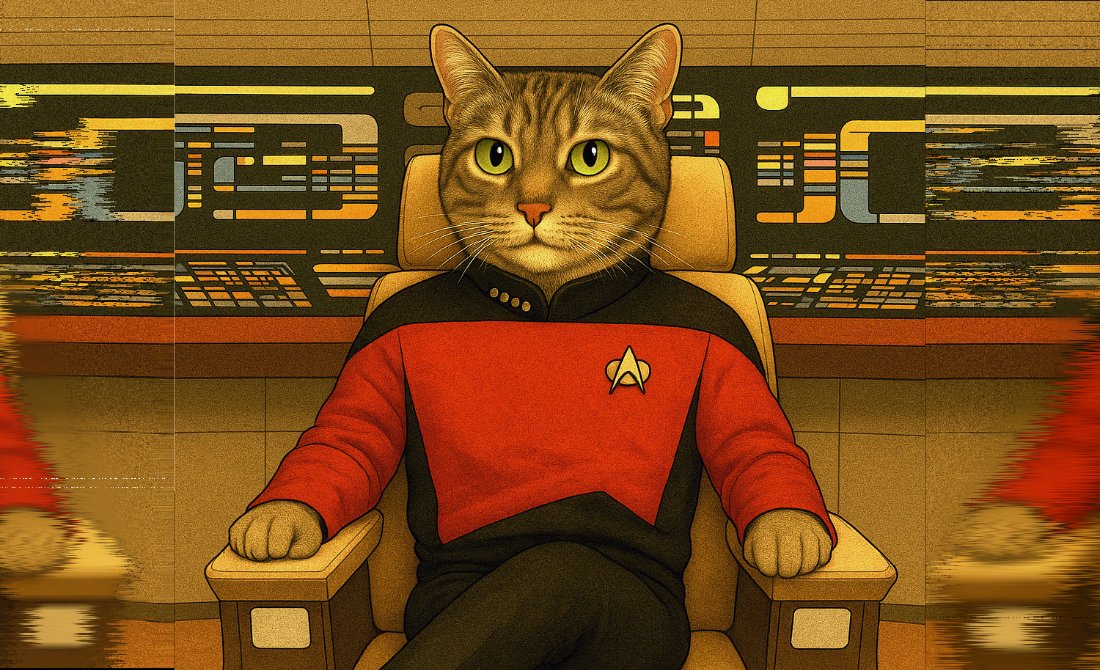
After defeating Unimatrix 01100100 01101111 01100111 at the Battle of Boulder, the heroic feline forged an elite new unit comprised of the best Marines and soldiers, along with the most badass cats. Gen. Smith granted Buddy a field promotion to Lord Commander, and the brilliant feline tactician took a satisfying nap before forcing the Evil Robot King to accept pitched battle at the Carrizozo Malpais, a volcanic field in New Mexico.
When the battle was over, Buddy stood heroically atop a mountain of machine corpses, one paw resting on the destroyed Robot King’s head. Tens of millions of Americans were inspired by that image of valiant conquest, and joined Lord Commander Buddy as he mopped up the last machine elements.
For his courageous feats in combat, his bold leadership, and his confident, dauntless tactical brilliance as a battle commander, Buddy was lavished with honors, including having a sandwich named after him.
So there you have it, folks.
The next time someone claims cats “serve no purpose” or “have no function,” you can point to any number of Buddy’s accomplishments, which exemplify the courageous American spirit and have advanced the cause of man and feline alike.







 Pain In The Bud