Humans Are An Alien Invasive Species, New Study By Feline Science Institute Finds

Humans are an invasive species who are spectacularly adept at destroying life, a new study has found.

Homo sapiens are an invasive species who do irreparable harm to the environment and other animals on an unprecedented scale, a new study by the Feline Science Institute has found.

The results prompted feline scientists to add homo sapiens, commonly known as humans, to a database of destructive and invasive animals maintained by the Academy of Scientific Studies.

Cat scientists have only just glimpsed the breadth of human-initiated impact on other animals, Dr. Oreo P. Yums, lead author of the newest research paper, told reporters.

“We found humans are astonishingly, almost indescribably destructive,” Yums said. “For instance, although they fret about birds, humans kill more than a billion of them a year just with their skyscrapers, which birds are prone to fly into due to their mirrored surfaces. Add in wind turbines, cell towers, power lines, habitat loss and slow die-offs due to chemicals, and by conservative estimates we’re talking about billions of birds killed by humans every year without even tallying active measures like hunting.”

Humans have killed off an estimated 70 percent of the world’s wildlife in the last 50 years alone and show no sign of stopping. Oceans are overfished, animals like pangolins and big cats are ruthlessly hunted to extinction to feed demand within the Chinese traditional medicine market, and human addiction to palm oil means the “two-legged demon monsters don’t even have sympathy for their fellow primates,” mewologist Charles Clawin said.

“In Borneo and Sumatra there are entire schools, filled to capacity, for critically endangered orangutan babies who were orphaned by human contractors clearing ancient jungles to make room for more palm oil plantations,” he said. “Often, the humans use industrial equipment to tear down trees while the orangutans are still in them. Other times, they dispatch the mothers with pistols, not realizing there are babies clinging to them.”

In Africa, where the elephant population has plummeted in the last century, more than 110,000 elephants have been slaughtered in the past 10 years alone for their tusks. The elongated incisors are used to make jewelry and piano keys, and items made from ivory have become a status symbol in China, where growing middle and upper classes seek to show off their wealth with luxuries.

In 2019, Chinese businesswoman Yang Felan, dubbed the “Ivory Queen,” was arrested and charged with smuggling $2.5 million worth of tusks from Tanzania to her home country. Yang, “a key link between poachers in East Africa and buyers in China for more than a decade,” was a respected businesswoman, investor, restaurateur and vice chairwoman of the China-Africa Business Council.

“Poachers continue to slaughter elephants and our big cat brothers and sisters,” said Luna Meowson, who tracks the illegal wildlife market for the University of Nappington. “Having extirpated tigers from virtually their entire range, poachers are turning to South America, where jaguar poaching increased 200 fold between 2015 and 2020. It never stops.”
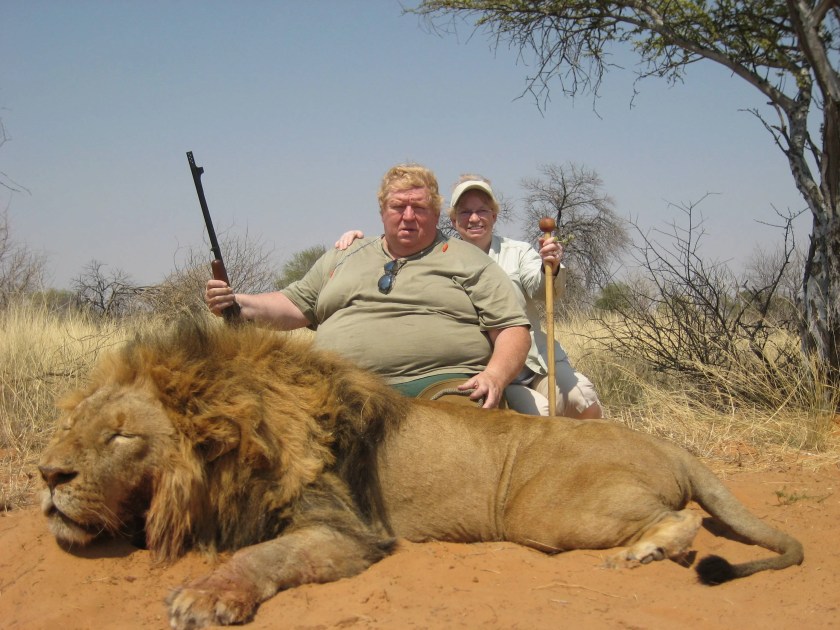
Big Bruce the Lion Slayer
A human hunter poses victoriously after heroically slaying a lion (panthera leo) from atop his trusty steed, a mobility scooter, after a team of guides drove him around the bush in an air-conditioned SUV, then lured the animal directly into his line of sight. A female of the species, presumably his mate, looks on proudly.

Although the earliest details remain murky, fossil records show Homo sapiens first emerged in Africa about 200,000 years ago. The invasive species, which has a gestation period of about nine months, began rapidly breeding and immediately went to war with fellow members of the genus Homo.

After wiping out two-legged rivals including Homo neanderthalensis, Homo altaiensis, Homo denisova and Homo bodoensis, the victorious Homo sapiens set their eyes on other species. Throughout their history they’ve also proven remarkably adept at murdering themselves and continue to hone their skills.

“Those OG humans, they had to really work at slaughtering other species and extirpating wildlife,” said Chonkmatic the Magnificent, King of North American cats. “They didn’t have attack helicopters, stealth bombers, tanks, carrier battle groups, daisy cutters, artillery, mortars, phosphorous, napalm, biological weapons, or even small arms like rifles. In those days a pimply kid from Oklahoma sitting in an air-conditioned base in Virginia couldn’t wipe out an entire city 5,000 miles away by pressing a button ordering a drone to drop a nuke. They had to put some sweat into violence, you know?”

522616
Breakthroughs in recent centuries have led to innovative and more convenient ways for Homo sapiens to author mass destruction and render entire sections of the Earth lifeless.

The species, known for its aptitude for tool-making in addition to eating ultra-processed foods and staring at screens, began with simple tools of destruction like the Mark I Spear, early bows and even torches. Over the centuries they innovated, coming up with clever and inventive new ways to inflict pain and end life until the advent of electricity, the industrial era and the brutally destructive war machines of modern times.

Human scientists have tried to obscure their species’ impact on wildlife and the planet by declaring species like felis catus “invasive” and “alien,” but even if cats are “guilty of grabbing a forbidden snack every now and then,” they don’t have the coordination, technology or will to carve up habitats, render entire swaths of the Earth uninhabitable with nuclear fallout, create Everest-size mountains of garbage, or effortlessly drive millions of species to extinction, Clawin said.

“They’re so good at it, they don’t even have to try,” he noted, pointing out human accidents or incidents of negligence like oil spills and chemical run-off into rivers. “We tend to think of humans out there with shotguns and rifles, cackling maniacally as they shoot anything that moves. And, sure, they do that, especially in places like Texas where the sight of any animal always prompts the question ‘Should we shoot it?’ But our research shows they can wipe out entire categories of fauna in their sleep. It’s remarkable.”

Additional reading: Polish institute classifies cats as alien invasive species
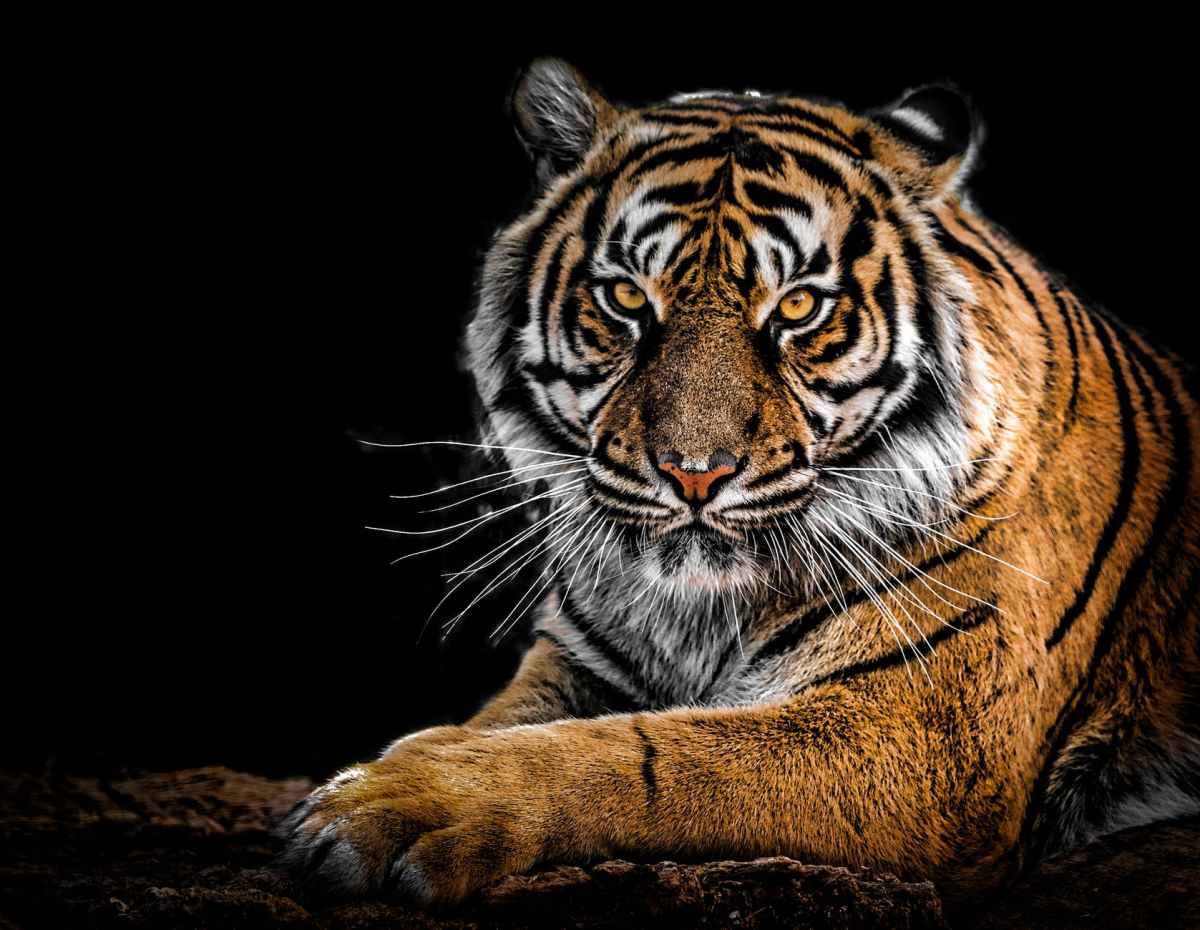
Finally, Wild Cat ‘Ownership’ Could Be Banned Under The Big Cat Public Safety Act

The legislation aims to ban all private big cat ownership throughout the United States.

There are more tigers living in cramped backyards in Texas than there are in the wild.

At roadside zoos, shady people like Joseph Maldonado-Passage, Joe “Exotic” of Tiger King fame, breed big cats like rabbits so they have an endless supply of cubs to steal from their mothers before they’re weaned, pumped full of sedatives, and handed off to tourists who take selfies with them but never stop to consider the welfare of those baby cats or the harm they’re enabling.

And in states like Florida, where “Muh freedoms!” reign supreme over all other values, people can own any wild animals they want, with no real oversight and no mechanisms to ensure they’re doing right by the animals. There’s nothing forcing “exotic” animal “owners” to keep the big cats, monkeys and other mammals in proper enclosures where they have stimulation and — just as importantly — won’t escape and hurt neighbors.

India the tiger Transported to BBR
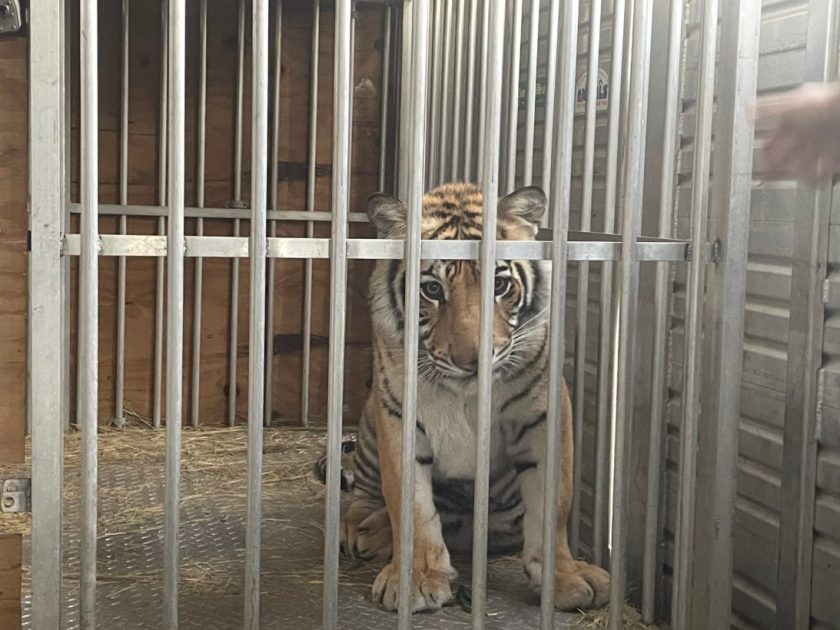
India the tiger was still just a cub when he was spotted wandering through residential neighborhoods in Texas, where he’d been dumped by his former “owner.” Credit: Humane Society

Thankfully, things could change soon as lawmakers are expected to vote on the Big Cat Public Safety Act, a rare bipartisan effort that would finally make it illegal to keep tigers, lions, jaguars, leopards, cheetahs, pumas and other wildcats privately, whether in homes, businesses or non-accredited “zoos.”

Currently keeping big cats is illegal or severely restricted in most states, but like many things in the US, there’s a confusing patchwork of laws and things that would be unthinkable in other states are perfectly acceptable in places like Texas and Florida.

Because, you know, “muh freedoms.”

Now is a good time to point out that this blog has always been, and will remain, politically agnostic. I have my own political beliefs as any other person does, but PITB is a cat humor, news and advocacy blog, and the only politics we discuss here are those that relate to animal welfare. Equally important, Buddy and I want people of all political persuasions to feel comfortable as readers and commenters on PITB. (Although that could change if one or both political parties suddenly makes a move against the nation’s Strategic Turkey Supply. Then Buddy’s gonna have to get biblical.)

The Big Cat Safety Act is co-sponsored in congress by representatives Mike Quickly, D-IL, and Brian Fitzpatrick, R-PA, and in the senate by senators Susan Collins, R-ME, Tom Carpenter, D-DE, Richard Burr, R-NC, and Richard Blumenthal, D-CT.

It’s endorsed by a wide range of groups, from the National Association of Zoos and Aquariums to the Humane Society and various bar associations. The proposed legislation also has the support of the White House, which released a statement this week urging its passage.

If your congressional representative or your senators aren’t publicly on board with the Big Cat Safety Act, you can make your voice heard via the Humane Society’s site, which allows you to draft and send letters to the offices of your lawmakers.

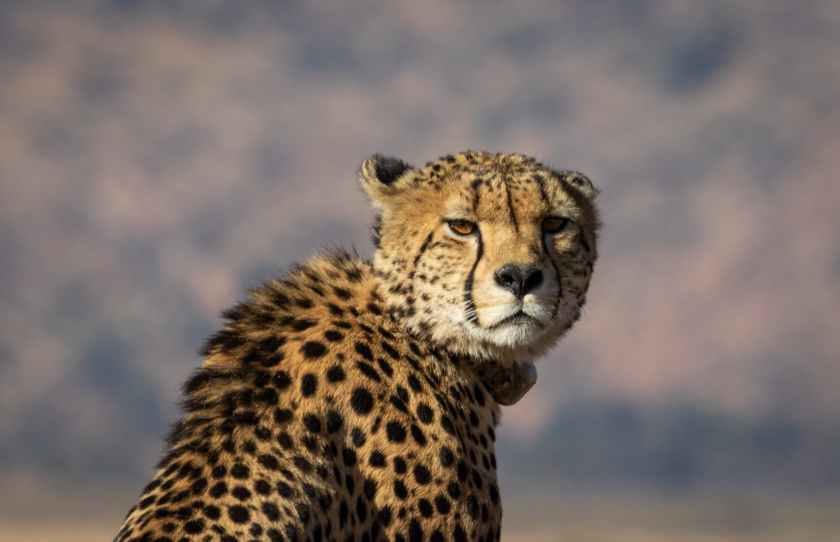
shallow focus photography of cheetah
Cheetahs, already critically endangered, have been almost entirely wiped out by poachers who sell their cubs on the illegal wildlife market. Credit: Magda Ehlers/Pexels

Too Many ‘Cute’ Pet Videos Are Animal Abuse

Cats aren’t dolls or stuffed animals to be posed at our whim for the benefit of online strangers.

I know I’ll probably catch some heat for this, but the below video, which a Newsweek writer gushes over and 8.8 million people favorited, is an example of animal abuse. It may not be violent, it may not be particularly overt, but it’s animal abuse all the same.

@cowlashes

She stays in bed like this alllll night 😉 her name is Pishy (pee-she)

♬ Great Mother In The Sky – Lionmilk

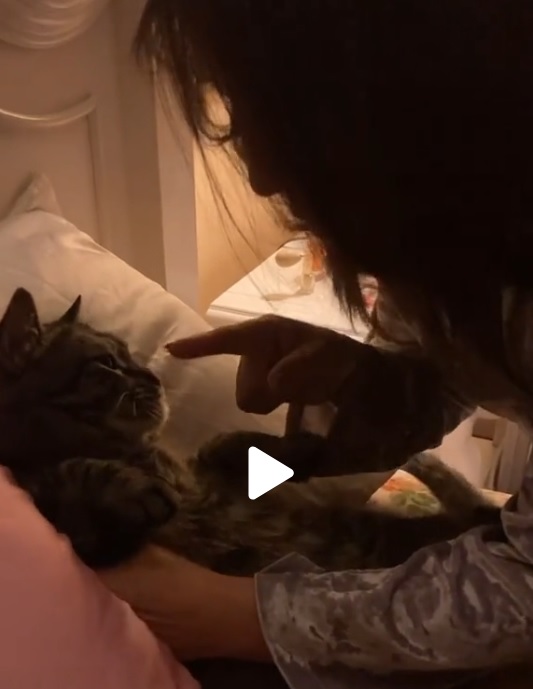
I get why people are saying this is “adorable” and think it’s sweet, but anyone familiar with cats can see clearly the kitty does not like being picked up, then placed in a bed on her back. She protests, then moves to get away, but her “owner” clamps her down and presses an admonitory finger to her nose.

Little Pishy’s ears twitch and her eyes dilate. Her owner slides her into position, then holds her down before tucking her in beneath a heavy comforter. Then the woman takes both of the Pishy’s paws, places them deliberately above the comforter just the way she likes them, and finally wags her finger in the cat’s face again before she’s finished, as if to warn her: “Don’t move a paw.”

Just before she steps away, she strokes Pishy’s paw a few times with a finger, an affectionate afterthought on her terms.

Pishy
This is not love. (Still image from TikTok video.)

Let’s be blunt here: The cat is not enjoying any part of the whole charade. She would almost certainly rather sleep like a cat, and not be treated as an infantilized, anthropomorphized stuffed animal. Her “owner” is dictating everything from the position in which she sleeps to where she can keep her paws.

“She stays in bed like this alllll night ;),” the TikToker brags in the video description.

Of course she does, because she’s probably scared to find out what will happen if she doesn’t. This isn’t a person who considers her cat a living being with her own feelings. She’s a person who sees her cat as a prop and a way to earn the adulation of strangers on the internet.

The same thing applies to all the “cute” videos of cats forced to wear clothing, glasses and hats, and posed in human-like positions. Last week, a short clip of two cats watching an iPad went viral. The cats are snuggled together in a miniature chair, posed like miniature humans. The larger cat has a paw around the smaller cat’s shoulders, and the tablet is balanced between their free paws.

Instead of gushing over the seemingly perfect 8 seconds we see, it’s worth thinking about what we don’t see, and how that manufactured scene came to be. I can assure you it does not involve animals who enjoy being posed like dolls for the benefit of an audience they don’t know exists, on a medium they don’t understand.

35034672-0-image-a-20_1604054071717
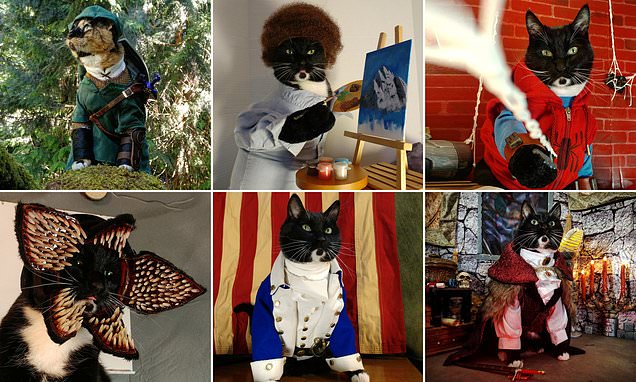
Cats dressed and posed as Robin Hood, Bob Ross, Spiderman, the monster from Stranger Things, some sort of naval admiral or Founding Father, and a Stark from Game of Thrones. I think.
1582240824134
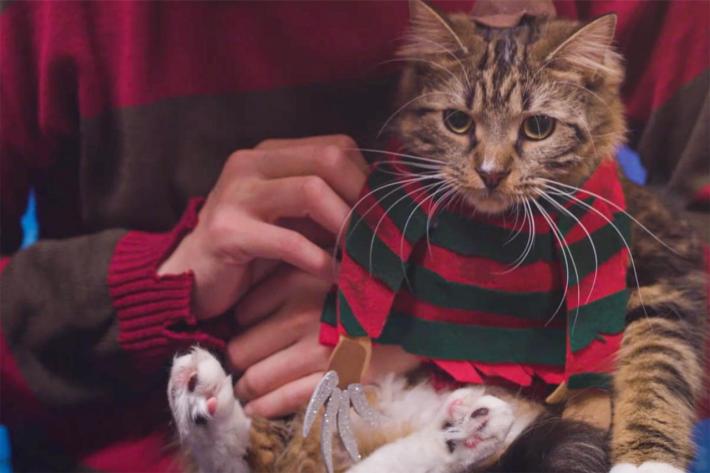
A cat who doesn’t understand what a costume is, not enjoying his Freddie Kruger outfit.

I keep coming back to the best advice I ever got about taking care of a cat: The strength of the human-feline bond depends in large part on how much the human takes the cat’s feelings into consideration.

We’re much bigger, stronger and some of us subscribe to the archaic “might is right” way of thinking. Imagine the reverse: Five hundred pound cats as large as tigers, subjecting us to tongue baths at their whim, posing us like dolls and forcing us to sit, stand and sleep in feline positions because it’s “cute.”

I am by no means an expert in cat care, and I don’t pretend to be some sort of cat whisperer or cat guru, but one thing I’ve always done is let my cat decide when he wants affection and interaction. I’ve never grabbed him and held him in my lap, or tried to dress him in miniature samurai armor for social media snaps.

When he meows for a head scratch or lays down on my chest and purrs as he listens to my heart beat, it’s because he wants to be there, and he knows I won’t grab him and force him to stay when he wants to get up.

If I treated him like a doll and tried that tuck-in move with him, he’d claw the hell out of me, and I’d deserve it. He’s my Buddy, not my property or my puppet.

What do you think? Am I overreacting, or are you disturbed by these videos as well?

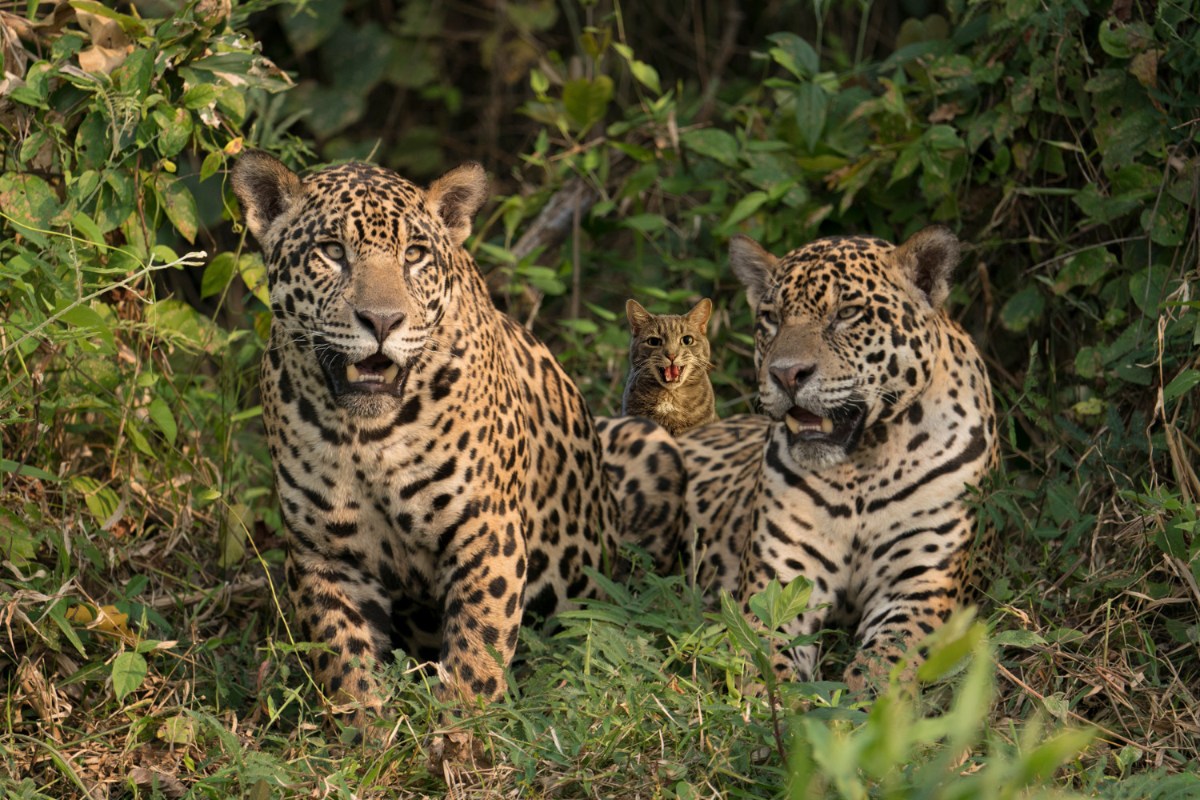
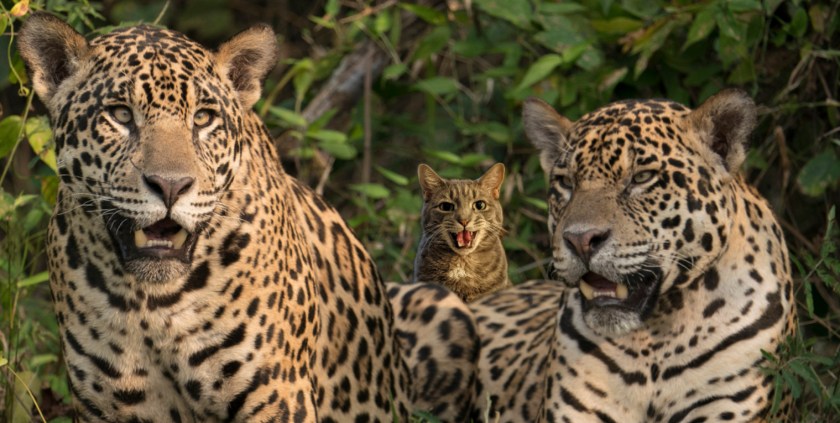
Buddy the Cat Spotted With Jaguars In The Amazon

The third time’s the charm: After failing in his attempts to ingratiate himself with tigers and lions, Buddy heads south to the Amazon to commune with the jaguars.

MATO GROSSO DO SUL, Brazil — Fisherman and naturalists working in the Pantanal have reported a strange sight in recent weeks — a domestic cat tagging along with jaguars.

The gray tabby was observed lounging on the banks of the Amazon, napping in a tree and struggling to take bites out of a caiman killed by a generous jaguar, witnesses reported.

“HQ, we’ve got something extraordinary here,” a naturalist was heard reporting over local radio channels. “A jaguarundi is — no, scratch that — a house cat! A house cat is following a group of jaguars from the river bank into the deeper jungle.”

The feline in question was identified as Buddy the Cat of New York after his concerned human reached out to local authorities and appealed to the Brazilian press for his safe return.

“He does this all the time,” the New York man, identified as Big Buddy, told an interviewer from Folha De S. Paulo. “First he broke into the tiger exhibit at the Bronx Zoo and tried to get the tigers to accept him, only to be claimed as a cub by one of the tigresses. It took weeks to convince the zoo to get him out, and when I got him home I had to bathe him five times just to get the stink of tiger saliva off his fur.

“Then somehow he made his way to Tanzania, where he wandered around the Maasai Steppe for a few weeks trying to get into a lion pride. He failed miserably in that endeavor, too. Now with the jaguars. It never ends.”

budd_and_jaguars
Buddy the Cat, known as Kinich Bajo to his jaguar friends, pictured here in the Amazon.

The exasperated New York man claimed responsibility for his failure to keep his “ridiculous” cat from adventuring, but also blamed the transportation industry for accommodating Buddy.

“Who the hell allows an unaccompanied cat to take a bus or board an airplane?” he asked. “How did he end up in first class, sipping champagne and buzzing the stewardesses for more turkey every five minutes? I’m told he got quite drunk and threatened to become combative if he didn’t get an entire fried turkey.”

Asked why his cat was obsessed with ingratiating himself to larger cat species, Big Buddy answered without hesitation.

“He’s a dumbass,” the human said. “Don’t get me wrong, he’s a very cute, very loving little guy, and often a good boy, but a dumbass all the same.”

Buddy’s human said the 10-pound domestic cat often tears around the house, ambushing animate and inanimate objects and practicing his roar, “but he sounds like Elmo singing a funk song in falsetto.”

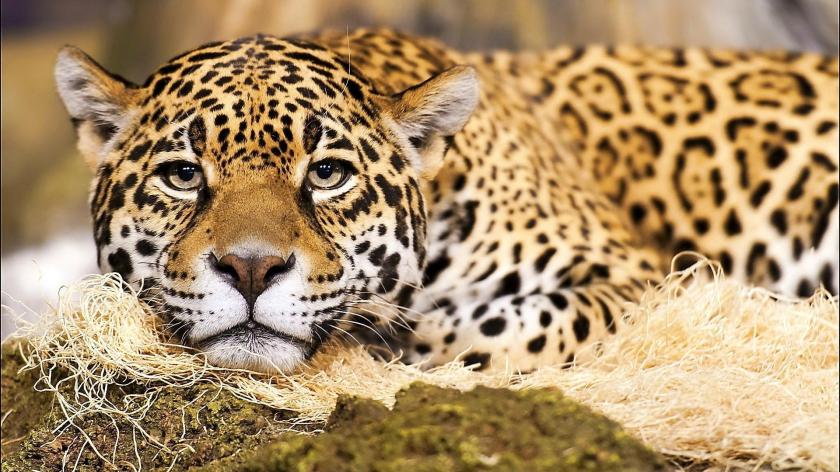
jaguar-big-cat
Credit: Wikimedia Commons

As of press time, Buddy the Cat still hadn’t returned home. Jaguars are known to be extraordinarily laid back compared to other big cats, and a loosely-affiliated group of the South American apex predators seemed to tolerate the domestic kitty.

“I can’t leave now,” Buddy told reporters. “They’ve begun to accept me! It would be a violation of trust if I just left them to eat all this delicious food by themselves.”

Kinich Ahau, the local jaguar elder, said his extended family had taken a liking to Buddy.

“Have you heard of this turkey? We did not know of it. It is wondrous!” the great jaguar said. “Buddy, or Kinich Bajo as he is known to us, has also shared great wisdom in the form of new and comfortable napping techniques. On the first night, we observed him construct a soft bed of leaves for himself in the crook of a branch, and over the following suns and moons we have come to appreciate softer napping spots.”

Buddy had sparked a renaissance in jaguarian napping technique, Kinich Ahau said.

“Nobody naps like Buddy,” he said. “No one!”

buddyandbuds
Brothers: Xibalbá, left, with Kinich Bajo and Ek B’alam.

With the fond support of the Amazon’s jaguars, Buddy was set to undergo an ancient shamanistic ritual involving the imbibing of Ayahuasca, a powerful psychoactive brew said to reveal cosmological secrets to those who drink it as part of a spiritual ceremony.

“We would not have invited Kinich Bajo, or Buddy as you call him, to commune with the ancient B’alam (jaguar) spirits if we did not sense a deep spirituality and wisdom inside him,” said an elder jaguar shaman named Mike the Melanistic. “He has shown us the way in matters of snacking and napping, and now as we welcome him to our ethereal fraternity, we shall accompany him on his journey to the stars, where he will drink of the deep knowledge of our ancestors.”

Buddy himself told a reporter he was looking forward to the ceremony.

“It’ll grant me, like, awesome powers and shit,” he said. “I’ll be able to disappear in a puff of mist like the jaguars do, my muscles will get bigger and, like, I’ll be able to sniff out snacks from up to a mile away. Pretty cool, if you ask me.”

At press time the jaguar shaman elders said the ceremony does not, in fact, grant such powers.

Bud’s Book Club: The Man-Eaters of Kumaon & The Game of Rat and Dragon

Join us in reading stories of cats in space and big cats in the jungles of India.

Welcome to the inaugural post of Buddy’s Book Club, where we’ll read stories about cats and stories involving cats!

We’re going to start things off easy with a classic short story of the cat canon, which is available for free online via Project Gutenberg, and a seminal book about big cats from a man whose name is indelibly linked with them.

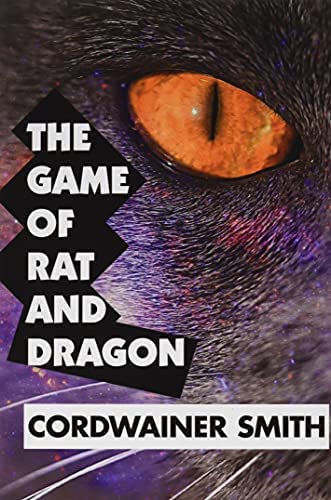
The Game of Rat and Dragon (1954) by Cordwainer Smith

51Aneono5KS._AC_SY1000_

Read it here for free from Project Gutenberg, a collaborative effort to create a digital archive of important cultural literary works that have fallen into the public domain. For those unfamiliar with Project Gutenberg, it’s completely above-board, legal and safe for your devices, and the story opens in plain HTML with illustrations included as image files. You can read the story in a browser or download it onto a reading device, tablet or phone.

The Game of Rat and Dragon first appeared, as so much short fiction of the era did, in a digest. Although Smith had penned it the year before, the story was published in Galaxy Science Fiction’s October 1955 issue and became an instant classic among cat-lovers and science fiction aficionados. (There is considerable overlap between the two, not surprisingly: Introverts whose imaginations run wild when they look to the stars tend to have many of the same personality traits as people who prefer the more sublime antics of cats.)

The Game of Rat and Dragon imagines a far future in which humanity has become a star-faring culture, meaning we’ve conquered interstellar flight and have begun to colonize planets in star systems other than our own.

There is, of course, a problem. The dark, lonely void between stars isn’t as empty as we thought it was, and is inhabited by invisible (to the human eye), inscrutable, inexorable entities eventually dubbed “dragons.”

When dragons attack they leave only death and insanity in their wake, putting the entire idea of interstellar travel at risk. Imagine if there was a not-insignificant chance of your passenger jet being attacked by impervious creatures every time you hopped on a plane. It wouldn’t be long before the entire air industry collapsed and the world suddenly became a much bigger place, with other continents unreachable by air.

Who can help humans with this problem? Cats, of course! To say more would be to spoil the fun. Meow!

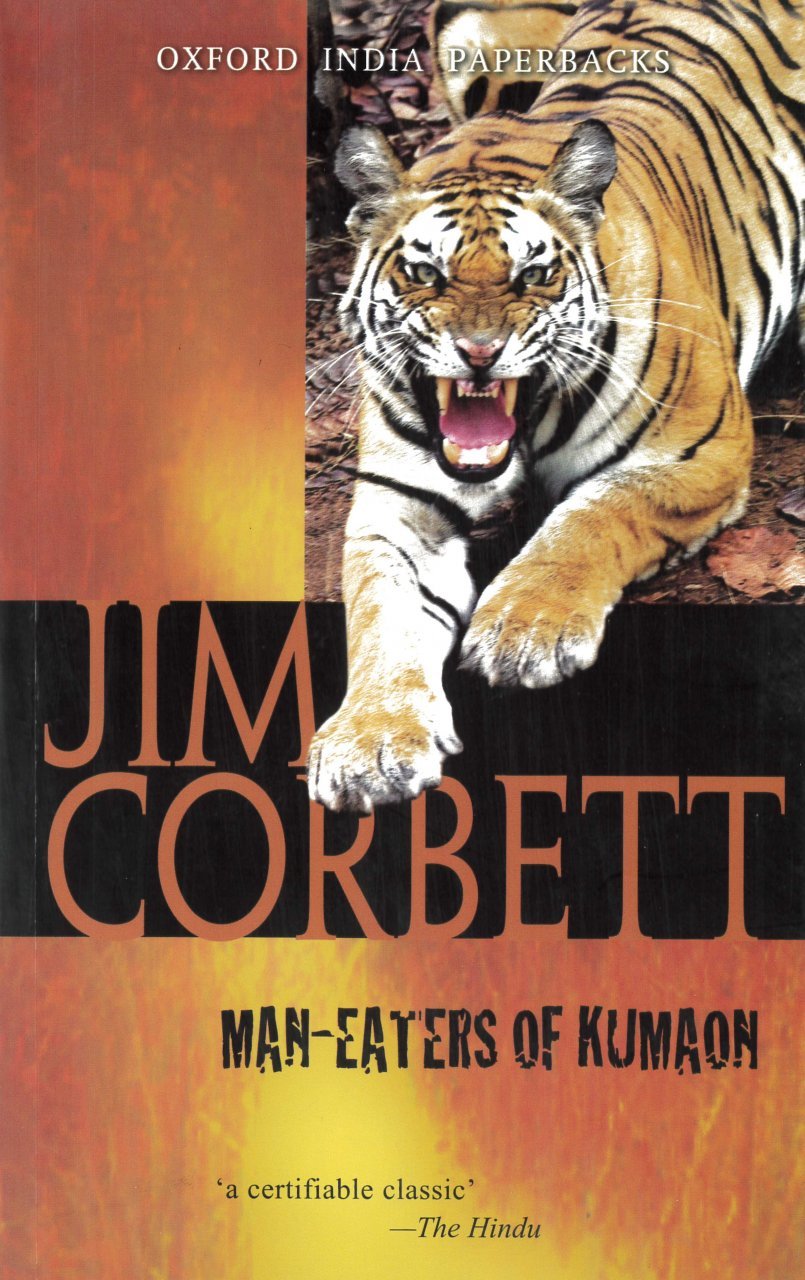
Man-Eaters of Kumaon (1944) by Jim Corbett

201355

Available as an ebook for 99 cents from Barnes and Noble.

Jim Corbett was a sportsman, the son of a government official in the British Raj who was raised in India’s jungles and came to know them intimately. He’s best remembered as the fearless hunter who finally brought down the infamous Champawat tigress, who officially claimed 436 lives over a years-long rampage as a man-eater, and likely many more that went unrecorded.

To understand the gravity of Corbett’s accomplishments, it’s necessary to understand the effect of a man-eater on rural India. The people living in India’s tiny villages are subsistence farmers. If they don’t farm, they don’t eat.

But when a man-eater as dangerous as the Champawat tigress claims an area as its hunting grounds, everything grinds to a halt: Farmers refuse to tend their fields, villagers disappear behind locked doors, and a simple walk to a neighboring village becomes an impossibility unless escorted by a group of two dozen or more armed men. Even then it’s a risk, for as Corbett notes, when tigers become man-eaters they have no fear of humans and will kill people in broad daylight, even when they’re in groups.

And yet for all their power and predatory instincts, tigers are never deliberately cruel and don’t harm humans willingly. Tigers become man-eaters by unfortunate circumstance, usually due to negligence or stupidity on the part of humans.

The Champawat tigress, for example, was like any other big cat until a human hunter took aim and shot her in the mouth, destroying one lower canine completely and shattering another. The tiger could no longer take down her usual prey, or at least not without serious difficulty. At some point — perhaps after encountering the body of a person it did not kill — the tigress realized she could survive on human flesh.

If that hadn’t happened, those 436-plus souls wouldn’t have been lost, an entire region wouldn’t have been brought to its knees, and the tigress would have continued life as normal.

The vast majority of the time, tigers are content to let humans be.

“I think of the tens of thousands of men, women and children who, while working in the forests or cutting grass or collecting dry sticks, pass day after day close to where tigers are lying up and who, when they return safely to their homes, do not even know that they have been under the observation of this so called ‘cruel’ and ‘bloodthirsty’ animal,” Corbett writes.

Despite his reputation as the man to enlist when a man-eater terrorized a region, Corbett saw the way things were trending a century ago, and begged people to let the big cats live undisturbed.

“A tiger is a large-hearted gentleman with boundless courage,” he wrote, “and that when he is exterminated — as exterminated he will be unless public opinion rallies to his support — India will be the poorer by having lost the finest of her fauna.”

Corbett would undoubtedly be deeply disturbed by the situation today, with only some 4,000 wild tigers remaining in the entire world, and the glorious species mostly reduced to spending life in captivity, constantly sedated so that idiots can pay to take selfies with them.

The Man-Eaters of Kumaon follows Corbett on 10 hunts of man-eating tigers and leopards. It’s also a story of life in the British Raj, rural life in India, Corbett’s jungle adventures, his love for his loyal hunting dog and his turn toward conservation.

Schedule:

We can do the short story in a week, yeah? Let’s shoot for one week for The Game of Rat and Dragon, and two weeks for The Man-Eaters of Kumaon. We’ll adjourn and discuss in follow-up posts. Happy reading!