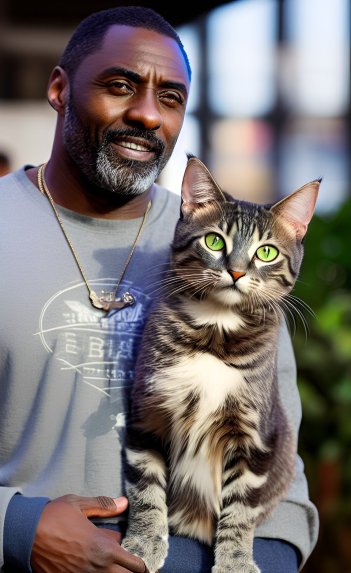
What’s with these horror movies? My human likes to curl up on the couch under a blanket, with me protectively in her lap of course, and watch these ghastly movies about serial killers, ghost infestations and lurking monsters.
Why would anyone want to scare themselves? You don’t see us creating an entire film genre dedicated to horrors like empty food bowls or late dinners, so why do humans make these movies?
Your fan, Mildly Curious in Manhattan
Dear Mildly Curious,
This is a question I’ve pondered for some time, inasmuch as I care about anything human-related to ponder. My human also watches those movies and he also does so with me sitting protectively in his lap.
Then I realized something. None of the people in these horror movies have cats!
The family from The Conjuring? They have a dog. Stanley Tucci’s family in that crappy movie about flying monsters that kill everyone? Dog! The family in that other crappy movie about giant axolotl-type things that terrorize people living in a coastal community?
You guessed it! They have a dog too.
You see where I’m going with this, right? Humans who serve us cats literally have no fear because no monster or crazy cereal killer would ever risk attacking a home with a cat in it.
Suppose a hungry evil monster is let loose in my neighborhood and is making its way through the street at night, then sees me in all my meowscular, intimidating, tigeresque glory sitting at the window, keeping watch over the nocturnal world.
That monster is going to skip right over The Buddy Domicile and go in search of easier pickings because it sure as heck doesn’t want to tangle with me and my claws. I have that effect on monsters.
They may be monsters, but they’re not stupid. Breaking into a home with a cat is like breaking into a t-rex enclosure. You’re asking to get mauled by a huge, meowscular apex predator who will eviscerate you and look handsome and badass while doing it.
People who serve us cats know this. They know no monster or killer or robber would be stupid enough to go near a house with a cat. They can probably sense my meowscularity two miles away!
So sometimes our humans may want to know what it feels like to be vulnerable, what it would be like if they didn’t have tigers like us guaranteeing that no intruder approaches. THAT is why they watch horror movies. Take it to the bank!
It took a tiger swiping at her for her to wake up from the dream of being close to big cats. Now Katherine Lee Guard’s mission is to educate people about the animals and how helping them means keeping a healthy distance.
No one knew Saigon better than Katherine Lee Guard.
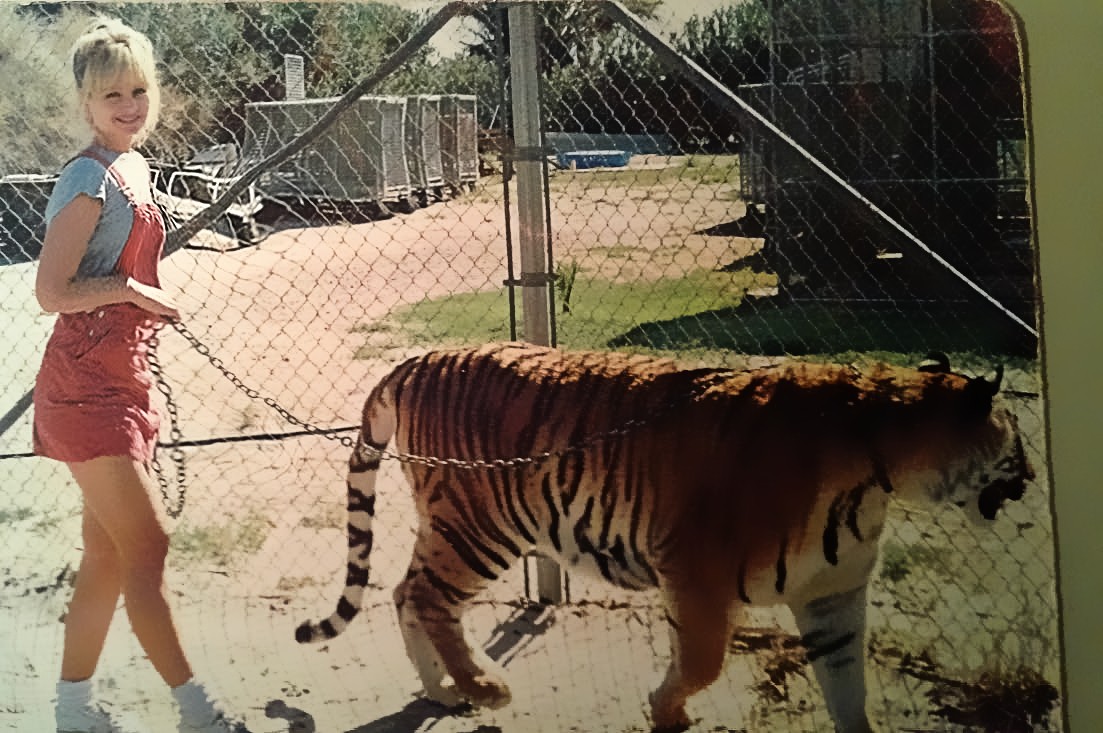
When he arrived at the wildlife ranch in Thermal, Calif., as a baby in the mid-90s, it was Guard who stayed up with him at night, bottle-feeding the orphan cub and swaddling him in soft blankets. She was by his side as he grew, tending to his needs, taking walks with him through the desert and scrubland on the compound that was his home.
Then one day the massive Amur tiger turned on her.
“It was just so shocking even though I knew it could happen,” Guard recalled. “I thought I knew but until it happened, I had no idea. It was terrifying and oddly a weird ‘How dare you!’ kind of feeling that came over me. Like ‘How dare you come at me after all I’ve done for you?’ Because I’d raised him, bottle fed him, been up all night with him.”
Guard was equally surprised by her own reaction, which she described as “more indignation than fear,” but it was that indignation that “allowed me to shelve my fear long enough to get away and out of the enclosure.” If Saigon had sensed her fear, his predatory instincts could have overridden the maternal affection he felt for her.
Saigon never tried to kill Guard. If he had, she wouldn’t be here to tell the story. He was merely warning her that he didn’t want her near him that day, and he made sure she got the message.
Katherine and Saigon on a happier day when the massive tiger was in a better mood. Credit: Katherine Lee Guard
Amur tigers, also known as Siberian tigers, are the largest big cat subspecies in the world, topping out at 700 pounds, with males spanning 10 feet from nose to tail.
But the encounter — a growl, a much-less-than full strength swipe and a warning bump — was enough to turn Guard into “a nervous, vomiting wreck” once she extricated herself from the enclosure.
“Getting swatted by a paw, even with sheathed claws, hurts like hell,” Guard told PITB. “I’d feel trounced, disappointed and relieved at the same time. And stupid for being in there with them, although I never would have admitted that to anyone back then.”
That first bad encounter with Saigon, and similar encounters with a lion named Tsavo that Guard had also bottle-fed when he was a cub, planted seeds of doubt in her mind about what she was doing on that California ranch, working with a man who had previously used the big cats in circus performances.
Years earlier when Guard’s mom came to visit her, Guard came out to meet her with baby Saigon in her arms, feeding him from a bottle.
Her mother stopped and took in the scene. “That’s not the baby I imagined for you,” she said flatly.
“I never forgot it,” Guard said.
Later, while caring for a female Bengal named Bombay, Guard had an epiphany. Like so many others who make it their life’s work to be near big cats, she had always been beguiled by the beautiful, powerful and dangerous animals. Looking at Bombay, Guard realized the regal tiger was “totally without pretense,” moving with the purpose and grace of a being self-assured in her existence.
“She was purposeful and unyielding and for the first time I felt separate from her and it didn’t bother me,” Guard said. “It was beautiful to realize that she didn’t need me or anyone else. Had she been given a chance in the wild, she would have flourished. The desire to know her thoughts and be her friend lessened in me because I started to appreciate her for her, not for how she could make me feel. ‘She’s not existing for me! She exists for herself!’ We don’t ‘own’ Bombay. Bombay ‘owns’ herself.”
“It was a light bulb moment, and in hindsight I think it was the beginning of the change in my mindset.”
Guard stopped the practice of going “full contact” with the big cats — meaning caring for them without any barriers or safety measures in place, relying on luck to avoid death or dismemberment — and eventually left the ranch around 2003.
In the two decades since, she’s been focused on educating the public about big cats, supporting conservation efforts and trying to rescue the unfortunate tigers, lions, jaguars, leopards and other wild felids who have the misfortune of living in roadside zoos where they’re sedated and exploited for customer selfies, or living sedentary, unnatural lives in cramped backyards in states like Texas and Florida.
Tsavo the lion, who was rescued from “a shitty private owner,” was another one of Guard’s bottle babies at the sanctuary.
Like many others who have dedicated their lives to helping those animals, Guard is encouraged by the 2022 passage of the Big Cat Public Safety Act — but also miffed that it took lawmakers so long, and worried that loopholes in the law will be exploited by people determined to “own” Earth’s endangered apex predators.
The world of big cat handling is a small one, and the people in that world tend to know each other if not always well, then by reputation or in passing. Guard remembers meeting Joe Exotic, the “star” of the infamous Netflix documentary Tiger King, in the late 1990s. Her boss and mentor at the time, Wayne Regan, wanted Exotic to surrender some of his cats to the sanctuary. Regan and Guard had seen “Exotic’s” handiwork up close when they examined some of the tigers another sanctuary had managed to wrangle out of his care. The tigers were stressed, suffered from poor nutrition and were not well cared-for.
Exotic came to the meeting with a sickly, malnourished lion cub as if taunting the pair.
“I hated him immediately,” Guard said.
She was overcome with a desire to “steal the poor malnourished cub he had with him,” but Regan cautioned her against it. Knowing what “Exotic” — real name Joseph Allen Maldonado — is capable of, it’s probably a blessing that she didn’t, but she still thinks of the cub all these years later.
Exotic remains in a federal prison in Fort Worth, Texas, where he’s serving a 21-year sentence after he was convicted of two counts of trying to hire a hitman to kill his arch-nemesis, big cat sanctuary operator Carole Baskin. He was also convicted of 17 counts of animal abuse, and his name is synonymous with the horror and suffering big cats endure when they’re in the possession of private “owners” and roadside zoo operators.
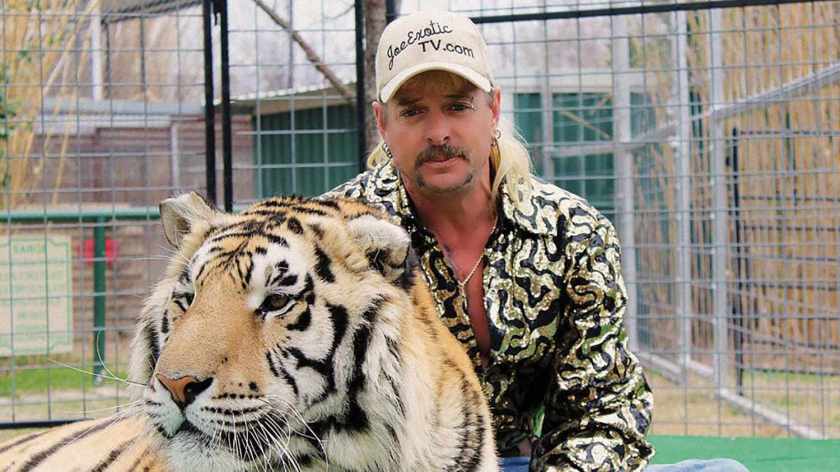
Joe Allen Maldonado, who styled himself as Joe Exotic, was the subject of the infamous documentary Tiger King detailing his exploitation of big cats and his outlandish criminal activity. Maldonado remains imprisoned in a federal facility after he was convicted of trying to have sanctuary operator Carole Baskin killed.
Big cat advocates lament the fact that the documentary, as popular as it was, spent more time focusing on Maldonado’s eccentricities, Machiavellian maneuvering and manipulation of people in his orbit than it did on the suffering of the animals in his “care,” but it did draw attention to his crimes and the plight of tigers in the US.
“He tortured and killed and exploited so many animals,” Guard told PITB. “He is a coward piece of shit who is right where he should be. He is no ‘Tiger King’ and never should have had a minute of fame.”
She has a similarly low opinion of Kevin “Doc” Antle, another eccentric animal abuser featured in the documentary. Antle has provided big cats and other animals for projects including the Ace Ventura films, a Jungle Book adaptation, a Britney Spears performance and an appearance on Oprah Winfrey’s talk show.
Earlier this year he was convicted of illegal wildlife trafficking in Virginia, where authorities said he tried to buy endangered lion clubs in violation of federal law. He’s racked up almost three dozen USDA violations for mistreatment of animals over the years, has been accused of gassing adult tigers to “make room” for more cubs, and faces a slew of additional charges related to money laundering and the alleged import of wild animals, including a chimpanzee and a cheetah.
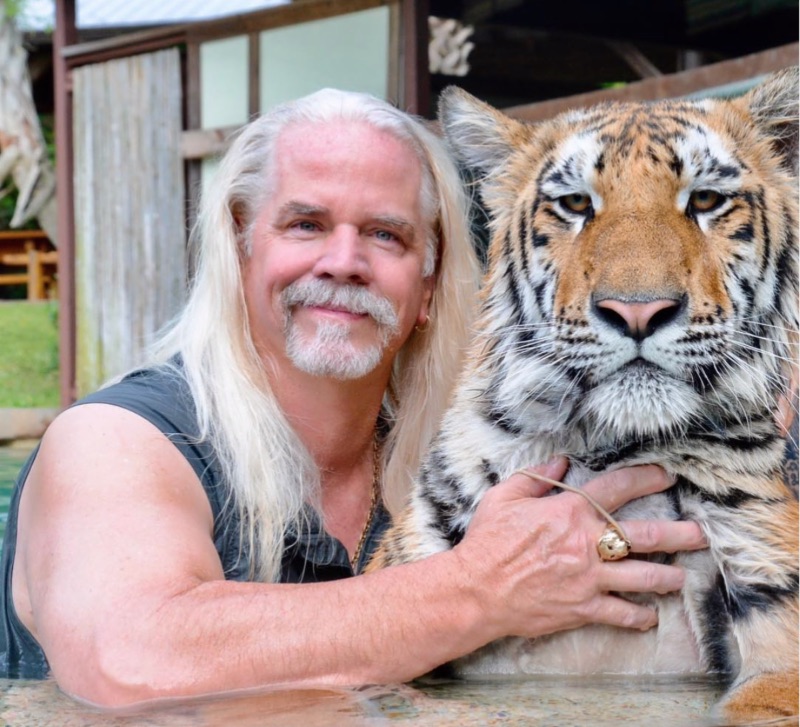
Kevin “Doc” Antle, who now calls himself Bhagavan Mahamayavi Antle,
Antle has also raised the ire of animal welfare advocates and conservationists for the controversial practice of breeding ligers — massive cats that are the result of breeding male lions with female tigers — and inbreeding tigers to produce a color morph commonly known as white tigers. While the latter are beautiful, majestic and rare, intentionally trying to breed them often results in cubs with malformations who either die in infancy or live short, brutal lives.
Guard does not regret the time she spent working with big cats on Regan’s ranch, just the naïve way she went about it. Like others who have spent years thinking about how to best protect and save big cat species, she’s come to the conclusion that the majestic felids are best helped — and appreciated — from a distance.
At the ranch, some of the felids were former show animals rescued from the entertainment business. Some, like Saigon, were abandoned young by people who had planned to use them in shows. Others were like Tsavo the lion, who “came from a shitty private owner.”
Regan was a former tiger trainer for circuses but had changed his views on using the animals for entertainment. He “was fastidious about taking care of the cats, very invested in their welfare and had only the best care for them,” she said. The ranch was sprawling, with enrichment items and toys everywhere, as well as a large lake with an island in the middle so the cats — particularly tigers, who are known for their love of water — could swim and play. At night they settled into their own individual habitats, each equipped with smaller pools, entertainment items and bedding.
In addition Wayne, Guard and their volunteers were reluctant to display the cats for anyone, even donors. They felt it would be a betrayal to the animals to be gawked at in a place that had become a haven for them.
Regan had learned the business from a man named Ron Whitfield, who remains active in the big cat community as the large carnivore curator at the San Francisco Zoo and trained animals for 30 years at the now-defunct Marine World in San Francisco.
“The business is so small that word gets around and Wayne, and Ron too, were known as good people to care for unwanted animals,” Guard said.
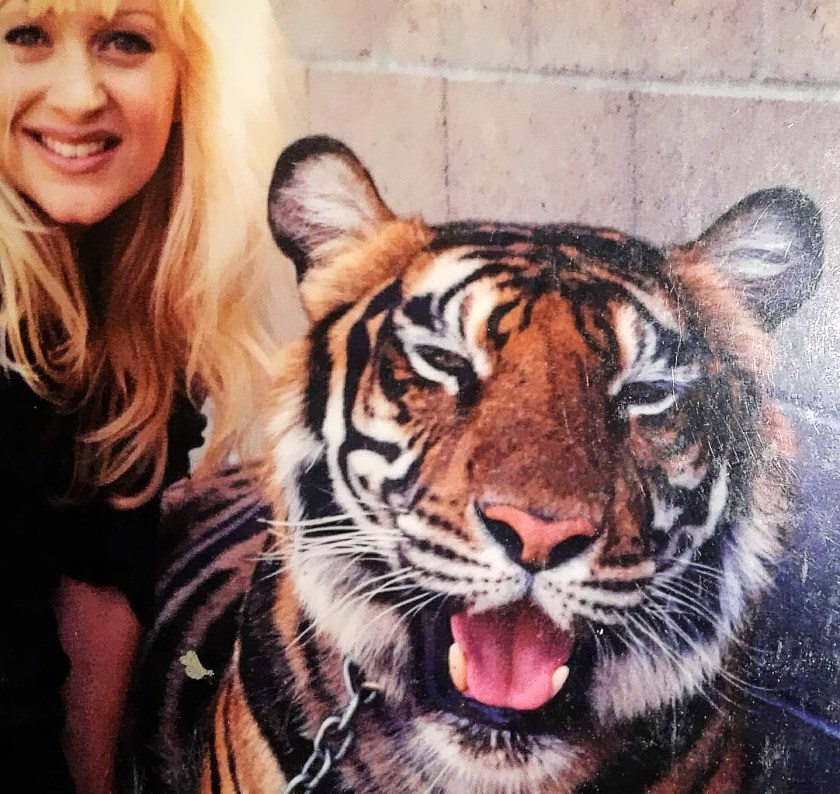
Guard and Saigon.
Tsavo as an adult.
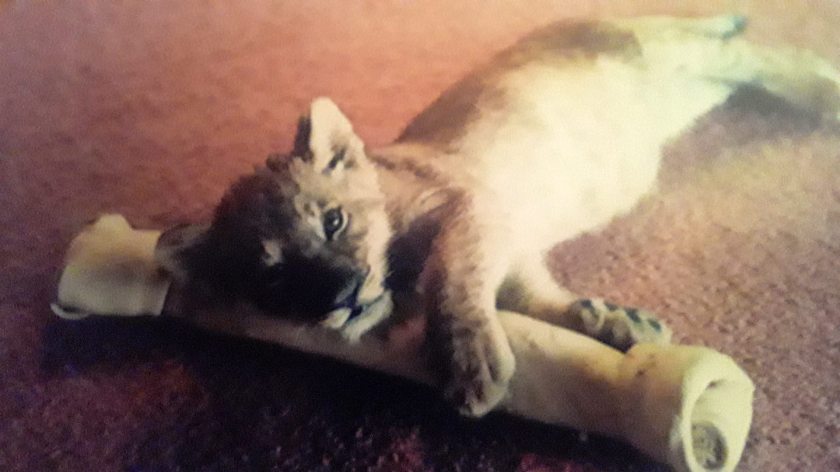
Baby Saigon
These days, Guard cares for small cats too as a caretaker and feeder of stray cat colonies in her California neighborhood. It’s a reminder of the good people can do in their own backyards, and of the need that exists in a country where some 800,000 unwanted felines are euthanized every year despite Herculean efforts to push spaying and neutering. (Those efforts have been very successful, and euthanizations of cats and dogs are only a fraction of the millions they were just 15 years ago, but the fact that so many unwanted animals are still killed illustrates the enormity of the problem.)
Mostly, she wants people to know that the idea of having a big cat for a companion, or even living in something resembling harmony with them, “is a fool’s paradise.” Luck is the only determining factor in whether a handler lives or, as Siegfried and Roy can attest, suffers life-altering injuries from accidentally triggering the ever-present predatory instinct of tigers, lions and other big cats like jaguars and leopards.
They are, after all, the planet’s apex predators, hyper-carnivores designed by nature with the most deadly weapons of any extant animal.
Guard says she hopes the practice of keeping big cats truly ends after the current generation of panthera “pets” — those grandfathered in under the Big Cat Public Safety Act — pass on. And she hopes that young people who are as “spellbound and mesmerized” by the spectacular felids as she was don’t follow her lead and endanger their lives, which is why she’s brutally honest about her own experiences and makes no pretense about benefiting from any factor other than luck.
“It’s been a long road for me to go from there to here,” she said. “I’m glad I can recognize my mistakes and hope I can prevent others from doing the same. I don’t know why people are drawn to do dangerous things but for me I didn’t think about the danger because I just wanted to be close to my cats.”
She understands the allure, but always comes back to the same conclusion: humans and big cats are not meant to live side by side.
“The cost is too great if something goes wrong,” she said. “And something always goes wrong given enough time.”
Did you like this story? Read some of PITB’s other long-form journalism and essays:
A Bengal tiger mourned his longtime mate and then did something extraordinary, replacing her as their cubs’ primary caregiver.
The magnificent tiger in the photo above is officially called P-243, but he’s affectionately known to locals as The Hulk of Panna.
He made his home about a decade ago in the Panna Tiger Reserve, a 210-square-mile national park in the Indian state of Madhya Pradesh, home to more than 72 million people.
What makes him special, aside from his massive frame, is the fact that when his longtime mate died and left four of their cubs to fend for themselves, the Hulk stepped up and became a full-time dad.
The mom, known as P-213-32, had previously given birth to a litter of four cubs, but only two survived. As far as the rangers at Panna National Park could tell, the Hulk and P-213 had been together for years. The new cubs were their second litter.
The Hulk “was not seen with any other tigress,” the rangers wrote in a report.
On May 12, 2021, park rangers were concerned when P-213’s radio collar began transmitting potential mortality signals, alerting them to the fact that the tigress hadn’t moved for about six hours. The rangers observed her from a distance, then dispatched a team of elephant scouts to take a closer look.
T1 (tigress 1) was known as the matriarch of the Panna Tiger Reserve. After poachers nearly wiped out the entire population of tigers almost 15 years ago, T1 and another tigress were the last two female tigers. T1 herself gave birth to 13 cubs and today the reserve has more than 80 of the endangered big cats living within its boundaries. Credit: RS Murthy
The use of elephants by experienced riders in India to monitor tigers is as ancient as it is ingenious — while virtually every other animal in a tiger’s habitat gives the big cats a wide berth, elephants and tigers have an unspoken mutual agreement, a kind of wild non-aggression pact. That’s because as massive and powerful creatures who move in packs, elephants are too much trouble for tigers to bother with. Unlike their lion cousins who do hunt elephants opportunistically, tigers don’t form prides and even if elephants were solitary animals and easier to hunt, even a mother and her hungry cubs — let alone a single tiger — can’t eat that much meat. They also can’t transport the kill to safer dining spots the way they do with their typical prey.
So tigers and elephants tend to do little more than acknowledge each other’s presence, and the tigers have learned that humans riding on elephants aren’t hostile.
The elephant rangers who got close to P-213 realized the tigress had a swollen right forelimb and they made the decision to sedate her. For the next two nights, field veterinarians accompanied the rangers and administered painkillers and antibiotics. The treatment seemed to work, the swelling was reduced and the tigress was ambulatory if still sluggish, but she died less than a week later.
Her death “came as a shock to all of us,” the team wrote. “A beautiful tigress and a caring mother, [her death] left her four cubs alone.”
Frustratingly, a postmortem and lab analysis of her blood didn’t turn up any obvious cause of death.
P-213’s death “was itself heavy loss to bear but now the major worry was her four orphaned cubs,” the ranger team wrote. The cubs were last seen with her on May 10, about 11 days before she died. The two previous days they’d been spotted sharing a kill with their mother, and rangers reported the cubs looked strong and healthy.
A few days later, after an exhaustive search by five elephant riders and 50 park rangers, a ground team found the cubs “healthy and active and [did not appear] hungry or stressed.” They also spotted their father, the Hulk, nearby.
What happened next was extraordinary.
After park rangers cremated P-213, the Hulk approached the site about an hour after the last people cleared out. The next day, rangers observed him “sitting for long hours at the place where P-213 died.”
They also saw the dedicated mate and father calling out softly as he looked for his cubs, three males and a female who were about seven months old at the time.
A few days later, the Hulk successfully hunted a sambhar, a type of deer, and shared the kill with his cubs according to a local news report. Then on June 6, the Hulk was spotted feeding the kids again after he killed a cow.
“For the entire day the tiger remained in the area but did not eat the kill. This was unexpected behaviour from a tiger and the PTR management deployed ground staff deployed to find out the reason,” the news report said. “The team found that the area where the tiger killed the cow is the territory of four tiger cubs. This male tiger, known as P243, is their father. The cubs had lost their mother a month ago.”
The Hulk prowls his territory. Credit: Sanjeev Siva
As if he hadn’t done enough to earn “dad of the year” honors for his species, the Hulk was even spotted playing with his offspring.
“After the death of the tigress, we located these cubs and placed camera traps in the area,” said U.K. Sharma, the director of Panna Tiger Reserve. “We found that the tiger visits these cubs regularly, and his behavior shows that he is not a threat to the cubs. We have seen the cubs playing with the male tiger and sharing kills.”
The team at Panna reserve continued watching closely and got to see the cubs flourish in the care of their dad. There were moments of uncertainty when rangers went days without seeing the cubs or finding their pug marks, but their fears were always put to rest by trail cameras that captured images of the Hulk with his kids in tow, resting with them in favorite spots and sharing meals with them as he taught them to hunt and survive.
Because male tigers typically aren’t known for nourishing behavior and their traditional role is to defend their territory to keep their mates and cubs safe, the Panna reserve’s staff were ready to step in if things began to look dicey. They never had to. A follow-up report about eight months later, when the cubs were healthy and fast-growing 15-month-olds, affirmed the team’s earlier decision to stay hands-off and let the Hulk do his thing.
“Surviving the wild without mother tigress is no mean feat but surprises do happen,” the rangers wrote. “And these become experiences, practices and lessons for the future. The lesson learnt is ‘[the] best thing one can do when tiger cubs are growing is to let them grow. Let us permit nature to have her way. She understands her business better than we do.'”
The annual tournament pitted more than 20 furry emcees against each other in a battle of rhymes and wit.
NEW YORK — Gripping the microphone in his paw, Panther the Pulverizer took aim at Buddy the Funky Feline and, when the beat dropped, launched into a blistering verse filled with punchlines about his opponent.
“You got no chance, so say sayonara,” the Pulverizer rhymed. “You’re so fat, cats thought you was a capybara!”
“My flow’s a gale, in a storm you’re supposed to bail. How you gonna carry weight when you broke the scale?” he rapped, drawing laughter from the crowd. “You’re known to fail, terrified with a bloated tail, so walk your ass home ’cause you won’t prevail!”
Hektah tha Headhunta, one half of duo Spliff an’ Wessin’, earned himself a quarterfinal berth with a raucous verse that dismantled Boss the Bocelot.
“Oh, snap!” one cat exclaimed and the all-feline crowd whooped and cheered as the Pulverizer continued his verbal assault.
The Pulverizer pressed forward, invading his opponent’s personal space as he fired the next salvo of punchlines.
“What’s wrong, lil’ Bud? Is it hard to diss us? You couldn’t move these cats if you farted citrus. Pardon it’s cause you’re avoiding this bout, knowing I’ll make you bounce like your primordial pouch.”
A collective “Dayum!” echoed throughout the crowd while the DJ doubled over with laughter. Meanwhile, Buddy sucked in his gut, suddenly self-conscious.
“My man got punchlines about primordial pouches, yo!” an approving member of the audience shouted, his tail swishing with excitement.
“Am I supposed to be intimidated? Hell no! You sound like a constipated Elmo. Truth is both my waistline and my raps are leaner,” he rhymed, gesturing toward Buddy. “While this cat runs screaming from a vacuum cleaner. Face it lil’ Bud, we ain’t rivals. You came here dead on arrival!”
The crowd roared for several seconds after the beat cut out as the Pulverizer basked in the audience’s approval.
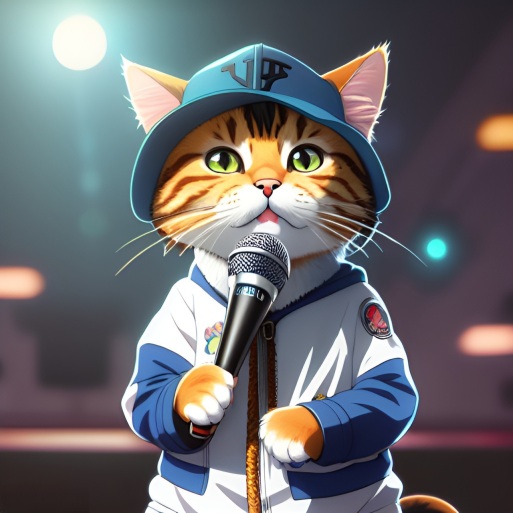
Panther the Pulverizer, a kitty rapper from Astoria, Queens.
Buddy, dressed in oversized Tommy Hilfiger jeans, a bubble jacket and a Yankees cap turned sideways, took the mic for his turn and wasted no time launching into his retaliatory verse.
“My name’s Buddy, I’m ferocious in fights. Little known fact: also dope on the mic!” he rapped. “You’re a joke over-hyped, frozen with fright, lookin’ like a ghost you’re so white! It’s hopeless, allright? You’re a featherweight, I’m Mike Tyson tonight.”
Lay-Z is a New York-based kit hop artist who admits to an easy housecat life, with his rhymes often boasting of stainless steel bowls, palatial cat condos and fine dining on human delicacies.
“Get ’em, champ!” a supporter shouted from the crowd.
“You don’t have the balls to diss me, that’s truth in fact! I’m the real tom, you’re just a neutered cat. Your whole crew is wack, don’t even try to diss! Buddy’s a lion, you’re just a pride of wimps.”
The Pulverizer glowered as the crowd roared with laughter.
“I got fans across the world, it’s me they’re feeling, the only fans you got are spinning on your ceiling,” Buddy the Funky Feline rapped, waving a paw at the roof. “Buddy’s the illest, thats why I spit it hot. You’re full of shit like an unscooped litter box.”
“Damn! Damn, damn, damn!” host Meowthod Man of the Mew Tang Clan shouted, waving off the beat. “Let’s hear what the judges have to say!”
The judges called the battle 2-1 in favor of Buddy, granting him the split decision and sending him to the semifinals.
The Funky Feline is due to face Crouching Tiger, the highly favored big cat with a smoky voice and crisp flow. The winner of that bout will advance to the finals to battle the winner of the semifinal match pitting the Deft Leopard against MC Hektah the Headhunta.
Buddy tha Funky Feline, also known as Snackmaster Flex, is known for his vivid lyricism about life in the ‘hood and exuberant rhymes about junk food.
Buddy the Funky Feline has been the target of criticism claiming that while he rhymes about “life in the hood” as a hardscrabble stray, he actually grew up as a pampered house cat in the suburbs. He seeks to burnish his street cred ahead of his new album, Chillmatic, which is expected to break record sales when it’s released later this month. It’s the first full-length release from the New York-based kitty rapper since 2020’s Got 2 Have Turkeys and his 2021 EP, Fowl Play.
While promoting the former record during a concert stop in Tokyo, Buddy’s tour bus was infamously overturned by a crowd of screaming female fans, who pelted the bus with bras and held signs professing their love for him.
His entry into the Cat Fight 2023 battle rap tournament is meant to signal that he’s more than just a prettyboy, with an appeal beyond his massive female fanbase.
“Buddy is so kawaii, we love him,” gushed Kei Kikuno, one of Bud’s many Japanese admirers. “I just want to pinch those little cheeks!”
The protesting felines, tired of being cast as villains, demanded “cuddlier representation” in movies and TV.
LOS ANGELES — Marching in a broad circle outside the Universal Studios headquarters on Monday, a group of about 200 cats demanded “more cuddly representation” in television and film.
The felid contingent included house cats, pumas, bobcats, tigers, lions, leopards and even a few jaguars, each holding signs with messages like “Cats are more than claws!” and “Stop The Stereotyping!”
“What do we want?” a house cat shouted into a megaphone.
“Cuddlier representation!” the crowd of cats shouted.
“When do we want it!”
“After our nap!” they replied in unison.
Monday’s protest was prompted by Universal Studios’ 2022 thriller, Beast, but protest organizer Buddy the Cat said the felid group was protesting “decades of tropes and injustices committed against cats by Hollywood and TV.” Examples include the undead cat in Stephen King’s Pet Sematary, the rampaging lion in Dutch horror-comedy film Prey (called Uncaged in the US), the many murderous felids in the CBS series Zoo, and Jackson Galaxy’s My Cat From Hell.
“We’re tired of always being cast as villains while dogs are the heroes. Take a cat like me, for instance,” Buddy told a reporter. “It’s easy to mistake me, with my razor sharp claws and ripped physique, for a threat to humans. But really I’m just a cuddly little guy who likes chin scratches.”
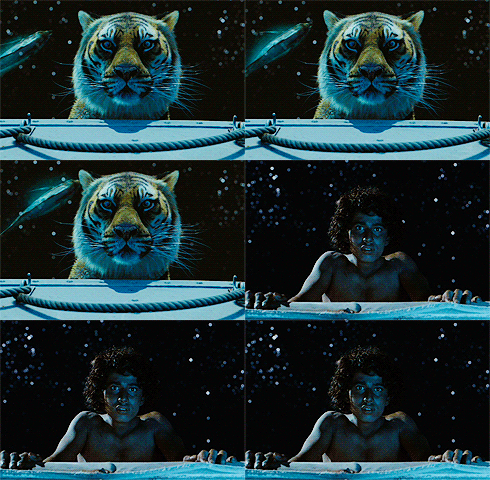
Linus, a 14-year-old Bengal tiger who starred as Richard Parker in the 2012 hit Life of Pi, said he was a young actor who didn’t know better when he agreed to portray the threatening antagonist.
“Now that I’m older and I have all this Frosted Flakes money coming in, I can be picky about the roles I accept and only choose movies I think will be Grrreat!” he told an interviewer. “But what about the next young tiger, or the jaguar fresh off the boat from the Amazon, who doesn’t have the power to tell the director a certain scene is offensive?”
Linus also took issue with the script, in which the writers have him refusing to share fish with Pi.
“Did you see the boat? It was filled with fish! What am I, some sort of glutton who’s gonna eat 200 pounds of fish while the human starves?” Linus asked, bewildered. “I mean, according to Hollywood we’re angry, dangerous, murderous criminals and we stuff our faces all the time. No wonder people are scared of us!”
Prey, also known as Uncaged, depicts an angry lion rampaging through Amsterdam and eating pretty much everyone.
Beast stars British actor Idris Elba and tells the story of a widowed medical doctor who takes his two daughters to South Africa, where they stay with a family friend and embark on a tour of the native wildlife.
Unbeknownst to them, an adult male lion is on a rampage after a team of poachers entered the reserve the previous night and slaughtered his entire pride. While Elba’s character, his two daughters and his friend (Sharlto Copley) explore the reserve, they discover the mutilated remains of an entire village’s population and eventually come face to face with the murderous lion.
“What’s all this barney, then?” Elba said when asked about the felid protest. “Well that’s unfortunate, innit, mate? I played a tiger in The Jungle Book, a proper tiger. I love cats.”
The actor, who rocketed to fame off the strength of his portrayals of Stringer Bell in American police drama The Wire, the title character in British detective thriller Luther, as well as major roles in franchises like the Marvel Cinematic Universe, the Star Trek reboot movies and science fiction action-adventure Pacific Rim, said he’s taken the cat’s criticism to heart.
“Buddy’s a good bloke,” says Elba, pictured with his feline friend.
“Me and me mate Buddy, we like to grab a pint on the regular, d’ya know what I mean?” Elba said. “This tosh with the movies, it’s gotta stop. Me mate Buddy is a good bloke, innit? So if he says Hollywood has to have more positive portrayal of cats, then that’s what we’ll do.”
In addition to their negative portrayal in films, which felids likened to the offensive portrayal of Italian-Americans as mafia figures, many cats cried foul at the idea that one of their kind would harm the beloved South African actor Sharlto Copley.
“That’s a very offensive portrayal,” said Chonkmatic the Magnificent, King of All Cats. “Sharlto Copley is the guy who made District 9, about aliens who eat cat food. Everyone knows cats love District 9. We wouldn’t lay a claw on Sharlto!”