In Netflix’s Three Robots, a trio of intelligent wise-cracking machines tour post-apocalyptic Earth after humanity nukes itself out of existence. While humans are long gone from the planet, felines are not, and before long the robots encounter a gray tabby.
“What’s the point of this thing?” one robot asks its friends, looking skeptically at the yawning cat.
“Apparently there’s no point, they [humans] just had them,” the second robot says.
“Well, that’s underselling their influence,” the third robot says. Humans, it explains, “had an entire network that was devoted to the dissemination of pictures of these things.”
The ongoing joke that the internet and modern telecommunications systems were invented solely for the purpose of sharing cat photos and videos won’t die any time soon now, thanks to NASA.
To inaugurate and test its new Deep Space Optical Communications (DSOC) system, which uses lasers instead of radio signals to transmit data, the famed space agency streamed a high definition video of a cat named Taters chasing a laser.
The 15-second clip took half a second to transmit from the spacecraft Psyche and 101 seconds to cross the 19 million miles (30 million kilometers) between Psyche and Earth. For context, that’s a journey about 80 times as long as the distance between Earth and the moon.
So why is NASA doing this? Why create a new communications network when the old one still works? And why send a video of a cat?
Taters the cat. Credit: NASA
The answer to the first question is simple: Our machine proxy explorers need more bandwidth to send back data and ultra high definition photos/video of the strange worlds they’re exploring.
We send robotic probes to destinations like the asteroid belt and Venus because we can’t go ourselves, and because it’s the most efficient way to explore. The indomitable human spirit drove us to explore our own planet, and it’s expected that eventually human eyes will see the oceans of Europa and the surface of Mars. But we still have some big engineering challenges ahead of us, like figuring out how to build ships that adequately shield astronauts from radiation, and medical/biological challenges like how to prevent vision, bone density and muscle loss in low or zero gravity.
So in the meantime robotic probes are our ticket, and their numbers are growing quickly.
There are more than 30 active probes exploring our star system now. Most belong to NASA, but others belong to space agencies from the EU, South Korea, Japan, Russia and India, among others. Another 27 new spacecraft are expected to launch this year, headed to destinations like Venus, Mars and the many moons of Jupiter, and at least that many are scheduled to join them in 2026.
That’s a lot of probes.
Each of those craft will have to transmit data back to Earth — scientific data, but also high definition photos and videos of planetary and moon surfaces, asteroid compositions and more.
There isn’t a traffic jam — yet. But there will be soon if every probe’s data is bottlenecked by the lower-bandwidth radio system.
While laser and radio transmissions both travel at the speed of light, the shorter wavelength of laser light allows more data transfer. In simple terms, the DSOC network is like upgrading from an old phone modem to broadband.
As for why NASA chose a video of Taters chasing a laser, there are two main reasons: Fun and honoring history.
Taters’ human, Joby Harris, works for NASA as a visual strategist. When NASA employees were talking about the significance of sending the first high-def video from a probe to Earth, one staffer mentioned that one of the first — or perhaps the first — test videos in the dawn of television was a simple video of a statue of Felix the Cat.
The rest fell into place. Transmitting a video of a cat chasing a laser seemed like the natural choice to test a laser-based comms system. Taters has become something of a celebrity in the process.
One thing we can be sure of: if aliens are watching us from afar, there’s a good chance they’ll conclude felines are the ones running things down here. They may not be wrong.
The outrage over the death of a pet cat may be the best barometer of Russia’s national mood as its disastrous war on Ukraine enters its third year.
For the past two years I’ve had a lurid hobby. I’ve been watching translated clips from the bizarre world of Russian state TV, where Vladimir Putin’s pet propagandists tell the Russian people what to think.
There’s ringleader Vladimir Solovyov, a guy who dresses like the admiral of a galactic fleet of military starships and is prone to wild mood swings. Depending on when you catch Solovyov he could be cackling maniacally at the prospect of nuking London or crying into his microphone as he laments the loss of his overseas bank accounts and his boss’s slipping grip on power.
There’s Margarita Simonyan, the 43-year-old head of RT (Russia Today) and rumored alcoholic who, strangely, is even-keeled compared to Star Admiral Solovyov.
Then there are the second-tier propagandists: Olga Skabeeva, the “Iron Doll of Putin TV” who matter-of-factly endorses horrific war crimes, and men like Anton Krasovsky, who famously fantasized about drowning Ukrainian children in the Tysa River, a tributary of the Danube, his desk rising three inches as he excitedly repeated “Just drown those children, drown them!” Apparently he forgot he was on television and said the quiet part out loud, forcing his boss (Simonyan) to grudgingly condemn his words.
Margarita Simonyan, left, and Vladimir Solovyov, right, are two of Russia’s most famous pro-Putin propagandists. Credit: Russian state TV
Solovyov, Simonyan and the others looked like a bunch of investors celebrating the sale of a billion-dollar company during the opening phases of the war in early 2022, giddily playing footage of Russian missiles taking out Ukrainian apartment buildings and artillery flattening hospitals.
Their rhetoric was extra-dimensional at the time: they spoke often of a glorious New World Order with Russia at its head and all of humanity united under Putin’s tiny feet, where people would undoubtedly conclude that life under Russian masters is better than any over-hyped concept of freedom.
When Russia faltered and Ukraine began stringing together victories with the help of western weapons and real-time intelligence from the US and UK, the tone of Putin’s propagandists grew bitter. Their body language mirrored their frustration. Solovyov began a tradition of threatening to nuke a different country every day, for “crimes” like acknowledging the reality of Russia’s military incompetence or calling for peace.
To date, Solovyov’s threatened to nuke the UK, France, Spain, Germany, Italy, Japan, Finland, Sweden and the US, and that’s just off the top of my head. He especially hates the British for reasons that aren’t entirely clear, but he regularly makes it clear that it’s only through Putin’s benevolence that cities like London and Paris continue to exist.
He’s also extremely fond of Tucker Carlson: he plays clips from Carlson’s show on X regularly, offered him a job after the American was fired by Fox News, and has declared him the greatest journalist in the western world.
In Putin Russia, cat feed you!
I thought of that motley crew of Putinious jackwagons this week as I read about the Russian public’s horrified response to an incident on a train.
A couple was traveling on a Russian Railways train to St. Petersburg when their beloved cat, Twix, escaped his carrier. The frightened ginger tabby just kept running until he was scooped up by a female conductor, who unceremoniously tossed him into the snow in Russia’s frigid Kirov Oblast. Temperatures regularly dip into the single digits and below zero in the winters there.
On Jan. 20, after a search joined by hundreds of people, little Twix’s body was found in the snow about a half mile from the train tracks. The feline, who was used to safety and warmth, suffered multiple animal bites and died either from his wounds or the temperature.
Twix the cat in a photo from his family that was reposted to a Russian Telegram channel.
To say Russians are furious is an understatement.
Twix’s fate has been the talk of Russian social media platforms for days. Surveillance camera footage of the conductor tossing the tabby ignited a new level of rage. As of Wednesday more than 300,000 Russians had signed a petition calling for the firing of the conductor, whose name hasn’t been released by the state-owned passenger railroad company. A second petition goes further, calling for criminal prosecution, and has 100,000 signatures in just a few days.
Public outrage about the fate of Twix just might be the first authentic sentiment to reach Russian media in years.
In an unusual move, the government acquiesced — partly — to the public’s demands and pulled the conductor from duty pending an investigation. They’ve also acknowledged that Twix’s humans had properly purchased a pass for him and were riding in a car designated for passengers with pets. In the future, they’ve vowed, conductors won’t toss animals from trains.
Russia is a famously cat-loving country. Felines comprise more than 64 percent of all pets kept by Russians, and more than half of all Russian households have pet cats. They’re considerably more popular than dogs in the nation of 143 million.
Cats are popular in Russian folklore, where traditions say the furry ones have the power to ward off evil, and they’re a much more convenient pet for the millions who live in Soviet-era apartment blocks in cities like Moscow and St. Petersburg.
Still, this feels like something more.
Russians haven’t had an easy two years thanks to Putin’s disastrous “special military operation.” They can face years in prison simply for calling for peace with Ukraine. Unless they’re part of the nation’s elite or have connections among them, men can’t leave the country because the military needs more warm bodies. The country’s economy is in shambles as the government pumps more money into the war and international sanctions have taken their toll.
A Russian tank laden with loot, including a toilet, rolls past the ruins of residential buildings in Popasna, a city in eastern Ukraine.
The government has canceled or downplayed annual military celebrations so the public won’t be reminded of the war’s costs. Russia is on pace to lose an astonishing 500,000 men in two years of combat, according to the UK’s Ministry of Defense, and Putin has tried to stem the anger of the country’s mothers by staging several meetings with actresses posing as the moms of Russia’s war dead, events which have been heavily covered by state press.
Russians can’t oppose the war they’re dying in. They can’t mourn their dead fathers, sons, brothers and husbands, not by revealing their real emotions.
Quality of life has further degraded in a country where tens of millions don’t even have indoor plumbing, which is why there have been so many clips of Russian soldiers stealing toilets, washing machines and other appliances from Ukrainian homes. The prospect of being pulled off the street, sent for two weeks’ worth of rudimentary training and deployed as cannon fodder hangs heavy over the heads of Russian men and their families, especially ethnic minorities and the poor.
But Twix? They can mourn him. They can get angry about what happened to him. The furious public sentiment regarding his death wasn’t manufactured by Solovyov and company. State TV didn’t spark the backlash, it was forced to acknowledge it.
I’m neither a Russophile nor an expert on that often difficult-to-understand country, but I’d bet all my rubles that those dueling petitions say more about the Russian mood than any opinion poll to come out of Russia since 2022, and definitely more than the words of anyone allowed to express an opinion on Russian TV.
There’s a scene in the first season of Slow Horses when Gary Oldman, in the role of a lifetime as MI5 supervisor Jackson Lamb, gathers his team as they’re being hunted.
“I don’t normally do these kind of speeches,” he says with an exasperated sigh, “but this feels like a big moment and if it all turns to shit, I might not see any of you again.”
He looks each of his agents in the eye, their fear reflected back at him, and sniffs.
“You’re f—ing useless, the lot of you! Working with you has been the lowest point in a disappointing career,” he says before barking at one of the young agents to accompany him and warning the rest not to get themselves killed.
Oldman is spectacular as Lamb, the gaseous, miserable MI5 veteran who captains Slough House, a purgatory where the agency’s worst agents are sent to waste away the remainder of their careers after humiliating themselves, usually in novel and cringe-worthy ways.
One agent was exiled after forgetting a disc with sensitive information on a train. Another was an alcoholic who didn’t notice her supervisor was feeding information to the Russians for years, while a third was banished to Slough House simply for being an insufferable jerk.
Gary Oldman as Jackson Lamb, who oversees the purgatory for disgraced MI5 agents known as Slough House.
Regardless of the reasons, each of the agents at Slough House is determined to get back into the good graces of agency brass by redeeming themselves in service to king and country.
Or, as Mick Jagger puts it in the show’s catchy theme song, they want “to dance with the big boys again.”
To do that they must endure consistently brutal needling from Lamb and navigate the most mundane, least glamorous assignments. If a job is a lose-lose proposition, MI5 hands it over to the rejects of Slough House — the eponymous Slow Horses — figuring their already stained reputations can’t get much worse.
So when a secretive MI5 plot goes off the rails and the agency’s leaders need someone to take the fall, they serve up the Horses.
There’s just one problem: Lamb, for all his misery, disgusting habits and bone-dry British humor, is an exceptional agent with old-school skills, and the Horses themselves aren’t necessarily incompetent. Several were promising young agents of great skill who got railroaded or were collateral damage in political warfare.
When MI5 second-in-command Diana “Lady Di” Taverner (an icy Kristen Scott Thomas) decides the disgraced agents will be blamed for a major agency blunder, Lamb is aghast and warns her he won’t accept it.
“They’re losers,” he says, “but they’re my losers.”
When we meet them for the first time they’ve already been tagged for sacrifice to the media and public, but don’t know it yet.
And when it turns out that the case has real consequences — a young man will be beheaded on a live stream by extremists if their demands aren’t met — the Slow Horses, led by the acid-tongued Lamb, use every trick at their disposal in an attempt to rescue the innocent victim.
Jack Lowden as River Cartwright, left, and Olivia Cooke as Sid Barrett, center, disgraced agents of MI5. Credit: Apple TV
Slow Horses, like Luther and similar UK crime dramas, is a different animal than the bland, formulaic cop shows we’re accustomed to on this side of the pond.
Whether it’s Law and Order, the many incarnations of CSI and NCIS or shows like Chicago PD, the audience always knows a few things for sure: The case will be solved and the bad guys apprehended by the end of the hour, the police will be righteous and earnest, and favorite characters will never find themselves in real danger. Mariska Hargitay’s character will live another day to continue on in her third decade fighting crime. Chicago’s tough-talking detective Hank might be rough around the edges and bend a few rules, but he’s fundamentally a good guy on the side of justice.
The Slow Horses have no such pretenses, nor plot armor. They’re deeply flawed people and they’re not immune to bullets or bad luck.
The result humanizes the agents in a way other spy thrillers and crime shows never manage to accomplish with their own characters. When one of the Horses takes a bullet from a Russian agent or risks life and limb to protect the British public, there’s a real sense of tension because the show makes it clear not everyone survives.
The show’s writers also know when to dial it back with moments of genuine humor, separating Slow Horses from contemporary spy thrillers like Homeland, which — with apologies to Claire Danes — always took itself seriously.
Kristen Scott Thomas as Diana “Lady Di” Taverner, MI5’s ruthless second-in-command, with Oldman as Jackson Lamb. Credit: Apple TV
As for Jagger, he signed on to write the show’s theme song with composer Daniel Pemberton because he’s a fan of the original Slow Horses novels by Mick Herron. While writing the lyrics, he said, the phrase “strange game” kept coming back to him. That became the title of the theme song and its primary hook. It’s an apt description of what MI5 agents are involved in as operators for a domestic agency that, unlike the American FBI, has the green light to involve itself in extensive subterfuge on home soil.
Slow Horses just finished airing its third season. A fourth has already been filmed and completed, a fifth is in production and a sixth season is currently in the adaptation/writing phase.
A production that runs like a finely tuned engine is appropriate for the series: each season is a taut six episodes, meaning there’s no filler and the tension does not let up on the gas pedal. With eight books and counting, there’s plenty more material to adapt, and if the response so far has been any indication — universal praise by critics and audiences in rare agreement — we’ll get to see every one of them make it to the small screen.
Title: Slow Horses Network: Streaming (Apple TV) Format: Series Release date: April 2022 (season 1), December 2022 (season 2), November 2023 (season 3), TBA 2024 (season 4)
Verdict: All the paws up! When it comes to crime and spy thrillers it doesn’t get any better than this. Slow Horses is tense and humorous in precisely the right proportions, knows when not to take itself too seriously, and benefits from an incredibly talented cast to match its excellent writing. We highly recommend this show.
Mankind’s achievements in space came at the expense of dogs, cats and non-human primates, who were sent into orbit during the early days of the space race.
I’ve been watching Apple TV’s exceptional show, For All Mankind, which dramatizes the space race of the 1960s and beyond in a sort of alternate history where the Soviets, not Americans, first lay boots on the lunar regolith.
That loss lights a fire underneath the behinds of the people at NASA and convinces American politicians that the space race is the ultimate measure of our civilization. In real life, American ingenuity and the creativity fostered by a free society allowed the US to leap ahead and “win” the space race. Space missions were already becoming routine by the time the drama of Apollo 13 briefly rekindled public interest.
Then the Soviet space program faded, the competition turned one-sided, and without an arch-enemy to show up, American politicians pulled back NASA’s funding to a fraction of what it once was, where it remains today. That’s why the rise of the private space industry — Elon Musks’s Space X, Jeff Bezos’ Blue Origin, etc — will almost certainly be our ticket to Mars.
But in For All Mankind, NASA remains the budgetary behemoth and source of prestige it was in the 60s and 70s, leading to the development of a permanent moon base, lunar mining operations and a planned mission to the red planet.
There’s a quiet moment in the second season when a Soviet cosmonaut, visiting the US as part of a peacekeeping mission, shares a drink in a dive bar with an American astronaut.
“Do you like dog?” the cosmonaut asks.
“Dogs?” the astronaut replies. “Of course. Who doesn’t like dogs?”
The Soviet shakes his head.
“No, dog,” he tells her. “Laika.”
Laika was the first dog in space, or more accurately, the first dog the Soviets acknowledged sending into space. (The Soviets didn’t acknowledge their failures, and we can only guess at the number of lost cosmonauts and animals officially denied by the Russians, drifting in space for eternity or disintegrated in atmospheric re-entry.)
Laika, also nicknamed Muttnick, wanted to please the humans who had taken her in, and didn’t understand that her trip would be one way. (Historical photo)
The moment turns somber as the cosmonaut recalls the Moscow street dog who was selected because she was docile, fearless and could handle the incredible noise and g-forces of a rocket launch.
“I held her in my arms,” the cosmonaut tells his American counterpart, taking a sip of his Jack Daniel’s. “For only one or two minutes on the launchpad.”
Then he leans in and tells her the truth: Laika didn’t triumphantly orbit the Earth for seven days in 1957 as the Soviet Union told the world. She didn’t endure the mission.
She perished, alone and afraid, just hours after launch when her capsule overheated.
The Soviets never designed the Sputnik 2, Laika’s ship, to return to Earth safely. Her death was predetermined.
We laud astronauts and cosmonauts, the brave men and women who willingly strap themselves into tiny capsules attached to cylinders of rocket fuel the size of skyscrapers and depart this Earth via brute force, knowing something could go wrong and their lives could end before they realize what’s happening. We should admire them. Their accomplishments are all the more impressive when you consider the fact that the combined processing power of every computer at NASA’s disposal in the 1960s was but a fraction of what we each hold in our hands these days when we use our smartphones.
Those first astronauts and cosmonauts were extraordinarily brave — but only up to a point.
Unwilling to risk human lives in the early days of space exploration, space programs used dogs, cats and later monkeys and apes, strapping them into confined spaces, wiring their brains with electrodes for telemetry data, poring over the information they gleaned about their heart rates, blood pressure and breathing as they left our home planet.
The sad eyes of a stray dog, separated from everyone she loved, were the first to behold Earth from space. A few years later the eyes of a French street cat took in the same view before humans did.
Felicette couldn’t move when she was placed into the capsule that took her to space and back.
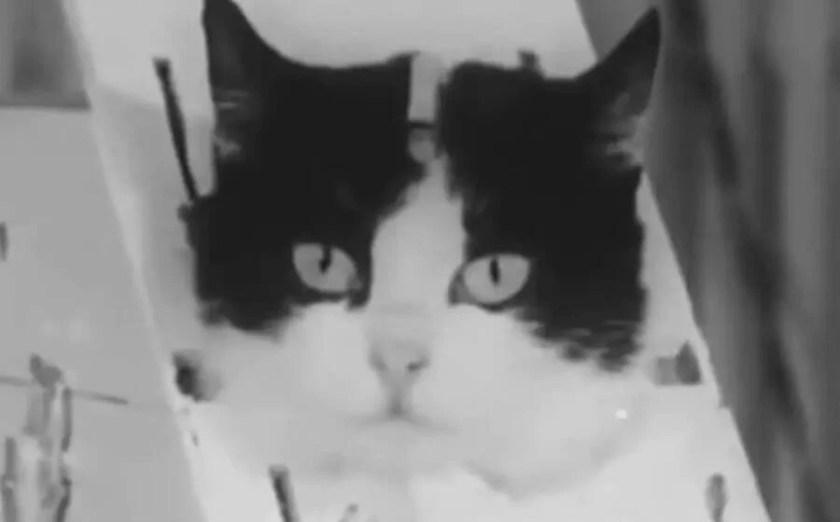
Felicette, the tuxedo cat who was launched into space by the French on Oct. 18, 1963, didn’t even have a name until the French recovered her capsule and took her back for examination.
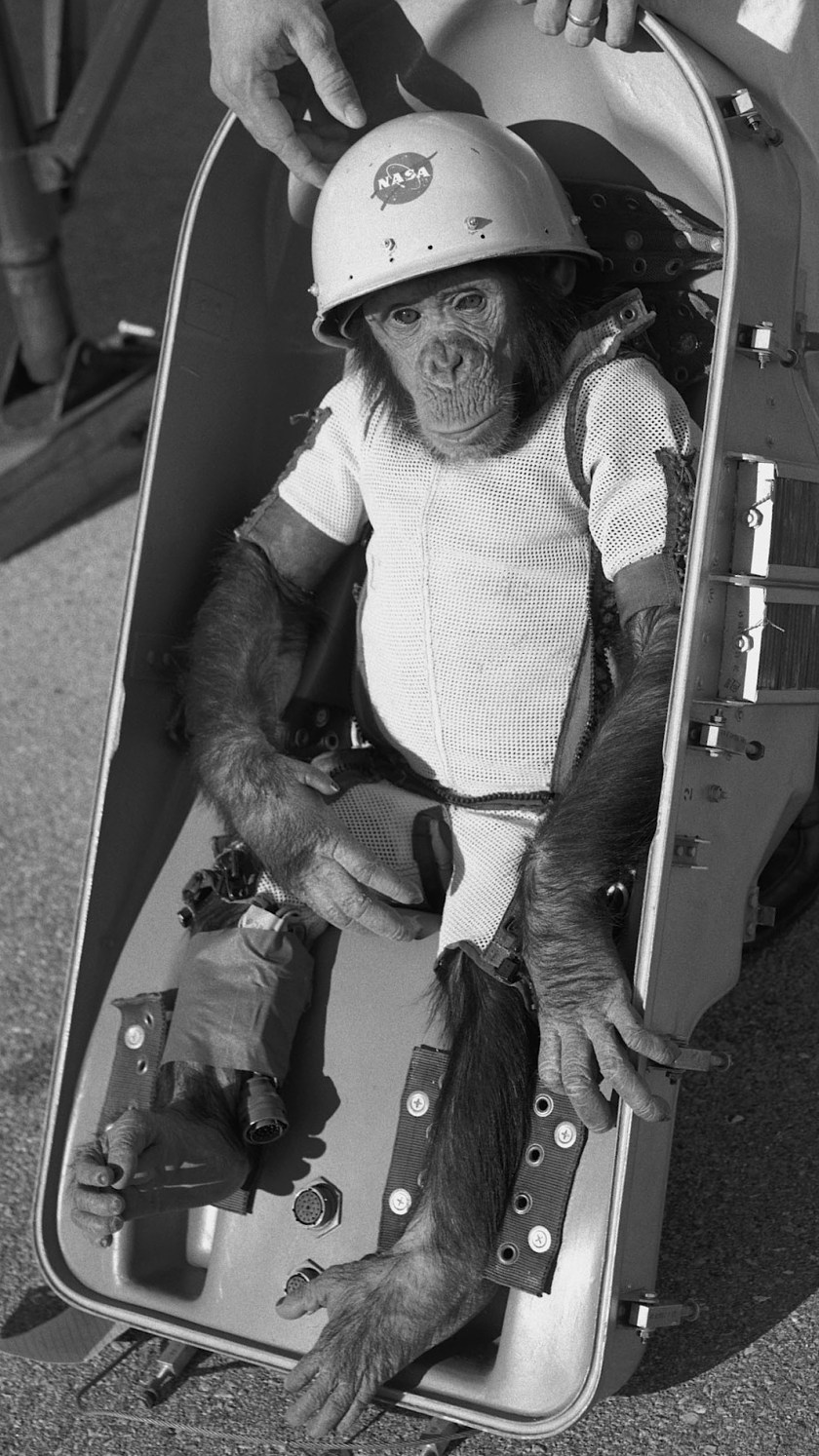
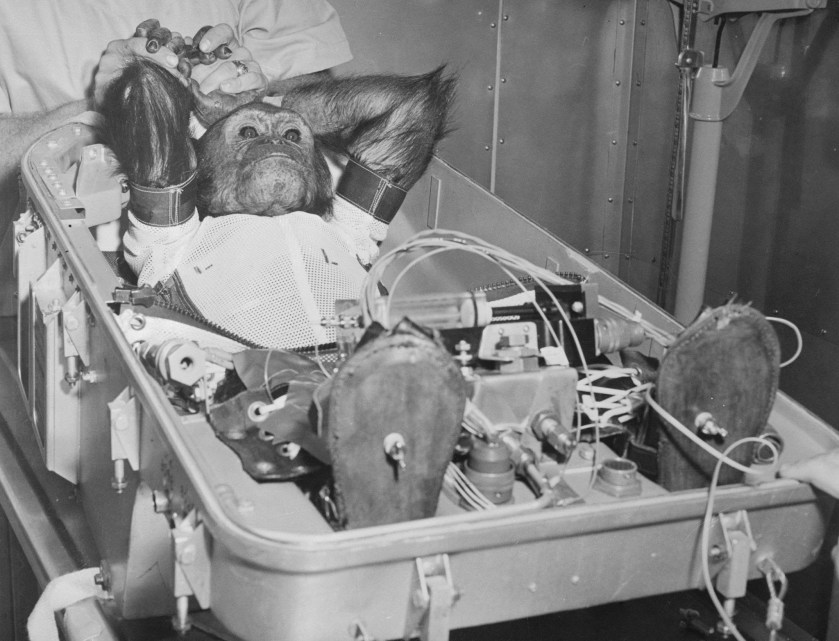
The scientists and engineers in charge of the launch didn’t want to humanize her if she didn’t make it, which was a common practice in space programs. (Ham, the chimpanzee sent into space by NASA in January of 1961, was known as No. 65 until his successful recovery. NASA was worried that a name would make him more sympathetic and lead to bad press if the chimpanzee died during the mission.)
Ham the chimpanzee was little more than a baby. Credit: NASA archives
Despite Felicette’s endurance and successful return, French scientists repaid her bravery by euthanizing her a month later so they could study her brain and learn more about the effects of spaceflight on mammalian biology.
Felicette, like Laika and Ham, was never given a choice. Those animals, with their child-like mental capacity, endured their missions out of a desire to please their human caretakers as much as any natural stoicism they may have possessed.
Would we do the same thing today? Will we repeat those experiments as we set our eyes on Mars?
Consider that the moon is a three day trip, and it’s close enough to Earth’s magnetic field to protect living beings from radiation. Mars is at least a seven month trip if the orbital conditions are right, and there will be no protection from radiation aside from what can be built into the craft. Take that trip without adequate protection and you’re guaranteed to get cancer.
It’s easy to say we wouldn’t make animals our test subjects for a Mars journey, and NASA now has decades of data on the effects of space and zero gravity thanks to the International Space Station.
And yet Neuralink, another company owned by Elon Musk, currently uses monkeys to test its brain interface technology, which allows the primates to operate computers with their thoughts. Those monkeys are forced to endure radical surgery to implant microchips in their brains. The teams working on the technology say suffering by those animals will be worth it as people with paralysis are able to do things with their thoughts and regain a measure of independence, increasing their quality of life.
Likewise, it will probably be an animal, or animals, who will be the test subjects on board craft that first venture beyond the Earth’s protective magnetosphere. Scientists and engineers will do their best to create a vessel that shields its occupants from harmful radiation, but they won’t know how successful they’ve been until the test subjects are returned to Earth and their dosimeters have been examined.
Will an astronaut volunteer for that kind of mission, knowing the “reward” could be a drastically shortened life?
Felicette pictured on commemorative stamps.
Felicette, left, was just one of several cats considered for the launch by French scientists.
To hear Musk and futurists tell it, pushing toward Mars is not just a matter of exploration or aspiration, but is necessary for the survival of our species. Earth becoming uninhabitable, they say, is an eventuality, not an if.
Others point out it’s much easier and wiser to pour our resources into preserving the paradise we do have, and the creatures who live in it, rather than banking on a miserable future existence on Mars where society will have to live underground and gravity, at 0.375 that of Earth, will change the human form in just a few generations.
To put it bluntly, while Musk and futurists look at life on Mars through the rose-colored glasses of science fiction fans, in reality living there is going to thoroughly suck.
If people do live on Mars they’ll never venture outside without a suit, never feel the sun on their skin, never swim in an ocean. They’ll never have another backyard barbecue, watch fireworks light up the sky on the fourth of July, or fall asleep to the gentle rain and crickets of warm summer nights. They’ll never hear birdsong or have the opportunity to see iconic animals like elephants and lions. Every gulp of air will be recycled, every glass of water will have passed through the kidneys of others. There will never be snow. Circadian rhythms will be untethered from the cycle that governed human biology for the 200,000 years our species has existed.
And while there could be a future — if you want to call it that — for people on Mars, there won’t be a future there for the rest of the living creatures on Earth.
As a lifelong fan of science fiction who devours SF novels, counts films like Alien and Bladerunner among my favorites, and is fascinated by shows like For All Mankind, The Peripheral and Star Trek, I understand the appeal of space and the indomitable human spirit that drives us to new frontiers. I just hope we can balance that with respect for the Earth and the animals we share it with. Let’s hope there is never another Laika, Felicette or Ham.
Correction: For All Mankind is the name of the Apple TV series about an alternate history space race. The first reference to the show’s name was incorrect in an earlier version of this story.
A close-up of Felicette’s face. Credit: French government archivesHam the Space Chimp waits for his apple reward. Credit: NASA archives
Happy birthday to us, happy birthday to us! Happy birthday dear Buddies, happy birthday to us!
We received a notification from WordPress congratulating us on four years with WordPress, although this blog isn’t technically four years old. It started as a place for my random scribbles about Buddy and as a sort of travelogue for my trip to Japan, and it wasn’t until September of 2019 that I registered the domain and started blogging in earnest, transforming the site into the Pain In The Bud we all know and love today.
Over the last few years we’ve been fortunate enough to merit the attention of critics, who have lavished praise on us:
“There’s a reason young kittens the world over have posters of Buddy on their walls. He’s effortlessly charming, possessed of inimitable wit and he’s got one hell of a singing voice.” – Fat Cats magazine
“An indictment of the American education system. I feel dumber for having read it.” – Oprah Winfrey, O Magazine’s guide to the Worst Blogs On The Internet
“An extraordinary blog focused on an exceptional cat whose wit is sharper than Valyrian steel. Endlessly entertaining.” – The Buddesian Times
“A catnip junkie and the human who enables him. Gives all cats a bad rep.” – Veterinary Association of America
“Has there ever been a cat more handsome and interesting than Buddy? That’s a rhetorical question, by the way.” – The Chronicle of Higher Buddy
“It’s difficult to tell who’s the bigger moron, the human or the cat. They enable each other, launching their idiotic schemes to take over the world and horde its turkey. Thankfully they’re as incompetent as they are clueless.” – Jefferson Nebula, host of My Cat From Hades
Of course we would not be here if not for our readers. Thanks for finding us, sending us your ideas and most of all, feeding Buddy’s ego by telling him what a charming, interesting and ferocious tiger he is.
On a related note, since I’m not sure of Buddy’s exact birth date, we celebrate his birthday and adoptiversary around the third weekend of April.
Happy birthday, Bud!
Bud, you sexy beast, you!
How the heck is the little guy nine years old? That doesn’t seem possible. The age equivalency chart says that’s the equivalent of 52 human years, but Bud still has a spring in his stride, meows like a little baby and likes playing with his toys, especially the game called “Mighty Hunter” in which I manipulate wand toys like prey and he ambushes them. Since he doesn’t know he’s supposed to deliver a “kill bite” and hasn’t made the connection that hunting = food, he happily bobbles the toy with his front paws while bouncing around on his feet, then rushes to cover to reset the game.
I will not dwell on or speculate about how long he’ll be with us because I turn into a blubbering mess despite being a grown ass man, so I’ll just say I’m extremely grateful that he’s healthy and happy, and I’ll continue to enjoy every minute with him.
Except when he meows really annoyingly when his food is late. And when he wakes me up by grooming my face. Oh, and his insistence on walking 1/10th of a stride in front of me so I’m always in danger of tripping on him. Also, when he goes into super annoying determined mode and tries to wake me by punching the door flap on his litter box, knowing the squeak of the hinges drives me crazy.
He is very accomplished at annoying me, but that’s okay. He’s my little Buddy.
Plagiarized, you say?
Thanks to those of you who alerted us to a PITB story that was plagiarized by a pet-focused site recently. We’re aware of it, and unfortunately it’s not the first time.
It takes a lot of time and effort to create readable, entertaining content, and there are people who simply don’t care and help themselves to the content without scruples. Almost all of them are based in countries whose authorities don’t respect US intellectual property rights and won’t cooperate with any takedown notices or legal threats.
The Drudge Report, for example, famously links to DNUYZ, a site run by an Armenian guy who steals content from the New York Times, Washington Post, The Atlantic, The Financial Times and other news sites. Google canceled DNUYZ’s AdSense account, but the operator simply signed up with a different ad server, and he makes a tidy profit by stealing content en masse.
If major media organizations can’t stop this nonsense, I have no hope. I’ve had some luck petitioning sites that host third-party content, but many don’t respond and I don’t even get an apology from those who do acknowledge that my content was posted to their sites, earning them pageviews and ad revenue.
There is a way you can help, however. Every time someone links to a PITB article, it incrementally increases our legitimacy in the eyes of Google, and that’s important because it means PITB shows up first when people search for an article or topic on this site, rather than the plagiarized versions copied by content scrapers in countries like India and Russia.
I am not asking people to randomly link to PITB. That wouldn’t help anyway. However, if there’s a story you really like, consider sharing it on social media and help spread the word. Organic virality is the name of the game, and Buddy and I think we do offer something relatively unique in the cat-o-sphere with a blog from a dudely perspective with a focus on absurdist cat humor, big cat conservation and important news stories that impact our furry little friends.
And if that’s not reason enough, well, just look at him. He’s a sexy beast, and surely your cat-loving friends would be angry with you if you did not tell them all about Buddy and his adventures. Don’t make them upset. Do them a solid and invite them to the Wonderful World of Buddy!