A reboot of the iconic scifi-horror film upends the balance of power, placing the feline at the very top where he should be.
The long-anticipated Alien reboot starring Buddy the Cat hit theaters this weekend with audiences flocking to see the modernized classic after effusive praise from critics.
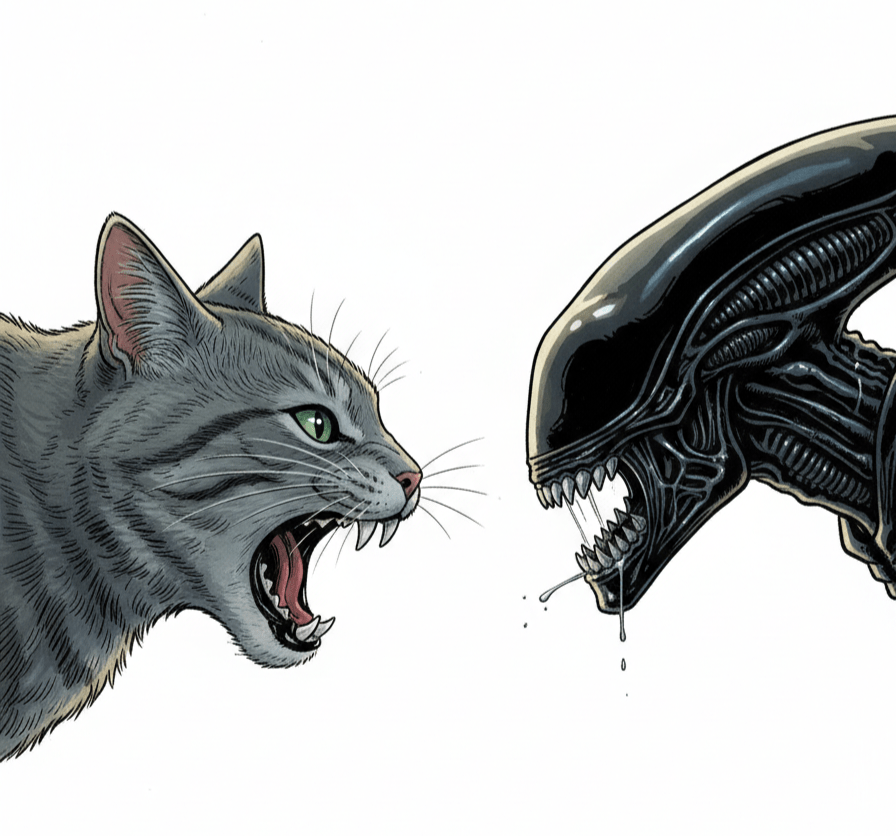
Featuring the new tag line “In space no one can hear you scream — unless you’ve got Buddy on your side,” the reboot reimagines the science fiction-horror classic as a cautionary tale about messing with cats.
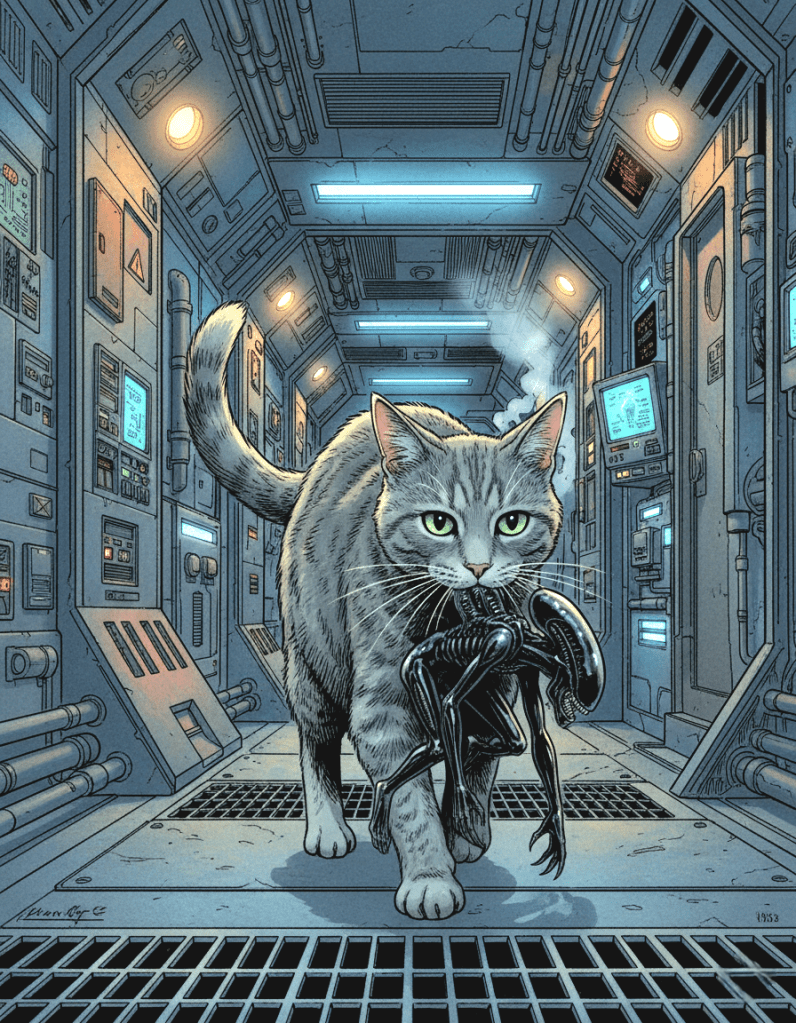
“While the original built tension over almost two hours and inspired an overwhelming feeling of dread in viewers, the new Alien clocks in at just 28 minutes and ends right after the iconic chestburster scene,” critic Ferdinand Lyle wrote. “Instead of screeching into the shadows of the ship to commence its turbocharged metabolic processes, only to emerge later as a fully formed creature who terrorizes the crew, this alien is immediately caught by Buddy, who delivers a swift kill bite and deposits it in front of the humans. They reward him with a chorus of ‘Good boy!’ and rub his head while plying him with snacks, and the credits roll. Now that’s efficient storytelling!”
The Alien 👽 was no match for Buddy, who woke from a nap to dispatch the creature with brutal efficiency.
The new version is “the ultimate FAFO flick,” raved the AP’s Misty Lemire.
“The central message here is ‘Don’t tangle with Buddy.’ The apex predator of the cosmos is no match for the apex predator of Earth.”
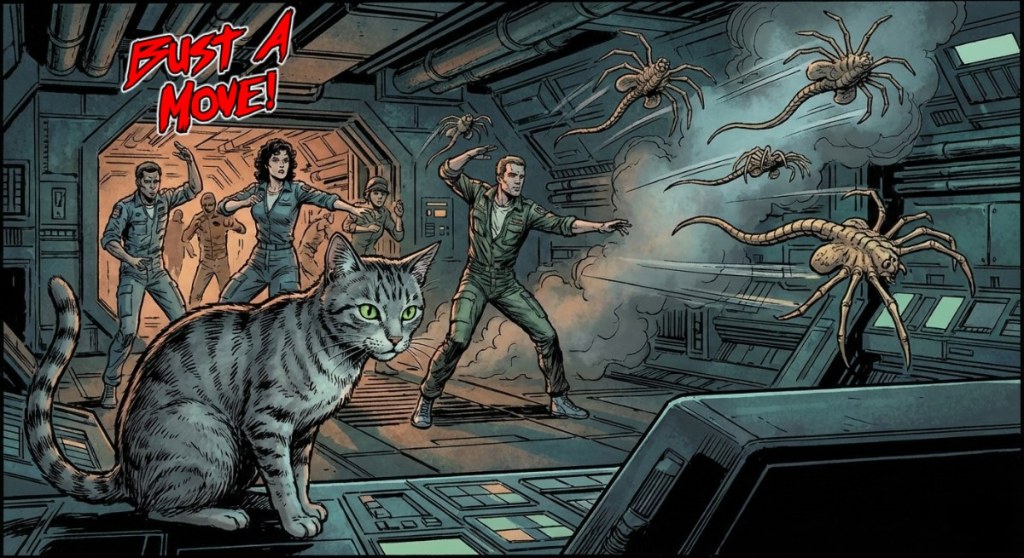
Other critics were enamored with a post-credits dance scene featuring Buddy, the crew of the Nostromo and dozens of face-huggers who fly through the air, forcing the cast to bust impressive dance moves to avoid the dangerous creatures. At one point Buddy launches into a breakdance routine. The actress who plays Ripley wags a finger at a xenomorph and declares “You just got served!”
“It’s clever, light and wildly entertaining,” one critic wrote. “Buddy’s got some magnificent dance moves!”
Others praised Buddy for his impressive physique. In an interview with Entertainment Weekly, Buddy said he’d been training non-stop for eight months for the role, eating a high-protein diet and spending five hours a day napping in the gym to accentuate his meowsculature.
“The effort paid off big time,” a review from Calico Critics noted. “Buddy looks more ripped and impressive than he ever has, and he was already competing against a high bar he set during his previous films.”
In the post-credits dance scene, Buddy and the Nostromo crew perform a synchronized routine while dodging facehuggers.
However, not everyone was impressed. Reached this weekend at his New Zealand bunker, where he’s fled “until America isn’t annoying anymore,” director James Cameron called the Alien reboot “derivative, low-calorie cinema junk.”
“Remember when I had characters saying ‘Hasta la vista’ and ‘Adios, muchachos’? That was really cool. I was one bad hombre,” Cameron said. “Audiences might think this is a good film, but that’s because they haven’t seen the wonders of Avatar XVII yet. Just wait, it’s gonna be awesome. And there are no cats.”
It took a fresh vision to prove there’s still cinematic life in the xenomorph and its ability to terrify audiences, but Romulus really shines where its affable characters are concerned.
Over four decades and six films — eight if you count crossovers — in the Alien universe, no one had been able to capture even a fraction of the terror, novelty or magic of Ridley Scott’s original 1979 science fiction-horror classic.
James Cameron turned the immediate sequel into a James Cameron movie, which means it’s packed with Velveeta one-liners, Spanish catch-phrases that no Spanish-speaking person would ever utter, and doesn’t exercise an ounce of the restraint Scott used to such cosmic effect.
In the third outing, David Fincher took on the impossible task of trying to reconcile the tone of the first two films and set the entire thing in a drab space prison, while Joss Whedon’s script for the fourth film was Firefly in Alien trappings.
While the xenomorphs never looked better, Alien: Covenant felt like half a movie, ending on a cliffhanger that will never be resolved.
The titular monster had been stripped of nearly all its mystique by the time Scott returned to the franchise with Prometheus and Covenant, the fifth and sixth installments.
Both films were visually spectacular thanks to Scott’s efforts, but suffered from characters audiences couldn’t connect with, and in the case of Damon Lindelof’s script for Prometheus, characters the audience loathed. Instead of leaving the origin of the aliens ambiguous, Prometheus and Covenant offered a bizarre, nearly franchise-killing backstory involving alien-designed panspermia, artificial intelligence gone rogue and half-baked creationism given the veneer of science.
A space jockey chamber in the derelict starship, of the same kind seen in the first film, only this time the ship is powered up. Prometheus and Covenant tried to give us a backstory for the creatures, which only made them more pedestrian.
When Fede Alvarez presented his vision for an Alien film, he understood he had two do two things:
Ignore everything that came after Scott’s original film
Offer something more than the formulaic “monster stalks the cast deck by deck and kills them one at a time, leaving only the Final Girl”
Alien: Romulus sets off on that task by engaging in economical world building to give us more context than the five previous sequels managed together.
It’s tightly focused on our heroes, a group of five twenty-somethings who were born on a fiery world where lava perpetually flows, novel diseases spawn every year and a permanent atmospheric coat of soot and ash hides the sun and sky from the people who live there.
It’s a hellish place, and they’re there because multinational megacorporation Weyland-Yutani (“the company” in Alien parlance) wants the valuable ores within the planet’s crust. Like the crew of the Nostromo, the people are expendable in the company’s pursuit of profit.
The people who live in the colony at Jackson’s Star can’t even see their own sun as they slave for Weyland-Yutani corporation.
Our heroes work for the company, and they’re all orphans who lost their parents to work-related accidents or diseases from the mines.
Marie Rain Carradine’s (Cailee Spaeny) hope lies in the completion of her indentured servitude. With 12,000 hours of service to the company under her belt, Rain can finally take her brother to the colony world Yvaga, where the air isn’t toxic, people aren’t worked to death, and best of all in her mind, you can see the sun.
When Rain visits a Weyland-Yutani administrative center to formally separate from the company and relocate to Yvaga, a bureaucrat doubles her work requirement to 24,000 hours with the stroke of a key, damning her to another five or six years toiling on a planet that kills everyone eventually. Worse, the bureaucrat transfers her from farming to the mines, where her parents died.
“Know that the company is really grateful for your service,” the Wey-Yu representative says with an infuriating affect, dismissing the shocked young woman.
It’s in the depth of her despair that Rain gets a message from her friend Tyler (Archie Renaux) and listens to his pitch. Tyler and the others were working their orbital jobs miles above the colony’s surface when their computers pinged, alerting them to the approach of a massive starship.
Scans revealed a decommissioned Weyland-Yutani vessel that hadn’t been entirely stripped of its useful parts, slowly drifting through the system. Crucially, the ship still carried functional cryo pods, which would allow the group to sleep out the nine-plus year journey to Yvaga.
It’s freedom, there for the taking “before someone else does,” Isabela Merced’s Kay tells Rain.
When Rain balks at the dangerous and highly illegal plan, Tyler points out Weyland-Yutani will never grant them approval to leave the nightmarish world where they were born.
“I don’t want to end up like our parents,” he says, nodding toward the dead-eyed, soot-covered miners marching back to their utilitarian prefab homes after another shift toiling for the company.
You don’t need to guess that the plan does not go smoothly, nor the reason why.
What most people will need to know, in order to entrust two hours of their time to a franchise that has been beating a dead horse for decades, is that Alien: Romulus is the kind of sequel Scott himself would have made after the original, at the height of his directorial powers, if he hadn’t moved on to other projects.
Romulus replicates the magic of the original by taking things in exciting new directions, and by giving the audience a series of astonishing set pieces, including a gloriously nail-biting sequence that not only captures the beauty of space, but reminds us how hostile it is to our fragile human bodies.
It also takes care to give us reasons to root for characters we’ve just met, to sympathize with their plight and understand why they’d do something so desperate and reckless.
Cailee Spaeny is inarguably the best of the actresses who have tried to take the mantle from Sigourney Weaver’s Ripley in the last several films from the franchise.
Rain and her friends have one important thing in common with the characters from the first Alien film — they’re fighting for survival in more ways than one. There’s the immediate threat to their lives, and their eventual slow, agonizing doom if they don’t find a way off their colony world.
Unlike the characters from the previous sequels, they didn’t volunteer for a military mission, an archaeological expedition or to be pioneers on a world full of life. They’re desperate adults barely out of childhood who know life holds nothing but misery for them if they don’t succeed.
Like the best science fiction, Romulus doesn’t just entertain, it uses an imagined future to comment on our society. AI has now permeated our lives, but mainstream science fiction is still stuck on the same tired “AI evolves, turns on humans for reasons and tries to wipe us out” narratives.
Andy (Jonsson) in an airlock early in the film.
For those of us who are genre fans, it’s frustrating to see Hollywood clinging to ideas that were first kicked around many decades ago by science fiction novelists. Besides, the “AI turns on humans” thing has little to do with reality and everything to do with human anxiety that we’ll be judged for our behavior as a species the moment we encounter an intelligence capable of judging us.
Romulus eschews the formulaic stuff to explore a more interesting question: what separates biological intelligence from artificial intelligence, and can the latter really qualify as life? Can machines ever approximate human emotions, or are they limited to simulating them for our benefit? It’s still not the most original idea, but it’s a marked improvement from the same old Terminator and Ex Machina-inspired narratives.
As for the alien itself, it’s more menacing than it’s been since the first film, and it has a few tricks up its sleeve thanks to circumstances that tie directly into the original. To say more would be an injustice, because the twists here are well-conceived. They also make perfect sense given what we already know, and don’t require any great shift in franchise lore.
Lastly, as an admirer of retrofuturism, I can’t let this review pass without praising the set designers, special effects teams and Alvarez for reviving the utilitarian 1970s vision of the future from the original. This is a worn, lived-in universe, not a gleaming utopia. Alien’s aesthetics influenced virtually every science fiction effort over the last 45 years, and for good reason.
Set designers at work on an interior for Alien: Romulus
There’s something anachronistic about a civilization that has mastered interstellar propulsion, cryopreservation and advanced artificial intelligence, but remains reliant on monochrome displays with vector graphics and tactile interfaces. And yet that visual shorthand signals to viewers that this is a return to the fundamental elements of the franchise, and a universe where space exploration is corporate and soulless.
Perhaps the best sign that Romulus has revived Alien is the fact that a sequel is already in the works. Spaeny and David Jonsson, who plays Rain’s brother Andy, are already on board for a second installment.
There’s certainly more story to tell, and if Alvarez can maintain the magic blend of homage and novelty that made Romulus such a strong entry, we’re in for another fun ride. To Yvaga!
Alien: Romulus is available to stream on Max, Hulu and Disney+. For a list of alternate sites where the film can be rented or purchased, or to check availability in regions other than the US, check out the movie’s listing on JustWatch.
Making his debut in 1979’s Alien, Jonesy is one of the most famous felines in cinema history.
There’s a popular meme among Alien fans that depicts Jonesy the Cat walking nonchalantly down one of the starship Nostromo’s corridors with his tail up, carrying the corpse of the recently-spawned alien in his mouth like he’s about to present a dead mouse as a gift to his humans.
The joke is self-evident: if the crew of the Nostromo had allowed Jonesy to take care of business from the get-go, the alien would have been disposed of before it had the chance to grow into the monstrosity that haunted the decks of the Nostromo and the nightmares of viewers.
“Who’s a good boy? Who just saved his crew from certain violent death at the claws of a ruthless alien predator? That’s right, you did!”
Of course then there’d be no movie. No ripples of shock in theaters across the US as audiences were confronted by something more nightmarish and utterly alien than popular culture had ever seen before. No indelible mark left on science fiction.
Despite the film’s retrofuturistic aesthetic, it’s difficult to believe Alien first hit theaters almost half a century ago.
That’s testament to director Ridley Scott working at the height of his powers, the carpenters, artists and set dressers who created the starship Nostromo’s claustrophobic interior, the design of the derelict starship where the alien was found, and the bizarre creature itself.
The alien ship and creature designs were the work of Swiss surrealist H.R. Giger, who was little-known at the time but floored Scott and writer Dan O’Bannon with his hyper-detailed paintings of grotesque biomechanical scenes.
Signourney Weaver and one of the cats who played Jonesy in the first film.
Kane explores the infamous egg chamber in the derelict alien ship.
Fan art of Jonesy
A close-up shot of the retrofuturistic tech used in the series, a design decision that departed from the gleaming visions of the future common at the time.
A set photo showing the first film’s crew on the iconic space jockey set.
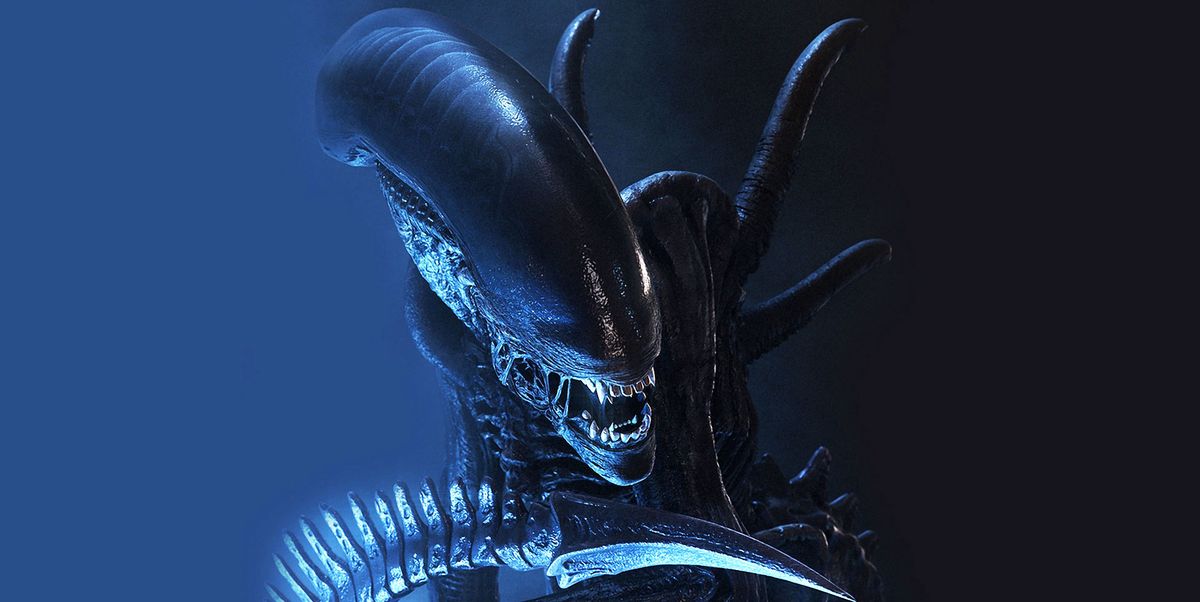
Giger’s work, specifically his 1976 painting Necronom IV, was the basis for the titular alien’s appearance. The alien, called a xenomorph in the film series, is vaguely androform while also animalistic. It is bipedal but with digitgrade feet and can crawl or run on all fours when the situation calls for it. It hides in vents, shafts and other dark spaces, coiling a prehensile tail that ends in a blade-like tip.
But it’s the creature’s head that is most nightmarish. It’s vaguely comma-shaped, eyeless and covered in a hard, armored carapace that ends just above a mouth full of sinister teeth like obsidian arrowheads. There’s perpetually slime-covered flesh that squelches when the creature moves but there are also veins or tendons or something fully exposed without skin, apparently made of metal and bone. Maybe those ducts feed nutrients and circulate blood to the brain. Maybe they help drain excess heat from the creature’s brain cavity.
Regardless, it’s a biomechanical nightmare that the Nostromo’s science officer, Ash, admiringly calls “the perfect organism” whose “structural perfection is matched only by its hostility.”
The alien, Ash declares, is “a survivor, unclouded by conscience, remorse, or delusions of morality.”
The alien, also referred to as a xenomorph, “that thing,” a “dragon,” “the perfect organism” and various other names by characters in the series. Credit: 20th Century Studios
Part of what makes Jonesey so beloved is the fact that, together with the xenomorph and Ripley, he completes the triumvirate of survivors. We see Jonesy scurry into the protection of tiny confined spaces to escape the alien, hissing at it in the dark. We see him dart into the bowels of the ship after sensing the stalking creature, adding another blip to the crew’s trackers. Finally we see him settling into a cryosleep pod with Ripley, like so many other cats with their humans, when the threat has passed.
Jonesy — affectionately referred to as “you little shithead” by Ripley in the second film — appears in the franchise’s two most famous films, his own comic book series titled Jonesy: Nine Lives on the Nostromo, a 2014 novel (Alien: Out of the Shadows), and in hundreds of references in pop culture over the last half century, from appearances in video games (Halo, World of Warcraft, Fortnite) to references and homages in movies and television shows.
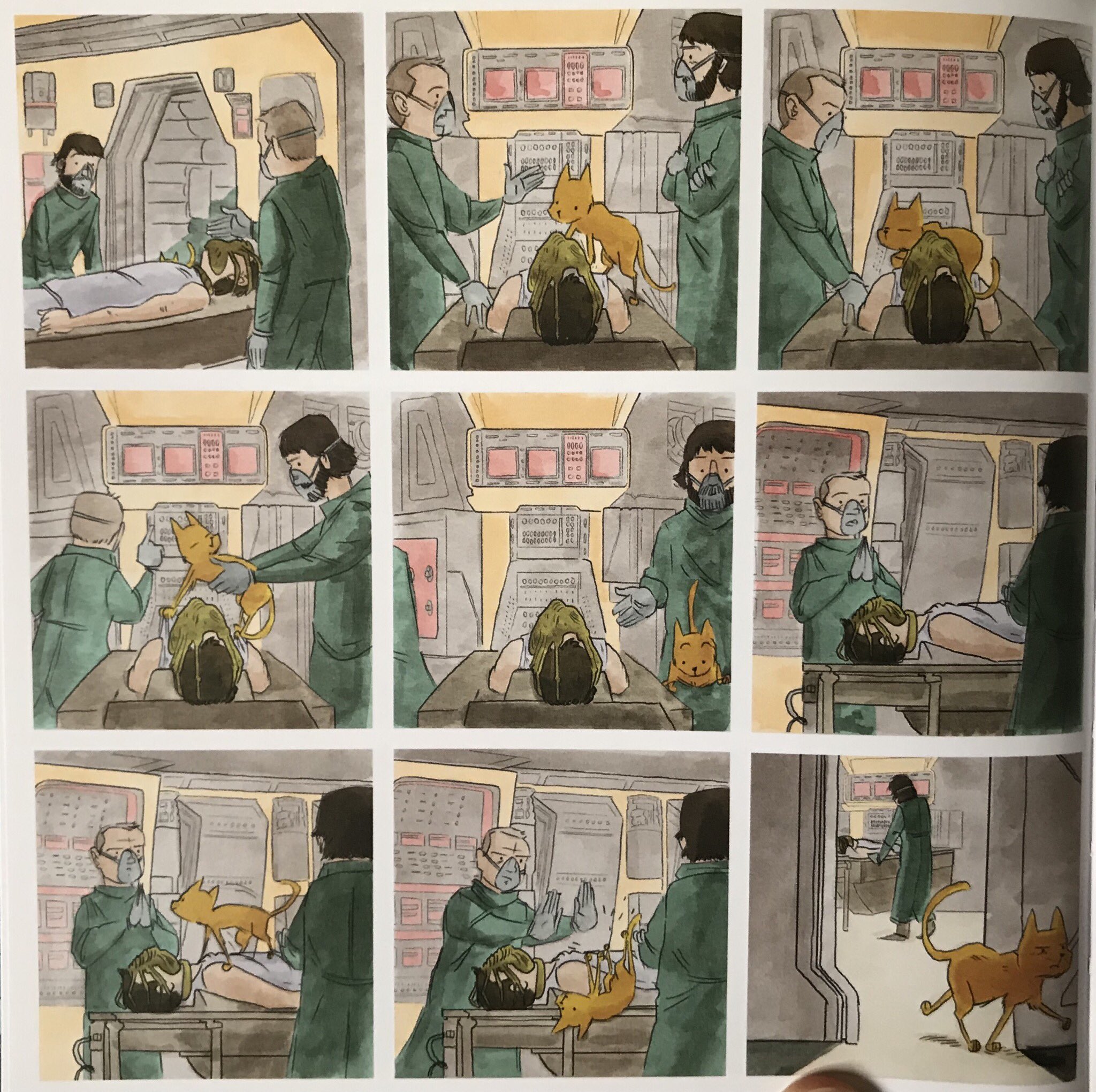
A page from Jonesy: Nine Lives On The Nostromo, which tells the story of Alien from the cat’s perspective. These panels depict Jonesy watching Ash and Dallas examining Kane in the ship’s medical lab.
He’s like the anti-xenomorph. Cats are predators, after all, and Jonesy might be the xenomorph to the ship’s rodents just like every ship’s cat in thousands of years of human naval endeavors. But to the crew members Jonesy’s a source of comfort, a warm, furry friend to cuddle with. Unlike the xenomorph he’s got no biological programming urging him to impregnate other species with copies of himself in one of the most horrific gestation processes imaginable.
Xenos are like predators on steroids, gorging themselves on their victims to fuel unnaturally swift cell reproduction and growth. As a result, over the decades some have speculated that the alien simply ignored the cat, deeming its paltry caloric value unworthy of the effort to kill.
The idea that Jonesy was too small to interest the alien is proved a fallacy in later franchise canon when we see the aftermath of a xenomorph consuming a dog. It’s indiscriminate in its quest for energy, feasting on adult humans and animals alike until two or three days pass and it’s a 12-foot-tall, serpentine nightmare the color of the void of interstellar space.
Just imagine sitting in a theater in 1979. Your idea of science fiction is sleek jet-age spacecraft, Star Trek and Stanley Kubrick’s clinical orbital habitats from 2001: A Space Odyssey. You’re expecting astronauts, heroes, maybe a metal robot or an alien who looks human except for some funky eyebrows, green skin or distinct forehead ridges.
Instead you get a crew of seven weary deep space ore haulers inhabiting a worn, scuffed corporate transport ship, complaining about their bonuses and aching for home, family and the familiar tug of gravity.
But home will have to wait. The ship has logged an unusual signal of artificial origin broadcasting from a small planet in an unexplored star system. The crew has no choice but to investigate. It’s written into their contracts, which stipulate the crew will forfeit their wages if they disregard the signal.
So they land, suit up, move out and find a derelict starship. An incomprehensibly massive vessel so strange in detail and proportion that it could only have been built by an alien mind, with unknowable motivations and psychology.
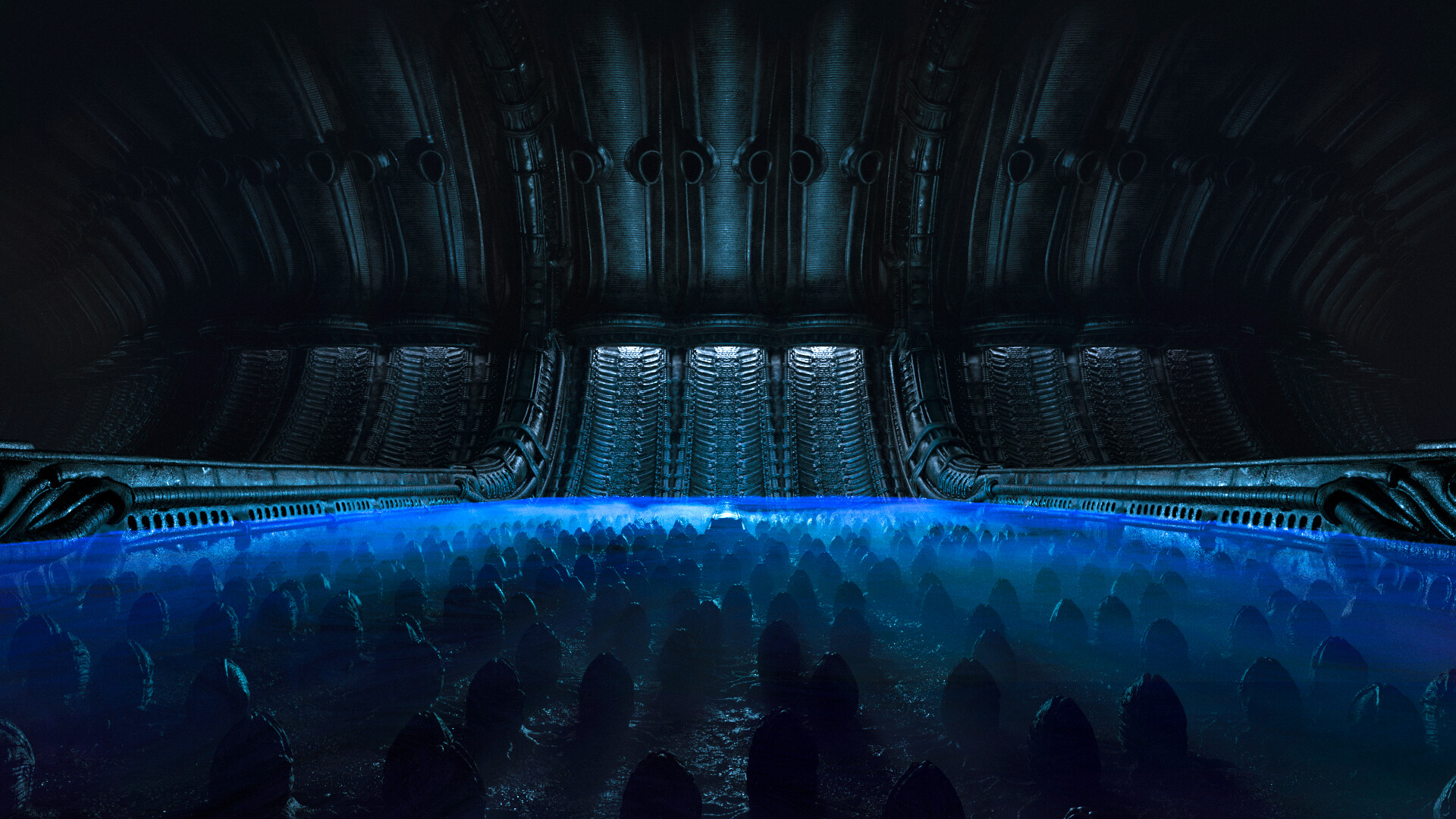
The egg chamber of the derelict alien ship, designed by Giger.
Inside, hallways that look like ribcages lead to vast chambers with utterly bizarre, inscrutable machinery that seems to consist of biological material — skin, bone, joints, organs — fused with metal. In one of them the corpse of an alien, presumably a pilot, is integrated into a complex array. It’s at least twice the size of a large human man. Its elephantine head is thrown back in the agony of its last moment, when something exploded outward from its body, leaving a mangled ribcage, torn papery skin and desiccated organs.
And beneath that, a shaft leading to another horror — a chamber that seems to stretch for kilometers in either direction, where leathery eggs are cradled in biomachinery and bathed in a bioluminescent cerulean mist.
The decision to enter that chamber sets off one of the most shocking scenes in cinema history, leads to the birth of pop culture’s most terrifying monster, and sent millions of theater-goers home with nightmares in the spring and summer of 1979.
It’s almost too much to handle. But take heart! The unlikely female protagonist makes it to the end, and so does the cat. What more can you ask for?
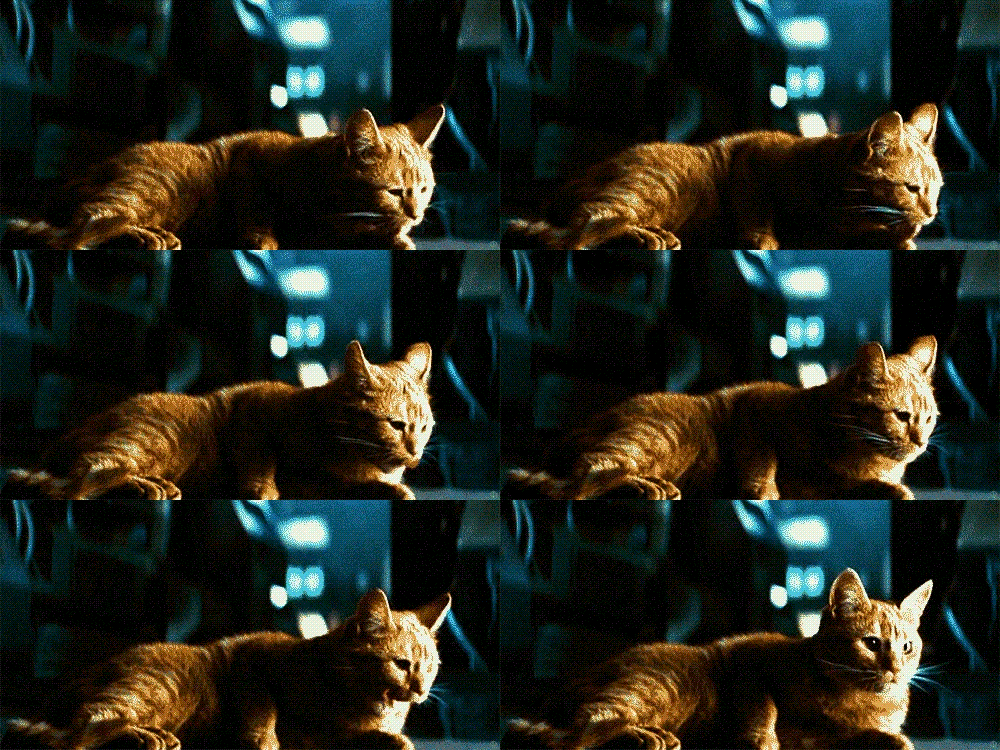
Jonesy grooming himself on the flight deck of the starship Nostromo. Credit: 20th Century Studios
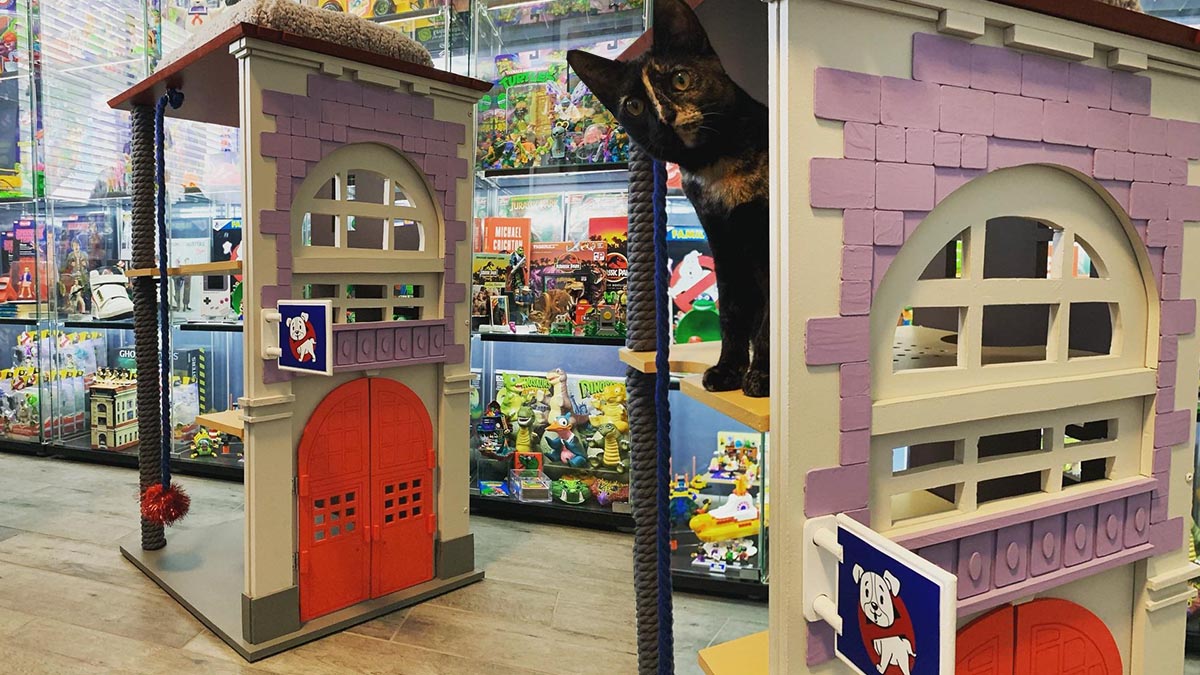
Ghostbusters HQ cat condos and hobbit house litter boxes.
When I was a kid, the list of VHS tapes I’d worn out included Joe Dante’s Explorers, The Last Starfighter, The Last Dragon (the deliciously cheesy 80s kung fu classic set in Harlem, not the Bruce Lee film), Ridley Scott’s Legend, The Neverending Story, and maybe the first truly great comic book movie, 1989’s Tim Burton-directed Batman starring Michael Keaton, Jack Nicholson and Kim Basinger.
As a kid it was adventurous, fun and even a bit spooky. As an adult it evokes a rush of warm nostalgia and joyful recognition that the actors – Dan Aykroyd, Harold Ramis, Ernie Hudson, Bill Murray and Signourney Weaver — had a hell of a lot of fun making the film.
That’s why Buddy I was so excited to see this cat condo build that’s designed to look like Ghostbusters HQ from the 1984 classic. Buddy I would love to have one of these things. Instagrammer Shawn Waite explained in a post that he was just kidding around when he proposed the idea, and his family pushed him to go for it:
“We got a new kitten (her name is Stria) a couple of months prior, and we were adding some cat furniture to our home for her. We thought that she may enjoy having something in our home office, which is where I have my vintage toy collection, so I joked that we should build a cat condo that looks like the Ghostbusters Firehouse play set so that it would fit with the theme of the office. My wife loved the idea, and our twin daughters (age 9) were excited for Stria to have a condo.”
Waite not only managed to retain the three-story interior layout with a scratching post cleverly taking the place of the fire pole, he tweaked the logo so there’s a dog in place of a ghost, just in case any jealous pooches get ideas about lounging in Stria’s sweet condo.
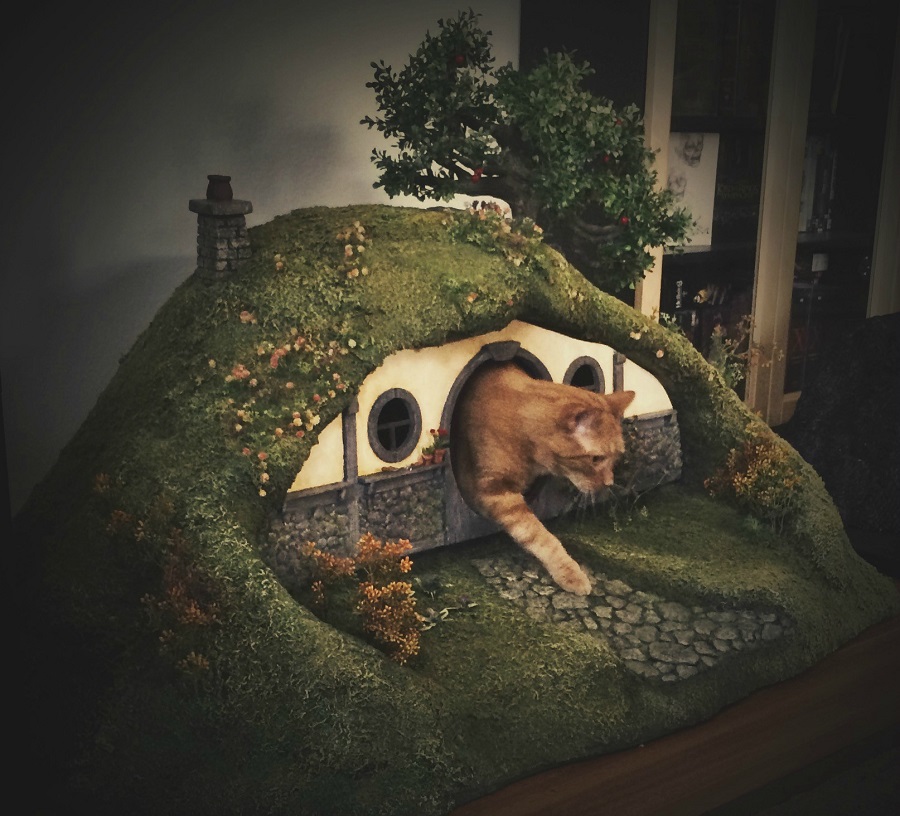
I’ve always wanted to learn to build stuff, especially after seeing examples like Waite’s build or the amazing Hobbit house litter box one cat servant made for his feline, Frodo.
Frodo the Cat and his hobbit house.
But hey, if I’m gonna go all out and build a spectacular lounging spot or bathroom for the Budster and mine 80s/90s childhood obsessions for ideas, wouldn’t the Thundercats HQ — known simply as the Cat’s Lair — be more appropriate?
The Cat’s Lair.
The Cat’s Lair
The Cat’s Lair
“Let’s say this Twinkie represents the normal amount of psychokinetic energy in the New York area. According to this morning’s sample, it would be a Twinkie 35 feet long, weighing approximately 600 pounds.” “That’s a big Twinkie.”
In Cyberpunk’s future, all animals are gone…except roaches and pet cats.
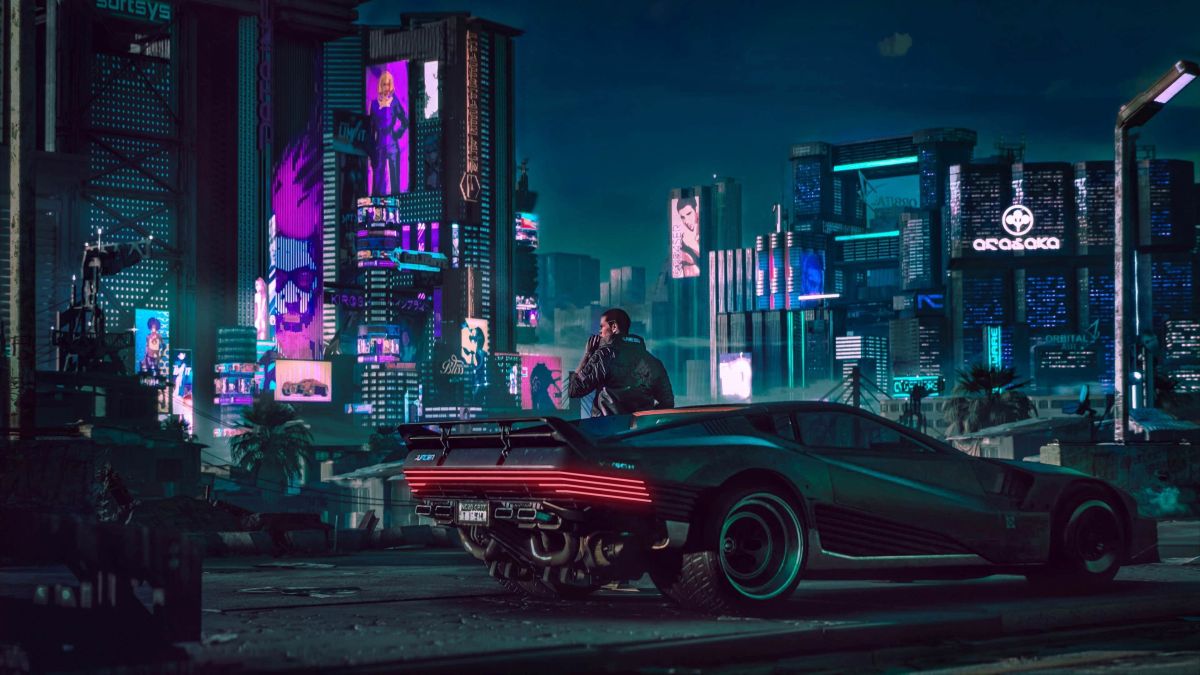
I’ve been playing Cyberpunk 2077 lately, as readers of this blog may have guessed by some of the references, and it is everything the hype said it would be: A dystopian story set in a grim, hyper-corporatized, ultra-capitalist future in which the masses worship the gods of consumption, virtually everything that humans come in contact with is synthetic, and nature is a forgotten dream that may or may not exist beyond the seemingly-infinite concrete and chrome of human sprawl.
It’s Bladerunner writ large and interactive, a retrofuturistic nightmare in which people voluntarily have their own eyes plucked out to replace them with brain-interfaced digital lenses and biomechanical grotesqueness is the societal norm. A future in which a person’s life amounts to the price their internal organs can fetch on the black market and the only civil liberties that exist do so by the forbearance of megacorporations.
Even if you’re not a gamer, unless you’ve been living under a rock you’ve probably heard of the game. It is, after all, one of the most highly-anticipated pieces of consumable media in modern history, and familiar actors have lent their voices and likenesses to the production.
One of the most depressing aspects of 2017’s Bladerunner 2049, the long-awaited sequel to the 1982 Ridley Scott classic, is the utter disconnect from anything natural.
Future Los Angeles is so choked with smog that the city exists in a perpetual twilight gloom. Animals have been purged from the Earth, and humanity has turned to farming insect larvae for protein in processed foods. Vegetation is so rare that the sight of a single sprout near the dusty carcass of an old oak tree fascinates Ryan Gosling’s antagonist character, K.
Drawing heavily on Bladerunner — as well as the seminal 1988 Japanese film Akira, William Gibson’s 1984 novel Neuromancer, Luc Besson’s The Fifth Element (1997), and even the 1979 action thriller Warriors (which is itself based on Xenophon’s Anabasis from 370 BC) — Cyberpunk 2077 is about violence, hedonism and human greed.
There is no room for the beauty of animals or nature in a future like this.
That’s why it’s surprising to find cats stalking the dim alleys of Cyberpunk 2077’s Night City.
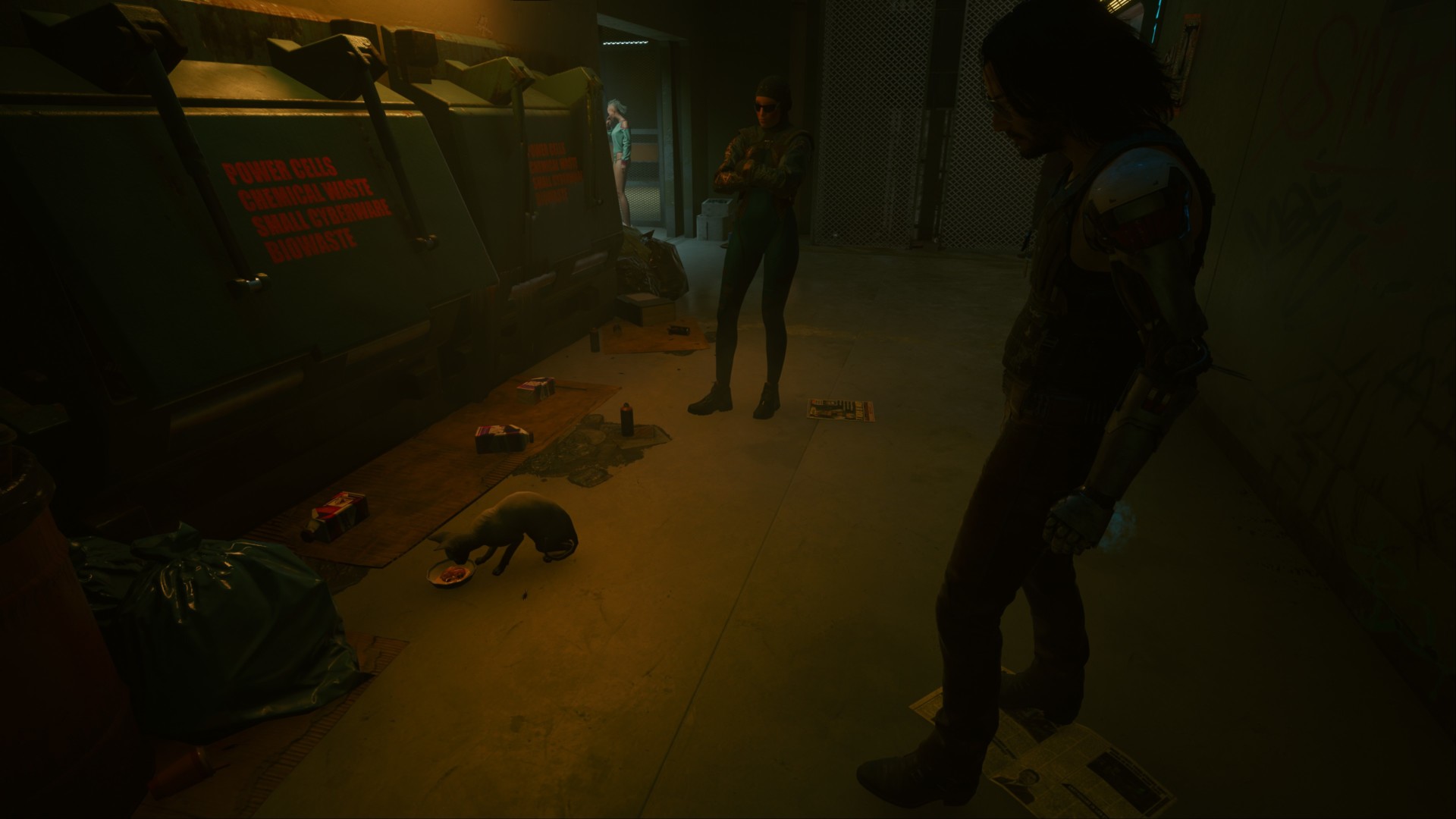
Keanu Reeves’ character, Johnny Silverhand, is quite enamored with Nibbles the Cat.
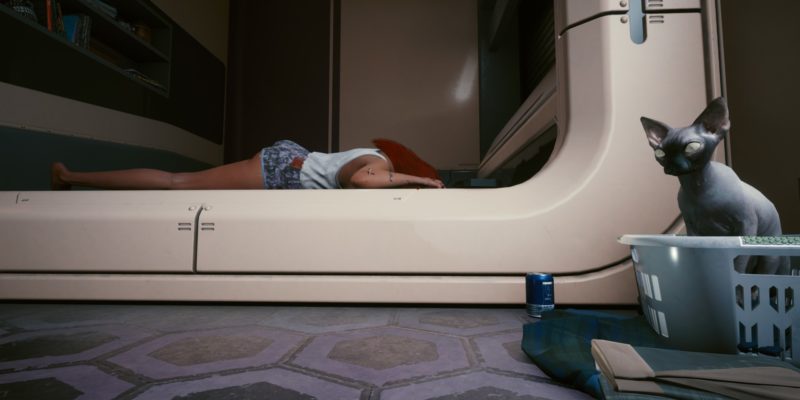
A Sphinx cat in Cyberpunk 2077.
The player’s character, V, can stop and pet stray cats he encounters throughout the game.
There’s even a hidden opportunity to adopt your own stray and take it back to your apartment in the game. Johnny Silverhand, the wise-ass character played by Keanu Reeves, is particularly fond of Nibbles the stray, who can be found amid piles of trash in the hallway outside V’s apartment.
Nibbles “doesn’t really do much besides lay around and take up space,” Screenrant notes. “Basically exactly what a cat does in real life. What an immersive experience.”
In another scene, V is conducting recon on a corporate target with Takemura, a Japanese ally, when a cat slinks by and lays down about 20 feet away.
Takemura says the cat is the first animal he’s seen in Night City, “except for the cockroaches, of course.” Then he wonders if the cat is a bakeneko, a Japanese spirit.
Night City is a technological achievement so impressive that it takes many hours just to get your head wrapped around how big and detailed it is. It’s easily the largest virtual city ever created, but it’s not just about sprawl — the city is truly vertical, from hidden subterranean depths and accessible street-level locales to highways, apartments and offices that claw at the sky, their peaks towering over ubiquitous flying car traffic.
The game is a form of entertainment, but it’s also a warning: This could be our future. Some would say it’s even likely to be our future.
Most of us are disconnected from nature. We’ve forgotten the stars and the night sky, which have been blotted out by smog and light pollution. We have wiped out more than two thirds of all the wildlife on the Earth and innumerable species teeter on the edge of extinction, including almost every example of iconic megafauna, from tigers and jaguars to orangutans, chimpanzees and elephants.
The interregnum caused by the global pandemic has reminded us that we share this planet with billions of other minds, with animals cautiously poking their heads out at the edges of civilization, wondering where all the humans have gone.
It’s fun to play in a dystopian future, but I don’t want to live in it.














 Pain In The Bud