

The Buddies wish all of you a wonderful Christmas filled with warmth, love, turkey, and lots of awesome stuff from Santa Claws!
Thank you for reading PITB and for being advocates for our furry friends!
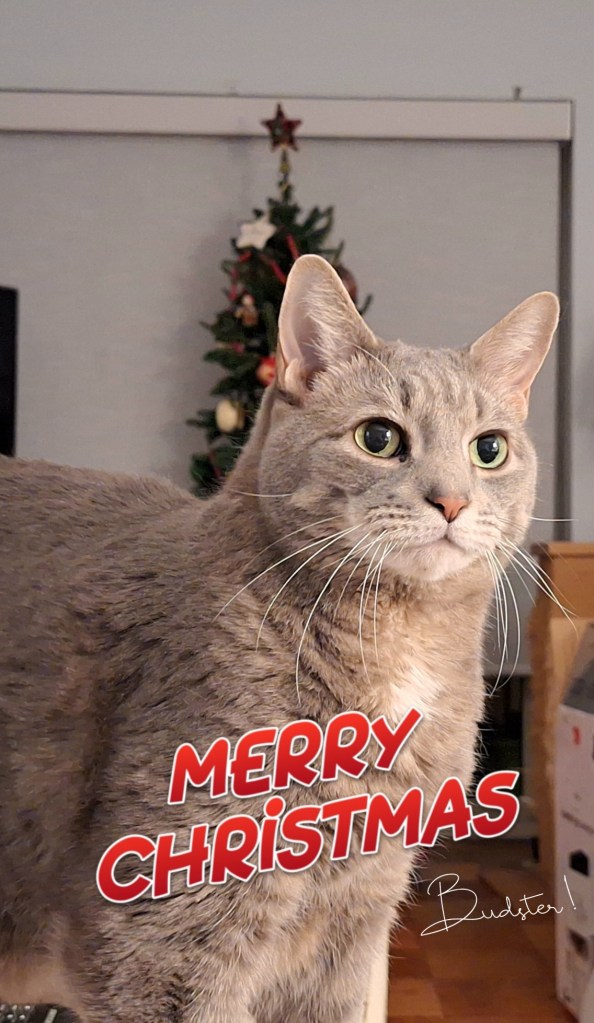
Zzzzzzz…zzzzzz…zzzzz…wait, what?! Oh. Merry Christmas!
The Buddies wish all of you a wonderful Christmas filled with warmth, love, turkey, and lots of awesome stuff from Santa Claws!
Thank you for reading PITB and for being advocates for our furry friends!
There’s a disconnect between the usually careful language of research studies and the exaggerated claims of news articles.
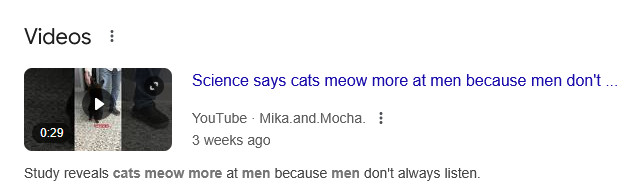
The headlines over the past few weeks have all been variations on the same riff: cats meow more frequently to male caregivers because we don’t know how to bond with the little stinkers, we disregard their feelings, and we ignore their pleas.
Others are more blunt in their assessment, like a story from YourTango that stated women “bond deeply” with cats, whereas we men are merely “manipulated” by them.
“Other studies have found that women are much better at giving their cats more attention, understanding their cats’ emotions, and are more likely to mimic their cats’ vocalization, too,” the YourTango story claims. “Whereas for men, the same cannot be said. Considering they tend to give affection more sparingly than women, it’s no wonder that the dynamic is different.”
Just picture it: women levitating above the rest of us, sharing their amazing Female Affection with the poor, emotionally starved pet felines who belong to men. If we’re trying to get rid of the “crazy cat lady” stereotype and spread the idea that cats are great companions for every kind of person, this probably isn’t helping.
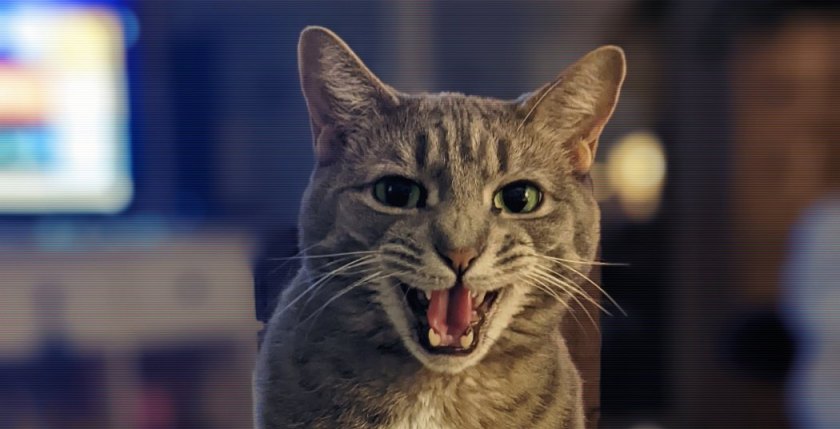
So what’s the source of these claims?
Apparently a study out of Turkey that involved just 31 cats and their humans. All of the human participants were Turkish, and just 13 of them were male. All were recruited online. (And for some parts of the study, like the analysis of greetings by owner gender, only 26 participants were included because the other five did not submit complete data, including the ages of their cats.)
It’s important to make a distinction between what the study’s authors claim and what the media reports, because they’re almost always two different things.

The research team from the University of Ankara counted more meows directed at the 13 male caregivers in their study compared to the 18 female caregivers. In their paper, the team acknowledged their sample size was too small to draw any conclusions, and lacked the demographic diversity to rule out innumerable potential reasons why those 13 cats meowed more frequently than the 18 cats cared for by women.
Even with a more robust sample size including men of different ages, social classes, and nationalities, correlation is not causation, and it may be that the apparent difference in feline vocalizations disappears with a larger study group that more accurately reflects universal demographics.
Indeed, the study’s authors state clearly that feline greeting behavior is “a complex, multidimensional phenomenon that defies straightforward explanation.” (Emphasis ours.)
The conclusion, as always, is that we need more data, which is one reason why studies must be repeatable.
That nuance doesn’t make it into listicles or stories optimized for maximum shareability on Facebook, so instead we get headlines that present studies as the last word instead of the first tentative steps to understanding a phenomenon.
In case it wasn’t obvious, there is no data to support the claim that men “give attention more sparingly” than women, or that women are better at reading feline emotions. We don’t even have baselines or criteria for those claims. How do we objectively measure “better” when it comes to reading cats, especially when every cat and human bonded pair have their own pidgin “language”? What’s the “right” amount of attention?

As the loyal servant of an infamously talkative cat, I’m not sure gender makes any difference. Bud’s vocal tendencies were already present from kittenhood, and I simply nurtured them by engaging in conversations with him, giving him loads of attention and doting on him.
Often our conversations go like this:
Bud: “Mreeeoww! Mow mow! Brrrrrt a bruppph!”
Me: “I know, little dude. You told me, remember?”
Bud: “Brrrrrr! Brrrruppp! Yerp!”
Me: “Yes, but they’ve tried that already. It’s not just about tokamak design, it’s…”
Bud: “Merrrrrp! Mow mow!”
Me: “No, it’s about plasma containment. No containment, no reaction, no energy gain!”
Bud: “Brrrrr! Mrrrowww! Brupbrupbrrrruppp!”
Me: “Yeah, well that’s just, like, your opinion, man.”
I really do talk about science and science fiction with my cat, since he seems to respond to it. Of course it’s gotta be at least partially due to my tone, but strangely if I talk to him about other abstract things, he acts like I’m bothering him with so much human nonsense.
Regardless, Buddy and I object to the claim that a talkative cat is a disengaged or neglected cat. It’s not that he talks a lot, it’s that he never stops!
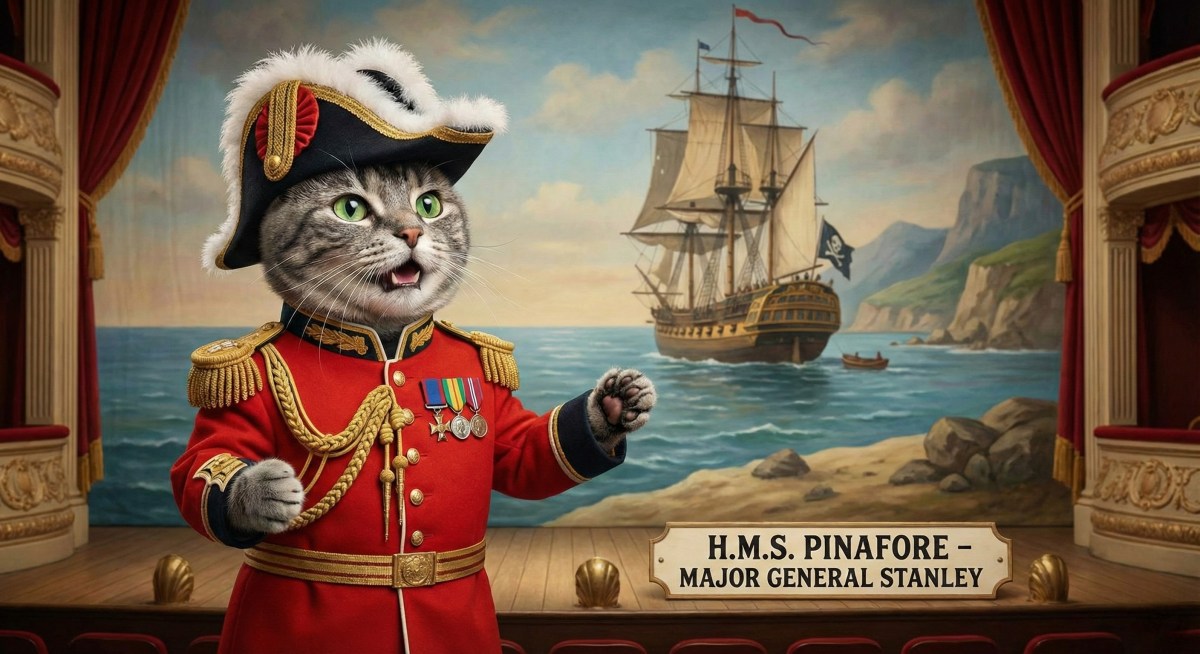
Buddy the Cat’s talents are innumerable! In this rousing number he slips into the style of Gilbert and Sullivan and uses verse to tell us what a feline should be.
“I am the very model of a feline so crepuscular
My visage is so handsome and my meowscles are so muscular!
I am a little tiger though the fact may seem improbable
My knowledge is near boundless in all matters gastronomical
I eat six meals a day in circumstances nominal
For serving snacks when I demand, my human is responsible
No challenge is impossible, no problem yet insoluble
I am the very model of a feline so phenomenal!
I’m schooled in all biology from macro to subcellular
A meowster of olfactory for every object smellular
My hearing’s extrasensitive in low and higher frequencies
I hear the mice a-chatter but the elephants don’t speak to me
My style is more Big Punisher than Doctor Dre or Easy E
Cuz when it comes to hip hop my tastes all face to easterly
I like to shake my booty, I’m funky when I need to be
I am the very model of a cat who does it easily!

I rule with iron paws be it jungle or the living room
And when I’m finished dining, I am content to sit and groom
When it comes to games I am the ultimate competitor
Obligatory carnivore, I am a model predator
Yet somehow cute and fluffy when I feel the need to be
Mostly when I tell my buddy “Wake up, human, and feed me!
I am well-versed in big cats whether tiger or jaguarian
And qualities of catnip like a feline rastafarian
Intimidating surely, in my home I am the guardian
Look dashing in a tux or the kit of a safarian!
When it comes to ladies all the gents seek my analysis
I designed the Taj Mahal and Cleopatra’s palaces
I drink champagne from bottles and sip water from my chalices
Then ignite sky with a range of borealises!
A champion of Opens like the French, Aussie and Wimbledon
My game is too complex for the tastes of canine simpletons
A predator so optimal, impeded by no obstacle
When I’m roused to anger you will find me quite unstoppable
Stylish with a monacle, calm and rarely volatile
I am the very model of a feline so phenomenal!
I am the very model of a feline so phenomenal!
[Chorus of girls]
He is the very model of a feline so phenomenal! Find a better cat? Well that is just impossible! He is the very model of a feline so phenomenal!”
Animals are a real source of joy in this world, and few things are better than cozying up on a couch with a book and a purring cat in your lap.
For more than two weeks after adopting him, I still didn’t have a name for my cat.
I imagined something badass, something funny, something better than all those boring pet names. But the playful, energetic, bold little kitten in front of me was no Brasidas (my favorite Spartan), Mo (my favorite pitcher) or Timothy Cavendish. (My favorite character from David Mitchell’s Cloud Atlas.)
So I kept calling him buddy while I waited for something to come to me, and then it became obvious: He is Buddy.
Original? Nah. But it describes him perfectly, and to me that’s the best part about adopting him, my first-ever pet.
We’re pals. Amigos. Chums. Accomplices. Buddies.

I don’t consider myself his “dad” even though I have parental, protective feelings for him. He’s my buddy who wants to be involved in everything I do, whether it’s helping me greet trick-or-treaters at the door like he did last night, batting a paw at my guitar strings to add his special touch to my recording takes, or just hanging out while I’m reading.
I knew it intuitively, but the best advice I ever got was to always remember your little friend, be it a cat or dog, has his or her own feelings.
There’s a lot of confusion around the word sentience and people often confuse it with the concept of sapience, but there is no doubt about it: mammals like cats and dogs, avian species like corvids (ravens, jays, crows and magpies), and even cephalopods like octopus are sentient.
They think. They feel. They experience emotions like joy, sadness, excitement, anxiety, love, loneliness and more, just as intensely as we do. They may not be able to articulate those feelings in words, but they’re real.
More than half a century’s worth of science has confirmed that fact at every step, and we continue to learn more about animal cognition with every advance in technology that allows us to peer deeper into their minds.

When you treat your pet with respect and keep their feelings in mind, you’ll have a friend for life.
A loyal friend whose love comes without condition.
A friend who won’t lie to you…except maybe when it comes to food. After all, Bud could win an Oscar for his role as a starving cat, even though a single glance at him confirms he’s never missed a meal.
If you’re where I was years ago and considering bringing a pet into your life, ask yourself if you’re ready for a commitment that could last two decades, if you’re ready and motivated to give an animal not just a forever home, but the best life the little one can live.
Remember that kittens and puppies grow up fast, and think about whether you’d rather have a whirlwind of energy who will wreck your sleeping habits for months, or an adult furball who is much more chill. Remember that you will have to do things you don’t like, whether it’s scooping a litter box or bagging poop on a walk. There will be expenses, scares, the occasional puked-on rug.
But the joy you’ll get, and the friendship you’ll have, will make it all worth it.
And if you’re sure, find yourself a buddy at your local shelter. Your life will be better for it.
P.S. If you’re a fool like me, you can also have fun imagining your cat or dog in absurd scenarios based on their personalities.






 Pain In The Bud