There’s a disconnect between the usually careful language of research studies and the exaggerated claims of news articles.
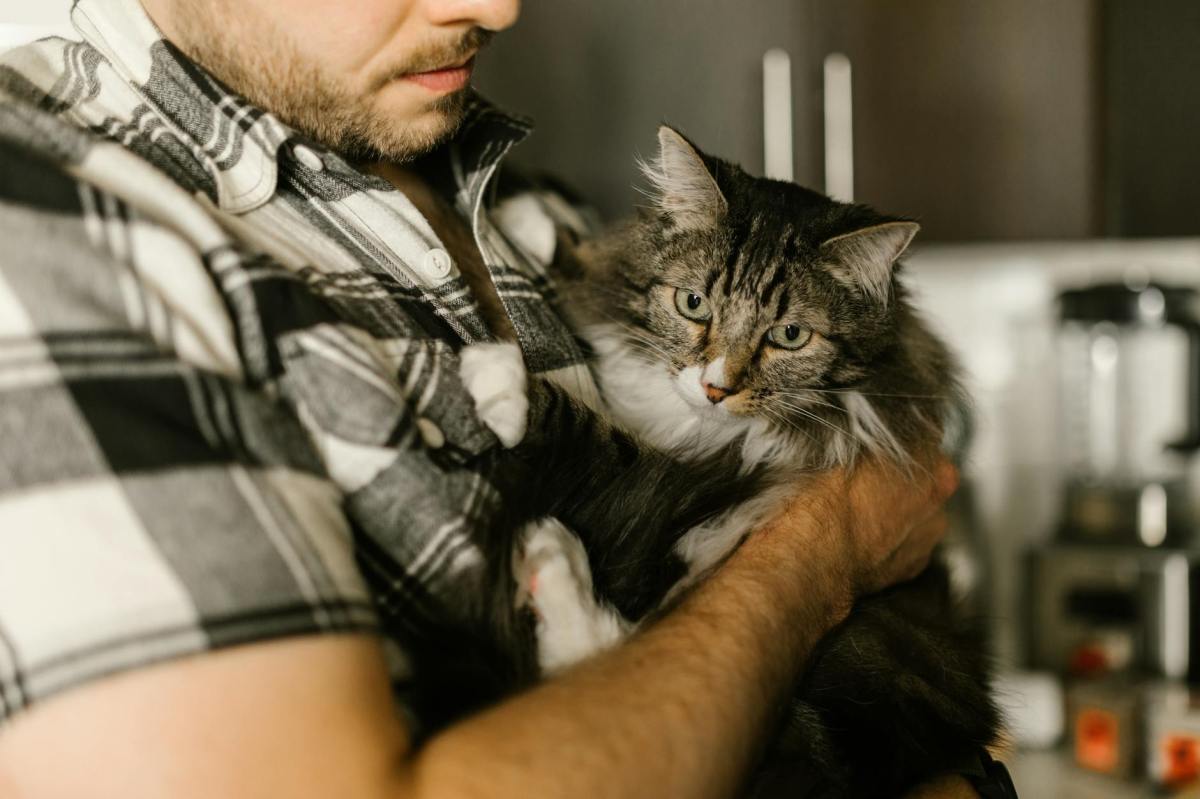
The headlines over the past few weeks have all been variations on the same riff: cats meow more frequently to male caregivers because we don’t know how to bond with the little stinkers, we disregard their feelings, and we ignore their pleas.
Others are more blunt in their assessment, like a story from YourTango that stated women “bond deeply” with cats, whereas we men are merely “manipulated” by them.
“Other studies have found that women are much better at giving their cats more attention, understanding their cats’ emotions, and are more likely to mimic their cats’ vocalization, too,” the YourTango story claims. “Whereas for men, the same cannot be said. Considering they tend to give affection more sparingly than women, it’s no wonder that the dynamic is different.”
Just picture it: women levitating above the rest of us, sharing their amazing Female Affection with the poor, emotionally starved pet felines who belong to men. If we’re trying to get rid of the “crazy cat lady” stereotype and spread the idea that cats are great companions for every kind of person, this probably isn’t helping.
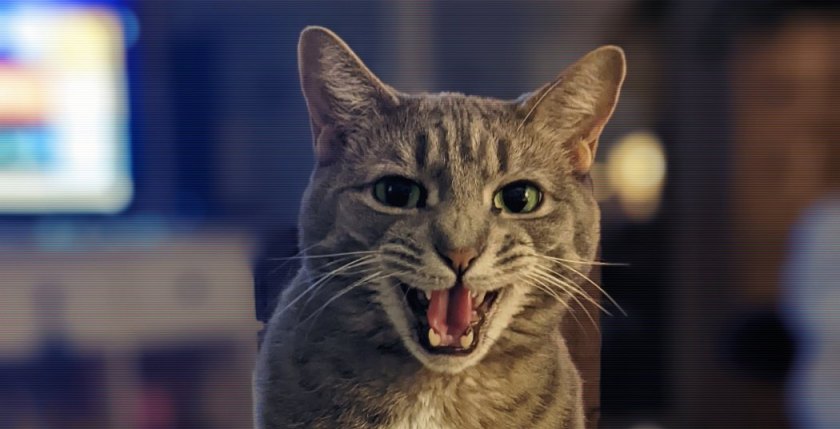
“I am NOT a loudmeowth!”
So what’s the source of these claims?
Apparently a study out of Turkey that involved just 31 cats and their humans. All of the human participants were Turkish, and just 13 of them were male. All were recruited online. (And for some parts of the study, like the analysis of greetings by owner gender, only 26 participants were included because the other five did not submit complete data, including the ages of their cats.)
It’s important to make a distinction between what the study’s authors claim and what the media reports, because they’re almost always two different things.
“Science” doesn’t “say” anything. Science is a method for investigating things we don’t understand. It’s not an entity, it has no opinions, and the only clear conclusion from such a small study is that we need more data.
Hogwash! Balderdash! Codswallop!
The research team from the University of Ankara counted more meows directed at the 13 male caregivers in their study compared to the 18 female caregivers. In their paper, the team acknowledged their sample size was too small to draw any conclusions, and lacked the demographic diversity to rule out innumerable potential reasons why those 13 cats meowed more frequently than the 18 cats cared for by women.
Even with a more robust sample size including men of different ages, social classes, and nationalities, correlation is not causation, and it may be that the apparent difference in feline vocalizations disappears with a larger study group that more accurately reflects universal demographics.
Indeed, the study’s authors state clearly that feline greeting behavior is “a complex, multidimensional phenomenon that defies straightforward explanation.” (Emphasis ours.)
The conclusion, as always, is that we need more data, which is one reason why studies must be repeatable.
That nuance doesn’t make it into listicles or stories optimized for maximum shareability on Facebook, so instead we get headlines that present studies as the last word instead of the first tentative steps to understanding a phenomenon.
In case it wasn’t obvious, there is no data to support the claim that men “give attention more sparingly” than women, or that women are better at reading feline emotions. We don’t even have baselines or criteria for those claims. How do we objectively measure “better” when it comes to reading cats, especially when every cat and human bonded pair have their own pidgin “language”? What’s the “right” amount of attention?
“Brrrrrrrruuuuppp!”
As the loyal servant of an infamously talkative cat, I’m not sure gender makes any difference. Bud’s vocal tendencies were already present from kittenhood, and I simply nurtured them by engaging in conversations with him, giving him loads of attention and doting on him.
Often our conversations go like this:
Bud: “Mreeeoww! Mow mow! Brrrrrt a bruppph!”
Me: “I know, little dude. You told me, remember?”
Bud: “Brrrrrr! Brrrruppp! Yerp!”
Me: “Yes, but they’ve tried that already. It’s not just about tokamak design, it’s…”
Bud: “Merrrrrp! Mow mow!”
Me: “No, it’s about plasma containment. No containment, no reaction, no energy gain!”
Bud: “Brrrrr! Mrrrowww! Brupbrupbrrrruppp!”
Me: “Yeah, well that’s just, like, your opinion, man.”
I really do talk about science and science fiction with my cat, since he seems to respond to it. Of course it’s gotta be at least partially due to my tone, but strangely if I talk to him about other abstract things, he acts like I’m bothering him with so much human nonsense.
Regardless, Buddy and I object to the claim that a talkative cat is a disengaged or neglected cat. It’s not that he talks a lot, it’s that he never stops!
Studies show most of us are pretty bad at interpreting our cats’ moods. A research team in Australia wants to change that.
Cats are constantly telling us how they feel, but many of us aren’t listening.
We’re not talking about chirping, trilling and meowing, although those are some of the ways our cats try to communicate with us.
While they might seem protective of their own thoughts and feelings, cats are actually transparent, and they can’t lie.* Their tails, ears, whiskers, facial expressions and body language all broadcast a cat’s mood.
The question is, are we picking up that broadcast?
In The Conversation, the University of Adelaide’s Julia Henning introduces us to a quiz she designed to answer that question, and invites us to take it.
The goal: to correctly assess each cat’s mood. What I liked most was that we’re asked to evaluate videos — clear, well-lit high resolution clips — instead of the low resolution stills that are often used for quizzes like this.
Sir Talks-a-lot
Henning has been studying the human-cat communication issue because when we misread cats, there’s a good chance we’re stressing them out. Henning and her team published the results of a study in September in which 368 participants from Australia were asked to evaluate a series of clips human-feline interaction.
It turns out they didn’t do so well at reading the signs that a cat is agitated, stressed or doesn’t want to play.
“For videos of cats who weren’t playing and were showing subtle negative cues (such as sudden tension in the body or avoiding touch), participants only recognised the negative cues about as well as chance (48.7%),” the authors of the study wrote.
Even when study participants correctly read a cat’s ears, tail, whiskers and body language, some of them indicated they’d do things that would unknowingly make a cat more agitated and stressed. A classic example is trying to pet a cat’s belly and misinterpreting their derpy way of trying to block you as a playful gesture.
Did you know? Approximately 96% of Buddy’s communication is related to yums.
In the paper, which was published in Frontiers in Ethology, Henning and her colleagues lay out the case for making sure we — the people who take care of cats — are sensitive to what our little buddies are feeling.
It’s not just about strengthening the bond, although that’s an important part. It’s about reducing stress and miscommunication, and increasing quality of life.
Cats are incredibly sensitive to our actions and moods because we are the most important living beings in their lives. We feed and house them, and we’re their pals. If we’re constantly subjecting them to play they don’t like or overstimulating them, they get stressed, and stressed cats can become depressed, sick or resentful cats.
If we want to make sure our buddies live their best lives, we have to understand what they’re trying to tell us.
(*) Except when it comes to food. When food is involved, these innocent, cute little furry creatures become master manipulators and can convince anyone they’re starving.
Note: The first version of this story linked to the study page twice when the first link should have pointed to the quiz. It’s fixed now, and email subscribers can follow the link through this version of the story. Apologies for the error.
The Europeans aren’t messing around when it comes to noise on public transportation, and a loud pet can cost you.
Note to self: Never take Buddy on a French train, unless I want to be out a few hundred bucks by the time I reach my destination.
That’s my takeaway after coming across this story about a woman who was fined €110 (about $130 in ‘Merican dollars) by the French National Railway Company after another passenger complained that her cat was causing “acute tensions” by vocalizing.
Naturally, the passenger and the railroad have two different versions of events. Camille, who was identified only by her first name, said she’d purchased a ticket (about $8) for her cat, Monet, and had the feline in a carrier for the trip from Vannes, Brittany, to Paris, per railroad rules.
Monet “meowed a bit at the start” at the beginning of the journey, Camille admitted, but wasn’t excessively loud.
“Loud? I’m merely expressing my displeasure with the level of service around here!”
Railroad operators said there were multiple complaints, not just one, and claimed a conductor asked Camille and her boyfriend, Pierre, to switch to a mostly-empty car as a compromise with other passengers.
A conductor ticketed Camille when she declined the “simple and common sense solution,” according to French broadcaster BFM.
I’ve joked in the past about sedating the Budster before flights so the other passengers won’t toss him out at 40,000 feet, but there’s truth at the heart of it: Buddy is a naturally chatty cat, he’s got strong opinions, and he doesn’t hesitate to share them with anyone.
Of course you don’t want your companion animal to create a scene or make other passengers uncomfortable. I still wince when ai think about the woman who forced fellow passengers to endure the smell, proximity and potential defecation of her “emotional support horse,” and when people began abusing the privilege of going places with emotional support animals (emotional support alligator, anyone?), it was only a matter of time before companies that operate common spaces — be they in a fuselage, a baseball stadium or a grocery store — tightened the rules to avoid conflict.
Still, unless the cat was wailing, or Camille really did refuse to switch seats, a $130 fine is excessive.
Just something to think about for those of us who have plans to travel with our cats.
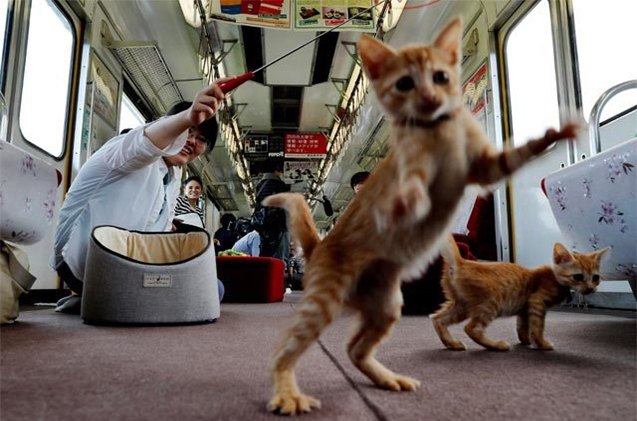
Header image of a cat cafe train car in Japan, credit: Wikimedia Commons
Every cat lover’s camera roll is dominated by photos of our fluffy little overlords. It’s the natural order of things.
I’ve always said Bud’s silent treatment can be worse than his vocal protests when it comes to gauging the intensity of his disapproval.
Howling at me to fetch him a snack? That’s normal. Sitting down two feet away and fixing me with his wide-eyed, accusatory stare as I eat a snack without getting one for him? Now that’s serious.
Andreas Nilsson, the director of a new ad highlighting a recently-introduced Apple feature, clearly understands the hierarchy of feline displeasure:
In the spot, a man uses Apple Intelligence to remove his cat, Garrett, from a photo he just snapped of his wife relaxing and reading a book.
“Look, I deleted Garrett,” he says, holding up the photo and clearly expecting something along the lines of “Wow, that’s a pretty cool feature!”
Instead, she gives him a dry “I always knew you hated Garrett” and goes back to her book.
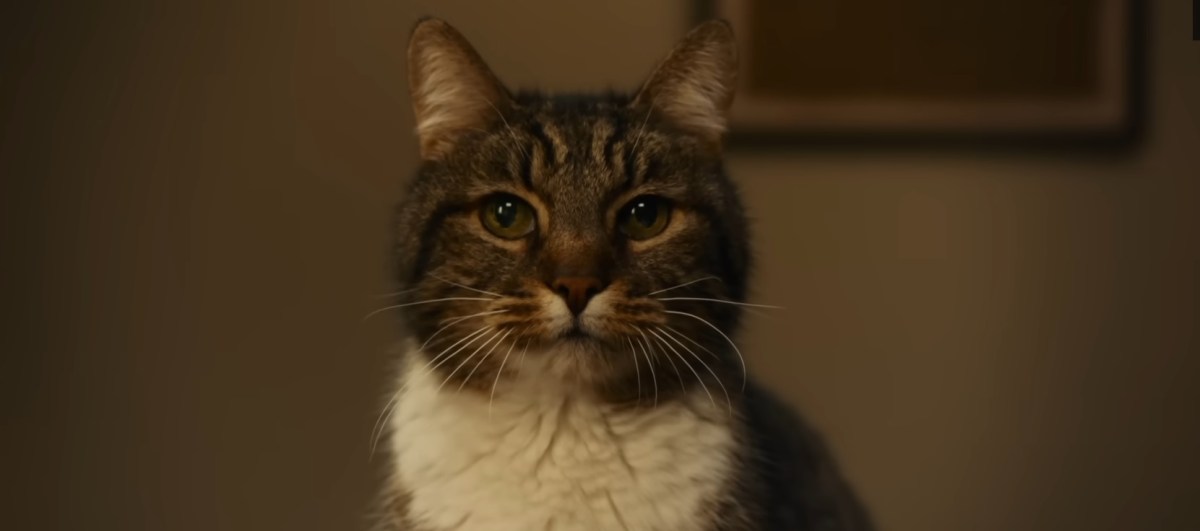
But Garrett himself doesn’t have to utter a single meow. His reproachful gaze is all the prompting the man needs to undo his mistake with the tap of his screen.
The commercial ends with a slow close-in on Garrett’s face, which has “You’re on thin ice, human!” written all over it.
I like this spot. The creative team took a risk in showing off a new feature in a way that made the characters react negatively, but cat people will love it, and viewers aren’t likely to forget what they saw.
Android users have had something very much like it for quite a while now. Sometimes it really does work the way it does in the commercials, with seamless results, but other images are a bit more difficult to clean up and require some manual tinkering. If Apple’s figured out a way to measurably improve this sort of thing, that’s a pretty big positive for the future of smartphone photography and editing.
In any case, cheers to Nilsson for knowing who holds real power in human-feline households. Now if you’ll excuse me, the king is demanding my attention, no doubt to have me scratch his chin, open a door for him, or serve him second breakfast…





 Pain In The Bud