One of the most pampered kitties in human history has been invited to the “most prestigious” fashion event, which will honor her late human servant this year.
She drinks out of silver bowls, is toted around in a custom $3,000 Louis Vuitton carrier and pads out her fortune by earning millions hawking makeup and luxury vehicles.
Now Choupette, the sapphire-eyed cat who belonged to the late fashion designer Karl Lagerfeld, has been invited to the most exclusive party in the world.
Choupette’s agent, Lucas Berullier, confirmed receipt of a Met Gala invitation to the New York Post, but was coy when asked if Choupette would actually show up.
The Birman cat was personally invited by Vogue editor-in-chief Anna Wintour, who oversees the event, and the Post points out Choupette could play a central role because the 2023 gala will honor Lagerfeld and his career as the creative director for Chanel.
Choupette is credited with mellowing the icy German designer, who quickly fell in love with her and made her his muse, adding her to fashion shoots where she lounged in the arms of models like Vanessa Paradis and Cara Delevingne.
Lagerfeld photographs Choupette, his beloved Birman cat.
Choupette appears in the current issue of Vogue, cradled by supermodel Naomi Campbell on a bridge in Paris’ Grand Palais. The photo and others in the gallery were shot by Annie Leibovitz.
The exact size of Choupette’s fortune has never been publicly disclosed, but publications like Forbes have reported Lagerfeld left $13 million of his $200 million-plus net worth to the pampered feline. Choupette has added to her largess over the years, amassing further millions as she appears in advertisements, fashion campaigns and photoshoots.
Lagerfeld’s former housekeeper, Françoise Caçote, cares for Choupette and manages her social media accounts.
The Met Gala is a charitable event, so normally it wouldn’t feel right to snark about it, but “the most prestigious fashion event” of the year looks like a Zoolander scene come to life. Guests are required to attend in haute couture outfits by prominent fashion designers, which means the typical attendee’s clothes and accessories cost more than many Americans earn in a year.
There’s a theme every year — aside from the usual preening privilege and a collective effort to ignore reality — and the outfits are ostensibly “costumes,” but no one’s showing up in stuff they bought from Party City.
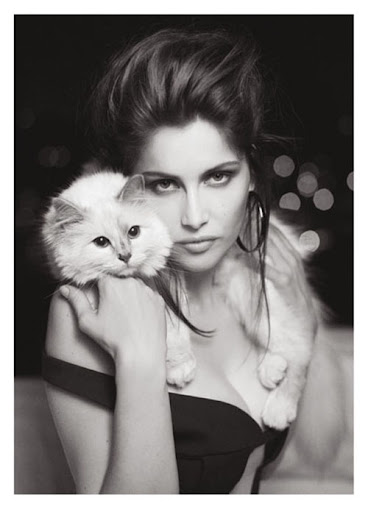
Choupette and supermodel Laetitia Costa pose for V Magazine. Choupette has also appeared on the cover of Vogue several times.
And while the gala is technically a charitable event, the proceeds won’t help starving kids or war victims — as the brainchild of Wintour, the event is designed to raise money for the fashion world to further celebrate itself.
When I see people like Wintour, the celebrities in her orbit and the old money types who like to be photographed at these events, I enjoy thinking about how they’d react if their jets went down over a place like the Amazon, and all the Dolce and Gabbana in the world can’t help them build a fire or catch dinner. “Do you know who I am?” doesn’t work in jungles.
But the one character I will never insult is Choupette herself. Buddy looks very handsome in a tuxedo, and I shall realize my plan to sneak him into one of these parties, have the two of them “accidentally” bump into each other, and let Buddy’s charm do the rest. Then he’ll really be living large. 🙂
The naturalist is excited to unveil his most striking documentary yet.
NEW YORK — All those hours trudging through the dense undergrowth of New York living rooms, hoping for a glance of an elusive feline, have finally paid off.
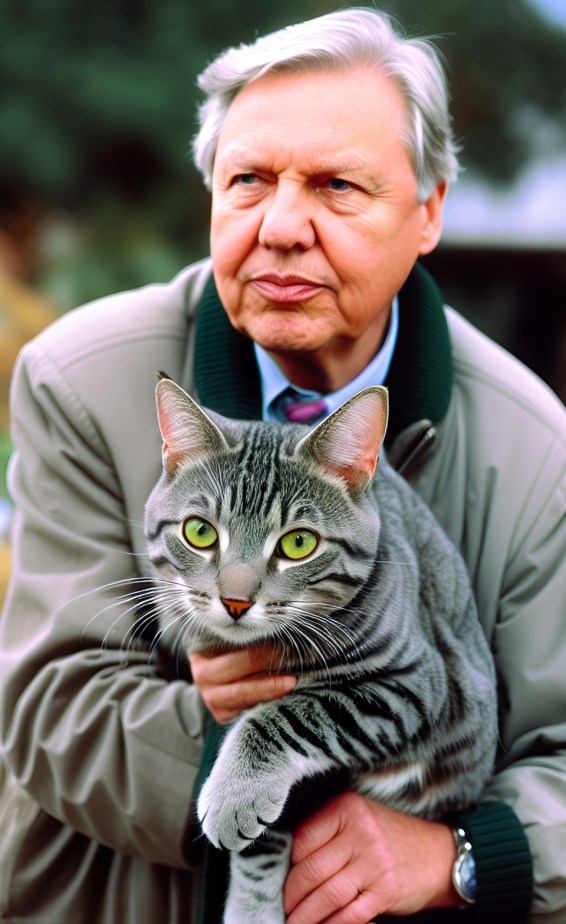
Speaking to reporters about his newest nature special, Sir David Cattenborough said he and his crew spent more than 200 hours in the natural habitat of the silver-furred Buddy.
Also known as the Buddinese tiger, the silver-furred Buddy is “native to the living rooms of New York” and, with his meowscular physique, “is the apex predator of his environment.”
“What a fascinating animal!” Cattenborough exclaimed.
The famous naturalist, conservationist and documentary narrator accompanied a camera crew into the thick jungles amid couches, pillows and carpets, where they observed the silver-furred Buddy at a safe distance as the fierce feline went about sleeping, eating and lounging.
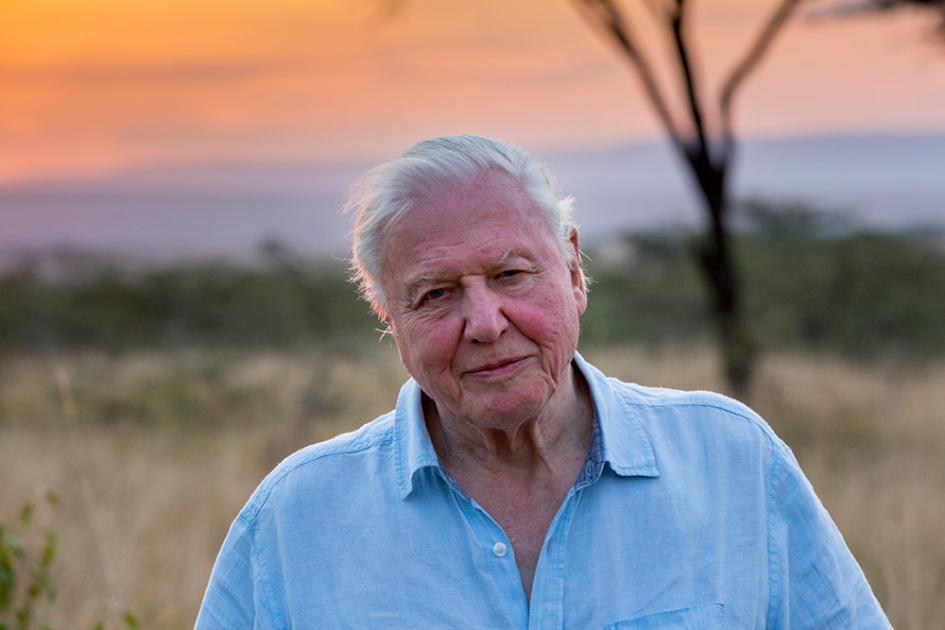
Sir David Cattenborough with Buddy the Cat.
Speaking excitedly in his familiar whimsical cadence, Cattenborough described the documentary crew’s luck in catching the Buddy on a hunt, when he ruthlessly brought down a red laser dot.
“People ask me, ‘Sir David, what makes the Buddy any different from other tigers and lions? Isn’t it basically the same animal?’ While they’re all famously fierce felids who strike fear into the hearts of other creatures, there are differences as well,” Cattenborough explained. “Thanks to the hard work of our dedicated crew, we’re able to bring our audience along as we take the closest look yet at this most elusive and fascinating beast.”
The new documentary, “Buddy: The Perfect Predator,” will be available to stream exclusively on Pain In The Bud, and was made possible by a grant from the Buddinese Foundation for Greater Buddesian Understanding, with additional financial support from the Coalition for Meowscular and Ripped Cats. Look for it this week on PITB!
Sir David Cattenborough was able to earn the trust of a silver-furred Buddy.
Humans are an invasive species who are spectacularly adept at destroying life, a new study has found.
Homo sapiens are an invasive species who do irreparable harm to the environment and other animals on an unprecedented scale, a new study by the Feline Science Institute has found.
The results prompted feline scientists to add homo sapiens, commonly known as humans, to a database of destructive and invasive animals maintained by the Academy of Scientific Studies.
Cat scientists have only just glimpsed the breadth of human-initiated impact on other animals, Dr. Oreo P. Yums, lead author of the newest research paper, told reporters.
“We found humans are astonishingly, almost indescribably destructive,” Yums said. “For instance, although they fret about birds, humans kill more than a billion of them a year just with their skyscrapers, which birds are prone to fly into due to their mirrored surfaces. Add in wind turbines, cell towers, power lines, habitat loss and slow die-offs due to chemicals, and by conservative estimates we’re talking about billions of birds killed by humans every year without even tallying active measures like hunting.”
Humans have killed off an estimated 70 percent of the world’s wildlife in the last 50 years alone and show no sign of stopping. Oceans are overfished, animals like pangolins and big cats are ruthlessly hunted to extinction to feed demand within the Chinese traditional medicine market, and human addiction to palm oil means the “two-legged demon monsters don’t even have sympathy for their fellow primates,” mewologist Charles Clawin said.
“In Borneo and Sumatra there are entire schools, filled to capacity, for critically endangered orangutan babies who were orphaned by human contractors clearing ancient jungles to make room for more palm oil plantations,” he said. “Often, the humans use industrial equipment to tear down trees while the orangutans are still in them. Other times, they dispatch the mothers with pistols, not realizing there are babies clinging to them.”
In Africa, where the elephant population has plummeted in the last century, more than 110,000 elephants have been slaughtered in the past 10 years alone for their tusks. The elongated incisors are used to make jewelry and piano keys, and items made from ivory have become a status symbol in China, where growing middle and upper classes seek to show off their wealth with luxuries.
In 2019, Chinese businesswoman Yang Felan, dubbed the “Ivory Queen,” was arrested and charged with smuggling $2.5 million worth of tusks from Tanzania to her home country. Yang, “a key link between poachers in East Africa and buyers in China for more than a decade,” was a respected businesswoman, investor, restaurateur and vice chairwoman of the China-Africa Business Council.
“Poachers continue to slaughter elephants and our big cat brothers and sisters,” said Luna Meowson, who tracks the illegal wildlife market for the University of Nappington. “Having extirpated tigers from virtually their entire range, poachers are turning to South America, where jaguar poaching increased 200 fold between 2015 and 2020. It never stops.”
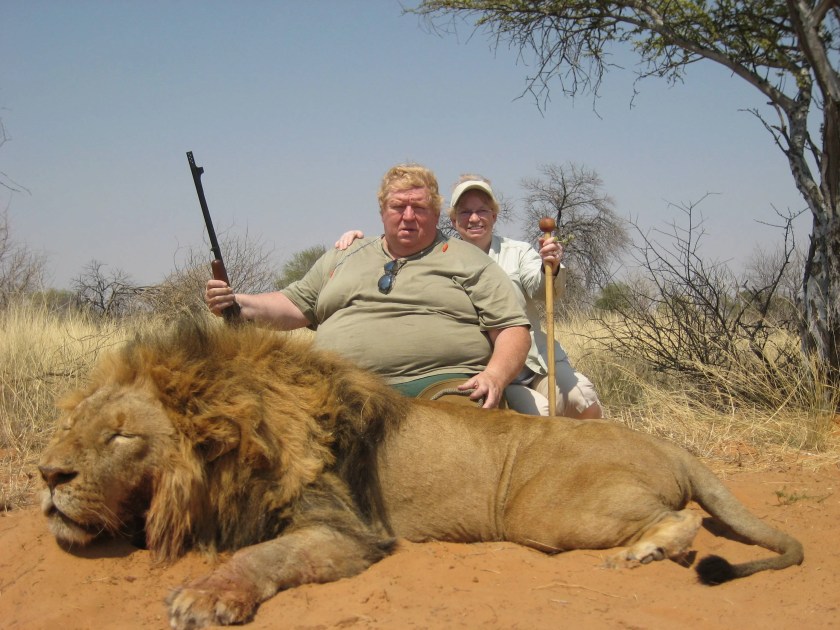
A human hunter poses victoriously after heroically slaying a lion (panthera leo) from atop his trusty steed, a mobility scooter, after a team of guides drove him around the bush in an air-conditioned SUV, then lured the animal directly into his line of sight. A female of the species, presumably his mate, looks on proudly.
Although the earliest details remain murky, fossil records show Homo sapiens first emerged in Africa about 200,000 years ago. The invasive species, which has a gestation period of about nine months, began rapidly breeding and immediately went to war with fellow members of the genus Homo.
After wiping out two-legged rivals including Homo neanderthalensis, Homo altaiensis, Homo denisova and Homo bodoensis, the victorious Homo sapiens set their eyes on other species. Throughout their history they’ve also proven remarkably adept at murdering themselves and continue to hone their skills.
“Those OG humans, they had to really work at slaughtering other species and extirpating wildlife,” said Chonkmatic the Magnificent, King of North American cats. “They didn’t have attack helicopters, stealth bombers, tanks, carrier battle groups, daisy cutters, artillery, mortars, phosphorous, napalm, biological weapons, or even small arms like rifles. In those days a pimply kid from Oklahoma sitting in an air-conditioned base in Virginia couldn’t wipe out an entire city 5,000 miles away by pressing a button ordering a drone to drop a nuke. They had to put some sweat into violence, you know?”
Breakthroughs in recent centuries have led to innovative and more convenient ways for Homo sapiens to author mass destruction and render entire sections of the Earth lifeless.
The species, known for its aptitude for tool-making in addition to eating ultra-processed foods and staring at screens, began with simple tools of destruction like the Mark I Spear, early bows and even torches. Over the centuries they innovated, coming up with clever and inventive new ways to inflict pain and end life until the advent of electricity, the industrial era and the brutally destructive war machines of modern times.
Human scientists have tried to obscure their species’ impact on wildlife and the planet by declaring species like felis catus “invasive” and “alien,” but even if cats are “guilty of grabbing a forbidden snack every now and then,” they don’t have the coordination, technology or will to carve up habitats, render entire swaths of the Earth uninhabitable with nuclear fallout, create Everest-size mountains of garbage, or effortlessly drive millions of species to extinction, Clawin said.
“They’re so good at it, they don’t even have to try,” he noted, pointing out human accidents or incidents of negligence like oil spills and chemical run-off into rivers. “We tend to think of humans out there with shotguns and rifles, cackling maniacally as they shoot anything that moves. And, sure, they do that, especially in places like Texas where the sight of any animal always prompts the question ‘Should we shoot it?’ But our research shows they can wipe out entire categories of fauna in their sleep. It’s remarkable.”
The third time’s the charm: After failing in his attempts to ingratiate himself with tigers and lions, Buddy heads south to the Amazon to commune with the jaguars.
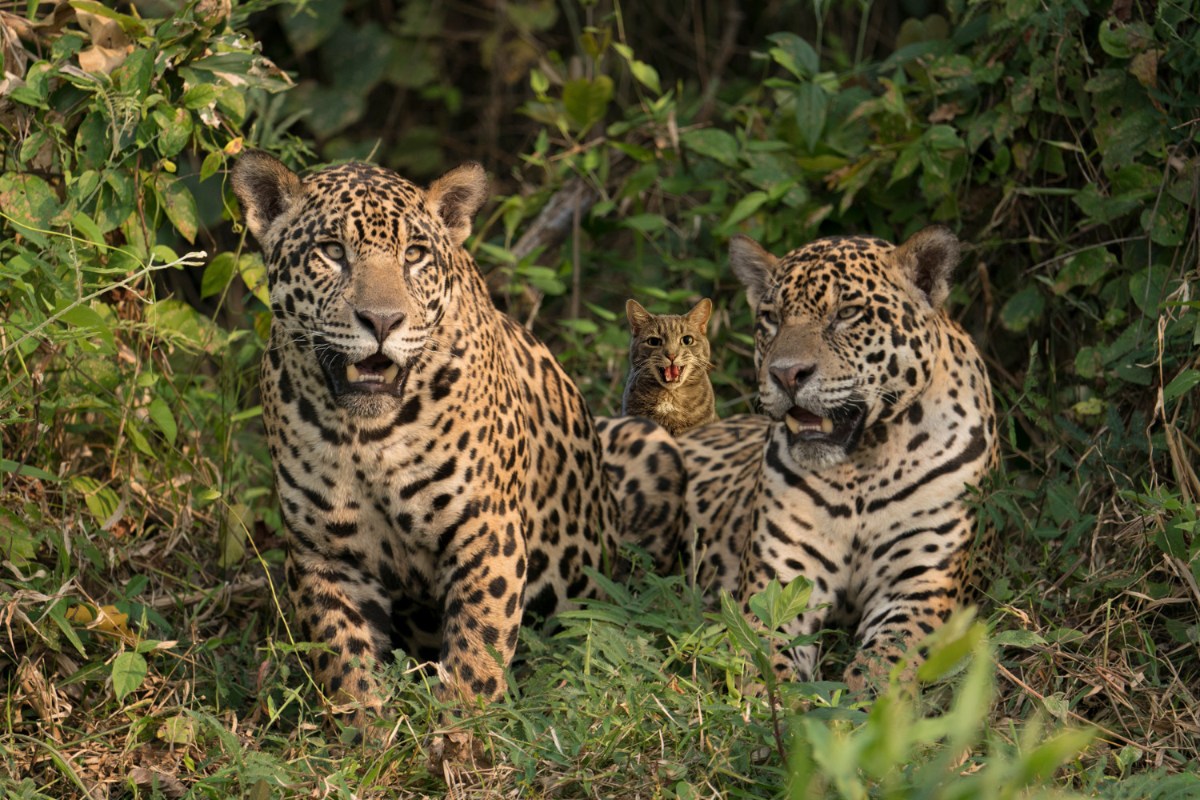
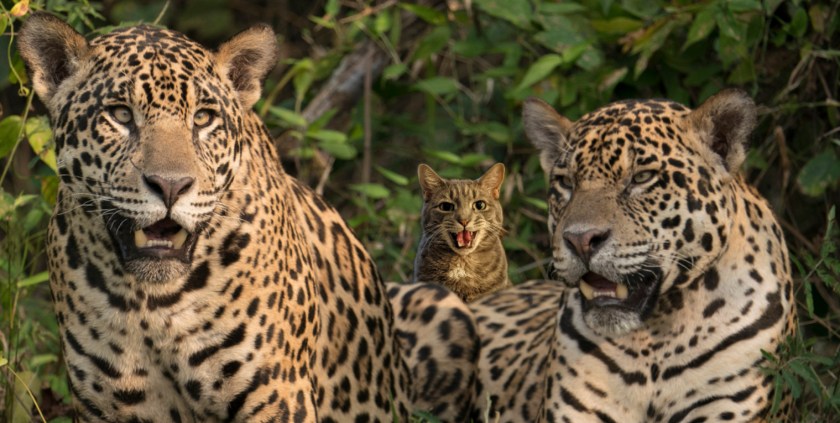
MATO GROSSO DO SUL, Brazil — Fisherman and naturalists working in the Pantanal have reported a strange sight in recent weeks — a domestic cat tagging along with jaguars.
The gray tabby was observed lounging on the banks of the Amazon, napping in a tree and struggling to take bites out of a caiman killed by a generous jaguar, witnesses reported.
“HQ, we’ve got something extraordinary here,” a naturalist was heard reporting over local radio channels. “A jaguarundi is — no, scratch that — a house cat! A house cat is following a group of jaguars from the river bank into the deeper jungle.”
The feline in question was identified as Buddy the Cat of New York after his concerned human reached out to local authorities and appealed to the Brazilian press for his safe return.
“He does this all the time,” the New York man, identified as Big Buddy, told an interviewer from Folha De S. Paulo. “First he broke into the tiger exhibit at the Bronx Zoo and tried to get the tigers to accept him, only to be claimed as a cub by one of the tigresses. It took weeks to convince the zoo to get him out, and when I got him home I had to bathe him five times just to get the stink of tiger saliva off his fur.
“Then somehow he made his way to Tanzania, where he wandered around the Maasai Steppe for a few weeks trying to get into a lion pride. He failed miserably in that endeavor, too. Now with the jaguars. It never ends.”
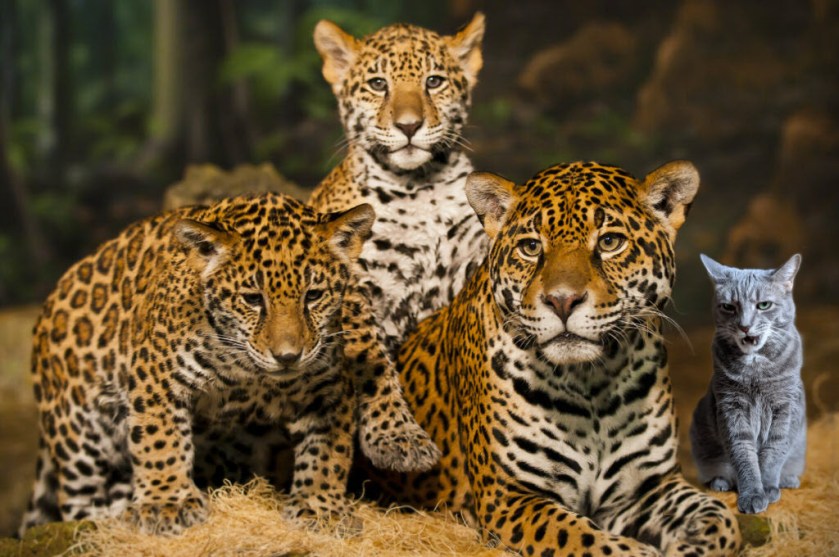
Buddy the Cat, known as Kinich Bajo to his jaguar friends, pictured here in the Amazon.
The exasperated New York man claimed responsibility for his failure to keep his “ridiculous” cat from adventuring, but also blamed the transportation industry for accommodating Buddy.
“Who the hell allows an unaccompanied cat to take a bus or board an airplane?” he asked. “How did he end up in first class, sipping champagne and buzzing the stewardesses for more turkey every five minutes? I’m told he got quite drunk and threatened to become combative if he didn’t get an entire fried turkey.”
Asked why his cat was obsessed with ingratiating himself to larger cat species, Big Buddy answered without hesitation.
“He’s a dumbass,” the human said. “Don’t get me wrong, he’s a very cute, very loving little guy, and often a good boy, but a dumbass all the same.”
Buddy’s human said the 10-pound domestic cat often tears around the house, ambushing animate and inanimate objects and practicing his roar, “but he sounds like Elmo singing a funk song in falsetto.”
Credit: Wikimedia Commons
As of press time, Buddy the Cat still hadn’t returned home. Jaguars are known to be extraordinarily laid back compared to other big cats, and a loosely-affiliated group of the South American apex predators seemed to tolerate the domestic kitty.
“I can’t leave now,” Buddy told reporters. “They’ve begun to accept me! It would be a violation of trust if I just left them to eat all this delicious food by themselves.”
Kinich Ahau, the local jaguar elder, said his extended family had taken a liking to Buddy.
“Have you heard of this turkey? We did not know of it. It is wondrous!” the great jaguar said. “Buddy, or Kinich Bajo as he is known to us, has also shared great wisdom in the form of new and comfortable napping techniques. On the first night, we observed him construct a soft bed of leaves for himself in the crook of a branch, and over the following suns and moons we have come to appreciate softer napping spots.”
Buddy had sparked a renaissance in jaguarian napping technique, Kinich Ahau said.
“Nobody naps like Buddy,” he said. “No one!”
Brothers: Xibalbá, left, with Kinich Bajo and Ek B’alam.
With the fond support of the Amazon’s jaguars, Buddy was set to undergo an ancient shamanistic ritual involving the imbibing of Ayahuasca, a powerful psychoactive brew said to reveal cosmological secrets to those who drink it as part of a spiritual ceremony.
“We would not have invited Kinich Bajo, or Buddy as you call him, to commune with the ancient B’alam (jaguar) spirits if we did not sense a deep spirituality and wisdom inside him,” said an elder jaguar shaman named Mike the Melanistic. “He has shown us the way in matters of snacking and napping, and now as we welcome him to our ethereal fraternity, we shall accompany him on his journey to the stars, where he will drink of the deep knowledge of our ancestors.”
Buddy himself told a reporter he was looking forward to the ceremony.
“It’ll grant me, like, awesome powers and shit,” he said. “I’ll be able to disappear in a puff of mist like the jaguars do, my muscles will get bigger and, like, I’ll be able to sniff out snacks from up to a mile away. Pretty cool, if you ask me.”
At press time the jaguar shaman elders said the ceremony does not, in fact, grant such powers.
These are some of the most stunning images of leopards and tigers you’ll ever see.
One photo shows a melanistic leopard — better known as a black panther — cautiously but curiously poking its head out from behind a tree. Another shows the same cat, tail raised and ready to spring as it stalks prey in the jungle mists.
The photos went viral this week, accumulating millions of views as people hailed the leopard as the second coming of Rudyard Kipling’s Bagheera, the beloved leopard from The Jungle Book.
Both photos come from the lens of Shaaz Jung, known as the “Leopard Man of India” for his astonishing shots of the majestic cats taken deep in the country’s jungles and forests.
“When people see these pictures, they think there are several leopards, but actually there’s just one black panther where we are — one melanistic leopard in the dense forest of Nagerhole. So it was like finding a needle in a haystack,” Jung told BusinessInsider.
The leopard has been named Saya by local wildlife enthusiasts, and he’s a bit out of his element in the deciduous Kabini forest, which is also home to a tiger preserve. Normally, leopards like Saya live in dense jungle, where the thick canopy and lack of light play to their advantage.
Jung patiently followed Saya, snapping photos of the big cat hunting, fighting and courting potential mates.
“He’s not just surviving, he is thriving,” Jung said.
Jung is a wildlife photographer, NatGeo’s director of photography for films and a big cat specialist in his own right. He also photographs India’s tigers, and his shots reveal a connection to — and a deep appreciation of — these regal apex predators who have been pushed back by human development and the resulting habitat loss.
The man behind the camera: Shaaz Jung.Tigers share a quiet moment as they trade scents. Photo: Shaaz JungLeopards are known for their exceptional climbing ability as well as their preternatural hunting skills. Photo: Shaaz JungA leopard enjoys a mid-day respite from the sun — and bothersome rivals — on a broad tree branch. Photo: Shaaz JungA tiger stops for a drink with the water reflecting its wary gaze. Photo: Shaaz JungTigers are the world’s largest, heaviest cats, the apex predators among apex predators. This close-up is a reminder of how beautiful and regal they are. Photo: Shaaz Jung