David Mosley wanted attention and allegedly killed a cat on camera to promote his Satanist-themed music.
What to do when you want to be a famous music artist, but your tunes are abominably awful and your gimmick is infantile?
If you’re David Mosley, apparently you beg the internet to notice you exist by allegedly murdering a cat.
The 26-year-old Bronx man was initially gleeful after sharing video and photos showing a dead cat in his Fordham North hovel surrounded by candles and a bunch of nonsense, including the word “SATAN,” spray painted on the walls.
“You should have heard the little bih squeal lol,” Mosley wrote on Instagram alongside a photo of a bloodied and dead cat in his apartment.
“I’m the king, n—a,” Mosley said in a follow-up video after mocking people who were upset that he allegedly killed the cat. “I can reach through the camera and put spells on you like that! That easily! I hexed you through the phone, through the camera. Ya’ll know I do f—ing voodoo, so don’t even call me delusional.”
Mosley during a live stream, during which he claimed supernatural powers.
A relevant question here: who adopted a cat out to this guy? I went through what felt like a CIA-level background check when I first went to adopt, and this Satanist who thinks he’s a wizard apparently had no problem just waltzing into a shelter and walking out with a cat.
Apparently angry that no one turned up to the first “show” in his illustrious music career, Mosley said he was going to take things to the “next level” with another “sacrifice” on Halloween night. In his musical endeavors he called himself Church of Ububal, with the latter word a reverse spelling of “Labubu” in reference to the viral toys.
“Be there or be square,” he wrote, per a screenshot posted to Reddit. “Like I said at my first show and no one came. But you will be at this one. Grab popcorn.”
When he got the attention he wanted, but not the reaction he wanted, he backpedaled during a live stream, claiming he found the already-deceased feline.
By that point, furious Redditors in a Bronx subreddit had closed in on his identity and exact location, and were pestering the NYPD to grab Mosley.
“Y’all are soft for falling for cheap parlor tricks” Mosley said during the live stream.
Incredibly, Bronx criminal court Judge Harold E. Bahr let Mosley walk free without having to post bail after a preliminary hearing this week, and adjourned a hearing this week after Mosley’s original attorney was not present. It’s not clear if that attorney will continue to represent Mosley.
Bahr must be confused about which decade this is. Constituents should (politely) register their displeasure with his office. People from several local cat rescues have already done so.
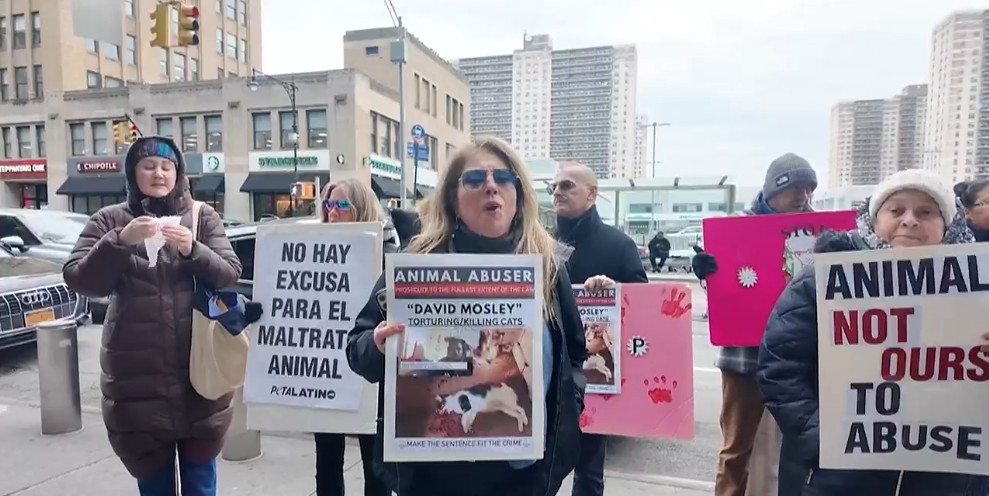
“We want the judge to take this seriously. We cannot wait for another crime like this to happen,” local animal welfare activist Rachel Ejsmont told News12 Bronx.
Mosley was initially charged with criminal mischief and aggravated cruelty to animals at his Oct. 30 arraignment. Activists are pushing the district attorney for more serious charges.
The court hasn’t set a date for Mosley’s next hearing after the Nov. 12 adjournment. We hope the scrutiny and his mounting legal troubles dissuade him from trying to get attention through violence again.
Lastly, I usually keep my mouth shut about this sort of thing because I know emotions run high and most people are well-intentioned, but already there are grifters latching onto this incident and using it to beg for donations for their activism, which amounts to little more than grumbling about this stuff on social media.
Be careful about who you donate to and make sure you’re giving to registered organizations with financials listed on Charity Navigator or Charity Watch. Donate your hard-earned money to groups that really do make a difference, such as the Humane Society, SPCA and local rescues that do outstanding work, like New Jersey’s Tabby’s Place. A transparent, effective charity will feature its IRS Form 990 on its website and use at least 75 percent of its revenue from donations on program spending. Be wary of “influencers,” people who say outrageous things for attention, clicks and donations, and anyone who claims they have special access to, or influence over, authorities.
The woman has been dubbed a “serial killer” of animals after eight of her pets and one of her horses met early ends, and several others simply disappeared. She’s part of an unfortunate trend of influencers and quasi-celebrities popularizing exotic pets, with “ownership” of the animals frequently leading to tragedy.
So apparently Katie Price is some sort of proto-Kardashian, a pioneer of the “famous for being famous” genre of hybrid reality/online celebrity, to use the term loosely.
Wikipedia says she got her first taste of fame in the 90s posing topless for British tabloid newspapers before moving on to loftier pursuits, like appearing on Big Brother and holding court on important topics, like whether toes have bones.
The background really doesn’t matter, except to establish that Price is someone with a lot of money, minimal common sense and extraordinarily poor judgment who has gotten so many of her pets killed or injured, PETA and other animal rights groups in the UK have begged politicians to write new laws preventing serial pet-killers from purchasing more animals.
Sort of a “10 strikes and you’re out” rule, if you will.
Four of Price’s dogs have been hit by cars, including one killed by a pizza delivery driver on her property. Another got stuck in an electric armchair and was crushed after Price gave him cannabis oil, pleading ignorance on its effects.
Previously, one of her breed cats was euthanized under mysterious circumstances at five months old, her rare chameleon fell ill and died because he wasn’t kept in a properly heated enclosure, and her “guard dog” was apparently intentionally killed by someone, although the information on that death comes from Price so there’s no way of telling what the actual circumstances were.
A horse Price owned was killed on the same road where two of her dogs met their end, which would bring the tally to nine depending on whether you consider a horse a “pet.”
Price, pictured this year.
There have also been animals — kittens, puppies, animals gifted by boyfriends, fiances, and friends — who were featured on Price’s social media feeds as babies and never heard from again, according to the UK’s Mirror. Some of them were given away to assistants and acquaintances. The fates of the others are unknown.
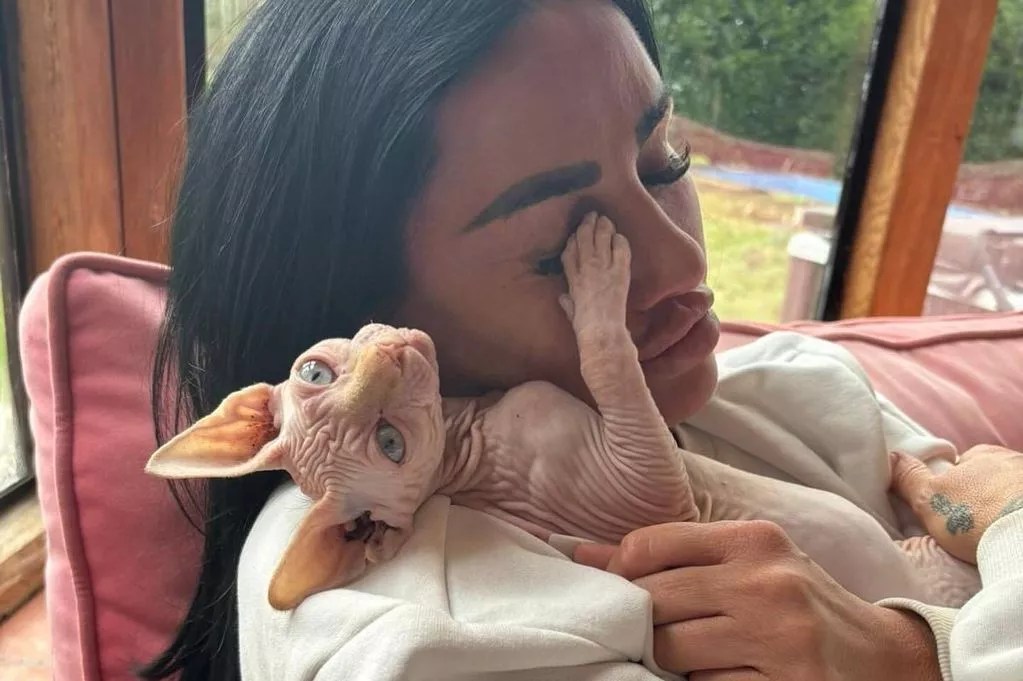
Price currently owns at least four chihuahuas and five Sphynx cats. An incident with one of the Sphynxes has animal lovers and welfare groups renewing calls to prevent her from buying new pets. (Price, like so many social media influencers, exclusively purchases breed pets for thousands of dollars each.)
In a new video posted online, Price — who has been dubbed a “serial killer” of animals by PETA — makes duck lips at the camera and rubs one of her Sphynx cats, Kevin, explaining that the little guy suffered sunburns.
“Oh Kevin you have been in the sun today, you have got sun burnt despite us putting sun cream on you… look at his little face,” Price said in the video. A caption written by Price claims “Trying to keep the cats out of the sun is hard work.”
A screen shot from Price’s recent video in which she shows one of her cats who suffered sunburn during the ongoing heat wave.
The latest incident is drawing fresh attention to a petition that calls for the UK government to step in to stop Price from owning animals.
As of July 10, there were 37,728 verified signatures on the Change.org petition, which mentions a number of additional disturbing incidents involving Price’s pets. One accusation claims Price’s guard dog — it’s not clear if it was the dog who was killed, or a new guard dog — bit the tail off one of her cats.
“Anyone who warns Katie not to hurt the animals she takes in might as well be screaming into the wind, for all she seems to care,” PETA’s Elisa Allen said. “And here we go again: her cat is sunburnt – something she was likely warned about when acquiring a gimmick cat, bred to look odd and be hairless.”
For her part, Price claims the deaths and unfortunate incidents that have befallen animals in her care are simply the result of bad luck and circumstances outside her control. Her representatives have also accused animal welfare groups of using the influencer’s fame to raise money.
That has not changed the narrative as new incidents continue to pile up. In a 2023 live TikTok stream, Price allegedly slapped her then-puppy, Tank — who she’s since discarded — for sitting on a hoodie. “Get off! You’re sitting on my jumpers, my jumpers that I love,” Price said after the sound of a loud slap off camera, leaving viewers fuming.
Price is not alone in the world of influencers, quasi-celebrities, Real Housewife types and entertainers who apparently view animals as disposable amusements.
Hilaria Baldwin, Alec Baldwin’s wife, has earned the nickname “Cruella Seville” from her detractors for her alleged treatment of her breed cats and dogs. The nickname is a play on the character Cruella de Vil from 101 Dalmations and the Spanish city of Seville, where Baldwin claimed to have roots before claiming she was born in Mallorca.
Baldwin with two of her Bengal kittens. New kittens have appeared in her Instagram posts several times in recent years, apparently replacing older Bengals she’d purchased previously.
Baldwin, you may recall, was enthusiastically Spanish until she wasn’t. She was essentially exiled from celebrity-adjacent society in 2020 after Twitter users dug up videos of her fluctuating accent and performative “forgetting” of English words like cucumber, outlet and onion. Former classmates, acquaintances and friends came forward to say she was the Boston-born Hillary Hayward-Thomas and didn’t go by Hilaria — or speak with an accent — until around 2010, when she met Alec Baldwin.
But the actor’s wife never stopped posting to social media, and in addition to animal lovers calling foul on videos that show her allegedly mishandling her dogs, her online posts show a rotating cast of Bengal kittens. Critics have called for action against Baldwin for her alleged treatment of animals, as well as buying Bengals despite the fact that it’s against the law to keep them as pets in New York City. PETA, which previously worked with Alec and Hilaria Baldwin on a publicity campaign, also called on the couple to stop buying exotic pets.
In the music world, mainstream pop artists like Justin Bieber and Rihanna have both come under fire for purchasing baby monkeys — a capuchin in the case of Bieber, and a slow loris for Rihanna.
The Rihanna incident, in which she shared a photo of herself with a slow loris pet to social media, resulted in raids on illegal wildlife markets in Thailand, where Rihanna allegedly acquired the animal. There are nine subspecies of slow loris, ranging from vulnerable to critically endangered in conservation status, per the World Wildlife Fund.
Rihanna posing with a slow loris, a nocturnal, arboreal animal that is notably the world’s only venomous primate. The venom glands are removed from slow lorises sold on the illegal wildlife market. People continue to poach and sell them despite their declining numbers in the wild.
Bieber named his monkey Mally OG and famously ditched the then-infant in Germany in 2013, when officials there seized the primate from his private plane after it touched down in Munich, citing his lack of permits and purchase records for the animal. (They essentially accused Bieber of buying Mally on the illegal wildlife market.)
“Honestly, everyone told me not to bring the monkey. Everybody,” Bieber told GQ magazine in an interview several years later. “Everyone told me not to bring the monkey. I was like, ‘It’s gonna be fine, guys!’ It was the farthest thing from fine.”
Bieber with his pet capuchin monkey, Mally OG, who was just an infant when he was ripped from his mother’s arms so he could be sold to the pop singer.Bieber with another capuchin monkey as part of a skit in which he joked about German authorities seizing his first monkey pet.
The singer said he’d return for his pet after retrieving the paperwork from one of his US homes, but he never did, and Mally OG was placed in a sanctuary after a long rehabilitation period.
In a follow-up story five years later, Asta Noth of Serengeti Wildlife Park said Mally was still trying to imitate human speech, and didn’t know how to communicate with his own species. That’s a common problem with monkeys who are former pets, as they do not understand the complex social dynamics of troops and family units.
His developmental problems stem from the fact that “he was taken away from his mother and natural family way too early,” Noth said. “He did not learn to be a monkey.”
The quest for clicks and attention is a race to the bottom, and “petfluencers” are willing to dive deep to differentiate themselves from the thousands of others trying to build an audience.
Clothes, sneakers and hats. Vitamin supplements, energy drinks and probiotics. Backpacks and costumes.
What do all those things have in common? People are buying them for their pets, not themselves, and they’re part of the reason people in the UK spent more on pets in 2024 than childcare, hobbies or dating, according to Nationwide UK.
The problem is, they’re not doing it for their pets. Experts, including veterinarians and animal behaviorists, tell The Guardian that most cats, aside from hairless varieties like Sphynx cats, don’t like wearing clothing, nor do they like wearing costumes, or taking baths with heavy perfumes and essential oils.
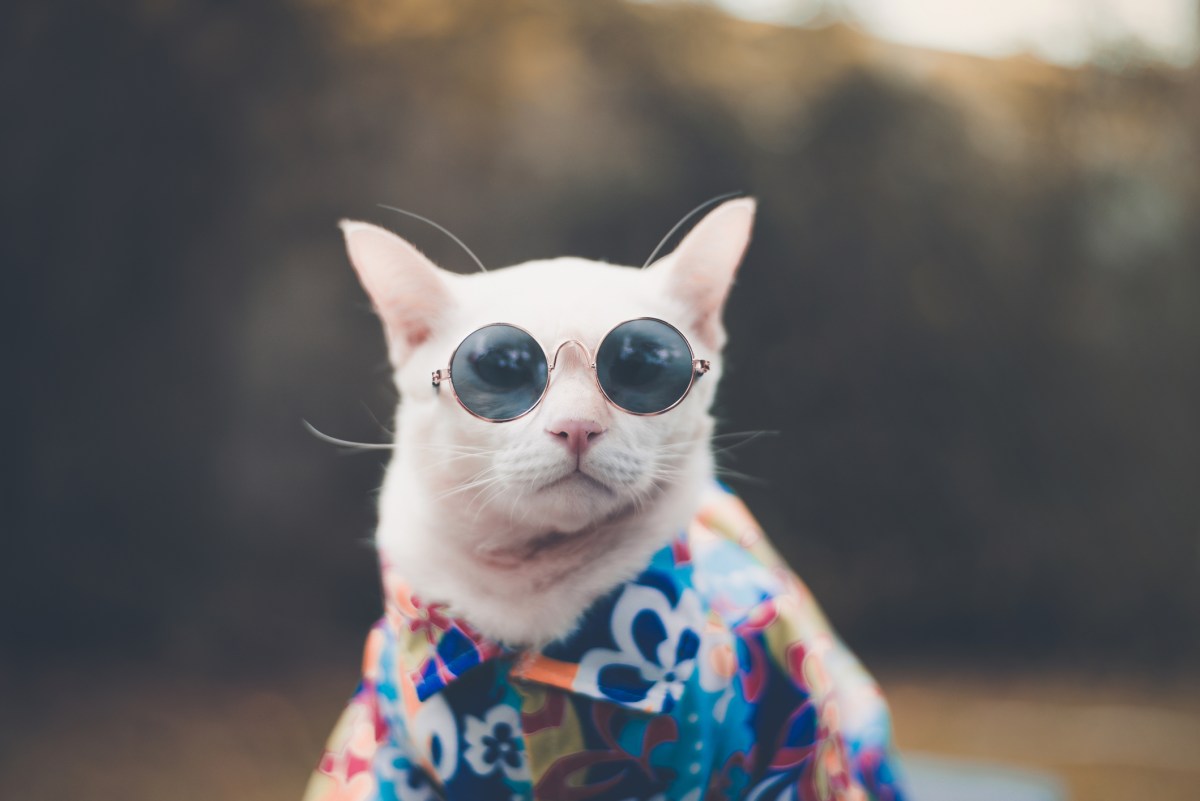
Portrait of Hipster White Cat wearing sunglasses and shirt
Influencers — or petfluencers — stage elaborate “pampering” scenes, and make their pets wear different clothes to show off their shopping “hauls.” Some pose their animals like dolls and find ways to coerce them to remain still. Audiences think it’s cute. It’s not.
As for me, I’ve got a handy chart when I’m unsure if Bud will be cool with something:
Make him wear clothes. Result: Get clawed to death
Give him baths with essential oils. Result: Get clawed to death
Make him wear sneakers. Result: Death by bite to the jugular
Force him to eat supplements or guzzle energy drinks. Result: Shredded skin and lots of blood, perhaps some light homicide.
While the animals themselves aren’t thrilled with these new trends, they probably won’t go away any time soon. There’s just too much money involved.
The average pet owner in the UK spent the equivalent of $163 per month on their companions, and only half of UK households have pets compared to 66 percent in the US. Although there’s not an apples to apples comparison of total expenses on pets per month by household in the US, Americans spend $68 a month on cats on average, according to research by ValuePenguin. For dogs, it’s about $110 a month.
‘Salty liquorice’ cats owe their unique coats to a missing snip of DNA
It’s always an interesting occasion when nature gives us something new, and the salmiak cat is definitely unprecedented in the world of feline aesthetics.
The unique cats, named after a popular liquorice candy from Finland, have a coat pattern that results from a gradient on individual strands of fur, starting out black and getting lighter toward the tip. It gives their coats a singular peppered look, and in photographs the unusual felines almost look as if they’re rendered in monochrome stippling.
Credit: Ari Kankainen
The Finnish candy the cats are named for.
The salmiak cat wasn’t the product of any breeding program, and reports in Finnish media say strays with the new coat pattern/color first emerged in 2007.
To find out how the salmiak emerged, a team of Finnish, British and American scientists sequenced the genomes of two salmiak cats. They found a mutation in genes that express coat color that resulted in a missing sequence of DNA, and they confirmed the mutation is recessive. That means to get salmiak kittens, both parents have to have the mutation.
Cats aren’t equipped to use human language and there’s nothing wrong with that. Our feline friends already go to great lengths to communicate in ways we can comprehend. The least we can do is meet them halfway.
I would love it if my cat could talk to me.
Sure, he never shuts up, but if he could speak English I’d know why he meows at the same spot at the same time every morning, or what he wants on the occasions when he’s still meowing insistently at me despite the fact that his bowls are full, his box is clean, he’s had his play time, and every possible need and want of his — that I can fathom — has been met.
Most of all, I’d really like to know he understands I’ll be back soon when I go away for a few days, and my (mostly ignored) pleas for him not to attack his long-suffering, way-too-kind sitter.
Alas, Bud cannot speak. No non-human animal has ever demonstrated even basic proficiency in human language. People will point to examples like Koko the Gorilla and Nim Chimpsky, but there’s a reason why funding dried up for that kind of experiment.
It doesn’t work. It never did.
The scientists who end up taking on dual roles as researchers and parents to the animals invariably serve as interpreters, get too close to their subjects and swear that a gorilla pounding shiny buttons for “food tree food submarine” means the ape wants to have a picnic next to the ocean, or “car fly house car star” means she wants to ride a Tesla Roadster to Mars and start a colony with Elon Musk.
Koko, Nim, Chantek and the other apes who were the subjects of decades-long attempts to humanize them — and teach them language in the process — were ultimately not much different than Clever Hans the horse, who was reading subconscious nonverbal cues from his owner and convinced tens of thousands of people that he could do math and understand spoken language.
Hans had scores of experts fooled until the German psychologist Oskar Pfungst figured out how the horse was coming up with the correct answers.
Regardless of which famous example we’re talking about, no animal has ever mastered syntax, and the best that could be said of their proficiency with language, or lack of it, is that they learned they’d get attention and food when they pounded on a talking board or approximated a word in sign language.
Even if non-human primates were able to learn a handful of words by frequently reinforced association with an object, there has never been any evidence that they are actually using the words as language rather than simply understanding “Pushing the button that makes this sound means I get a treat!” (And yes, there is a profound difference. The former reveals the presence of cognitive processes while the latter is a conditioned response.)
Despite decades of intense effort, no animal has ever demonstrated the ability to use human language. At best an animal bangs on a few buttons and people are left to speculate on the intent. Maybe Fluffy likes the way a certain word sounds. Maybe it’s just fun to hammer on buttons the way it’s fun to pop bubble wrap. Most likely, these cats and dogs know that using a talking board is a guaranteed way to get attention, a treat and a head scratch from their caretakers.
Influencers and their talking boards
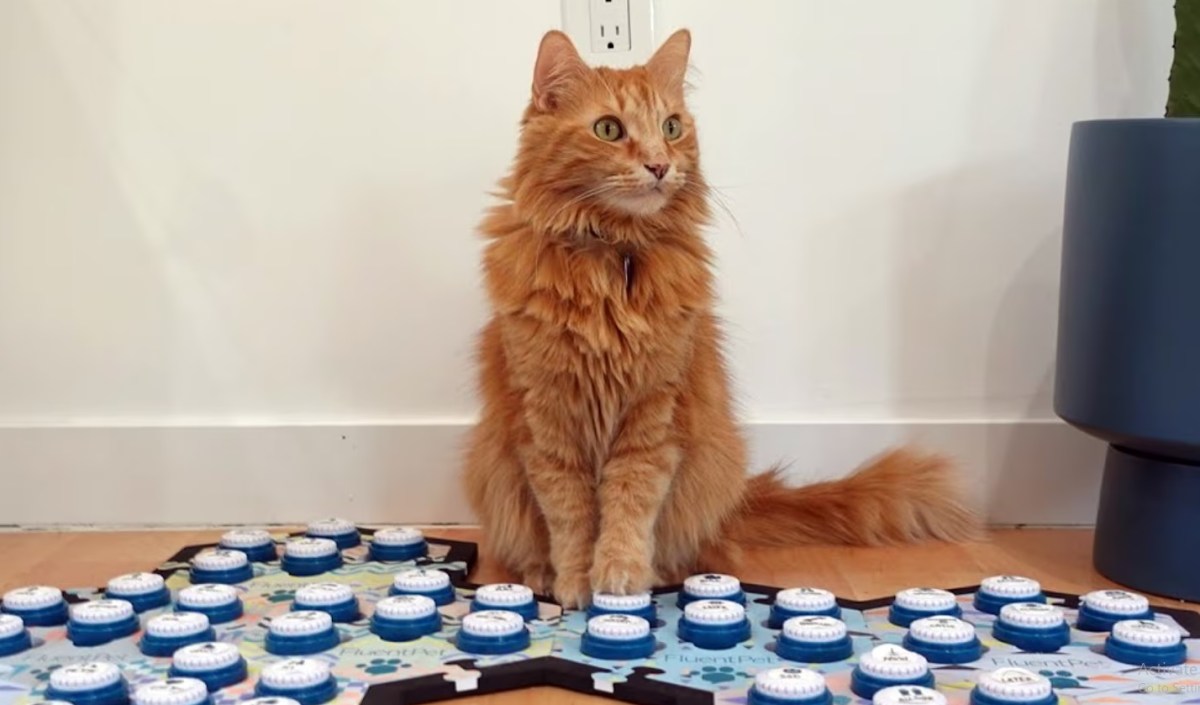
TikTok, which spawns inane trends with the reliability of an atomic clock, has provided a platform for people who insist their cats and dogs can talk. Using “talking boards” — elaborate set-ups in which words are assigned to their own buttons — they “teach” their cats how to express themselves in English and provide proof in the form of heavily edited, out-of-context clips that require the same sort of creative interpretation pioneered by Penny Patterson, Koko’s caretaker.
Seriously?
I just watched a video in which a woman claims her cat, named after Justin Bieber, was describing an encounter with a coyote by stomping on buttons for “stranger,” “Justin,” “Mike,” and “stranger.”
The woman says she thought Justin was asleep at the time, but now she believes the orange tabby saw the coyote outside and was still stressing about it well into the next day.
While she’s repeating Justin’s “words” back to him, two of her other cats come by and step all over the talking board. I guess whatever they had to say wasn’t important.
Justin’s talking board has 42 buttons, which stresses credulity well beyond the breaking point. More than half of the buttons are used for abstract concepts.
But forget all that for a moment and ask yourself how our own efforts to decode the meow have been going.
Despite our status as intelligent, sapient animals, despite the powerful AI algorithms at our disposal, despite the benefit of being able to digitally record and analyze every utterance, we haven’t come close to a reliable method for interpreting feline vocalizations.
Likewise with dolphins, whale song, corvid calls and the sounds made by other animals at the top of the cognition pyramid.
Mostly, we’re learning we’ve underestimated the complexity of our non-human companions’ inner lives, especially when it comes to the kind of multi-modal communication humans also engage in, but only subconsciously. We say what we want with our mouths, while our eyes, facial expressions and body language say what we’re actually thinking.
Likewise, the meow is an unnatural way for cats to communicate, and it contains only a fraction of the information cats are putting out there. It’s just that we can’t reliably read feline facial expressions, let alone tail, whisker and posture. (Studies have shown most of us, even when we live with cats, don’t get measurably better at this. In fact, we’re often no better than people with limited feline experience, but we think we’re better.)
Putting the burden on our furry friends
If we can’t crack a simple and limited system of vocalizations, aren’t we putting unrealistic expectations on cats? The average person has a vocabulary of tens of thousands of words, yet somehow we expect cats can latch on to an arbitrary number of them, approximate mastery of syntax that has eluded even our closest cousins, and bridge a cognition gap we haven’t been able to bridge ourselves.
It’s all too much.
I’ve had Buddy since he was eight or nine weeks old, and in more than nine years I still don’t know why he makes this praying motion. We may be best buds, but some things just don’t translate.
There’s a simple truth at the heart of this: Cats did not evolve to speak or parse human language, and that’s perfectly fine.
The little ones already meet us more than halfway because they understand we are hopelessly incompetent at reading tail, whisker or body language, and they understand we communicate with vocalizations.
By forgoing their natural methods of communication in favor of ours, cats are already taking on most of the burden in interspecies communication. Asking them to do more than that, to learn many dozens of words and the rudimentary rules of language, seems like laziness, wishful thinking or insanity on our part. Pretending that certain cats are successful is an exercise in the same kind of cynical opportunism that fuels every other desperate attempt by people trying to turn their pets into influencers. People do it because the reward is money and attention.
Worse, it contributes to the spread of misinformation. TikTok’s talking board videos routinely net millions of views, converting a credulous audience into an army of true believers who are convinced that, with just a little effort, their feline pal can shoot the shit with them.
If people want to construct elaborate talking boards in their homes and pretend their cats are expressing themselves in English, who am I to object? It’s not the smartest use of time, but have at it. What I won’t do is participate in the delusion that felines are a few buttons away from being able conversation partners, nor will I pretend these efforts have any relationship to science.
So to the journalists who keep writing credulous stories about these supposedly talking animals: please familiarize yourself with the example of Clever Hans, and please, I beg you to stop promoting these videos as if they’re anything more than wishful thinking. You are doing your readers a disservice for the sake of a few clicks.
Note: Jackson Galaxy isn’t a fan either, saying he’s “got some serious problems” with the talking board trend. Calling it “problematic,” he points out that cats are not only partially domesticated and the only animal species in history to take that step without human prompting, but humans have never selectively bred cats for specific behaviors or to bring out intelligence traits as we have with canines. (Think of sheep dogs or retrievers, who are the products of thousands of years of breeding for well-defined tasks.) There simply hasn’t been a need to breed cats for behavioral traits since the thing humans traditionally valued most about them — their ability to reliably eradicate rodents and protect human foodstuffs — is innate. No one had to teach cats how to hunt or breed them for the task. It’s only in the last two hundred years or so that certain human societies began breeding cats, and they did so for aesthetic attributes like coat patterns. Galaxy also notes that animals do not express emotions the same way humans do. Like monkeys, who “smile” when they’re terrified, felines express joy, anger and fear with their tails, whiskers, ears and body language. It’s not in their nature to tell us they’re happy or scared by padding up to a contraption and hammering on a button.
Top image of “Justin Bieber” the cat credit Sarah Baker.
Allexis Ferrell pleaded guilty to felony animal abuse, but she still hasn’t explained her actions.
A judge struggled to find words for his anger while handing down a sentence to an Ohio woman who ate a cat in front of her home this summer.
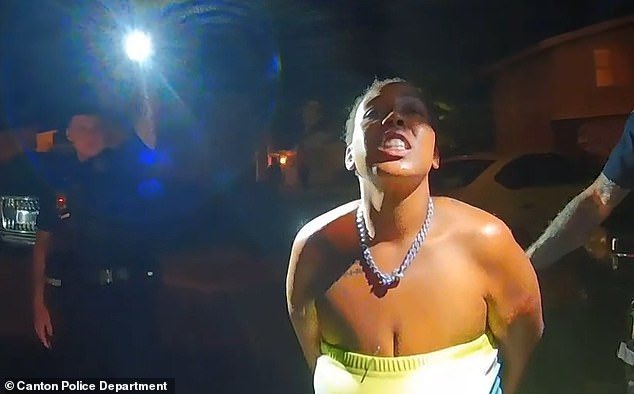
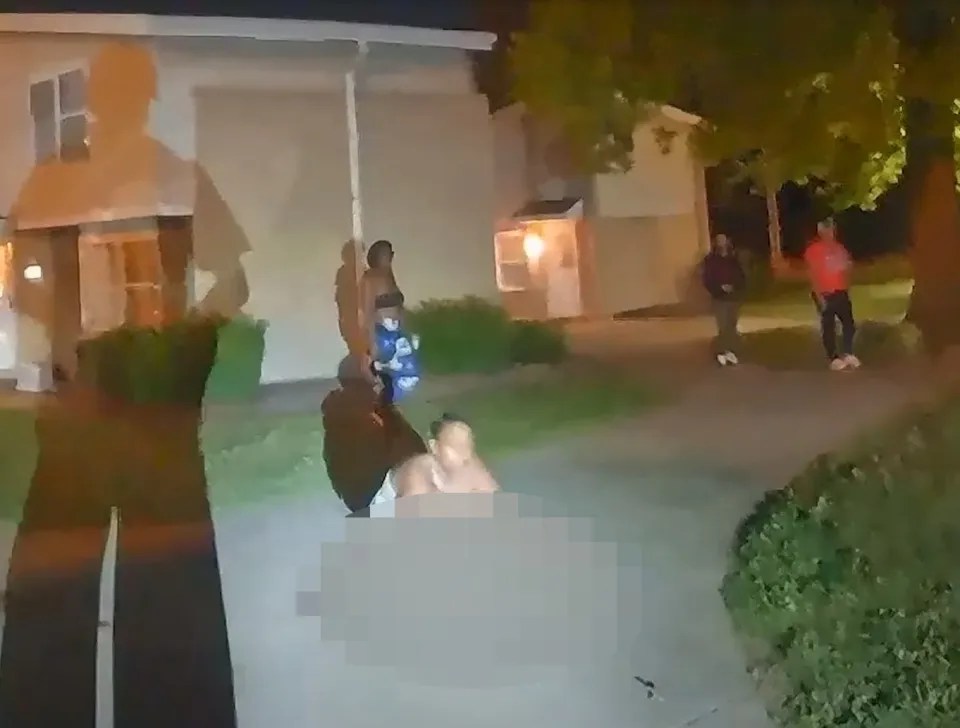
On the night of Aug. 16, 27-year-old Allexis Ferrell grabbed a stray cat and began eating it while it was still alive. Footage from freaked-out neighbors shows Ferrell on all fours in a driveway as she devoured the poor animal.
When horrified police officers arrived and asked Ferrell why she ate a cat, the woman — whose mouth was covered in blood — had no answer.
She still hasn’t explained her actions.
“This is repulsive to me. I mean, that anyone would do this to an animal. And an animal’s like a child. I don’t know if you understand that or not,” said Stark County Judge Frank Forchione. “I can’t express the disappointment, shock, disgust that this crime has brought to me.”
The judge says he considers Ferrell a threat to the community.
Shocked neighbors called the police when Ferrell attacked the cat.
On Monday, Forchione sentenced Ferrell to a year in prison, which she’ll serve in addition to 18 months’ prison time for two earlier cases involving theft and child endangerment. The one-year sentence is the maximum for felony animal cruelty in Ohio.
The incident made national headlines not only because it was vile, but also because the details weren’t made public until September — after then-candidate Donald Trump claimed immigrants in Springfield, Ohio, were eating pets.
Unscrupulous social media influencers and clickbait “news” sites added to the confusion by initially tagging Ferrell as one of the pet-eating immigrants, despite Canton’s location some 170 miles northeast of Springfield. Ferrell is an American citizen and was born here.
Oddly, although follow-up stories reported Ferrell’s attorneys petitioned the judge for drug and alcohol abuse treatment for their client, there was no mention of Ferrell being under the influence of drugs or alcohol the night she killed the cat.
Here on PITB we’ve flagged stories that illustrate the disturbing normalization of violence toward cats and other animals, but this incident defies categorization. Hopefully Ferrell is given the help she needs and is prevented from ever owning or interacting with animals in the future.









 Pain In The Bud