Crumbs was rescued from a bad situation where people fed him without regard for his health. Now he’s got a lot of work ahead of him as his new caretakers help him lose weight so he can walk on his own again.
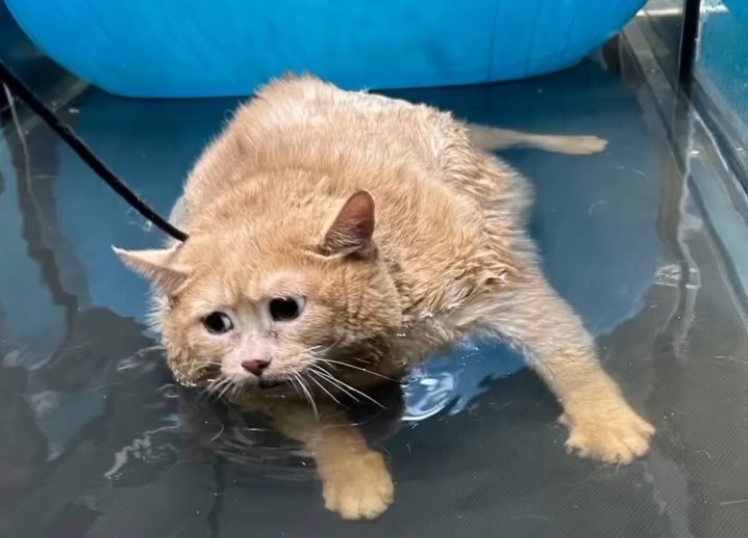
Crumbs, the morbidly obese tabby who was rescued from the basement of a Russian hospital last week, is already putting in the work to melt pounds.
That means he’s enduring two things most cats hate — exercise and water. You’ll recall from our earlier post that Crumbs weighs 38 pounds and cannot walk under his own power, so his new caretakers at Matroskin animal rescue in Perm, Russia, have him on a special waterproof treadmill where he gets the benefit of buoyancy while he gets his steps in.
The big guy is not a happy camper in the video, but he’s doing his best.
I’ve heard horror stories about the hospitals in Russia and Ukraine, so if it sounds strange that the staff at a hospital would feed cookies, soup and other inappropriate food to a cat, well, let’s just say it’s not the kind of environment most of us picture when we think “hospital.” (Which is another reason to be grateful for living in the west, where we have it much better than most of us generally realize.)
Non-native English speaking staff at the Hindustan Times may have confused Whiskas the cat food brand with whiskey, the alcoholic beverage, or there may have been a translation error.
Interestingly, a Hindustan Times story about Crumbs claims the hospital employees served whiskey to the obese cat in addition to the junk food, a claim repeated in the headline and article.
That would add another wrinkle to an already ridiculous story, but thankfully it’s not true. Your intrepid friends here at PITB checked the original text and with the help of translation software, determined it used the Russian word for “Whiskas,” as in the cat food, not whiskey. (It probably goes without saying, but never give alcohol to your cat. As little as a teaspoon of whiskey could be fatal.)
So if there’s some small comfort here, it’s that the people who fed Crumbs for so long weren’t completely ignorant to his needs, and it appears he got at least some species-appropriate food.
Crumbs shortly after he was rescued. Credit: Matroskin animal shelter
Cats understand a lot more than we give them credit for.
Even those of us who love cats often joke about how aloof they are, and then they go and do something that shows such a profound understanding of human behavior that we’re left thunderstruck.
That was the case in Turkey’s Izmir province, where a ginger tabby dragged her two babies into a health clinic this week one at a time, according to a report in the English-language Turkish news site Daily Sabah:
The official said that they noticed the animal while they were attending to patients as she started “constantly meowing.” When they saw something was wrong with kittens, they took a closer look and discovered the kittens’ eyes were closed tightly. “We gave them some drugs and they started opening their eyes and later, we transferred them to the veterinary department. It was the first time that an animal walked into our clinic, and it was a very emotional moment for us,” the official said.
Both kittens had eye infections and fully recovered.
This isn’t the first time cats have asked humans for help, nor is it the first time a mom cat brought her kittens into a hospital or clinic.
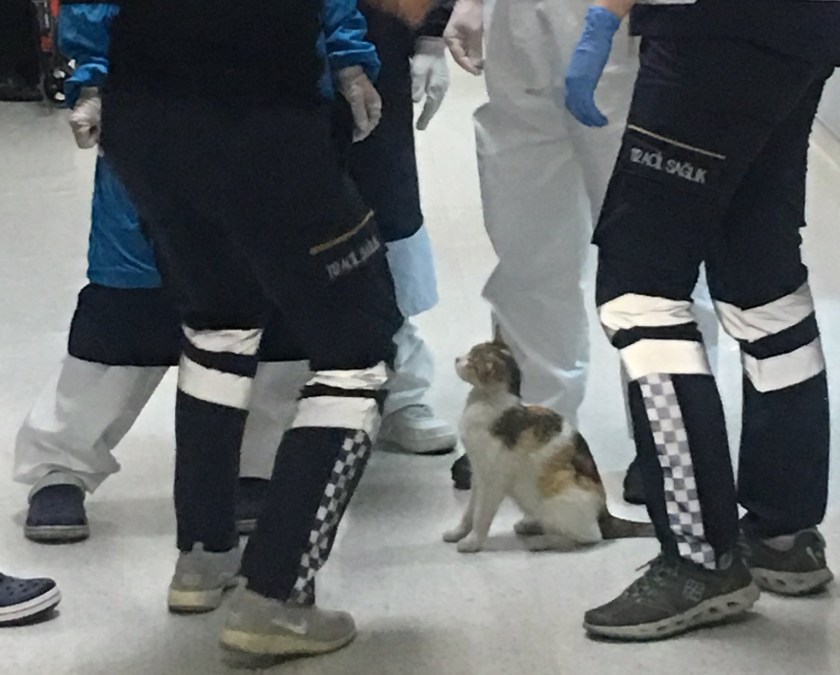
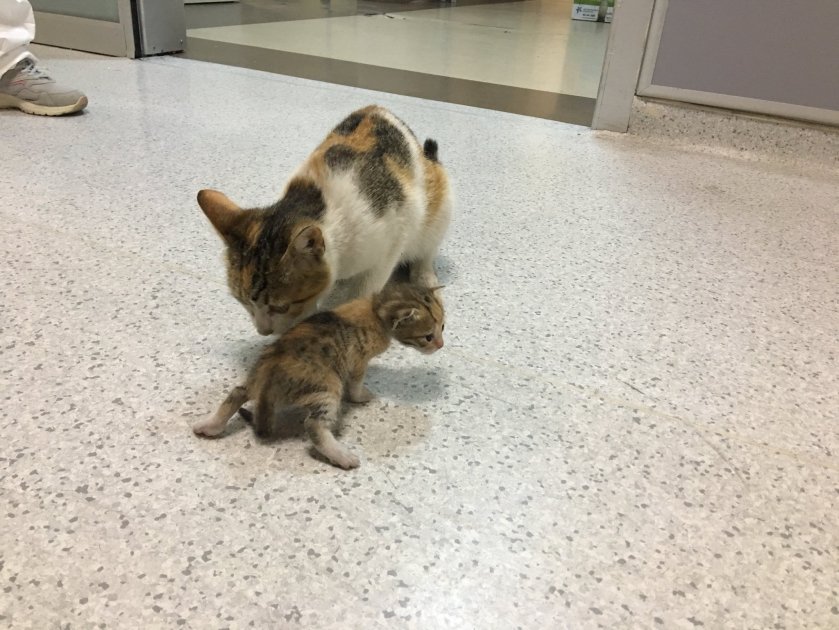
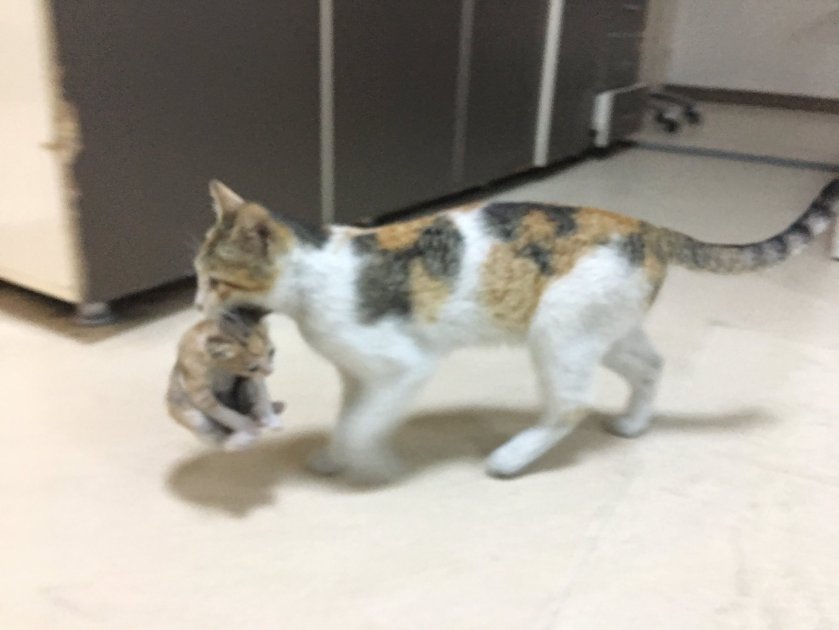
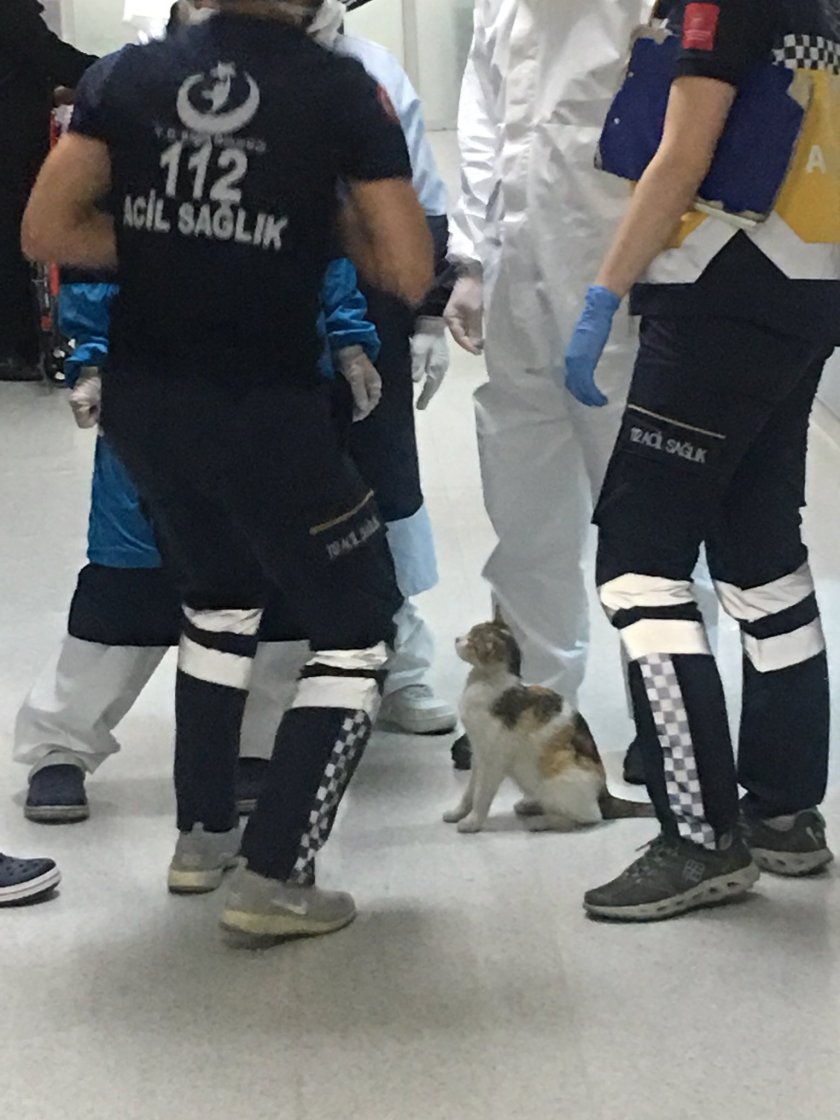
On April 27, 2020, a female cat walked into the emergency room of Kucukcekmece Hospital in Istanbul while carrying her kitten in her mouth, then deposited the “mischievous” little one right in front of a group of hospital employees who were chatting.
Hospital staff gave the mom food and water while they examined her baby.
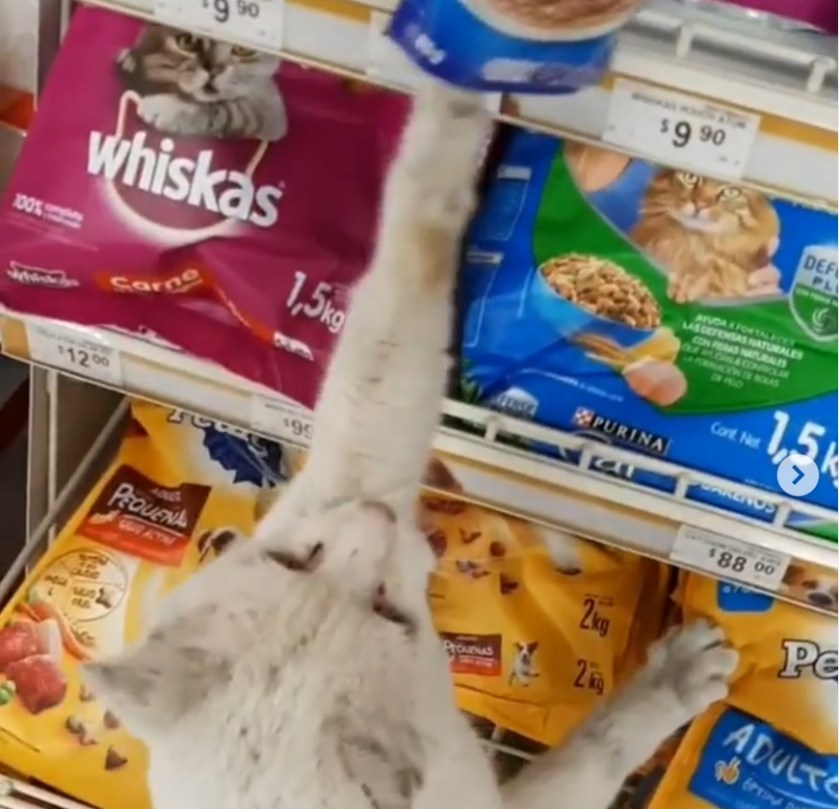
And in May of 2020, a cat in Mexico shocked a woman with his understanding of how the human world works. After she saw him in front of a store and bent down to pet him, he led her into the store, guided her to the pet food aisle and pointed to the exact type of food he wanted.
Not only did this cat understand that he had to be accompanied by a human to get into the store, and precisely where to direct her, but he also knew the packaging of his favorite food and understood that she had to buy it for him. He may not understand the concept of currency, but he does know a human has to get him the food and he can’t just tear into it.
The woman was so moved that she adopted the smart little guy and named him Rabbit.
Rabbit points to the food he wanted a kind woman to buy for him.
These examples not only show how astonishingly intelligent and observant cats are — or can be, when they’re motivated — they also make it difficult for anyone to cling to old beliefs that cats and other mammals are unthinking, unfeeling automatons. Or the dreaded, all too common “it’s just a cat.”
If cats understand hospitals and health clinics are places where the sick and injured are treated, and they understand abstract social concepts like “a human must obtain this for me,” it makes you wonder what else they observe and fully understand in those furry little heads.
A story from Turkey illustrates the deep bond animals share with their favorite people.
A story about an extraordinarily loyal dog has touched the hearts of animal lovers all over the world, and probably has many of us thinking: If I had a medical emergency, would my pet chase an ambulance to the hospital and wait there for days until I emerged?
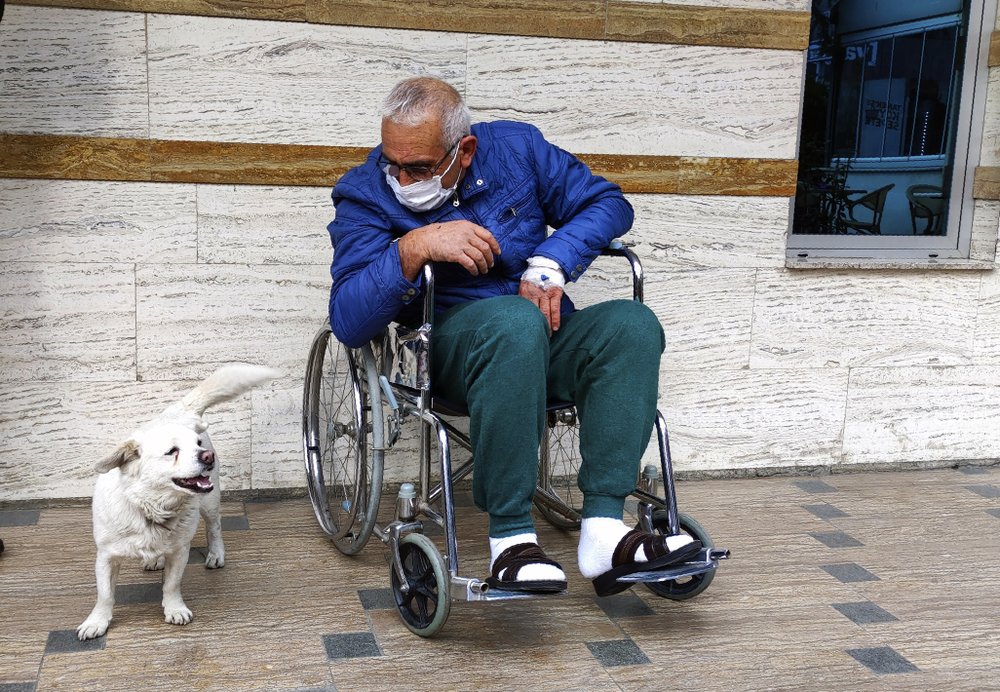
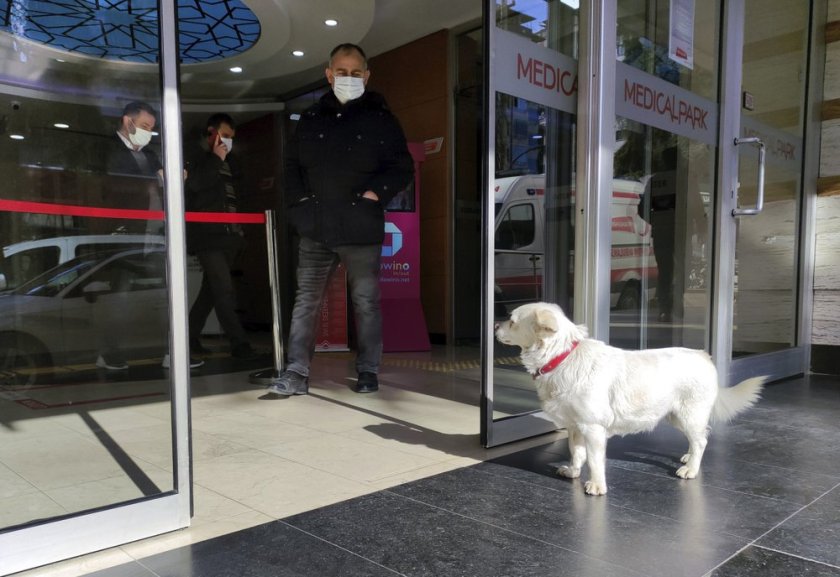
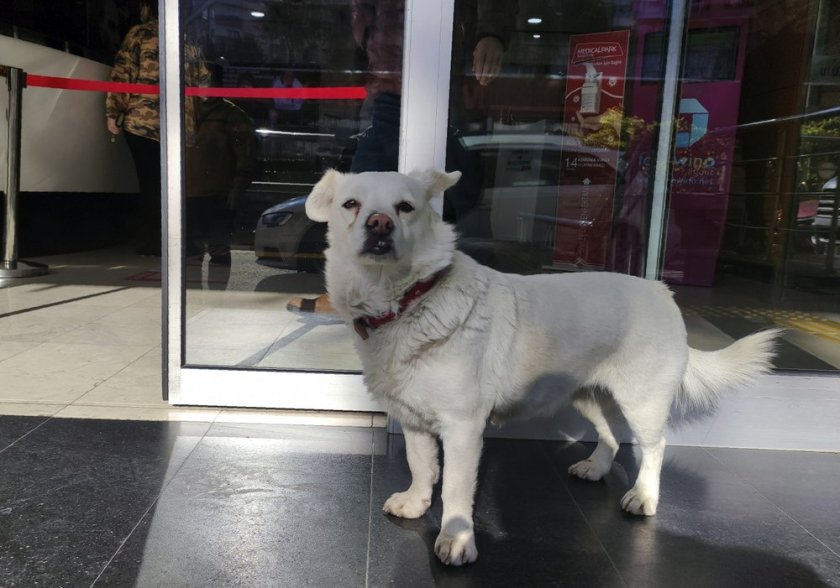
That’s what Boncuk the loyal dog did after her owner, Cemal Senturk, suffered a brain embolism and was taken to a hospital in the northern Turkish city of Trabzon on Jan. 14.
Boncuk waited patiently for her best friend until Aynur Egeli, Senturk’s daughter, took the loving pup home the first night.
The next morning Boncuk was gone, and Egeli knew exactly where she was going.
“She comes every day around 9 a.m. and waits until nightfall,” Muhammet Akdeniz, a security guard at the hospital, told local media. “When the door opens she pokes her head inside,” Akseniz said, but the polite pooch “doesn’t go in.”
Boncuk poked her head inside but knew she wasn’t allowed inside the hospital.
Boncuk was reunited with Senturk on Wednesday when an orderly wheeled the man out to the hospital entrance. Senturk was later discharged.
In photos and a short video of the reunion, Boncuk is the image of happiness and relief: Her tail wags uncontrollably and she can’t contain her enthusiasm as she literally jumps for joy.
“She’s very used to me,” Senturk said. “And I miss her, too, constantly.”
Boncuk’s story reminds us of Hachiko, the Japanese Akita dog who was so devoted to his owner, Hidesaburō Ueno, that he’d run to Shibuya station every day to greet Ueno as he stepped off the subway. Ueno was in mid-lecture in front of a class of students when he suffered a brain hemorrhage and died on the spot.
It’s a story of animal devotion that resonates so strongly with people that Hachiko was memorialized with a statue just feet from the spot where he stood every day, waiting for Ueno.
Boncuk waits for her owner in front of the hospital.
Yes, this wonderful story begs the question: Would my pet do the same for me?
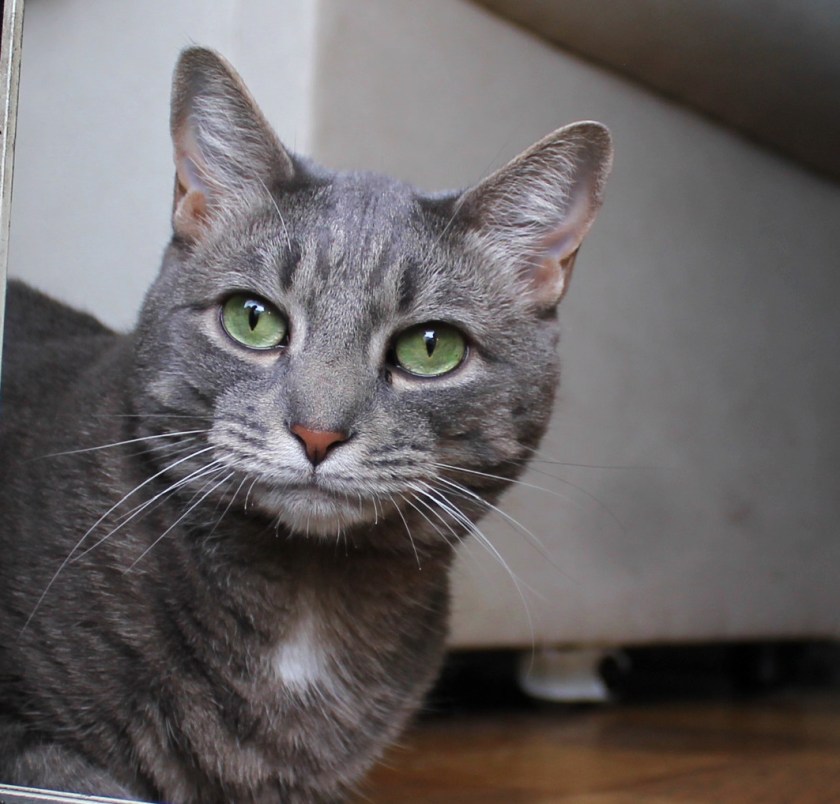
Putting aside the problem of actually getting to the hospital — which would be almost impossible given the distance, traffic and the fact that he’s an indoor cat — if Bud were allowed to stay in a hospital room with me, I believe wholeheartedly that he would remain by my side.
Like other pets who have strong bonds with their people, he knows when I’m not feeling well, and when I was sidelined with Bell’s palsy and a debilitating headache a few years ago, he never left my side.
That is not to say he wouldn’t be his usual incorrigible self. You know that little button that calls the nurse? He would abuse the hell out of it if he knew its function, and he’d probably think the nurses were there to serve him, bring him snacks and fluff his pillow.
“Nurse! In here! My pillow needs fluffing! Also, could you be a doll and fetch me some Temptations?”
The truth is that pets are not allowed in the vast majority of hospitals. Writing in PetLife, Alicia Beyer notes pets “not only brighten patients’ spirits, but hospitals are reporting that the pet visits can have dramatic effects on patient’s health, recovery and emotional well-being.”
In Canada, there’s an organization called Zachary’s Paws, which was started by Donna Jenkins in honor of her 25-year-old nephew.
“While Zachary was in the hospital for many weeks and very sick after having a stem cell transplant, he begged to see his dog, Chase,” Jenkins told Bored Panda. “We sneaked Chase into ICU to see him and the effect it had on Zachary was remarkable. When Zachary realized he was not going to survive his cancer, he made me promise to start the organization.
But as PetMD notes, there are good reasons why most hospitals don’t allow pets, including problems pets can pose to patients with compromised immune systems and allergies. Hospitals that do allow pet visits have strict standards, and the animals must be thoroughly cleaned by staff before they’re allowed in.
Alas, even as more hospitals allow pet visitation or therapy animals, many exclude cats, and a 2015 report by the Society for Healthcare Epidemiology of America says cats “should be excluded.” The report claims cats can’t be trained as well as dogs, the risk of bites and scratches is higher, and more patients may be allergic to cats.
Buddy and I were a bit skeptical when we first heard the story of a cat who padded into the emergency room of a hospital, carrying her kitten by the scruff of the neck, to plead for help for the little one.
The story first appeared on Reddit without any details, but we were able to track down some of the people involved to fill out the narrative and answer some questions.
A woman was waiting in the emergency room of Kucukcekmece Hospital in Istanbul at about 5 p.m. on April 27 when the cat dragged her baby through the open doors.
A mom cat brings her sick baby into an ER in Istanbul. Credit: Merve Özcan
The witness, Merve Özcan, described the kitten as “a little bit mischievous” in Twitter posts about the incident.
An article in Sözcü, a daily newspaper whose name translates to “spokesperson,” said the mother cat brought her kitten right up to the blue-gowned hospital staff, meowing for attention.
Hospital staff immediately helped — more about that below — and the cat mom followed them, keeping her eyes on her baby as they brought the kitten into a room for treatment.
“While the kitten was being cared for, the mother cat was given milk and food,” the newspaper reported. “Hospital staff ensured full treatment by passing them onto a veterinarian after their intervention.”
Staff take the kitten as the mother watches. Credit: Merve Özcan
The story doesn’t say exactly what was wrong with the kitten, and Özcan did not know either.
While this story would seem insane to most of us, it starts to make a lot more sense when you consider where it happened: Istanbul, a city famous for its massive cat population, and the humans who revere those felines.
Cats are the most beloved animal in Istanbul and the living attraction of this huge city. They are extremely friendly, come in all sorts of cuddly colors and sizes, and always respond with a greedy “meow.” Stray cats usually take the best seats at cafes and restaurants in Istanbul without anyone even bothering moving them. They maneuver around tables and customers, inside and out of the buildings in search of the most comfortable spot.
Caring for the city’s hundreds of thousands of cats is a community effort: People feed them, pet them, bring them to veterinarians when they’re injured, and even build little dwellings for them.
With that in mind, it makes sense that a cat in Istanbul would know to approach humans for help, and to go to a hospital. If the mom cat lives in the area, undoubtedly she’s seen the sick and injured walk through those doors many times.
“Money is not an issue to some people when it comes to cats,” Ozan, a pet shop employee, told Reuters. “They take in cats with broken legs, blind ones or ones with stomach problems and bring them to the clinic. When they see that they are healed, they let them live on the street again.”
In an article titled “Istanbul: The City of Cats,” Goran Tomasevic of Reuters describes the relationship between the city’s inhabitants and their feline friends:
They are so ubiquitous that no one bats an eye at a cat padding across the lobby of a high-rise office building, or when one curls up to sleep on a nearby barstool. Shop owners and locals often know their neighbourhood cats by name and will tell tales about them, as if chatting about a friend.
A cat house next to water and food bowls on an Istanbul street. Credit: Reuters
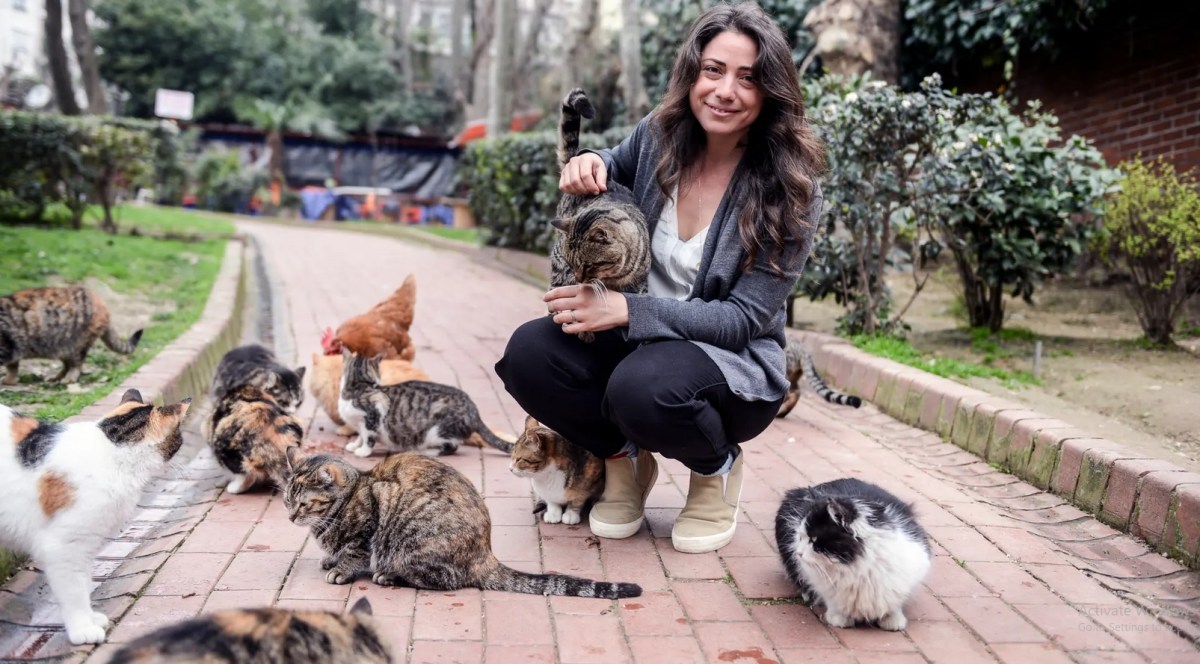
A 2017 documentary, Kedi (Turkish for cat), explores the world of Istanbul’s street cats and the people who love them. Pictured at the top of this post is Kedi director Ceyda Torun, posing with cats in Istanbul.




 Pain In The Bud