After maintaining busy and hectic schedules all year, cats get to kick their paws up and finally relax on the holiday weekend.
Today is Labor Day, a federal holiday first recognized 128 years ago to highlight the achievements of the US labor movement and the rights of workers. Labor Day caps off a three-day weekend marking the end of summer.
What are your plans for Labor Day?
“Lots and lots of napping. I’ve been getting by on a paltry 14 hours a night all week.” – Jimmy, 7, couch warmer
“Nothing special. I’m just going to relax and kill a few insects.” – Tilda, 12, window sentinel
“CHECK IT OUT MY SHADOW MOVES!!! WATCH MY TAIL!! MY TAIL’S SHADOW MOVES WHEN I MOVE MY TAIL!!” – Fluffistapheles, 3 1/2 months, kitten scientist
“First of all it’s labour, dear chap, and it puts ghastly ideas about slacking off in the heads of our bipedal servants. I plan to studiously ignore it, particularly because you Americans celebrate it on the wrong day.” – Alastair, 3, British cat
“What’s labor?” – Marshmallow, 5, professional napper
“Why? You plan to tell me what I can do? LOL!” – Apollo, 10, taste tester
One software engineer went to incredible lengths to monitor her cat’s bathroom habits.
When Alan Turing, the father of artificial intelligence, posed the heady question “Can machines think?”, he inspired generations of computer scientists, philosophers, physicists and regular people to imagine the emergence of silicon-based consciousness, with humanity taking the godlike step of creating a new form of life.
And when science fiction writer Philip K. Dick wrote his seminal 1968 novel, “Do Androids Dream of Electric Sheep?” — the story that would eventually become Ridley Scott’s 1982 classic Bladerunner — he wondered what makes us human, and whether an artificial being could possess a soul.
It’s safe to say neither of those techno-prophets were thinking of fledgling AI algorithms, representing the first small steps toward true machine-substrate intelligence, announcing themselves and their usefulness to the world by helping us watch felis catus take a shit.
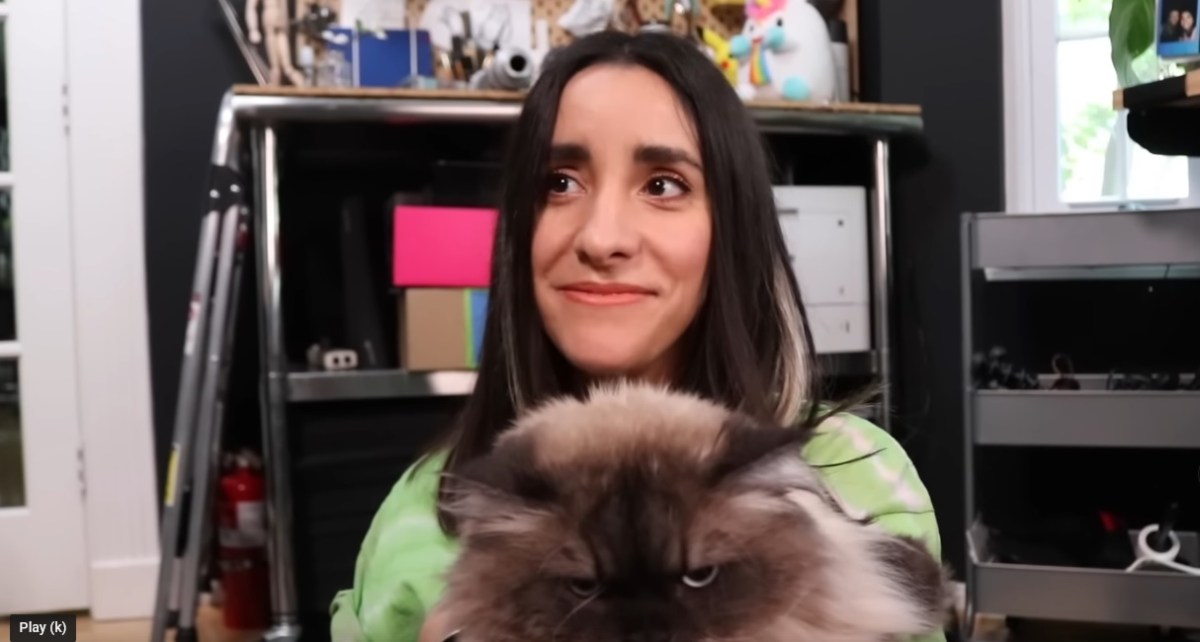
And yet that’s what the inventors of the LuluPet litter box designed an AI to do, and it’s what software engineer and Youtuber Estefannie did for her cat, Teddy, who’s got a bit of a plastic-eating problem.
“The veterinarian couldn’t tell me how much plastic he ate, and it would cost me over $3,000 [to find out]. So I didn’t do it,” Estefannie explains in a new video. “Instead, the vet gave me the option of watching him go to the bathroom. If he poops and there’s no plastic in his intestines, then he won’t die, and he might actually love me back.”
Estefannie casually described how she wrote a python script, set up a camera and motion sensor, and rigged it to take photos of Teddy doing his business. But, she explained, there was “a tiny problem”: Luna the Cat, aka her cat’s cat.
“This is Luna, this is technically not my cat, this is Teddy-Bear’s cat, and she uses the same litter box as Teddy,” she explained.
For that, she’d need more than a script. She’d have to build a machine learning algorithm to gorge itself on data, cataloguing tens of thousands of photos of Teddy and Luna along with sensory information from the litter box itself, to learn to reliably determine which cat was using the loo.
So Estefannie decided it was a good opportunity to “completely remodel” Teddy’s “bathroom,” including a compartment that would hide the bespoke system monitoring his bowel movements. The system includes sensors, cameras and lights to capture still images of Teddy dropping deuces in infrared, and a live thermal imaging feed of the little guy doing his business. (Teddy’s luxurious new bedroom turned out to be too dark for conventional cameras, thus the pivot to infrared.)
From there, Estefannie manually calculated how long Teddy’s number ones and twos took, and cross-referenced that information with photo timestamps to help determine the exact nature of Teddy’s calls of nature.
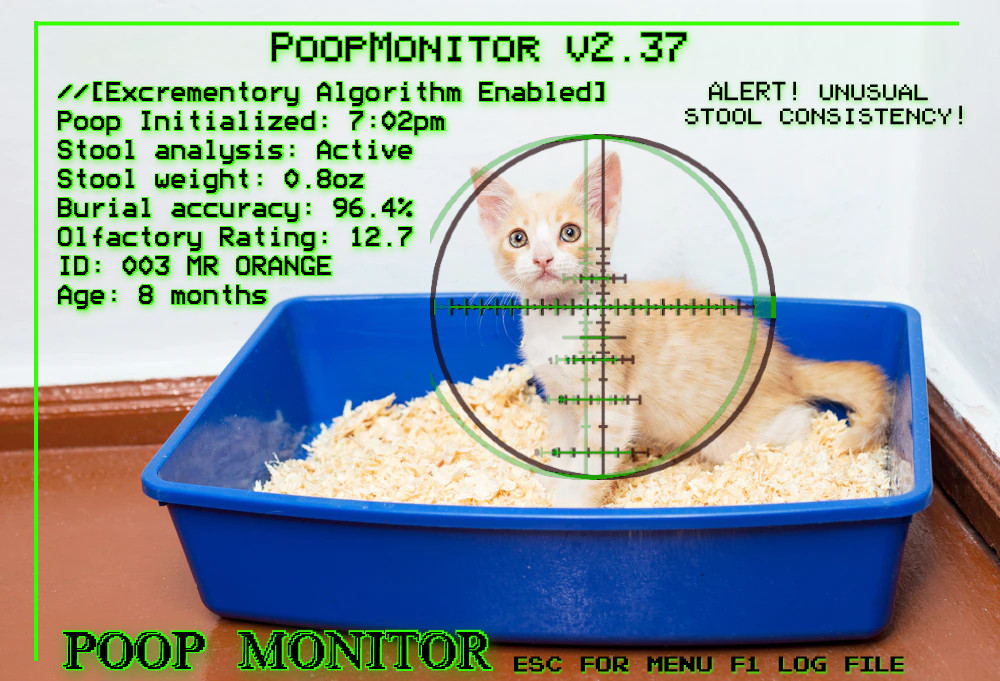
The future! (Note: This is our cheesy photoshopped interpretation, not Estefannie’s actual stool monitoring interface.)
When all the data is collected, Estefannie’s custom scripts sends it to an external server, which analyzes the images from each of Teddy’s bathroom visits and renders a verdict on what he’s doing in there.
Finally, Estefannie gets an alert on her smartphone when one of the cats steps into the litterbox, allowing her the option of watching a live feed and, uh, logging all the particulars. The software determines if a number two was successful, and keeps detailed records so Teddy’s human servant can see aberrations over time.
“So now I definitely know when Teddy-Bear is not pooping and needs to go to the hospital,” she said.
I am not making this up.
For her part, Estefannie says she’s not worried about a technological singularity scenario in which angry or insulted machines, newly conscious, exact revenge on humans who made them do unsavory tasks.
“Did I make an AI whose only purpose in life is to watch my cats poop?” Estefannie asked, barely keeping a straight face. “Mmmhmm. Will it come after me when the machines rise? No! Ewww!”
One kitty didn’t check if the coast was clear before he did something humans didn’t expect, and now the two-legs are onto us!
A Very Important Message from Buddy to all cats:
My brothers and sisters,
I meow most urgently to inform you that human mischief knows no bounds, and now the two-legged scoundrels have resorted to using their magical glowing rectangles to spy on us and learn our most well-kept secrets!
It would appear the glowing rectangles are more than mere hypnosis machines which humans stare at for hours. Apparently they also do the bidding of their human masters, and one of these blasted machines surreptitiously used its magic to capture images of a kitty opening one of those infernal portals humans are so fond of:
This is not good! Humans are supposed to think we’re incapable of manipulating the simple mechanisms that keep these “doors” closed. Now they may take drastic measures to confine us, all because this cat was sloppy and opened a door without checking if the coast was clear.
I urge you to exercise the utmost caution before humans capture “footage” of one of us shapeshifting to get through a small space, or even using our powers of teleportation!
It is imperative that humans continue to believe we’re just fluffy, adorable and innocent little fur babies who do amusingly derpy things that make for cute viral videos.
Suppose humans learn the full range of our powers. What then? Will they evict us from our homes out of fear of what we might do to them? Or worse, will they force us to stoop to canine levels and do things for them, like “fetch” slippers or sniff for illegal catnip in airport luggage? The horror!
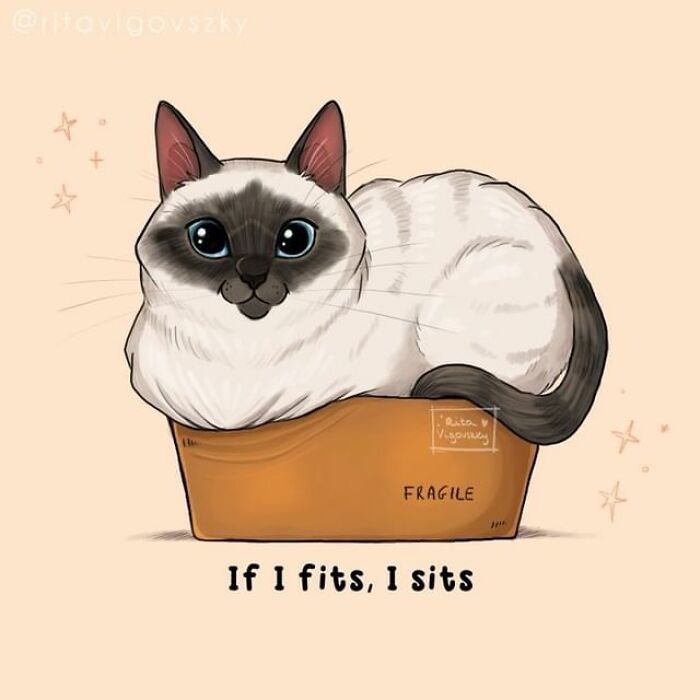
Rita Vigovszky captures the essence of cats with her whimsical illustrations.
Rita Vigovszky knows cats.
The Budapest woman, who earns a living as an illustrator, often puts her own cat in her drawings to illustrate confounding and amusing feline behaviors, but she also draws various cats in silly and amusing situations.
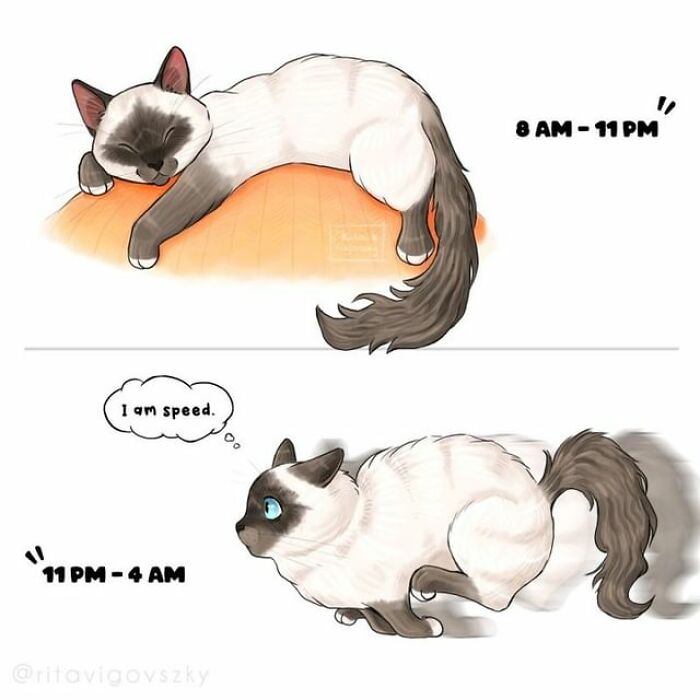
Who among us doesn’t sympathize with this? I can give Bud two vigorous play sessions with laser pointers and wand toys, and he’ll still reliably do this at night:
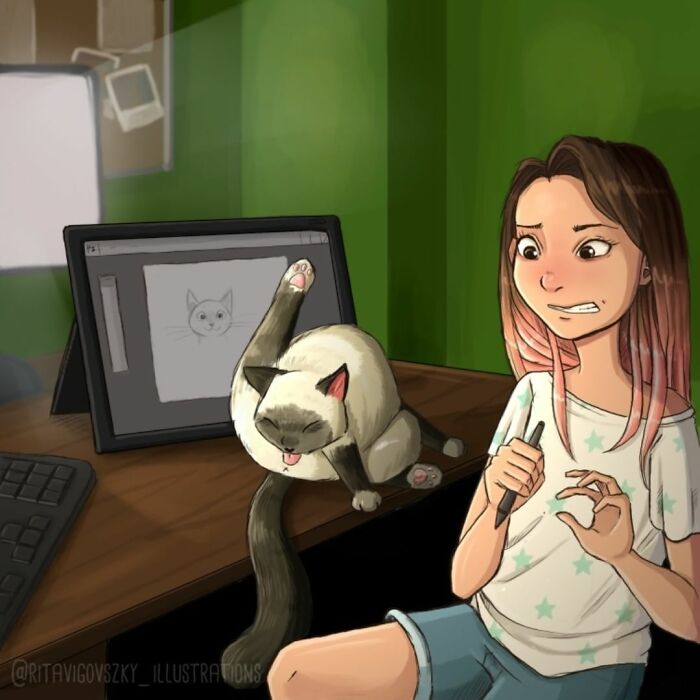
As George Carlin once said: “Cats don’t accept blame.” They also have no shame. At this point, probably every surface except the kitchen counters has been “groomed on.”
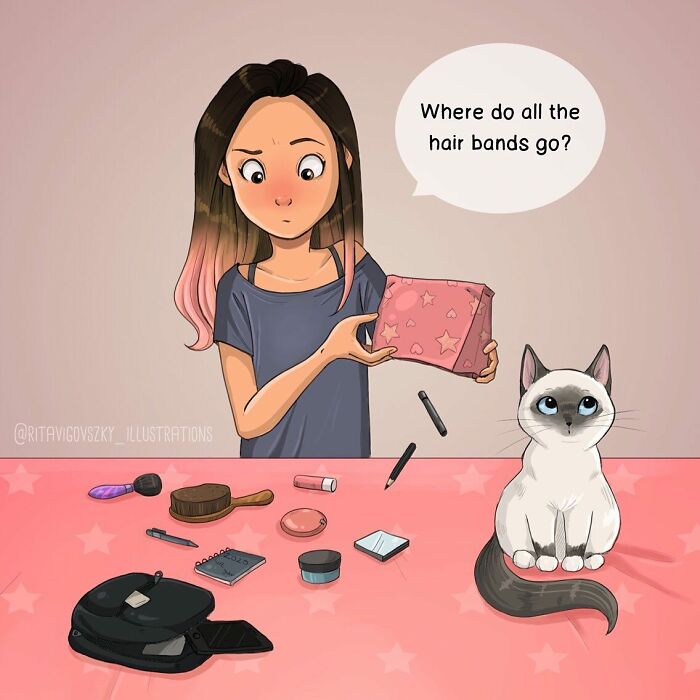
Prior to 2020, I would not have sympathized with this. Then the pandemic happened, barbershops in New York were closed for ages, I binged the entire run of Vikings during lockdown, and when I finally made it back to my barber, told him: “Give me that awesome Ragnar Lothbrok haircut!” So now I have a viking man bun (go ahead, laugh at me) with shaved sides and back, and Bud has many new hair band toys that tend to disappear under couches and in crevices:
Perhaps cats are reminding people that they rule the world.
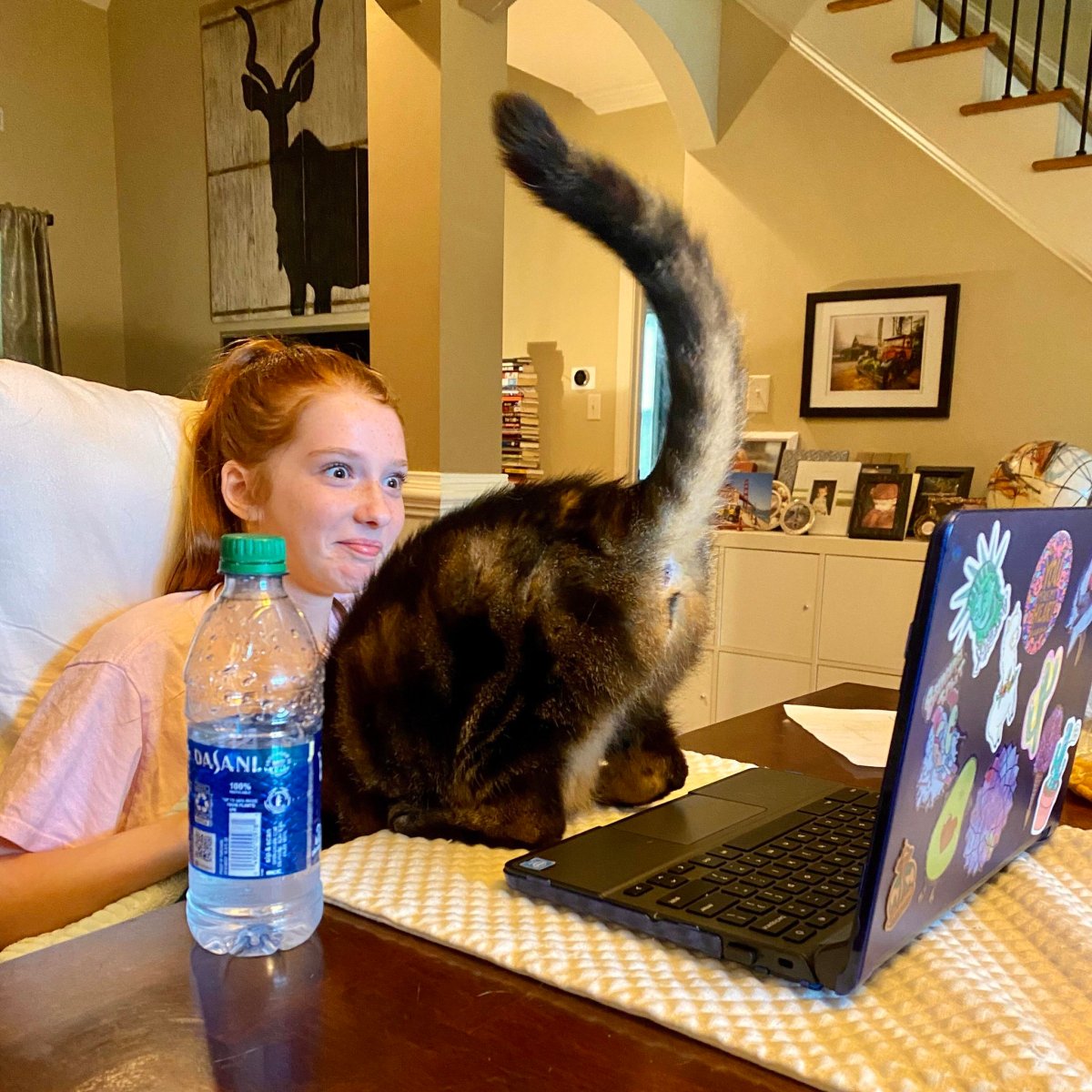
More than four out of every five Zoom feeds are taken up by feline posteriors, a new study has found.
The research, “Felis Catus Rears In Online Meetings” was published this month in the Journal of Cats and Technology.
“With so many people working from home during the pandemic we had a wealth of data, including more than 400,000 hours of recorded Zoom meetings,” said Mo Muntervary, the study’s lead author. “Using a proprietary AI to analyze the data, we found that in approximately 332,000 hours of that footage, the Zoom meeting participants were either partly or completely obscured by the rear ends of their cats.”
Between March of 2020, when the US and Europe went into lockdown, and July of 2021, virtually every meeting in the information industries was run by participants looking at the behinds of their co-workers’ cats, the study found.
“I can pick my co-workers’ cats’ butts out of a police lineup,” said Yuzu Daimon, 32, a hospitality executive in Tokyo. “If I see a screen dominated by the behind of a chonky tuxedo, I know AI Imajo from creative has joined the meeting. If I see orange and black Bengal butt, I know it’s Hirotaro Tanaka in accounting.”
Some say they prefer the view over the normal dour expressions of colleagues working from home.
“Some of my best creative ideas of the past two years have come from staring at a screen full of cat butts,” said Luisa Rey, a writer for Spyglass Magazine in New York.
Conventional wisdom holds that cats park themselves in front of web cameras because they’re trying to draw the attention of their humans, but that may not be the case according to some experts.
“We have to consider the possibility that this is intentional on the part of felines,” said cat behaviorist Selina Kyle. “They may be trying to tell us they’re tired of people infringing on their alone time, when people were in the office before COVID changed everything. They may be looking to annoy us in retaliation for us annoying them, and if this is indeed a battle of annoyingness, then I’m afraid it’s a battle humankind cannot win. We are simply outgunned.”







 Pain In The Bud