How Much Does It Cost To Care For A Cat?

Two new reports estimate the cost of caring for a cat over a typical 15-year lifespan.

Two stories published in recent days give wildly varying estimates of how much it costs for the privilege of serving a cat.

First we should note that both reports assume the cats are adopted in kittenhood and the average lifespan of a cat is 15 years. That’s in line with current data showing well cared-for, indoor-only cats live between 12 and 18 years, with outliers on both ends. It’s not uncommon to hear about cats living well into their 20s just as some cats sadly pass on before their time, whether due to natural causes, illness or accidents.

A Texas cat named Creme Puff is the Guinness World Record holder for longest-lived house cat, holding on for an astonishing 38 years until her death in 2005.

Caring for a house panther can cost between $4,250 and $31,200 over kitty’s lifetime, according to an analysis of associated costs by The Ascent, a vertical of financial literacy site The Motley Fool.
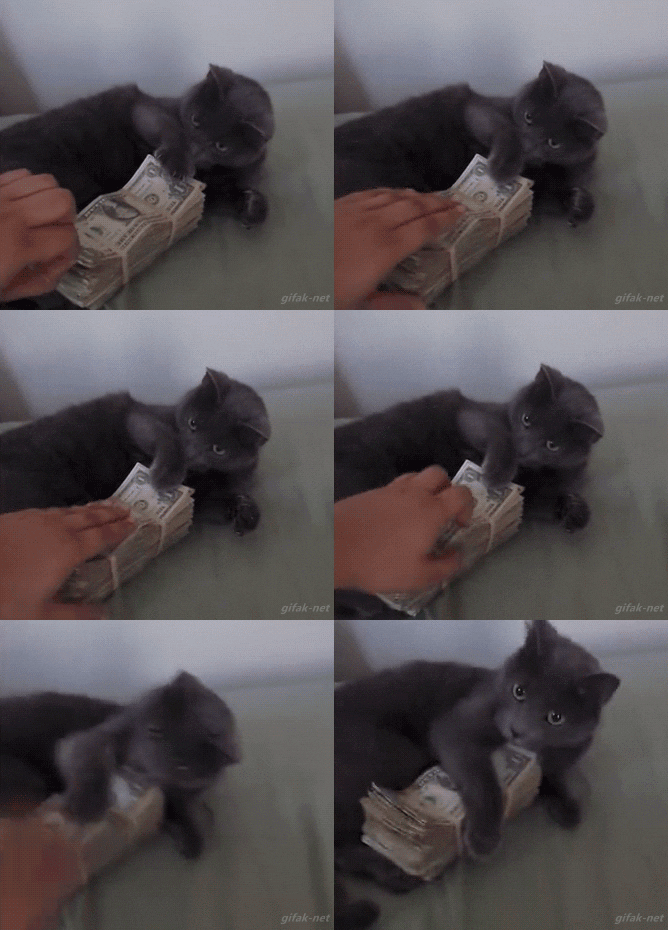
Kitty Cash
“My moneys, human! MINE! Unpaw those bills!” Credit:@catsandmoney/Twitter

The estimates break costs down into recurring expenses — which include food, treats, litter and veterinary care — and fixed expenses like scratching posts, toys, additional cat furniture, bowls, grooming tools and similar items.

Not surprisingly, the biggest expense is food, the cost of which has been exacerbated by inflation, rising fuel costs and lingering supply chain issues that caused a cascade effect during the pandemic. Everything from sourcing metal for cat food tins to meat availability was impacted as ports were closed and meat processing plants were shuttered at various points since early 2020.

An unrelated estimate from OnePoll, based on a survey commissioned by pet food company Solid Gold, put the lifetime estimate of cat servitude at $25,304. Like the Motley Fool analysis, OnePoll’s respondents cited food as the primary expense, followed by veterinary care.

The wide range from the Motley Fool analysis could be attributable to geography, how well the cat is fed, and how many extra things caretakers do for their cats. A person who lives in Manhattan, splurges on bespoke feline furniture and buys ultra-premium cat food at almost $3 a can is going to spend significantly more than an eastern European cat servant who feeds raw or home-cooked food and builds their own ledge loungers and scratching apparatus.
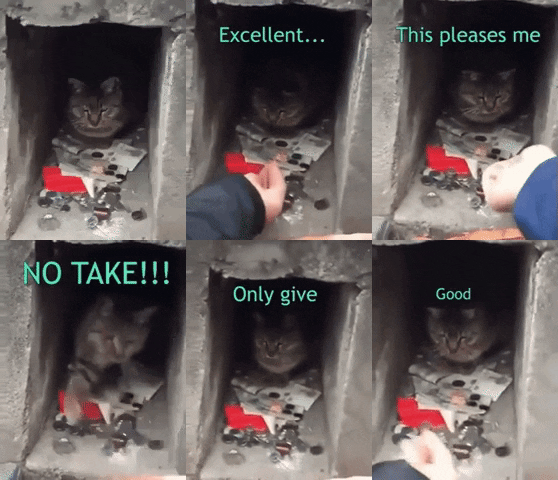
Teh Bank of Kitteh
“Welcome to Teh Bank of Kitteh, you may make a deposit but not withdraw!” Credit: @catsandmoney/Twitter

Here in New York the cost of cat food in local grocery stores has spiked dramatically, but online prices have remained steady. Keeping in mind we’ve never really endorsed any particular brand or vendor on PITB, I switched from occasionally buying food online to Chewy auto-shipments during the pandemic because Bud’s favorite food was becoming very difficult to find locally, and that arrangement has worked out cost-wise as well.

Bud’s a true Pain In The Bud when it comes to “leftovers” so his primary wet food is Sheba Perfect Portions. It’s reasonably priced, comes in variety packs and helps avoid waste since each meal comes in its own 1.3oz recyclable blister-like plastic package. (Recycling is especially important with these single-serve packages, tiny as they are.) His dry food is Blue Buffalo Wilderness Adult Chicken recipe, although occasionally I’ll buy the weight control version of the same dry food when it looks like Little Man has gotten a bit chubby. He doesn’t protest, thankfully.

I feed him two 1.3oz wet meals a day and fill his dry bowl less than halfway at night so he can have his late snack and doesn’t have to wake me up if and when he gets hungry overnight. Sometimes I’m dimly aware of him sliding off me, padding over to his little dining nook and munching on dry food before hopping back onto the bed and dozing off again.

Overall it works out to about $21 a month, so I’d call it an even $25 with treats. You can schedule your auto-ship at any interval you choose, edit it at any time, and prompt the shipment immediately if you’re running out of food, so you can save more by ordering a few months’ worth of food at a time and taking advantage of free shipping on orders of more than $50.

Has inflation impacted cat food prices in your local area? How much does it cost to feed your cat(s) every month?
Rich Kitty
“I’m a nip dealer, so what? Stop judging!”

Buddy Quarantines His Human After Learning Cats Can Get COVID

The effort follows Buddy’s unsuccessful attempt to get vaccinated and plans for airtight domes over his sleeping and eating spots.

NEW YORK — Citing a recent article about the possibility of humans infecting their pet cats with Coronavirus, Buddy the Cat took the extraordinary step of quarantining his human, sources said.

The tabby cat, who is normally infamous for his deep loathing of barriers, had constructed an elaborate series of intra-apartmental checkpoints and procedures designed to keep him separate from his human, Big Buddy.

Under the new procedures, Big Buddy was banned from his own bedroom and had his snuggling privileges revoked.

“I just can’t take the chance, especially not with this Omicron variant infecting everyone,” Buddy said of his decision. “It’s not just about getting sick. Did you know sometimes COVID destroys your sense of taste and smell? It’s true! What life is worth living if you can’t taste every delicious morsel of turkey, if you can’t savor the aroma of dirty socks?”

As of Friday, the cautious cat had placed ads on Craigslist and other local sites.

“Seeking Temporary Servant,” the ad reads. “Must serve my meals, clean my poops, feed me snacks, allow me to sleep on you, and give me massages while telling me what a good boy I am. Applicants must agree I am a very handsome cat, and you will be expected to write a short essay about why you’re excited to serve me. THIS IS NOT AN ENTRY LEVEL POSITION. Experienced cat servants only!!!”

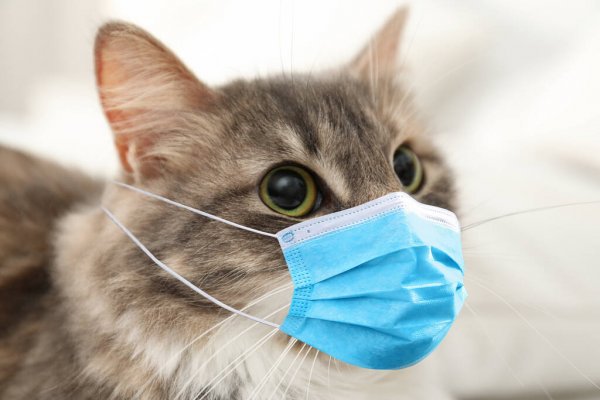
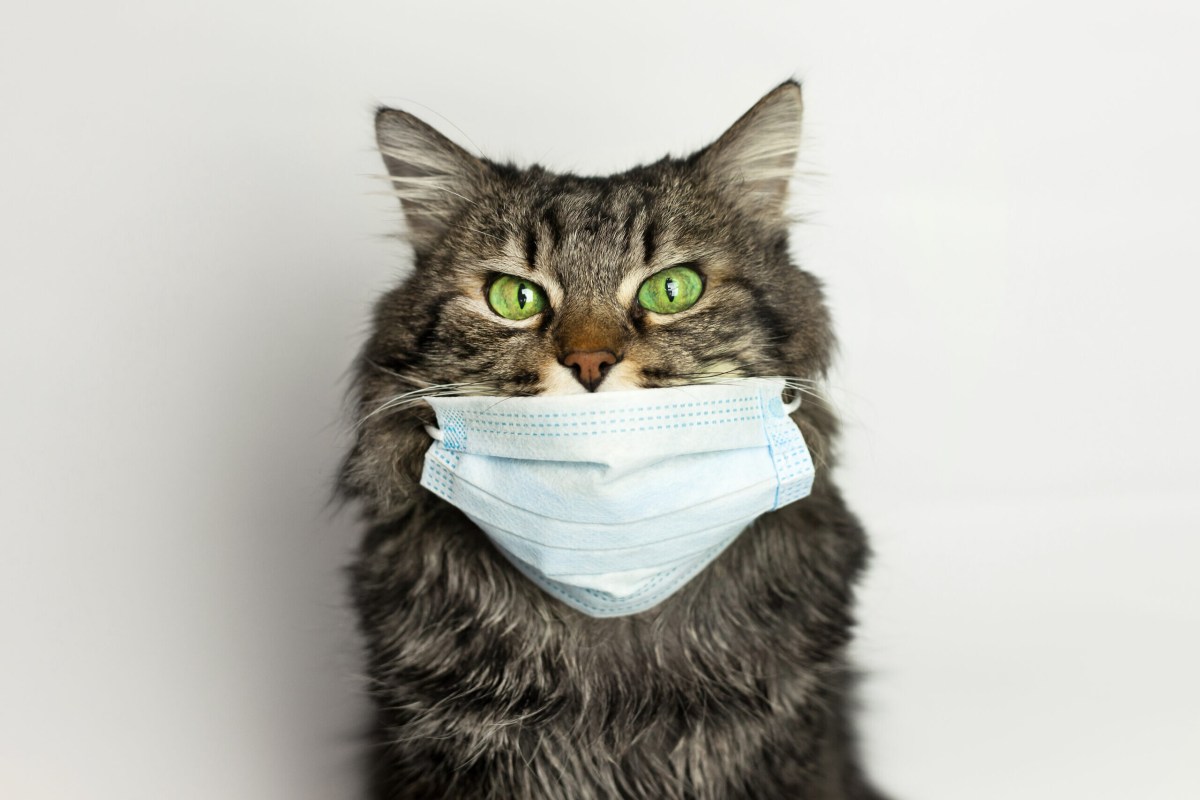
Cat in mask
“Back away, human, and return to your designated quarantine zone!”

The new quarantine measures mark the second time Buddy has taken drastic action in response to fears about COVID. The silver tabby constructed an air tight, clinically sealed dome around his food and water bowls in November after three snow leopards at a Nebraska zoo fell ill and died from the virus.

A second, larger dome meant to encapsulate his human’s his bed was under construction when Buddy was convinced to delay his plans for the holidays in order to spend time with friends and family. Now construction on the bubble has resumed.

Pharmacy techs at CVS refused to vaccinate the domestic shorthair after he showed up for an appointment in early January. A spokesman for the pharmacy chain said the vaccines were not FDA approved for cats, and Buddy isn’t as smart as he thinks he is.

Meanwhile, efforts to get Big Buddy to secure a dose for Buddy have been fruitless.

“I’m not asking much,” Buddy said. “All I want him to do is steal a vaccine from a highly secure area, educate himself on how to inject me, calculate an appropriate dose for my species and body weight, and give me the jab. How hard is that?”

UPDATE: Airline Investigates Cat Breastfeeding Incident, Flight Attendant Speaks Out

There have been more than 5,000 confrontations involving unruly passengers on airlines in 2021, on pace for more than all other years combined.

When we first heard about an airline passenger grossing out her fellow travelers by breastfeeding her cat, we figured at least kitty was happy with the situation — but apparently not, according to a flight attendant who was involved in the incident.

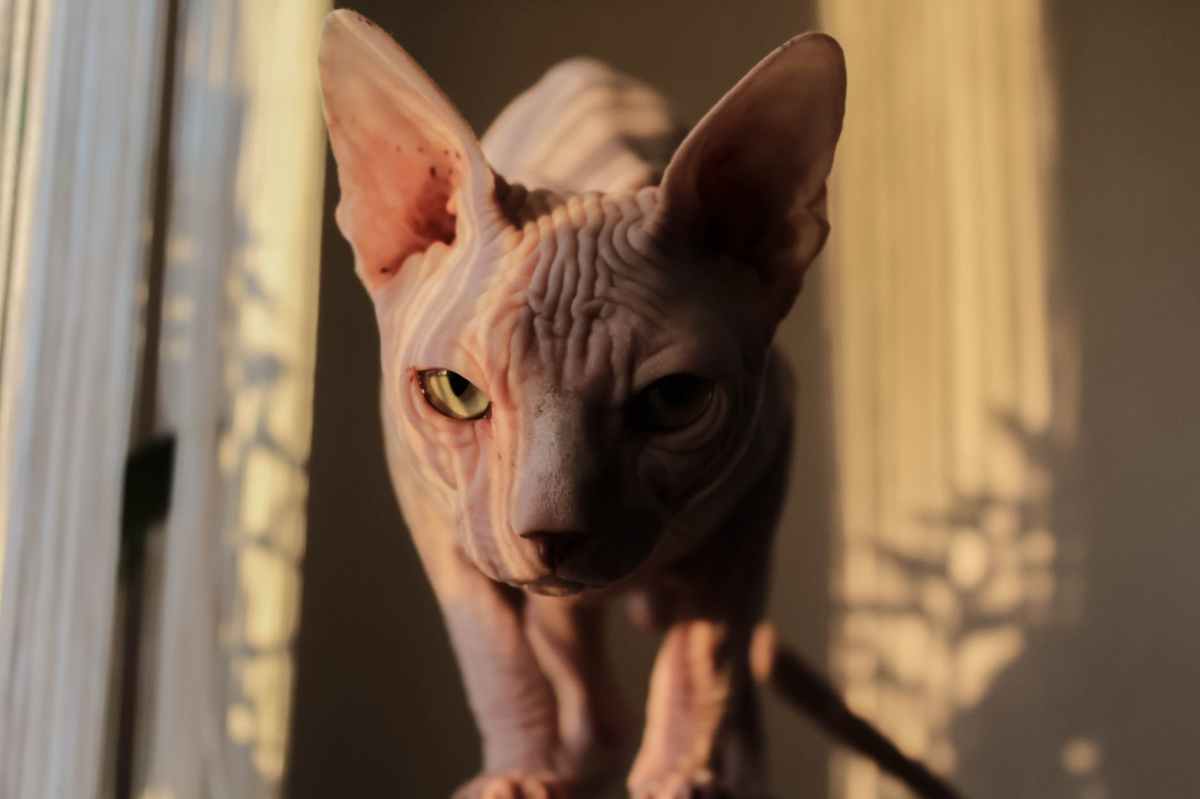
Instead of purring and kneading in a milk coma, the cat — likely a Sphinx — wanted nothing to do with feeding from the woman’s breast on the flight in late November, flight attendant Ainsley Elizabeth said.

“This woman had one of those, like, hairless cats swaddled up in a blanket so it looked like a baby,” Elizabeth said in a video about the incident. “Her shirt was up and she was trying to get the cat to latch and she wouldn’t put the cat back in the carrier. And the cat was screaming for its life.”

“What does she do at home if she’s doing that in public?” Elizabeth asked. “And then security met the flight just to tell her that she couldn’t do that again, cause it was weird and gross.”

Elizabeth has since deleted the social media account she used to upload the video.

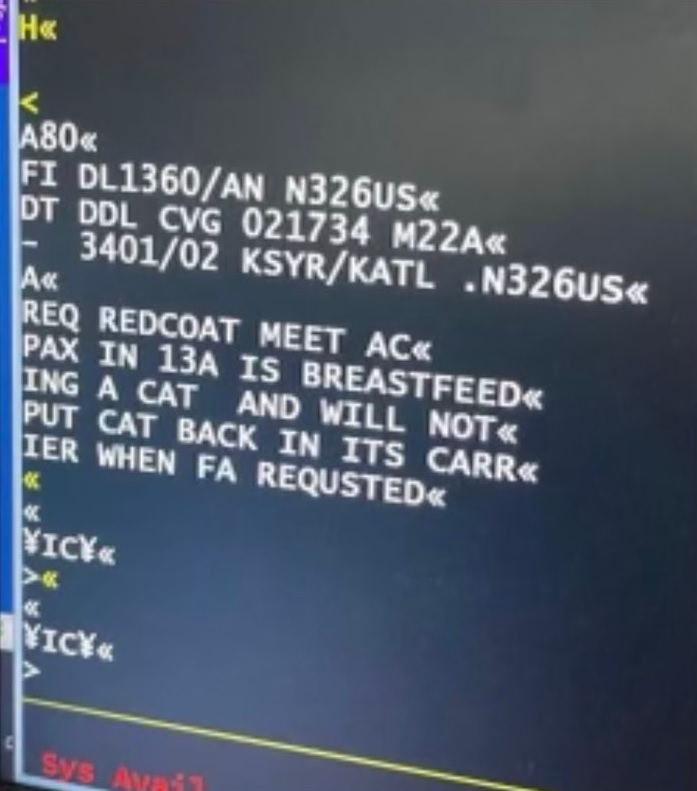
As we noted in our earlier post, the woman was uncooperative when flight attendants asked her to stop, prompting the pilot to send a message ahead to the destination airport via ACARS, short for Aircraft Communications Addressing and Reporting System.

acarscat
An ACARS message sent from Delta Air flight DL1360 to ATL, Hartsfield-Jackson Atlanta International Airport.

The bizarre incident happened aboard a Delta Airlines flight from Syracuse, NY, to Hartsfield-Jackson Atlanta International Airport in Georgia.

Meanwhile, Delta airlines has begun an investigation into the Great Breastfeeding At 40,000 Feet saga, after the incident went viral last week and garnered headlines around the world — including newspapers in the UK, Australia, New Zealand and dozens of non English-speaking nations.

Initially the passenger was reprimanded, but an investigation could result in more serious consequences, like a ban on using the airline.

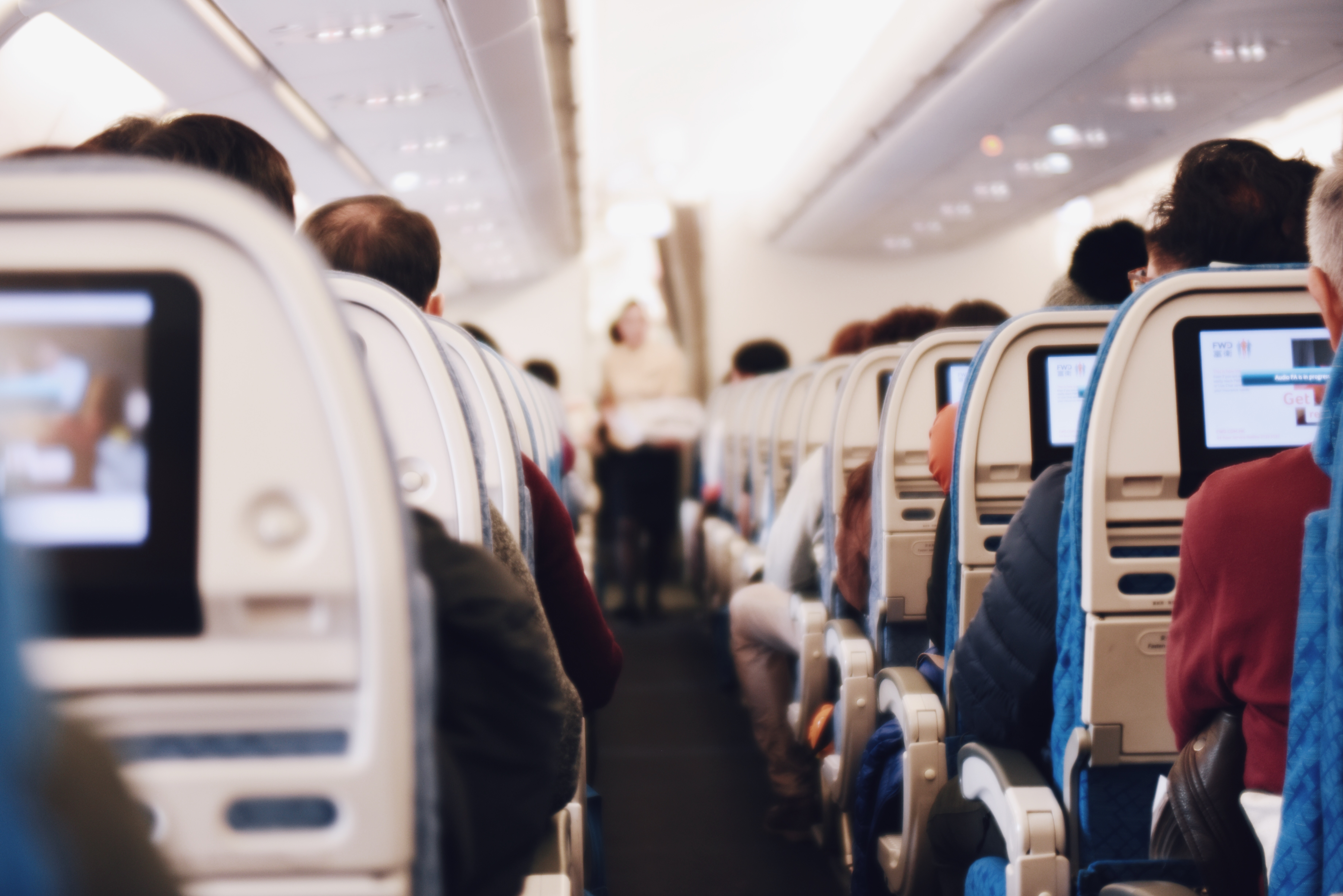
Airline aisle during flight
In-air confrontations have skyrocketed in 2021, mostly due to disagreements over COVID-19 safety rules such as wearing masks. Credit: Wikimedia Commons

The story comes amid a general surge in violent attacks and tense confrontations aboard passenger jets — and now the FBI is getting involved.

As of Nov. 4, the FAA had logged 5,033 cases involving “unruly passengers,” including 37 that were referred to the FBI for criminal prosecution.

That puts 2021 on track for more cases than all other years combined, according to the Association of Professional Flight Attendants. The majority of those incidents — as many as three out of every four — are related to confrontations over mask policies due to the Coronavirus pandemic.

Teddy Andrews, a long time flight attendant with American Airlines, testified before a congressional committee in September, recalling an incident in which a passenger called him the n-word when Andrews asked the man to wear his mask.

“These days I come to work anticipating disruptive behavior,” Andrews told USA Today. “Our colleagues are anxious, fearful. What is going to happen on the next flight? How will this passenger react if I remind them to wear their mask? Will complying with airline policies set them off? Can I avoid engaging, or would that be an evasion of my duties?”

I Was A Good Boy On Halloween, Now Give Me Snacks!

Buddy agrees to dress up for Halloween in exchange for catnip and treats.

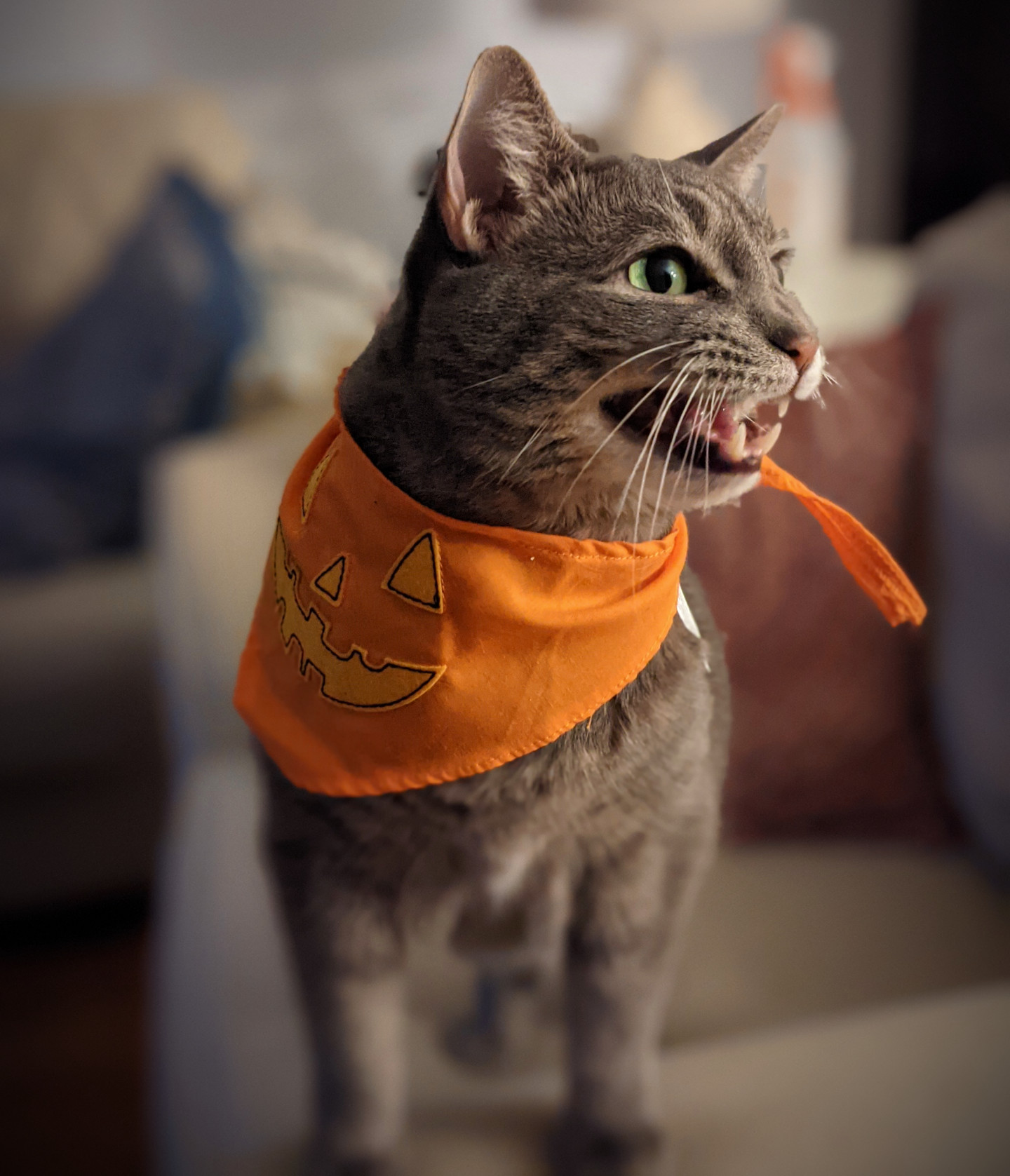
Bud won’t tolerate a costume and I wouldn’t make him wear one, but he’s cool with wearing a festive scarf courtesy of my mom, who insists she doesn’t like him but somehow ends up buying stuff for him.

The cool thing about having an unusually curious and friendly cat is that he dashes to the door like a dog whenever someone knocks. Halloween is no exception, and Bud has been helping me hand out candy since he was a kitten.

When trick or treaters come by, the little guy can’t wait to see who’s in the other side of the door. He sits on the threshold and just takes it all in — the new people, the funny costumes, the strange human ritual that involves helping children get an epic sugar high and upset stomach.

For Bud it’s a night of excitement without any anxiety since no one’s actually stepping into his territory. They all keep a respectful distance, like supplicants with an audience before a powerful but benevolent king, and in turn the king allows his servant to reward their fealty with gifts of candy.

Bud on Halloween
“Let’s just get this over with, human. Remember, you said I could have catnip AND extra yums if I wear this infernal scarf!”

Sadly Halloween was a dud this year even more than last year, which was our first pandemic All Hallow’s Eve. Living in an apartment building, especially on the first floor, usually means a steady stream of kids, but this year I had maybe six or seven knocks on the door, and the kids were trick or treating in ones and twos. (All kids are chaperoned by parents these days too. It makes me wonder how my brother and I — and our friends — survived as kids, going out into the big bad world ourselves to trick or treat!)

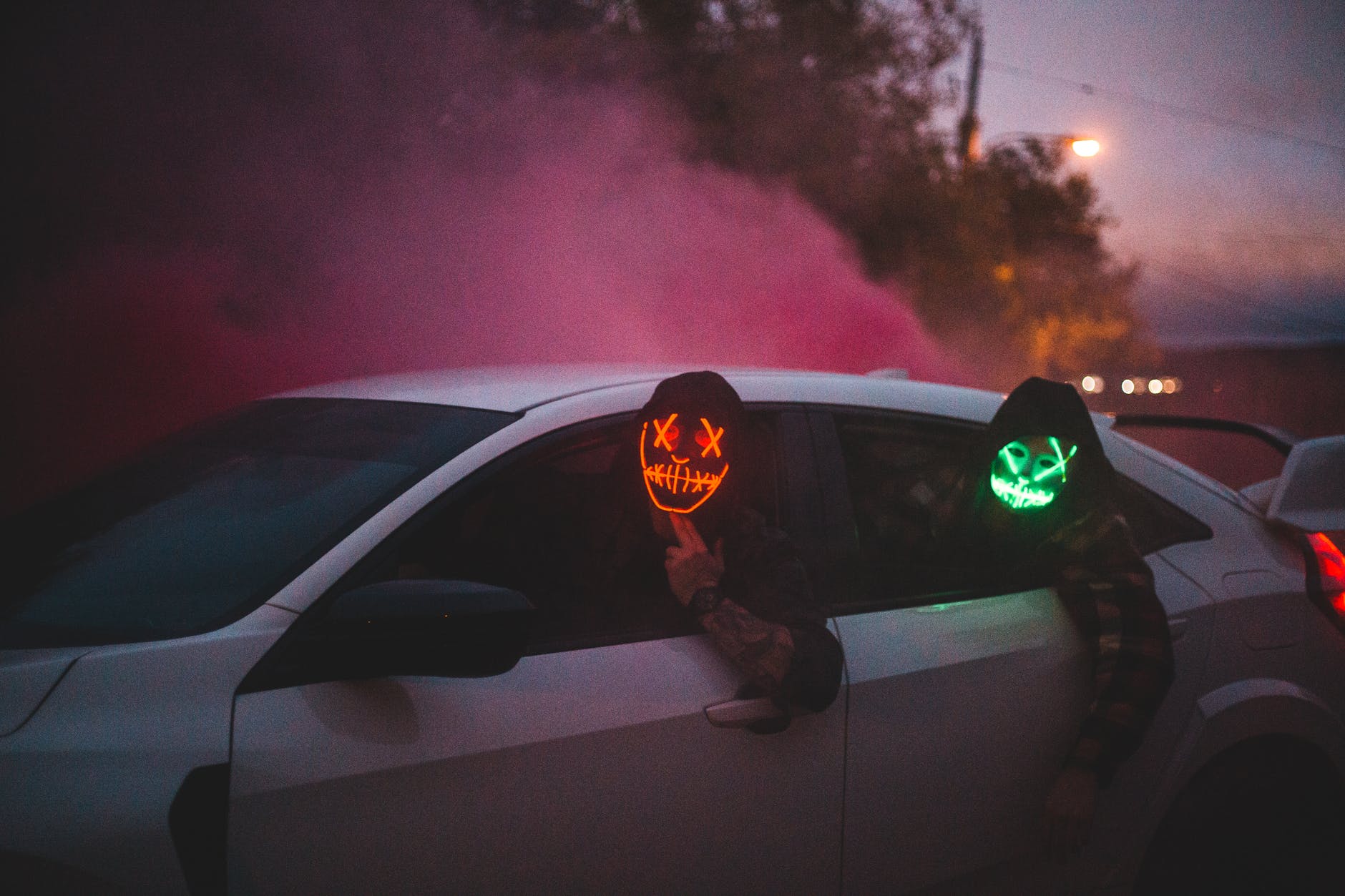
unrecognizable men in glowing halloween masks driving car at night
You’d think Halloween was Purge Night by how parents hover over their kids. Credit: Erik Mclean/Pexels.com


Going To Asia? Leave Your Pets At Home, Plus: Aussie Former Soldier Pleads In Shelter Assault

Authorities in some countries are killing pets as a precaution against spreading COVID even though virologists say there’s no evidence humans can contract the virus from their pets.

The coronavirus pandemic hasn’t been kind to pets, but the virus itself has done little damage to animals compared to the actions of scared and misinformed people.

After finally admitting it had a human-to-human transmissible virus on its hands — months after it knew privately about the virus outbreak — the Chinese government waged a war on pets in the first few weeks of 2020 as the world watched in horror.

People abandoned pets en masse in empty homes and apartments, while government authorities shot dogs and cats on sight to prevent the spread of the virus even though there was no evidence they could be infected, much less pass the virus to people. As paranoia and misinformation spread, people even resorted to clubbing pets to death on the streets.

Now we know cats can get the virus, but there’s still no evidence they can transmit it to humans, which makes the practice of killing COVID-infected pets even more infuriating in addition to pointless.

The latest incident is from Vietnam, where authorities killed 15 dogs and a cat belonging to a local bricklayer who returned to his home province after work dried up. Authorities seized his pets and “destroyed them” last week in what a government official is now calling a mistake prompted by “COVID prevention pressure and local coercion.”

danchoonghung83871633869679-16-5401-4445-1633923236_680x408
Pham Minh Hung, 49, with his dogs as he returned home to Ca Mau, Vietnam. Credit: Pham Minh Hung

That story follows an incident in the Chinese city of Harbin, where three cats were euthanized in late September — over the owner’s objections — by authorities who said they were worried the pets would “re-infect” their owners.

Pet ownership and respect for animals among the public has increased in countries like China and Vietnam in recent years, prompted by an increase in disposable income and the influence of the internet. Both cases caused widespread backlash in their respective countries, with users defying laws prohibiting criticism of government to complain about the pet killings.

“It doesn’t seem very realistic that the cats would contaminate the environment so badly that they would be a risk for their owner to re-contract COVID,” Rachael Tarlinton, a virology professor at the UK’s University of Nottingham, told Reuters.

He REALLY Wanted His Cat Back

Meanwhile in Australia, a former soldier has pleaded guilty to reduced charges after he “stormed” a pet shelter in Melbourne’s suburbs to recover his cat in January.

Prosecutors say 45-year-old Tony Wittman was outfitted with a fake but real-looking rifle and full military gear when he went to the Lost Dog’s Home in Cranbourne West late on a January night, holding a female employee at gunpoint while demanding to know where the cats were kept.

Wittman had called the shelter 10 minutes before it closed earlier that night, Australian media reported at the time, and was told the shelter had recovered his cat, but that he’d have to wait until morning to claim her.

Wittman, who threatened to shoot the employee if she didn’t comply with his demands, told the court he suffers from PTSD and felt he needed to retrieve the lost feline immediately because he “loves his cat and relies on his cat for support.”

Wittman got spooked and left the shelter before taking his cat. He dumped his tactical vest and other gear in bushes not far from the shelter.

The incident was captured on the shelter’s security cameras, and Wittman was caught when he dropped by the following morning to pick up his cat as if nothing had happened.

“The victim and her work colleagues are absolutely traumatised by what’s happened,” a detective told the court in an earlier hearing. “He’s aware of their workplace. He lives close by. He has shown a complete disregard for the safety and wellbeing of the general public.”

Wittman’s lawyers were able to negotiate a deal with prosecutors in exchange for a guilty plea to lesser charges