Cats see the world differently, in objective physical terms as well as psychologically.
Have you ever wondered what the world looks like to your cat?
Veterinarians, animal ophthalmologists and researchers from the University of Pennsylvania’s ophthalmology group provided insight for this article and the accompanying images, which show how scenes look to us humans and to our feline friends.
The images are striking and show the relative strengths and weaknesses of feline vision. While cats see the world in muted colors and in less acuity than typical humans, they make up for it with their astounding night vision and their ability to instantly detect motion within their visual fields.
This image shows feline night vision at work thanks to the tapetum lucidum, a layer of tissue that acts as a retroreflector, increasing the amount of light that makes it to the photoreceptors in cats’ eyes. The tapetum lucidum is best known as the reflective “lens” that makes cat eyes appear to glow in the dark:
This image shows the trade-off compared to human vision. Cat eyes have a wider field of view, seen below, but they don’t pick up reds or greens, and their overall vision is blurry compared to average human eyesight, represented in the top image:
Night vision and extreme visual sensitivity to movement are important to cats as crepuscular hunters, allowing them to spot prey in low light conditions and to negate advantages from natural camouflage, as motion gives away the presence of prey animals.
Cats have a slightly wider visual field than people do, at approximately 200 degrees compared to the human 180 degrees, while most cats have between 20/100 and 20/200 vision. (That’s much better than Big Buddy sans glasses, whose 20/600 vision enables him to see blurry, colorful shapes and not much else. No wonder Little Buddy likes to torture his human by swiping his glasses.)
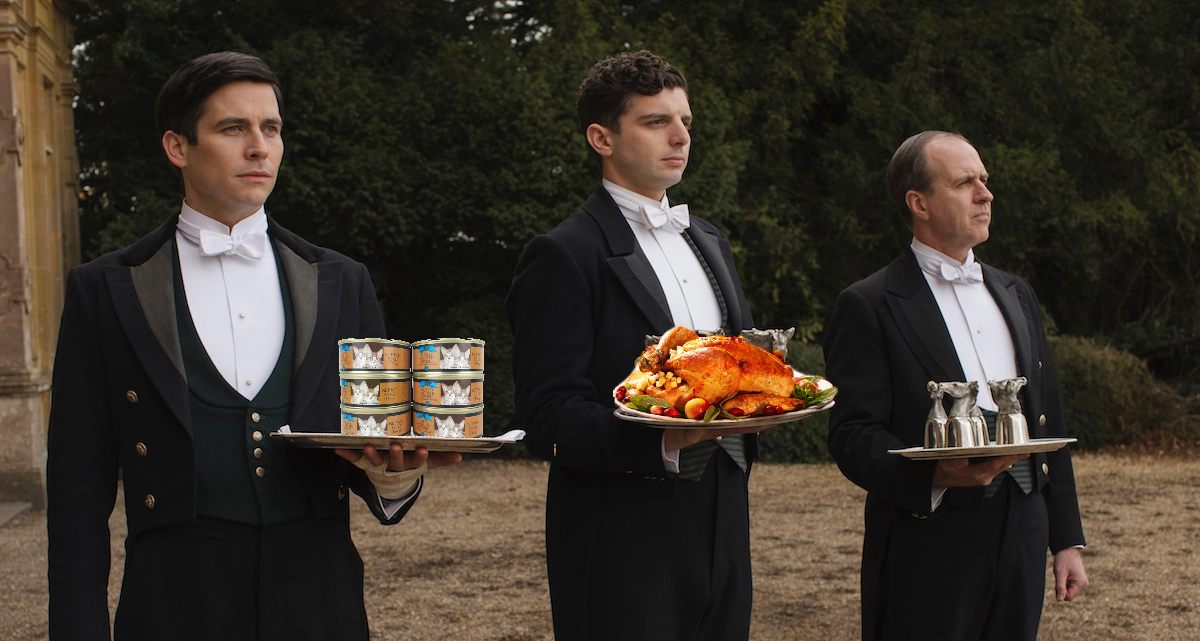
Of course, these images do not entirely account for how cats see the world, which is why I’ve created my own image. Behold a Buddy’s Eye View, showing how the world — and humans — look to him:
From Buddy the Cat’s perspective, humans are all servants, constantly standing by to attend to him.
Buddy the Cat sings holiday and Christmas classics from a feline perspective.
Oh Christmas tree, oh Christmas tree, I am going to destroy you! Oh Christmas tree, oh Big Buddy, I am going to annoy you! Got yummies in my bowl to taste, and ornaments and lights to break Oh Christmas tree, oh Christmas tree, I am going to destroy you!
Your branches point so high and straight Just begging for a swipe to take Oh Christmas tree, oh Christmas tree I will annihilate you!
Oh Christmas tree, oh Christmas tree, how lovely are your branches? Oh Christmas tree, oh Big Buddy, I am going to faceplant it! The Hallmarks will shatter and break, I’ll make disaster of this place Oh Christmas tree, oh Big Buddy, I am going to annoy you!
You sparkle like the morning dew Look mangled when I’m done with you Oh Christmas tree, oh Christmas tree What fun it is to wreck stuff!
Buddy’s Favorite Things
Temps in my bowlses and snacks in the kitchen Taunting the street cats and smacking some kittens Leaving the neighbor’s dog tied up in strings These are a few of my favorite things!
Bubble wrap, peanuts and UPS boxes 4 a.m. zooms when I scream like a rocket Waking my human with songs that I sing These are a few of my favorite things!
At nail clip time, things I dislike When I’m really mad I simply remember my favorite things And then I don’t feel so bad!
Calico booties and slices of Gouda Ambushing like I’ve been launched by bazooka No consequences ’cause I am the king These are a few of my favorite things!
Screeching in anguish at doors closed between us Shattering Wise Men and statues of Jesus I helped myself to the buffalo wings These are a few of my favorite things!
Meow at my bowl as if I’ve been forgotten Screeching in panic ’cause I see the bottom Gorging on kibble till I am puking These are a few of my favorite things!
When I’m told no, ’cause I broke those When my dad is mad I’ll get away with my favorite things Because I’m a real cute cat!
It’s Beginning To Look A Lot Like Christmas
It’s beginning to look a lot like Christmas Everywhere I look Take a look at the Christmas tree, it’s been redesigned by me And the lights are broken!
It’s beginning to look a lot like Christmas Coal in every sock It’s beginning to look a bit like I’ve had too much catnip And now I’m dizzy!
A Santa Claws surprise and a Roomba for me to ride Is the wish of Buddy the Cat A box to take a nap and another to take a crap What do you think of that? And my human can hardly wait for vacation!
It’s beginning to look a lot like Christmas With every wrap I shred Now it’s nap time for me, underneath the Christmas tree Then I’ll demand treats!
Twelve Days of Christmas
On the first day of Christmas My human gave to me A can of delicious turkey
On the second day of Christmas My human gave to me Two window perches And a can of delicious turkey
On the third day of Christmas My human gave to me Three cozy boxes Two window perches And a can of delicious turkey
On the fourth day of Christmas My human gave to me Four kneading blankets Three cozy boxes Two window perches And a can of delicious turkey
On the fifth day of Christmas My human gave to me Five golden bowls Four kneading blankets Three cozy boxes Two window perches And a can of delicious turkey
On the sixth day of Christmas My human gave to me Six Chewy orders Five golden bowls Four kneading blankets Three cozy boxes Two window perches And a can of delicious turkey
On the seventh…zzzz… …zzzz…
Hey, Bud?
…zzz…turkeh…zzzz…
Bud!
…zzz…
Well, it looks like the catnip and tryptophan have done their thing and the little guy is asleep, dreaming of turkey and presents. Don’t worry, he’ll be singing these songs for five more days. Five more days?!?! Ugh…
Cats are deeply traumatized when they hear the distinct sound of a food package opening and discover it’s not for them.
NEW YORK — Buddy the Cat was enraged Friday night when he was woken from a deep sleep by the sound of an aluminum can being opened, then bolted upright, jumped off the bed and ran to the kitchen only to find his human with a freshly-opened can of corn in his hands.
Calling such incidents “cruel teases” and “deeply unfair” to him and other felines, the silver tabby demanded the food industry develop alternate methods of packaging human food.
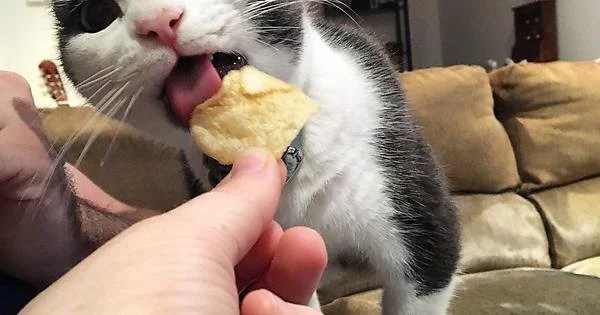
“We’ve all heard the plasticky rustle of a bag and come running, just drooling with anticipation for the Temps only to skid to a halt as we catch that first putrid whiff of sour cream and onion potato chips or tortilla chips,” Buddy told reporters at a press conference later Friday evening. “I’m not judging, by the way, but human food is disgusting. I mean, you literally eat leaves and call it ‘salad’ so you forget you’re eating leaves. Give me a mound of chicken in a paste-like consistency any day.”
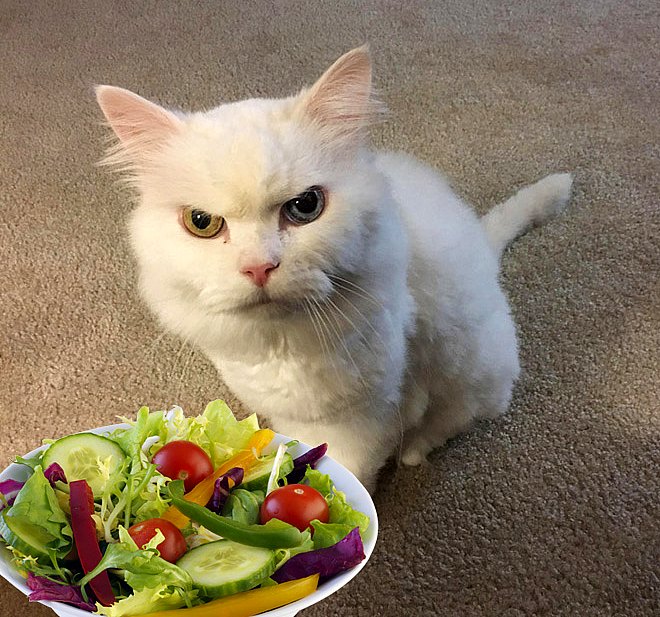
Torture: Cats are offended by the very presence of salad. How can humans consume such disgusting food?
Joining him at the podium, four-year-old Siamese Burton recalled his disappointment at hearing the crinkle of an aluminum package and scurrying to the kitchen to witness his servant, Olivia, scattering 4C breadcrumbs onto a vegetarian casserole bound for the oven.
“I almost puked,” Burton said, shuddering from the trauma as Buddy placed a supportive paw on his shoulder. “Vegetarian casserole! Vegetables! How do you people eat this stuff? It’s madness!”
If humans were genuinely considerate of their feline friends, Buddy insisted, they’d make some of their own food palatable to cats.
“I’m not just talking about cooking a nice steak without any spices or sauces,” Buddy said. “Why not make beef pate flavor potato chips or apples that taste like salmon? Has anyone ever thought of tuna-flavored ice cream? I bet you wouldn’t even be able to keep it in stock, that’s how popular it would be.”
Salmon-flavored potato chips would be a hot seller, President Buddy insists. Credit: Reddit
The former president of the Americats said his bad experiences with food have even prompted ideas about opening up his own restaurant for cats.
“Not one of those lousy casual dining places either,” he said. “I’m talkin’ about a nice type of joint where the waiters wear bow ties and open the cans right in front of you at the table. The kind of place that has you check your collar at the entrance, where you could take a lady friend.”
Reached after his feline’s hastily-arranged press conference, human Big Buddy said he wasn’t aware his cat was campaigning for alternative forms of food packaging.
“That’s tragic,” he said, “because I’ve got a big bag of pistachio nuts I’m planning on opening later. Maybe I’ll wait to do that until Bud’s fast asleep. You know, for entertainment purposes.”
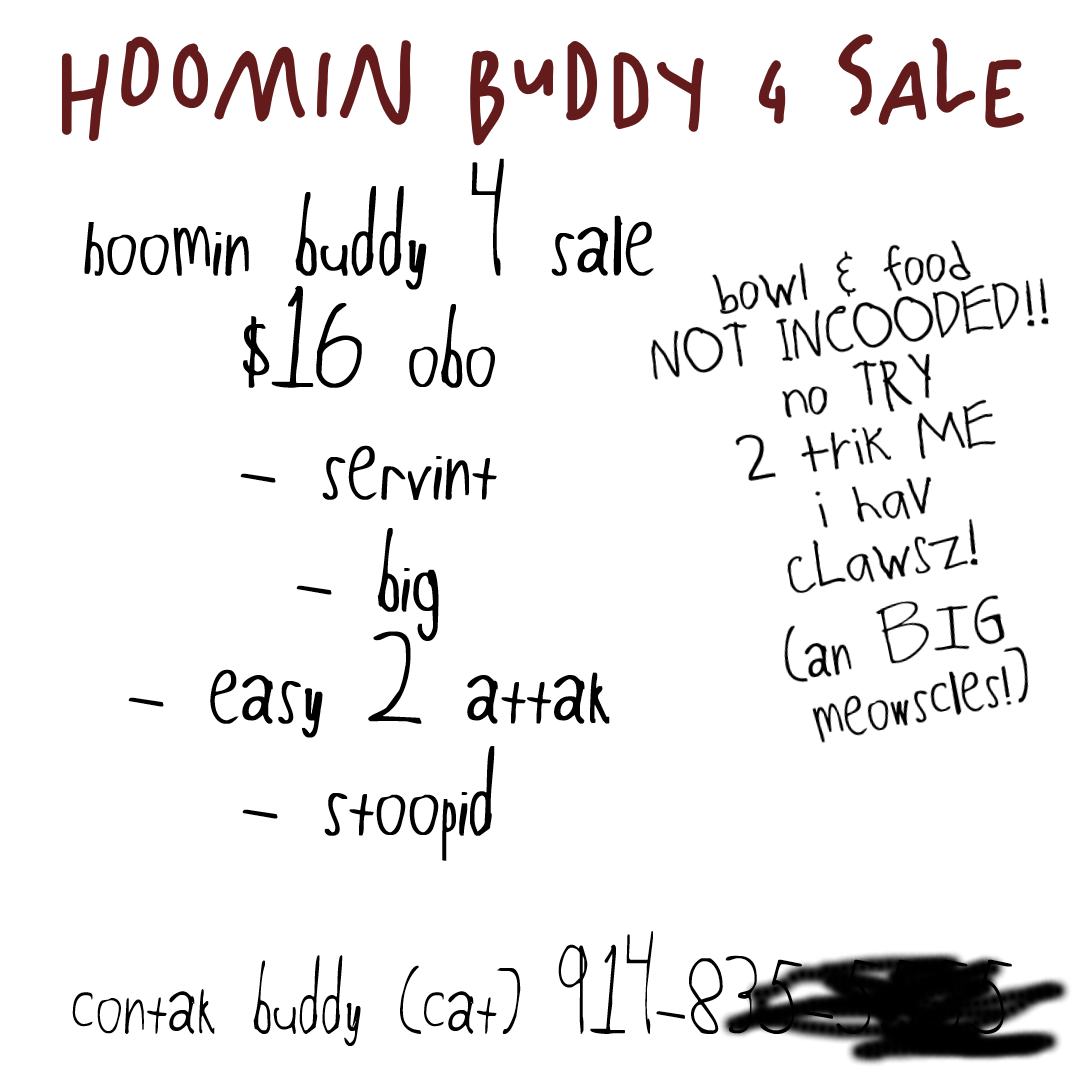
Buddy the Cat tries to sell his human. Meanwhile, UK soccer stars adopt their own new buddy from Qatar.
Happy Sunday, dear readers. Buddy’s apparently angry with me about something, because I found a copy of this on the printer:
Listed under “For sale by owner.”
What could I have done to deserve this? And $16? Isn’t that a little low? It’s insulting! We’re gonna need to have a little chat, Buddy to Buddy.
Should Cats Be Allowed On Airplanes?
CNN’s Jacqueline Swartz has a column about the challenges of traveling when you’re afflicted with severe allergies. Swartz is thoughtful, isn’t resentful of cats and understands it’s on her — for the time being, at least — to prep for flights by taking allergy medication, but she also believes airlines can do more to accommodate people who are allergic to pets.
As a cat guy and someone who dealt with really bad cat and dog allergies in my childhood and teenage years, I can sympathize with Swartz’s plight, and I agree that airlines can do more.
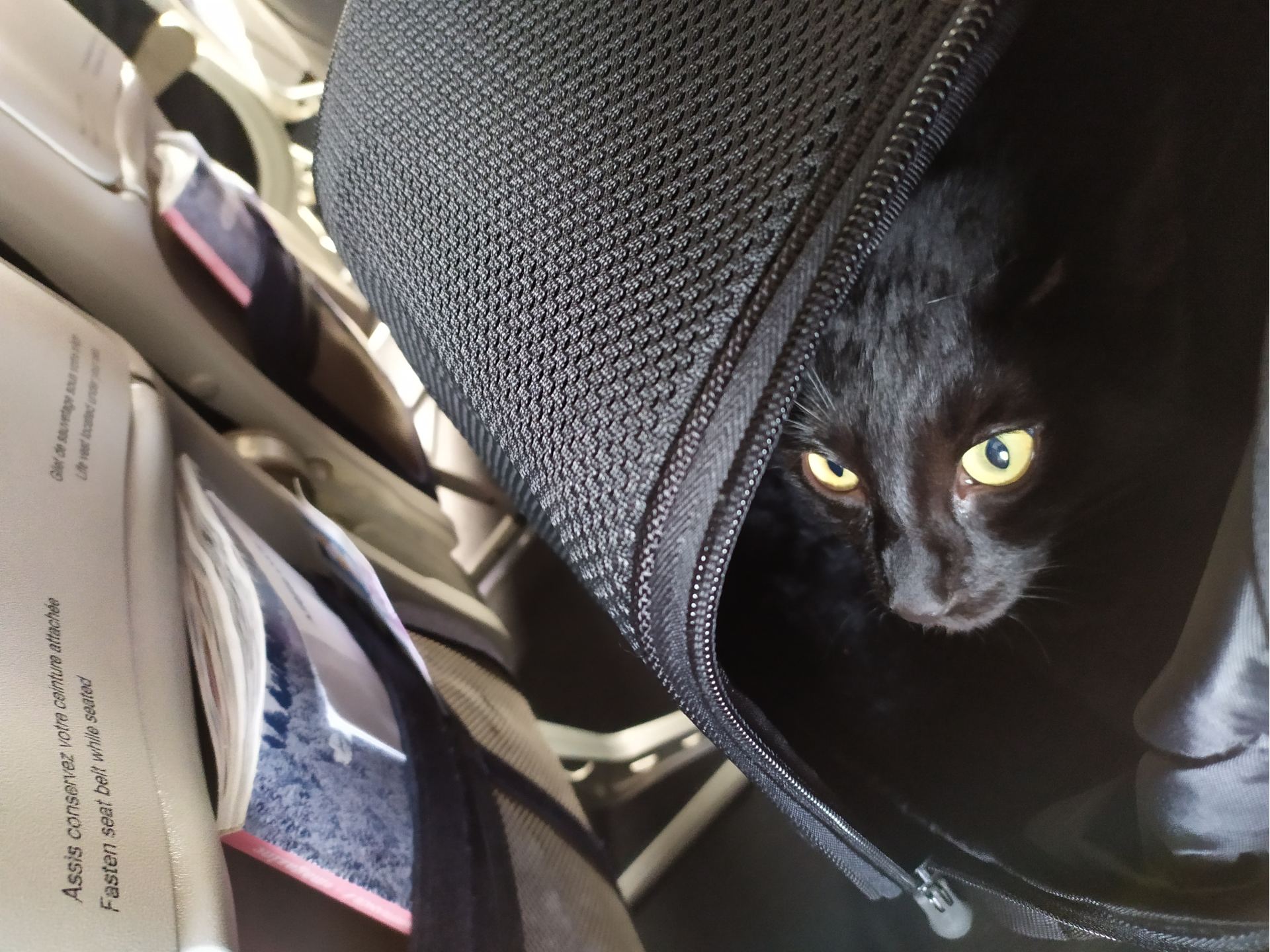
Of course, by “Should cats be allowed on airplanes?” she’s really asking if cats should be allowed in the passenger cabin. Even if a feline’s snug in a carrier, tucked beneath its human’s seat and well-behaved during the flight, a relatively short six-hours from New York to LA can cause all kinds of havoc on the immune systems and sinuses of people who are ultra-sensitive to cat dander.
Credit: Wikimedia Commons
Putting cats in cargo compartments is not an answer, and neither is banning cats from flights. Sometimes flying with a cat is a necessity, whether you’re moving cross-country or planning to live abroad temporarily. But airlines are notorious for trying to extract every dime from passengers, whether it’s charging thousands for business class or up-selling regular seats as “premium coach” by offering a Louis Vuitton-branded pillow or whatever.
Perhaps some enterprising airline executive could build goodwill with travelers, earning extra business and loyalty along the way with an innovative and friendly way to handle animals. How much space could possibly be required for a quiet, closed-off, climate-controlled closet where six or eight cats in carriers can snooze during a flight? That would solve the allergy problem, make life easier for everyone and probably make traveling easier on cats too.
Dave the Cat has a new home in England
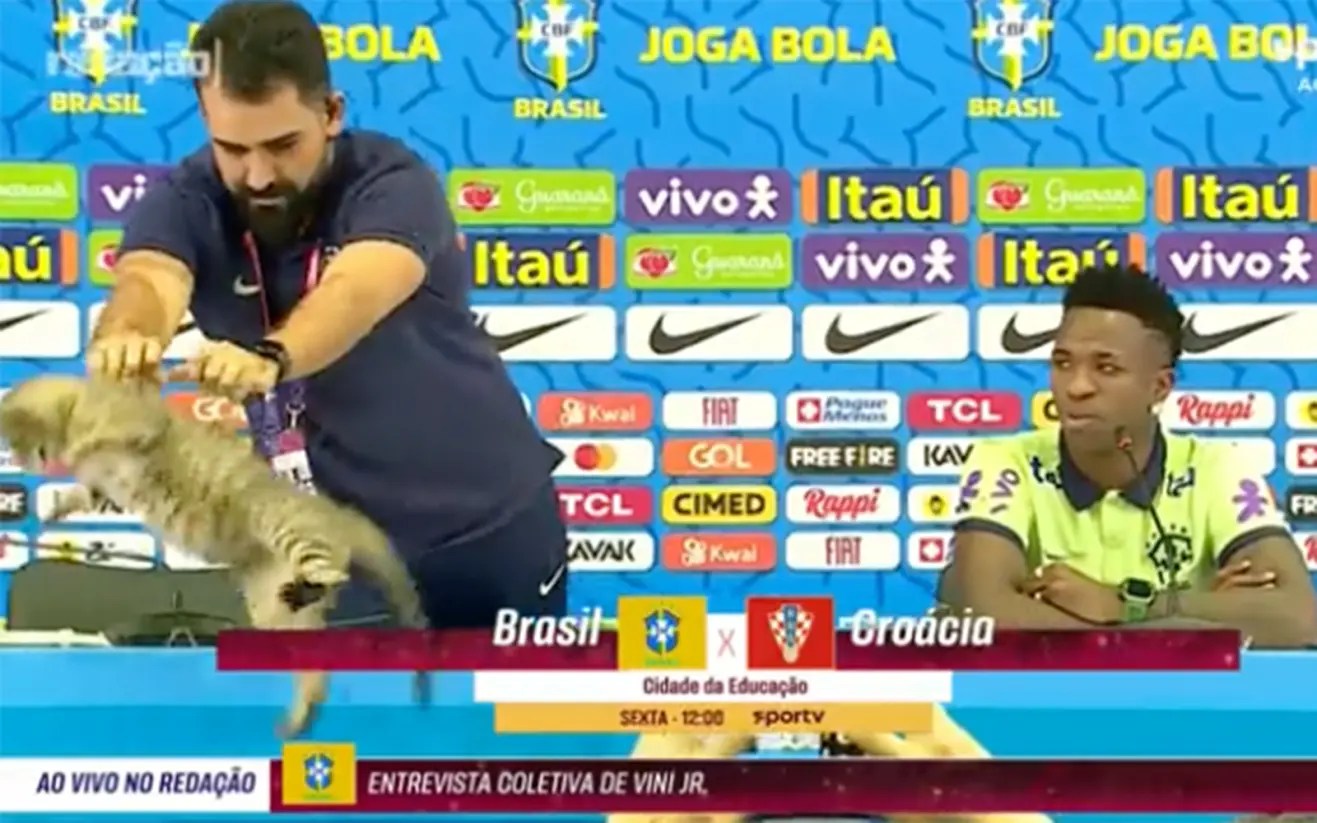
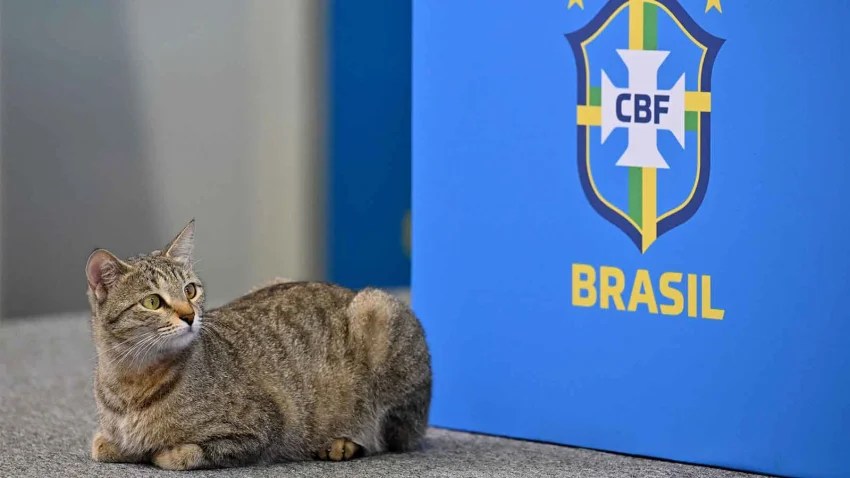
While a thoughtless PR official for Brazil’s national team drew the ire of animal lovers for the way he mishandled a cat during a press conference — an unforced error, since the cat wasn’t bothering anyone — some good is coming out of the World Cup for at least one feline.
Dave the Cat, a friendly stray befriended by England defenders Kyle Walker and John Stones, will be adopted by the players, who both suit up for the Premiere League’s Manchester City during normal club play.
Dave, a cream-colored tabby, won’t be reunited with his new pals right away. He’ll have to endure four months of quarantine first, as per the UK’s rules on bringing animals to the country, and then presumably he’ll be adopted by Walker, Stones or the entire team.
An official with Brazil’s national team caught heat for the way he picked up and tossed a cat in Qatar. (Screengrab)
Genetics, gene-editing and cloning have rapidly matured since the days of Dolly the Sheep, which means we have less time than we think to grapple with some heady moral questions.
Should scientists resurrect long-extinct species? Is it ethical to clone thousands of animals who will not live, but have their organs harvested for human patients?
Those are some of the questions people are asking as the cloning industry — once relegated to producing one-off copies and genetically identical versions of deceased pets for wealthy clients — is expanding with new capabilities.
This story by the BBC’s David Cox provides an informative, brief history of cloning before pivoting to the current state of the industry and how it could continue to evolve.
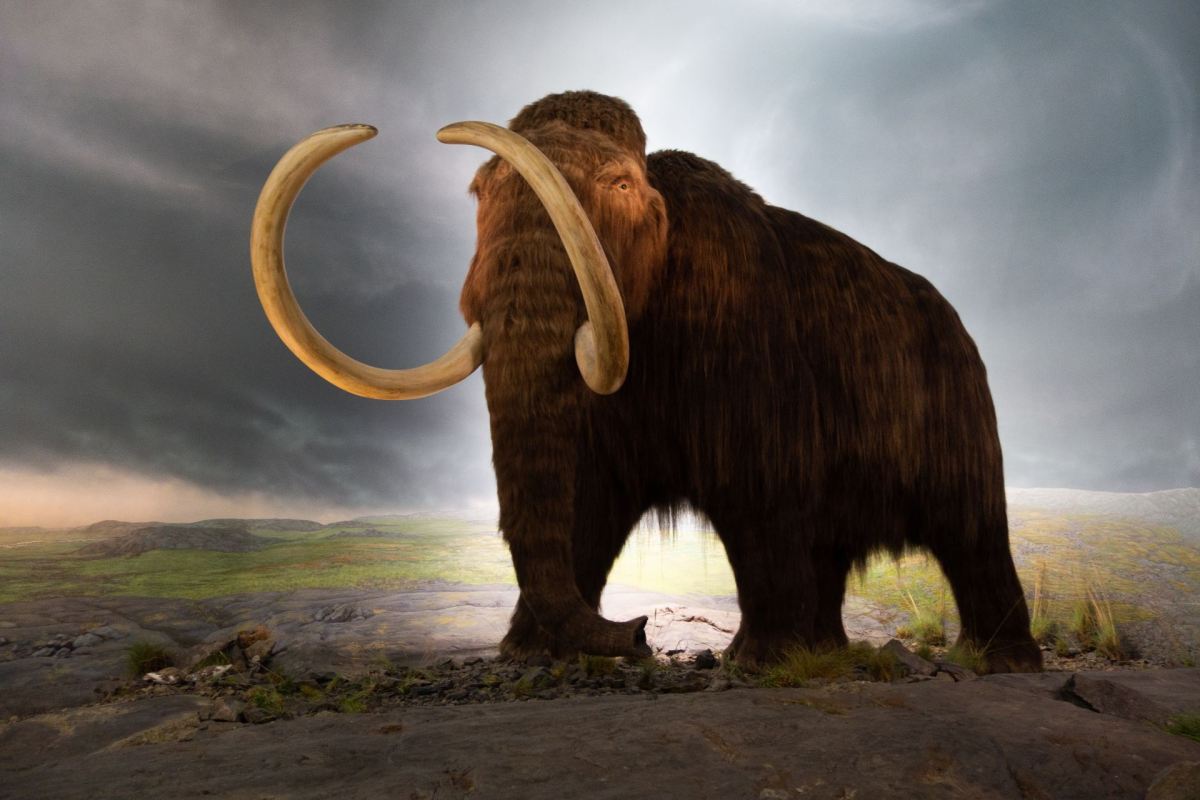
Two of the most fascinating prospects have to do with conservation. One company, Colossal, is working on bringing back the extinct woolly mammoth, while other scientists are turning to cloning as a way to prevent the extinctions of species like the white rhino, which is functionally extinct without any breeding pairs left living.
Scottish scientists shocked the world when they cloned Dolly the Sheep in 1996.
As with anything in science, innovations in cloning unlock new applicative branches, and scientists have partnered with the medical field to address human health concerns. Some, like the practice of editing genes to prevent diseases in newborns, tend to fly under the radar. But others, like the push to adapt organs from animals like pigs so they can be replacements for human organs, are much more controversial and have met opposition from animal welfare groups.
Then there’s the elephant in the room, no pun intended. What about cloning humans?
Right now no one’s gone down that route, at least not publicly, because of the inevitable backlash. What’s happening deep in the bowels of clandestine medical facilities in nations with murky ethics laws is another question entirely.
I am opposed to human cloning, but I don’t believe it will remain the immutable taboo some people think it is. Someone will break the dam, and while that pioneer will likely get raked over the coals, the bell cannot be unrung. Things change so fast these days that what’s shocking one day merits a shrug the next, and it’s possible the world will be introduced to a man or woman one day before it’s revealed the person is, in fact, a clone. (Not unlike the way the world was introduced to Imma, a Japanese influencer and model who exists only digitally.)
Imma has more than 400,000 Instagram followers, she models the latest fashions and she appears in adverts for products like beverages and watches, but she doesn’t exist. She’s a digital creation.
They’ll be the Dolly the Sheep of the human race, and ethicists won’t get a say in whether they should exist because it’s already been done.
“See how normal they are?” people keen on cloning will say. “They’re just regular people. Are you going to tell them they shouldn’t live?”
But before that, it looks like the movie Gattaca will become reality, and people will order up a great baseball player or a child with intuitive musical genius just like they might commission a piece of art or a custom car job. Gene editing with CRISPR is surprisingly trivial.
Of course, it won’t be lost on people that we’re cloning humans when there are millions of unwanted, uncared-for street kids in the third world, not to mention people who live without the consideration of their fellow human beings in every nation. Just like it hasn’t escaped the notice of activists that South Korea and China are leaders in cloning pets, yet dogs and cats are also food in those countries.
What separates the dogs and cats bound for restaurant kitchens from the dogs and cats having their cells preserved for cloning?
Nothing except for their individual value to humans, just like pure luck separates a cat who finds a loving home from a cat who ends up euthanized with a needle. We are a fickle species.
Yet both the beloved pet and the unwanted shelter cat are sentient, experience intense emotions and have their own thoughts. That’s not conjecture, it’s fact as confirmed many times over experimentally, but it shocks a lot of people. Our education system has not done right by the billions of non-human minds we share our planet with.
These rhesus macaque infants were cloned in a lab in China. The remaining barriers to human cloning are ethical, not technological.
I’ve thought about what might have happened if Buddy had been adopted by someone else, and what his fate may have been. I love the little guy, but it’s possible that someone else may have viewed him as an annoyance, a loud and incessantly chatty cat who needs an inordinate amount of attention and affection, sometimes lashes out, and needs to be surrendered.
Likewise, unwanted cats have languished in shelters for months before viral posts spark interest in them, and suddenly offers to adopt come in by the hundreds from across the globe. Nothing about those cats changed, but humans formed an emotional attachment to them after learning their stories.
Of course, the ethics of how we treat and consider animals can change depending on where you’re sitting. If you’re young, healthy and energetic, your view may be radically different than the person sitting on an organ donation waiting list, knowing their time may be up before a new liver or kidney becomes available. Suddenly a seemingly simple moral calculus becomes murky and complex.
There’s strong evidence that people who take the first steps toward cloning their beloved cats and dogs spend time wrestling with the ethics of the decision as well. Texas-based ViaGen, the western leader in commercial cloning, told the BBC that 90 percent of its clients are not people who have gone through with cloning, but have only taken the initial step of preserving their pets’ cells for $1,600.
And what of the mammoths? Bringing them back from extinction isn’t as simple as filling in the gaps in their genome, implanting gene-edited eggs in female elephants and hoping gestation takes care of the rest. Mammoths are social animals. Will an elephant mother raise a mammoth baby? Where does that mammoth baby belong? Without a herd of its own kind, can it be happy?
We can’t ask the mammoths, and even if we could, it might not be up to them anyway. As one paleogeneticist put it to NPR last year: What if the technology isn’t used to resurrect the mammoth, but to save the elephant? Does the end justify the means in the latter situation, but not the former?
Mammoth, Dolly the Sheep and rhesus macaque images credit Wikimedia Commons








 Pain In The Bud