Photographer Angel Hidalgo thought the color was a trail camera malfunction until he saw the incredible feline for himself.
For the first time in history, a white Iberian lynx has been photographed.
A Spanish man who works in a factory by day and photographs wildlife as a hobby was behind the camera for the unprecedented shots.
It wasn’t easy.
Angel Hidalgo told National Geographic that first spotted fleeting images of the extraordinarily rare feline on one of his camera traps, but he was skeptical.
“I couldn’t believe it,” the 29-year-old said. “I thought it was a camera effect, and from then on, I dedicated myself to the search for the lynx. I’m still in shock.”
While hiking in late October, Hidalgo saw the “ghost cat” with his own eyes and quickly took a handful of shots and a short video before the cat vanished.
Credit: Angel Hidalgo
The Iberian lynx, as its name indicates, is native to Spain and a small range in Portugal. The cats call mountain ranges like Sierra Morena and Montes de Toledo home.
The white color morph is due to leucism, not albinism: the difference is the former causes only partial loss of pigmentation, and the eyes are unaffected.
In the video footage, the cat sits calmly and regards Hidalgo for about 15 seconds before blinking and turning its head. It’s a fleeting but fascinating look at an animal that most of us will never have the opportunity to see in the flesh.
Hidalgo won’t say where he encountered the white lynx, which is a smart move in an age when bored rich kids in places like Dubai can throw money at wildlife poachers and help themselves to the rarest and most vulnerable wildlife.
Because they know the authorities in their countries won’t bother them, the sons of oil oligarchs and emirs openly flaunt their wild “pet” collections: Instagram and TikTok host thousands of photos and videos of young men and women posing with cheetahs, lions and tigers, with the cats often riding shotgun in hypercars from Lamborghini, Ferrari and McLaren.
We hope the location remains a secret for the sake of the wild cat and because the Iberian lynx is a conservation success story. The species was on the brink of extinction in the 1990s and now has a healthy breeding population that numbers in the thousands.
Today we’re admiring photos of the majestic Amur (Siberian) tiger, a species that has been pulled back from the brink of extinction thanks to the hard work of conservationists.
The Amur tiger, panthera tigris altaica, is the largest subspecies of the largest cat in the world.
Click an image in the gallery to view a higher resolution version:
All images in the gallery above via Wikimedia Commons. Header image via Pexels.
Ocelots, one of the western hemisphere’s most adaptable cat species, are often mistaken for young jaguars.
In 1999 biologists from the Dallas Zoo were lending a hand on a project to monitor and protect America’s ocelots, who primarily range in southern Texas.
With limited resources, the team was trying to keep the wild cats in a protected area and get them to use paths where camera traps had been installed. One tried and true method was to use scents, but what could attract ocelots?
“Sort of on a lark, one of our research assistants produced a bottle of Obsession,” Dallas Zoo’s Cynthia Bennett said at the time.
The felines loved it. Members of the research team watched astounded as the scent magically transformed previously ignored objects into items of sudden fascination.
The cats happily rubbed their cheeks and bodies against anything sprayed with the stuff.
“It´s a little embarrassing to watch, actually,” Bennett said. “It does make you wonder what´s in the perfume.”
(It’s probably civetone, a synthetic version of a pheromone produced by civets used as a binder in the Calvin Klein scent.)
Credit: Victor Landaeta/Pexels
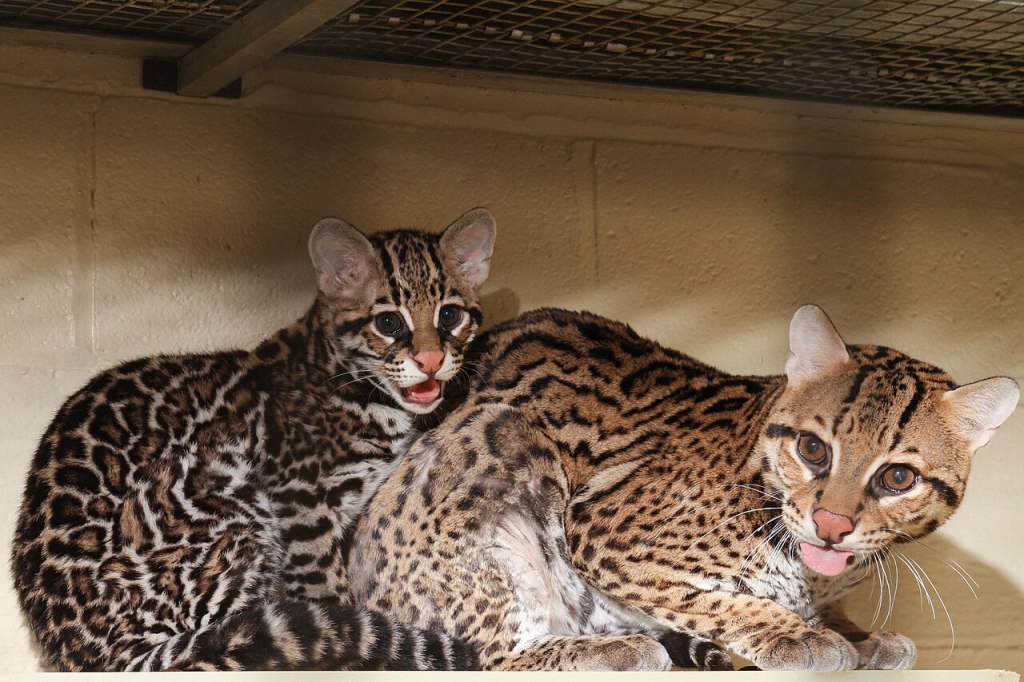
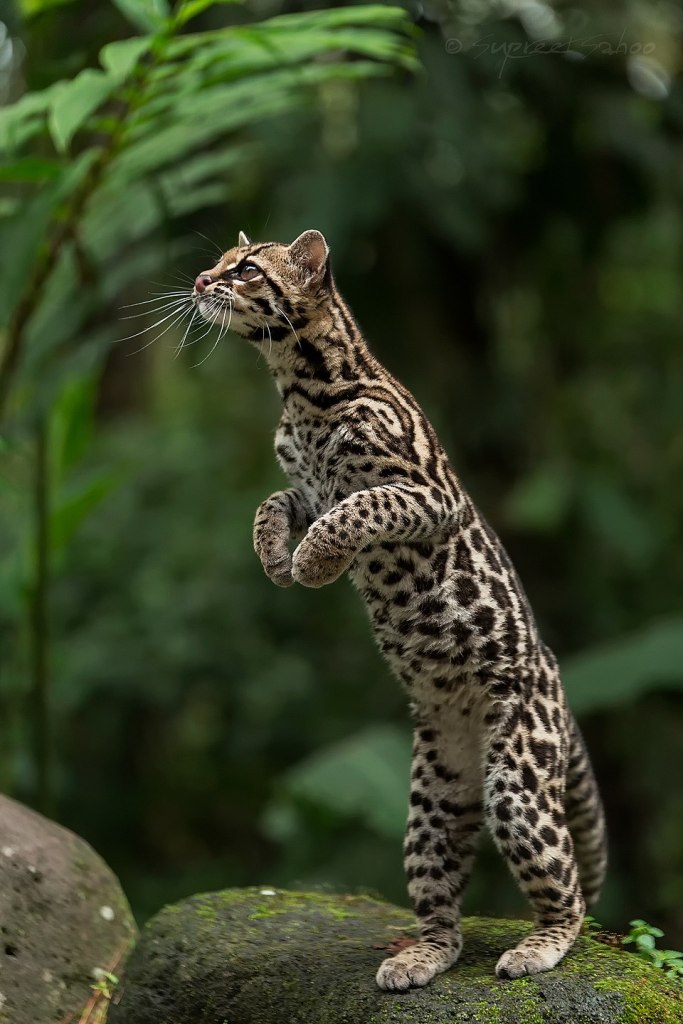
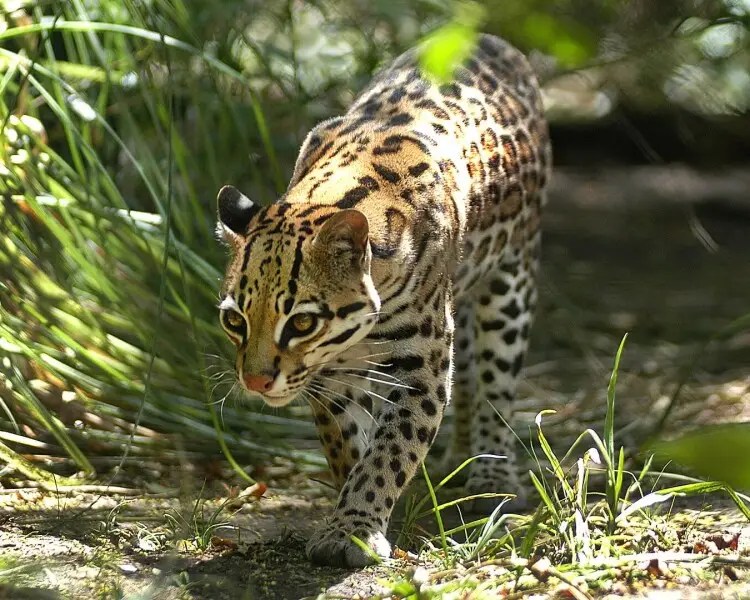
In addition to their predilection for cologne, ocelots are known for enjoying water, hunting by twilight, and napping in trees. The medium-size felids, who weigh up to 40 pounds in the wild, are also easily recognizable by their big eyes, the dark rings that surround them, and the way those markings become twin stripes that sweep over their foreheads.
Perhaps most striking are their large, wavy rosettes, which sometimes get them confused for young jaguars. In several indigenous South American languages, ocelots and jaguars share a name or have very similar names.
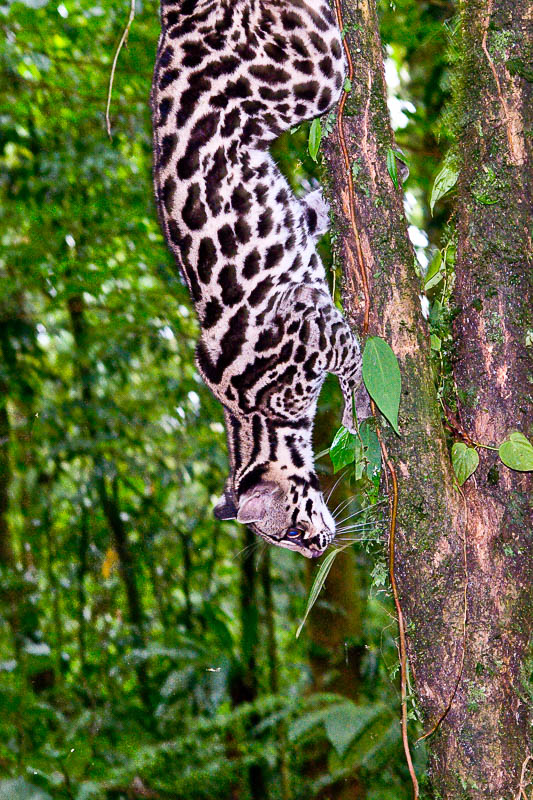
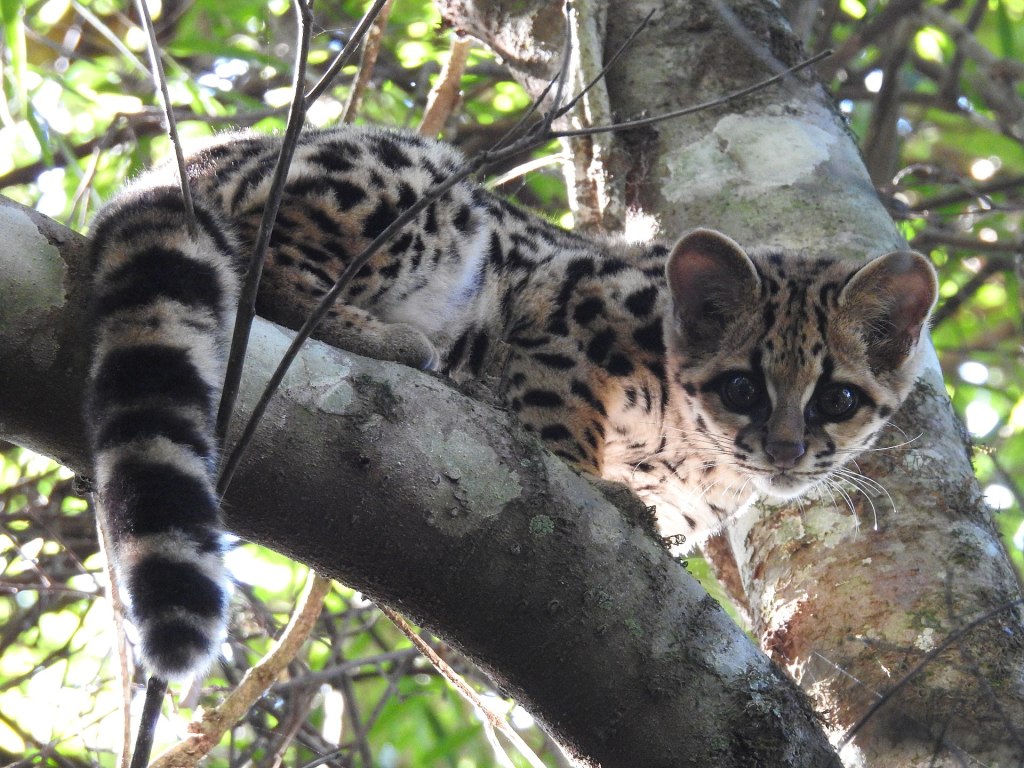
An ocelot kitten. After a gestation period of about three months, ocelot moms give birth to as many as three kittens. Credit: Wikimedia CommonsAn ocelot resting in a tree. Like other leopardus species, ocelots are proficient climbers. Credit: Wikipedia Commons
Ocelots have another quality that may lead people to confuse them with jaguars: they’re fond of water and they’re considered strong swimmers. That allows them to master their habitats, which often include rivers winding through rainforests and mangrove swamps.
The resourceful cats are adept predators on land and they can also pluck fish out of rivers.
An ocelot going for a dip. Credit: yellowlime_des/Reddit
Ocelots are categorized as a species of “least concern” by the IUCN (International Union for Conservation of Nature) but that doesn’t mean they’re thriving. Like pumas, the species is adaptable and can survive in varied surroundings. Still, ocelots contend with the same pressures other species experience, including habitat loss and fragmentation, hunting and poaching.
And while they can’t get enough of Calvin Klein’s Obsession for Men, maybe that’s a good thing.
According to zookeepers and wild cat experts, ocelots have a uniquely funky body odor which is amplified by their prodigious scent-marking. They want everyone to know where their territory is.
For zookeepers, the cats’ Obsession obsession could pull double duty as olfactory enrichment in their habitat — and a way to mitigate the stink.
Credit: Wikimedia Commons
Name: Ocelot (leopardus pardalis) Weight: Up to 40 pounds, with limited sexual dimorphism (males are slightly larger) Lifespan: Up to 20 years in captivity Activity: Crepscular, nocturnal Habitat: Claims territory in places where prey, water and dense ground cover are plentiful but the species is adaptable and survives in varied biomes
Goodall spent the better part of seven decades with the chimpanzees of Tanzania. Her discoveries were so profound, they forced the scientific community to reevaluate what separates humanity from other animals.
As I’m sure most of you have heard, Jane Goodall passed away Wednesday of natural causes. She was 91.
Goodall’s work was revolutionary and her career was extraordinary. It’s difficult to imagine now, but when Goodall first pitched camp in Tanzania’s Gombe Stream National Park in July of 1960, the scientific community knew virtually nothing about great apes.
Goodall wasn’t exactly welcomed with open arms. Being female and photogenic were the first two strikes against her in the eyes of the establishment.
She was self-taught, didn’t have a degree (she later earned a doctorate at Cambridge), and perhaps her biggest “sins” involved empathy and an attitude more buttoned-up scientists saw as anthropomorphizing the animals.
Goodall with a Gombe chimpanzee. Credit: Wikimedia Commons
Goodall gave the chimps names (a no-no at the time among scientists), carefully observed and recorded their family trees, worked out the obtuse — to human eyes– social hierarchy of primate troops, and witnessed behavior that no one had ever seen before.
She saw friendship, love and loyalty among the chimpanzees, witnessed a bitter war between the Gombe troop and a splinter group, followed families over generations, and saw one chimp die of a broken heart after his mother passed away. (I recommend Goodall’s 1990 book, Through A Window: Thirty Years With The Chimpanzees of Gombe, and the 2002 follow-up, My Life With Chimpanzees, for anyone who wants to read more.)
Her first major contribution, in October of 1960, not only fundamentally challenged our assumptions about animals, it forced us to change the way we regard our own species.
Goodall, observing the chimpanzees from a distance despite the rain that day, watched as a male she named David Graybeard repeatedly dipped blades of grass into the Earth. Curious, Goodall approached the site after Graybeard left, grabbed a few blades of grass and imitated what she’d seen the chimp doing.
She was astonished when she pulled the grass out and the strands were covered in termites. David Graybeard had been eating. He was using a tool to eat!
Goodall at Gombe in the early 1970s. The primatologist secured unprecedented access to the chimpanzees by gaining their trust. Credit: Wikimedia Commons
The discovery was huge because scientists believed tool use was, at the time, limited to mankind. We build and use tools, animals don’t, the thinking went.
When Goodall reported her findings to her mentor, anthropologist Louis Leakey, his prompt response indicated the gravity of her discovery: “Now we must redefine ‘tool,’ redefine ‘man,’ or accept chimpanzees as humans.”
Goodall never stopped working with the chimpanzees of Gombe, and today her formerly humble camp has become a permanent compound where researchers — all inspired by Goodall’s story — continue to study our genetic relatives.
But in her later years, Goodall became known for her activism just as much as her work as a scientist. She traveled constantly, engaging audiences on the subjects of animal conservation, respect for nature and understanding our place in the natural order. It’s a job that has become more necessary than ever as relentless human expansion, habitat fragmentation and human behavior push thousands of species toward extinction.
Credit: The Jane Goodall Institute
We lost Frans de Waal, the famous primatologist, in 2024. Now we’ve lost Goodall, and Sir David Attenborough is less than six months shy of his 100th birthday. We’re going to need people to pick up where they left off, and the job is much more difficult than it looks, requiring expertise, charisma and the ability to connect with audiences who know little about the subject matter.
But that’s a problem for another time. For now, let’s remember Jane and appreciate all she’s done over the span of an incredible life and career.
Free-ranging cats do have a negative impact on wildlife, but we’re not going to solve the problem by demonizing them and culling them by the millions.
The Literary Hub story starts off with a provocative question: what if cats ruled the world?
This is a question I find amusing to ponder, so instantly my mind was filled with images of cats scandalizing foreign heads of state by insouciantly swiping gifts off tables, angering diplomats by yawning and nodding off during summits, and financing the construction of massive and unnecessary coastal walls, on the off chance the ocean decides to move inland and get them wet.
Then the writer cited the repeatedly-debunked “study” that credulous media of all stripes still reference without bothering to read the text — that infamous 2013 Nature Communications paper, published by birders who author books with titles like “Cat Wars: The Consequences Of A Cuddly Killer.”
Some journalists don’t know any better, some are overworked, and some are frankly too lazy to read the study with a critical eye, but I think one of the more likely reasons people continue to cite the paper is because it’s easier to blame felinekind for wildlife extirpation than it is to admit we’re the primary culprits. After all, according to the WWF’s most recent annual review, we’ve killed off 73 percent of Earth’s wildlife since 1970, and we certainly didn’t need house cats to help us push elephants, rhinos, every species of higher non-human primate, and innumerable other species to the brink of extinction.
We did that. We did it with our relentless development, consuming and fracturing wild habitats. We did it with careless industrialization, by dumping chemicals and garbage into our rivers and lakes until more than half of them were rendered too polluted to swim in or drink from. We did it by bulldozing old growth forest and jungle, by exploiting species for fur, folk medicine, ivory, sport hunting and in the illegal wildlife trade.
Cheetahs are critically endangered, and they’re being driven to extinction even faster by poachers, who sell them to wealthy buyers in oil-rich gulf states where they’re trendy pets. Credit: Riccardo Parretti/Pexels
More than 47,000 species — that we know of — are headed toward extinction. It’s so much easier to blame it on anyone or anything else than admit we need to make major changes to our lifestyles and policies.
But don’t take my word for it. Here’s what Alley Cat Allies has to say about the 2013 meta-analysis and its derivative papers:
“The Smithsonian-funded study published in Nature Communications is not rigorous science. It is a literature review that surveys a variety of unrelated, older studies and concocts a highly speculative conclusion that suits the researchers’ seemingly desperate anti-cat agenda. This speculative research is highly dangerous. It is being used by opponents of outdoor cats and Trap-Neuter-Return (including the authors) to further an agenda to kill more cats and roll back decades of progress on TNR. And it is being spread unchecked by the media.“
Here’s what a group of ethicists and anthropologists wrote about the claims against cats in the journal Conservation Biology, lamenting the lack of nuance and danger in arguing that cats must be stopped “by any means necessary.” The drive to blame felines, they argue, has “fueled an unwarranted moral panic over cats”:
“Contrary to Loss and Marra’s claims that the scientific consensus is consistent with their views that cats are a global threat to biodiversity, the actual scientific consensus is that cats can, in certain contexts, have suppressive population-level effects on some other species (Twardek et al. 2017). This is something that is true of all predators, native or not (Wallach et al. 2010). Thus, cats should not be profiled as a general threat a priori and without reference to important factors of ecological context, situational factors, clear definition of harms, and evidence thereof.”
“There are there are serious reasons to suspect the reliability of the new, extreme cat-killer statistics,” wrote Barbara J. King, retired chairwoman of the department of anthropology at The College of William and Mary.
Feline predatory impact varies by local conditions. Free-ranging cats in cities and suburbs kill rodents, but have minimal impact on other animals, data shows. Credit: Patricia Luquet/Pexels
Like we’ve often noted here on PITB, the authors of the Nature Communications study can’t even say how many free-ranging felines exist in the US. They say it’s between 20 and 120 million. That’s a 100 million difference in the potential cat population! How can they tell us how many birds and mammals are killed by cats if they can’t even tell us how many cats there are? No amount of massaging the numbers can provide an accurate picture if the initial data is shaky or nonexistent.
Furthermore, the nature of a meta-analysis means the authors depend on earlier studies for estimates on predatory impact, but the 2013 Nature Communications paper does not include any data —not a single study — on feline predatory impact. In other words, they have no idea how many animals free-ranging cats actually kill.
In authentic studies that actually do measure predatory impact, the data varies widely in geographic and demographic context. Data derived from the D.C. Cat Count, for example, shows that cats living more than 800 feet from forested areas rarely kill wildlife, and are much more likely to kill rodents.
Those who cite the bunk study and its derivatives are “demonizing cats with shaky statistics,” King wrote, adding she was alarmed by “an unsettling degree of uncertainty in the study’s key numbers.”
Free-roaming populations are reduced when cat colonies are managed, and the animals are fed and fixed. Credit: Mia X/Pexels
Ultimately, we agree with Wayne Pacelle, former president of the Humane Society of the United States.
The meta-analysis authors “have thrown out a provocative number for cat predation totals, and their piece has been published in a highly credible publication, but they admit the study has many deficiencies. We don’t quarrel with the conclusion that the impact is big, but the numbers are informed guesswork.”
Cats do have a negative impact on wildlife, it varies according to local circumstances, and those of us who love cats have a responsibility to keep our pets indoors and help manage free-ranging populations.
But cooler heads must prevail, approaches to managing cats must be evidence-based, and the effort requires people of all kinds working together — which becomes much more difficult when agenda-driven pseudoacademics whip people into a frenzy by portraying felines as bloodthirsty, invasive monsters who need to be wiped out “by any means necessary.”
Solving the problem of free-ranging cats requires us to own up to our own role in species extinction and to take measured, evidence-based steps to protect vulnerable wildlife. Otherwise, we’re inflicting a whole lot of suffering on sentient creatures and accomplishing absolutely nothing.