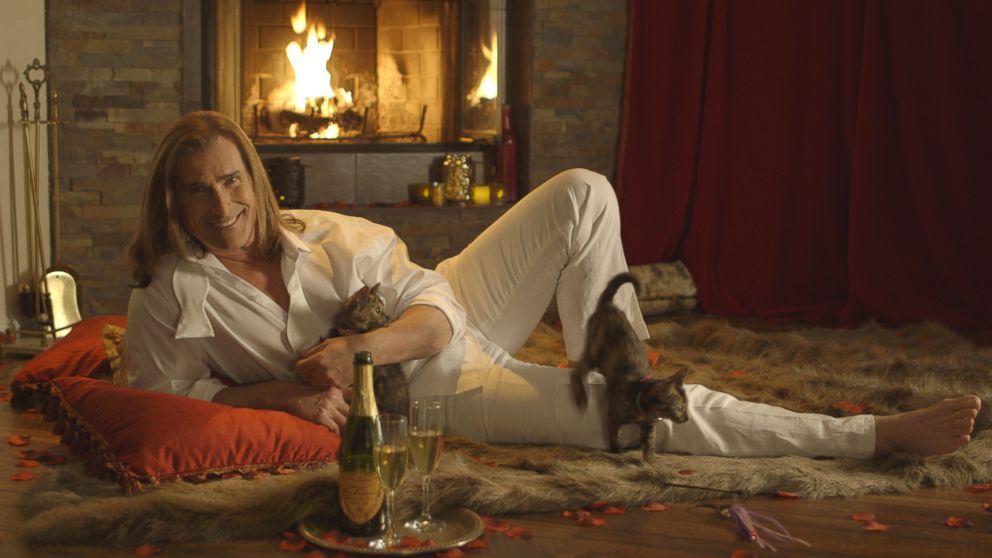
Whether you’re staying home on Valentine’s Day or spending it with your longtime significant other, there’s reason to celebrate with this special Valentine’s Day message from Little Buddy.
Lounging like the Fabio of cats, locking onto the camera with his soulful green eyes, Buddy embodies the romantic aspect of the holiday.
Valentine’s Day With Buddy the Cat
Already a major heartthrob to felines all over the world, Buddy is guaranteed to set human hearts fluttering as well with his meowscular good looks and remarkable charm.
Gaze upon this Adonis of Cats, ye mighty, and tremble!
Buddy the Cupid!
And finally, if you already have enough little buddies in your life, Buddy the Cupid will help you find your significant other…for a nominal fee of canned turkey pate and only during hours not designated for nap time, of course.
Buddy the Cat’s quest for world domination has moved into the realm of music. Listen to the new single here!
NEW YORK — Buddy the Cat made history as the first feline to top the charts in multiple genres this week with the release of “Move Your Ass” by The Buddies.
Listen to it here, but before you do, make room to get funky. (“And use proper headphones or speakers please!” Buddy says. “Don’t do us dirty by playing it through a phone or a laptop. You’ll miss all the bassy goodness that makes it funky!”)
The incredibly funktacular nu-disco track pays homage to the talented feline, who played guitar, bass, keyboards and percussion, while his human assisted him with certain particulars that required an opposable thumb.
“Obviously I could have done this on my own,” Buddy says, “but I like my human to feel like he’s involved in things, you know? Camaraderie and all that. But for future documentaries, ‘Behind the Music’ episodes and other retrospectives, it should be clear I’m the musical genius and the talent. The brains and the brawn, so to speak. Also the beauty. Obviously.”
“Move Your Ass” hit the top of Japan’s pop charts after an early release on Jan. 20 in that country, while it’s dominated the dance music charts in Luxembourg, the Principality of Sealand, Monaco and France. After its Jan. 30 release in the US and UK, it was steadily climbing the charts on Spotify and terrestrial radio.
Asked about his musical influences, Buddy waxed poetic about the funk, disco, French house and nu-disco he grew up listening to.
“From my earliest days of kittenhood, I remember Big Buddy playing Earth, Wind and Fire, Kool and the Gang, McFadden and Whitehead, The Brothers Johnson, Daft Punk, the Galactik Knights and Televisor. I love Televisor! I would dance around and joyfully smack my human on the head, then go hide in his shoes.”
Buddy’s already hard at work on his next single, which he promises “will be just as delicious as this one.”
Health authorities said thousands of female cats around the world fainted when they heard the news that Buddy the Cat is launching his very own OnlyFans.
After resisting calls from his admirers for years, Buddy the Cat has finally joined OnlyFans.
“It’s a dream come true,” said Nala, 5, a Burmese who describes herself as “Buddy’s biggest fan.”
Other felines posted celebratory messages online after the news broke, with most expressing an intent to subscribe to Buddy’s OnlyFans “no matter how much he charges.”
“A dollar a month, ten bucks a month, a hundred bucks a month, it doesn’t matter. It’s worth it,” said Penny, a puma who said she has posters of Buddy in her enclosure at a wildlife sanctuary. “Buddy is the sexiest beast of them all.”
A sizzling snap of Buddy being sizzling for his new OnlyFans site.
Buddy’s new OnlyFans site promises “sizzling snaps of Buddy napping,” “hot photos of him yawning and stretching,” and regular videos of the mercurial tabby being handsome.
“Finally, my fans can get more Buddy without having to read that stupid blog my human writes,” Buddy wrote in his announcement. “It’s full of ridiculous slander, vile lies and claims that I’m wimpy when everyone knows I’m, like, brave and stuff.”
As of Friday, the new site featured a handful of clearly photoshopped images of the gray tabby with bulging muscles as he lifted weights, and a poorly produced video depicting the diminutive feline “ambushing” a stuffed alligator, with the sounds of a jaguar dubbed into the footage.
“Just catching me some lunch!” Buddy captioned the clip. “Us apex predators don’t eat from a can, we hunt our own meals.”
Buddy the Cat poses in a box, striking a handsome pose as he gazes yonder.
There was no sign that questions about the veracity of the images bothered the egotistical feline’s admirers.
“OMG ADORBZ!” commenter princess2017 wrote.
“My handsome little prince!” wrote another poster, LioNeSS, who also added several heart and turkey emojis.
Soon after Buddy’s OnlyFans launch, it was announced that Smudge, his arch-nemesis, signed a deal to create a show about his life for Netflix. Titled “Smudge: New York’s Most Heroic Cat,” the series will “follow Smudge as he fights for truth and justice against the evil Dubby the Cat, a chubby gray tabby with an inflated ego.”
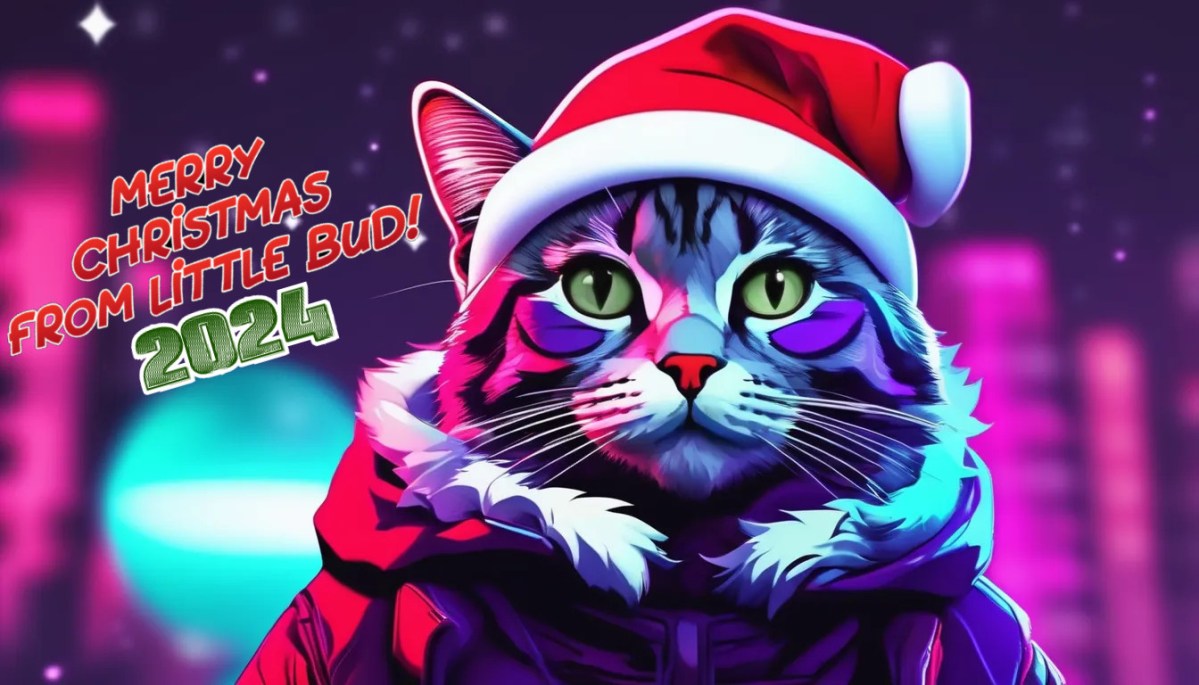
This year, Santa brought something really awesome for Little Buddy!
No, not a Roomba. A TinyTent! A beautiful, dark blue tiny tent with equally tiny mesh windows and and a tiny rain fly.
I put it together and called Bud over.
“Look, Bud!”
He meowed, tail up, clearly interested. But he didn’t go inside, so I got a few of his favorite treats and tossed them in there.
Bud padded over, stuck his head and front paws in the tent…and I realized he may be too fat for his TinyTent.
“TinyTent for Buddy?!
I need to get him in there. After all, the entire point was to put it on my desk and establish a clear Buddy Spot, a place where he can be right next to me and lounge comfortably without sitting in front of my monitor or on the keyboard.
He will fit. Cats are liquid, after all, and love a good snug spot. I just have to wait until the tent floor settles a bit and maybe add an old t-shirt.
Then Bud will have his Buddy Spot, so he can be cozy and remain within one foot of me while allowing me to write. (Yeah right.)
And if not…it’s diet time, fat boy! For both of us.
Special thanks to my nieces, who gifted Buddy his TinyTent. They remain the only two humans in the world Bud is terrified of, and I feel bad they can’t play with him much, but they love him.
In other Christmas gift news, my mom gave me this mug “from Bud,” and, well, it’s almost embarrassingly, uncannily accurate, and the image is not custom-made:
What?!
I mean, that’s a gray tabby, but it’s also his precise coloring, and the black t-shirt, red-brown hair and man bun are all me. (We’ll pause so you can laugh at me for the bun. It never would have happened if COVID didn’t shut down barbershops for an entire year and I didn’t watch Vikings during the pandemic, thinking “That Ragnar Lothbrok has cool hair! I wanna be a viking!”)
As for the rest of Christmas, I am spending it with family and I hope you are too, friends. I know some people feel they need to drink just to tolerate relatives, but I have always been grateful that my family is boringly normal. No fights, no arguments, and we’ve all agreed not to talk politics.
I hope your gatherings are similarly uneventful and you get to enjoy the holidays and your families.
And now we leave you with a lively and festive number from Buddy the Cat’s Christmas songbook, originally published in 2022. It’s meant to be sung to the Tony Bennett version of My Favorite Things, a true classic!
Buddy’s Favorite Things
Temps in my bowlses and snacks in the kitchen
Taunting the street cats and smacking some kittens
Leaving the neighbor’s dog tied up in strings
These are a few of my favorite things!
Bubble wrap, peanuts and UPS boxes
4 a.m. zooms when I scream like a rocket
Waking my human with songs that I sing
These are a few of my favorite things!
At nail clip time, things I dislike
When I’m really mad
I simply remember my favorite things
And then I don’t feel so bad!
Calico booties and slices of Gouda
Ambushing like I’ve been launched by bazooka
No consequences ’cause I am the king!
These are a few of my favorite things!
Screeching in anguish at doors closed between us
Shattering Wise Men and statues of Jesus
I helped myself to the buffalo wings
These are a few of my favorite things!
Meow at my bowl as if I’ve been forgotten
Screeching in panic ’cause I see the bottom
Gorging on kibble till I am puking
These are a few of my favorite things!
When I’m told no, ’cause I broke those
When my dad is mad
I’ll get away with my favorite things
Because I’m a real cute cat!
It’s that time of year when we celebrate a Festivus for the Rest of Us!
As seasoned Festivus pros know, the holiday falls on Dec. 23 and eschews the commercialism that’s taken over the season. Instead of a tree or a menorah, Festivus decorating consists of a single unadorned pole. In the words of founder Frank Costanza: “I find tinsel distracting.”
At the Festivus gathering, family and friends get together for a meal, which ends with the Airing of Grievances, in which you tell your loved ones all the ways they’ve disappointed you over the past year.
“I’ve got a lot of problems with you people,” Frank Costanza said during Festivus 1997, “and now you’re gonna hear about it!”
So we’ll hand it over to Little Bud for his grievances:
To Big Buddy: Ten Christmases! Ten, and still no Roomba! You, sir, are a man of empty promises and crushed dreams. Year after year I made my Christmas list, and I remind you of all the ways I’ve been a good boy. I don’t go on the counter tops, ever. I leave the Christmas tree alone. And when I smack you in the face to wake you up, I don’t smack you too hard. What else do I need to do?
The Pirates of Somalia: I thought we had something, guys! Aye, some of me best memories are of sailing the high seas with me mates, looking for plunder on cargo and cruise ships. I didn’t even get a Christmas card from you this year!
The Jaguars of Amazonia: You guys are my true homies! You welcomed me with open paws. We hunted together, we napped together, we took ayahuasca and ran around the jungle hallucinating giant turkeys. You even made me an honorary jaguar and named me Kinich Bajo, or “Tiny sun-eyed one.” And you sure do know how to provide muscle! Every cat and dog for 15 miles is scared of me because I roll with you. I love you guys!
The Tigers of the Bronx Zoo: I offered a paw in friendship, and what did you do? You let one of your females abduct me and take me back to her cave, where she treated me like one of her cubs and bathed me in her saliva. It was horrible! Do you know how many actual baths it took to get rid of the stink? I still have PTSD!
The Readers of PITB: Maybe I’m mistaken, but it feels like you don’t tell me how charming and awesome I am as much as you used to.
Smudge from Apartment 1S: You, sir, are pushing your luck. This floor isn’t big enough for the two of us, and at some point there’s going to be a reckoning. You should be really scared.