Blog Posts

Local Cat Enjoys 7 Meals A Day From 7 Houses

The resourceful cat has mastered the art of meowing adorably and appearing hungry, tugging at the heartstrings of seven neighbors who all think he doesn’t get enough to eat.

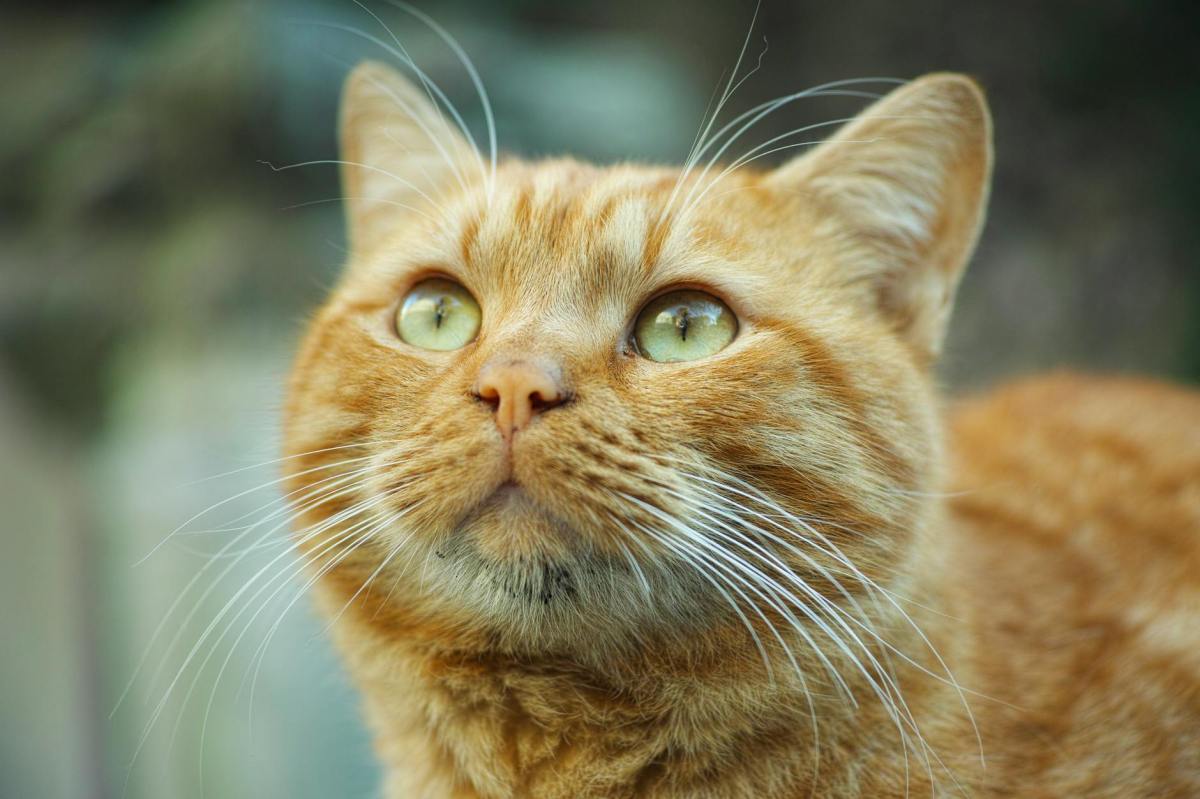
NEW PALTZ, NY — It’s not easy playing the part of a hungry stray to seven different families in a one block radius, but local cat Tangerine says he makes it work by sticking to a strict schedule.

“I’m always at the green house at 7:45 am sharp, ’cause that’s when the kids leave for the school bus. When they see me they call out to their mom, who’s usually got tuna or eggs for me,” the enterprising feline said.

From there it’s on to the three-story Dutch revivalist house on the corner, where a retired gentleman calls Tangerine “Rusty” and offers him a generous bowl of kibble.

“The key is to master the plaintive meow and to look just a bit unsure of yourself,” Tangerine explained, “like you haven’t had a meal in ages and aren’t sure where your next meal is coming from.”

But Tangerine isn’t nearly done after only two houses. The crafty cat has his stops all planned out and knows the routines of every one of his neighbors, a feat of efficiency and logistical planning that would make FedEx envious.

If the weather’s nice, the orange tabby will settle down for a rest in the neighbor’s yard, which has flowers that are particularly enjoyable to defecate on. If it’s chilly or raining, Tangerine heads back home for his morning snooze.

Immediately after First Nap is the highlight of the morning: a visit to the Bacon House where the inhabitant, a 47-year-old software engineer, has bestowed the name Simba on Tangerine and always offers deliciously crispy bacon, the feline said.

A visit to Bacon House
Visiting Bacon House is a highlight of the day, never to be missed. Image: PITB

Next it’s Second Nap followed by Fourth Meal at the wrap-around porch two houses down, which provides ample shade for subsequent snoozing. The people there call Tangerine “Creamy Delicious” and offer him a wide variety of palate-pleasing treats.

Tangerine prepares for the visit by rolling in the dirt for a minute or two, making himself look scruffy and unkempt.

“You poor thing!” the woman who lives there often says as Tangerine nuzzles against her hand and meows cutely. “You probably haven’t eaten since yesterday!”

The rest of the afternoon through early evening takes the orange tabby between three additional homes where he enjoys diced chicken, crumbled sausage and occasional steak.

By the time he’s finished his rounds, Tangerine is drained and returns home to rest.

“It’s not easy doing that much eating and sleeping,” Tangerine said with a wide yawn. “If it were easy, every cat would be out there like I am with the side hustle.”

As of press time Tangerine said it was too early for a formal announcement, but said he’s been working on “considerations of sleep and logistics” that would allow him to expand to an ambitious route of nine houses and nine meals daily.
Pet Theft Up 40 Percent Since Pandemic, Criminologist Says

Incidents like Sunday’s attempted cat robbery are happening more often in recent years, a forensic investigator specializing in animal-related crimes says.

Pet theft is a low-risk, high-reward way for the criminally-minded to make a quick buck, which is one reason why such crimes have become much more common since the pandemic, a forensics professor told the New Haven Register.

Virginia Maxwell, who specializes in forensic investigation of animal cruelty, spoke to the newspaper in the wake of Sunday’s failed gunpoint robbery when two men broke into an East Haven, Conn., home and demanded the victims’ “high dollar value cat.”

But first we’d like to draw your attention to an announcement we made back in February of 2021. At the time pet theft was in the headlines after robbers shot a man walking Lady Gaga’s breed dogs, while across the country in Portland a man stole a van full of daycare-bound pups.

Here’s what we wrote at the time:

“Buddy would like everyone to know he does not actually live in New York, and that his true location is a secret.

“I could be living in Rome,” the troublemaking tabby cat said. “I could be Luxembourgish. Maybe I live in Königreich Romkerhall or the Principality of Sealand. You just don’t know.”

“The one thing you can be certain of is I definitely don’t live in New York.”

We would like to make clear that we continue to blog from Not New York.

On a more serious note, financial woes brought on by the pandemic, painful inflation and a generally difficult economy have attracted the criminally inclined to the petnapping trade, and as Maxwell pointed out to the Register, few people are held accountable for animal-related crimes. That includes darker endeavors like dog fighting and puppy/kitten mills.

“Sadly, animal cruelty in general is under-prosecuted, and very, very few actually end up resulting in jail time,” Maxwell said.

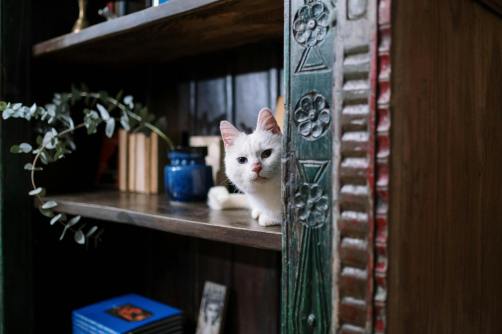
white cat on brown wooden shelf
A cat stays above the fray and surveys her surroundings from an elevated perch. Credit: cottonbro studio/Pexels

Sometimes pet thieves are opportunists who see a cat or dog who catches their fancy, or they believe might be worth money. Those cases often include people luring well-loved animals off porches and property with food.

Most, however, are people who intentionally target breeds that command high prices and are primarily responsible for what Maxwell says is a 40 percent spike in petnappings since early 2020. For felines that means Bengals, Savannahs, Ragdolls, Maine Coons, Norwegian Forest Cats and other breeds that can net the thief a solid payday for minimal effort.

“They’re going to steal your pedigree cat, your pedigree dog that’s worth thousands” and immediately flip the animal, Maxwell told the newspaper.

Social media, it turns out, is a double-edged sword.

While cops and animal welfare organizations warn people against showing off valuable pets online — and urge people to disable features like location tagging — the same platforms are often invaluable for retrieving stolen cats and dogs. Groups on sites like Reddit and Facebook help people find their well-loved four-legged family members and warn others when they identify resellers.

You can help keep your furry friends safe by making sure they’re microchipped, only allowing them outdoors when you’re there to accompany them, and keeping gates, doors and garages closed and locked.

2 Men Break Into House, Demand Cat At Gunpoint, Cops Say

The would-be robbers knew the cat was worth money and specifically targeted the victims, according to police.

Two armed men broke into a Connecticut home on Sunday afternoon and demanded the victims turn over their “high dollar value cat,” according to the East Haven Police Department.

The would-be robbers initially tried to force their way into the East Haven house through a rear sliding glass door, but when the victims tried to prevent them from getting in, one of the men simply kicked through the glass, cops said.

That’s when the intruders brandished a handgun and demanded not cash, not jewelry or other valuables, but the cat!

The kitty in question must have been spooked by all the commotion because the frustrated robbers left empty-handed after a few minutes of fruitless searching. They hopped into a blue BMW and sped off, the victims told police.

Cops didn’t offer any description or breed information about the feline, describing it simply as a “high dollar value cat.”

It’s not uncommon for prized breed cats to command $5,000 from prospective buyers, and some breeds like the “exotic” Savannah cat can sell for as much as $20,000.

bengal cat on white background
Bengal cats like the one above are favorite targets of thieves. Credit: jerry u6770/Pexels

While it’s unusual for someone to break into a home and demand a cat at gunpoint, in the middle of the day no less, cat theft is actually a thing.

Thieves most frequently go after Bengals, Savannahs, Maine Coons, Ragdolls and other breeds that can make them a quick buck by selling them to unsuspecting buyers. Surprisingly domestic shorthairs are on several lists of most commonly stolen cats, but a vet tech tells Reader’s Digest that moggies make the list simply because there are so many of them.

Part of the problem is that the penalties for stealing cats aren’t prohibitive. Most states either treat cats and dogs as property that can simply be replaced, or classify theft of pets in archaic agriculture and markets laws, which were designed to deal with disputes over livestock and farm animals, not pets.

Advocates in some countries, like the UK, are pushing legislation that would make stealing a pet a criminal offense with much harsher penalties.

In Sunday’s attempted robbery, police found the BMW abandoned in Hamden, a town about 10 miles north of East Hampton. They’re still looking into the unsuccessful caper, telling local media that the attempt was planned, not a crime of opportunity or a random event.

Still, if you have a “high dollar value cat,” it’s worth taking some precautions. Here at Casa de Buddy we’ve installed a feline version of a panic room: a panic box! Reinforced with heavy shipping tape, the thick corrugated cardboard is sure to keep bad guys out while also remaining roomy, yet paradoxically snug.

buddybox2
“Yes, this will do nicely, human.”

NY Cat Eats At The Table With His Humans, Plus: More Kittens And Climate Change!

A cat eating at the table with his humans? Let’s hope Bud doesn’t get any ideas!

File this under “Information that must be hidden from Buddy at all cost, lest he get ideas.”

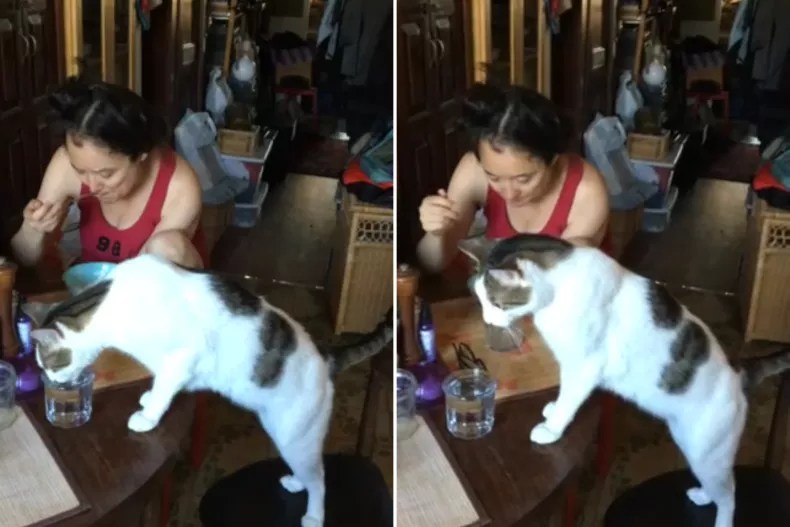
Franklin, a cat who lives in Brooklyn, has gone from fending for himself on the streets of New York to a very comfortable indoor existence with two humans who are happy to let him sit at the table with them for meals. Bowls? Pfffft. Franklin drinks from his own glass:

Franklin the cat
Credit: Andrea and Alice via Newsweek

As the dutiful servant to a cat who most definitely believes he’s a human — or should have all the privileges and none of the responsibilities of one — this makes me uneasy. If Bud were to somehow find out about this, all hell would break loose and before I know it he’ll be demanding custom cutlery and a silk pillow on which to rest his behind and elevate him to the level of the table.

As a vegetarian I don’t necessarily have to worry about Bud eating my food, but he sure does love sticking his face in it and giving it an exploratory lick or three.

“Is that…? Dude, let me in there, I just wanna stick my face in your mashed potatoes and confirm I don’t like them,” I imagine him saying. “Yep. Still don’t like them. Oh stop being so dramatic, you can pick the fur out!”

A reasonable take on the kitten/climate change claims

The Grist has a new story about the alleged connection between an “increase” in kittens and climate change, and while it unfortunately links to one of the bunk studies that uses meta-analysis to make wild claims about feline impact on the environment, it does include the most measured and reasonable take so far on the claims:

“Others, like Peter J. Wolf, a senior strategist at the Best Friends Animal Society, think the increase comes down to visibility rather than anything biological. As the weather warms, Wolf said people may be getting out more and noticing kittens earlier in the year than before. Then they bring them into shelters, resulting in rescue groups feeling like kitten season is starting earlier.”

As we noted on Sunday, the claim that there are more kittens, or that kitten season is longer, is entirely dependent on anecdotal evidence. Unfortunately no one has any data for baseline population numbers when it comes to cats in the US, let alone historical data that allows us to say there are more kittens born in recent years.

The best we’ve got is the excellent but single-city DC Cat Count, and to establish a convincing link between climate change and kittens we’d not only need hard data, but we’d also need to eliminate dozens of other potential factors like ever-increasing light pollution, urban heat islands and wave effects from 2020, when society went into lockdown and animals were mostly left to their own devices.

Once again, there’s only one measurement that really matters in the end, and that’s the number of cats euthanized annually because there aren’t homes for them. Spaying/neutering and education efforts have driven that number down dramatically over the past 20 years, and ultimately that’s the best solution we have.

Some Cat Advocates Claim Kitten Season Is Getting Longer Due To Climate Change

Is there any evidence to support claims of a longer kitten season?

Is kitten season getting longer because of climate change?

Some rescuers in California think so, according to a story in Santa Rosa’s Press-Democrat.

“Heat and warmth is what it’s all about,” said Mary Pulcheon, trapping coordinator for Forgotten Felines of Sonoma County.

Pulcheon and the executive director of Forgotten Felines, Pip Marquez de la Plata, told the Press-Democrat that strays in their care had given birth as late as December in 2023 when kitten season generally runs from late March through October.

They say the typical kitten season has shifted and is now longer due to rising temperatures caused by climate change.

It’s an unverifiable claim for several reasons.

First, we don’t have reliable estimates for how many cats there are in the US, let alone stray and feral cats. Any estimates are guesses, and they vary wildly from 20 million on the low end to 120 million, which seems an excessive and unrealistic number.

To date there’s been a single comprehensive feline census in the US, the D.C. Cat Count. It took three years, several million dollars, hundreds of trail and trap cameras, and the efforts of an army of volunteers and staff.

The final tally: 203,595, with only 6,533 unowned cats fending for themselves and drifting between managed colonies.

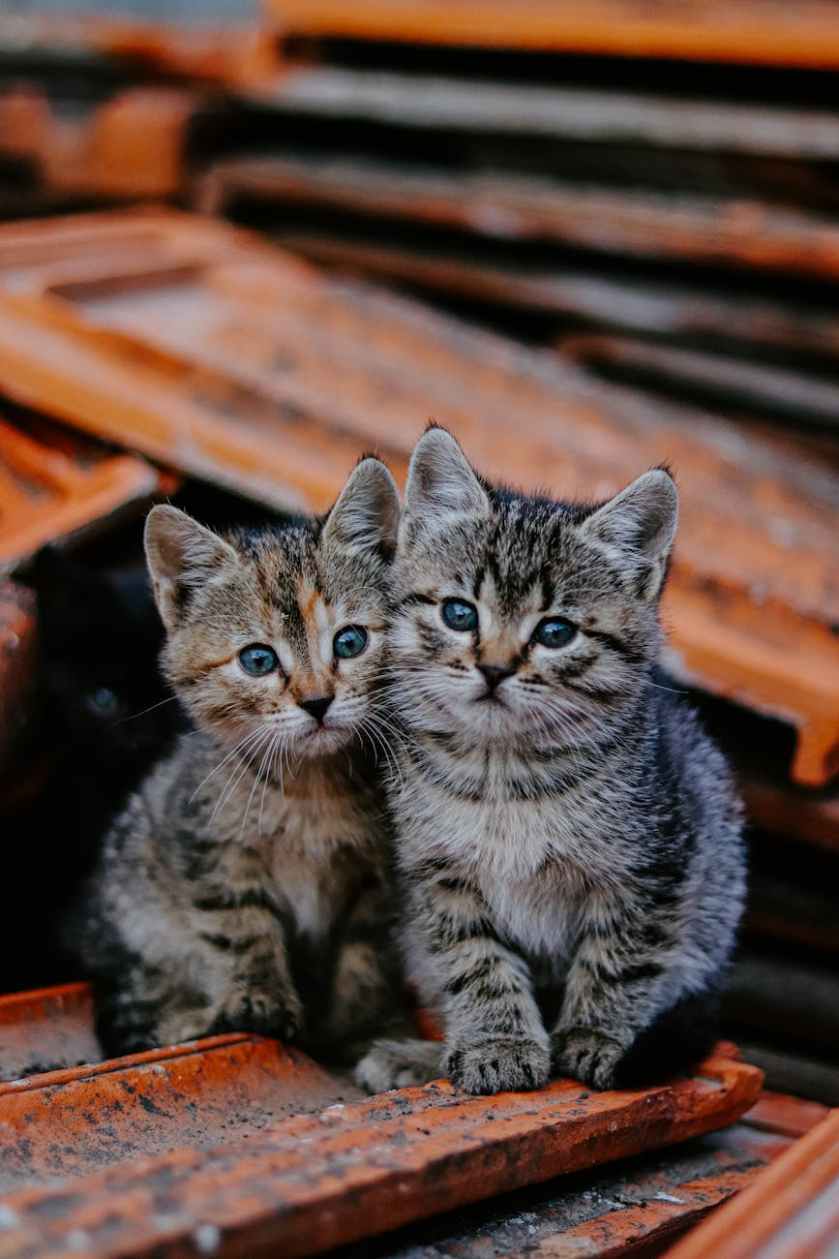
adorable tabby kittens
Credit: Ejov Igor/Pexels.com

The DC Cat Count is historic and has already proven its value by facilitating informed debate, showing rescuers/TNR volunteers where to direct their efforts, and yielding valuable data on local ecological impact.

Alas it’s a one-off, so we don’t know anything about how the population has changed over time.

Secondly, while there absolutely is scientific consensus that human activity is driving global temperatures up, there’s debate about how much temperature flux is directly attributable to modern civilization. We’re also looking at planetary timescales here, tracking changes that happen not just over decades, but centuries and millennia.

Attributing shifts in kitten season to climate change is a bit like attributing single storms to climate change. These are single data points from which we can’t draw conclusions.

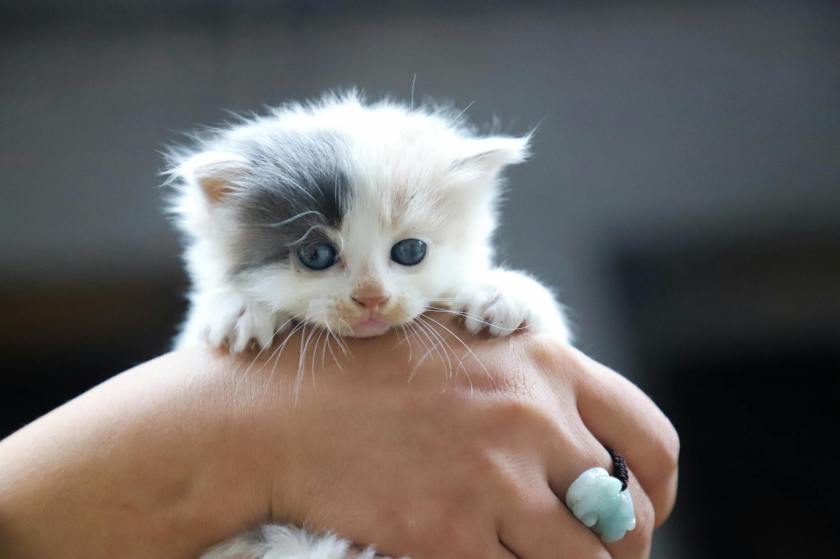
close up photo of person holding white kitten
Credit:Cats Coming/Pexels

Lastly, there could be dozens of factors skewing “normal” kitten season, and that’s assuming the March through October season is normal by historical measurements. We don’t know that for sure, and we can’t know it without data.

I’m limited by a lack of imagination here, but changes in kitten season could be regional, reflect non-climate weather patterns, or adjust according to cyclical patterns. Things as seemingly unimportant as ambient light pollution can have a profound effect on animal behavior, and it always helps to remember that felines are sensitive to stimuli that we literally cannot detect. Cats can pick up high frequency sounds we can’t hear and smell things beneath the notice of our own weak noses. They even have a second form of olfactory input, a literal sixth sense that is unmatched by anything in human biology.

We understand very little about how those things impact feline behavior.

With all things considered there could be hundreds of reasons for changes in kitten season, and that’s assuming the changes are real and people aren’t mistaking outliers for trends.

Ultimately we don’t need to draw conclusions about whether there are more kittens born each season. We know TNR, while imperfect, is the best way to humanely reduce stray and feral populations, and we still have a way to go before cats are no longer euthanized because we can’t find homes for them.