Blog Posts

A Cruel, Emotionally Manipulative New Scam Targets Cat Owners

“I had to leave work because I was a wreck, fully believing my cat was on the verge of life and death. It’s cruel that people do this,” one victim said.

Two weeks after his beloved cat vanished, Justin Hills received a phone call that simultaneously gave him hope and filled him with dread.

The man on the line spoke with practiced professionalism and told him that his cat, Little Wayne Shorter, had been found badly injured after he was hit by a car.

Little Wayne urgently needed surgery, said the man who identified himself as a staffer with Seattle Animal Shelter. Veterinarians were ready to begin surgery if Hills gave them the go-ahead and sent $2,800 via Venmo.

“The back of my head is screaming, ‘This is a scam. This is a scam.’ But at the same time, because it’s such an emotional pull, I’m thinking, even if there’s only a 10% chance that this is real, you know, I want to go ahead with it,” Hills told Seattle’s WKIRO.

Little Wayne Shorter

“The guy was rehearsed, was smooth. He sounded like, you know, an experienced person,” Hills said. “They had done some research on me before they called. You know, they knew my name. They knew my cat’s name, you know, the address and all this.”

When Hills called his bank, they warned him it was a scam. Hills said he’s glad he didn’t send the money but also devastated his cat is still missing — and that he was given false hope by someone trying to manipulate him in his desperation to be reunited with Little Wayne.

He’s not alone. In a post to Facebook group for missing pets in King County this week, Seattleite Harris Alex described a call from a person who claimed to work for Seattle Animal Shelter.

“They said someone found my cat, Binx, and that he had been hit by a car. They told me if I didn’t pay for surgery, he would die or be paralyzed within the next hour,” Alex wrote.

A caller said Binx, above, was seriously injured and needed urgent — and expensive — veterinary care.

Alex grew suspicious when the caller asked for a payment via Venmo, Paypal or Chime.

“I called the shelter to confirm they do not have him,” Alex wrote. “I had to leave work because I was a wreck, fully believing my cat was on the verge of life and death. It’s cruel that people do this. Be careful out there.”

Staff at Seattle Animal Shelter, which is run by the city, are aware of the scam and have gotten several calls from people asking if the shelter has their cats after being in contact with the impersonators.

“We would never ask somebody over the phone to make a payment,” said Don Baxter, manager of field services at the hospital. “We’re going to get that pet to a veterinarian and get it care and treatment, and then we’ll work out how to get the pet back to the owner after that.”

The lost/injured pet scam isn’t limited to Seattle, and the perpetrators will often switch to targets in another city if too many people become aware of their efforts, only to pop back up again later. The scam’s combination of social engineering and emotional urgency encourages victims to act quickly without giving the situation too much thought.

Experts advise people to keep their cool despite their hopes or fears, and demand proof that the person has the animal:

“This is one of the more difficult scams to deal with emotionally. If someone really has your pet, they should be able to at the very least send photos. Most people should be able to do a video call.

In general, scammers will pressure you to send money in advance. They will often make lots of excuses for not being able to provide proof they have your pet or meet in person.”

This general category of scam isn’t new, but social media has enabled scammers to believably pose as shelter staff using information pulled from the victim’s own lost pet posts and profiles, the FBI notes. The bureau also warns of several variations on the scheme.

Binx

The people running the con find their victims by scanning local missing pet groups on sites like Facebook and Reddit. They gather names and descriptive details, spin a narrative that shocks their intended victims, and create a sense of urgency by saying the cat will die if there’s any delay in performing surgery.

That’s what happened to Susan Burgess, who’d posted about her 15-year-old tabby cat, Linus, going missing. The caller said Linus was hurt and he needed to confirm her name, but Burgess realized he would have known it if he’d scanned Linus’ microchip.

She gave the scammer a piece of her mind before hanging up on him.

“On the off chance that you do have my cat, I hope that you are able to show some compassion and do the right thing,” she told the caller. “But I’m pretty sure that you don’t, and what you’re doing is very cruel.”


PSA: Speaking of scammy behavior, I can’t control the ads that are shown on PITB, but if you’re seeing ads for an amazing-looking, ultra-realistic toy rabbit presented as a great Easter gift, don’t fall for it. Here’s a video revealing what you’ll actually get from the deceptive seller:

Wordy Wednesday: Critically Endangered Orangutan Babies

The palm oil and logging industries have killed so many orangutan mothers, there are now more than a dozen major orangutan orphanages in Borneo and Sumatra. The pressure on orangutans, with whom we share 97% of our DNA, shows no signs of abating.

Orangutans are critically endangered, and the biggest threat to their continued existence comes from the agricultural sector, which has razed 55 percent of the species’ habitat in recent decades.

Jarang, a baby orangutan born in 2023. Credit: Blackpool Zoo

Logging companies clearing irreplaceable, old-growth jungle to claim more land for palm oil plantations have no compunction when it comes to flattening jungles despite the presence of orangutans hiding in the trees. The loggers often shoot the large apes on sight, leaving terrified, traumatized babies still clinging to their dead mothers, or taking them to sell as pets.

Of those left to die, the lucky babies are rescued before they starve and are brought to one of the many orangutan orphanages in Borneo and Sumatra, where they attend “school” to learn how to do everything from climb to forage. It takes at least eight years to teach them how to survive on their own, which is about the time it takes orangutan mothers to do the same job in the wild.

The unlucky babies end up as local pets, sold off to entertainment troupes or shipped off to places like Dubai, where wealthy clients will pay a premium for them.

Caretakers must start by teaching rescued orphans the most basic things, like how to climb and move through the jungle Credit: Borneo Orangutan Survival Foundation
Logos, an orphaned baby orangutan who was rescued in 2023 by the Jakarta Animal Aid Network (JAAN) Credit: International Animal Welfare Fund (IAWF)
Baby Galaksi (Indonesian for galaxy), was found wandering the jungle without his mother in 2021 by a villager in Borneo. He’s now in a “school” that teaches orphaned orangutans how to do everything from evading predators to discerning edible fruit from harmful and poisonous varieties. Credit: Samboja Lestari Orangutan Rehabilitation Centre

So what is palm oil, and why are countries in Asia bulldozing ancient jungles and forests to clear room and make more plantations?

Per the WWF:

“Palm oil has been and continues to be a major driver of deforestation of some of the world’s most biodiverse forests, destroying the habitat of already endangered species like the Orangutan, pygmy elephant and Sumatran rhino. This forest loss coupled with conversion of carbon rich peat soils are throwing out millions of tonnes of greenhouse gases into the atmosphere and contributing to climate change. There also remains some exploitation of workers and child labour. These are serious issues that the whole palm oil sector needs to step up to address because it doesn’t have to be this way.

Palm oil is in nearly everything – it’s in close to 50% of the packaged products we find in supermarkets, everything from pizza, doughnuts and chocolate, to deodorant, shampoo, toothpaste and lipstick.”

Palm oil is in constant demand, and it’s an easy to grow, incredibly efficient crop. Indonesia and Malaysia, the only two countries in the world where orangutans exist, produce 85 percent of the world’s palm oil.

Images of orangutan babies in wheelbarrows are common on social media, but usually stripped of context. Orphanages use the wheelbarrows to bring infants and toddlers to and from “school” every day. Credit: International Animal Rescue
Asoka was found crying in the jungle by a fisherman in Borneo. He was brought to an orphanage in Borneo. Credit: International Animal Rescue’s rehabilitation Centre in Ketapang, West Kalimantan

We share 97 percent of our DNA with orangutans, making the species our second-closest cousins from a genetic standpoint. Some studies claim orangutans are our closest relatives based on our phenotypical similarities.

Orphaned orangutans attending “school” to learn how to survive in the wild. Credit: Borneo Orangutan Survival Foundation
A baby at an orangutan orphanage is fed by a caretaker. Credit: Borneo Orangutan Survival Foundation

Want to read more and learn how to help?

Here are some links to get you started. PITB is a big fan of the Jakarta Animal Aid Network, which successfully pushed Jakarta’s municipal government to ban the incredibly cruel “topeng monyet” monkey street shows:

World Wildlife Fund: Orangutans
Jakarta Animal Aid Network
Borneo Orangutan Survival Foundation
The Orangutan Project
Rainforest Trust

‘Relax, It’s Just A Cat’ Guest Says After Shoving Kitty Off Couch

A woman asks Reddit if she overreacted when she tossed her friend out over the way the friend treated her cat.

A Redditor has been assured she didn’t overreact after recounting a disturbing incident involving one of her friends and her cat.

Describing her cat as “super friendly, but a little skittish” and prefacing the anecdote by noting she always asks guests “to be gentle with her,” the Redditor relayed what happened when her cat jumped onto the couch near the seated guest.

“Out of nowhere, my friend shoved her off the couch. Not a little nudge—an actual shove that made her hit the floor hard. My cat ran and hid under my bed, and I lost it. I asked them what the hell that was, and they just laughed and said, ‘Relax, it’s just a cat.'”

“I told them to get out immediately. They acted like I was overreacting, saying they didn’t mean to hurt her and that it wasn’t a big deal. But my cat was terrified, and I don’t care if it was intentional or not—that kind of reaction to an innocent animal is not okay with me.”

The offending party is telling mutual friends that the Redditor “threw them out over ‘nothing,'” but others in their social circle have “admitted they never liked how this friend treated animals.”

Still, some told the woman she may have been too harsh for telling the cat-shover to leave immediately.

What do you think?

Tornado of claws!

For what it’s worth, most people who responded to the AITA (“Am I The Asshole?”) thread sided with the poster, and others pointed out that someone who will casually shove a cat off a couch while the caretaker is right there might do much worse if no one’s around. In other words, don’t let that person watch your cat under any circumstances.

I have never had this problem, obviously, because no one would dare shove my incredibly ripped and meowscular cat.

Jokes aside, I can’t imagine anyone I’m friends with would harm him when they know how much little dude means to me.

And as much of a wimp Bud is when it comes to vacuums, loudly crinkling paper bags and Swiffers, he has absolutely no fear of people. If someone tried to shove or toss him off a couch, I’d actually feel sorry for them, because the next instant would involve 11 pounds of furball screeching like a furious Elmo while producing a tornado of claws.

Reddit’s AITA is a reliable source of insight into antisocial behavior and social faux pas, which makes it fun to browse, but it also offers people a chance to gauge if they’ve overreacted in heated situations.

What would you have done if you were in the Redditor’s shoes?

Who Would Ever Leave New York?

“Start spreadin’ the news, I’m leaving today! I want to be a part of it, New York, New York!”

Terrified By Reports Of Bird Flu, Buddy Appoints His Human As Food Taster

“If you keel over and die, I’ll know not to eat the food,” Buddy told his human.

NEW YORK — Driven to paranoia by reports of spreading bird flu, Buddy the Cat has appointed his human as his food taster, sources confirmed.

The decision was made on Friday after the self-described “brave and fearless” tabby cat heard a news report about new cases of bird flu, including a cluster of the deadly virus in several cats in Hunterdon County, New Jersey, only 60 miles from Casa de Buddy.

Little Buddy made the act official, naming his human as “praegustator,” a title borne by imperial food tasters of ancient Rome.

“Your lunch, Your Meowjesty,” Buddy’s human, Big Buddy, said as he placed a bowl of chicken pate and fresh water before the feline.

Buddy looked at his human.

“What?” Big Buddy asked. “You want me to eat it for you, too?”

Big Buddy chuckled, but Little Buddy remained stone-faced.

“As a meowter of fact, I do,” the feline said. “Dig in.”

Big Buddy made a disgusted face.

“I’m not eating that, that’s your food, little dude,” he said. “What’s gotten into you?”

Buddy chuffed derisively.

“Bird flu, that’s what!” he said. “If you keel over and die, I’ll know there’s bird flu in the food!”

“Taste my food, human!”

The human rolled his eyes.

“If I die, who feeds you? Who gets your claws unstuck from the door screen, rubs your head and tells you what a brave little guy you are? Who serves as your human pillow? Who gives you scritches while you purr and tells you about your website, and how many people all over the world love you?”

Buddy’s satellite dish ears twitched.

“I hadn’t thought of that,” he admitted. “But I’m still not eating that until I know it’s safe!”

Big Buddy picked up the bowl.

“Fine,” he said. “I’m sure Smudge next door will be thrilled with another meal.”

Buddy’s eyes went wide.

“Do not give my food to that…that scoundrel!” he meowed indignantly.

Big Buddy sighed. “Then we’re back to square one.”

“Yes,” Little Buddy said. “Now eat the food, human!”

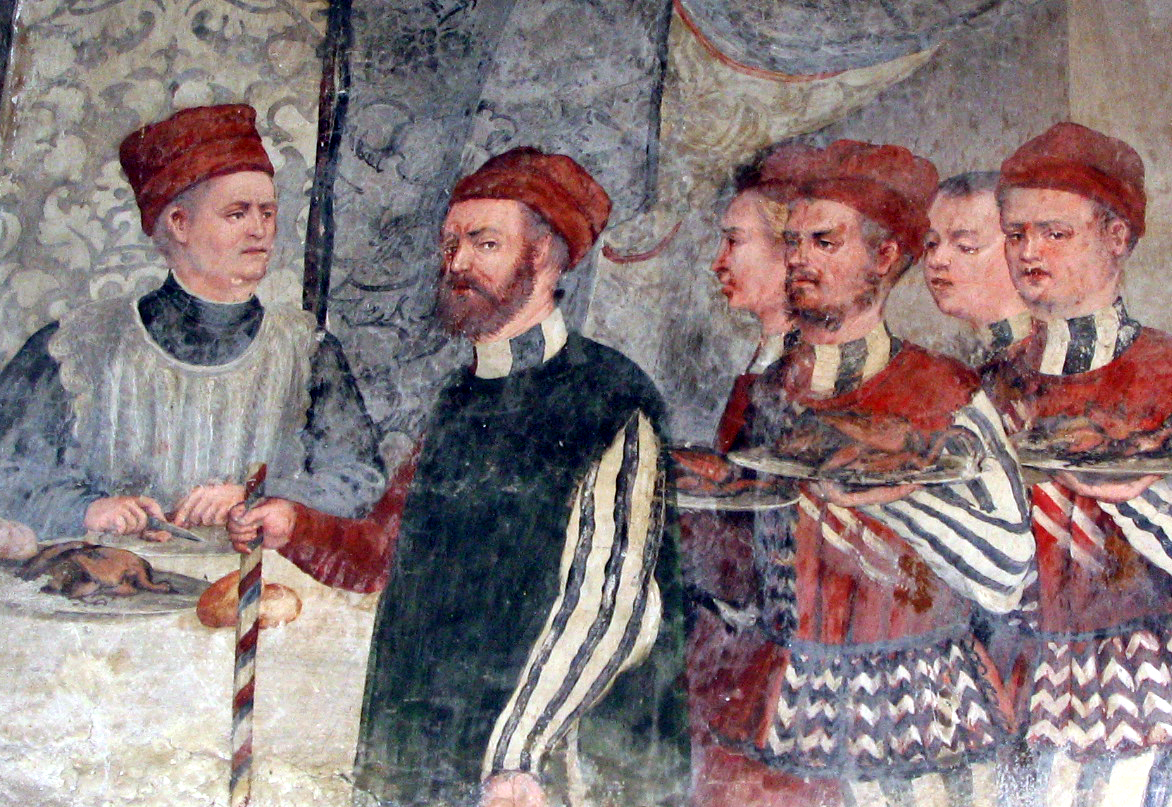
Top image: Food tasters at the Feast of Bartolomeo Colleoni in honor of Christian I of Denmark, 1467/ Wikimedia Commons