Blog Posts

Why Scaring Cats Isn’t Funny

Scaring your cat with cucumbers or animatronic Halloween toys will damage your cat’s trust in you.

Whether they’re surreptitiously placing cucumbers behind their cats’ backs while the kitties are eating or filming their felines’ terrified reactions to Halloween props, some people apparently love scaring their furry friends.

Since many of the resulting videos go viral, people hungry for online fame have even more incentive to “prank” their cats as they chase clicks. The result is potentially thousands of house cats terrorized by people with ambitions of being the next TikTok or YouTube star.

On the surface, the way cats respond to being startled might seem comical. The term “scaredy cat” didn’t manifest out of nothingness, and cats who are truly frightened have a cartoonish way of leaping back and pumping their little legs while they’re still in the air like Looney Tunes characters.

But when you think about it from your cat’s perspective, in the context of feline evolution and psychology, the cruelty of scaring a cat for “lulz” becomes obvious.

Screenshot 2021-11-01 at 08-48-55 245 jpg (WEBP Image, 1200 × 800 pixels)

First, cats are ambush predators. It’s why they love boxes, why they do the adorable crouch-and-butt-wiggle routine before pouncing on their toys, and why they like vantage points where they can see but not be seen.

They particularly dislike surprises, which is why they bolt. Cats are supposed to get the jump on other animals, not the other way around. The impulse to flee as quickly as possible — and return unseen — is hardwired into the feline brain, as natural to them as burying their poop or kneading when they feel content. Because domestic cats are small and can be predator and prey, that impulse is even stronger, but it also exists in 500-pound tigers or 200-pound jaguars.

So when you intentionally frighten your cat with an object that will be perceived, however briefly, as a predator, you’re triggering a fight-or-flight response, a rush of adrenaline and fear.

catwiggle

However, scaring a cat in its own territory (your home) or in a place he or she feels especially secure (feeding areas) adds another layer. A cat walking around outside will be naturally wary, but if you’re giving your cat a good home, as well as the love and space she deserves, she’ll feel comfortable. She’s on her home turf, in a closed environment where threats don’t pop up unexpectedly.

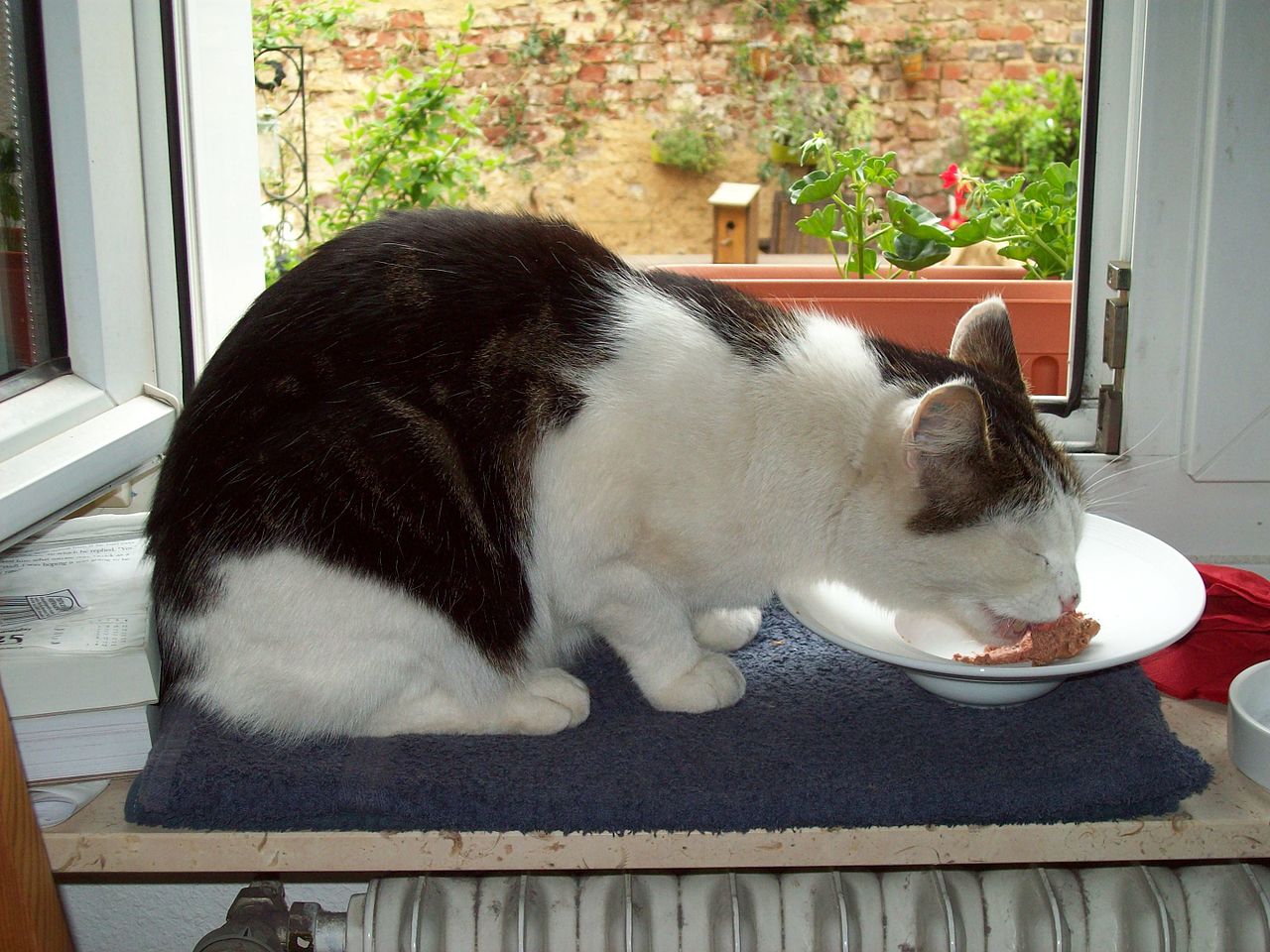
When a cat turns around after enjoying some yums and sees a cucumber, her hardwiring takes over, she registers the intrusive vegetable as a snake and goes into flight mode, scrambling to get away as fast as possible. It’s not just that kitty’s shocked or can get hurt scurrying away from a perceived threat, it’s also the inherent cruelty in teaching your cat that the place she thought was absolutely safe from intruders may not be.

We’re not immune to this kind of conditioning ourselves. If you settle down for a nap one day and your spouse, a sibling or a friend thinks it’s funny to wake you by dropping an ice cold bucket of water on your face, will you feel comfortable dozing off on the couch next time?

Trust is implicit in our relationships with our cats. If we abuse that trust, especially for something as meaningless as social media likes, we’re endangering our human-feline friendships and making our cats feel unsafe in their own homes.

I Was A Good Boy On Halloween, Now Give Me Snacks!

Buddy agrees to dress up for Halloween in exchange for catnip and treats.

Bud won’t tolerate a costume and I wouldn’t make him wear one, but he’s cool with wearing a festive scarf courtesy of my mom, who insists she doesn’t like him but somehow ends up buying stuff for him.

The cool thing about having an unusually curious and friendly cat is that he dashes to the door like a dog whenever someone knocks. Halloween is no exception, and Bud has been helping me hand out candy since he was a kitten.

When trick or treaters come by, the little guy can’t wait to see who’s in the other side of the door. He sits on the threshold and just takes it all in — the new people, the funny costumes, the strange human ritual that involves helping children get an epic sugar high and upset stomach.

For Bud it’s a night of excitement without any anxiety since no one’s actually stepping into his territory. They all keep a respectful distance, like supplicants with an audience before a powerful but benevolent king, and in turn the king allows his servant to reward their fealty with gifts of candy.

Bud on Halloween
“Let’s just get this over with, human. Remember, you said I could have catnip AND extra yums if I wear this infernal scarf!”

Sadly Halloween was a dud this year even more than last year, which was our first pandemic All Hallow’s Eve. Living in an apartment building, especially on the first floor, usually means a steady stream of kids, but this year I had maybe six or seven knocks on the door, and the kids were trick or treating in ones and twos. (All kids are chaperoned by parents these days too. It makes me wonder how my brother and I — and our friends — survived as kids, going out into the big bad world ourselves to trick or treat!)

unrecognizable men in glowing halloween masks driving car at night
You’d think Halloween was Purge Night by how parents hover over their kids. Credit: Erik Mclean/Pexels.com


National Cat Day Is Tomorrow! PLUS: ‘Cat Man’ Meows 55 Times In Court

A man in Argentina, accused of a grisly double murder, was thrown out of court after meowing incessantly during a pre-trial hearing.

National Cat Day is tomorrow, Oct. 29!

While the day was founded in 2005 by an animal welfare advocate and the ASPCA to raise public awareness about the number of shelter cats who need homes, it’s expanded into an opportunity for people to show their cats off online and do something special for them. The day’s founders also recommend a range of ways to celebrate from adopting a new cat, to volunteering at a local shelter, to pampering your own feline.

I’ll be celebrating by giving Bud some catnip and a special treat, and spending extra time playing with him. After he’s tired out, he’ll probably enjoy one of his favorite activities — climbing on top of me and taking a nap.

The Cat Man Cometh

A man accused of brutally murdering his mother and aunt was thrown out of court on Tuesday for repeatedly meowing.

Nicolas Gil Pereg meowed when Judge Laura Guajardo asked him his name and ID number at the beginning of the court hearing, then kept on going, vocalizing a total of 55 times and ignoring a warning from the judge before she lost her patience and had him tossed.

“Mr. Gil Pereg, before the entry of the jury I warned you that if you wanted to remain in the courtroom, you should do so in silence, with respect and decorum,” Guarjardo said in a surreal scene, as the disheveled man continued meowing.

The so-called “cat man” allegedly killed his mom and aunt when they flew in from Israel to visit him in 2019, according to local media reports. Gil Pereg, who lived in a dilapidated home with 37 cats and several dogs, is accused of burying their bodies in shallow graves less than four feet deep on his own property, then reporting them missing to local authorities.

He’s performed his unimpressive approximation of a meow in earlier court trials, and asked to be moved from prison to a psychiatric unit. In addition, he petitioned the judge to allow him to have his cats with him in psychiatric care.

During earlier hearings, he stripped his clothes off and urinated in front of the judge, according to the Daily Mail. Before the murders, he had assumed the name Floda Reltih — Adolf Hitler backwards — for an indeterminate period of time, reports say.

Gil Pereg’s attorneys argue he’s not sane, but so far there’s no indication the court is buying it. A 2020 evaluation by criminal psychologists described Gil Pereg as a “hostile, evasive, challenging, ironic and confrontational person.” The accused murderer is manipulative, the forensic psychologists said, and only expresses emotions toward his pets.

The prosecutor warned the trial’s six jurors “not to be fooled” by the eccentric man’s behavior, saying his calculated actions after the murders show he fully understood “the criminality of his actions.”

NYC Mayoral Candidate Has 16 Cats

Both major party mayoral candidates in NYC are longtime animal welfare advocates.

We normally avoid politics on this blog except for the occasional light-hearted satire imagining Buddy as a comically inept president of the Americats, but we’ll make an exception for the New York City mayoral race, which features two animal-loving major party candidates.

Eric Adams, a Democrat, is a former NYPD captain, Brooklyn borough president and vegan who has supported TNR programs in Brooklyn, pushed for more animal-friendly housing in the city and hosted adoption events in his home borough, according to the Humane Society’s Legislative Fund.

Curtis Sliwa is best known nationally as the founder of the unarmed crime prevention group the Guardian Angels, and in New York as a host on the city’s biggest talk radio station. (He’s been on hiatus since launching his mayoral campaign to comply with election law.)

He survived an attempted mafia hit in 1992, jumping out of a cab after he was shot several times by Gotti family enforcers, and he’s a dedicated cat lover, sharing his home with 16 rescues. Most of Sliwa’s cats have disabilities or were pulled from local shelter kill lists. Not all of them are permanent, and the Sliwas consider themselves long-term fosters until they can find the right homes for special needs cats. Last year they were able to place 10 kitties in good homes.

Still, the felines come first in their 87th Street apartment.

“Guess what? It’s the cats who rule the roost,” Sliwa told a New York Post cameraman in June. “We take whatever room is left after the cats carve out their territory.”

Cat furniture dominates the studio apartment Sliwa shares with his wife, Nancy, who told the Post she’s considering adopting more furballs, including a special-needs rescue who is blind. (They had 15 cats at the time and have adopted one more since then.)

Turning to her husband, she quipped: “We might have to lose your half of the closet.”

The couple share litter box duties and clean the multiple boxes in their home at least three times a day, they told the Post.

NYC mayoral candidate Curtis Sliwa plays with his cats.

At the end of Tuesday’s televised mayoral debate, when asked which qualities they admire in their opponents, both Sliwa and Adams praised each other for their work with animals.

The city and its surrounding environs lean heavily blue. Sixty-eight percent of registered voters in the five boroughs are registered Democrats, and Adams holds a commanding 36-point lead according to the latest poll.

Like all Republicans who set their sights on the mayor’s job, Sliwa knew it was going to be an uphill battle even though New Yorkers have tired of the current mayor, Democrat Bill DeBlasio. Sliwa hopes one of his central campaign promises — to enact a no-kill policy across the city’s shelter system — will resonate with voters across the aisle.

Republicans who have won in the past have been centrist, like former Mayor Rudy Giuliani, or nominally Republican, like businessman turned politician Michael Bloomberg. The latter enjoyed widespread name recognition before he turned to politics and supplemented his campaign hauls with his own considerable resources.

Still, the Guardian Angels founder sees Gracie Mansion, the mayor’s Upper East Side home, as a potentially fantastic cat house.

“I’ve been in Gracie Mansion before,” Sliwa told New York magazine. “There is easily room in there for 60 cats.”

The Cat Houses of Istanbul: ‘Everybody Accepts Cats Must Have Their Own Life Spaces In The City’

Thanks to a young architect’s impulse, cat houses — miniature shelters for strays and ferals — are now common all throughout Turkey.

We’ve written quite a bit about Turkey and how it serves as a model for co-existence and fondness between humans and cats, as well as other animals.

In Turkey — and especially in ancient Istanbul, the most populous city in Europe — cats are fed, welcomed into homes and shops, and taken care of by the entire community. Pets are still a thing there, but Istanbul’s stray population is the best cared-for in the world. They have their own parks, they’re protected by the people, and they’re even given miniature shelters which famously dot the city of 15 million.

“The whimsical structures — more like miniature apartment buildings than single-kitty houses — can be found in parks, outside shops and cafes, abutting private homes, and on university campuses, providing shelter for the city’s estimated 125,000 strays,” Reason to Be Cheerful’s staff wrote.

Cat house Turkey
A custom-built wooden cat house in Turkey.

The practice of creating shelters for strays and ferals began in 2008, when a young architect named Didem Gokgoz would pass strays in Istanbul’s Mistik Park as she walked to and from work every day.

“Every day I passed the park and saw them looking for a place to get some warmth during the winter, and I felt desperate,” Gokgoz said.

At first she began making small shelters from recyclable materials, but the compact structures weren’t always tolerated in parks and other places where people felt they were an eyesore, so after meeting with the city’s mayor, Gokgoz engaged in an experiment: She built larger, more aesthetically acceptable permanent structures in the park, including one that looks like a large catio with a sloping, house-like roof, draped in greenery and nondescript among the park’s other features.

Mistik Park cat house
The Mistik Park cat houses are protected by a catio-like structure. Only volunteers can use the human-size door, while small cat-size openings allow felines access. Credit: Transitions.

The project was a success, and soon she found herself with requests to build more. But they aren’t just built and installed: Each cat house is run by about a dozen volunteers who keep track of the local cats, feed them, get them spayed/neutered and see to their other needs.

Almost 14 years later, cat houses have become a permanent fixture not only in Istanbul, but in other Turkish cities as well.

“It became something normal; individuals make requests for cat houses,” Gokgoz told the Turkish journalism site Transitions. “That was our main goal, and we’ve reached it. Today, everybody accepts that cats must have their own life spaces in the city.”

Istanbul cat houses
Credit: Istanbul Metropolitan Municipality