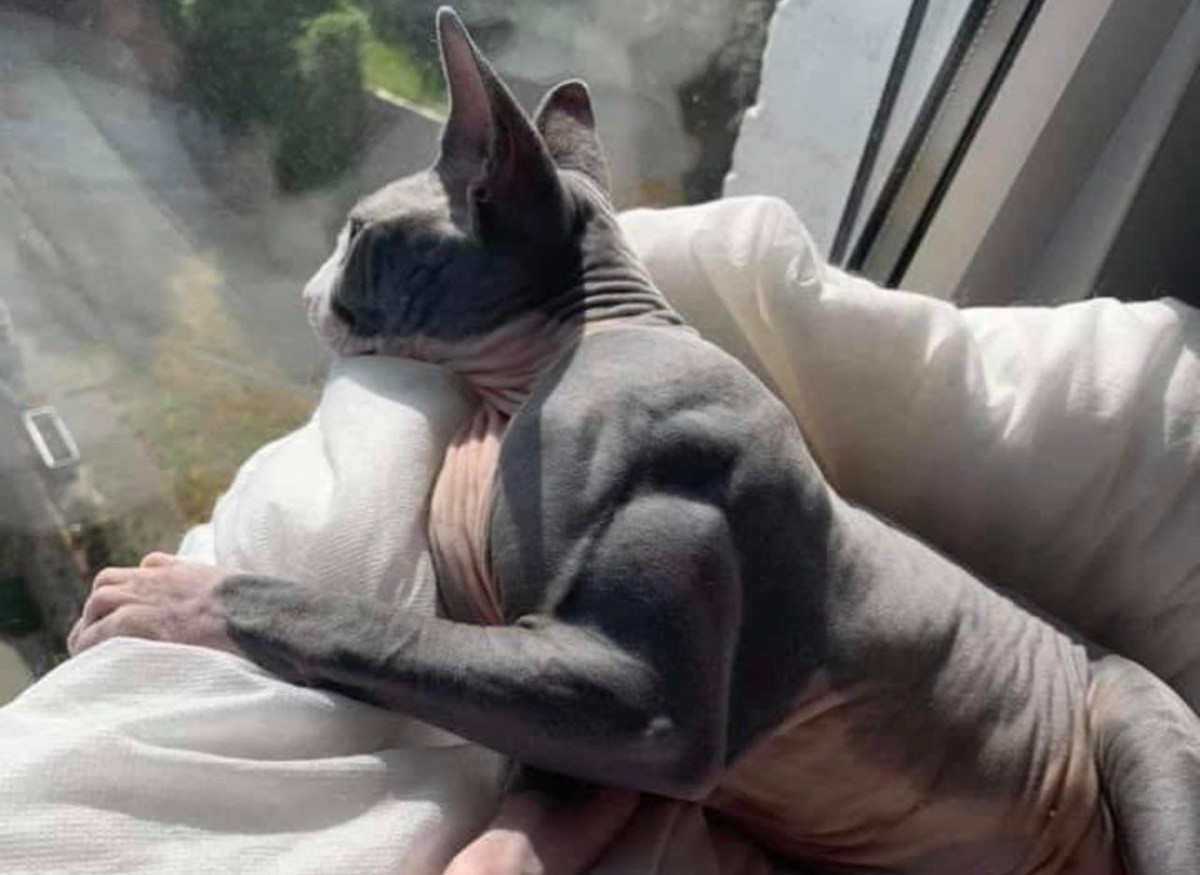
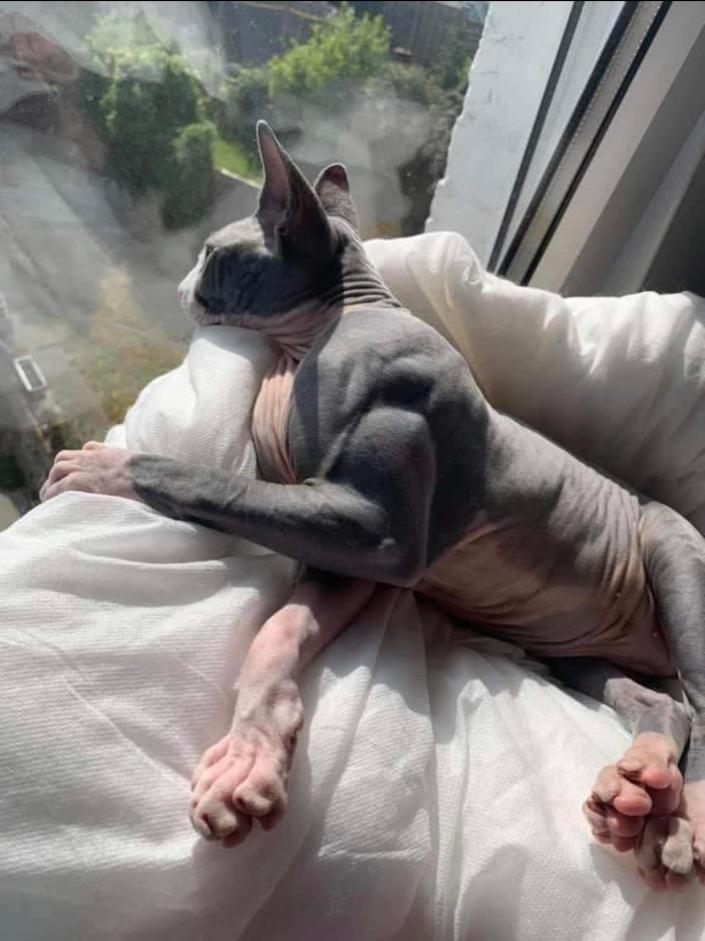
The cat has a rare genetic condition that makes him look like a weight lifter.
An incredibly muscular cat has taken the internet by storm — and shockingly, it’s not Buddy!
A Reddit user posted a photo of a Sphinx cat who looks like he eats UFC fighters for breakfast and bullies lions in his spare time. But it turns out there’s a medical reason for his bulging physique, and it’s not just the result of tens of thousands of kitty push-ups.
The hairless feline has “Myostatin-related muscle hypertrophy, a rare condition that causes muscles to grow excessively large,” the poster explained.
“Yes, you’re totally right, that IS your spot. Forget I even asked.”
Humans and animals can be impacted by the condition. Myostatin-related muscle hypertrophy also results in reduced body fat and doesn’t just potentially double muscle size — it results in increased strength as well, per the National Institutes of Health.
“Affected individuals have up to twice the usual amount of muscle mass in their bodies. They also tend to have increased muscle strength,” according to the NIH. “This condition is not known to cause any medical problems, and affected individuals are intellectually normal.”
When one user asked if the cat will be alright, another answered in the affirmative, but with a caveat: “Anyone who pisses him off won’t be.”
The cat’s already racked up nicknames like Kitbull, Katzenegger and The Purrminator.
Asked for comment on the photo, Buddy the Cat insisted the super-muscular cat poses no threat to him.
“My meowscles are even yuger, it’s just that you can’t see them because of my fur,” Buddy explained. “If I were a hairless breed like a Sphinx you would see my bulging meowscles, but I’m a Buddinese tiger, and my coat is luxuriously silky smooth.”
Buddy the Cat, pictured, says he’s “totally ripped” under his fur.
There have been more than 5,000 confrontations involving unruly passengers on airlines in 2021, on pace for more than all other years combined.
When we first heard about an airline passenger grossing out her fellow travelers by breastfeeding her cat, we figured at least kitty was happy with the situation — but apparently not, according to a flight attendant who was involved in the incident.
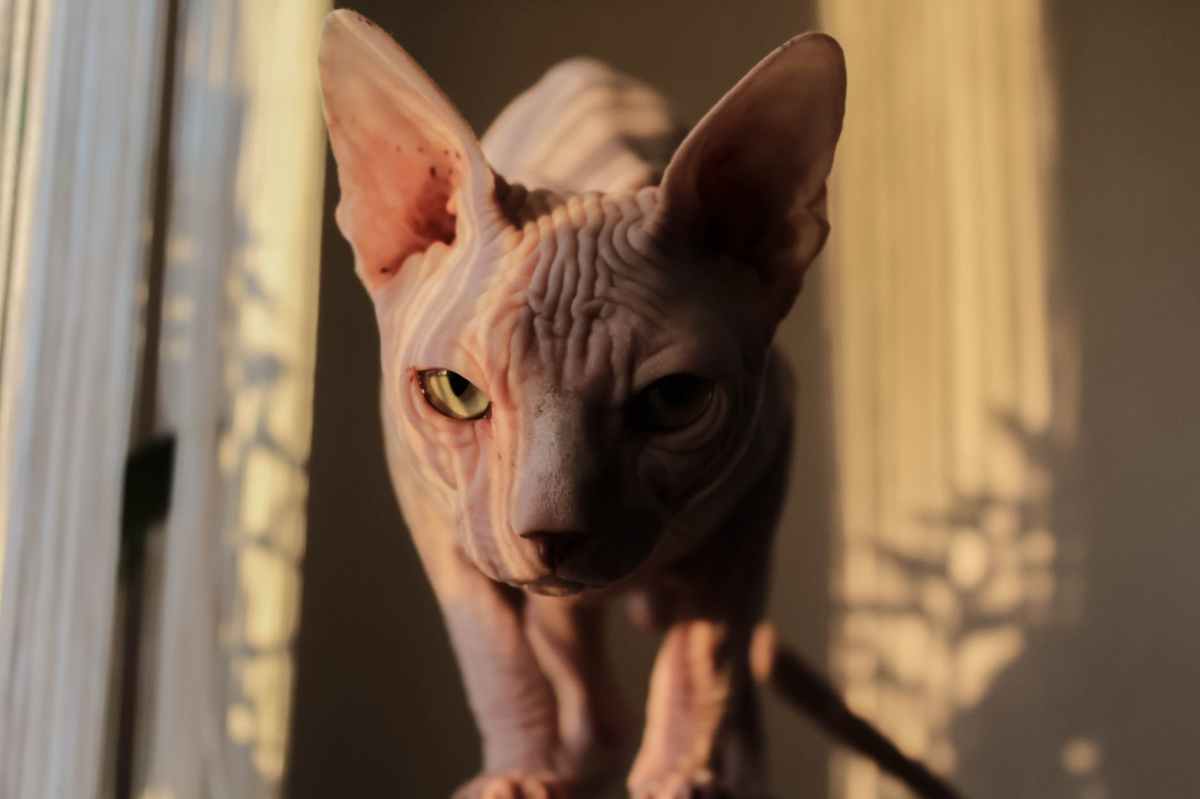
Instead of purring and kneading in a milk coma, the cat — likely a Sphinx — wanted nothing to do with feeding from the woman’s breast on the flight in late November, flight attendant Ainsley Elizabeth said.
“This woman had one of those, like, hairless cats swaddled up in a blanket so it looked like a baby,” Elizabeth said in a video about the incident. “Her shirt was up and she was trying to get the cat to latch and she wouldn’t put the cat back in the carrier. And the cat was screaming for its life.”
“What does she do at home if she’s doing that in public?” Elizabeth asked. “And then security met the flight just to tell her that she couldn’t do that again, cause it was weird and gross.”
Elizabeth has since deleted the social media account she used to upload the video.
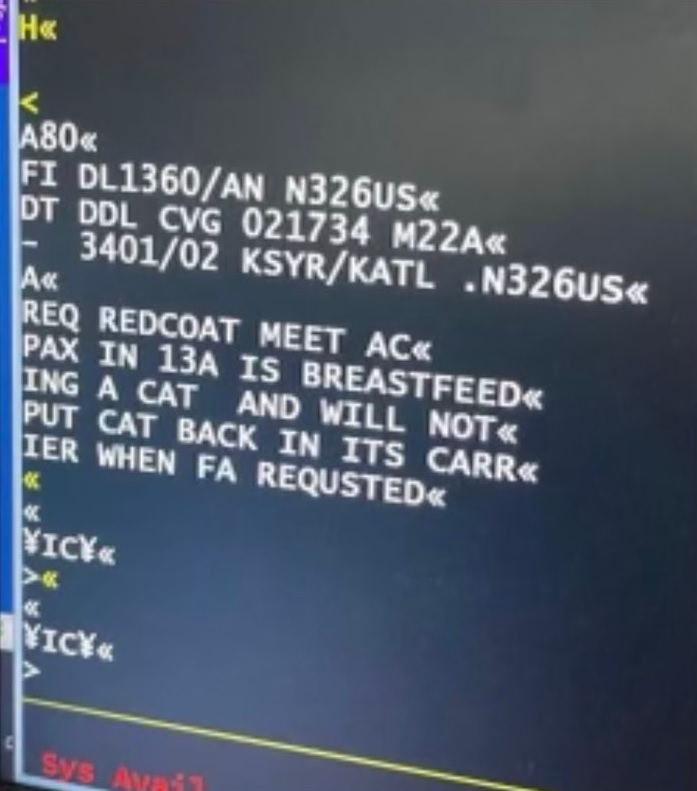
As we noted in our earlier post, the woman was uncooperative when flight attendants asked her to stop, prompting the pilot to send a message ahead to the destination airport via ACARS, short for Aircraft Communications Addressing and Reporting System.
An ACARS message sent from Delta Air flight DL1360 to ATL, Hartsfield-Jackson Atlanta International Airport.
The bizarre incident happened aboard a Delta Airlines flight from Syracuse, NY, to Hartsfield-Jackson Atlanta International Airport in Georgia.
Meanwhile, Delta airlines has begun an investigation into the Great Breastfeeding At 40,000 Feet saga, after the incident went viral last week and garnered headlines around the world — including newspapers in the UK, Australia, New Zealand and dozens of non English-speaking nations.
Initially the passenger was reprimanded, but an investigation could result in more serious consequences, like a ban on using the airline.
In-air confrontations have skyrocketed in 2021, mostly due to disagreements over COVID-19 safety rules such as wearing masks. Credit: Wikimedia Commons
The story comes amid a general surge in violent attacks and tense confrontations aboard passenger jets — and now the FBI is getting involved.
That puts 2021 on track for more cases than all other years combined, according to the Association of Professional Flight Attendants. The majority of those incidents — as many as three out of every four — are related to confrontations over mask policies due to the Coronavirus pandemic.
Teddy Andrews, a long time flight attendant with American Airlines, testified before a congressional committee in September, recalling an incident in which a passenger called him the n-word when Andrews asked the man to wear his mask.
“These days I come to work anticipating disruptive behavior,” Andrews told USA Today. “Our colleagues are anxious, fearful. What is going to happen on the next flight? How will this passenger react if I remind them to wear their mask? Will complying with airline policies set them off? Can I avoid engaging, or would that be an evasion of my duties?”
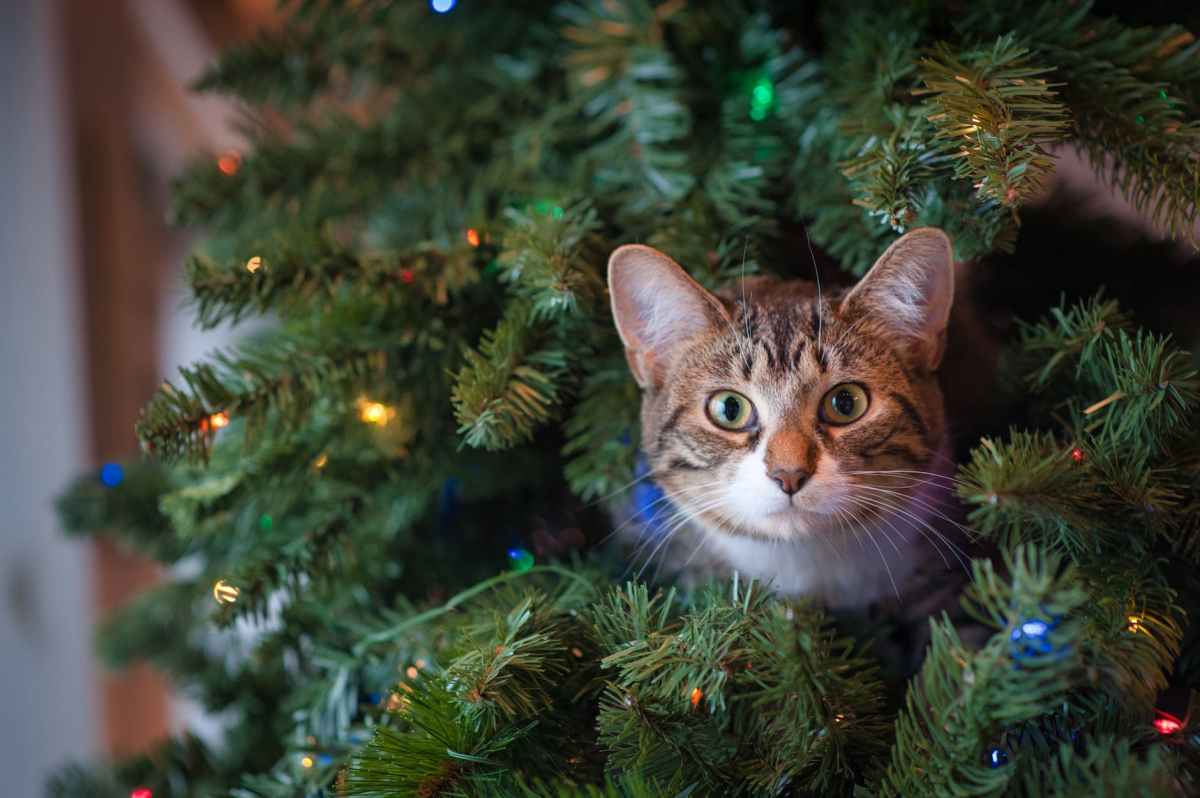
The newest trend on TikTok is terrorizing cats with Christmas trees so they’ll leave the trees alone during the holidays. Not cool.
Proving once again that social media has little or no redeeming value, TikTokers have latched onto a trend that has them using Christmas trees to terrify their cats.
The trend was started by a user who shared a “hack” she’d invented: Chase your chat around your home while wielding your new Christmas tree like a weapon, she said, and the cat won’t mess with the tree or its ornaments the rest of the holiday season.
“If you chase your cat around with the Christmas tree, it’ll be too scared to f**k with it,” said the “hack” originator, @alexisjj_.
User “@becs.richards” racked up more than 25 million views with a video that shows her holding her Christmas tree and thrusting it like a lance toward her confused and scared cat. She wore a big smile as she did so, and set the video to upbeat Christmas music.
Terrorizing your cat is a bad idea, author Anita Kelsey told Newsweek.
“A cat will not have any idea why you are causing them stress or fear and, more than likely, frightening a cat with a Christmas tree can lead to the cat being fearful of the room the tree is in, fearful of the tree, urinating around the home or on the tree and urinating on anything around the tree—like presents,” said Kelsey, author of Let’s Talk About Cats. “It also can cause a breakdown of trust between the cat and the person trying to frighten them.”
Daniel Cummings of the UK’s Cat Protection nonprofit said the method may seem successful, but it “doesn’t take into account how cats learn” and could cause long term problems.
“No cat owner would want to intentionally stress out their cat,” he said, “and part of cat ownership is accepting their natural behaviors.”
Unfortunately this newest trend isn’t surprising, especially coming from a user base of people who happily hand over their user data to the Chinese government, which controls TikTok and makes use of its data just as it does with any other ostensibly “private” company operating in China. There have been more than enough investigative stories illustrating how the Chinese government weaponizes data for any reasonable person to avoid platforms like TikTok.
I’m fortunate that Buddy is a good boy and mostly doesn’t mess with Christmas trees. He’s swiped a handful of ornaments off branches in the past, but so what? He’s a living being with feelings, and ornaments are just things.
Besides, as Cummings notes, curiosity and playfulness are part of the deal when we adopt cats. If people aren’t up for that, they shouldn’t adopt.
Kaya the kitten is recovering at her foster home after surgery.
UPDATE, 12/1: To Rescue says Kaya the kitten is “healing nicely” after surgery on her eyes, but will remain with her foster family for another week before she’s cleared for adoption. Kaya was examined by a veterinarian on Nov. 30 and was given the all-clear. She’ll stay in foster care until she’s finished with her medication.
Original post:
Several readers asked for a follow-up about Kaya the kitten after our earlier post about her.
The shelter To Rescue turned to the internet for help after not a single potential adopter showed interest in Kaya, who has a congenital facial malformation but is otherwise healthy.
Kaya had successful surgery on her eyes on Nov. 16 and has been recovering in her foster home, where she continues to be her natural, playful self, shelter staff say.
She was scheduled for a follow-up vet visit today, Nov. 30. We’ll update as soon as we hear anything else.
If you’re interested in adopting sweet Kaya, you can visit the shelter’s site and fill out an adoption application.
The horror-drama from Netflix is more interested in untangling uncomfortable questions from the abstract than it is in providing answers. And that’s just fine.
Movie: The Platform (2020) Director: Galder Gaztelu-Urrutia Genre: Horror, social commentary Medium: Netflix
The premise of The Platform is simple: A man wakes up in a concrete prison cell. The center of the cell is dominated by rectangular gaps in the floor and ceiling, and when our protagonist warily steps closer he can see levels of identical cells above and below him. The cells extend as far as the eye can see in both directions, each populated by two prisoners.
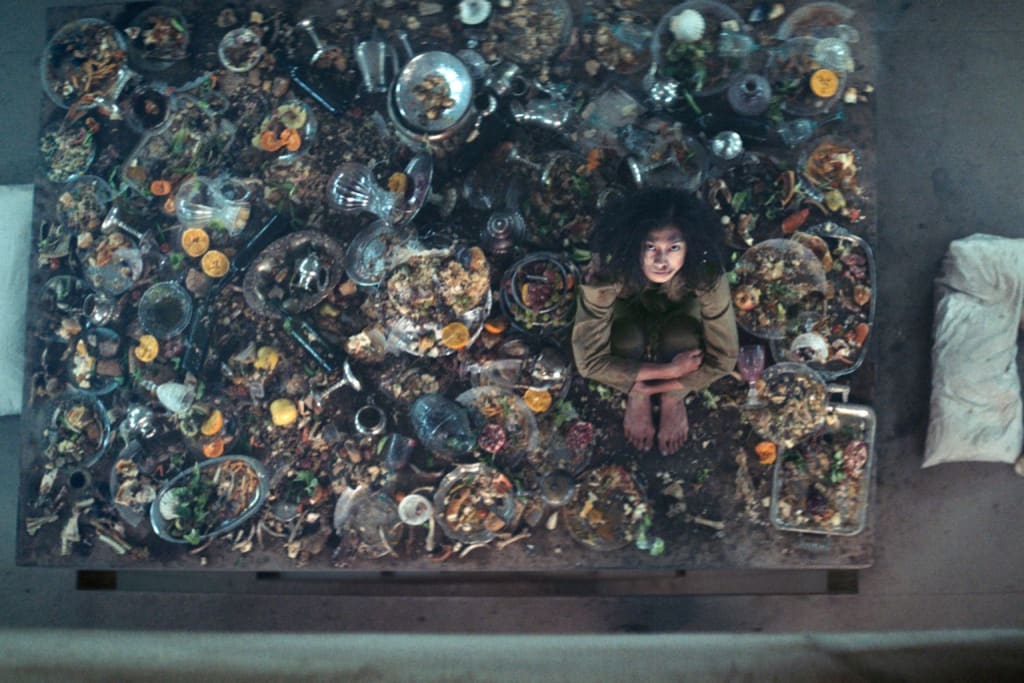
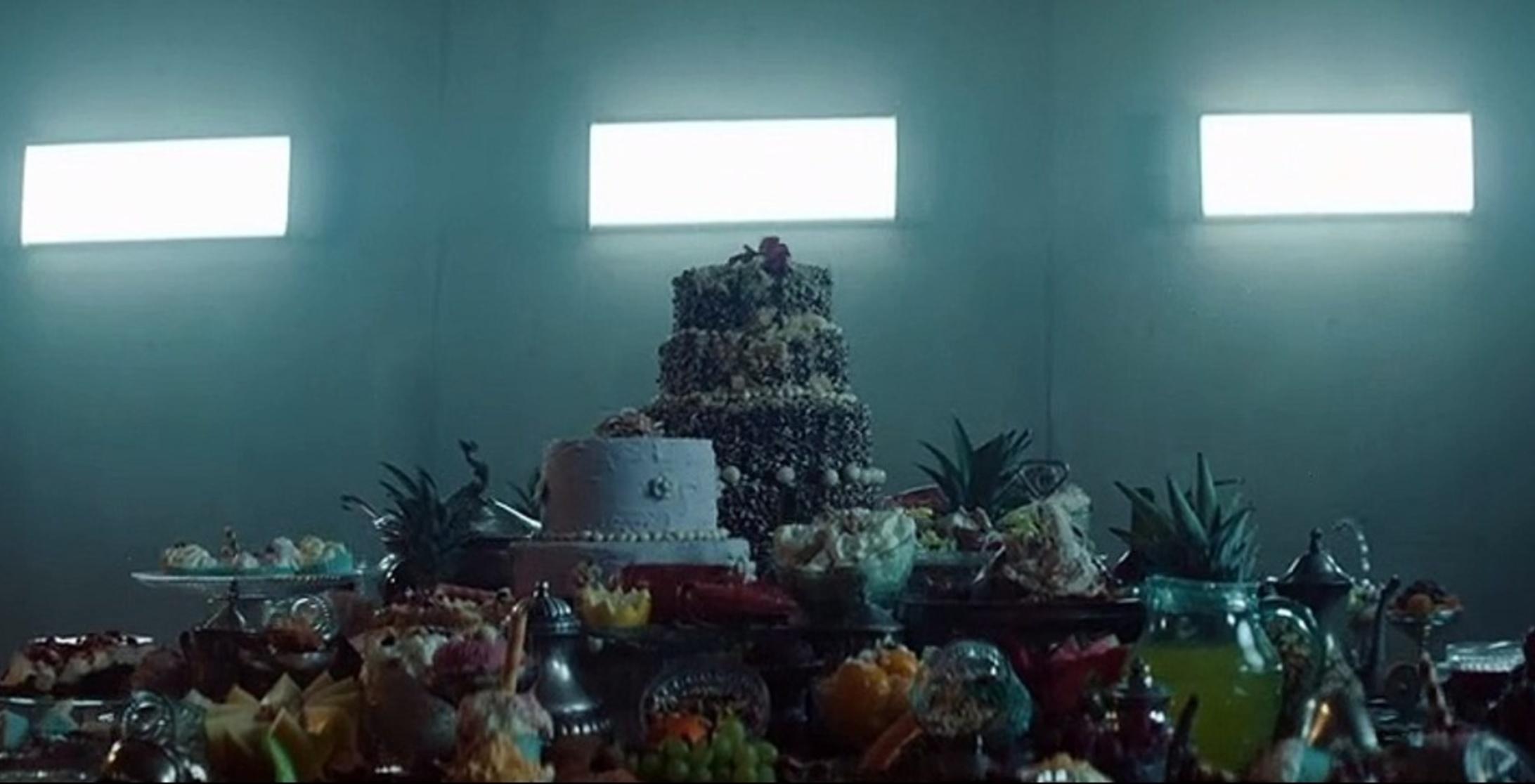
Every day, a platform is lowered level-by-level, laden with a massive feast: Meats, wine, cheese, bread, cake, soup, pie, fish, escargot, paella, salads, grapes, apples and other fresh fruit, vegetables, juice. Every kind of food you can imagine, cooked and prepared to perfection by professional chefs.
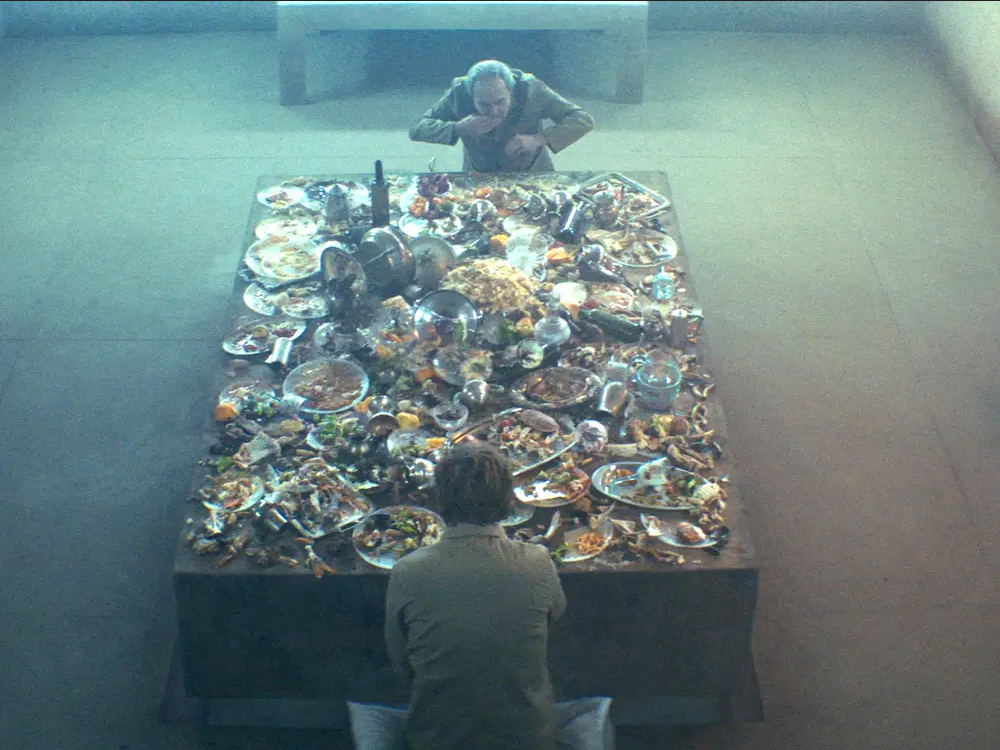
Goreng, our protagonist, is greeted by his cell mate, a kindly old man named Trimagasi who sits down next to the edge of the hole in the floor in anticipation of the platform’s arrival. When it descends to their level he pigs out, shoveling as much food as he can into his mouth before a buzzer sounds and the platform descends another level.
Goreng looks on, digusted: The food is scattered all over the platform, much of it half-eaten. Clearly, these are someone’s disgusting leftovers.
Trimagasi, top, pigs out while Goreng picks at food scraps.
Trimagasi urges Goreng to eat, and explains that they are very fortunate indeed: At level 48 there’s still enough food leftover from the prisoners on the 47 levels above that they won’t starve this month. At the end of every month, he says, each pair of cellmates are put to sleep with gas and wake up on a new level that is chosen at random by the people operating the cruel social experiment.
Trimagasi tells Goreng he once spent a month on level 132, where not a scrap of food is left by the time the platform descends. Goreng asks the old man how he survived, and Trimagasi demures.
We also learn that Goreng voluntarily entered in exchange for a real-world opportunity promised to him after he spends six months inside. Trimagasi was sent there as punishment: Infuriated by a TV commercial for a self-sharpening knife called the Samurai Plus after he’d just purchased a knife sharpening kit, Trimagasi threw his TV out of his window and unintentionally killed an illegal immigrant who was riding a bicycle below. He’s approaching the end of his two-year sentence in what the authorities call the VSC, short for Vertical Self-management Center.
Each prisoner is allowed to take one item with them inside: Goreng takes a copy of The Ingenious Gentleman Don Quixote of La Mancha, harboring romantic notions of finally reading the book with his time in the prison. Trimagasi, who loves to use the word “obviously,” told Goreng his choice of item was obvious: His prized Samurai Plus, which he cradles lovingly as he boasts about how it can cut concrete without dulling.
Goreng puts two and two together, realizing how Trimagasi survived on level 132.
Going down: Just a portion of the feast as it exists on the platform before it’s consumed, defiled and excreted, level by level.
The Platform is a blunt allegory for human civilization, specifically the enormous wealth disparities of modern societies. The occupants of level 1 are the Jeff Bezoses and Walton families of the world, people with unimaginable, multigenerational wealth pigging out on life’s resources without thinking of the starving street children of India, the homeless of cities like New York and San Francisco, the families in North Korea eating tree bark.
Some reviewers think it’s a critique of capitalism, but I think it’s more universal than that: The kleptocrats of countries like Mexico, Russia and Brazil, the monarchies and emirates of the Middle East, and the party bigwigs of communist countries like China pig out on their own respective first levels while the people 130 “levels” down starve just the same.
The rest of us? We’re in the 30s, 40s and 50s, happily scarfing down the scraps from above, the ad revenue the Zuckerbergs and Pichais allow us by their forbearance, the slightly comfortable salaries allowed by corporate shareholders, the house and garage we might enjoy if we’re fortunate enough to run a successful small business in an industry that hasn’t been pillaged by the multinationals yet.
Looking down at the levels below in The Platform.
A plan to preserve food for the lower levels by force.
Trimigasi with his beloved Samurai Plus.
A poster for the Japanese release of The Platform. Credit: Netflix
Some people might find the movie heavy-handed, but I don’t see it that way. As uncomfortable as it is to watch at times, reality is much, much worse. The fact that some of the movie’s scenes are difficult to watch is testament to how lucky we are to be born in circumstances where that kind of suffering isn’t part of our experience, let alone our daily lives. Show The Platform to one of the handful of people to ever escape a North Korean hard labor camp, for instance, and they probably won’t even blink.
It also shows how our betters divide and conquer to keep the rest of us distracted and themselves secure. The idea that most people who receive social services are lazy bums is a popular one in some quarters, encouraging people not to have empathy for the less well off, but to loathe them. Likewise, the people occupying the higher floors of The Platform’s prison don’t feel sorry for those beneath them. In one scene, two cellmates tell a man they’ll help him ascend to their floor, then literally shit on him as he’s just within reach, cackling with delight as he falls.
I didn’t take it as a call for socialism either. The movie makes it pretty clear that neither asking people to moderate their consumption, nor trying to enforce sharing works out for the people who try those methods. Indeed when socialism has worked in real world circumstances, it’s been part of a hybrid model that still uses capitalism as its economic engine.
Mostly, The Platform exists to make people think. While Jeff Bezos goes to sleep tonight in his $50 million compound estate, dreaming of his next vanity flight to low Earth orbit or the next hypercar he’s going to buy, there’s someone shivering on a park bench with 15 cents in their pocket, stomach grumbling, knowing the people who pass them by every day don’t even see them as human.