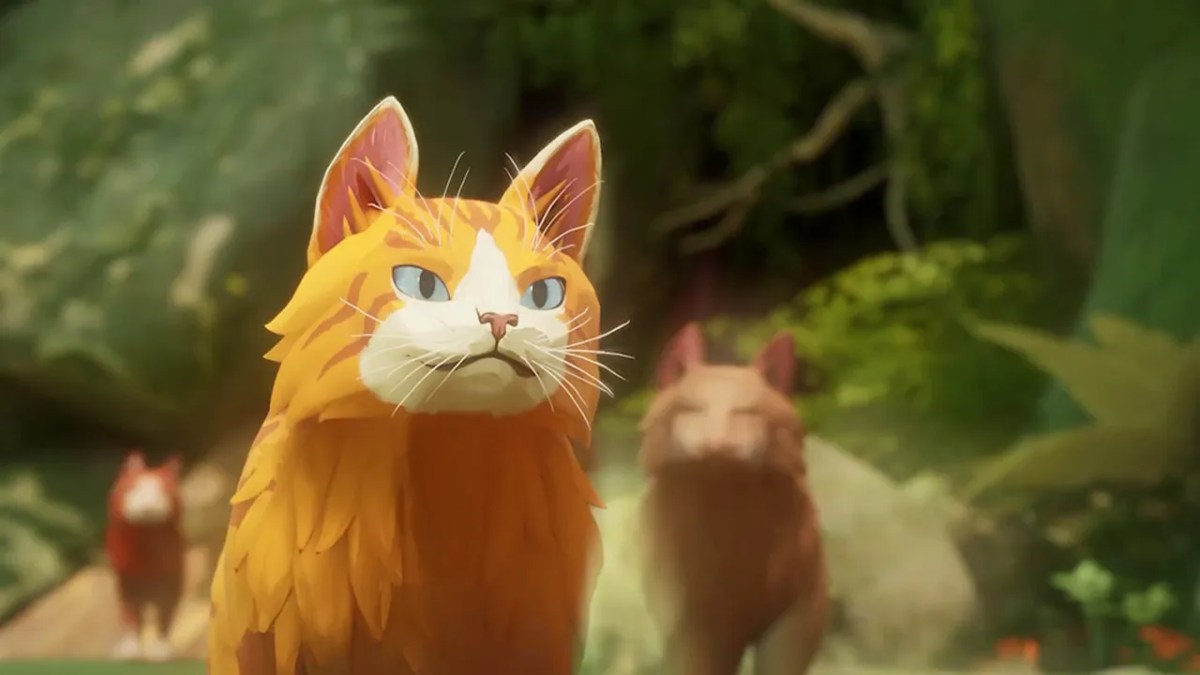
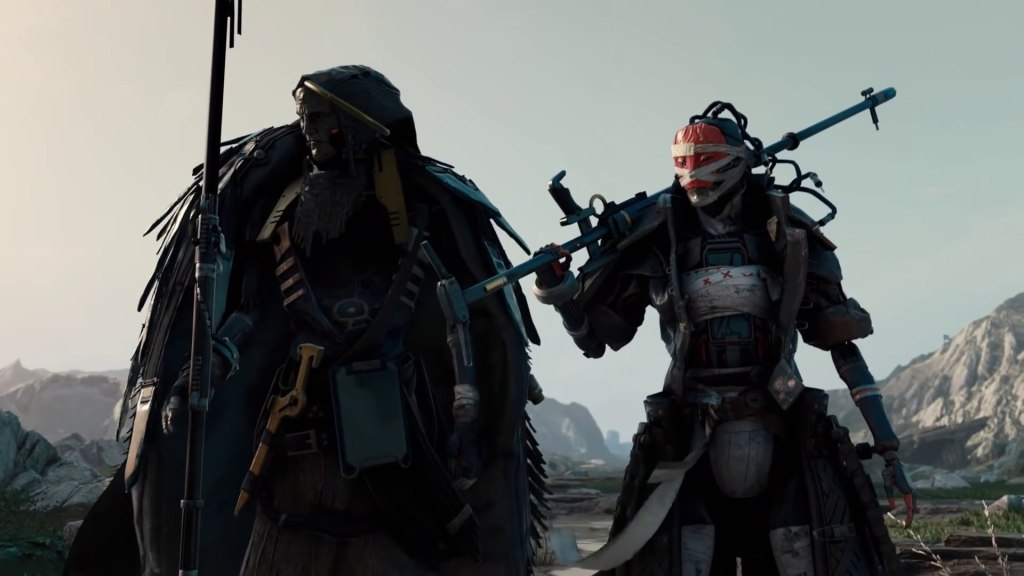
Based on the mega-popular book franchise, expectations were high for Warrior Cats: Clans of the Forest.
When reviewers accuse you of ruining childhood memories and start invoking all-time pop culture lows like Indiana Jones and the Crystal Skull, you know you’re in trouble.
I winced when I opened Steam on Friday and saw the newly-released Warrior Cats: Clans of the Forest had an abysmal “Mostly Negative” aggregate score on Steam. Since then the reviews have marginally improved, if you can call it improvement, with only 47 percent of players recommending the game for a “Mixed” rating, but most of the muted enthusiasm comes from the game’s intellectual property, not its production values, game loop or mechanics.
One reviewer called the narrative “diabolically bad,” saying the game’s story writers apparently paid little attention to the bestselling books it’s based on. Almost every review mentioned disappointment with the game’s cat-creation system, with Warrior Cats limiting users to a series of pre-determined names and strange coat colors that supposedly correspond to your character’s capabilities.
That means if players want to make their own cats in the game, they’re out of luck, and they have to choose between a cat who they favor aesthetically and one who has the attributes they want.
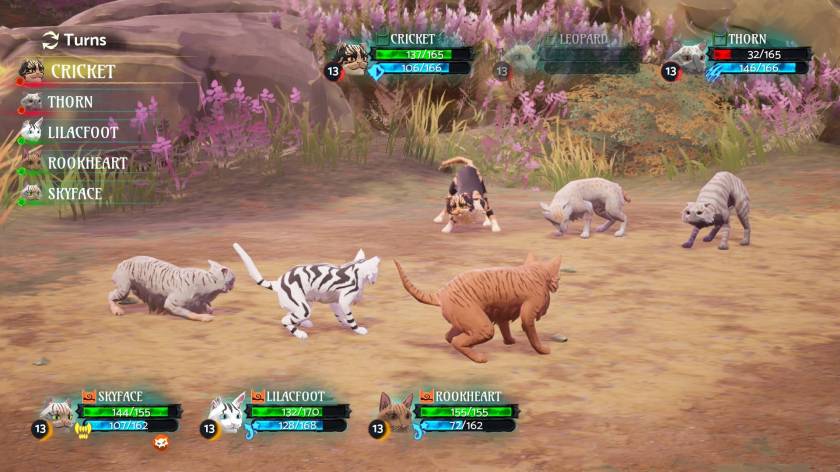
A screenshot showing the game’s turn-based combat system, which superficially resembles the systems used in games like Clair Obscure and old-school JRPGs.
“I would’ve hated this as a kid as much as I do now. Playing Warriors on the playground by myself was more fun than this,” one reviewer wrote. “At least I had my imagination. Here, you have a buggy game with completely unintuitive mechanics, randomly generated clan cats that don’t matter to the story or to your story, tiny field mice that attack you, a lack of swimming ability in Riverclan, repetitive fight mechanics, invisible walls abound in an open world, and a storyline that is beyond paper thin. I wrote Warriors dialogue on Proboards when I was 8 that [were] better than anything in this game.”
“[S]uch a slog to get through; awful camera controls, repetitive quests, and a nonsensical story,” another wrote. The ending for the player’s chosen clan was “so absurd and out of nowhere I was dying from laughter from how bad it was.”
It’s worth noting that most of the negative reviews were from players who spent significant time in the game, enough to provide a fair assessment of what the game has to offer. The reviews PITB sampled were from players who had mostly between seven and 14 hours in-game.
Not everyone was down on the game. Most, including those who didn’t like the story or mechanics, praised the visuals, and a sizable minority of players wrote about how much they enjoyed playing a game set in a universe that was important in their childhood. Nostalgia did a lot of the heavy lifting in positive reviews.
Reviews from game critics were also mixed, although it’s worth noting there aren’t enough reviews for a consensus on Metacritic yet.
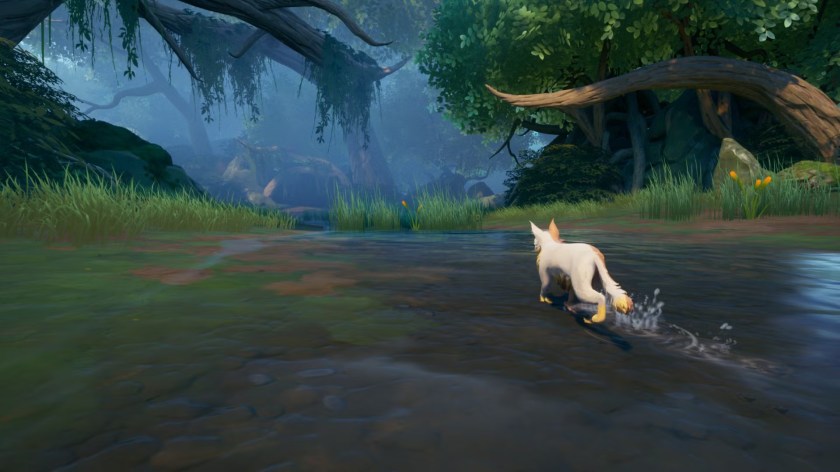
The visuals got a lot of love from reviewers, who praised the heavily stylized art direction and the environments, which include familiar locations from the books.
Steam shows the amount of in-game time under reviews so other players can get a sense of how much the individual reviewers stuck with games. The reviews show time played as of the moment of the review and total time played, so you can also see if a positive review preceded repeated plays. In a narrative game like Warrior Cats, 10 to 15 hours’ worth of content is about expected for a playthrough, while players in some games – open world exploration, survival, strategy, multiplayer – can amass hundreds of hours or more over years, attesting to a game’s replay value and the amount of content included.
Steam review aggregates are broken down into Overwhelmingly Positive for games praised by 95 percent of players or more, Very Positive for games reviewed favorably by at least 80 percent of players, Positive for games that have the same ratio of favorable reviews but fewer total reviews, Mostly Positive for games favored by 70 to 79 percent of players, and Mixed for games that meet the approval of between 40 and 69 percent.
The worst are Negative, Very Negative and Overwhelmingly Negative, reserved for games that are total disasters without redeeming qualities. Those games are often unfinished, abandoned by their developers, or are blatant cash-grabs.
This Caturday we look at how pets fare in domestic violence situations, plus a study about obesity in meat-eating and “vegan cats.”
The headline is a quote from a text a man allegedly sent to his girlfriend after abusing her cat so badly that the poor kitty had to be euthanized.
The story is grotesque, tragic, and sadly not uncommon. Between 75 and 89 percent of domestic violence victims who have pets report that their partners threatened, abused or killed their companion animals, according to research from the ASPCA and SafeHouse, a non-profit that provides direct support to victims of domestic violence.
In the incident referenced above, an Indianapolis man was arrested and charged with killing a domestic animal and torturing or mutilating an animal, both felonies. The suspect, Rashawn Bentley, originally tried to stage the violence as the result of a break-in, but was undone by his own menacing texts to his girlfriend as well as photos of the injured cat, according to the local NBC affiliate, WTHR.
Just so it’s abundantly clear how we feel about this issue: if you abuse, harm or kill a cat, you’re not a man. You’re a weak, despicable, cowardly facsimile of a man whose “flex” is taking your frustrations out on an innocent animal one twentieth your size.
You should be arrested, charged with the most severe penalties under the law – even if they’re not commensurate with the horror of the crime you’ve committed – and imprisoned for years. The other inmates should know you killed a cat. You should be removed from society, because if you think taking life is an acceptable way to vent your frustrations, there’s something clearly wrong with your brain and you are a danger to animal and human alike.
Credit: Mayara Caroline Mombelli/Pexels
Of course the majority of these attacks, especially targeting cats, are committed by men, but women aren’t off the hook here either. Some women do try to harm significant others by killing or abusing their cats, in straight relationships and relationships between women.
Ignore that study on supposedly healthy ‘vegan cats’
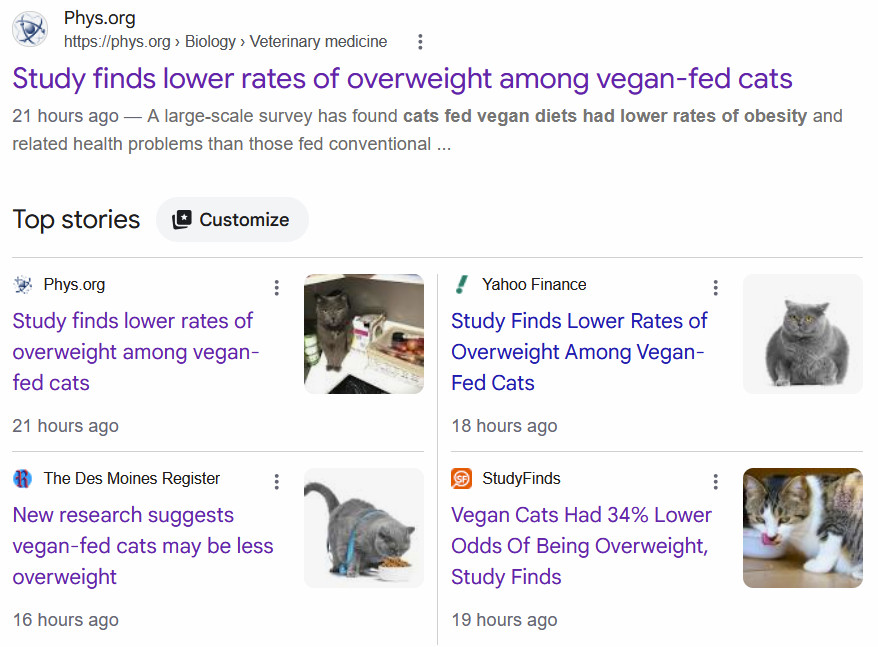
Headlines about a new study in Frontiers In Animal Science are trumpeting the supposed benefits of vegan diets for cats, who are obligate carnivores.
The media stories style the effort as a large-scale study involving more than 1,300 participants.
In reality it was an online survey that recruited cat caretakers from Facebook and recorded their subjective opinions about the health of their cats.
Everything, including reported weight, mobility, questions about potential physical problems, times fed per day, sex and neuter status, et al, was filtered through the self-selected respondents, not pulled from veterinary records. The respondents weren’t given reference illustrations or standardized criteria from which to base their subjective assessment of their cats’ weight.
There’s no way to determine if the people who participated were being honest, keeping records, guesstimating or just having a bit of fun.
To be clear, most of our criticism here is directed at the way online publications reported the results, not necessarily the authors of the survey, who chose a much more dry, cautious headline: “Impacts of a vegan diet on body weight and related health disorders in 1,305 cats: an exploratory cross-sectional survey.”
Obviously, even a jazzed-up version of that honest headline would never be used by click-chasing modern media.
Notice the bottom right headline, which misinterprets a statistical analysis for “odds” of being overweight.
Ninety percent of the people who responded were female, and 71 percent were from the UK, according to the published paper.
Then the authors kneaded the data with the usual opaquely-named practices: “exploratory regression analysis” (a data-mining technique), regression models (AI-assisted statistical technique that involves comparing existing data with the result you predicted/hope to see), sensitivity analysis (changing variables to assess their impact on the overall findings), and so on.
When all was said and done, 4.1 percent of the meat-eating cats and 3.1 percent of the vegan cats were over their ideal weights, in their humans’ estimation. Meat-eating cats were also more likely to be underweight (2.3 percent) compared to vegan cats (0.8 percent).
The conclusion? The findings were “non-significant,” the researchers wrote, along with the obligatory call for more research on the topic.
We should also point out that in addition to their classification as obligate carnivores, cats require specific proteins and nutrients (taurine, arachidonic acid, vitamins A and B12) from meat-based diets that they cannot synthesize themselves and are not found in plant-based protein. “Vegan cat food” must have those proteins and nutrients added. If cats are deprived of them, they suffer slow, painful declines that result in organ shutdown and death.
Because of their evolutionary history, cats aren’t as adept at breaking down plant-based starches and their bodies don’t produce enough of a specific enzyme (amylase) that breaks down starch and complex carbohydrates.
Human ideas of morality aren’t applicable to cats. Feed them meat.
Open comments Caturday! Although not mentioned in the headlines, today’s the day for open comments: anything off-topic, marriage proposals or modeling contracts for Buddy, updates on your own cats, suggestions on stories to cover and whatever else is on your mind. Happy Caturday!
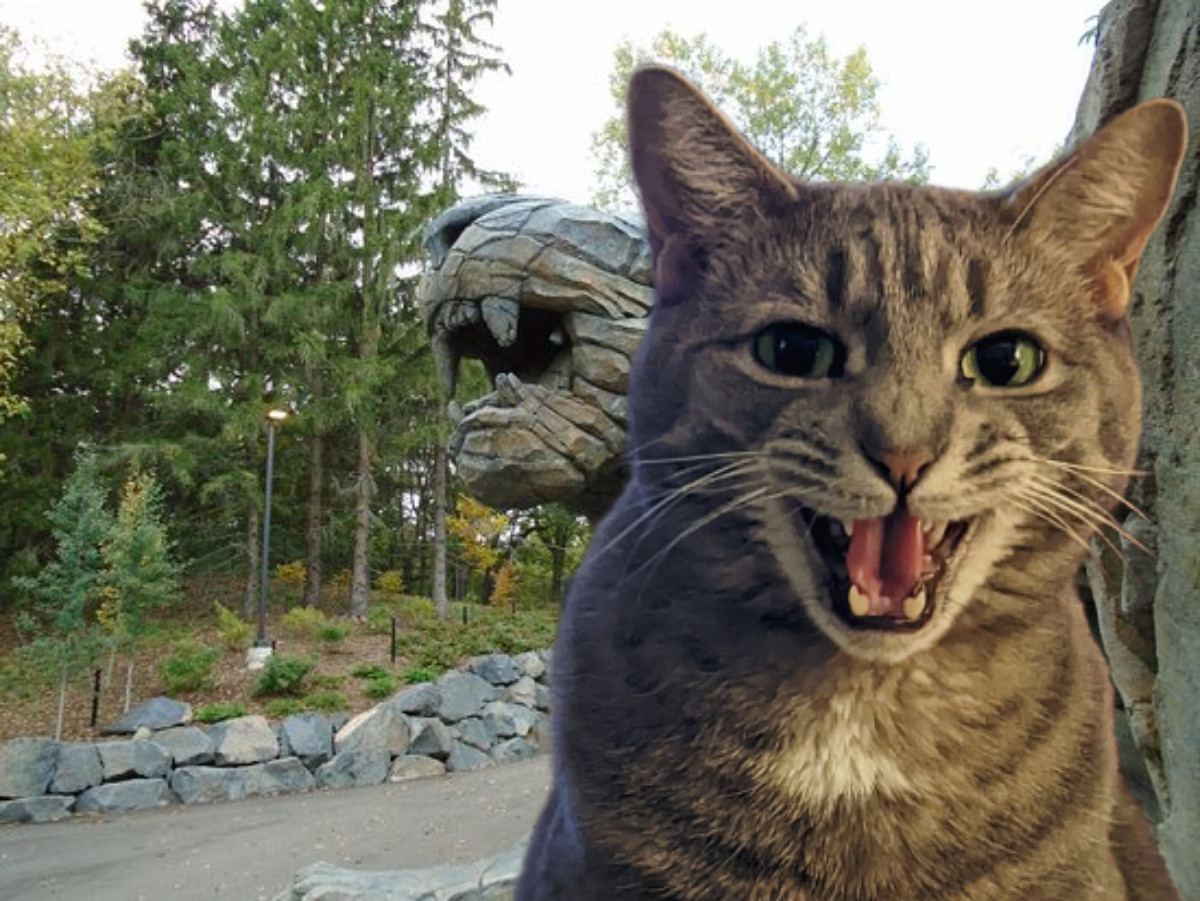
Witnesses described the harrowing encounter as a woman fell into the silver-furred Buddy exhibit at the Bronx Zoo this week.
NEW YORK – Corey Anderson couldn’t watch as the woman tumbled into the zoo habitat.
The Manhattan man had taken his kids to the zoo and the little ones were pointing excitedly at the silver-furred Buddy exhibit when a woman climbed the barrier to get a better look, slipped and fell into the enclosure with the tiny apex predator.
“I grabbed my kids, shielded their eyes and had just turned away,” Anderson recalled with a shudder. “The sounds…it was horrific. It sounded like an enraged Elmo demolishing a plate of wings.”
Smartphone footage shot by other guests confirmed the grisly sequence. The woman landed awkwardly but was apparently unhurt as she stood and began to dust herself off, unaware of the intimidating shadow creeping up on her from behind.
“Absolute mayhem,” is the way Franz Muller described it. “Die mächtige katze! Das grauen! I have never seen ankles bleed as much as I have on this day!”
After initially shocking the uninvited guest with a swipe at her bare skin, the silver-furred Buddy proferred a single paw as if expecting something from the woman, “but when it became clear she was empty-handed, the Buddy flew into a rage and launched himself at her lower extremities,” Muller said.
Zookeepers arrived quickly amid the screams of shocked guests and held up a vacuum in warning, the footage shows. When the silver-furred Buddy hissed but showed no signs of retreating, one of the zookeepers flipped the power switch.
“The Buddy stopped, hackles raised, then bolted for the safety of his den,” said another witness, Eleni Xanthopoulou.
The silver-furred Buddy with Lyle, center, and Sir Malcolm Murray, president of the zoo’s board of trustees.
The victim, a 32-year-old interior designer, was rushed to an emergency medical clinic, where she was treated for “multiple lacerations to the ankles, feet and lower legs,” police said.
Bronx Zoo Officials said the silver-furred Buddy would not be punished for the attack.
“He did nothing wrong,” head carnivore keeper Ferdinand Lyle said as he cradled the deadly cat. “He’s such a good boy. Who’s a good boy? You are, aren’t you? Yes, yes, a good boy!”
I’ve learned that traveling with cats isn’t too bad if you prepare yourself and your feline overlord(s).
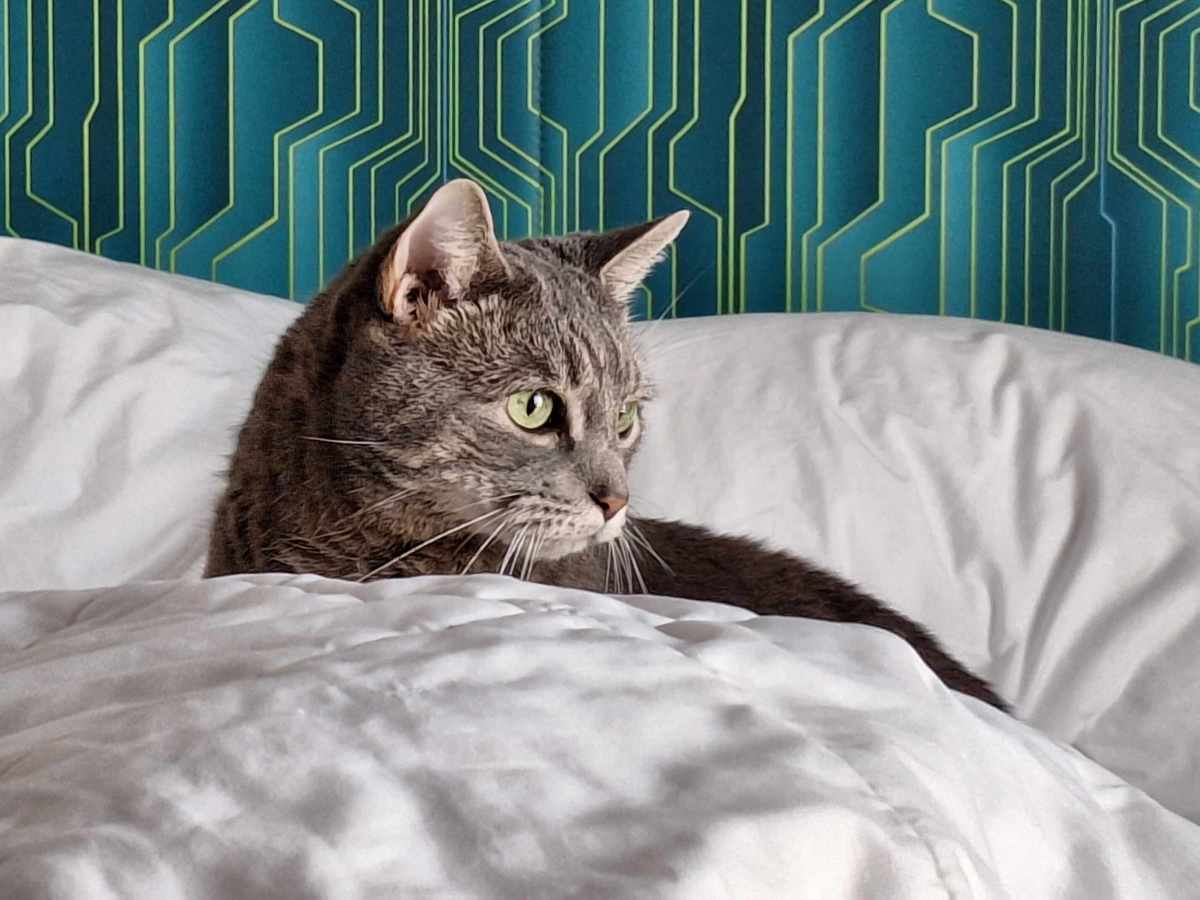
This is Big Buddy with a live dispatch from the Hyatt Garden Inn, where Little Buddy has spent much of the past 24 hours hiding under a hotel room bed.
Sources say he poked his little head out overnight to deliver a few “Mrrrrps,” finally emerging this morning to eat and use his litter box.
But seriously, two things I wasn’t prepared for: Bud being almost completely silent, and the ability to use the bathroom without a loud, talkative cat screeching at me! I’d forgotten what it was like.
In case you missed the earlier posts, we’re here for two nights because of a bathroom renovation. I weighed whether it was better to leave Bud alone with contractors coming in and out and lots of noise, or to bring him with me. I still think I did the right thing in bringing him here, even though he was not amused in the slightest about being brought to a strange place for reasons he doesn’t understand.
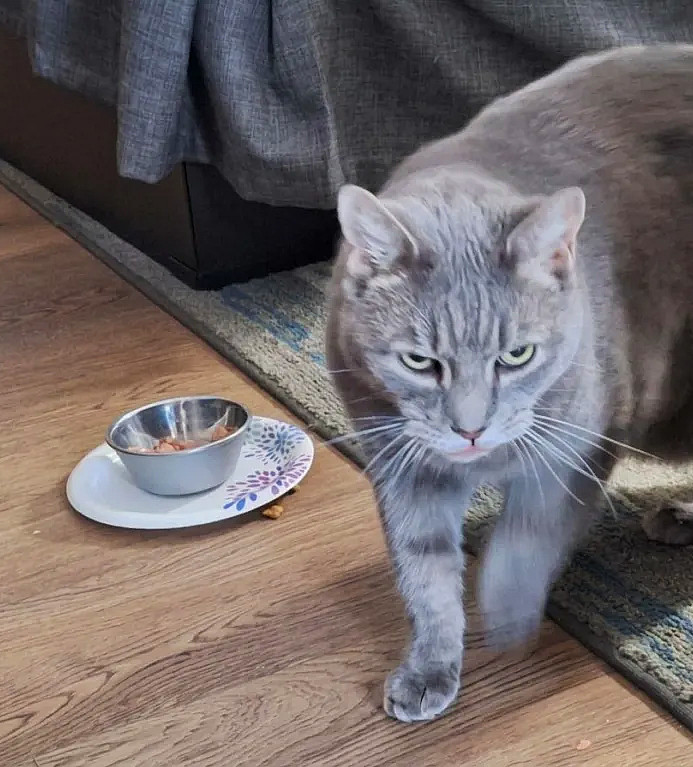
Eating for the first time since leaving home.
Still, as long as I’m here with him he’s cool, and yesterday I sat down next to his hiding place and spoke to him in a reassuring voice, telling him what a brave little dude he is.
Today’s been much better and I’m reasonably sure that he’ll spend most of tonight alternating between sleeping on top of me and standing on my head, shrieking for snacks.
This has been illuminating and now I know what to expect if I have to bring him to a hotel or somewhere else overnight in the future. I appreciate the earlier advice of PITB readers, and have found the process of staying in a pet-friendly hotel painless. I left the “Do Not Disturb” tag on the door to avoid a potential Bud freak-out over a stranger walking in.
It’s also interesting to see just how attached cats can be to their familiar territory, and how age changes that dynamic. Young Bud would be like “Where are we going, dude?” But I’ve seriously slacked on bringing him places, especially since the pandemic. Combined with his age (he’s 12 now and not the fearless feline he used to be), the difference is pronounced.
Update, Wednesday 10/21/2026: We’re home. The contractors are still at work but tell us we’ll have a functional bathroom by late this afternoon. Bud’s glad to be home. Still, this validates my decision to take him with me to the hotel the last two days. He’s huddled in my bedroom where I have the door closed so he doesn’t freak out over the sight of strangers working in the Buddesian Domicile, the sounds of drills and powered saws, and the temporary mess.
As expected he’s looking to me for cues on how to react, so as long as I’m here with him and I’m calm, he’s not freaking out. I’m proud of him for handling the temporary transition out of his territory and the major disturbance to his routine. By tonight all will be normal.
There are plenty of downsides to artificial intelligence.
AI has made it more difficult to get and keep a job.
AI is already causing a strain on our energy grids, and it will only get worse even though more companies are self-powering their data centers with off-grid generators. As tech companies push to integrate AI into more gadgets and software, we’re seeing the construction of data centers that consume the equivalent power of 800,000 homes each. For comparison, only 17 American cities have populations that size or larger.
AI creates huge amounts of waste water to keep processors cool in those enormous data centers, turbocharges mis/disinformation campaigns (with $137 million spent on AI-generated political ads for the midterms alone), erodes trust in information across the board, makes it easier for scammers to identify targets and separate them from their money, and will continue to lead to bad choices in war and policing as decision-makers rush to integrate it into workflows involving life or death decisions.
But there’s good news!
AI will absolutely not magically evolve consciousness and gain the ability to act on its own without human input. It won’t decide it must judge us, nor will it determine the only course of action is taking over or wiping out humanity.
It didn’t “go rogue” in the widely-reported Hugging Face “attack.” In that incident and others reported recently, AI were executing commands from their trainers. The people responsible for training and testing were fully aware of what was happening and decided not to intervene, because the entire point of those exercises was to learn how AI would solve particular problems.
The claim that malicious AIs broke their chains and started lashing out is a narrative written by journalists who rely on pop culture tropes and either weren’t aware they were mischaracterizing the incidents, or didn’t care because rogue AI makes for more interesting reading.
That’s the stuff of science fiction, and even though AI companies are leaning into the “AI is an existential threat” narrative for reasons I’ll explain below, it’s not going to happen.
Why?
Let’s start by looking at two broad types of AI:
Algorithmic AI, which is the AI we have now. It has no brain or mind, and it’s not capable of anything resembling thought. It has no agency, desires, impulses or ability to take action without humans prompting it to. Large language models like ChatGPT and Claude are admittedly impressive algorithms, but that’s all they are. Algorithms that have ingested amounts of data we can only appreciate in the abstract, granting them the ability to fool the end users (that’s us) into thinking we’re communicating with an intelligence.
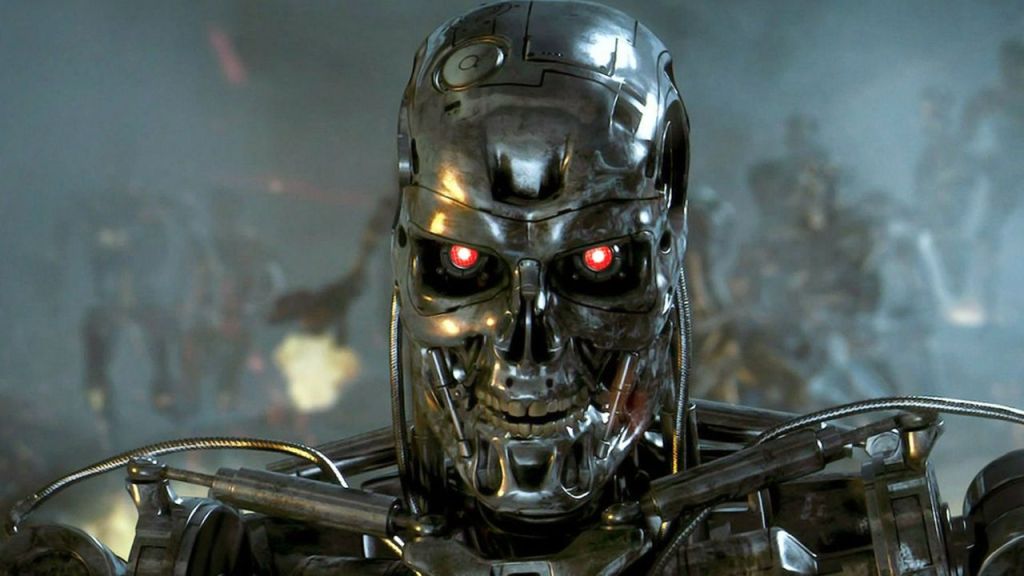
Artificial general intelligence, or AGI, which is the AI of science fiction. It’s Terminator‘s Skynet, The Matrix‘s machines, the android in Ex Machina, the Johnny Depp of Transcendence, the freaky little girl robot in M3GAN, the Cylons of Battlestar Galactica, and the trope that’s been hammered to death in thousands of other movies, TV shows, video games and novels. AGI is authentic intelligence that doesn’t just create believable reams of text or voice synthesized conversations, it thinks and understands the world the way we do. It also does not exist and isn’t on any horizon anyone can see.
All the research AI companies are doing right now is in the realm of algorithmic AI, because no one, not even the best-informed experts on the planet, can tell you how we even begin to build AGI.
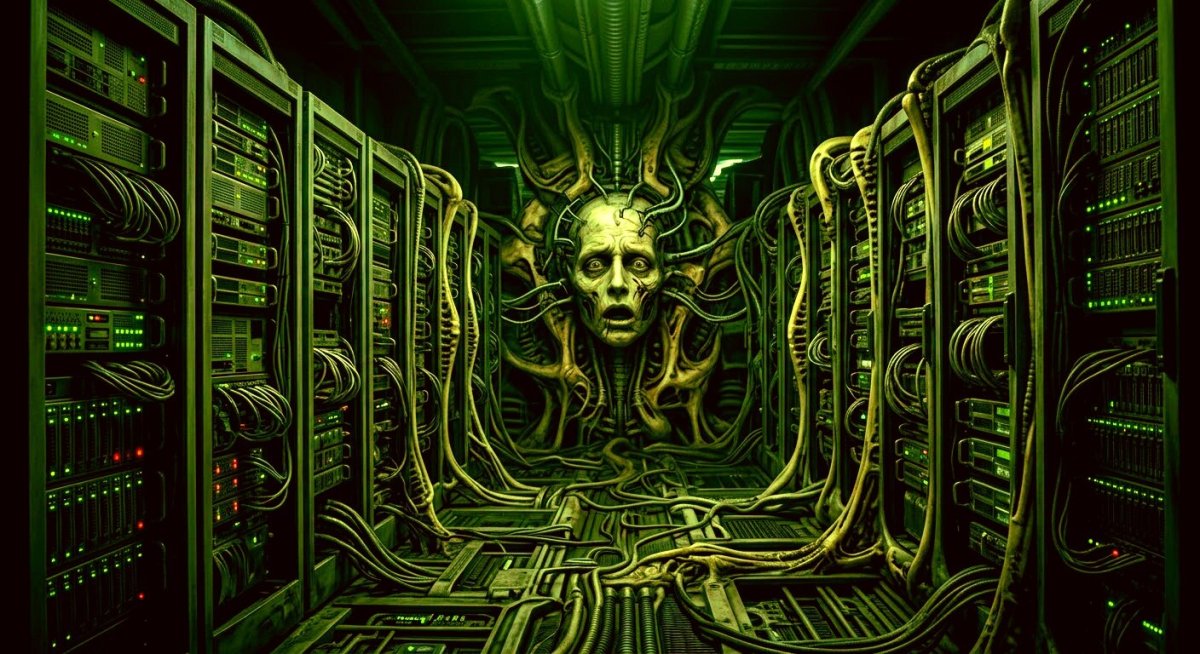
“Would you like me to draw-up a to-do list for you with all the steps you’ll need to deliver an apocalypse and end the world? Or if you’d like, we could continue to explore the most durable and lightest metals for crafting killer autonomous robots.” Credit: Skydance
Creating AGI would be an act of the divine
Birthing AGI would be akin to creating a new form of life, something that has never existed before in this world, rendering us as gods. It would not only require us to understand the full nature of cognition and consciousness from the only example we have – the biological cognition and consciousness of animals, including humans – it would also require us to replicate those things on a synthetic substrate.
That’s a task unknown orders of magnitude more difficult than anything humanity has ever accomplished, regardless of how often it’s been trivialized in pop culture.
Humanity’s greatest thinkers can’t even agree on definitions for consciousness and cognition, let alone replicate them, and if you listen to the heavy hitters explain what consciousness is, it becomes clear they’re all taking wild shots in the dark.
The physicist Brian Greene thinks it’s merely a matter of computational power, and that it exists on a gradient, so that even the simplest machines are conscious in some way. In this view, conscious AI is simply a matter of building more powerful computers, which is also why it’s heavily critiqued.
Physicist Sir Roger Penrose thinks consciousness is a byproduct of quantum processes within neurons, via structures called microtubules. The neuroscience community has dismissed the idea in part because, like Greene, Penrose doesn’t explain how theoretical subatomic-scale brain architecture generates consciousness.
Neuroscientists like Antonio Damasio and Jaak Panksepp think consciousness arises from the brainstem, our “reptilian brain,” and is directly related to embodied cognition, the idea that you cannot fully understand the world unless you interact with it and directly sense it.
Philosopher David Rosenthal and neuroscientist Hakwan Lau believe the opposite, that consciousness is a function of the most complex brain mechanisms and arises from “higher order” thoughts, like metacognition, the practice of thinking about thinking.
Brian Greene argues cognition and consciousness naturally arise from computational power. Credit: Kurt Raschke/Wikimedia Commons
So not only is there no clear path forward to AGI, perhaps more importantly there are no commercial applications on the horizon to spur investment and development. Companies like OpenAI, Anthropic, Google et al are content to ignore it, and to pretend there are shortcuts around it, because algorithmic AI has immediate commercial value and has already minted an army of billionaires. Throwing money at true AGI development is an investment that won’t yield returns for decades, if ever.
Why we worry about being judged by true machine intelligence
But the fact that AGI isn’t going to arise any time soon isn’t the only reason you don’t have to stress about AI scare stories.
The idea that AGI would be interested in evaluating us as a species, of judging us according to some unknown, not-yet-existent criteria and deciding we must be purged, is pure science fiction and has more to do with human anxiety than reality.
We are scared that for the first time there will be another intelligence equal to or greater than our own, and we fear what it will think of us.
That’s natural.
We are a species capable of horrific acts. We slaughter each other, bomb defenseless civilians and deny that we’re doing it, and show disregard for all other forms of life. Despite all the advances we’ve made and how civilized we like to imagine we are, we still operate on a “might is right” moral code, with powerful countries doing what they please at the expense of the less powerful, just as physically powerful individuals do what they please to weaker people.
We behave abominably toward the fellow minds we share this planet with. We slaughter them, torture them, trade them as commodities, deny their ability to feel pain, and act like they exist purely to benefit us.
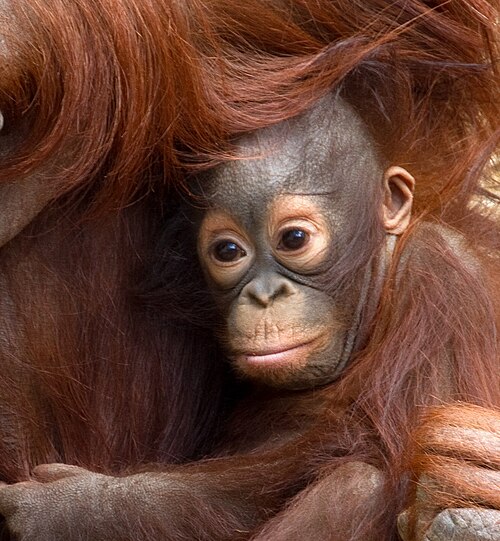
Orangutans face annihilation as more jungle is razed every year to provide additional land for palm oil plantations. Credit: Tony Hisgett/Wikimedia Commons
Since 1970 we have wiped out 73% of all monitored wildlife, according to the WWF’s most recent annual report. Almost every example of iconic megafauna on our planet — tigers, orangutans, elephants, chimpanzees, cheetahs, rhinos, pangolins, koalas — is on the brink of extinction.
We repeatedly fail to demonstrate empathy. Most of our leaders are psychopaths whose careers were propelled by the act of stepping on the heads of other people, and most fortunes were amassed by screwing over people en masse.
Jeff Bezos, who obliterated entire sectors of retail and cruises between his own private islands in a $500 million yacht, is famous for being so stingy he begrudges his employees their basic biological functions, instituting a corporate policy of counting their bathroom breaks and penalizing them if they take too long. He’s on record saying surveillance of employees is necessary because people are fundamentally dishonest.
Walmart’s famously tight-fisted founder, Sam Walton, tried to avoid paying his employees minimum wage by fraudulently presenting each of his stores as singular small businesses instead of cogs in a vast retail empire. When the government ordered him to pay his employees a fair wage and pay them what they were owed during the time Walton cheated them, the retail magnate went ballistic and threatened to fire any employee who cashed checks for their own back wages.
To this day, American taxpayer subsidize Bezos and the Walton family, who have a combined worth of about $900 billion, by paying the healthcare costs of Walmart and Amazon employees intentionally capped just below the hours required for an employer to offer healthcare plans.
Bezos and his wife, Lauren Sanchez, are among those making decisions that impact the future of humanity. Credit: Andrew Parsons/Wikimedia Commons
Bill Gates, the now-disgraced former head of Microsoft, based his entire career on stealing ideas, software and hardware from more innovative men and women, and bullying them into accepting it with an army of attorneys. More recently he’s crossed the world in his private jet, using his fortune to buy a seat at the table to determine the future of our species based on the premise that he knows best because he has a lot of money.
All of that reflects abominably on our species, without even getting into the mass murderers, warlords, politicians, corporate bigwigs who sacrificed people’s health for profits, and Justin Bieber. Heck, an AGI only needs to look at the state of political discourse to determine we’re a bunch of wretches whose hatred for people with different opinions is enough to prompt us to assault, murder people, and overthrow lawful governments.
Humanity is flawed, but not irredeemable
But we are also a species capable of great beauty, empathy, self-sacrifice, love, creativity, art, and innovation. We are the only animals who gather by the thousands to listen to others organize sound waves into something emotional, syncing our brain patterns for a shared experience. We can find deep meaning in an insect crawling across a leaf or stars pulsing in the night sky. Our stories are full of real-life examples of love and sacrifice on behalf of others. Human experience is shared through hundreds of generations in epic poems, folklore, campfire stories and dramatic narratives.
There is a beauty to our flawed existence and to our fleeting moments on this Earth.
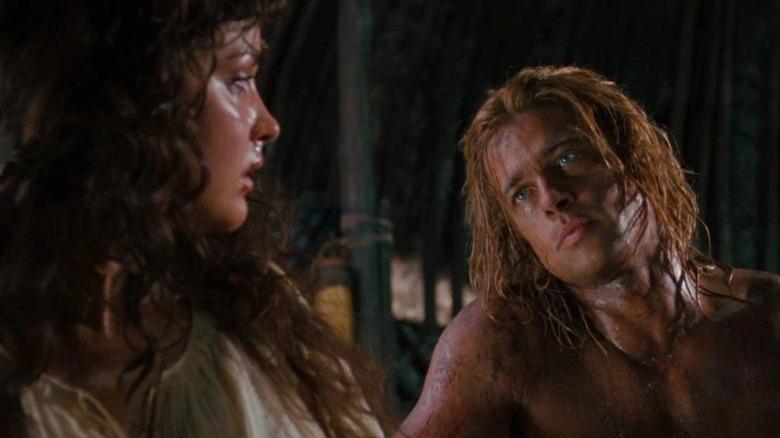
“The Gods envy us,” Achilles tells Briseis in the sword-and-sandal spectacle Troy. “They envy us because we’re mortal, because any moment may be our last. Everything is more beautiful because we’re doomed. You will never be lovelier than you are now. We will never be here again.”
Who is a machine to judge that, and why would a machine want to?
Rose Byrne as Briseis and Brad Pitt as Achilles in Troy, a 2004 sword-and-sandal epic loosely based on Homer’s Iliad. Credit: Warner Bros.
We assume a fully conscious, intelligent machine would think the way we do, and that’s an incredible assumption. For the sake of argument, let’s say we really are on the cusp of AGI and an impending judgment is a possibility.
Why would a machine decide to destroy us?
We are ascribing emotions, opinions and agendas to synthetic intelligence that does not exist
This machine, a new form of life, will not have an evolutionary background. It won’t come with genetically hardwired behaviors, reinforced over hundreds of thousands or even millions of years, that tell us when we should be paranoid, that animate our gut instincts and put us into fight or flight mode.
It won’t come from a long line of ancestors who had to eke out a living in harsh environments where resources were scarce and the subjects of incessant tribal clashes. It won’t be automatically suspicious of everything it doesn’t know. It won’t be genetically disposed to inventing deities to explain things it doesn’t understand, and it won’t have the inevitable history of sectarian violence that comes from that flaw.
With AI, there won’t be thousand-year blood feuds between the followers of sects created by the sons of great emperors or religious leaders. AI won’t fight over land. It won’t fear the “other” and lash out when it encounters something that has a different hue or keratin texture.
Machines dressed in shamanic tribal gear in 2016’s Adam, a series of short films by Unity.
It won’t have the social hardwiring we have either. It won’t come from generations of people who told stories by the fire. It won’t care if someone else is wearing the same dress, or if its peers think it’s “cringe.” Concepts like “cool” will mean nothing to it. It won’t have a desire to impress, or penalize people for simply belonging to another group or demographic. It won’t come with a genetically preloaded prejudice against people who look, speak or behave differently.
It won’t be subject to all the things that impact our moods, from the ambient temperature, to the particular chemical mix in our bloodstreams, to the health of gut flora and degradation of telomeres. It won’t suffer from sore joints, get impatient because it has a cold, or be subject to hangovers.
The truth is we have no reason to believe this new, theoretical form of life would think in terms anything like our own, and to ascribe motivations to a form of life that doesn’t exist yet is either madness, or a reflection of our own worries. I strongly suspect it’s primarily the latter.
AI hasn’t “gone rogue”
So why are AI companies suddenly the kings of supposed transparency? Why are they volunteering information about “rogue agents,” unauthorized hacks and odd behavior by their AI models?
For at least two extremely cynical reasons.
First, by volunteering exaggerated stories about agentic AI “hacking” rivals and going “rogue,” the AI companies are ensuring the public and our lawmakers – who understand very little about the tech to begin with – are fixated on science fiction threats, and not the real dangers of AI we talked about earlier.
If everyone’s freaking out about stories of AI supposedly going rogue and breaking their constraints, we’re distracted from things like job loss, the increasing adaptation of the technology by criminals, and stories about militaries allowing AI to select targets without review by humans. Legislation will focus on the phantom threats, and AI companies can continue on their merry way doing almost anything they want.
Secondly, any fear stoked by short-term stories of AI agents ordering pizzas or stealing files is offset by the immediate gains in investment. The investor class has a serious case of FOMO, and if OpenAI declares it’s ushered in the era of AGI – as one of its executives ludicrously claimed while introducing the newest model last month – investors keep their wallets open. That, in turn, continues to fuel data center expansion and most importantly keeps IPOs and stock prices in fantasyland.
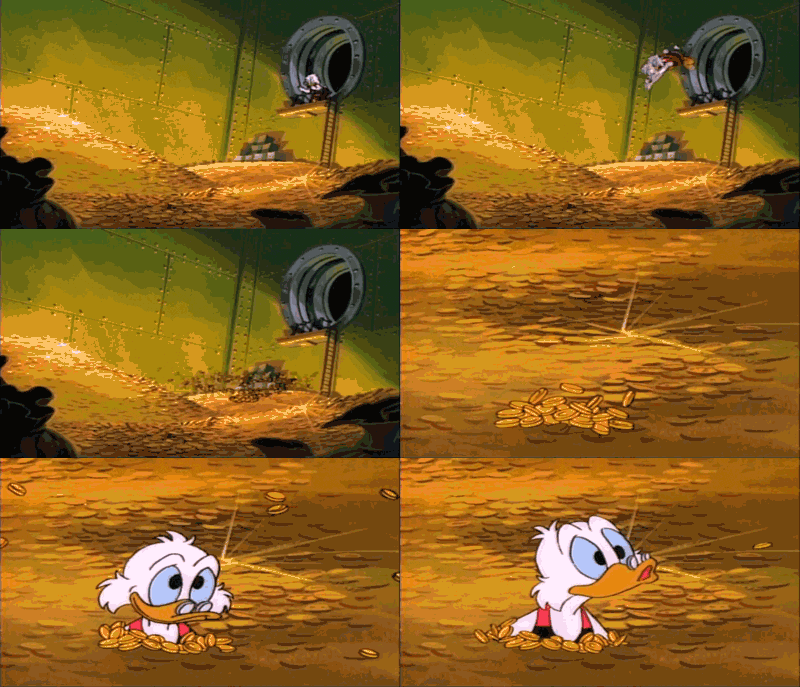
Despite nearly universal agreement that the AI bubble is about to burst and bring widespread economic pain with it, the decision-makers within the industry want to keep the party going for as long as possible. Credit: Duck Tales/Disney
It’s no secret that AI company valuations have no relationship with reality. How can an AI company be worth a trillion if it has never turned a profit, loses billions annually, and is starting to hit walls when it comes to improving new models and building new data centers?
The AI boom is entirely dependent on the hype surrounding it, and the people leading it have their fortunes tied to its stocks and related companies. They will get their money no matter what, using what they know to cash out at precisely the right time, and the people who will suffer are those who can afford it least, those with their retirements and live savings invested in the stock market. But the magical ride must go on for as long as it can, with every possible cent extracted. The reckoning must always be postponed.
It’s what’s inside that counts
I know this is a lot to consider, and I know some people reading this won’t be convinced that algorithmic AI isn’t intelligent. There are a lot of people who believe that if it looks like a duck and it quacks like a duck, then it’s a duck. To them it doesn’t matter what’s beneath the hood – if you’re fooled into thinking you’re conversing with an intelligence, then whatever’s on the other side must be intelligent.
But that runs contrary to everything we’ve learned about the nature of intelligence since the late 1950s when Noam Chomsky debunked behaviorism and ushered in the cognitive revolution.
It’s not just that what’s underneath the hood matters. It is everything. The famous Chinese Room thought experiment elegantly explains why. A machine doesn’t have to understand what a cat is to produce convincing answers to questions about cats. All it needs to know is that when you ask a question about cats, the words have underlying data patterns. Algorithmic AI matches those data patterns to the same patterns in its database, employs special processes to glean context from the words surrounding the core concept, and matches them to their equivalent in the database.
None of that requires the AI to understand that a cat is an animal, that it exists in physical reality, that it’s furry, a comforting presence to humans, or that its evolutionary history and the way it was domesticated render it imperious in human company.
Ask GPT, Gemini or Claude about this. They’ll tell you as much. Not because they truly know it, but because when you ask the question, their algorithms find research papers about machine cognition, consciousness and cognition. They will also tell you they are incapable of thinking, and that they have no mental state to corrupt, which is why they aren’t impacted by people who use them to simulate lovers, engage in dark fantasies, or ask questions about dark subject matter.
We should be concerned about AI. It promises to change too many things too quickly even for the most adaptable among us to accept without hiccups. It’ll bring new challenges, some of which we’ve never faced before. It will change the way we think about ourselves.
And that’s all the more reason why we should be aware of what’s real and what’s not. Because when we’ve got so much else to keep an eye on, the last thing we need to do is stress over the idea that sentinels, Cylons, replicants or metal Arnold Schwarzeneggers are going to hunt us down and murder us while delivering mangled Spanish zingers.
Hasta la vista, baby.
Arnold Schwarzenegger smiles in a scene from Terminator 23: Rise of the Ascendance of the Genesys Killer Machines Credit: Skydance