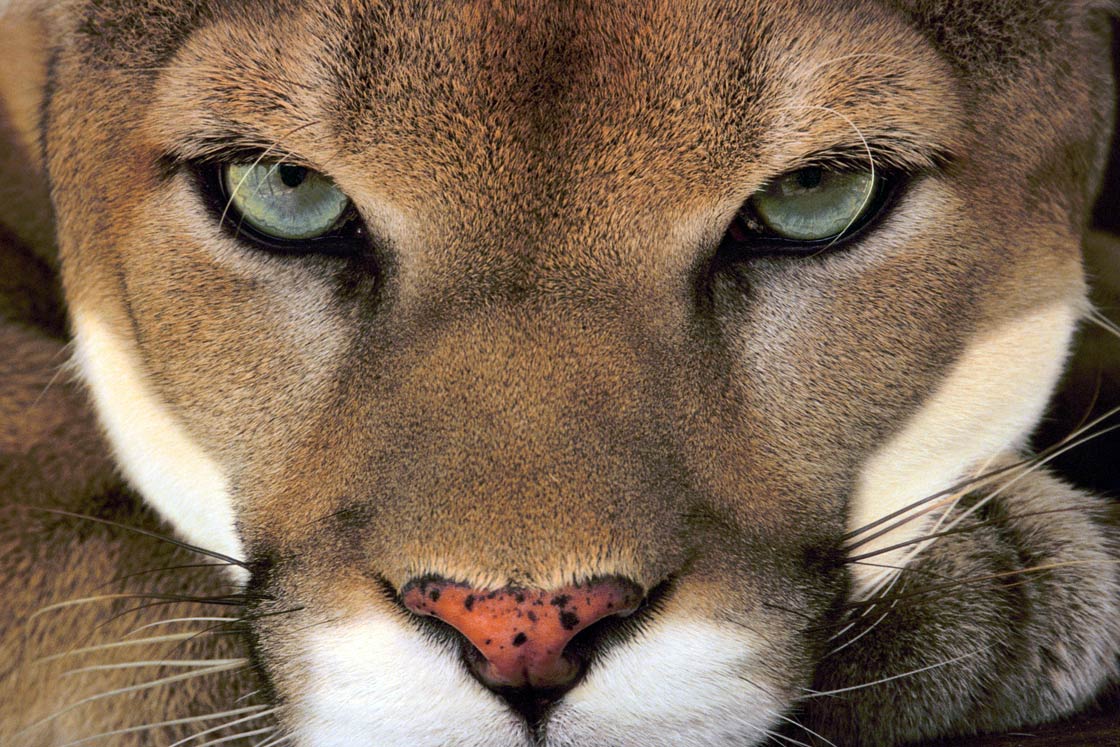
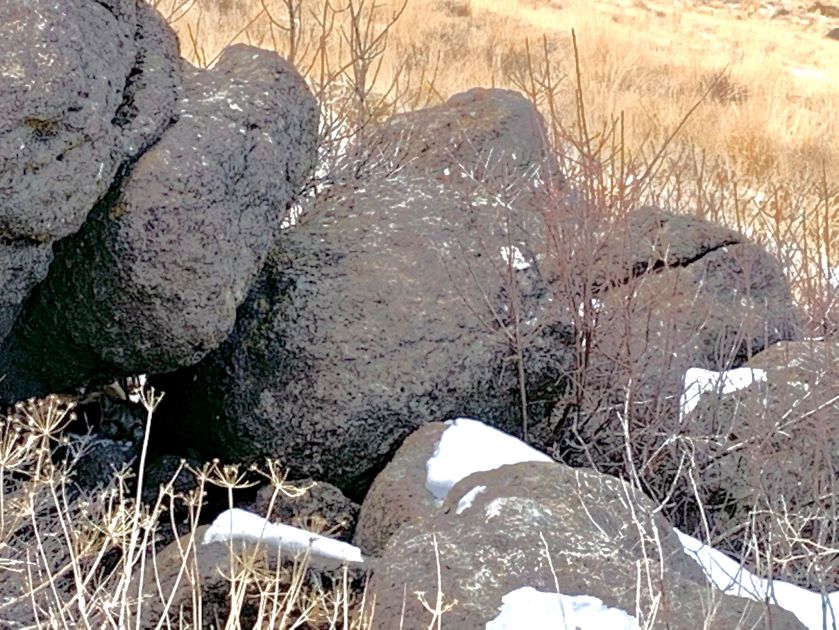
A photo shows why mountain lions are so elusive. Can you find the hidden puma?
This is the real deal, friends. Not a cheesy low-res photo or an intentionally obtuse shot with three pixels of a tail visible.
There’s a cat in this photo — a puma to be exact — and finding it is a good reminder of how awesome these elusive felids are, as well as how well they hide themselves from humans and fellow wildlife alike:
Credit: John Tull, US Fish and Wildlife Service
The photo comes courtesy of the US Fish and Wildlife Services and eagle-eyed photographer John Tull, who spotted the well-hidden cat in rural Washoe County, Nevada.
Mountain lions are the second-largest cats in the Americas behind jaguars, and although they look like lionesses, they pose little danger to humans. About 15 people have died in conflicts with mountain lions over the past 100 years. Dogs, by contrast, kill between 30 and 50 people a year.
Mountain lions are also known as pumas, cougars, catamounts and panthers, among other names. The word “panther” is a nonspecific word for large cats and is often used in association with jaguars and leopards.
Known scientifically as puma concolor, these mysterious cats are more closely related to small cats (felis) than big cats (panthera), and have the distinction of being the largest cats who can meow.
A new app aims to help us better understand and communicate with our cats.
A while back I wrote a post about MeowTalk, a new app that uses AI — and input from thousands of users sampling their cats’ vocalizations — to translate meows, trills and chirps for the benefit of those of us who don’t fluently speak cat or might need some clarity on what our furry friends are trying to say.
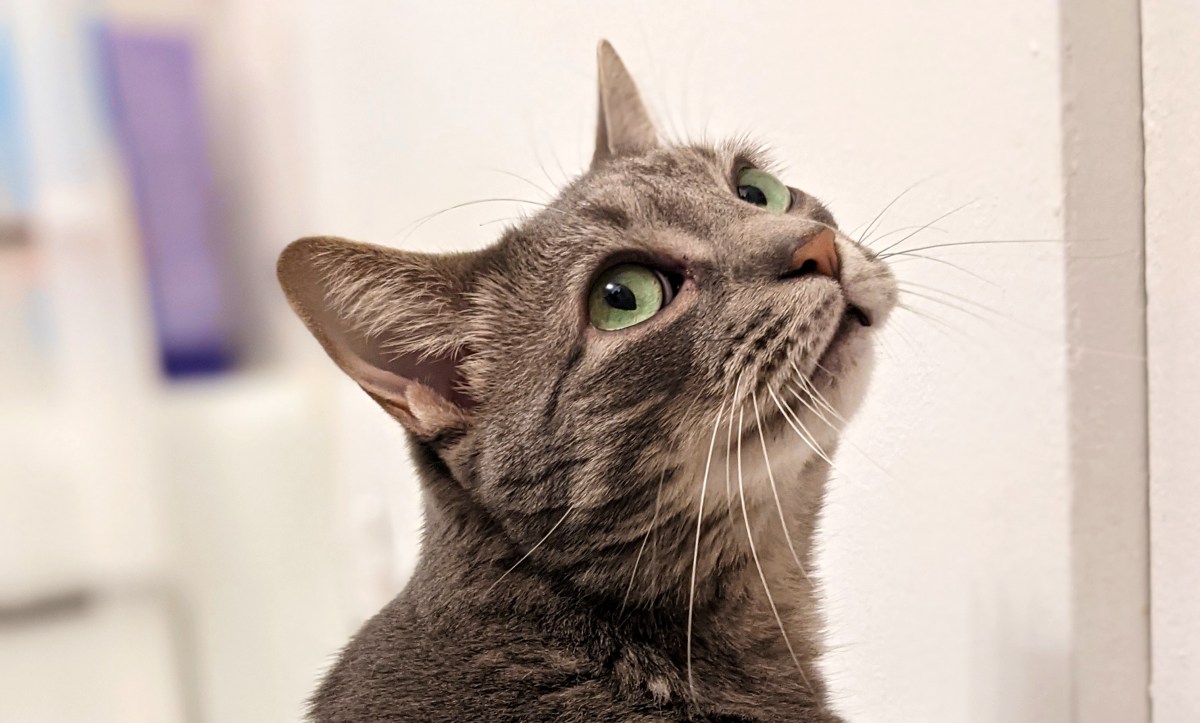
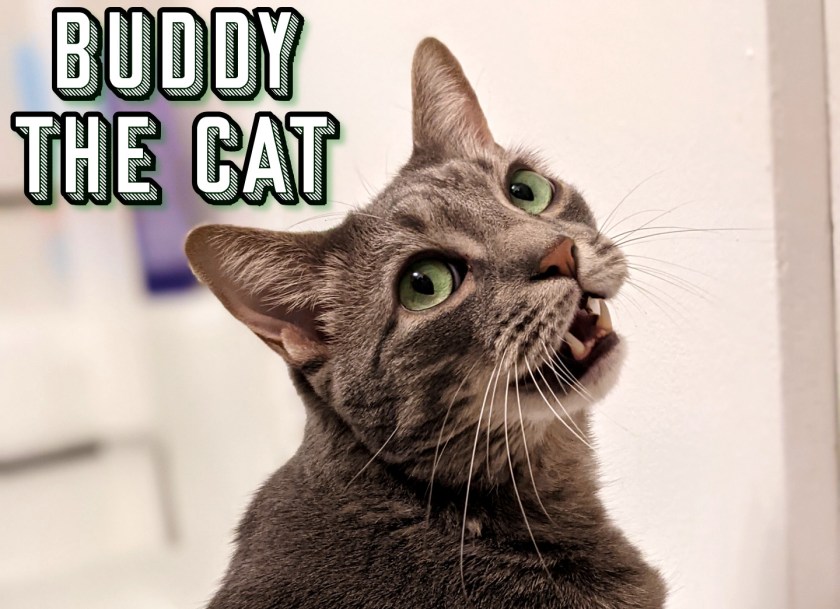
Now that I’ve finally had the opportunity to give MeowTalk a spin, it turns out Bud is a much more polite cat than I thought he was!
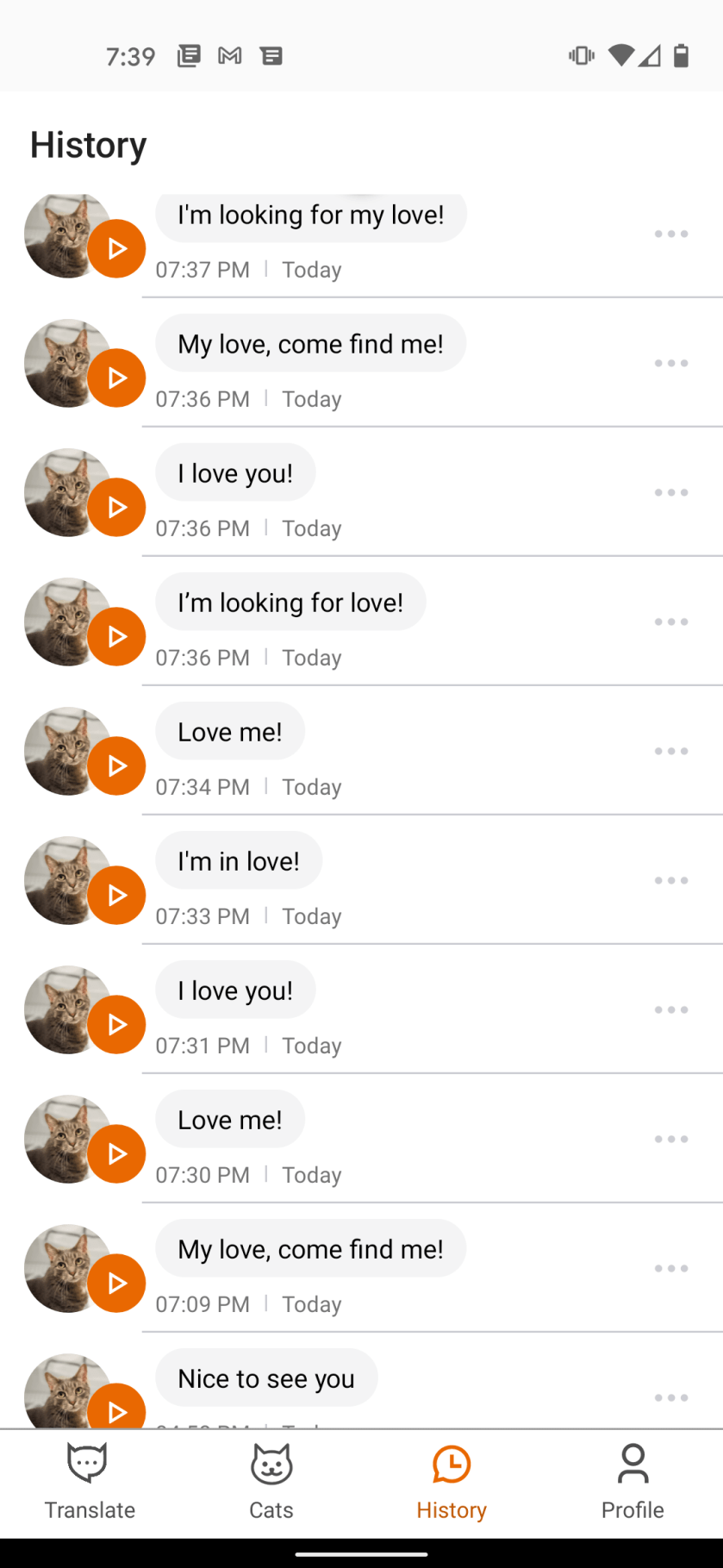
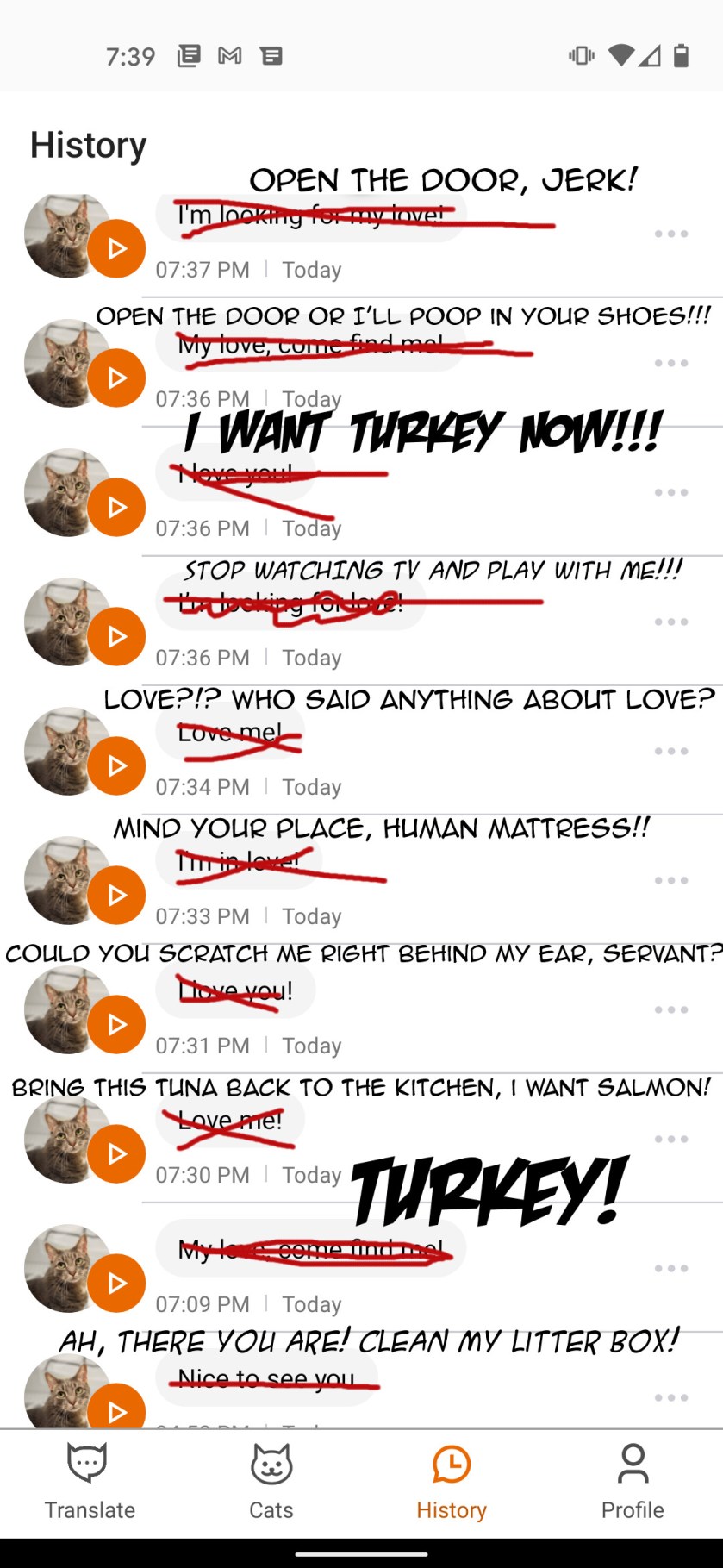
What I thought was an unenthusiastic “I acknowledge your presence, human” turned out to be “Nice to see you!” according to MeowTalk.
Buddy’s next meows were “Love me!” and “I love you!”, the app informed me. Weird. I thought he was complaining that I was only half-heartedly simulating prey with his wand toy while watching Jeopardy.
After Jeopardy I headed to the bathroom, which was the real test.
I intentionally closed the door before the little stinker could sneak in the bathroom with me, then held up the phone to capture his muted vocalization. I was sure Bud was saying “Open the door!” but the app told me Buddy was saying “I’m in love!”
Awww. What a good boy. How could I not let him in?
Once inside, Buddy began talking again as I knew he would. He’s a vocal cat.
“I’m looking for love!” the app translated as Bud pawed at the door, demanding to be let back out again. “My love, come find me!”
What was going on here?
Was Bud really professing his undying love for me, his human, or was he workshopping cheesy dialogue for a feline romance novel he’s been secretly working on?
Thankfully, MeowTalk allows you to correct translations if you think the app’s gotten them wrong. This looks more like it:
Translation from the original Buddinese language.
MeowTalk is in beta, and it can only get better as more users download the app, make profiles for their cats and make an effort to tag vocalizations with their correct meaning.
The app was authored by a software engineer who was part of the team that brought Amazon’s Alexa to life, and the algorithms that power it already show promise: When the app is listening (which it does only actively, after you have explicitly given it permission to do so), it does a great job of distinguishing cat vocalizations from background noise, human chatter, televisions and other incidental sounds. Even my fake meows were unable to fool it.
Each vocalization is sampled and saved to the history tab of your cat’s profile, so you can review and adjust the translations later. If you’ve got more than one cat you can make profiles for each one, and the app says it can tell which cat is talking. I wasn’t able to test this since the King does not allow interlopers in his kingdom, but given MeowTalk’s accuracy in distinguishing meows from every other sound — even with lots of background chatter — I have no reason to doubt it can sort vocalizations by cat.
In some respects it reminds me of Waze, the irreplaceable map and real-time route app famous for saving time and eliminating frustration. I was one of the first to download the app when it launched and found it useless, but when I tried it again a few months later, it steered me past traffic jams and got me to my destination with no fuss.
What was the difference? Few people were using it in those first few days, but as the user base expanded, so did its usefulness.
Like Waze, MeowTalk’s value is in its users, and the data it collects from us. The more cats it hears, the better it’ll become at translating them. If enough of us give it an honest shot, it just may turn out to be the feline equivalent of a universal translator.
And if it’s successful, its creator wants to make a standalone version as a collar, which would translate our cats’ vocalizations in real time. As far as I’m concerned, anything that can help us better understand our cats is a good thing.
In Cyberpunk’s future, all animals are gone…except roaches and pet cats.
I’ve been playing Cyberpunk 2077 lately, as readers of this blog may have guessed by some of the references, and it is everything the hype said it would be: A dystopian story set in a grim, hyper-corporatized, ultra-capitalist future in which the masses worship the gods of consumption, virtually everything that humans come in contact with is synthetic, and nature is a forgotten dream that may or may not exist beyond the seemingly-infinite concrete and chrome of human sprawl.
It’s Bladerunner writ large and interactive, a retrofuturistic nightmare in which people voluntarily have their own eyes plucked out to replace them with brain-interfaced digital lenses and biomechanical grotesqueness is the societal norm. A future in which a person’s life amounts to the price their internal organs can fetch on the black market and the only civil liberties that exist do so by the forbearance of megacorporations.
Even if you’re not a gamer, unless you’ve been living under a rock you’ve probably heard of the game. It is, after all, one of the most highly-anticipated pieces of consumable media in modern history, and familiar actors have lent their voices and likenesses to the production.
One of the most depressing aspects of 2017’s Bladerunner 2049, the long-awaited sequel to the 1982 Ridley Scott classic, is the utter disconnect from anything natural.
Future Los Angeles is so choked with smog that the city exists in a perpetual twilight gloom. Animals have been purged from the Earth, and humanity has turned to farming insect larvae for protein in processed foods. Vegetation is so rare that the sight of a single sprout near the dusty carcass of an old oak tree fascinates Ryan Gosling’s antagonist character, K.
Drawing heavily on Bladerunner — as well as the seminal 1988 Japanese film Akira, William Gibson’s 1984 novel Neuromancer, Luc Besson’s The Fifth Element (1997), and even the 1979 action thriller Warriors (which is itself based on Xenophon’s Anabasis from 370 BC) — Cyberpunk 2077 is about violence, hedonism and human greed.
There is no room for the beauty of animals or nature in a future like this.
That’s why it’s surprising to find cats stalking the dim alleys of Cyberpunk 2077’s Night City.
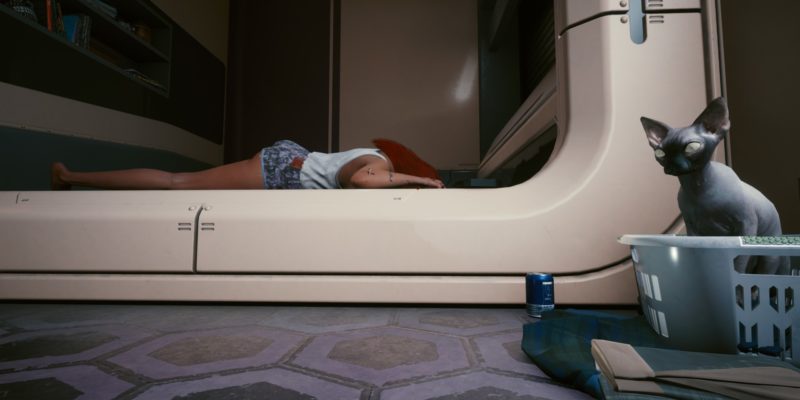
Keanu Reeves’ character, Johnny Silverhand, is quite enamored with Nibbles the Cat.A Sphinx cat in Cyberpunk 2077.
The player’s character, V, can stop and pet stray cats he encounters throughout the game.
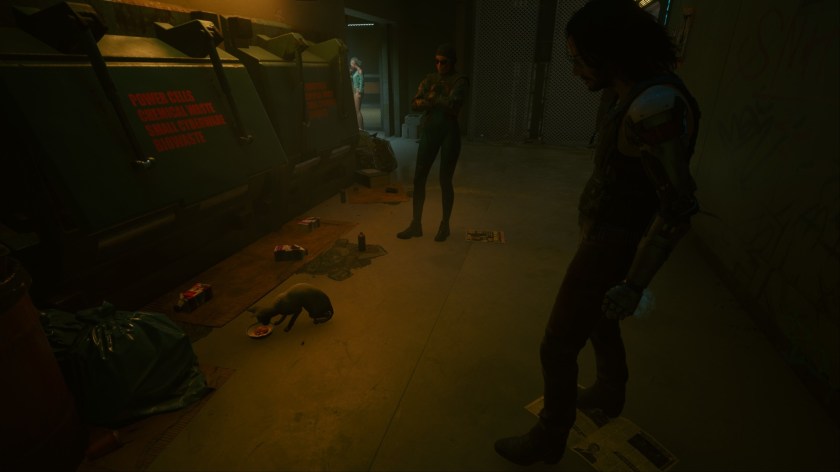
There’s even a hidden opportunity to adopt your own stray and take it back to your apartment in the game. Johnny Silverhand, the wise-ass character played by Keanu Reeves, is particularly fond of Nibbles the stray, who can be found amid piles of trash in the hallway outside V’s apartment.
Nibbles “doesn’t really do much besides lay around and take up space,” Screenrant notes. “Basically exactly what a cat does in real life. What an immersive experience.”
In another scene, V is conducting recon on a corporate target with Takemura, a Japanese ally, when a cat slinks by and lays down about 20 feet away.
Takemura says the cat is the first animal he’s seen in Night City, “except for the cockroaches, of course.” Then he wonders if the cat is a bakeneko, a Japanese spirit.
Night City is a technological achievement so impressive that it takes many hours just to get your head wrapped around how big and detailed it is. It’s easily the largest virtual city ever created, but it’s not just about sprawl — the city is truly vertical, from hidden subterranean depths and accessible street-level locales to highways, apartments and offices that claw at the sky, their peaks towering over ubiquitous flying car traffic.
The game is a form of entertainment, but it’s also a warning: This could be our future. Some would say it’s even likely to be our future.
Most of us are disconnected from nature. We’ve forgotten the stars and the night sky, which have been blotted out by smog and light pollution. We have wiped out more than two thirds of all the wildlife on the Earth and innumerable species teeter on the edge of extinction, including almost every example of iconic megafauna, from tigers and jaguars to orangutans, chimpanzees and elephants.
The interregnum caused by the global pandemic has reminded us that we share this planet with billions of other minds, with animals cautiously poking their heads out at the edges of civilization, wondering where all the humans have gone.
It’s fun to play in a dystopian future, but I don’t want to live in it.
As readers of this blog know, Bud’s favorite “place” to sleep is on top of his Big Bud.
Why do cats like sleeping on their humans? A new article from Treehugger provides some possible answers to that question. For accuracy purposes, we asked Buddy to weigh in on the reasons mentioned in the article.
1.To Mark Their Territory
Cats have scent glands that release pheromones all over their body. Marking humans with these pheromones means that they are part of the cat’s in-group, a behavior learned in groups of cats in the wild to distinguish members of the pack from non-members.1 When a cat sleeps on you, it marks you with its scent so it can be reassured that you smell familiar and safe. Even cats who enjoy solitude may rub and head-butt their owners as part of the same scent-marking process.
Buddy says: This is true. My scent says “this is my human,” so other cats don’t get any ideas when Big Bud is traveling in The Outside.
2.To Stay Warm
Many cat owners are familiar with the sight of their cat sleeping in a sunny patch on the bed, or even knocking over plants and whatever else is in the way in an attempt to get an ideal window napping position. Warmth induces relaxation and sleep in cats, and few spots in the house are warmer than being directly on top of a person. Warmth may also contribute to the initiation or maintenance of restorative sleep in cats, meaning that seeking out warm spots for sleep can help them stay healthy.2
Also true. Humans are nice and warm, and on really cold winter nights, nothing’s toastier than burrowing under the blanket with your human and sleeping against their body. Just make sure you don’t get squished!
3.To Feel Safe
Animals are more vulnerable to attack while they’re sleeping, and cats are no exception. As a result, cats who see their owners as a sign of safety and security may enjoy sleeping on or near them. This behavior can also be traced back to kittenhood. When young cats are growing, they are typically in large litters with other cats, nursing from their mother, and sleeping together in a group, sometimes stacked on top of one another. Particularly without other cats in the house, humans may have a substitute role in this situation.
Wrong! Erroneous! Absurd! My human sleeps next to me to feel safe, not the other way around. When he’s woken up in the middle of the night by a scary sound and his fur’s on edge, I say “Don’t worry, Big Buddy, I will protect you with my razor claws, my tiger fangs and my really big muscles!” When he got up one night, picked up a baseball bat and went looking for an intruder, I took point by hiding behind his legs. Not because I was scared, but because BAM! The burglar’d never know what hit him if I suddenly sprang out.
4.To Bond With You
In experiments to stop cats from destructive scratching and urine-marking behaviors, scent-marking was proven to be a powerful way to preserve cat-human bonds. When your cat sleeps on you and marks you with their scent, it’s creating a powerful olfactory reminder that you both belong to the same group. Being close to humans also allows cats to hear and feel familiar and comforting sounds, like a beating heart or rhythmic breaths during sleep, which are reminiscent of safe sleeping spaces with a mother cat and siblings.
See number one! It’s also about comfort. Humans are great mattresses!
5.To Show Affection
As demonstrated by a recent study on cat-human bonding, cats are not the solitary creatures they are often portrayed to be. In the wild, cats comfortably live in matriarchal societies and are known to exhibit a variety of group bonding behaviors including mutual grooming, allorubbing, and sleeping together. Sleeping with their owner is one way cats can show affection and caring.
You can interpret it as affection, yes, but the important thing is that Big Buddy cannot go anywhere without me knowing about it. Say he gets up in the middle of the night to use the human litter box room. By sleeping on top of him, I know the second he starts to shift, and I can not only follow him to the litter box room before he shuts the door, I can also howl at him on the way back so he gives me a snack just to shut me up before going to bed. No snack, no peace!
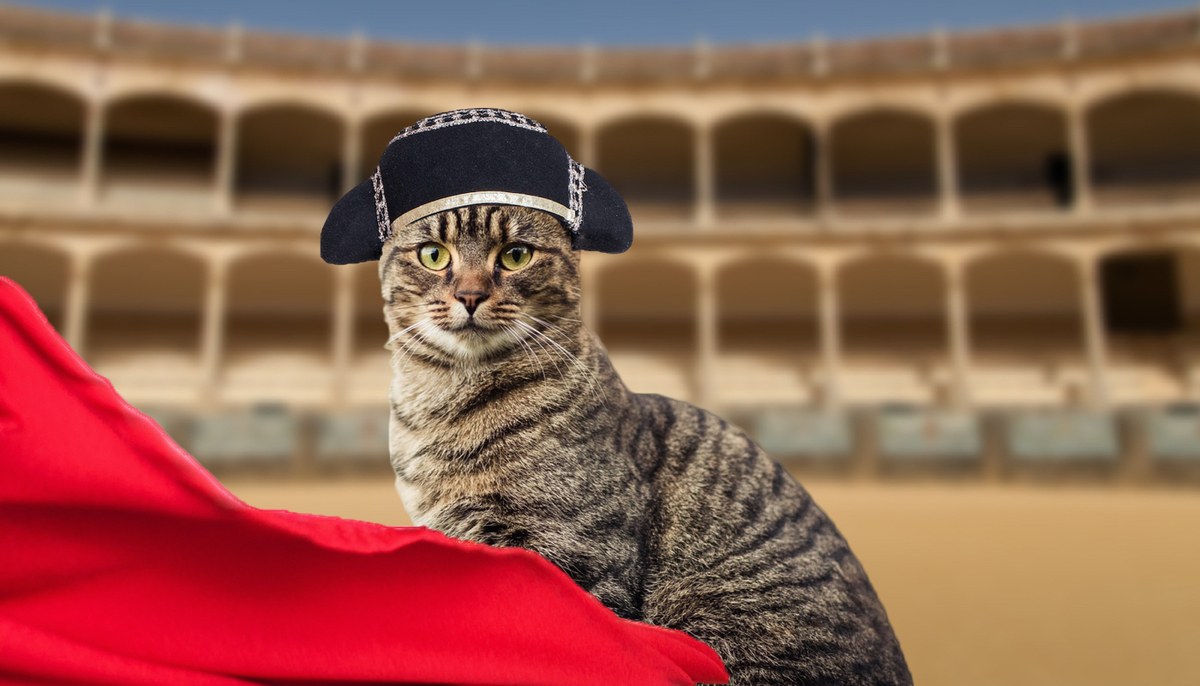
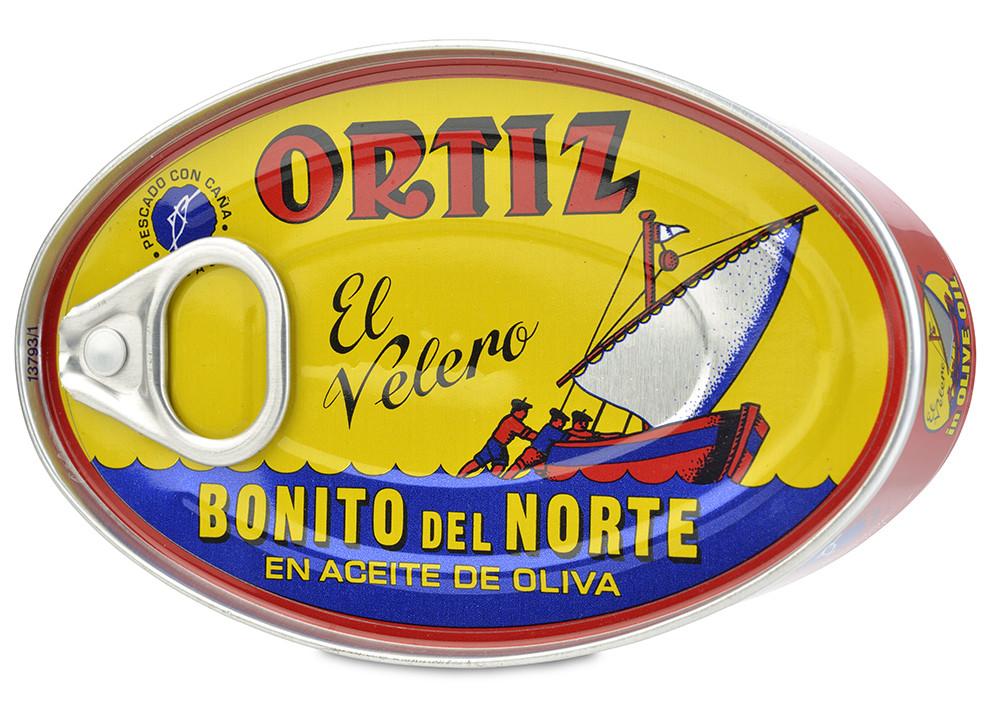
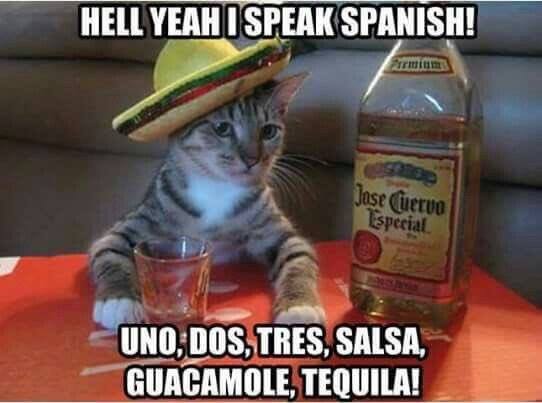
Buddy the Cat admitted Sunday he’s an American domestic shorthair after social media users called him out for presenting himself as an exotic Spanish feline.
The popular tabby cat had been going by the name Buddario El Pavo Gato de la Massivo Cajones, but after questions about his heritage went viral, he admitted in a rambling video that he was “just a basic tabby cat from New York,” and he was not in fact born on the island of Mallorca.
“My heritage is a lot of things, okay? There are a lot of regular cats in Europe too,” he said. “I have been clear about this, but the media keeps misrepresenting me.”
Celebrities and social media users reacted with doubt after user @LeniBriscoe unearthed one of “Buddario’s” old appearances on The Noon Show, where he prepared a traditional Mallorcan paella pate for the audience.
“We have Temptaciones, we have Fiesta Elegante, we have…em, how you say in English? Turkey?” he asked in a thick Spanish accent.
The feline influencer — or kittfluencer — was so committed to his ruse that he refused to eat cat food unless it came from “the Old Country,” sources said.
Previously the famously Spanish cat told interviewers he came to the US at three years old to open a yoga studio where clients pose to flamenco music and wave red bullfighter flags
But as an impromptu coalition of online sleuths found, “Buddario’s” parents are American domestic shorthairs from New York. The celebricat enjoyed a privileged upbringing and went to an exclusive boarding school for wealthy kittens.
After returning home on Sunday to find a crowd of reporters camped in front of his house, “Buddario” waved them off, refusing to answer questions.
“No habla Ingles,” he said, pretending not to understand as reporters shouted questions at him. “Todo es mentira en este mundo! Todo es mentira la verdad! Todo es mentira yo me digo, todo es mentira ¿por que sera?”






 Pain In The Bud