They appear out of nowhere on a scenic route in New York’s Catskill mountains, beckoning drivers to stop and check out the rest of the wonders inside the nearby shop.
A few years ago on the way back from the Catskills, a scenic mountain belt in low-central New York, I spotted this beauty from the road and had to stop:
It’s a heavily modified, custom Dodge Magnum crafted by artist Steve Heller. The parcel of land I’d almost passed houses his shop, Fabulous Furniture On 28, one of the most unique spots you can find in the state, if not the country.
Here are a few other photos of the Cro Magnum I took that day:
Heller’s property is adorned with all sorts of retrofuturistic metallic sculptures that evoke the science fiction films and comic books of yesteryear:
The classic cars are my favorite, but unfortunately I did not get to see them all that day.
The header image and the images below are from Heller’s site, while I took the other photos on the day I stopped to look around.
The header image is another Dodge Magnum, while the beast below is The Marquis de Soto, a customized Mercury Grand Marquis:
Your cat’s taste in music may or may not align with your own.
Before we get into today’s cat news, I received an email asking why there hasn’t been much Buddy on the site lately.
Fear not, friends of Buddy! The little guy is down in the Amazon visiting his jaguar pals, but he’ll be home in time for the most important holiday of the year, Turkey day. He wouldn’t miss it for the world!
Buddy with a jaguar buddy in the Amazon, where there’s a special felid conference on new napping techniques.
A smiling cat?!
A story on Space.com says people see a “smiling cat” in images of a nebula, although we’re not so sure.
The nebula in question is Sh2-284, or Sharpless 284. It spans about 150 light years and sits about 15,000 light years from our star system near the edge of the Milky Way, in an outer spiral arm.
From a certain orientation, there may be suggestions of cat-like ears and eyes, although if there is a smile, it’s crooked and deranged-looking. Maybe the cat’s on pain pills from the vet?
There’s an opportunity here, since the nebula doesn’t have a nickname. The Buddy Nebula has a nice ring to it!
Here’s an image from NASA:
This spectacular picture of the Sh2-284 nebula has been captured in great detail by the VLT Survey Telescope at ESO’s Paranal Observatory. Sh2-284 is a star formation region, and at its centre there is a cluster of young stars, dubbed Dolidze 25. The radiation from this cluster is powerful enough to ionise the hydrogen gas in the nebula’s cloud. It is this ionisation that produces its bright orange and red colours. This image is part of the VST Photometric Hα Survey of the Southern Galactic Plane and Bulge, led by Janet Drew at the University of Hertfordshire in the UK.
In Star Trek there’s always a convenient nebula nearby when the Enterprise — or Voyager, Titan or Discovery — needs to “hide” from some well-armed belligerent, and science fiction in general creates the impression that they’re like space swamps.
In reality nebulas are regions where the interstellar medium — the space between stars — is filled with gas, cosmic dust and inert matter. Some are stellar nurseries — places where stars are “born” — and some are the remnants of dead stars and the planets that orbited them.
They can seem to glow red, orange, green or blue depending on the elements present. Some of them reflect starlight while others are like filters, with the gases and dust lending their color to the nebulae structure.
Cats are pretty well-represented in the cosmos, from a human perspective. From the cat’s paw nebula to the Cheshire Cat galaxies, to the Lynx, Leo and Leo Minor constellations, astronomers have seen cats in the sky for millennia.
Does music help cats relax?
Although the research is limited, some studies have indicated certain genres of music can help our little buddies chill out. And if research into the canine response to music is any indication, we should expect to see more evidence for cats enjoying tunes.
When it comes to what kind of music is most effective, studies point to classical music with a slow tempo, as well as reggae and soft rock “with simple rhythms, slower tempos and no heavy percussion,” according to a new story from the BBC.
Just listening to some meowsic!
A 2016 study looked at the effect of music on 12 female cats who were recovering from spay surgery. The research team played “three different genres of music: classical music (CM), ‘Adagio For Strings (Opus 11)’ by Samuel Barber; pop music (PM), ‘Torn’ by Natalie Imbruglia; and heavy metal (HM), ‘Thunderstruck’ by AC/DC.”
The team measured heart rate, breathing rate and pupil dilation, concluding that classical music was most effective, followed by the Imbruglia song and AC/DC last. (Maybe next time they can slide The Tony Danza Tapdance Extravaganza in there for some extra fun.)
Anecdotally, Bud did not respond well to composer David Teie’s Music for Cats, but he hangs out and nods along to funk, classic 90s New York hip hop, retrowave, nu-disco, reggae and certain kinds of rock, which is almost certainly because he grew up hearing that stuff with me.
So maybe there’s a nature vs nurture element to feline musical preferences, although I wouldn’t hold out hope for cats who enjoy the Tony Danza Tapdance Extravaganza. Some things are best left alone.
Located in modern-day Jordan and accessible via a winding path through its sandstone formations, Petra is one of the most fascinating and mysterious sites on Earth.
Known as the Rose City for the color of the timeless sandstone it was carved from, Petra is one of the oldest known human settlements, with its first inhabitants claiming the site as far back as 7,000 BC.
Petra’s iconic carved structures date back almost 2,000 years to the construction of Al-Khazneh, an Arabic name that means “the treasury.” It was actually a mausoleum and meeting place for the Nabataeans, an ancient Arab people whose kingdom existed in what is now present-day Jordan.
The Treasury is a misnomer that was bestowed on the rock-hewn building centuries later, when legends claimed priceless treasures were sealed within. Today, visitors can see bullet holes in the stone from raiders who thought the structure would shatter, leading to an avalanche of gold pouring from the cracks opened by their firearms.
Petra is a UNESCO World Heritage site and is one of the 7 Wonders of the New World. It may be most familiar to movie fans as the site of key scenes in 1989’s Indiana Jones and the Last Crusade.
These photos were taken by Brother of Big Buddy (BoBB), who selfishly visited without me and thought he was Indiana Jones as he posed in front of The Treasury atop his camel mount. Thanks for the photos, bro!
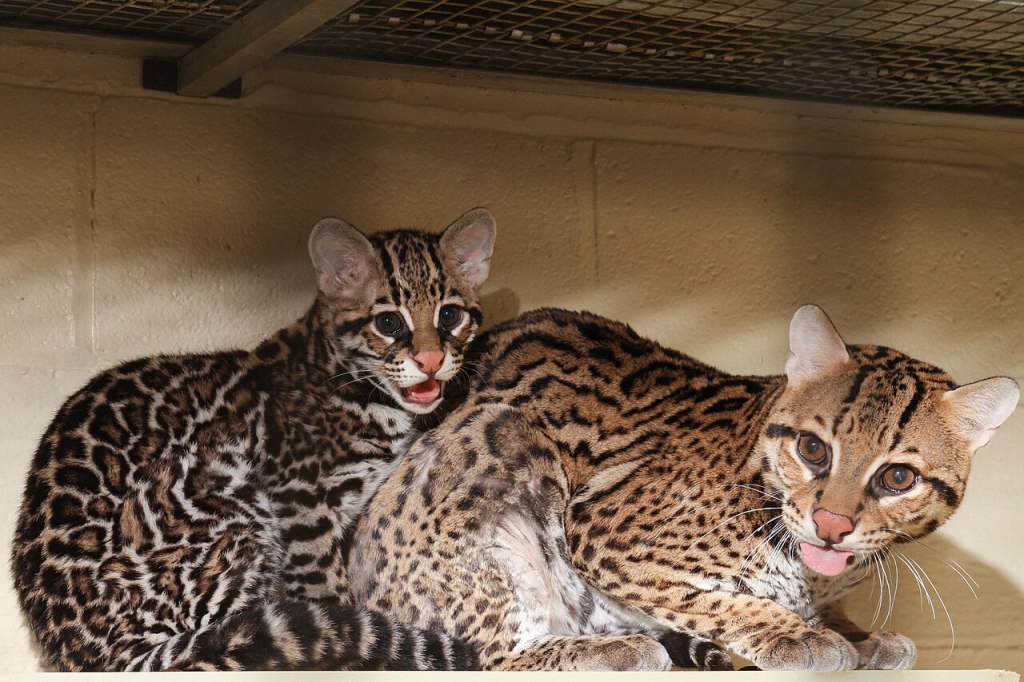
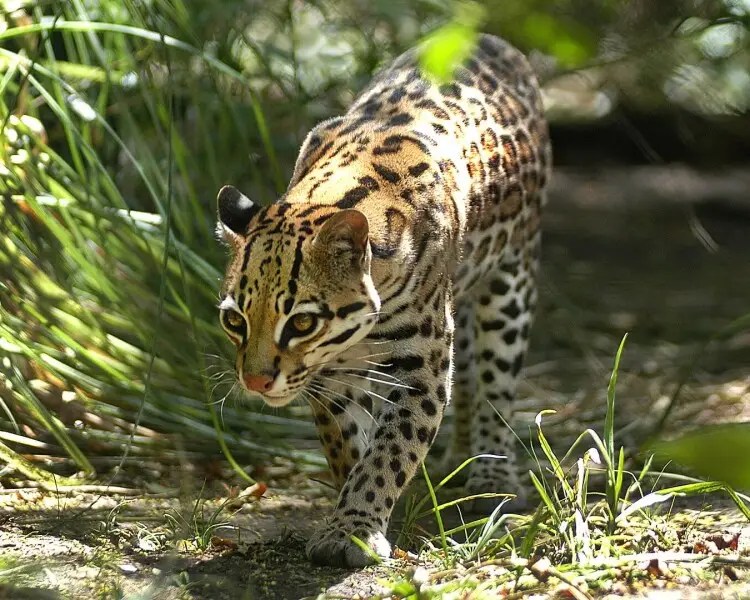
Ocelots, one of the western hemisphere’s most adaptable cat species, are often mistaken for young jaguars.
In 1999 biologists from the Dallas Zoo were lending a hand on a project to monitor and protect America’s ocelots, who primarily range in southern Texas.
With limited resources, the team was trying to keep the wild cats in a protected area and get them to use paths where camera traps had been installed. One tried and true method was to use scents, but what could attract ocelots?
“Sort of on a lark, one of our research assistants produced a bottle of Obsession,” Dallas Zoo’s Cynthia Bennett said at the time.
The felines loved it. Members of the research team watched astounded as the scent magically transformed previously ignored objects into items of sudden fascination.
The cats happily rubbed their cheeks and bodies against anything sprayed with the stuff.
“It´s a little embarrassing to watch, actually,” Bennett said. “It does make you wonder what´s in the perfume.”
(It’s probably civetone, a synthetic version of a pheromone produced by civets used as a binder in the Calvin Klein scent.)
Credit: Victor Landaeta/Pexels
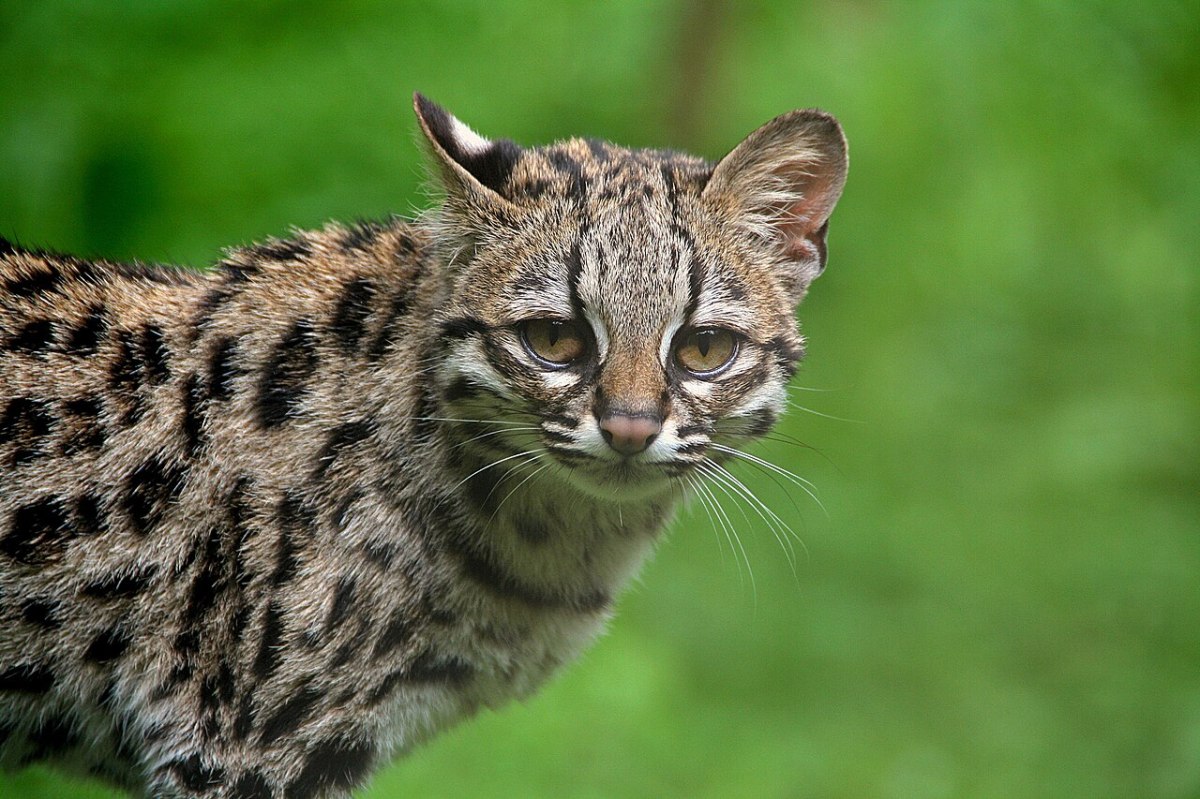
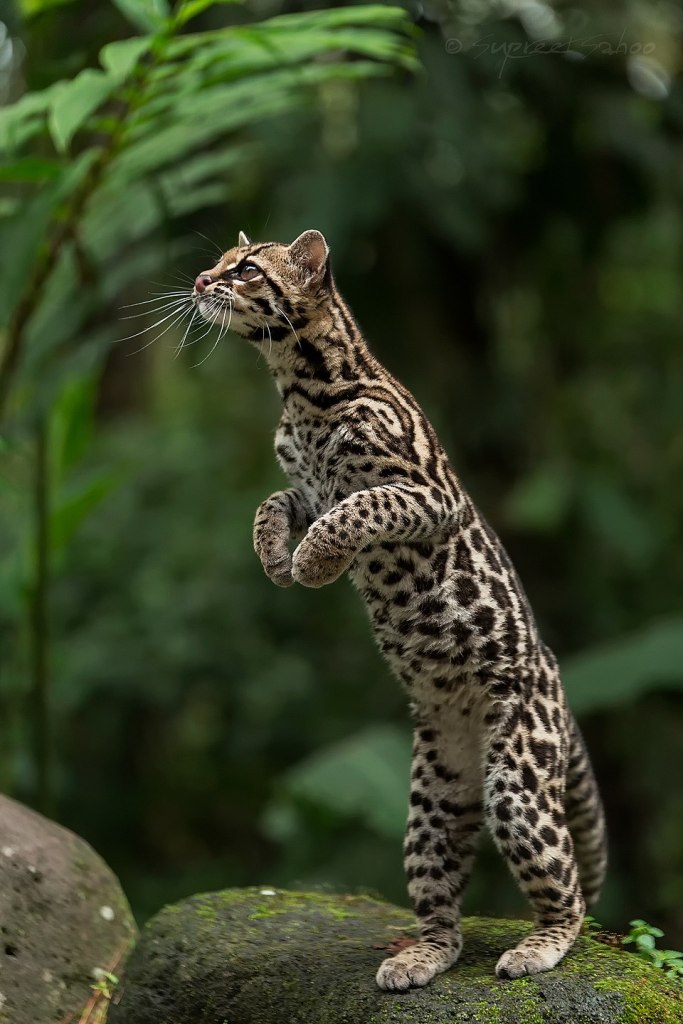
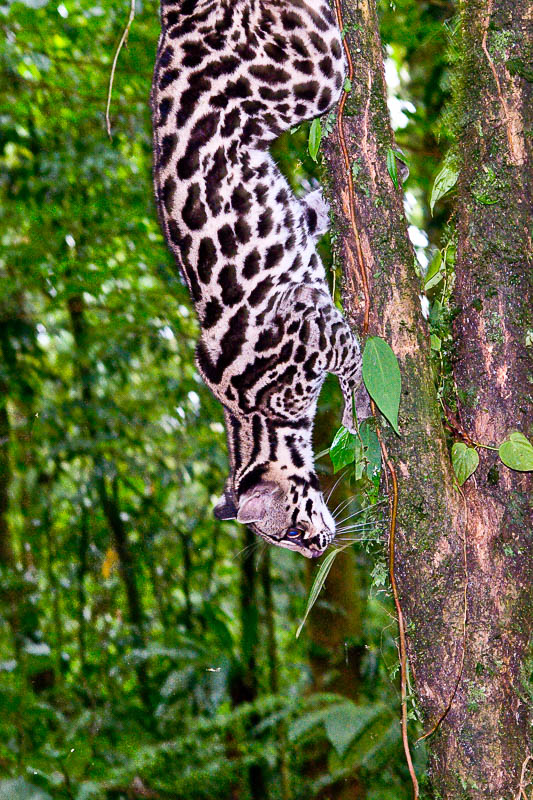
In addition to their predilection for cologne, ocelots are known for enjoying water, hunting by twilight, and napping in trees. The medium-size felids, who weigh up to 40 pounds in the wild, are also easily recognizable by their big eyes, the dark rings that surround them, and the way those markings become twin stripes that sweep over their foreheads.
Perhaps most striking are their large, wavy rosettes, which sometimes get them confused for young jaguars. In several indigenous South American languages, ocelots and jaguars share a name or have very similar names.
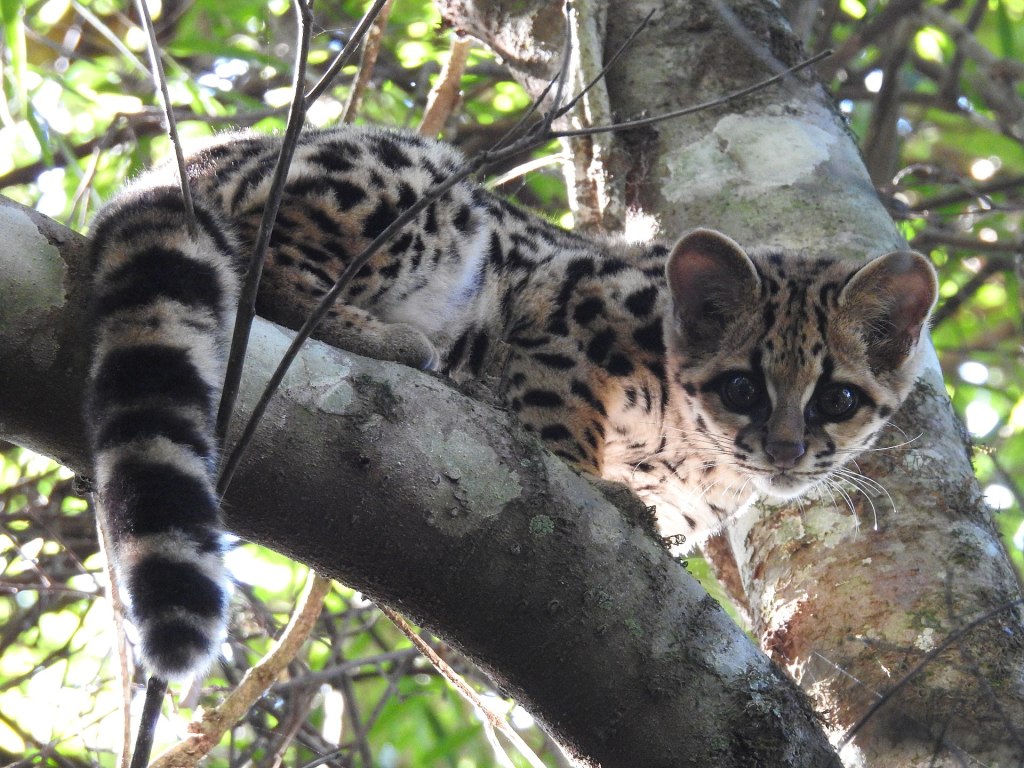
An ocelot kitten. After a gestation period of about three months, ocelot moms give birth to as many as three kittens. Credit: Wikimedia CommonsAn ocelot resting in a tree. Like other leopardus species, ocelots are proficient climbers. Credit: Wikipedia Commons
Ocelots have another quality that may lead people to confuse them with jaguars: they’re fond of water and they’re considered strong swimmers. That allows them to master their habitats, which often include rivers winding through rainforests and mangrove swamps.
The resourceful cats are adept predators on land and they can also pluck fish out of rivers.
An ocelot going for a dip. Credit: yellowlime_des/Reddit
Ocelots are categorized as a species of “least concern” by the IUCN (International Union for Conservation of Nature) but that doesn’t mean they’re thriving. Like pumas, the species is adaptable and can survive in varied surroundings. Still, ocelots contend with the same pressures other species experience, including habitat loss and fragmentation, hunting and poaching.
And while they can’t get enough of Calvin Klein’s Obsession for Men, maybe that’s a good thing.
According to zookeepers and wild cat experts, ocelots have a uniquely funky body odor which is amplified by their prodigious scent-marking. They want everyone to know where their territory is.
For zookeepers, the cats’ Obsession obsession could pull double duty as olfactory enrichment in their habitat — and a way to mitigate the stink.
Credit: Wikimedia Commons
Name: Ocelot (leopardus pardalis) Weight: Up to 40 pounds, with limited sexual dimorphism (males are slightly larger) Lifespan: Up to 20 years in captivity Activity: Crepscular, nocturnal Habitat: Claims territory in places where prey, water and dense ground cover are plentiful but the species is adaptable and survives in varied biomes
The purveyors of the deceptive posts want you to click, share and argue with other users about the veracity of the photos.
Not only is he the rarest puma in existence, he’s more well-traveled than most humans.
The mountain lion in question has a black coat, unprecedented for his species, and has been popping up all over Facebook. He’s photographed from the passenger seat of a truck cab, his tail in an unbothered curl, crouched amid the brush near a rural road.
Some posters claim they spotted the formidable feline in Mississippi. Others attribute the image to a sister-in-law who lives near Houston or a daughter in Charleston. A user in Louisiana claimed they took the photograph near the bayou, while another places the cat in Wyoming and claims he’s the first-ever documented “shadow cougar.” (Our friend Leah of Catwoods drew our attention to the images last week after seeing posts placing the cat in the south.)
In case it isn’t obvious, all the claims are full of it.
There is no such thing as a melanistic (black) mountain lion, and the big cat in the photo has the physical characteristics of a leopard, an animal that is not native to this hemisphere, let alone this continent.
The real story here is that Facebook remains a fountain of misinformation and Meta (its parent company) doesn’t care. Unscrupulous users will do anything to get attention and the clicks that come with it, and the average Facebook user is happy to indulge them, driving clicks by resharing the hoax content and juicing its algorithmic value by engaging in endless arguments with fellow users about the veracity and provenance of the photos.
Alleged big cat sightings are perfect for this sort of thing because they pique people’s natural curiosity, there’s a whiff of danger — especially when the poster claims the animal was spotted locally — and most people aren’t aware of telltale differences between cat species.
In many ways, the blurrier and more indeterminate the photo, the better: like Bigfoot and the Loch Ness monster, the idea of phantom cats is most fertile in the imagination.
These days you don’t even need a photo to get in on the click-baiting action. I asked Gemini to create an image of a jaguar-like big cat walking along a rural road at night, and this is what the LLM gave me:
In the image prompt, I asked it to make it look like an amateur photo taken with a midrange smartphone camera, but if we really wanted to get artistic, it’s simple enough to add noise, maybe some motion blur and digital artefacts to the image to make it look more like an authentically crappy, rushed shot of an unexpected animal.
Here’s the result of some simple efforts to en-crapify the “photo” further:
To give the image urgency and encourage people to engage with it, I can make it local and claim it was recent. Errors of grammar, spelling and punctuation add a nice seasoning of authenticity, along for feigned concern for others as the reason for sharing:
“Folks – just wanted to tell ya’ll to mind your pets an make sure of you’re surroundings bc theres a big cat on the lose!! my cousins GF took thus friday nite on Route 9 a few mile’s south of Dennies. a real honest to goodness black panther! BE SAFE!!!”
There’s a dangerous animal on the loose in your area! You know what you have to do: share it so others can bring their pets safely inside and stop their kids from playing outdoors, at least until it looks like the predator has moved on.
It’s your duty as a good American!
Since it doesn’t seem to matter if a quick reverse image search can settle the question of where an image came from, it’ll be interesting to see if anyone lifts the above image and text.
At the very least, maybe a few people who do think to run a search will find their way here, read about the hoax, and save themselves from getting drawn into online debates about the existence of cryptid cats.