The strange footprint may date back as far as 35 million years ago, according to a preliminary analysis.
Before house cats, tigers and lions, before sabretooth cats and their scimitar-toothed relatives, Pseudaelurus (pseudo-cat) stalked the forests and plains of Europe, Asia and North America between eight and 20 million years ago.
Before Pseudaelurus, Proailurus — an animal whose name literally means “before cats” — stalked the Earth beginning 30 million years in the past.
Proailurus was thought to be the earliest true feliform ancestor, but now there may be evidence of a felid or feliform animal that predates both Proailurus and Pseudaelurus. Feliform is a term that encompasses cat-like creatures both extinct and extant, from familiar felines to civets and mongoose.
Deep in South India’s Nallamala Forest, near one of the country’s largest tiger reserves, members of the aboriginal Chenchu tribe found a fossil that could put the cat lineage back even further.
The fossil is well-preserved and clearly defined, made by an animal whose paw was about the size of an adult man’s hand. It bears a striking resemblance to tiger pug marks, but perhaps the most striking feature is its three toes.
The recently discovered fossil. Credit: Times of India
“Based on the distinctive characteristics of the sandstone, identified as the Cuddapah subgroup Quartzitic sandstone, the estimated rock’s age is approximately 35 million years,” archaeologist Arun Vasireddy told the Times of India. “It was around this time that sandstones were formed and it is likely that the animal would have cast its prints.”
Biologists have had to reshuffle their picture of felid lineage many times over the past century and a half as new discoveries uncover previously unknown species of cats and cat-like creatures. Since they first appeared, cats have taken hundreds of different forms with significant variations in size, appearance, hunting methods and preferred terrain.
The experts aren’t popping the champagne yet. There’s a lot more work to do before they can declare a newly-discovered species or even offer more than educated guesses about its niche and appearance.
Nallamala Forest may yet hold more secrets, and research teams will look for additional prints as well as potential remains. It’s a process that will unfold over years and decades, perhaps even longer.
Still, it’s a tantalizing clue about the past and the origin of some of Earth’s most iconic animals.
In the meantime, Vasireddy said, “nothing can be said clearly until further research.”
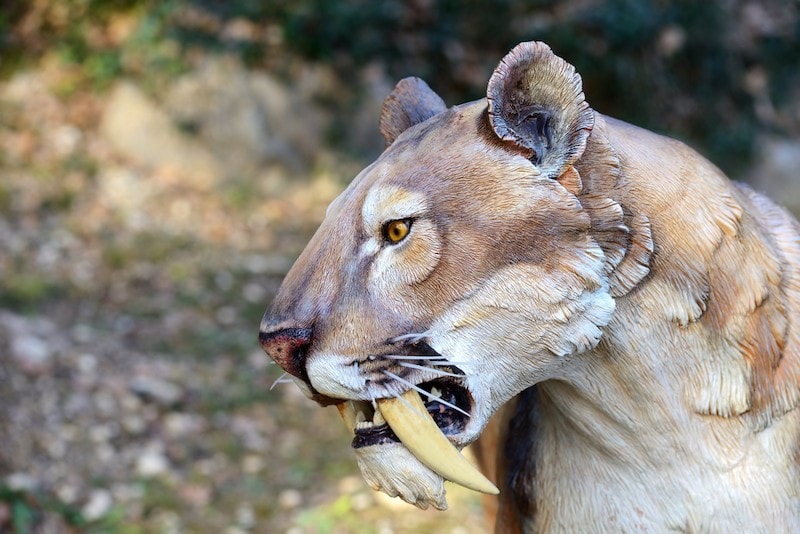
A reconstruction of Homotherium, a scimitar-tooth cat that first appeared about four million years ago. Credit: Wikimedia Commons
Styriofelis lorteti predates modern pantherine cats and was the size of a small leopard. Credit: Spanish National Research Council and the National Museum of Natural Sciences in Madrid
The recently-discovered fossil compared to a man’s foot. Credit: Times of India
Roadside zoos persist despite recent law changes, but even the best zoos fail to provide adequate facilities and enrichment for big cats, the report found.
The Amur tigress at Bearsdley Zoo is the lone occupant of her enclosure, which is large by the zoo’s standards, outfitted with a pool, toys and other enrichment, but small compared to what her natural range would be.
When I visited last summer, I spent the better part of an hour watching her pace the perimeter of her enclosure, walking in an endless loop as if in a daze, never stopping, altering her stride or reacting to anything.
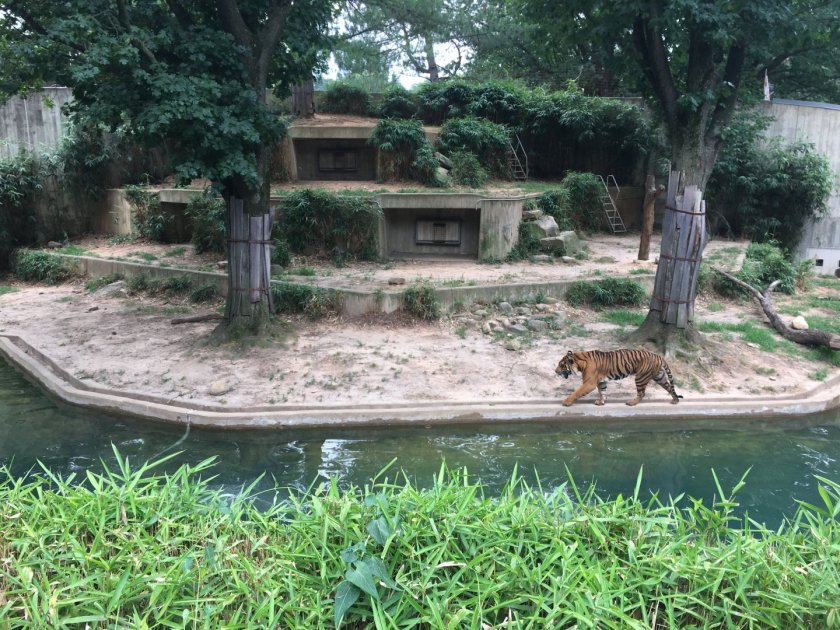
But what made me realize how bad captivity really is for big cats was what I saw at the Smithsonian National Zoo, a well-funded world class facility. The tigers there have two outdoor enclosures with a topographic design: they’re vertical spaces separated into tiers, with large trees and narrow “caves” for shelter from the elements. Both enclosures are surrounded by wide moats that ring the perimeter just inside the security fencing.
One of two similar Bengal tiger habitats in the Smithsonian National Zoo in Washington. Credit: ZooChat
It was feeding time on a hot summer day. Lionesses chowed down on large slabs of meat and licked blocks of ice, but the lone male tiger next door was pacing in a circle. He paced and paced, covering the same 10 to 12 feet, ignoring his food. I watched him for a long time. His behavior was a clear sign of zoochosis.
If a tiger in a national accredited zoo — where an entire team of keepers and caretakers is responsible for enrichment and welfare — suffers from clear signs of captivity-induced distress, what chance do tigers in other facilities have?
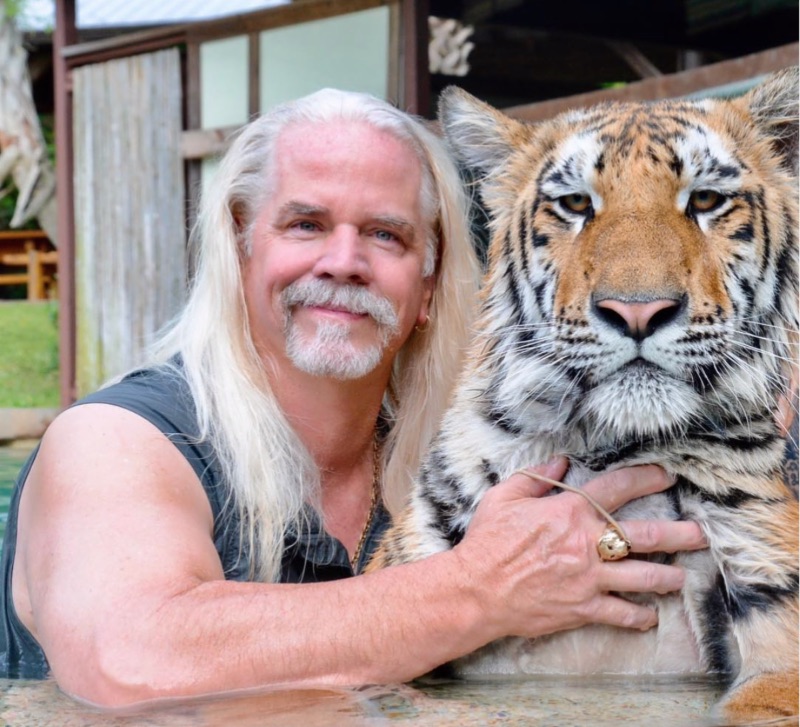
When we think of big cats suffering in captivity, we think of the roadside zoos where the Joe Exotics and Doc Antles of the world exploit them for financial gain, drug them, force them to take selfies with visitors and keep them in cruel conditions. But a new report from Born Free USA goes beyond roadside zoos and says big cat arrangements, even in the best zoos, are inappropriate, unhealthy and demoralizing for the animals.
“Unable to escape the crowds of humans, unable to follow some of their fundamental urges such as hunting and roaming over large distances, unable to fulfil their social needs – whether that be living solitarily or forming a pride with others – big cats show us their mental anguish by adopting abnormal behaviors,” reads the report [PDF], Clawing at the Cages. “These behaviors, known as stereotypies, manifest in obsessive pacing. Some big cats spend most of their days tracing the same, short, tedious route around their enclosures. This behavior is a recognized sign of stress, and only documented in captive animals.”
A captive jaguar. Credit: Yigithan/Pexels
The wild lives of animals like tigers are fundamentally at odds with the concept of zoos. In the wild, tigers range up to 50 miles in a single day, occupying vast ranges. Male tigers protect their home ranges, their mates and their cubs from other males as well as threats of all sorts.
That sort of lifestyle, which is hard-coded into their DNA, is not compatible with a guest-oriented operation in which habitats are designed primarily to give people the best view of the animals.
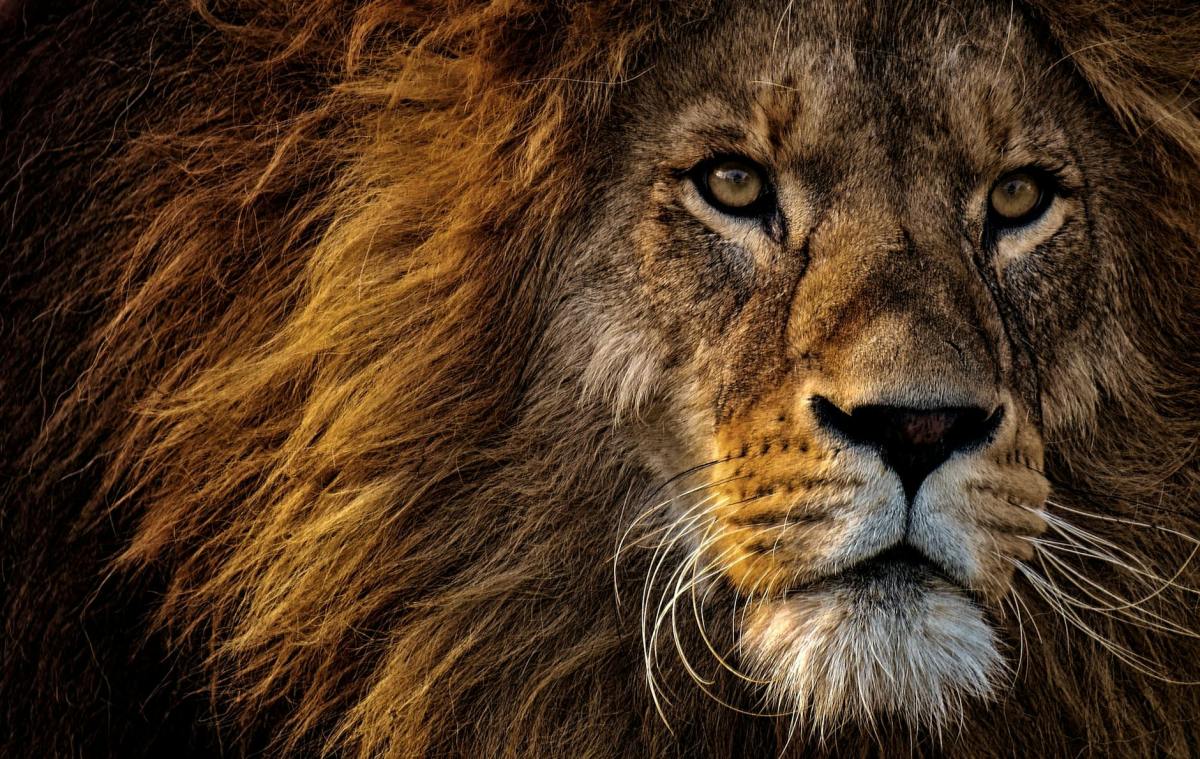
Lions might have it slightly better, though that’s arguable. As a social species they can interact with each other and they tend to have larger enclosures, but zoos rarely group animals according to their preferred family units or prides, instead matching individuals according to breeding plans as part of conservation efforts.
Yet even the conservation aspect is iffy, according to Born Free USA. Because of restrictions on “importing” animals and a population that is descended from just a handful of big cats, inbreeding is rampant. There’s a lack of scientific research on the captive zoo-held population, but the authors cite a 1983 study that found “six animals out of the approximately 1,000 Siberian tigers held in zoos in 1983 were responsible for 69.4% of the founder representation of the living population at that time. 70% of the population had a positive inbreeding
coefficient.”
Because little has been done to remedy that genetic bottleneck, “genetic viability remains low, and inbreeding of big cats in zoos can only have increased in the intervening years since these studies,” the report states.
Inbred cats suffer more health problems, don’t live as long and are much more susceptible to birth defects.
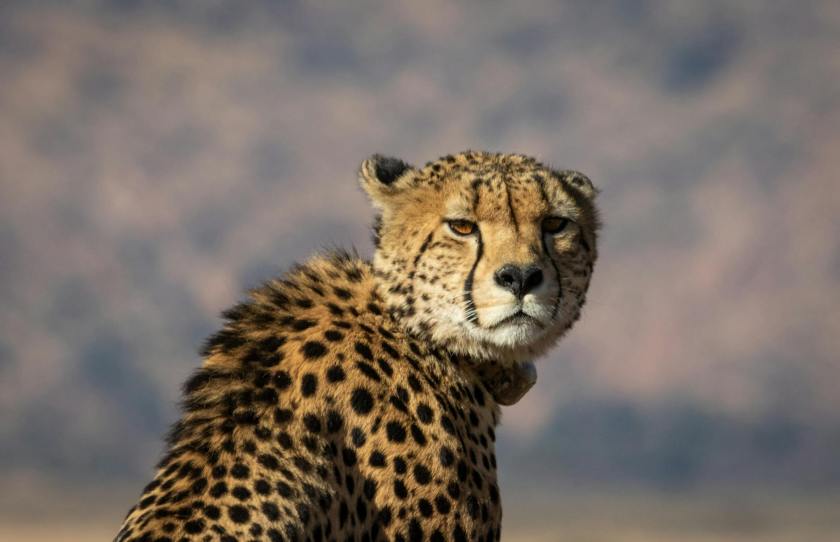
A cheetah. Credit: Magda Ehlers/Pexels
Despite the passing of the Big Cat Public Safety Act, Born Free USA’s report notes, roadside zoos still exist, and many of them have simply ignored the new laws because their operators know inspectors are overworked and lack manpower. Years can elapse between inspections, even at roadside zoos operated by serial offenders with long histories of keeping animals in abysmal conditions.
For example, Single Vision of Melrose, Florida — which bills itself as a “conservation” facility — openly flaunts its mistreatment of big cats with enormously popular video content from “Safari Sammie” on Youtube, TikTok and Instagram, despite the fact that it’s been the subject of dozens of violations and has an ignominious record when it comes to the health of its big cats. The facility was charged with 20 violations of animal rights laws in the previous two years, and has had multiple cases of animals dying due to neglect, yet continues to sell “experiences” in which “guests” can interact with heavily sedated tigers, jaguars, cheetahs and other wild cats.
In her videos, “Safari Sammie” — an employee of Single Vision — is routinely seen interacting directly with the apex predators, treating them like house cats and creating dangerous situations.
Other roadside zoos and animal “experience” operators continue to intentionally inbreed big cats to create “exotic” white tigers as well as ligers, tigons and other hybrids that aren’t found in the wild but are big attractions.
Overall, the report found:
Zoos fail to provide adequate environments for big cats, including lack of space, lack of ability to hide from public view, and the regular practice of locking big cats in tiny night quarters during the hours when zoos are
closed. The latter often results in big cats spending the vast majority of their time significantly confined.
Social and behavioral needs are not met in zoos. For example, solitary big cats are often forced to live with conspecifics, and social big cats are prevented from creating natural prides. Big cats are prevented from
hunting live prey – a behavior fundamental to them – while often housed alongside prey animals who also suffer stress from being forced to live near predators.
Inbreeding of big cats has become commonplace due to limited genetic diversity among captive populations, as well as unethical and deliberate inbreeding of color morphs such as white tigers and lions,
resulting in significant health issues for the cats involved.
Due to the inbreeding of big cats in zoos, as well as their habituation to humans, big cats kept in zoos are generally not candidates for release to the wild. As such, extensive and ongoing breeding programs simply serve to ensure that zoos remain “stocked” with these animals.
Monitoring of data on big cats in captivity is incomplete, with significant numbers of individuals disappearing from studbooks – the databases ostensibly responsible for tracking living big cats in captive facilities.
The licensing system intended to implement the Animal Welfare Act in the United States only achieves superficial monitoring of big cats in zoos, due in part to its risk-based assessment protocols as well as lack of meaningful
information in reporting that would allow effective public understanding and external expert oversight.
Despite the introduction of the Big Cat Public Safety Act in the U.S. in early 2023, some facilities continue to engage in dangerous activities with big cats, both in violation of, and in compliance with the new law.
Zoos around the world have killed healthy big cats due to overcrowding and lack of perceived usefulness to breeding programs. Other healthy big cats have been killed when human error or enclosure failure allowed their escape, or when attacked by conspecifics in their enclosures.
Due to all the issues above, and others, the overall health and welfare of big cats is compromised in zoos. This results in high mortality (particularly in infants), and recognizable signs of stress in the form of significant occurrences of stereotypic behaviors.
The report includes detailed anecdotes of typical problems in captive situations involving jaguars, lions, tigers and cheetahs, documents persistent problems with habitat design and security, and outlines loopholes and other problems with existing laws, which still don’t go far enough to ensure some of the world’s most iconic apex predators aren’t exploited and forced to endure lifelong misery.
You can find the report’s landing page, with links to a petition, a summary and the full text here.
What’s with these horror movies? My human likes to curl up on the couch under a blanket, with me protectively in her lap of course, and watch these ghastly movies about serial killers, ghost infestations and lurking monsters.
Why would anyone want to scare themselves? You don’t see us creating an entire film genre dedicated to horrors like empty food bowls or late dinners, so why do humans make these movies?
Your fan, Mildly Curious in Manhattan
Dear Mildly Curious,
This is a question I’ve pondered for some time, inasmuch as I care about anything human-related to ponder. My human also watches those movies and he also does so with me sitting protectively in his lap.
Then I realized something. None of the people in these horror movies have cats!
The family from The Conjuring? They have a dog. Stanley Tucci’s family in that crappy movie about flying monsters that kill everyone? Dog! The family in that other crappy movie about giant axolotl-type things that terrorize people living in a coastal community?
You guessed it! They have a dog too.
You see where I’m going with this, right? Humans who serve us cats literally have no fear because no monster or crazy cereal killer would ever risk attacking a home with a cat in it.
Suppose a hungry evil monster is let loose in my neighborhood and is making its way through the street at night, then sees me in all my meowscular, intimidating, tigeresque glory sitting at the window, keeping watch over the nocturnal world.
That monster is going to skip right over The Buddy Domicile and go in search of easier pickings because it sure as heck doesn’t want to tangle with me and my claws. I have that effect on monsters.
They may be monsters, but they’re not stupid. Breaking into a home with a cat is like breaking into a t-rex enclosure. You’re asking to get mauled by a huge, meowscular apex predator who will eviscerate you and look handsome and badass while doing it.
People who serve us cats know this. They know no monster or killer or robber would be stupid enough to go near a house with a cat. They can probably sense my meowscularity two miles away!
So sometimes our humans may want to know what it feels like to be vulnerable, what it would be like if they didn’t have tigers like us guaranteeing that no intruder approaches. THAT is why they watch horror movies. Take it to the bank!
It took a tiger swiping at her for her to wake up from the dream of being close to big cats. Now Katherine Lee Guard’s mission is to educate people about the animals and how helping them means keeping a healthy distance.
No one knew Saigon better than Katherine Lee Guard.
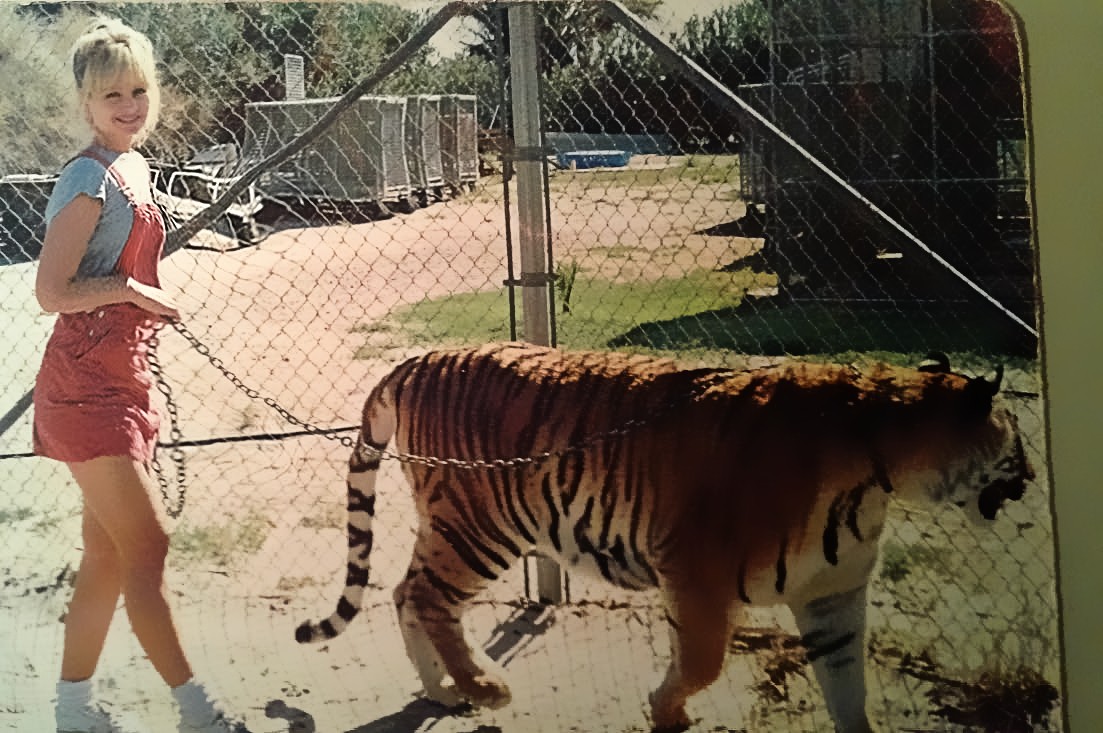
When he arrived at the wildlife ranch in Thermal, Calif., as a baby in the mid-90s, it was Guard who stayed up with him at night, bottle-feeding the orphan cub and swaddling him in soft blankets. She was by his side as he grew, tending to his needs, taking walks with him through the desert and scrubland on the compound that was his home.
Then one day the massive Amur tiger turned on her.
“It was just so shocking even though I knew it could happen,” Guard recalled. “I thought I knew but until it happened, I had no idea. It was terrifying and oddly a weird ‘How dare you!’ kind of feeling that came over me. Like ‘How dare you come at me after all I’ve done for you?’ Because I’d raised him, bottle fed him, been up all night with him.”
Guard was equally surprised by her own reaction, which she described as “more indignation than fear,” but it was that indignation that “allowed me to shelve my fear long enough to get away and out of the enclosure.” If Saigon had sensed her fear, his predatory instincts could have overridden the maternal affection he felt for her.
Saigon never tried to kill Guard. If he had, she wouldn’t be here to tell the story. He was merely warning her that he didn’t want her near him that day, and he made sure she got the message.
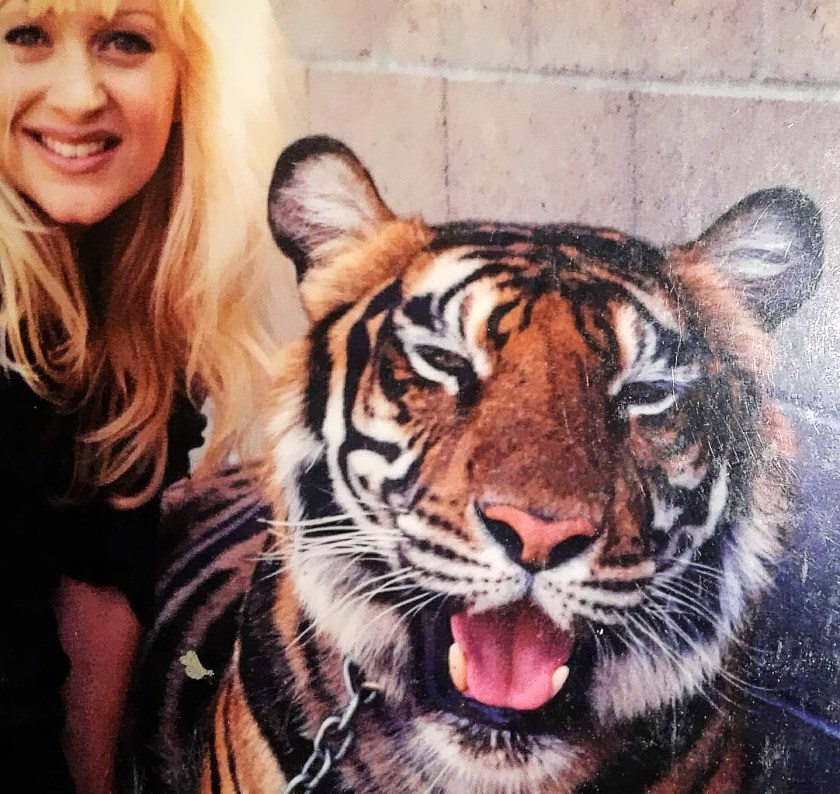
Katherine and Saigon on a happier day when the massive tiger was in a better mood. Credit: Katherine Lee Guard
Amur tigers, also known as Siberian tigers, are the largest big cat subspecies in the world, topping out at 700 pounds, with males spanning 10 feet from nose to tail.
But the encounter — a growl, a much-less-than full strength swipe and a warning bump — was enough to turn Guard into “a nervous, vomiting wreck” once she extricated herself from the enclosure.
“Getting swatted by a paw, even with sheathed claws, hurts like hell,” Guard told PITB. “I’d feel trounced, disappointed and relieved at the same time. And stupid for being in there with them, although I never would have admitted that to anyone back then.”
That first bad encounter with Saigon, and similar encounters with a lion named Tsavo that Guard had also bottle-fed when he was a cub, planted seeds of doubt in her mind about what she was doing on that California ranch, working with a man who had previously used the big cats in circus performances.
Years earlier when Guard’s mom came to visit her, Guard came out to meet her with baby Saigon in her arms, feeding him from a bottle.
Her mother stopped and took in the scene. “That’s not the baby I imagined for you,” she said flatly.
“I never forgot it,” Guard said.
Later, while caring for a female Bengal named Bombay, Guard had an epiphany. Like so many others who make it their life’s work to be near big cats, she had always been beguiled by the beautiful, powerful and dangerous animals. Looking at Bombay, Guard realized the regal tiger was “totally without pretense,” moving with the purpose and grace of a being self-assured in her existence.
“She was purposeful and unyielding and for the first time I felt separate from her and it didn’t bother me,” Guard said. “It was beautiful to realize that she didn’t need me or anyone else. Had she been given a chance in the wild, she would have flourished. The desire to know her thoughts and be her friend lessened in me because I started to appreciate her for her, not for how she could make me feel. ‘She’s not existing for me! She exists for herself!’ We don’t ‘own’ Bombay. Bombay ‘owns’ herself.”
“It was a light bulb moment, and in hindsight I think it was the beginning of the change in my mindset.”
Guard stopped the practice of going “full contact” with the big cats — meaning caring for them without any barriers or safety measures in place, relying on luck to avoid death or dismemberment — and eventually left the ranch around 2003.
In the two decades since, she’s been focused on educating the public about big cats, supporting conservation efforts and trying to rescue the unfortunate tigers, lions, jaguars, leopards and other wild felids who have the misfortune of living in roadside zoos where they’re sedated and exploited for customer selfies, or living sedentary, unnatural lives in cramped backyards in states like Texas and Florida.
Tsavo the lion, who was rescued from “a shitty private owner,” was another one of Guard’s bottle babies at the sanctuary.
Like many others who have dedicated their lives to helping those animals, Guard is encouraged by the 2022 passage of the Big Cat Public Safety Act — but also miffed that it took lawmakers so long, and worried that loopholes in the law will be exploited by people determined to “own” Earth’s endangered apex predators.
The world of big cat handling is a small one, and the people in that world tend to know each other if not always well, then by reputation or in passing. Guard remembers meeting Joe Exotic, the “star” of the infamous Netflix documentary Tiger King, in the late 1990s. Her boss and mentor at the time, Wayne Regan, wanted Exotic to surrender some of his cats to the sanctuary. Regan and Guard had seen “Exotic’s” handiwork up close when they examined some of the tigers another sanctuary had managed to wrangle out of his care. The tigers were stressed, suffered from poor nutrition and were not well cared-for.
Exotic came to the meeting with a sickly, malnourished lion cub as if taunting the pair.
“I hated him immediately,” Guard said.
She was overcome with a desire to “steal the poor malnourished cub he had with him,” but Regan cautioned her against it. Knowing what “Exotic” — real name Joseph Allen Maldonado — is capable of, it’s probably a blessing that she didn’t, but she still thinks of the cub all these years later.
Exotic remains in a federal prison in Fort Worth, Texas, where he’s serving a 21-year sentence after he was convicted of two counts of trying to hire a hitman to kill his arch-nemesis, big cat sanctuary operator Carole Baskin. He was also convicted of 17 counts of animal abuse, and his name is synonymous with the horror and suffering big cats endure when they’re in the possession of private “owners” and roadside zoo operators.
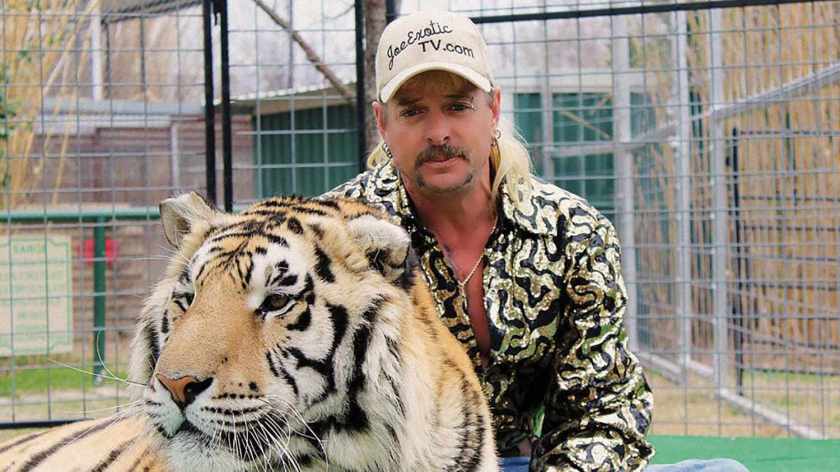
Joe Allen Maldonado, who styled himself as Joe Exotic, was the subject of the infamous documentary Tiger King detailing his exploitation of big cats and his outlandish criminal activity. Maldonado remains imprisoned in a federal facility after he was convicted of trying to have sanctuary operator Carole Baskin killed.
Big cat advocates lament the fact that the documentary, as popular as it was, spent more time focusing on Maldonado’s eccentricities, Machiavellian maneuvering and manipulation of people in his orbit than it did on the suffering of the animals in his “care,” but it did draw attention to his crimes and the plight of tigers in the US.
“He tortured and killed and exploited so many animals,” Guard told PITB. “He is a coward piece of shit who is right where he should be. He is no ‘Tiger King’ and never should have had a minute of fame.”
She has a similarly low opinion of Kevin “Doc” Antle, another eccentric animal abuser featured in the documentary. Antle has provided big cats and other animals for projects including the Ace Ventura films, a Jungle Book adaptation, a Britney Spears performance and an appearance on Oprah Winfrey’s talk show.
Earlier this year he was convicted of illegal wildlife trafficking in Virginia, where authorities said he tried to buy endangered lion clubs in violation of federal law. He’s racked up almost three dozen USDA violations for mistreatment of animals over the years, has been accused of gassing adult tigers to “make room” for more cubs, and faces a slew of additional charges related to money laundering and the alleged import of wild animals, including a chimpanzee and a cheetah.
Kevin “Doc” Antle, who now calls himself Bhagavan Mahamayavi Antle,
Antle has also raised the ire of animal welfare advocates and conservationists for the controversial practice of breeding ligers — massive cats that are the result of breeding male lions with female tigers — and inbreeding tigers to produce a color morph commonly known as white tigers. While the latter are beautiful, majestic and rare, intentionally trying to breed them often results in cubs with malformations who either die in infancy or live short, brutal lives.
Guard does not regret the time she spent working with big cats on Regan’s ranch, just the naïve way she went about it. Like others who have spent years thinking about how to best protect and save big cat species, she’s come to the conclusion that the majestic felids are best helped — and appreciated — from a distance.
At the ranch, some of the felids were former show animals rescued from the entertainment business. Some, like Saigon, were abandoned young by people who had planned to use them in shows. Others were like Tsavo the lion, who “came from a shitty private owner.”
Regan was a former tiger trainer for circuses but had changed his views on using the animals for entertainment. He “was fastidious about taking care of the cats, very invested in their welfare and had only the best care for them,” she said. The ranch was sprawling, with enrichment items and toys everywhere, as well as a large lake with an island in the middle so the cats — particularly tigers, who are known for their love of water — could swim and play. At night they settled into their own individual habitats, each equipped with smaller pools, entertainment items and bedding.
In addition Wayne, Guard and their volunteers were reluctant to display the cats for anyone, even donors. They felt it would be a betrayal to the animals to be gawked at in a place that had become a haven for them.
Regan had learned the business from a man named Ron Whitfield, who remains active in the big cat community as the large carnivore curator at the San Francisco Zoo and trained animals for 30 years at the now-defunct Marine World in San Francisco.
“The business is so small that word gets around and Wayne, and Ron too, were known as good people to care for unwanted animals,” Guard said.
Guard and Saigon.
Tsavo as an adult.
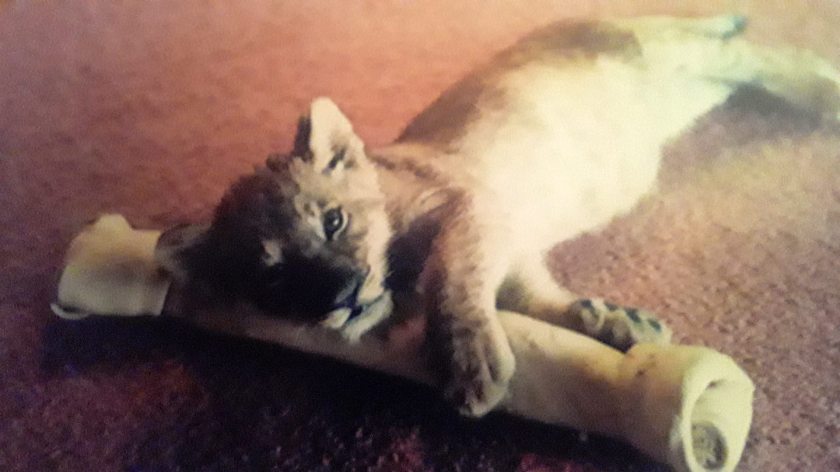
Baby Saigon
These days, Guard cares for small cats too as a caretaker and feeder of stray cat colonies in her California neighborhood. It’s a reminder of the good people can do in their own backyards, and of the need that exists in a country where some 800,000 unwanted felines are euthanized every year despite Herculean efforts to push spaying and neutering. (Those efforts have been very successful, and euthanizations of cats and dogs are only a fraction of the millions they were just 15 years ago, but the fact that so many unwanted animals are still killed illustrates the enormity of the problem.)
Mostly, she wants people to know that the idea of having a big cat for a companion, or even living in something resembling harmony with them, “is a fool’s paradise.” Luck is the only determining factor in whether a handler lives or, as Siegfried and Roy can attest, suffers life-altering injuries from accidentally triggering the ever-present predatory instinct of tigers, lions and other big cats like jaguars and leopards.
They are, after all, the planet’s apex predators, hyper-carnivores designed by nature with the most deadly weapons of any extant animal.
Guard says she hopes the practice of keeping big cats truly ends after the current generation of panthera “pets” — those grandfathered in under the Big Cat Public Safety Act — pass on. And she hopes that young people who are as “spellbound and mesmerized” by the spectacular felids as she was don’t follow her lead and endanger their lives, which is why she’s brutally honest about her own experiences and makes no pretense about benefiting from any factor other than luck.
“It’s been a long road for me to go from there to here,” she said. “I’m glad I can recognize my mistakes and hope I can prevent others from doing the same. I don’t know why people are drawn to do dangerous things but for me I didn’t think about the danger because I just wanted to be close to my cats.”
She understands the allure, but always comes back to the same conclusion: humans and big cats are not meant to live side by side.
“The cost is too great if something goes wrong,” she said. “And something always goes wrong given enough time.”
Did you like this story? Read some of PITB’s other long-form journalism and essays:
A Bengal tiger mourned his longtime mate and then did something extraordinary, replacing her as their cubs’ primary caregiver.
The magnificent tiger in the photo above is officially called P-243, but he’s affectionately known to locals as The Hulk of Panna.
He made his home about a decade ago in the Panna Tiger Reserve, a 210-square-mile national park in the Indian state of Madhya Pradesh, home to more than 72 million people.
What makes him special, aside from his massive frame, is the fact that when his longtime mate died and left four of their cubs to fend for themselves, the Hulk stepped up and became a full-time dad.
The mom, known as P-213-32, had previously given birth to a litter of four cubs, but only two survived. As far as the rangers at Panna National Park could tell, the Hulk and P-213 had been together for years. The new cubs were their second litter.
The Hulk “was not seen with any other tigress,” the rangers wrote in a report.
On May 12, 2021, park rangers were concerned when P-213’s radio collar began transmitting potential mortality signals, alerting them to the fact that the tigress hadn’t moved for about six hours. The rangers observed her from a distance, then dispatched a team of elephant scouts to take a closer look.
T1 (tigress 1) was known as the matriarch of the Panna Tiger Reserve. After poachers nearly wiped out the entire population of tigers almost 15 years ago, T1 and another tigress were the last two female tigers. T1 herself gave birth to 13 cubs and today the reserve has more than 80 of the endangered big cats living within its boundaries. Credit: RS Murthy
The use of elephants by experienced riders in India to monitor tigers is as ancient as it is ingenious — while virtually every other animal in a tiger’s habitat gives the big cats a wide berth, elephants and tigers have an unspoken mutual agreement, a kind of wild non-aggression pact. That’s because as massive and powerful creatures who move in packs, elephants are too much trouble for tigers to bother with. Unlike their lion cousins who do hunt elephants opportunistically, tigers don’t form prides and even if elephants were solitary animals and easier to hunt, even a mother and her hungry cubs — let alone a single tiger — can’t eat that much meat. They also can’t transport the kill to safer dining spots the way they do with their typical prey.
So tigers and elephants tend to do little more than acknowledge each other’s presence, and the tigers have learned that humans riding on elephants aren’t hostile.
The elephant rangers who got close to P-213 realized the tigress had a swollen right forelimb and they made the decision to sedate her. For the next two nights, field veterinarians accompanied the rangers and administered painkillers and antibiotics. The treatment seemed to work, the swelling was reduced and the tigress was ambulatory if still sluggish, but she died less than a week later.
Her death “came as a shock to all of us,” the team wrote. “A beautiful tigress and a caring mother, [her death] left her four cubs alone.”
Frustratingly, a postmortem and lab analysis of her blood didn’t turn up any obvious cause of death.
P-213’s death “was itself heavy loss to bear but now the major worry was her four orphaned cubs,” the ranger team wrote. The cubs were last seen with her on May 10, about 11 days before she died. The two previous days they’d been spotted sharing a kill with their mother, and rangers reported the cubs looked strong and healthy.
A few days later, after an exhaustive search by five elephant riders and 50 park rangers, a ground team found the cubs “healthy and active and [did not appear] hungry or stressed.” They also spotted their father, the Hulk, nearby.
What happened next was extraordinary.
After park rangers cremated P-213, the Hulk approached the site about an hour after the last people cleared out. The next day, rangers observed him “sitting for long hours at the place where P-213 died.”
They also saw the dedicated mate and father calling out softly as he looked for his cubs, three males and a female who were about seven months old at the time.
A few days later, the Hulk successfully hunted a sambhar, a type of deer, and shared the kill with his cubs according to a local news report. Then on June 6, the Hulk was spotted feeding the kids again after he killed a cow.
“For the entire day the tiger remained in the area but did not eat the kill. This was unexpected behaviour from a tiger and the PTR management deployed ground staff deployed to find out the reason,” the news report said. “The team found that the area where the tiger killed the cow is the territory of four tiger cubs. This male tiger, known as P243, is their father. The cubs had lost their mother a month ago.”
The Hulk prowls his territory. Credit: Sanjeev Siva
As if he hadn’t done enough to earn “dad of the year” honors for his species, the Hulk was even spotted playing with his offspring.
“After the death of the tigress, we located these cubs and placed camera traps in the area,” said U.K. Sharma, the director of Panna Tiger Reserve. “We found that the tiger visits these cubs regularly, and his behavior shows that he is not a threat to the cubs. We have seen the cubs playing with the male tiger and sharing kills.”
The team at Panna reserve continued watching closely and got to see the cubs flourish in the care of their dad. There were moments of uncertainty when rangers went days without seeing the cubs or finding their pug marks, but their fears were always put to rest by trail cameras that captured images of the Hulk with his kids in tow, resting with them in favorite spots and sharing meals with them as he taught them to hunt and survive.
Because male tigers typically aren’t known for nourishing behavior and their traditional role is to defend their territory to keep their mates and cubs safe, the Panna reserve’s staff were ready to step in if things began to look dicey. They never had to. A follow-up report about eight months later, when the cubs were healthy and fast-growing 15-month-olds, affirmed the team’s earlier decision to stay hands-off and let the Hulk do his thing.
“Surviving the wild without mother tigress is no mean feat but surprises do happen,” the rangers wrote. “And these become experiences, practices and lessons for the future. The lesson learnt is ‘[the] best thing one can do when tiger cubs are growing is to let them grow. Let us permit nature to have her way. She understands her business better than we do.'”







 Pain In The Bud