“Can’t find your keys, human? That’s terrible. I don’t know where they are, but perhaps I could recall that information if, say, there were treats involved. Take your time, I’m in no rush even if you are.”
A new study shows dogs and human toddlers are eager to help when their adult caregivers are looking for a missing item, but cats don’t seem to care.
The study, which involved running the same experiment for young children, dogs and cats in their own homes, made it clear cats were fully aware of what was happening and understood their humans were looking for the missing object.
They just didn’t care.
There was one notable exception, of course. If the missing items were important to the cat — a favorite toy, for instance, or a bag of treats — the felines were motivated to help search or direct their humans to the missing objects, the research team from Eötvös Loránd University in Hungary found.
But at all other times, feline observers were content to hang back and watch, even when they understood their humans were getting frustrated.
By contrast, young children and dogs actively tried to help and signaled to adults when they thought they’d found the object.
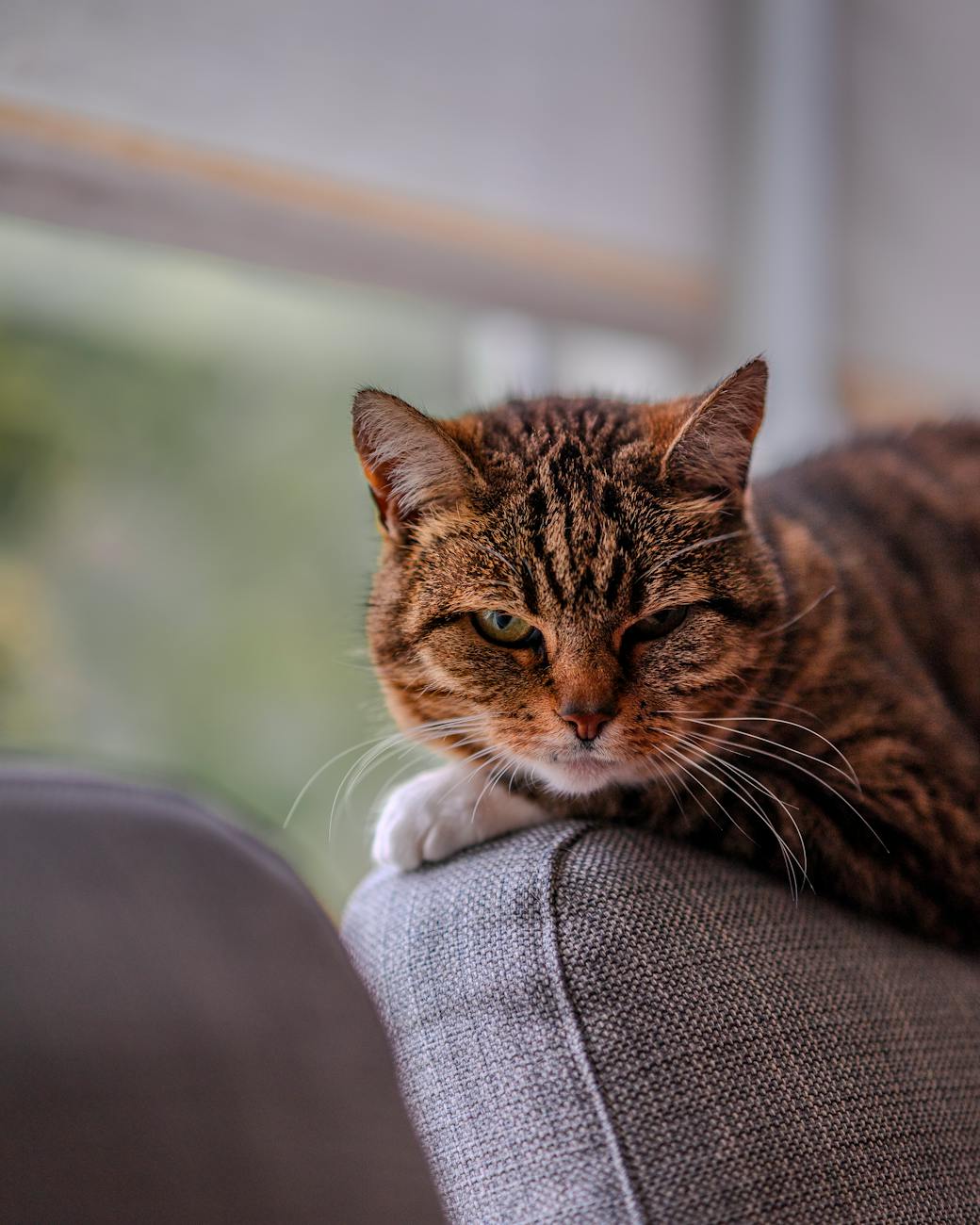
“Lookin’ for something? No, I’ll just watch, thank you. Warm, warmer…oh! Cold…colder…that direction doesn’t look promising, human.” Credit: Gord Maclean/Pexels
So does this mean cats are jerks? Probably. Are we surprised by the results? Not at all.
We still love our furry friends, who do have their own unique ways of demonstrating they care about their humans beyond seeing them as providers of food, shelter, and safety, as well as playmates, minions and servants.
Besides, testing whether dogs or cats were helpful or not wasn’t the point. As the authors note, “[t]hese three species provide an important comparison because they share a similar anthropogenic environment but differ in their ecological and evolutionary backgrounds.”
In other words, they’re interested in figuring out how evolution plays a part in how species behave in particular situations. Although it’s yet to be conclusively proven for this behavior, a likely reason is because domestic cats are the descendants of a mostly solitary wildcat species, whereas we humans and our canine friends have long evolutionary histories of living in social groups and cooperating with each other.
The study is included in the March 2026 issue of Animal Behavior.
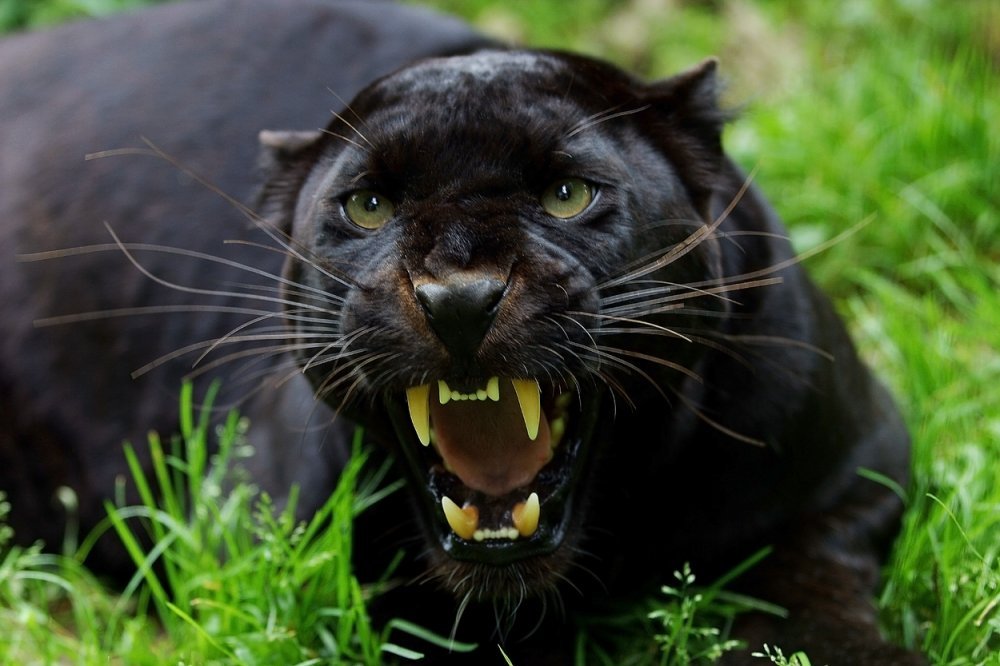
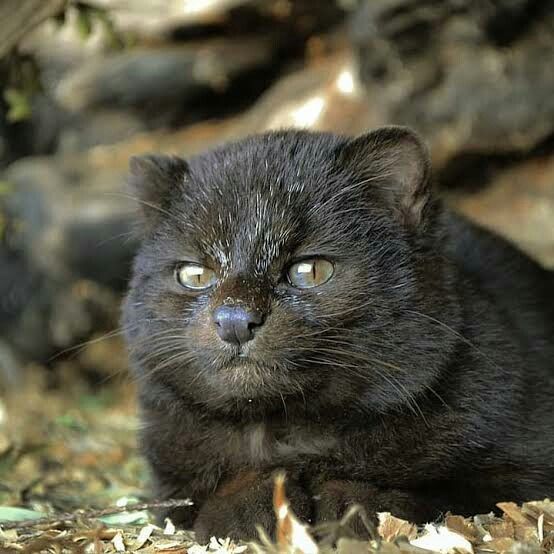
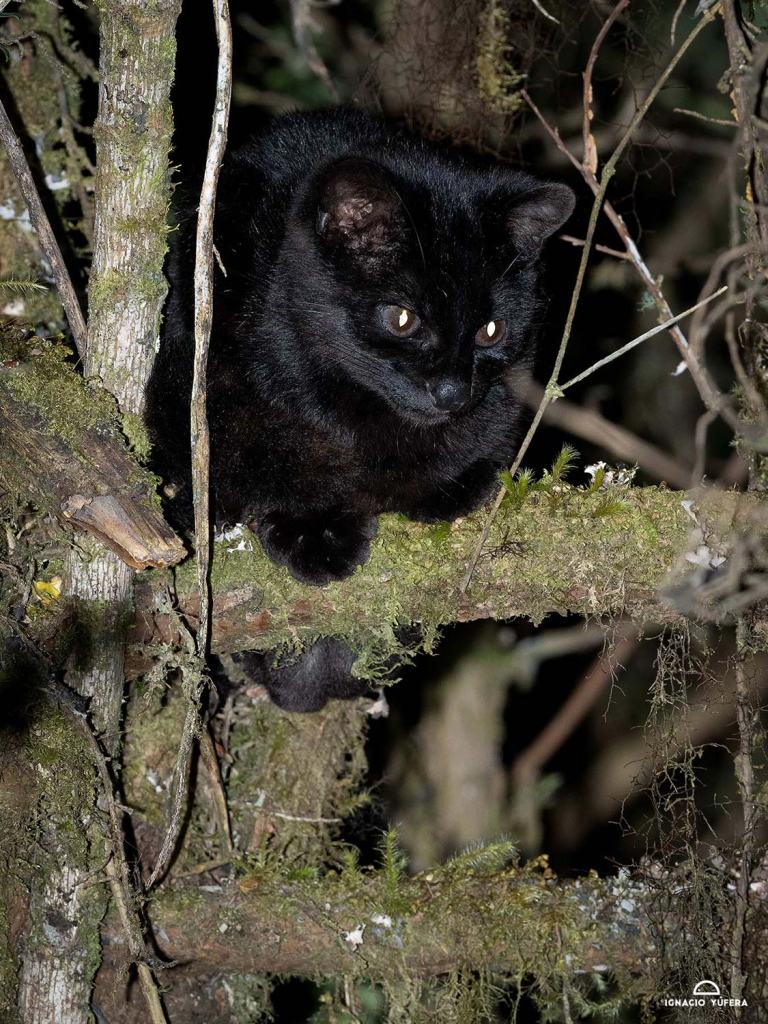
House cats, jaguars, leopards, Servals and jaguarundi are just some of the species that have melanistic (black) color morphs.
Everyone knows house cats, jaguars and leopards can be voids, but did you know other cats have black color morphs too?
The Asian golden cat, the Serval, jaguarundi, Margay, kodkod, Geoffrey’s cat, oncilla, Pampas cat, and bobcat all have melanistic variants.
Unfortunately when it comes to house cats, research supports the longstanding claim that black cats are adopted at lower rates, and are euthanized in greater numbers, than other felines. Part of that can be chalked up to superstition. It’s also due in part to the fact that black cats are more difficult to photograph.
But as these photos prove, all you need is some decent ambient light, smart framing and maybe a bit of shadow/highlight correction to help bring out a black cat’s natural features.
Image credits: Top two rows via Pexels, with photographers listed in the captions. All other photos via Wikimedia Commons. Last image (melanistic oncilla) credit Ignacio Yufera
When serial cat killers serve sentences of less than a year due to plea deals and early release for good behavior, how much deterrent value do our laws have? Not much, it seems.
Note, 5/3/2025: We’ve heard from two readers who say the MyNorthWest report contains inaccuracies. We’ve reached out to the police and will follow up with police and courts on Monday to verify the facts and correct potential misinformation. Apologies for the confusion.
Every couple of months, at least in the last year or two, I’ve slowed down on posting, and almost always for the same reason: my cat-related news alerts are seemingly endless streams of depressing stories about people shooting, strangling or dismembering cats.
It never ends, and sometimes it’s so overwhelming that I’m put off from writing for days. At the same time, I am not a believer in the idea that all animal blogs should be saccharine feel-good fests about fluffy kittens and TikTok videos of cats doing silly things.
There’s always a place for celebrating cats, but if they’re in danger, and if the stories point to wider trends that cat lovers should know about, then I think it’s our responsibility to remain educated. Not only so we can guard against threats to our little friends, but also so we can add our voices to the chorus calling for tougher laws and greater accountability.
That’s ultimately what this is about: accountability.
Stories about two cat serial killers in about a week have made it clear that even the strengthened animal protection law — the Preventing Animal Cruelty, or PACT Act — passed in 2019, during the first Trump administration, raising animal cruelty and murder to the level of a felony, are still not enough. They’re not a deterrent, especially when the convicted abusers and killers end up serving a year or less because prisons are overcrowded and the wider law enforcement community still doesn’t take animal-related crime as seriously as other violence.
Antoine Leander Runner Jr. is a serial murderer of cats. The Seattle man was recently released from prison after serving just a year for a felony animal cruelty conviction.
The 43-year-old’s modus operandi was setting up crude, homemade snares and traps to capture and harm felines. He was also known in cat rescue circles, where he posed as a cat lover and took advantage of programs to get free supplies, including “cat food, kennels, collars, leashes, and treats to lure cats and kill them,” according to MyNorthWest, a Seattle news site.
When locals discovered new homemade traps in Runner Jr.’s old haunts and trail cameras picked up images of the man himself stalking wooded areas, neighbors called police and area shelters. The evidence showed Runner Jr. was allegedly visiting cat colonies at night and had picked up right where he left off. One colony cat’s body was discovered on March 31, “disemboweled and publicly displayed.”
“Animal Control confirmed the injuries to the cats were human-caused,” MyNorthWest reported, adding that it appears Runner Jr. was visiting colonies “every night” to hunt cats.
Above images by u/picardhasyourback, posted to the SeattleWA subreddit. Click on the images to see full-size versions.
Runner Jr. was picked up by Seattle police this weekend after a neighbor spotted him in a wooded area and phoned authorities. The convicted cat killer, who had a new bench warrant out for his arrest, was charged with a misdemeanor, but more charges are likely as police investigate his latest alleged attacks on Seattle-area cats.
The Seattle man was originally arrested for killing cats in 2023, but was released early. The Seattle area was also terrorized by a serial cat killer who stalked the area in 2018, mutilating cats so badly that I won’t repeat the details on this blog out of respect for readers.
It should be made clear that Runner Jr. was not connected to the 2018 killings, but police should reconsider those cases as well because if it turns out Runner Jr. is guilty of these latest cat murders, it will be abundantly clear that he is a high recidivist offender who cannot be trusted to leave the animals alone. He should serve a long, unabridged prison sentence and be subject to constant monitoring when he’s released.
Antoine Leander Runner Jr. was arrested this weekend by Seattle police. Credit: Sarah Seiler/Facebook Georgetown Community Discussion Group
What’s the solution here? Increasingly tough criminal penalties for animal abuse and murder? Expensive monitoring equipment to watch over every cat colony? Education and training for law enforcement so violence toward animals is taken as seriously as it should be?
I hate to keep pointing out that people who harm animals are likely to “graduate” to harming humans, as many studies have shown, because it implies that we should only be concerned about animal abuse for its tendency to turn into human abuse. It obscures the fact that animal life is intrinsically valuable, and that cats — and dogs, many bird species, mammals and marine life — are sentient, with their own thoughts and emotions. But if that’s what it takes for people to take this sort of thing seriously, then it’s worth repeating the point.
Once again, we’ve underestimated cats. There’s so much more to the ways in which they communicate than we realize.
We know cats use non-verbal signals to communicate with each other, but recent research suggests we may just be scratching the surface, glimpsing only a portion of the information that passes between our furry friends.
Cats “talk” to each other by the way they position their tails, whiskers and ears, in addition to their overall body language.
It turns out there’s more. A group of interdisciplinary scientists from universities in Kansas, Arkansas and Haifa, Israel, found cats also employ specific facial expressions, and rapidly mirror each other’s expressions during play time to signal they’ve got good intentions and aren’t going to hurt each other.
From there, the coders and mathematicians on the team created an algorithm to record and sort the facial expressions the cafe cats used, employing CatFACS (Cat Facial Action Coding System) to associate each expression with its meaning.
The problem is, we humans are terrible at reading them. Even veterinarians trained in CatFACS still struggle to get it right, but happily this is precisely the sort of task algorithmic AI excels at. Like facial recognition software, a well-trained machine learning algorithm can recognize faces and record them more accurately and much faster than any person could.
In a column praising the facial expressions study, evolutionary biologist and Jane Goodall Foundation ethics board member Mark Bekoff said it’s the kind of labor-intensive work that truly advances our understanding of the ways animals communicate.
For cats and their human caretakers, Bekoff notes, it could help us reduce inter-species misunderstandings and make it easier to read our cat’s emotions, so we know when they’re not feeling well or need something.
“There are no substitutes for doing what’s needed to learn about the nitty-gritty details of how animals communicate with one another in different contexts,” Bekoff wrote. “This study of play opens the door for more widespread comparative research focusing on how animals talk to one another.”
“Do I look happy, human?” Credit: Milan Nykodym/Wikimedia Commons
We also know adult cats very rarely meow to each other, and the meow is reserved for cat-to-human communication. Imagine the frustration our little friends must feel when they have so much to tell us, but the only thing we understand are vocalizations — meows, chirps and trills — that can convey only basic ideas at best.
Cats aren’t equipped to use human language and there’s nothing wrong with that. Our feline friends already go to great lengths to communicate in ways we can comprehend. The least we can do is meet them halfway.
I would love it if my cat could talk to me.
Sure, he never shuts up, but if he could speak English I’d know why he meows at the same spot at the same time every morning, or what he wants on the occasions when he’s still meowing insistently at me despite the fact that his bowls are full, his box is clean, he’s had his play time, and every possible need and want of his — that I can fathom — has been met.
Most of all, I’d really like to know he understands I’ll be back soon when I go away for a few days, and my (mostly ignored) pleas for him not to attack his long-suffering, way-too-kind sitter.
Alas, Bud cannot speak. No non-human animal has ever demonstrated even basic proficiency in human language. People will point to examples like Koko the Gorilla and Nim Chimpsky, but there’s a reason why funding dried up for that kind of experiment.
It doesn’t work. It never did.
The scientists who end up taking on dual roles as researchers and parents to the animals invariably serve as interpreters, get too close to their subjects and swear that a gorilla pounding shiny buttons for “food tree food submarine” means the ape wants to have a picnic next to the ocean, or “car fly house car star” means she wants to ride a Tesla Roadster to Mars and start a colony with Elon Musk.
Koko, Nim, Chantek and the other apes who were the subjects of decades-long attempts to humanize them — and teach them language in the process — were ultimately not much different than Clever Hans the horse, who was reading subconscious nonverbal cues from his owner and convinced tens of thousands of people that he could do math and understand spoken language.
Hans had scores of experts fooled until the German psychologist Oskar Pfungst figured out how the horse was coming up with the correct answers.
Regardless of which famous example we’re talking about, no animal has ever mastered syntax, and the best that could be said of their proficiency with language, or lack of it, is that they learned they’d get attention and food when they pounded on a talking board or approximated a word in sign language.
Even if non-human primates were able to learn a handful of words by frequently reinforced association with an object, there has never been any evidence that they are actually using the words as language rather than simply understanding “Pushing the button that makes this sound means I get a treat!” (And yes, there is a profound difference. The former reveals the presence of cognitive processes while the latter is a conditioned response.)
Despite decades of intense effort, no animal has ever demonstrated the ability to use human language. At best an animal bangs on a few buttons and people are left to speculate on the intent. Maybe Fluffy likes the way a certain word sounds. Maybe it’s just fun to hammer on buttons the way it’s fun to pop bubble wrap. Most likely, these cats and dogs know that using a talking board is a guaranteed way to get attention, a treat and a head scratch from their caretakers.
Influencers and their talking boards
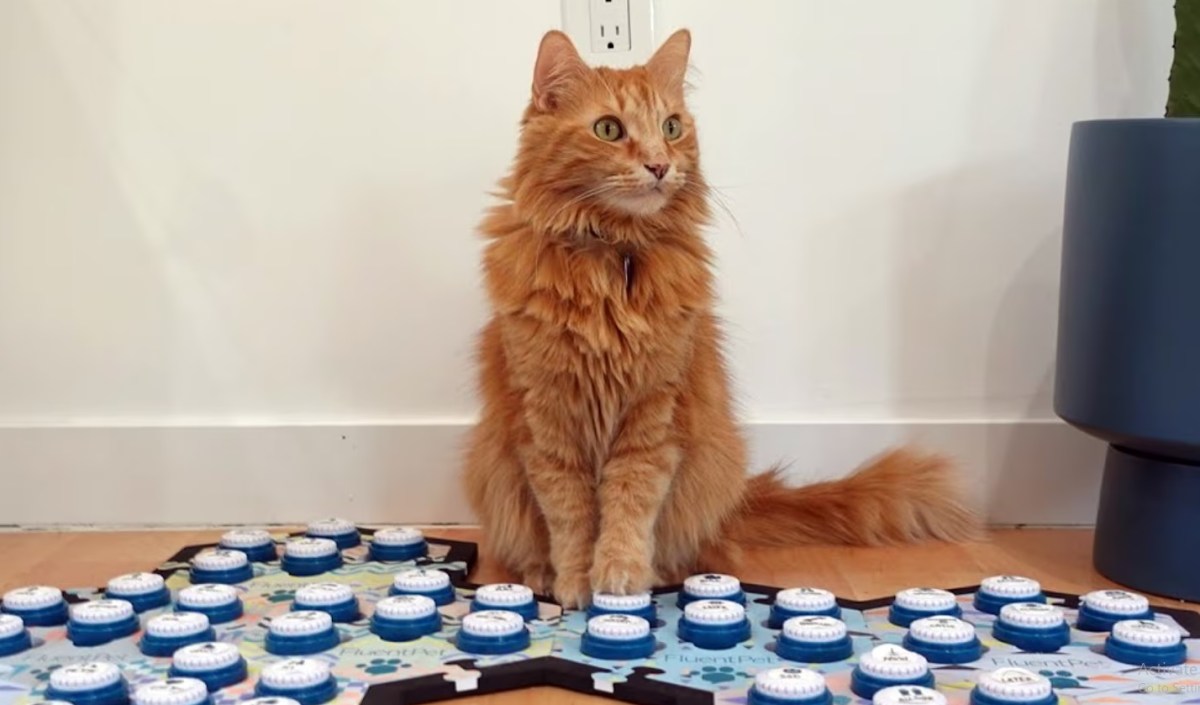
TikTok, which spawns inane trends with the reliability of an atomic clock, has provided a platform for people who insist their cats and dogs can talk. Using “talking boards” — elaborate set-ups in which words are assigned to their own buttons — they “teach” their cats how to express themselves in English and provide proof in the form of heavily edited, out-of-context clips that require the same sort of creative interpretation pioneered by Penny Patterson, Koko’s caretaker.
Seriously?
I just watched a video in which a woman claims her cat, named after Justin Bieber, was describing an encounter with a coyote by stomping on buttons for “stranger,” “Justin,” “Mike,” and “stranger.”
The woman says she thought Justin was asleep at the time, but now she believes the orange tabby saw the coyote outside and was still stressing about it well into the next day.
While she’s repeating Justin’s “words” back to him, two of her other cats come by and step all over the talking board. I guess whatever they had to say wasn’t important.
Justin’s talking board has 42 buttons, which stresses credulity well beyond the breaking point. More than half of the buttons are used for abstract concepts.
But forget all that for a moment and ask yourself how our own efforts to decode the meow have been going.
Despite our status as intelligent, sapient animals, despite the powerful AI algorithms at our disposal, despite the benefit of being able to digitally record and analyze every utterance, we haven’t come close to a reliable method for interpreting feline vocalizations.
Likewise with dolphins, whale song, corvid calls and the sounds made by other animals at the top of the cognition pyramid.
Mostly, we’re learning we’ve underestimated the complexity of our non-human companions’ inner lives, especially when it comes to the kind of multi-modal communication humans also engage in, but only subconsciously. We say what we want with our mouths, while our eyes, facial expressions and body language say what we’re actually thinking.
Likewise, the meow is an unnatural way for cats to communicate, and it contains only a fraction of the information cats are putting out there. It’s just that we can’t reliably read feline facial expressions, let alone tail, whisker and posture. (Studies have shown most of us, even when we live with cats, don’t get measurably better at this. In fact, we’re often no better than people with limited feline experience, but we think we’re better.)
Putting the burden on our furry friends
If we can’t crack a simple and limited system of vocalizations, aren’t we putting unrealistic expectations on cats? The average person has a vocabulary of tens of thousands of words, yet somehow we expect cats can latch on to an arbitrary number of them, approximate mastery of syntax that has eluded even our closest cousins, and bridge a cognition gap we haven’t been able to bridge ourselves.
It’s all too much.
I’ve had Buddy since he was eight or nine weeks old, and in more than nine years I still don’t know why he makes this praying motion. We may be best buds, but some things just don’t translate.
There’s a simple truth at the heart of this: Cats did not evolve to speak or parse human language, and that’s perfectly fine.
The little ones already meet us more than halfway because they understand we are hopelessly incompetent at reading tail, whisker or body language, and they understand we communicate with vocalizations.
By forgoing their natural methods of communication in favor of ours, cats are already taking on most of the burden in interspecies communication. Asking them to do more than that, to learn many dozens of words and the rudimentary rules of language, seems like laziness, wishful thinking or insanity on our part. Pretending that certain cats are successful is an exercise in the same kind of cynical opportunism that fuels every other desperate attempt by people trying to turn their pets into influencers. People do it because the reward is money and attention.
Worse, it contributes to the spread of misinformation. TikTok’s talking board videos routinely net millions of views, converting a credulous audience into an army of true believers who are convinced that, with just a little effort, their feline pal can shoot the shit with them.
If people want to construct elaborate talking boards in their homes and pretend their cats are expressing themselves in English, who am I to object? It’s not the smartest use of time, but have at it. What I won’t do is participate in the delusion that felines are a few buttons away from being able conversation partners, nor will I pretend these efforts have any relationship to science.
So to the journalists who keep writing credulous stories about these supposedly talking animals: please familiarize yourself with the example of Clever Hans, and please, I beg you to stop promoting these videos as if they’re anything more than wishful thinking. You are doing your readers a disservice for the sake of a few clicks.
Note: Jackson Galaxy isn’t a fan either, saying he’s “got some serious problems” with the talking board trend. Calling it “problematic,” he points out that cats are not only partially domesticated and the only animal species in history to take that step without human prompting, but humans have never selectively bred cats for specific behaviors or to bring out intelligence traits as we have with canines. (Think of sheep dogs or retrievers, who are the products of thousands of years of breeding for well-defined tasks.) There simply hasn’t been a need to breed cats for behavioral traits since the thing humans traditionally valued most about them — their ability to reliably eradicate rodents and protect human foodstuffs — is innate. No one had to teach cats how to hunt or breed them for the task. It’s only in the last two hundred years or so that certain human societies began breeding cats, and they did so for aesthetic attributes like coat patterns. Galaxy also notes that animals do not express emotions the same way humans do. Like monkeys, who “smile” when they’re terrified, felines express joy, anger and fear with their tails, whiskers, ears and body language. It’s not in their nature to tell us they’re happy or scared by padding up to a contraption and hammering on a button.
Top image of “Justin Bieber” the cat credit Sarah Baker.









 Pain In The Bud