The abandoned cat found his way to the basement of a hospital in Russia, where staff members provided him with inappropriate food — and way too much of it.
Animal rescuers in Russia have their work cut out for them after taking in a mega-chonky cat weighing 38 pounds.
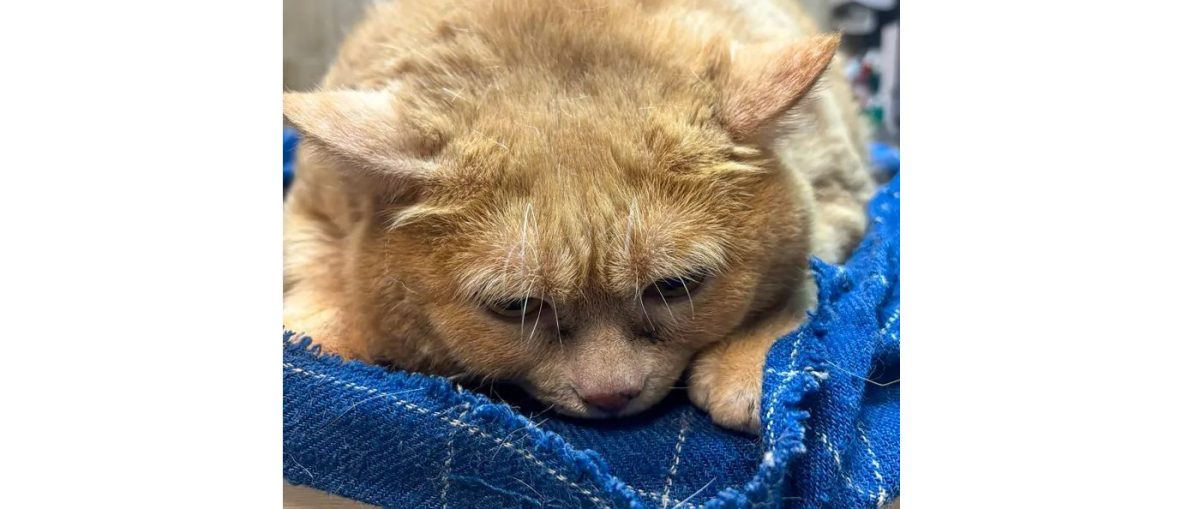
The orange tabby, named Crumbs by his rescuers because he leaves none in his wake, is so overweight he can’t walk and has been placed on a strict diet to meet his first goal of becoming ambulatory.
After that, his rescuers said, the real work begins as they try to get Crumbs down to about 10 pounds, which they believe is a healthy weight for a cat of his original size.
Crumbs with one of his rescuers who is helping the morbidly obese feline shed pounds.
Staff at Matroskin Shelter in Perm told Russian media that Crumbs was abandoned by his owners and was living in the basement of a hospital in the city.
It wasn’t clear if Crumbs was already obese when he was surrendered, but hospital staff were not providing him with the kind of protein-rich meat cats need to stay healthy. Instead, they plied him with cookies and calorie-dense soups, apparently putting no limits on his food consumption.
“Kroshik’s story is an extremely rare case when someone loved a cat so much that they fed him to such a state,” shelter volunteers said.
Crumbs is in for a shock as he adjusts to his new diet, but the more difficult challenge may be the treadmill sessions that await once he’s able to move under his own power.
Barsik suffered the indignity of being labeled “The Fattest Cat In New York” and even made the front cover of the New York Post, but the former chonkster and his new human had the last laugh:
The problem of overweight cats has received more attention in recent years, with veterinarians warning people not to intentionally overfeed their cats. Unfortunately, some people have taken to fattening up their felines for the sake of social media success, looking to copy others whose extraordinarily “chonky” cats have earned equally massive online followings.
In Poland, Gacek the cat was removed from his street-side tiny house and taken indoors because visitors to the city of Szczecin would not stop feeding the overweight celebrity chonkster, despite signs pleading with them to stop. (It also didn’t help that people tried to steal Gacek after he became internationally famous.)
Above: After Gacek went viral for being the top-rated attraction in his home city of Szczecin, Poland, a steady stream of admirers made the pilgrimage to see him in person, offering tribute in the form of snacks.
Here at Casa de Buddy, I had to put His Grace on a diet because he was pushing about 12 1/2 to 13 pounds, up from his natural weight of about 10 or 11 pounds. That might not seem like much, but Bud isn’t a very large cat despite his belief that he’s a hulking tiger. Two pounds is as much as 20 percent of his ideal body weight.
As you might imagine, the little guy was not happy about his significantly reduced snack allotment and made sure to communicate that to me loudly and often.
“I am NOT chubby, I am meowscular!”
There have also been success stories. Barsik, once dubbed “The Fattest Cat In New York” after tipping the scales at an astonishing 41 pounds, made a second round of headlines after he shed a significant portion of his weight. Nowadays he’s looking happy and healthy as he’s able to run and jump like a cat should.
Buddy didn’t get his ripped body by just laying around doing nothing. He also ate a lot of snacks to meet his protein requirements!
Dear Buddy,
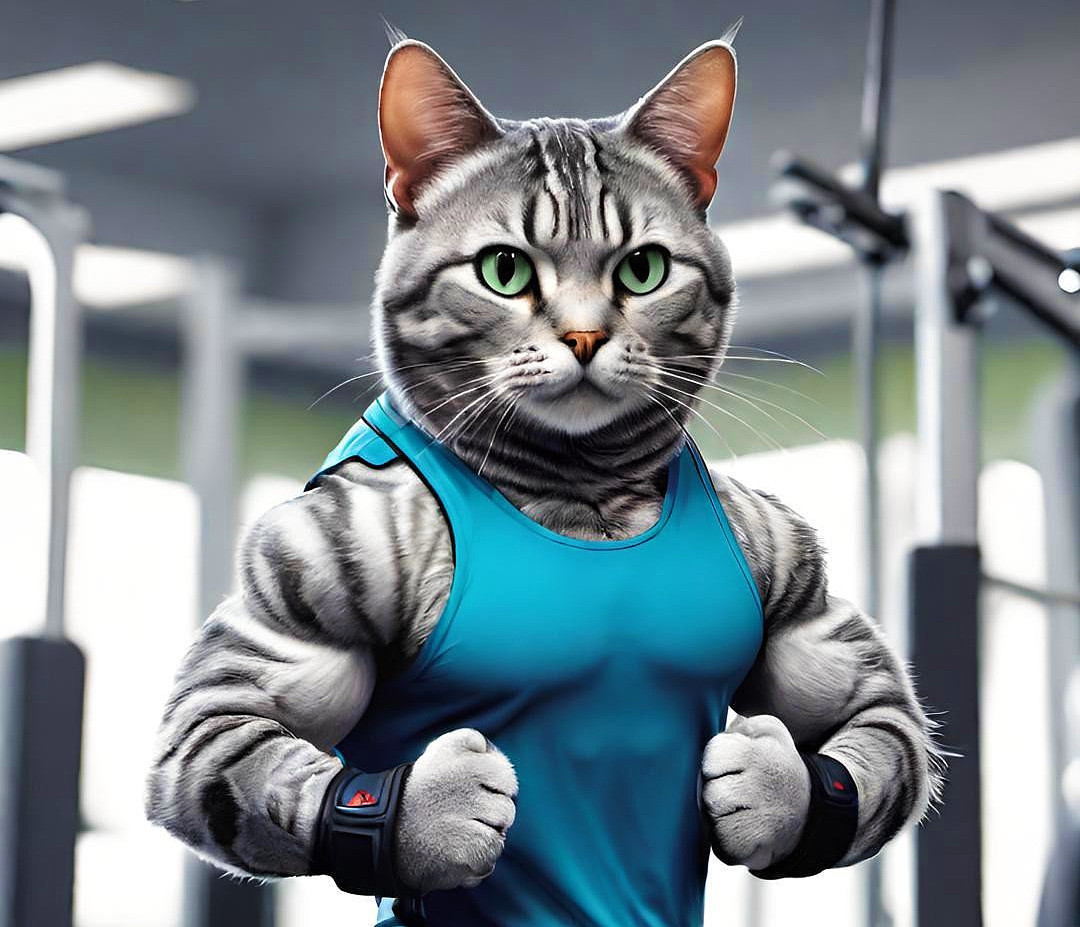
I want to be as ripped and meowscular as you are. What’s your secret, Oh Great One? How do you pack on so much meowscle mass and walk around looking like Thor if Thor were a cat?
Buddy taking a break between reps at the gym.
Buddy flexing powerfully as he readies for another set of bench presses.
Respectfully,
Awestruck in Arlington
Dear Awestruck,
It’s true, I’m pretty ripped. It’s not Photoshop either. Those are 100% real feline meowscles.
I’d say you should set realistic goals for yourself first. Half of it’s genetics, and as you know I’m a Buddinese Tiger. We’re a particularly buff breed of cat.
But if you’re committed and don’t mind rigorous workouts, you can make gains like I have, my friend! They’re the result of a grueling regimen of eating, sleeping and working out.
I break my fast first thing after waking up by screeching at my human for meowscle-building treats, which are high in protein. I usually do a light workout by making a few laps around the house, then it’s time for First Nap so I can solidify my gains and let my body heal.
The rest of the day must run like a precisely tuned machine. It’s absolutely essential that you force yourself to set aside long periods of doing absolutely nothing in order for your muscles to heal and grow.
For example, after Third Snack I like to work my abdominal muscles by having my human dangle the wand toy above me when I’m laying on my back, allowing me to perform sets of rabbit kicks. When I’m feeling the burn I do another lap, maybe chirp at some birds, and then it’s nap time again to consolidate the gains and replenish my stores of energy.
Another great workout is what I call box jumps, which are exactly what they sound like: jumping in and out of boxes.
After 7th Nap and 10th Snack I’m usually wiped, which is when it’s time for pre-bedtime sleep using my human as a pillow. His body heat helps me burn more calories and fuel meowscle growth.
It’s a daunting regimen, but if you’re committed you can look like a Catdonis just like me!
A new story claims a Japanese immunologist has “created a miracle” with his treatment for cats.
The cat world is abuzz with a new report that hails the efforts of a Japanese scientist, claiming he’s “created a miracle” that can extend cat lifespans to 30 years.
The story on Bored Panda claims the drug has “astounding potential,” boasting “a level of efficacy that has exceeded all expectations and has the potential to revolutionize feline healthcare.” According to Bored Panda, we’re headed toward a gleaming future and “soon we will be able to grow old with our beloved pets and be grey together.”
“Cat Lovers Rejoice As New Medicine Will Extend Cat Lifespan To 30 Years,” the headline declares.
Okay, let’s dial it back a bit and break down what’s true and what’s not.
First and most obvious, the story oversells the treatment and if you’re counting on your cat living to 30, you’ll need to readjust your expectations.
That’s unfortunate because there’s a good story at the heart of this, and there may be real benefits to cats eventually.
Toru Miyazaki is an immunologist who discovered a protein that helps the kidneys flush out toxins. Eight years ago, he realized the protein — apoptosis inhibitor of macrophage, or AIM — doesn’t always work properly in felines, which is why so many cats are susceptible to kidney failure, especially when they reach age 10 or so.
The AIM protein, Miyazaki explained, launches from immunoglobin antibodies “like a jet fighter from an aircraft carrier,” removing waste and debris from the kidneys.
But in cats, sometimes the AIM protein — the fighter jet — is “too tightly bound” to the antibodies, meaning it doesn’t “launch” in the first place and can’t do its job of flushing out toxins.
Miyazaki was continuing his research into feline kidney failure while he was a professor at the University of Tokyo, but funding dried up in 2020 as the lion’s share of research money in immunology was directed toward addressing SARS-CoV-2 and the disease it causes, COVID-19.
When a Japanese newspaper published a story about Miyazaki having to abandon his research, donations came pouring in. Cat lovers across Japan donated an astounding $2.3 million, prompting Miyazaki to leave his post at the University of Tokyo and found a non-profit dedicated to tackling kidney disease in cats.
As of September 2023, Miyazaki’s organization is running clinical trials on his AIM therapy, and it has partnered with a Japanese pet food company on new food that is supposed to reduce the possibility of kidney disease.
There’s not enough data yet to make any definitive statement, and even if the data existed, the AIM therapy is not a cure: Miyazaki says if all goes well, kittens who are given AIM therapy injections from an early age, and eat a diet with the AIM-enhancing formula, could have their risk of developing kidney problems reduced and potentially live longer lives.
That’s a far cry from Bored Panda’s image of cat lovers dancing in the streets, joyous with news of a miracle pill that will allow Socks and Oreo to run around like kittens for three decades.
While it’s natural to be excited about the potential of AIM therapy, calling it a “miracle” that will “revolutionize feline healthcare” and allow us to grow old with our cats can give people false hope.
Even if the trials go perfectly and AIM therapy breezes through the approval process, the soonest the injection therapy could be available in Japan is 2025. The US, UK and Europe have their own regulatory agencies and clinical data requirements. That means it might help kittens born years from now, but it won’t double the lifespans of the cats we love now.
It’s also worth mentioning that not everyone is thrilled to hear Miyazaki has partnered with a pet food company that sells ultra-processed kibble. Over at bark&whiskers, Karen Shaw Becker — a veterinarian who specializes in preventative care — points out that ultra-processed dry food is thought to be a major contributor to the feline kidney problems, with the ingredients, rendering methods and lack of moisture (water) all posing health hazards to cats. Cats have low thirst drives and get most of their hydration from meat.
While Becker writes she’s watching the trials closely, like other veterinarians, she recommends cat lovers continue to feed their furry friends wet and/or fresh food with high quality ingredients, no fillers and lots of protein.
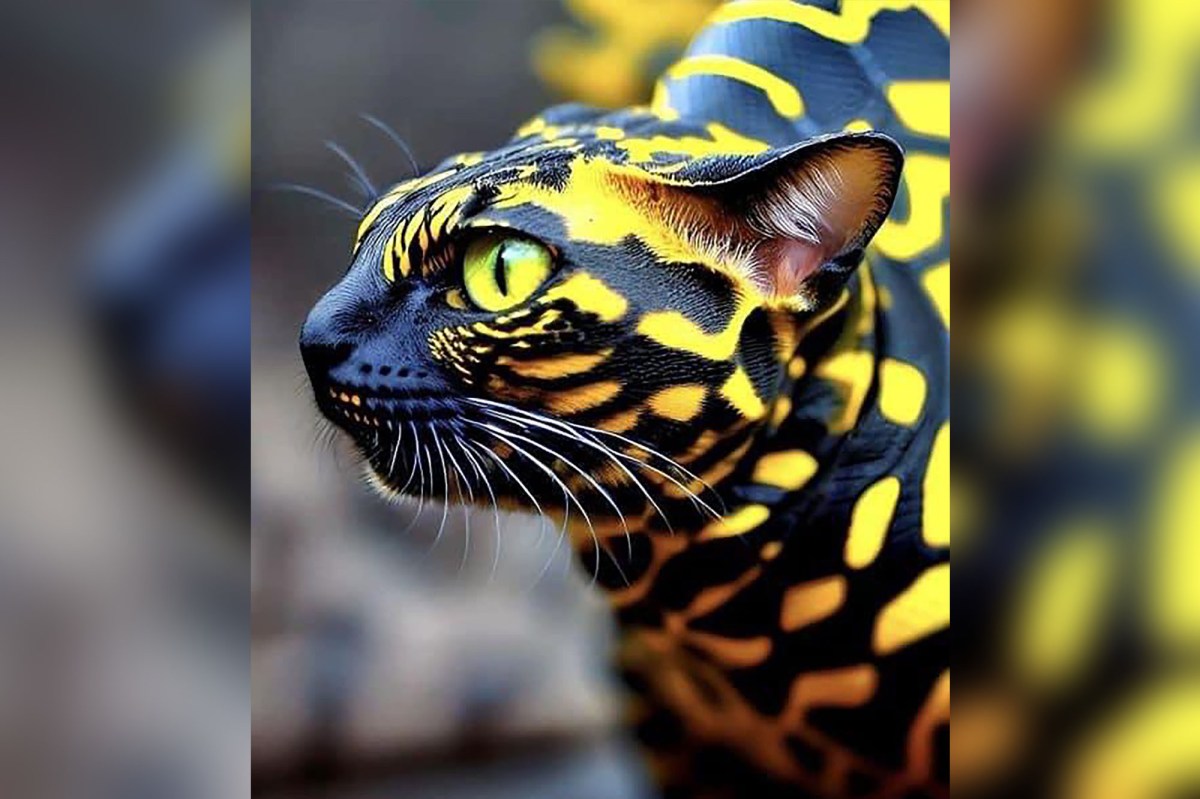
A viral image allegedly depicts a “snake cat,” described as an extremely rare species native to the Amazon rainforest.
Say hello to felis retrowavus, commonly known as the synthwave cat, one of the rarest species of felid on Earth.
Using the same technique GloFish employed to create bioluminescent neon fish for the pet market, scientists engineered felis retrowavus by extracting fluorescent proteins from jellyfish and inserting them into cat embryos, which incorporated the new proteins into their genome.
The result? A new species of cat that glows in fabulous colors like Tigerbrite Orange™, Electro Azure™, RadarGlo Green™, 1984 Pink™ and SithRed™!
Your brand new Neon Feline™ will run, jump and meow just like a regular cat, but unlike a plain old kitty, your Neon Feline™ will snuggle up with you at night and serve as your personal biological night light! Collect them all!
If that sounds like BS, that’s because it is.
Obviously.
Likewise, it should only take a second or two to realize the widely disseminated photo of a “snake cat” is a fake rendered by an AI.
The image has all the hallmarks of an AI generated image fail: Anatomical errors, fuzzy pixels where the AI struggled with the way light hits fur, a misshapen head and a nebulous, blurry background.
Although the media seems to be more obsessed with the snake cat hoax than people are (the snake cat image “mystified the internet,” the New York Post claims), after years of witnessing people take Onion stories seriously and confidently repeat misinformation online, I’m not really surprised when something like this makes the rounds.
The image was accompanied by a clever bit of writing claiming the cat isn’t well known because it’s native to the deep jungle of the Amazon, where scientists have difficulty tracking it. The text even offered a taxonomical name for the cryptid animal.
Enough people apparently fell for it that the staff at Snopes felt the need to debunk the image, even going as far as to check with a biologist who specializes in tropical fauna.
The original author of the snake cat post says he created the image and accompanying text to prove how easy it is for people to be fooled by AI-generated fakes. A noble goal if true, but I’m not sure everyone got the message.
In any case, the “snake cat” proves once again that AI, like all innovations, isn’t inherently good or bad. It’s what we do with the technology that counts.
Now can I interest anyone in a brand new Purple Velvet or Flaming Hot Cheetos SnuggleCat™?
Looking to break into the profitable hypoallergenic cat market, scientists have turned their efforts to editing cat DNA.
On paper, the promise of “hypoallergenic cats” sounds great.
For the first time, people who love cats but are allergic to the furry little guys would be able to open up their homes to them. More cat lovers and more homes for cats is always a good thing, right?
Maybe not in this case.
The quest to create cats who do not trigger allergies depends on CRISPR gene editing, a method that allows scientists to edit, delete and replace sections of the genome. In this case, Virginia-based biotech company InBio wants to edit the genome of domestic felines to block Fel d 1 (Felis domesticus allergen I), a protein produced in cat saliva and in tiny subdermal exocrine glands, which secrete the protein via the same ducts that allow a cat’s fur to grow out from its skin.
Since cats are fastidious neat freaks and groom themselves constantly, the Fel d 1-carrying saliva is applied to their coats several times a day. When it dries, it contaminates a cat’s living space by flaking off the fur as dander or by shedding.
That’s why people who are allergic to cats can suffer symptoms like sneezing, itching and watery eyes not only from petting them, but also from spending time in homes where cats live.
What does Fel d 1 do, and why do cats need it?
The problem is that no one knows why cats produce Fel d 1 and what purpose it serves. Other proteins, like Fel d 4 found in pheromones and Fel d 2, help cats communicate by scent and prevent certain fluids from leaving the bloodstream, respectively.
Take a look at this quote from Nicole Brackett, a geneticist at InBio: (The emphasis on certain words is ours)
“The gene sequences don’t appear to be that well conserved over the course of evolution, which suggest things about whether or not the gene is essential,” Brackett told BioSpace, a life sciences publication. “An essential gene, one that would be required for survival or viability, generally doesn’t change much over evolution, and we’re seeing change between the exotic and domestic cat that suggests that maybe those sequences are not conserved, and maybe the protein is not essential.”
While we understand scientists have to be circumspect, especially regarding research that breaks new ground, that’s a lot of hedging and a lot of uncertainty. (It’s also not clear if Brackett is comparing domestic feline Fel d 1 levels to wild cats — felis sylvestris and lybica — wild felids in general, or hybrids like Bengals and Savannah cats, which are more commonly called exotics.)
Credit: cottonbro/Pexels
The team members developing the allergen gene edit assume Fel d 1 doesn’t have a critical function because individual domestic cats and other species of felids may produce different quantities of the protein.
But that’s a huge assumption, and it’s also presumptuous to assume we humans would know whether the gene edits have a major impact on felines. After all, we still don’t always know when cats are in pain or the reasons for many of their behaviors, and we don’t know what sort of cascade effect can be triggered by shutting down the production of a protein.
The race to make cats hypoallergenic
Companies see a huge opportunity for profit in the cat allergy alleviation market. Last year, Purina announced to much fanfare the availability of a new kind of cat food the company claimed would drastically reduce allergens after about three weeks of putting kitties on the new grub.
The claims haven’t been independently verified, and most press coverage is either credulous or consists of marketing masquerading as news coverage, like this advertisement from Purina that is presented like a news story in USA Today.
Back when a company called HypoCat announced it had conducted successful trials of a “vaccine” that would “neutralize’ Fel d 1, we spoke with immunologist Kamal Tirumalai, who pointed out that humans making such profound changes to companion animals for the sake of human convenience “passes neither the scientific nor the moral smell test.”
Like others, Tirumalai said she worried about unintended consequences.
“A vaccine given to cats to reduce their allergenicity for humans burdens them unnecessarily when human allergy to cats is primarily a human problem and should have a human solution in the form of reducing people’s cat allergies,” Tirumalai told PITB at the time. “Cats are perfect as they are. Why should they be the ones forced to change in order to be accommodated by a human whose immune system happens to have a problem with one of their proteins? This solution just doesn’t pass the moral smell test.”
HypoCat uses an injection to “induce anti-Fel d 1 antibodies in the cat,” while the CRISPR technique would snip the relevant DNA out entirely.
“Come now, let us not be absurd. Do you really think a designer kitten could be as handsome as I am?” Credit: Big Buddy
So far, Brackett and her colleagues have deleted one of two cat cells that produce Fel d 1 in samples in a petri dish, and have not made any changes to live animals. The experiments yielded a “55 percent knockout rate” for the Fel d 1 allergen, Brackett said, “which we were really happy with.”
Designer kittens: Gattaca for cats
If subsequent attempts are successful and the company sees commercial promise in editing feline genes, the process could be used to create “designer kittens” or to alter the genomes of existing cats. Brackett told Smithsonian magazine that the goal is to accomplish the latter.
But if it turns out the edits don’t work for existing cats, or the designer kitten trend becomes a thing, there’s another major moral concern similar to the objections to cat cloning. If people buy designer kittens, they’re not opening their homes to the millions of cats who need them.
Manipulating feline DNA isn’t a novel idea. A decade ago, a research team spliced genes from jellyfish using a different method to create cats who glow in UV light as part of a study into feline immunodeficiency virus (FIV).
Ultimately it comes down to what we’re willing to do for the sake of our own convenience. At a time when declawing has finally been outlawed in two states and dozens of cities, and people are more conscientious than ever with regard to their pets, do we want to risk their health so we don’t have to pop a few Benadryl?







 Pain In The Bud