After learning that wildcats — including jaguars, tigers and ocelots — love Calvin Klein’s Obsession for Men, Buddy the Cat explores the world of colognes to find one that drives domestic kitties crazy.
Earlier we wrote about the accidental discovery that ocelots respond enthusiastically to Calvin Klein’s Obsession for Men. Subsequent experiments proved jaguars and tigers are particularly fond of the scent as well.
Then a reader’s comment posed a question so obvious, we’re ashamed we didn’t think of it ourselves: do domestic kitties like colognes?
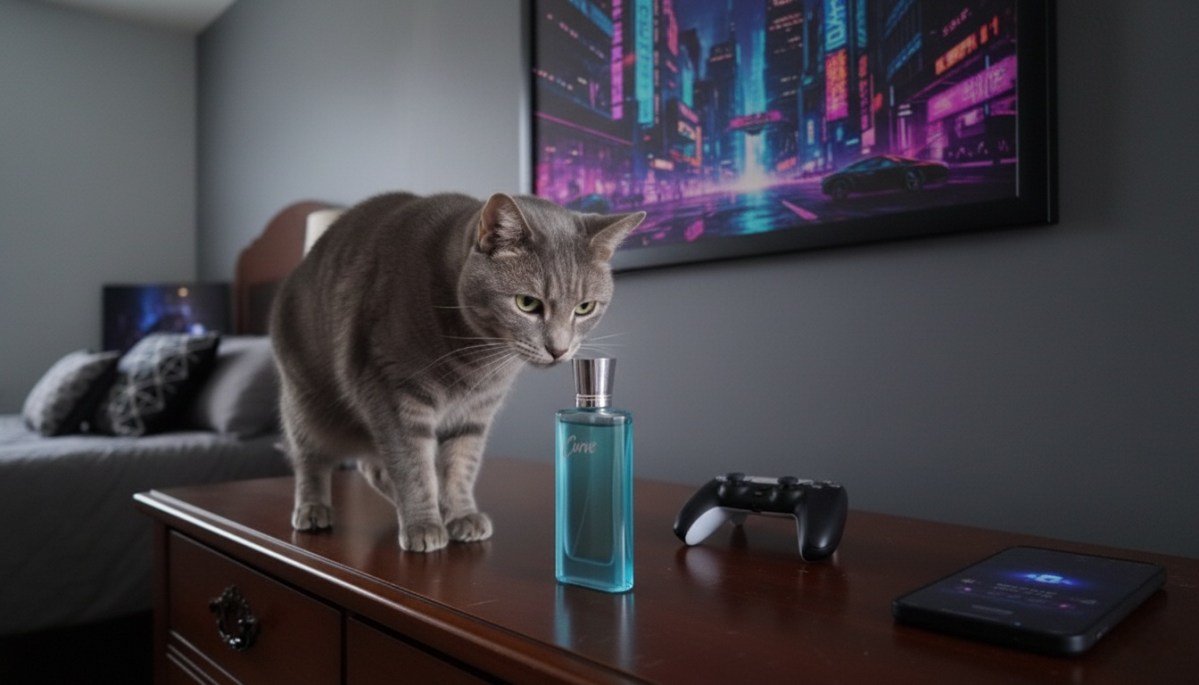
To find out, we asked Buddy the Cat, aka Little Buddy, to evaluate several fragrances. He’s taken the assignment seriously and provided thoughtful analysis, giving us just a hint of what it’s like to have an incredibly keen feline sense of smell.
Dolce and Gabbana Pour Homme
“The first ecstatic whiff takes me back to kittenhood. Days napping in the sun and chasing flies. Fresh cut grass and fragrant foliage. I was so deep into my reverie that the base notes nearly bowled me over when they arrived suddenly in their regal glories, like a king’s entourage without a herald. Rich cedar and musk evoke hours spent luxuriating in the potent funk of my human’s sneakers. Quiet woods and spices, like a litter box a day after feasting on rabbit, gently whisper of naps. Buddy likes this one!”
Cool Water by Davidoff
“Its initial briny hints conjure impressions of a dock at low tide, fish baking in the sun while a graybeard captain lights his pipe. Through confident middle notes, its warm embrace gently tugs you inward, like an antiquarian beckoning you inside a rare book shop with a rodent infestation. Aged leather book bindings and dark oak react provocatively with the paw-licking intensity of decadent mouse urine. Meowgnificent!”
Jaguar by Jaguar
“A carnival of candy for the nose, like accompanying your human to the bathroom post-Chipotle! The first hints arrive furtively, like a disguised aristocrat casting nervous glances as he makes a beeline for a brothel. Then it asserts itself in force: an army of jaguars advancing in the moonlight, their meowscles rippling in the silver mist, scent-marking in unison! Musk, civetone, ammonia. Pheromonic bliss!”
Drakkar Noir by Guy Laroche
“Powerful but restrained, like a certain silver tabby in his carrier, a single spritz of this magnificent scent conjures memories of halcyon days as a young feline. Mid notes whisper of woods and spices, a grove of wild catnip undulating in a summer breeze. Underneath it all is an unshakable foundation of warmth, like being swaddled in my human’s t-shirt after it’s been worn on a humid 97 degree day.”
Tyrannosaurus Rex by Zoologist
“Bergamot and verdant iridescence arrive as our olfactory escorts, ushering us in to a delectably frisky gourmand accord. It’s as if we’re drifting on chocolate seas with vanilla currents playfully nudging us to shore where beefy undertones await. Umami! Steaks sizzle, beckoning our noses toward the grill, stomachs rumbling. A most delicious scent!”
So there you have it. T Rex emerges as the winner in this round, but can it compare to mainstays by Yves Saint Laurent and Giorgio Armani? Only Buddy can tell us. Tune in next time as we accompany the Budster on an aromatic journey!
Cats and dogs communicate primarily by scent, touch and body language, but human efforts to understand them have focused exclusively on meows and barks. If we want to truly understand our non-human friends, we need to take an approach that considers the other ways animals “talk” to each other.
A few years ago when MeowTalk made a minor splash in the startup world, I was pretty bullish on its potential to help us understand our cats better.
Sure, the app had an unhelpful habit of attributing improbably loving declarations to Buddy, but I thought it would follow the trajectory of other machine learning models and drastically improve as it accumulated more data.
More users meant the app would record and analyze more meows, chirps and trills, meaning it was just a matter of time before the AI would be able to distinguish between an “I want attention!” meow and a “My bowl is dangerously close to empty!” meow.
Obviously that didn’t happen, and what I personally didn’t take into account back then — and should have, given how obvious it is in retrospect — is that cats don’t just communicate via vocalizations.
In fact, cats don’t normally incorporate vocalizations into communication at all. Pet kitties do it entirely for our benefit because they know we’re generally awful at interpreting body language and we are completely useless when it comes to olfactory information.
It’s actually amazing when you really think about how much of the heavy lifting cats do in our efforts to communicate with each other. They recognize we can’t communicate the way they do naturally, so they try to relate to us on our terms. In return, we meet them less than halfway.
No wonder Buddy sometimes looks frustrated as he meows at me, as if I’m the biggest moron in the world for not understanding the very obvious thing he’s trying to tell me.
“Human, how can you not understand the simple feeling of innerer schweinehund I’m trying to convey here? The cringe is killing me!”
Now the Chinese tech giant Baidu is throwing its hat into the ring after filing a patent in China for an AI system that uses machine learning to decode animal communication and “translate” it to human language.
Machines are designed to process things from a human viewpoint according to human logic, so if Baidu wants to succeed where MeowTalk has not, its engineers will need to take a thoughtful approach with the help of animal behavior experts.
This is a hard problem that encompasses animal cognition, neuroscience, linguistics, biology, biochemistry and even philosophy. If they approach this strictly as a tech challenge, they’ll set themselves up for failure.
Without the information and context clues provided by tails, whiskers, facial expressions, posture, eye dilation, heart rate, pheromones and even fur, an AI system is only getting a fraction of the information cats are trying to convey.
Trying to glean meaning from that is like trying to read a book in which only every fourth or fifth letter is legible. There’s just too much missing information.
Even if we can train machines to analyze sound visual, tactile and olfactory information, it may not be possible to truly translate what our cats are saying to us. We may have to settle for approximations. We’ve only begun to guess at how the world is interpreted differently among human beings thanks to things like qualia and neurodivergence, and the way cats and dogs see the world is undoubtedly more strange to us than the way a neurodivergent person might make sense of reality.
“He grimaced. He had drawn a greedy old character, a tough old male whose mind was full of slobbering thoughts of food, veritable oceans full of half-spoiled fish. Father Moontree had once said that he burped cod liver oil for weeks after drawing that particular glutton, so strongly had the telepathic image of fish impressed itself upon his mind. Yet the glutton was a glutton for danger as well as for fish. He had killed sixty-three Dragons, more than any other Partner in the service, and was quite literally worth his weight in gold.” – Cordwainer Smith, The Game of Rat and Dragon
An animal’s interpretation of reality may be so psychologically alien that most of its communication may be apples to oranges at best. Which is why I always loved Cordwainer Smith’s description of the feline mind as experienced via a technology that allows humans with special talents to share thoughts with cats in his classic short story, The Game of Rat and Dragon.
In the story, humans are a starfaring civilization and encounter a threat in the void between stars that people don’t have the reaction speed to deal with. Cats, however, are fast and swift enough, and with a neural bridge device, teams of humans paired with cats are able to keep passengers safe on interstellar journeys.
The narrator, who is one of the few people with an affinity for teaming up with felines, hopes he’ll be paired with one of his two favorite cats for his latest mission, but instead he’s assigned to partner with an old glutton of a tomcat whose mind was dominated by “slobbering thoughts of food, veritable oceans of half-spoiled fish.”
The narrator wryly notes that the last time one of his colleagues was paired with that particular cat, his burps tasted of fish for weeks afterward. But the cat in question, despite being obsessed with fish, is a badass at killing “dragons,” the human nickname for the bizarre entities that attack human ships in space. (The software that allows felines and humans to link thoughts also portrays the “dragons” as rodents in the minds of the cats, stimulating their ancient predatory drive so they’ll attack instantly when they see the enemy.)
We can’t know for sure if Smith’s interpretation of the feline mind is accurate, but another part rang true when he wrote that cat thoughts were all about the moment, filled with sentiments of warmth and affection, while they rapidly lost interest in thoughts about human concerns, dismissing them “as so much rubbish.”
If the mind of a cat is that relatable, we’ll be incredibly lucky. But in reality we’re dealing with animals who evolved in drastically different ecological niches, with different priorities, motivations, and ways of looking at the world — literally and figuratively.
That doesn’t mean we shouldn’t try to understand our furry friends. Research has yielded interesting information about the way animals like whales and elephants communicate, and AI is at its best when it augments human creativity and curiosity instead of trying to replace it.
Even if we don’t end up with a way to glean 1:1 translations, the prospect of improving our understanding of animal minds is tantalizing enough. We just need to make sure we’re listening to everything they’re saying, not just the meows.
Oscar the Cat lived in a Rhode Island nursing home where he became famous for knowing exactly when a patient was dying.
There’s a scene in the film adaptation of Stephen King’s Doctor Sleep that shows Ewan McGregor’s character, Danny Torrance, working the night shift as a hospice orderly when a cat jumps up onto the desk and nuzzles his hand.
“Hi, Azzie,” Torrance says, and watches as the cute feline pads down the hall and enters a patient’s room.
Danny Torrance (Ewan McGregor) pets Azzie in Doctor Sleep.
When Danny pokes his head in, the patient is distraught. He knows he’s going to die.
“Cat’s on the bed,” the man says. “I knew he would be. That cat…always seems to know when it’s time. Guess it’s time.”
Danny shakes his head.
“No,” he reassures the old man. “It’s just Azrael being a silly
old cat.”
“Nope. Been that way since I got here. The cat knows when it’s time
to go to sleep, everybody knows that. I’m gonna die.”
It’s a pivotal moment early in the movie because it marks Danny’s evolution into Doctor Sleep, a man whose innate ability to “shine” allows him to comfort the dying. (Yes, Doctor Sleep is the sequel to Stanley Kubrick’s The Shining. Do yourself a favor and watch the Director’s Cut, which is the definitive and most satisfying version. It’s a long film, but worth it in every sense.)
It turns out Azzie is based on a real cat: Oscar, the resident feline at Steere House Nursing and Rehabilitation Center in Providence, Rhode Island.
Oscar, who died in 2022 at the age of 17, had an uncanny ability to sense the imminent deaths of patients. When someone was near death, Oscar would leap onto the person’s bed and stay with them until they passed.
Oscar at the nurse’s station in the Rhode Island nursing home where he lived.
When his story was first publicized in a 2007 essay in the New England Journal of Medicine, Oscar had “predicted” the deaths of a few dozen patients.
“Thus far, he has presided over the deaths of more than 25 residents on the third floor of Steere House Nursing and Rehabilitation Center in Providence, Rhode Island. His mere presence at the bedside is viewed by physicians and nursing home staff as an almost absolute indicator of impending death, allowing staff members to adequately notify families. Oscar has also provided companionship to those who would otherwise have died alone. For his work, he is highly regarded by the physicians and staff at Steere House and by the families of the residents whom he serves.”
In a follow-up story by Reuters in 2010, Oscar had snuggled with more than 50 dying patients.
To be clear, no one’s suggesting Oscar is peering into supernatural realms. Cats are known for their remarkable hearing, but they’ve also got an exceptional sense of smell. In fact, they have a unique olfactory organ in their mouths, the vomeronasal organ, that allows them to “taste” scents.
We know very little about what kind of information they’re able to glean from scent alone, but we do know animals can sense things that would otherwise require sophisticated machines for us to detect, including cancers and other diseases.
A cat’s Flehmen response looks like a disgusted reaction, but actually indicates cats are processing a scent through their vomeronasal organ.
It may be that the most unusual thing about Oscar’s case is that he was allowed to live in a nursing home. The vast majority of medical facilities have strict prohibitions against allowing animals due to potential allergies and the perception that they’re dirty, despite the fact that they have significant therapeutic benefits. Even the facilities that do allow animals typically do so under controlled circumstances and for short periods, as when therapy dogs or cats are brought to visit patients.
Perhaps we’d hear about Oscars all the time if they were resident cats in hospitals and nursing homes.
“I don’t think Oscar is that unique, but he is in a unique environment,” Dr. David Dosa told Reuters. “Animals are remarkable in their ability to see things we don’t, be it the dog that sniffs out cancer or the fish that predicts earthquakes. Animals know when they are needed.”
It’s a reminder that just because we can’t see, smell or hear something, that doesn’t mean there’s nothing there. When dogs “bark at nothing,” they may have caught the scent of a stranger in the neighborhood. When a cat stares at a wall, it could be picking up mice making sounds that are too high in frequency for human ears to detect.
There are likely thousands of sounds, smells and even forms of tactile feedback to which we remain oblivious, but are noticed by animals. Migratory birds, for example, have magnetoreception abilities. That is to say, they can detect Earth’s magnetic field and magnetic dips, an ability they put to use when navigating as the seasons shift.
And then, of course, there’s Buddy and his incredible ability to detect catnip. Little man could be in a deep sleep in another room, yet the instant I open the sealed container of the good stuff, it’s a matter of seconds before he’s at my feet, meowing happily. In fact, it’s a reliable way to find him when he’s in some novel hidden napping spot, doesn’t respond to me calling for him, and I get worried because I haven’t seen or heard him in some time.
So next time your cat freaks you out by apparently staring at a corner of your living room, remind yourself she’s probably been alerted to something you can’t sense — and be wary of any cats who aren’t snugglers but suddenly climb into your bed.
Is there any evidence to support claims of a longer kitten season?
Is kitten season getting longer because of climate change?
Some rescuers in California think so, according to a story in Santa Rosa’s Press-Democrat.
“Heat and warmth is what it’s all about,” said Mary Pulcheon, trapping coordinator for Forgotten Felines of Sonoma County.
Pulcheon and the executive director of Forgotten Felines, Pip Marquez de la Plata, told the Press-Democrat that strays in their care had given birth as late as December in 2023 when kitten season generally runs from late March through October.
They say the typical kitten season has shifted and is now longer due to rising temperatures caused by climate change.
It’s an unverifiable claim for several reasons.
First, we don’t have reliable estimates for how many cats there are in the US, let alone stray and feral cats. Any estimates are guesses, and they vary wildly from 20 million on the low end to 120 million, which seems an excessive and unrealistic number.
To date there’s been a single comprehensive feline census in the US, the D.C. Cat Count. It took three years, several million dollars, hundreds of trail and trap cameras, and the efforts of an army of volunteers and staff.
The final tally: 203,595, with only 6,533 unowned cats fending for themselves and drifting between managed colonies.
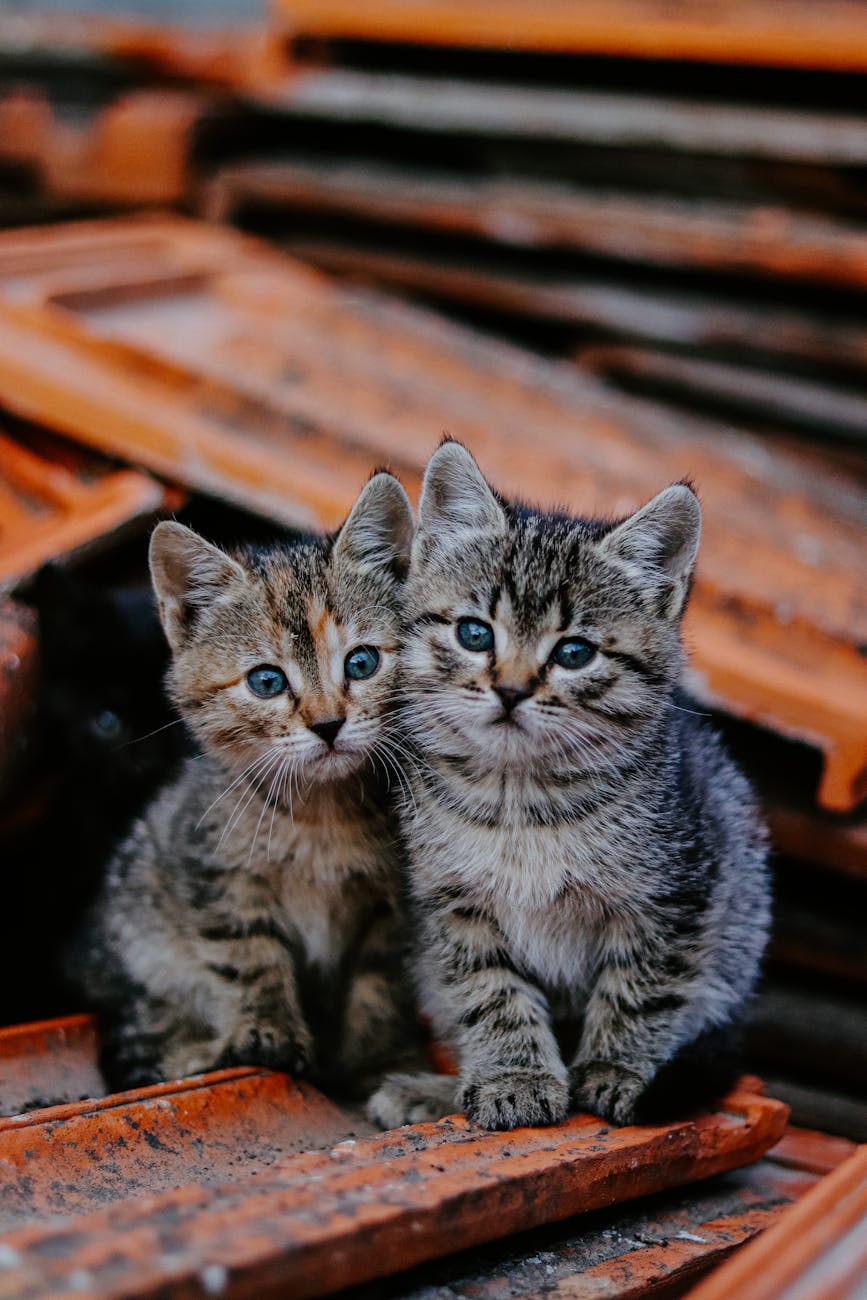
Credit: Ejov Igor/Pexels.com
The DC Cat Count is historic and has already proven its value by facilitating informed debate, showing rescuers/TNR volunteers where to direct their efforts, and yielding valuable data on local ecological impact.
Alas it’s a one-off, so we don’t know anything about how the population has changed over time.
Secondly, while there absolutely is scientific consensus that human activity is driving global temperatures up, there’s debate about how much temperature flux is directly attributable to modern civilization. We’re also looking at planetary timescales here, tracking changes that happen not just over decades, but centuries and millennia.
Attributing shifts in kitten season to climate change is a bit like attributing single storms to climate change. These are single data points from which we can’t draw conclusions.
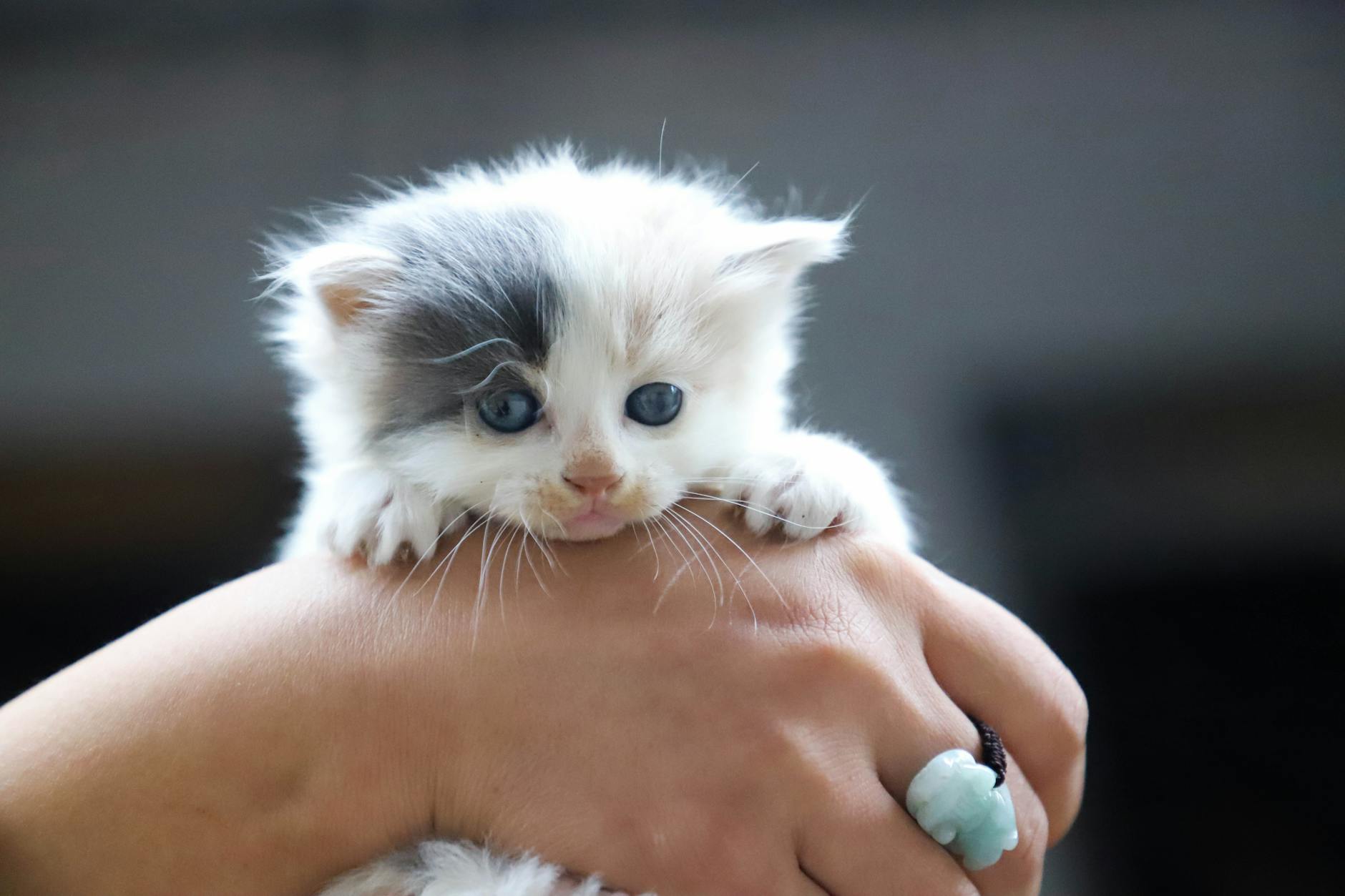
Credit:Cats Coming/Pexels
Lastly, there could be dozens of factors skewing “normal” kitten season, and that’s assuming the March through October season is normal by historical measurements. We don’t know that for sure, and we can’t know it without data.
I’m limited by a lack of imagination here, but changes in kitten season could be regional, reflect non-climate weather patterns, or adjust according to cyclical patterns. Things as seemingly unimportant as ambient light pollution can have a profound effect on animal behavior, and it always helps to remember that felines are sensitive to stimuli that we literally cannot detect. Cats can pick up high frequency sounds we can’t hear and smell things beneath the notice of our own weak noses. They even have a second form of olfactory input, a literal sixth sense that is unmatched by anything in human biology.
We understand very little about how those things impact feline behavior.
With all things considered there could be hundreds of reasons for changes in kitten season, and that’s assuming the changes are real and people aren’t mistaking outliers for trends.
Ultimately we don’t need to draw conclusions about whether there are more kittens born each season. We know TNR, while imperfect, is the best way to humanely reduce stray and feral populations, and we still have a way to go before cats are no longer euthanized because we can’t find homes for them.







 Pain In The Bud