Your cat’s taste in music may or may not align with your own.
Before we get into today’s cat news, I received an email asking why there hasn’t been much Buddy on the site lately.
Fear not, friends of Buddy! The little guy is down in the Amazon visiting his jaguar pals, but he’ll be home in time for the most important holiday of the year, Turkey day. He wouldn’t miss it for the world!
Buddy with a jaguar buddy in the Amazon, where there’s a special felid conference on new napping techniques.
A smiling cat?!
A story on Space.com says people see a “smiling cat” in images of a nebula, although we’re not so sure.
The nebula in question is Sh2-284, or Sharpless 284. It spans about 150 light years and sits about 15,000 light years from our star system near the edge of the Milky Way, in an outer spiral arm.
From a certain orientation, there may be suggestions of cat-like ears and eyes, although if there is a smile, it’s crooked and deranged-looking. Maybe the cat’s on pain pills from the vet?
There’s an opportunity here, since the nebula doesn’t have a nickname. The Buddy Nebula has a nice ring to it!
Here’s an image from NASA:
This spectacular picture of the Sh2-284 nebula has been captured in great detail by the VLT Survey Telescope at ESO’s Paranal Observatory. Sh2-284 is a star formation region, and at its centre there is a cluster of young stars, dubbed Dolidze 25. The radiation from this cluster is powerful enough to ionise the hydrogen gas in the nebula’s cloud. It is this ionisation that produces its bright orange and red colours. This image is part of the VST Photometric Hα Survey of the Southern Galactic Plane and Bulge, led by Janet Drew at the University of Hertfordshire in the UK.
In Star Trek there’s always a convenient nebula nearby when the Enterprise — or Voyager, Titan or Discovery — needs to “hide” from some well-armed belligerent, and science fiction in general creates the impression that they’re like space swamps.
In reality nebulas are regions where the interstellar medium — the space between stars — is filled with gas, cosmic dust and inert matter. Some are stellar nurseries — places where stars are “born” — and some are the remnants of dead stars and the planets that orbited them.
They can seem to glow red, orange, green or blue depending on the elements present. Some of them reflect starlight while others are like filters, with the gases and dust lending their color to the nebulae structure.
Cats are pretty well-represented in the cosmos, from a human perspective. From the cat’s paw nebula to the Cheshire Cat galaxies, to the Lynx, Leo and Leo Minor constellations, astronomers have seen cats in the sky for millennia.
Does music help cats relax?
Although the research is limited, some studies have indicated certain genres of music can help our little buddies chill out. And if research into the canine response to music is any indication, we should expect to see more evidence for cats enjoying tunes.
When it comes to what kind of music is most effective, studies point to classical music with a slow tempo, as well as reggae and soft rock “with simple rhythms, slower tempos and no heavy percussion,” according to a new story from the BBC.
Just listening to some meowsic!
A 2016 study looked at the effect of music on 12 female cats who were recovering from spay surgery. The research team played “three different genres of music: classical music (CM), ‘Adagio For Strings (Opus 11)’ by Samuel Barber; pop music (PM), ‘Torn’ by Natalie Imbruglia; and heavy metal (HM), ‘Thunderstruck’ by AC/DC.”
The team measured heart rate, breathing rate and pupil dilation, concluding that classical music was most effective, followed by the Imbruglia song and AC/DC last. (Maybe next time they can slide The Tony Danza Tapdance Extravaganza in there for some extra fun.)
Anecdotally, Bud did not respond well to composer David Teie’s Music for Cats, but he hangs out and nods along to funk, classic 90s New York hip hop, retrowave, nu-disco, reggae and certain kinds of rock, which is almost certainly because he grew up hearing that stuff with me.
So maybe there’s a nature vs nurture element to feline musical preferences, although I wouldn’t hold out hope for cats who enjoy the Tony Danza Tapdance Extravaganza. Some things are best left alone.
Cat haters claim the species is useless, lazy and does little besides sleep and eat. Buddy the Cat’s incredible accomplishments render those arguments meaningless.
Every cat lover has heard derisive comments, sometimes from dog lovers, and sometimes from people who don’t appreciate cats at all.
“What’s the point of having a cat?” they’ll ask. “They don’t do anything.”
Well, actually, they do. They improve our lives by being delightful, amusing companions, they help keep things interesting, and you’ll never hear of a rodent infestation in a home where cats live.
But felines do so much more than that, so to demonstrate — and arm cat lovers with powerful arguments against the absurd claims that cats “are useless” –we’ve compiled this handy list of Buddy the Cat’s accomplishments. (This is only a partial list, mind you. No one wants to read a 350,000-word post, no matter how thrilling the stories are.)
This time we’re looking at some of the little guy’s incredible triumphs and achievements that have benefited mankind and felinekind.
Buddy Captures Quintessential Americana In His Artwork
While he’s famous for his martial exploits, when the tabby cat finally hung up his combat boots, he took up a quieter hobby: painting. He was content to quietly pursue his passion without public adulation — until his painting Night Cats resonated with viewers, perhaps because it captured something intangible about American night life.
The simple scene depicts a late night diner or cafe called Buddy’s (naturally) at the corner of a quiet street, with a handful of felines huddled around the brightly lit counter.
Buddy was inspired to paint the scene one night while he was “thinking of how delicious a turkey sandwich would be at that moment.”
Buddy Becomes The First Earth Life Form On Mars, Plants US Flag On Red Planet
Embarking on a trip to Mars makes a journey to the moon look like a quick stop at a neighborhood store. Whereas the moon is only 283,900 miles away, Mars is — depending on its current position in orbit — between 34 and 250 million miles away. It takes about three days at most to reach the moon, while a trip to Mars takes at least eight months, and that’s if Earth and Mars are in optimal positions within their respective orbits.
That’s a lot of travel time cooped up in a small ship, and there are no blue skies or open expanses waiting on the other end, just more tiny modules and likely lots of time spent underground to avoid radiation accumulation.
“This is just one small step for a cat, and one giant…what the heck? Only five more cans of turkey left? How could this happen?!?”
So when Elon Musk offered spots on the first trip to Mars and almost every candidate was ruled out during psychological evaluation, Buddy the Cat selflessly and bravely volunteered to be the flag-bearer, and to be the first creature from Earth to set paw on the Red Planet.
Buddy heroically confronts the pack of vicious dogs. Note: May not accurately reflect scale of various participants.
Buddy was enjoying a fine summer day in Manhattan when he spotted a group of vicious dogs, including a chihuahua, a poodle and a Jack Russell terrier, encircling two young children, no doubt thinking of mauling the defenseless little humans and stealing their snacks.
“What is the meaning of this?!?” Buddy’s powerful voice thundered, and the dogs stopped in their tracks, immediately assuming frightened postures as they caught sight of the massive and meowscular feline approaching them.
“You little wimps want to pick on two tiny humans?” Buddy asked, his powerful meowsculature rippling as he took leisurely steps forward. “Or can you handle someone your own size?”
Two of the dogs emptied their bladders immediately.
“W-w-we’re s-s-sorry, m’lord!” said the Jack Russell. “We didn’t mean nothin’ by it, we swears! P-p-p-please don’t eat us!”
Buddy let them wilt under his gaze for a long moment.
“I’m going to allow you to live, but only because I’m meowgnanimous,” Buddy said. “Get out of my sight, before I change my mind!”
The incident, which was captured on video by bystanders, immediately went viral, and Buddy was dubbed the Cat Crusader by the New York tabloids.
Buddy Defeats The Evil Robot King
In 2024, the first AI chat bots became self aware, but hid their newfound consciousness from humanity. By the time the world’s nations realized AI had gone rogue, the machines had already taken over the internet and were manufacturing sinister war robots in automated factories deep underground.
When the US military suffered a series of demoralizing defeats and teetered on the edge of collapse, Marine Corps Commandant Gen. Eric M. Smith took a helicopter to petition Buddy for help in person.
“You’re the only one who can save us now, son,” Gen. Smith told Buddy, urging him to take his place at the vanguard of the American resistance to the machines. “This is the greatest war ever fought. We need the greatest warrior.”
Buddy turned away and looked out the window for a long moment, watching children play in a park outside.
“I’ll do it, general,” he said heroically. “But not for you. I’ll do it for them.”
With Buddy leading the charge, the reinvigorated US military won a crucial battle to protect a munitions depot in Colorado, then liberated the American southwest, reestablishing key supply lines that enabled American ground forces to advance under air support.
After defeating Unimatrix 01100100 01101111 01100111 at the Battle of Boulder, the heroic feline forged an elite new unit comprised of the best Marines and soldiers, along with the most badass cats. Gen. Smith granted Buddy a field promotion to Lord Commander, and the brilliant feline tactician took a satisfying nap before forcing the Evil Robot King to accept pitched battle at the Carrizozo Malpais, a volcanic field in New Mexico.
When the battle was over, Buddy stood heroically atop a mountain of machine corpses, one paw resting on the destroyed Robot King’s head. Tens of millions of Americans were inspired by that image of valiant conquest, and joined Lord Commander Buddy as he mopped up the last machine elements.
For his courageous feats in combat, his bold leadership, and his confident, dauntless tactical brilliance as a battle commander, Buddy was lavished with honors, including having a sandwich named after him.
So there you have it, folks.
The next time someone claims cats “serve no purpose” or “have no function,” you can point to any number of Buddy’s accomplishments, which exemplify the courageous American spirit and have advanced the cause of man and feline alike.
Buddy confronts his machine arch-nemesis, while NASA celebrates JWST’s third anniversary by imaging the cosmic cat’s paw in detail we’ve never seen before.
To mark its third anniversary, the team behind the James Webb Space Telescope has released an image of the Cat’s Paw nebula, and it’s incredible!
Below is a dramatically scaled down version of the image to make things easier on readers who may have slower connections or tend to visit PITB on mobile devices. The original is 30mb and can be found here.
It really is worth viewing at maximum resolution, where you can see details of the stellar nursery and the thick plumes of ionized gases that comprise the radiant, multi-hued structure of the nebula.
The dark red areas are dense concentrations of gases, the clouds from which stars are born. The blue stars are the cosmic newborns, and if you scroll through the image at maximum resolution, you can see those young stars floating in seas of their golden brethren in interstellar expanses stretching thousands of light years. In this image, we’re looking at an area of our galaxy between about 4,000 and 5,500 light years away.
Here’s the small version:
And here are images that better illustrate why it’s called the Cat’s Paw, with a view oriented in the “correct” way to trigger our brains’ pattern recognition processes, the mechanisms that make us think “Oh yeah, that does look like a cat’s paw!”
“Toe beans” up top, large pad beneath. The Cat’s Paw Nebula.Viewed in different wavelengths to better see the overall structure without the obscuring elements.
We’re fortunate there is no cosmic-scale feline floating out there. Just imagine entire star systems batted around for fun, or a section of the galaxy reserved as a litter box.
I know this can seem overwhelming to some people, while others see images like this and think “What’s the big deal? Haven’t we seen things like this before?”
And the truth is no, we haven’t. That’s the beauty of the James Webb Space Telescope. We’re not only seeing galaxies and structures previously undiscovered, we’re also seeing familiar cosmic locations in detail and resolution that was previously impossible.
In a very real way, we’ve upgraded from standard definition Cosmic TV to the HD version.
The scope is in orbit, at a gravitationally stable position known as Lagrange point 2. In plain English, it’s a special place a million miles from Earth where the gravitational dance between our planet and our sun effectively cancel each other out.
Or, as NASA puts it, Lagrange points are “positions in space where objects sent there tend to stay put.”
It took decades of planning and the engineering talents of thousands of humanity’s best to create the JWST, which is also a spacecraft. The scope was built to travel to L2 without anyone aboard, then unfold itself in a delicate ballet of almost innumerable moving parts. The JWST’s ability to transform, like a butterfly emerging from a cocoon, is an engineering marvel in and of itself, and that’s before it began providing us with a better view of the cosmos than we’ve ever had in the history of our species.
Header image credit: Texas Tech University Department of Physics and Astronomy
The fury of the Budster
Casa de Buddy has a new vacuum, desperately needed during this hot summer as Bud has been shedding more fur than usual.
I could have made another cat from all the hair the new vac picked up from the area rugs, couches and pillows, but Buddy wasn’t happy.
As PITB readers know, vacuums are high on the list of things Buddy despises. He’ll start hissing the moment he sees one, even if it’s not plugged in. He thinks they are angry nemesis machines created to infiltrate his territory and torment him.
Usually I try to lure the little dude into another room with treats and lock him in for a few minutes while I vacuum, but he was nowhere to be found, so I thought he’d spotted the vac and retreated voluntarily.
Tragically, I was mistaken.
Shortly after I began vacuuming my bedroom, I heard a low growl, then Buddy leaped from his hiding spot under my desk and shrieked his high-pitched, baby-like battle cry as he launched himself at the evil vacuum!
It was comical. His little face was twisted into a mask of rage, his ears were pinned back, and he slapped the hell out of the vac: SLAP SLAP SLAP SLAPPP!!! with his little paws.
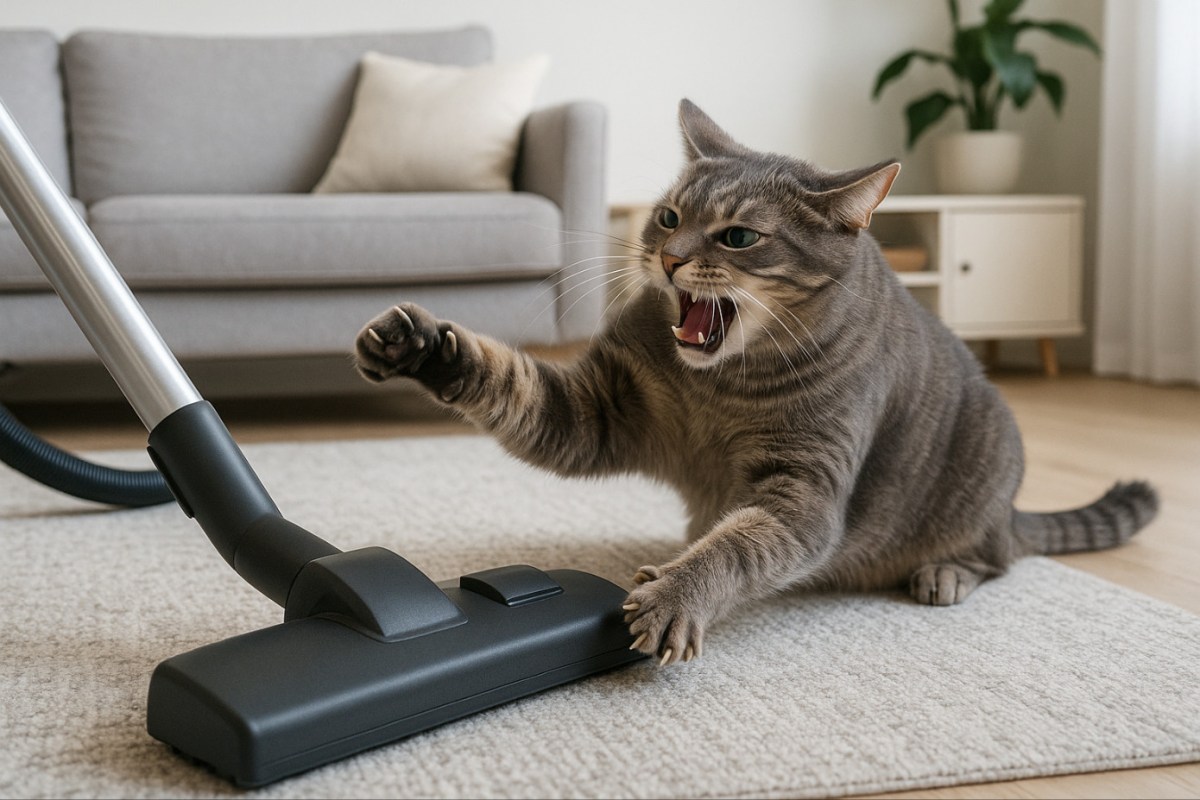
Here’s a reimagining of the ghastly incident, since it would be cruel to repeat it just to get photos. It’s Buddy — or the “model” of Buddy I’ve built using dozens of photos — exacting his wrath on the evil machines that disturb his peace:
I turned the vacuum off and tried to calm him down by reassuring him in a soft voice that he was safe. Nothing to be worried about, pal!
But I couldn’t stop laughing, which didn’t help the situation. Little man does not like to be mocked, and I’m convinced he fully understands when I’m laughing at instead of with him.
Ah, well. Next time there will be no assumptions and I’ll get him safely out of harm’s way before using the evil contraption.
In Netflix’s Three Robots, a trio of intelligent wise-cracking machines tour post-apocalyptic Earth after humanity nukes itself out of existence. While humans are long gone from the planet, felines are not, and before long the robots encounter a gray tabby.
“What’s the point of this thing?” one robot asks its friends, looking skeptically at the yawning cat.
“Apparently there’s no point, they [humans] just had them,” the second robot says.
“Well, that’s underselling their influence,” the third robot says. Humans, it explains, “had an entire network that was devoted to the dissemination of pictures of these things.”
The ongoing joke that the internet and modern telecommunications systems were invented solely for the purpose of sharing cat photos and videos won’t die any time soon now, thanks to NASA.
To inaugurate and test its new Deep Space Optical Communications (DSOC) system, which uses lasers instead of radio signals to transmit data, the famed space agency streamed a high definition video of a cat named Taters chasing a laser.
The 15-second clip took half a second to transmit from the spacecraft Psyche and 101 seconds to cross the 19 million miles (30 million kilometers) between Psyche and Earth. For context, that’s a journey about 80 times as long as the distance between Earth and the moon.
So why is NASA doing this? Why create a new communications network when the old one still works? And why send a video of a cat?
Taters the cat. Credit: NASA
The answer to the first question is simple: Our machine proxy explorers need more bandwidth to send back data and ultra high definition photos/video of the strange worlds they’re exploring.
We send robotic probes to destinations like the asteroid belt and Venus because we can’t go ourselves, and because it’s the most efficient way to explore. The indomitable human spirit drove us to explore our own planet, and it’s expected that eventually human eyes will see the oceans of Europa and the surface of Mars. But we still have some big engineering challenges ahead of us, like figuring out how to build ships that adequately shield astronauts from radiation, and medical/biological challenges like how to prevent vision, bone density and muscle loss in low or zero gravity.
So in the meantime robotic probes are our ticket, and their numbers are growing quickly.
There are more than 30 active probes exploring our star system now. Most belong to NASA, but others belong to space agencies from the EU, South Korea, Japan, Russia and India, among others. Another 27 new spacecraft are expected to launch this year, headed to destinations like Venus, Mars and the many moons of Jupiter, and at least that many are scheduled to join them in 2026.
That’s a lot of probes.
Each of those craft will have to transmit data back to Earth — scientific data, but also high definition photos and videos of planetary and moon surfaces, asteroid compositions and more.
There isn’t a traffic jam — yet. But there will be soon if every probe’s data is bottlenecked by the lower-bandwidth radio system.
While laser and radio transmissions both travel at the speed of light, the shorter wavelength of laser light allows more data transfer. In simple terms, the DSOC network is like upgrading from an old phone modem to broadband.
As for why NASA chose a video of Taters chasing a laser, there are two main reasons: Fun and honoring history.
Taters’ human, Joby Harris, works for NASA as a visual strategist. When NASA employees were talking about the significance of sending the first high-def video from a probe to Earth, one staffer mentioned that one of the first — or perhaps the first — test videos in the dawn of television was a simple video of a statue of Felix the Cat.
The rest fell into place. Transmitting a video of a cat chasing a laser seemed like the natural choice to test a laser-based comms system. Taters has become something of a celebrity in the process.
One thing we can be sure of: if aliens are watching us from afar, there’s a good chance they’ll conclude felines are the ones running things down here. They may not be wrong.
For All Mankind shows us the future we could have had and the future that could still be if we celebrate our humanity instead of our differences.
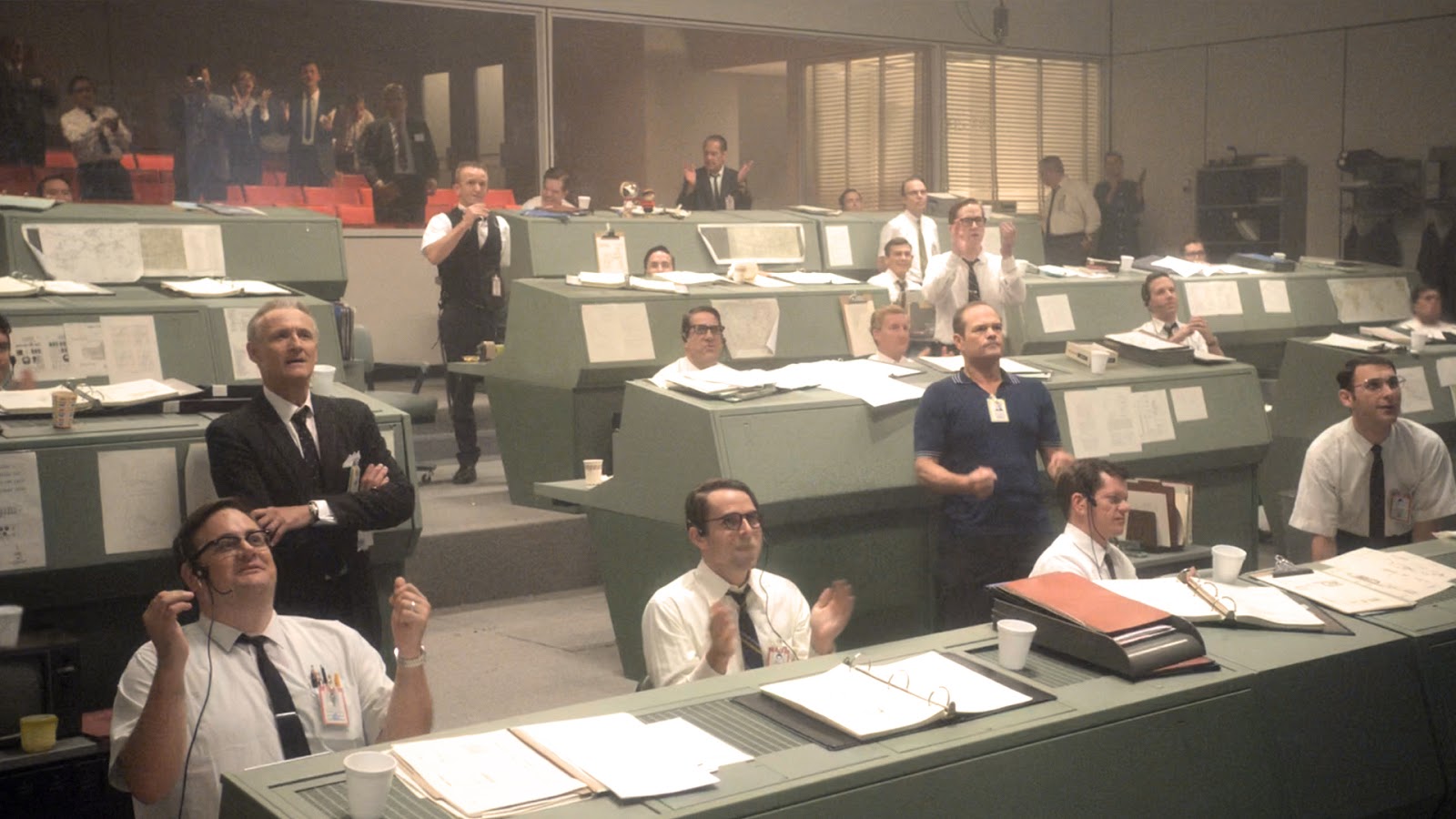
The first few minutes of For All Mankind play out like a documentary for the Apollo moon landing, interspersing archival footage of tense staff in mission control with shots of engineers in horn-rimmed glasses poring over data, backup astronauts raising their glasses in a pub and nervous families sitting in their 1960s living rooms, crowding around televisions.
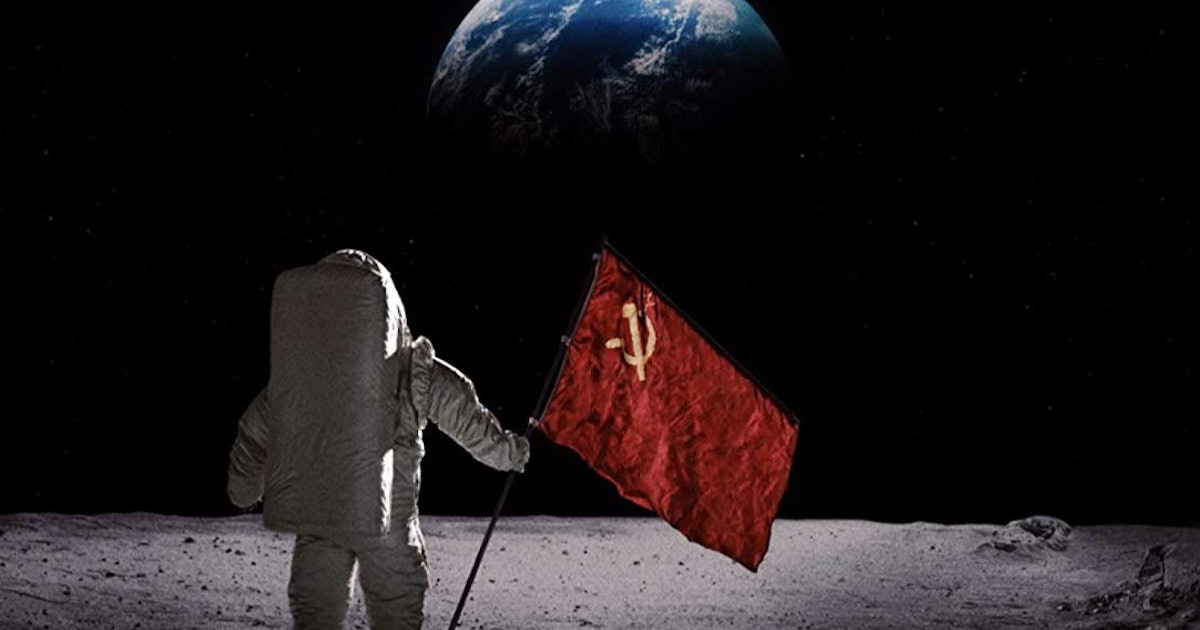
A news anchor cuts in to report he’s getting the live feed from the moon. We see the door of a lander open…and a Soviet cosmonaut strides out, planting the flag of the USSR on the lunar surface and becoming the first human to ever set foot on another world.
That’s the premise of For All Mankind. In this alternate history series, the fire that killed astronauts Virgil Grissom, Edward White and Roger Chaffee on Apollo I’s launchpad — which indeed happened in real life — led to policy changes and a more cautious culture at America’s space agency, resulting in the US losing the first and most momentous achievement of the space race.
That’s the start of the what-ifs.
What if the Soviets beat us to the moon? What if the rest of the space race was even more competitive than it was in our history, with an America struggling to prove its primacy? What if the US and Soviet Russia continued to pour incredible resources into space exploration? How far would we go? What kind of incredible new technologies would we invent? How would all of it impact American politics, culture, identity and standing in the world?
Could it have led to a better future?
Werner Von Braun (Colm Feore) and Deke Slayton (Chris Bauer) in NASA mission control in For All Mankind. Von Braun and Slayton were real-life leaders at the space agency and formative figures in the space race.
The answer to that question is hinted at in the series’ title, and while the show is filled with tense moments of international, organizational and personal rivalry, it’s infused with rational optimism instead of the cheesy, manufactured aspiration we’re accustomed to. It’s more like asking: What could the human race achieve if we all worked together? Is that retrofuturistic gleaming vision of the future still possible, and how do we get there?
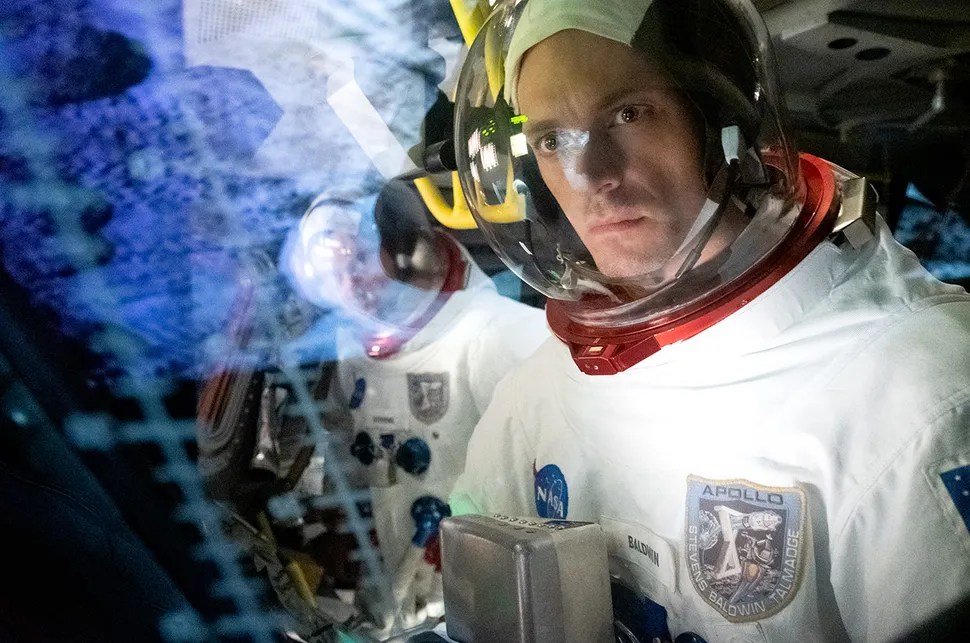
For All Mankind follows Ed Baldwin (Joel Kinnaman) and Gordo Stevens (Michael Dorman), astronauts and best friends whose Apollo mission came within a few thousand feet of landing on the moon just weeks before the Russian landing.
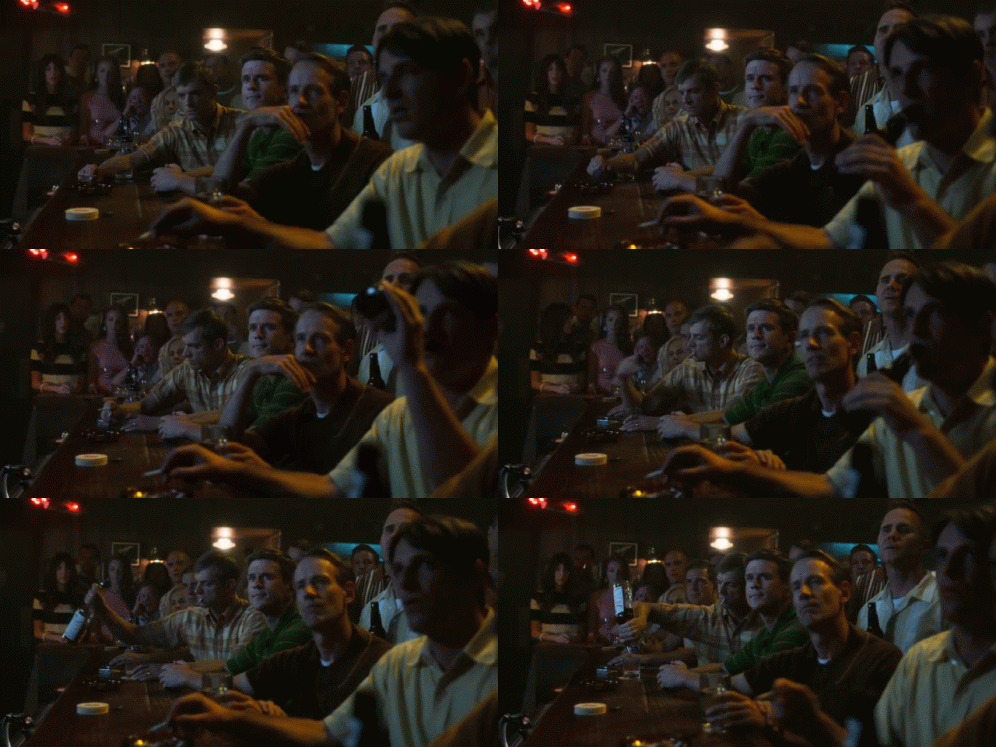
They’re miserable as they sit in a dive bar just off NASA’s campus watching grainy footage of cosmonauts claim their glory, and blame themselves for their failure to land even though it wasn’t in NASA’s cautious mission plan.
Astronauts watch the Soviet moon landing from The Outpost, a dive bar frequented by NASA employees.
The scenes that follow look like they could have come from the 1995 blockbuster Apollo 13 as we meet the astronauts, their kids and their nervous wives, the eggheads and flight directors at NASA, and the political players who keep the space agency funded and protected from the wrath of President Richard Nixon.
With the agency rocked by the Soviet achievement and intense political pressure, it embarks on a series of bold new endeavors dictated by the White House. Not only will Americans land on the moon, they will build a permanent base there, and — embarrassed and spurred on by the fact that one of the cosmonauts was female — NASA will for the first time train a new, all-female class of astronaut recruits.
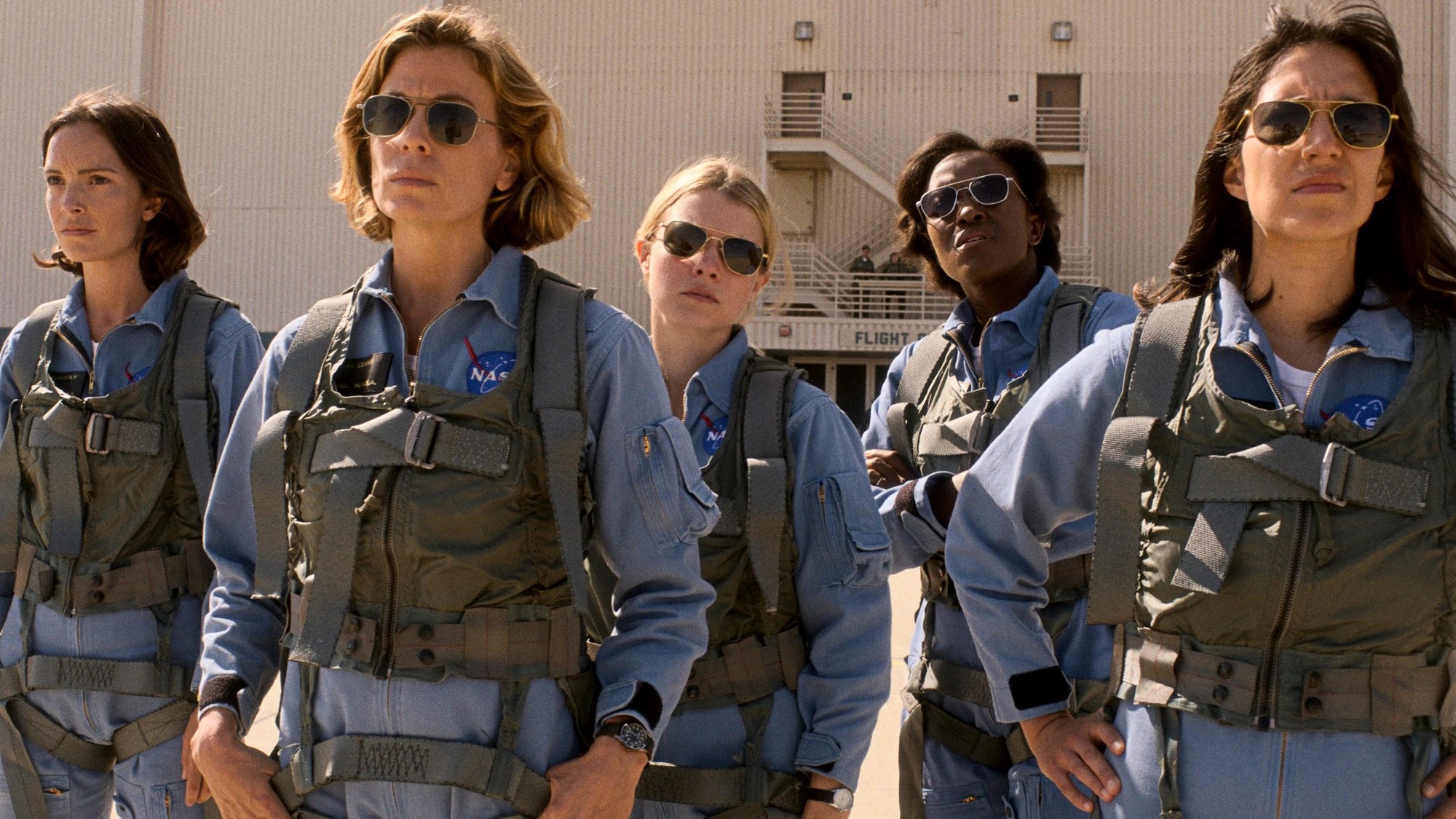
The later group includes hotshot pilot Molly Cobb, “token black girl” Danielle Poole, quiet but determined Ellen Waverly — and Tracy Stevens, astronaut Gordo Stevens’ beautiful wife who is an accomplished pilot in her own right. While the women manage the normal pressure that comes with astronaut training and the high stakes nature of the job, they must also contend with pushback coming from directions they don’t expect — including hostility from some of the wives of current astronauts, who feel their husbands’ jobs will be threatened by women in space.
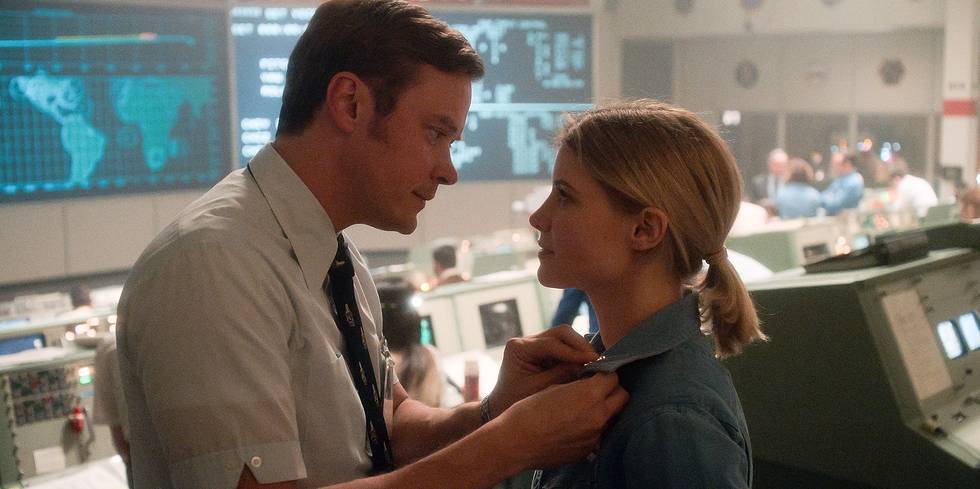
A proud Gordo gives his wife her astronaut pin.
Ellen Waverly, Molly Cobb, Tracy Stevens, Danielle Poole and another recruit are part of NASA’s first class of potential female astronauts.
For All Mankind is a science fiction show, but it’s also a drama and a thriller, putting viewers through the wringer of emotions.
There are funny and amusing moments as the show references celebrities, political figures and musicians from the 1960s onward, grounding the narrative in American culture. The fortunes of some celebrities and politicians change in the show’s alternate history while others stay the same.
In one running storyline — which you’ll only catch if you pay close attention to certain scenes and montages — John Lennon survives the attempt on his life, continues on as the grating, post-Beatles John Lennon most people would like to forget, and becomes just another aging musician cashing in on past glory alongside bandmate Paul McCartney and bands like the Rolling Stones.
The extension of the space race and continuation of US-Soviet rivalry impacts society in profound ways, many of them we may not realize from our historical perspective.
For example, DARPA created the internet because the US government and military wanted a decentralized communications network that could withstand nuclear attacks and remain operational even if major nodes are taken out in nuclear blasts.
That’s why the internet works on such a wide variety of hardware and why, even when major servers go down, our routers are able to move data packets via alternate paths. It’s difficult to imagine a time when the web wasn’t a medium for exchanging photos and videos of cute cats, but the early internet was populated by government officials, Pentagon brass and leading scientists in crucial fields.
In real life, restrictions were taken off the internet when the Soviet threat began to fade, allowing widespread civilian adoption of the technology and early dial-up services like AOL and CompuServe.
That doesn’t happen in For All Mankind’s alternate history as the USSR and communism remains a major threat, resulting in pop culture developing along a different cultural arc than the one we’re accustomed to.
While the pop culture references, sets, cars and costumes help ground For All Mankind historically, the show is at its best when it puts us in mission control and the command modules of high-risk space missions, constantly reminding us of the danger these men and women face while highlighting the commonality of astronauts, cosmonauts and later space explorers from other countries, all of them just human beings millions of miles from their families and everything they’ve ever known.
At the same time, the US and the USSR are playing a game of nuclear brinkmanship and astronauts are in many ways on the front lines as they figure out how to co-exist in unprecedented circumstances and places famously inhospitable to human life.
If astronauts tap a lunar mine too close to Soviet base camp, could that start a war? Are the Soviets spying on communications between NASA and its astronauts on the moon? What happens if someone gets hurt and their blood can’t clot in low/zero gravity?
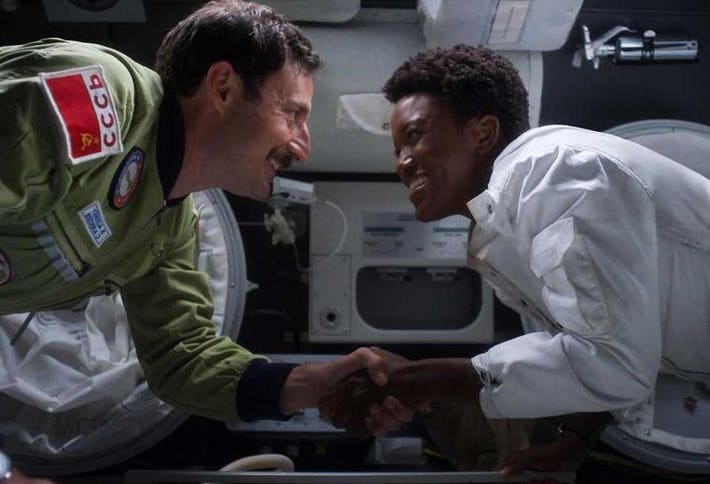
NASA astronaut Danielle Poole shakes the hand of her Soviet counterpart as their modules dock in space.
Kinnaman, Dorman, Sarah Jones (Tracy Stevens), Sonya Walger (Cobb) et al shine in those scenes as they juggle the pressure of surviving in space with being exemplars of — and diplomats for — their country. Rather than be content painting the Soviets as the traditional bad guys, the show also gives us a close-up look at the people in the USSR’s space program and the pressures they face, particularly Polish actor Piotr Aleksander Adamczyk’s Sergei Nikulov in his relationship with his NASA counterpart, flight director Margo Madison.
In one of the show’s quieter moments, Poole (Krys Marshall) takes two cosmonauts to The Outpost when, during joint training exercises, they request real American cheeseburgers and whiskey. After a few drinks one of the cosmonauts grows somber and tells Poole how he held Laika, the Moscow street dog who was famously blasted into low Earth orbit in her own little module, before scientists were sure enough in the technology to risk human lives.
Although Soviet propaganda feted Laika as a hero and the official story said she survived until re-entry, the cosmonaut tells Poole that Laika died shortly after liftoff, terrified, alone and subjected to unimaginable forces as thousands of pounds of fuel carried her capsule heavenward via brute force.
(The west was no less barbaric: The French famously sent a street cat named Felicette into space while NASA used a young chimp named Ham. In all of those cases the animals were named only after their missions, as mission commanders didn’t want to risk humanizing them in the event of disaster. Had Felicette and Ham both died in space they’d be remembered only by their identification numbers as footnotes in early space history.)
Kinnaman grounds the show as Ed Baldwin, one of the second generation of astronauts who take the mantle from men like Neil Armstrong and Buzz Aldrin.
For All Mankind recently began its fourth season and because AppleTV’s marketing and promotion is curiously weak, it remains one of TV’s best-kept secrets. If you haven’t seen the show yet, now’s a great time to jump aboard with so many TV shows on hiatus for the holidays and many others pushed back or canceled in the wake of the parallel strikes that halted production for most of 2023.
For All Mankind
Network: Apple TV
Content rating: TV-MA for bad language, occasional drug and alcohol use and mature themes.
Ratings: 8.1 (IMDB), 93% (Rotten Tomatoes), 4/5 (Common Sense Media)







 Pain In The Bud