Would your cat resemble a sphynx if you shaved its fur? Buddy the Cat investigates!
Dear Buddy,
Do all cats look like sphynxes underneath their coats? What I mean is, if someone were to shave off all your fur, would you look like a weird wrinkly little alien thing too?
Wondering In Wyoming
Dear Wondering,
Who told you that? Is Big Buddy planning to have me shaved? Is he gonna condemn me to one of those “groomers” and have me transformed into some undignified, naked, dumb-looking creature?
I will end him!
Buddy
Dear Buddy,
Whoah, hold up there, champ! No one’s got anything planned for you, it’s just a hypothetical. I’m genuinely curious about the no fur thing, that’s all. And I asked you because you’re the expert on every topic!
Wondering in Wyoming
Wondering,
Okay, okay, but I’m not letting my guard down. As the wise man George W. Bush once said: “Fool me once, shame on you. Fool me…uh, you can’t get fooled again!”
I thought about your question and became more curiositized as well because sphynxes are weird and I don’t want to look like those freaks. Get mistaken for one and the next thing you know, they’re bringing you back to their mothership.
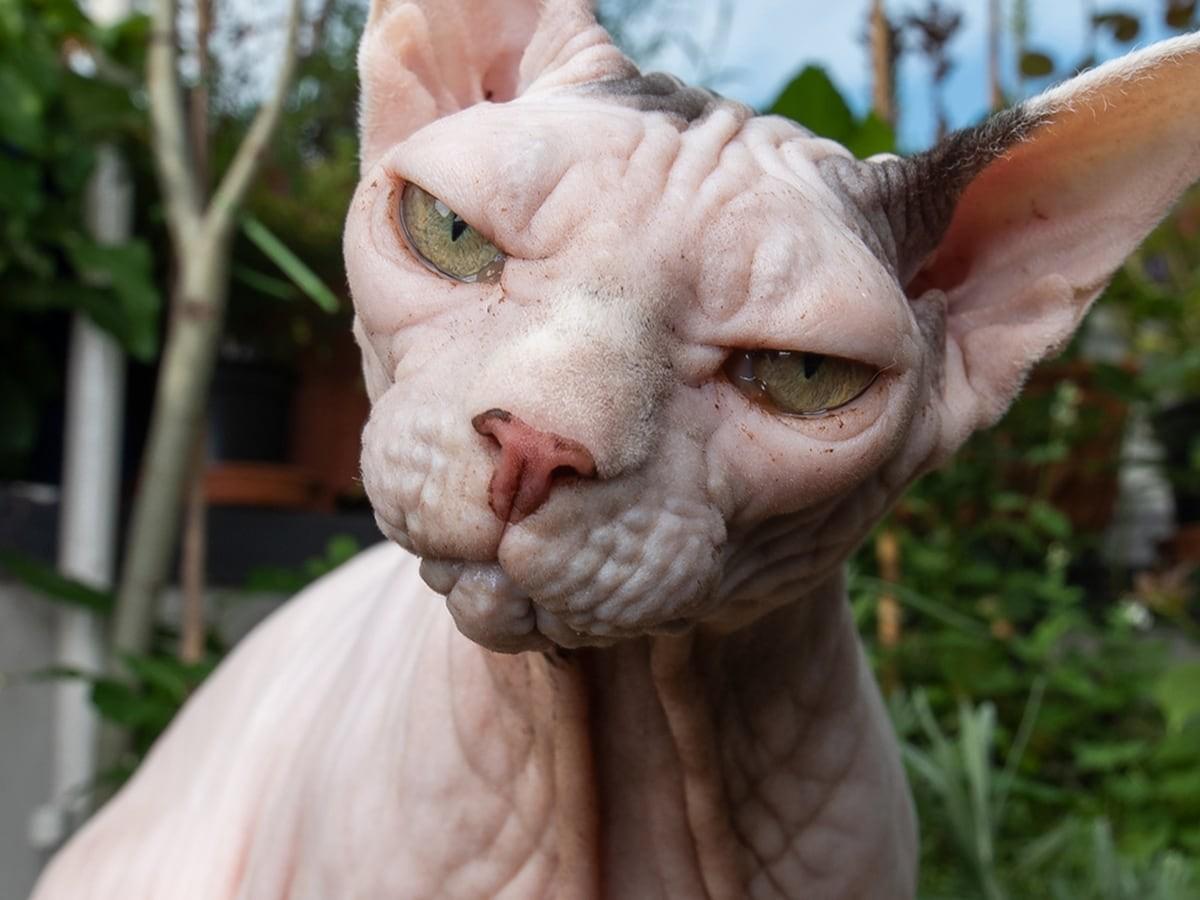
Above: These sphynxes are plotting your doom! They want to beam you up to their ship, test your skin for potential scratching post material, and eat your brains.
I can assure you that I would not resemble a sphynx if somehow I was overpowered (a tall order that would require a small army), drugged and shaved of my luxurious fur. I would just look more ripped, as there wouldn’t be any long fur to cover up my six pack and my rippling meowscles.
Due to his impressive meowsculature, Buddy would simply look even more ripped if someone with a death wish tried to shave his fur.
As for other cats, apparently they would not look like sphynxes either, because those freaks are uniquely covered in wrinkly skin, which is probably a side effect of the strange atmospheric conditions on their homeworld.
During my detailed investigatory investigation, I found images of domestic shorthairs, Maine Coons, Persians, Bengals, ragdolls and many other types of cats who were forced to endure ignominious “lion cuts” and other ridiculous “grooming” efforts. While many of them looked skinny and much less impressive without their fur bulking them up, they pretty much look like regular cats with a fuzzy, velvety coat instead of fluff.
Not as ripped as me, obviously, but not like sphynxes either.
I hope that answers your question. Remain vigilant, my friend! One never knows when one’s devious human might decide to humiliate one by shaving off all of one’s fur.
The would-be robbers knew the cat was worth money and specifically targeted the victims, according to police.
Two armed men broke into a Connecticut home on Sunday afternoon and demanded the victims turn over their “high dollar value cat,” according to the East Haven Police Department.
The would-be robbers initially tried to force their way into the East Haven house through a rear sliding glass door, but when the victims tried to prevent them from getting in, one of the men simply kicked through the glass, cops said.
That’s when the intruders brandished a handgun and demanded not cash, not jewelry or other valuables, but the cat!
The kitty in question must have been spooked by all the commotion because the frustrated robbers left empty-handed after a few minutes of fruitless searching. They hopped into a blue BMW and sped off, the victims told police.
Cops didn’t offer any description or breed information about the feline, describing it simply as a “high dollar value cat.”
It’s not uncommon for prized breed cats to command $5,000 from prospective buyers, and some breeds like the “exotic” Savannah cat can sell for as much as $20,000.
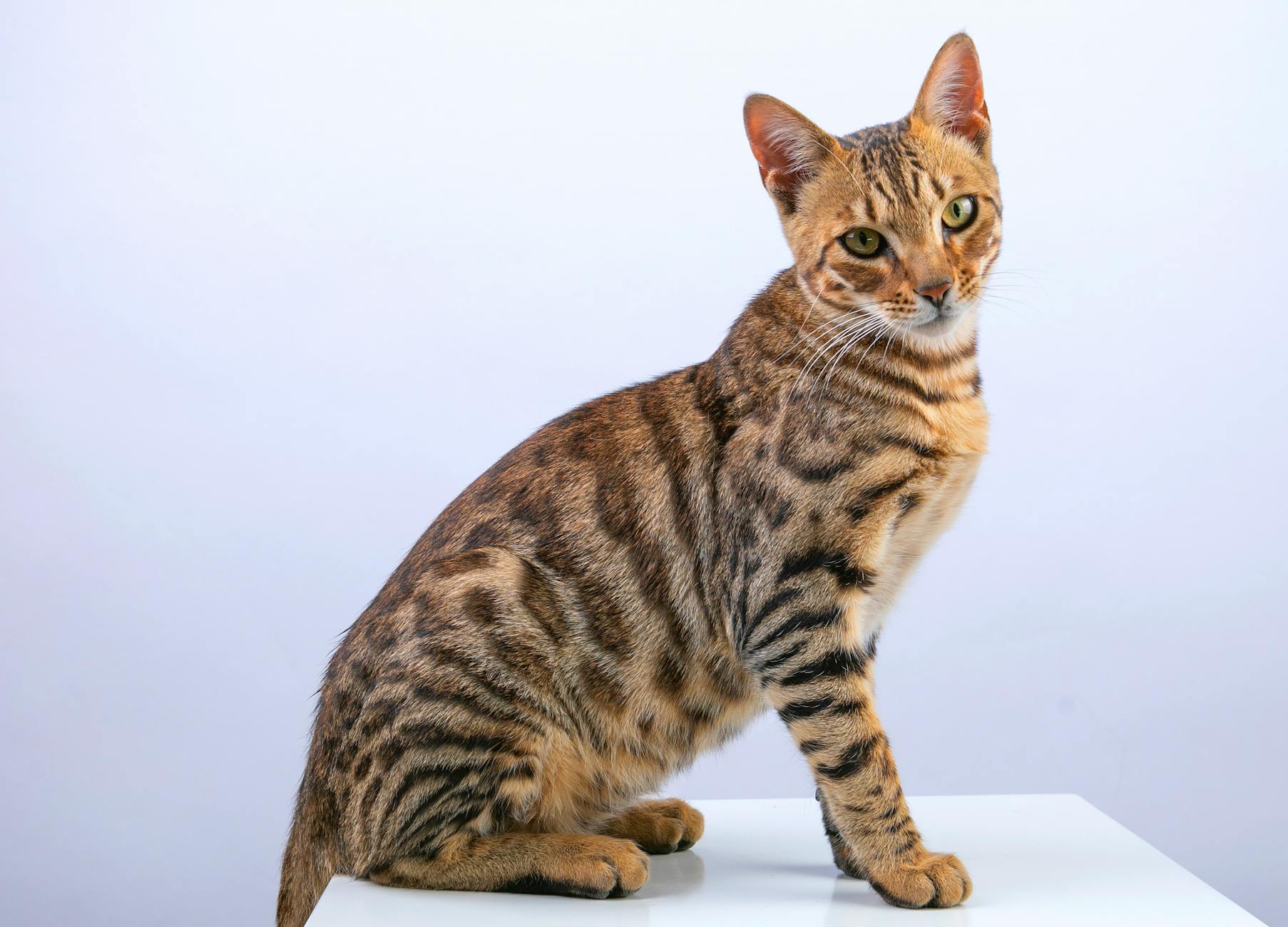
Bengal cats like the one above are favorite targets of thieves. Credit: jerry u6770/Pexels
While it’s unusual for someone to break into a home and demand a cat at gunpoint, in the middle of the day no less, cat theft is actually a thing.
Thieves most frequently go after Bengals, Savannahs, Maine Coons, Ragdolls and other breeds that can make them a quick buck by selling them to unsuspecting buyers. Surprisingly domestic shorthairs are on several lists of most commonly stolen cats, but a vet tech tells Reader’s Digest that moggies make the list simply because there are so many of them.
Part of the problem is that the penalties for stealing cats aren’t prohibitive. Most states either treat cats and dogs as property that can simply be replaced, or classify theft of pets in archaic agriculture and markets laws, which were designed to deal with disputes over livestock and farm animals, not pets.
In Sunday’s attempted robbery, police found the BMW abandoned in Hamden, a town about 10 miles north of East Hampton. They’re still looking into the unsuccessful caper, telling local media that the attempt was planned, not a crime of opportunity or a random event.
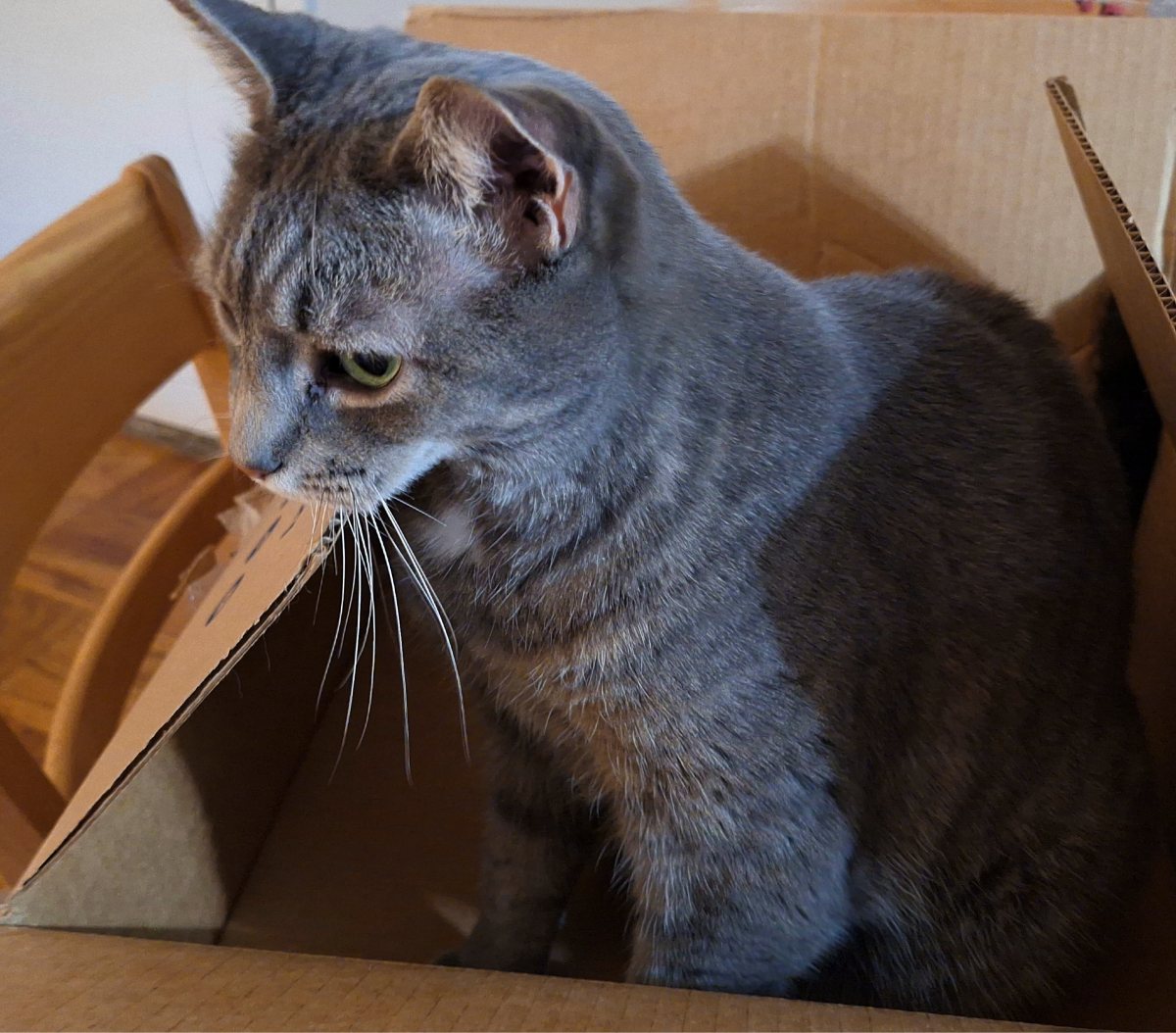
Still, if you have a “high dollar value cat,” it’s worth taking some precautions. Here at Casa de Buddy we’ve installed a feline version of a panic room: a panic box! Reinforced with heavy shipping tape, the thick corrugated cardboard is sure to keep bad guys out while also remaining roomy, yet paradoxically snug.
A man in Guam now has two cats after his little buddy adopted his own little buddy.
Last year we wrote about Youtuber Estefannie and her attempts to DIY a sophisticated artificial intelligence-enabled bathroom for her cat Teddy and her “cat’s cat,” Luna, after the former racked up a $3,000 vet bill prompted by an incorrigible plastic-munching habit.
One of the problems, Estefannie explained in her entertaining video on the building and coding process, was that Luna was “technically not my cat, this is Teddy-Bear’s cat.” Luna “uses the same litter box as Teddy,” so Estefannie had to train a machine learning algorithm for the high tech bathroom’s cameras to distinguish between felines.
I’ve always been fascinated by the phenomenon of “cat’s cats,” meaning stray cats who are adopted by la vida loca-living kittypets to share in their warmth, yums and human servantry.
“You gotta move in, Stripes,” I can imagine a well-fed moggie telling a stray buddy. “The service is great, the food is out of this world and the ambience? Oh, the ambience!”
In those cases, the stray usually follows the housecat right into their new home, which is what happened when Christian Fleming’s cat, Little, came back with a friend.
“I was surprised the cat came inside, initially,” said Fleming, who lives in Guam. “But if he’s hungry enough to be that brave, I wasn’t going to begrudge the food.”
Little, left, and his new friend Tedo. Credit: Christian Fleming
Little, left, and his new buddy Tedo. Credit: Christian Fleming
Fleming named the new cat Tedo and told Newsweek he’s “90 percent sure he used to be someone’s pet or they left him, which is largely the case with friendly strays out here.” Guam is a US territory in the Pacific, about 1,450 miles east of the Philippines, and to say it’s got a stray cat and dog problem is an understatement, with tens of thousands of homeless animals.
One local veterinarian called the problem “astronomical” in an article for the Pacific Daily News, pointing out there more than 60,000 dogs alone on the 210 square mile island. By contrast there are 168,000 people living in Guam, meaning there’s more than one dog per three people. Cats similarly run rampant, although estimates of their population are harder to pin down.
There’s been a strong effort to spay and neuter in recent years, but local veterinary groups have a massive job in front of them to get the Micronesian island’s domestic animal population under control and reduce the suffering of unwanted cats and dogs.
Tedo is one of the lucky ones and has settled down nicely in his new digs. He’s adjusted to indoor life, regular meals and feeling protected with Little and Fleming, who says he now has “a small herd following me around” in his home.
“He has since gotten braver and more comfortable,” Fleming said. “When he jumped on me to snuggle with Little, I knew he had decided to live here.”
RIP Nacho
I’m not a fan of gastronomical fetishism, the concept of celebrity chefs or the idea that watching someone else eating food on television counts as entertainment, but I do respect Bobby Flay for two things: he’s a cat guy and he had a hilarious cameo in HBO’s Entourage in which he enraged high-powered agent Ari Gold by dating Mrs. Ari while the two were separated.
Flay, who has been the star of more than 20 cooking shows (not including specials) on the Food Network and Cooking Channel, saw the potential for profit in the pet food market and launched Made By Nacho in 2021, naming the food line after his little buddy.
Sadly the photogenic Maine Coon died this week, Flay announced in an Instagram post. Nacho was only nine years old and while that may seem a tragically young age for a cat to die — and it’s tragic any time someone’s beloved pet passes away — Maine Coons lose in lifespan what they gain in size, living an average of 10 to 13 years compared to the 13 to 18 year life expectancy of domestic felines in general.
Flay used the occasion of his cat’s death to hawk his outrageously expensive pet food line, which is weird. In his goodbye post, Flay wrote that “Nacho’s inclusiveness in our home inspired me to create something that would nourish cats everywhere.” Everywhere meaning houses where people don’t mind paying $3 for a 3oz can. (We don’t endorse any particular brand at PITB but Bud’s wet food, which always has real meat as the first ingredient and doesn’t include grain or fillers, costs 51 cents per meal when bought in bulk from Chewy.)
Cat food issues aside, Flay’s undoubtedly grieving his well-loved little friend, and although he recently adopted two more cats, that’s little consolation for losing a feline you’ve loved and bonded with. Best of luck to the Flay family and RIP Nacho.
Plus: Bruno, who was surrendered to the shelter twice for being “too affectionate,” has found a new home.
Meet Kusa, an absurdly large Maine Coon.
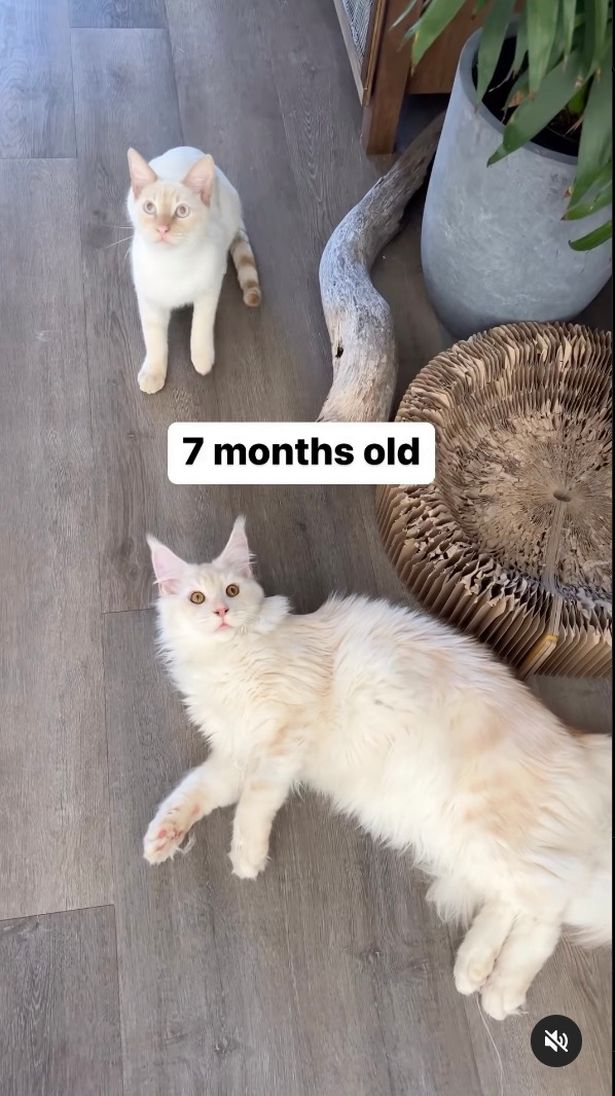
Of course you’ve seen huge Maine Coons before, so what’s special about Kusa? Aside from being a stunning white-furred beast of a cat, the big guy is still a kitten! At nine months old, Kusa could make a light snack of most felines. And because Maine Coons continue to grow until they’re three years old or even past that age, Kusa could have a legitimate crack at being the biggest domestic cat in the world, in addition to scaring the pants off unsuspecting pedestrians if his people take him out for a stroll.
Here’s Kusa as a baby:
And here’s Kusa now:
Kusa lives with his human, Chastity Hobbs, in Phoenix, Arizona. She says one of the biggest challenges was finding a litter box big enough to accommodate him. She may have to swap it out for an even bigger one before long.
“People are amazed when they see him,” Hobbs said. “They always think that he’s crossed with a bobcat or something.”
Maine Coons are known as gentle giants and tend to be relaxed compared to most cats. Credit: Chastity Hobbs/Instagram
Bruno gets a new home
Bruno the Cat has had a tough run early in life through no fault of his own.
The first time he was adopted all seemed well until one of his family’s children appeared to have a cat allergy, so the little guy was brought back to the shelter. But he was still young and very cute, so it wasn’t long before another family brought him home during the pandemic.
Unbelievably that family returned Bruno because he was “too affectionate.” Their definition of “too affectionate”? Little Bruno liked to head bunt the mother while she was working from home and he liked to sleep in bed with her daughter. The mother didn’t like the fact that her daughter was staying up late to play with Bruno, so back he went to the shelter.
Bruno’s story went viral when Montville Animal Shelter of New Jersey posted about his plight and included a photo of him looking depressed. Who wouldn’t be if they thought they’d found their forever home twice, only to be rejected for being a snugly, happy cat?
The Facebook post amassed more than 200,000 views and hundreds of comments, leading to more than 50 applications to adopt Bruno, Montville Animal Shelter’s Lindsay Persico told USA Today. It was also a boon for the shelter’s other animals.
“People were coming to our door to meet Bruno and we got almost all the cats in the store adopted in the meantime,” Persico said.
Let’s hope the third time’s a charm for dear Bruno and he really has found his forever home. He deserves it.
Bruno was sad after he was surrendered to the shelter for the second time.
Big cat sightings across the UK have a lot in common with UFO sightings in the US.
Shhhhh!
No one tell NewsCorp that “black pumas” don’t exist, pumas are native to the Americas, leopards are native to Africa and Asia, and a “black panther” is a color morph, not a species of cat.
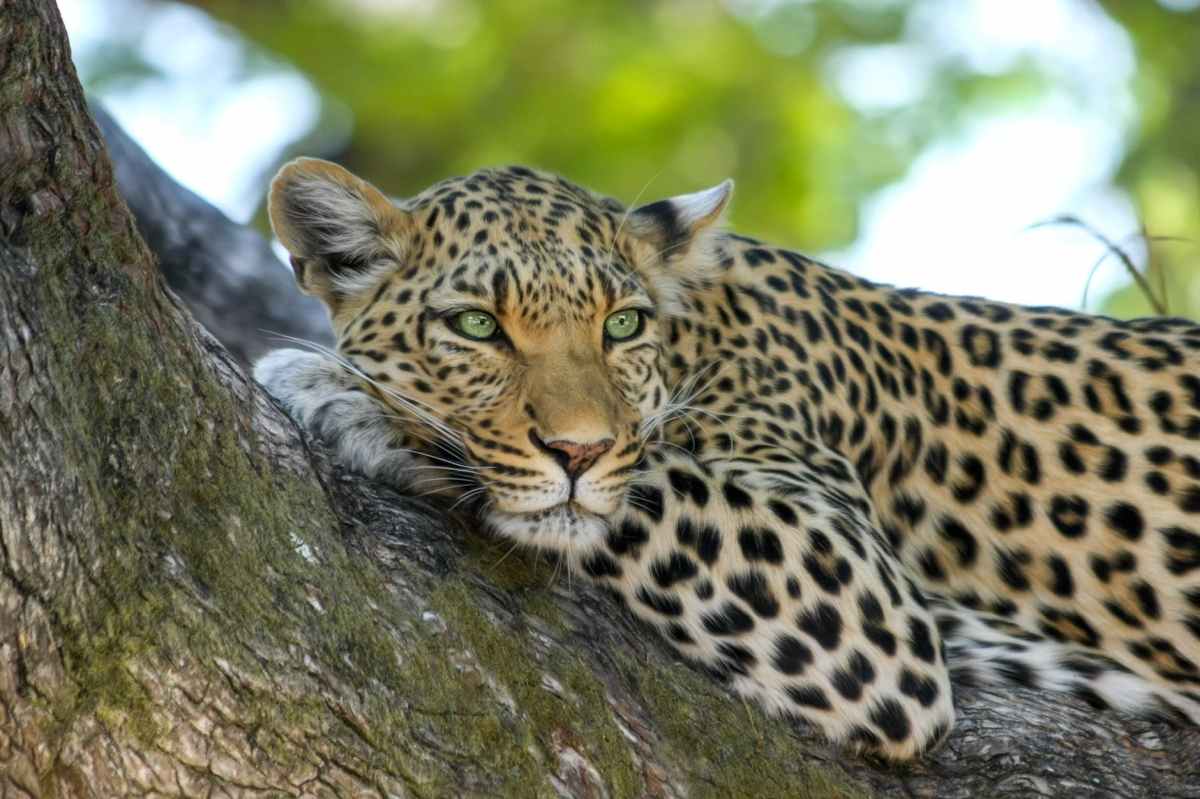
A story from Fox News — prompted by a similar story in the UK’s Sun, part of the same Rupert Murdoch-owned media conglomerate — claims the British are “unnerved” by an “uptick” in sightings of cryptid big cats. The mysterious creatures are supposedly running rampant in the British countryside and in the suburbs, according to the article, which identifies them as black pumas, black panthers and black leopards.
Oddly, the story says the sightings are up significantly because there have been three “big cat” sightings in October, immediately before informing readers there are 2,000 such sightings in the UK every year.
Little Buddy and I are not exactly known for our math skills, but 2,000 sightings a year works out to 167 sightings per month, which is a lot more than three. Fifty five times more, in fact. So the story should really be about a dramatic dip in phantom big cat sightings, shouldn’t it?
What evidence does the Fox report cite for its breathless claim about big cats taking over the UK? A pair of grainy security camera videos, including one showing a “big cat sighting” at night, and the word of a “big cat sighting expert,” alternately called a “countryside expert” in other media reports, who by the way happens to be hawking a documentary on the sightings.
“It’s a crucial issue,” self-described wildcat expert Rick Minter told The Sun. “How do we come to terms with living alongside big cats in Britain?”
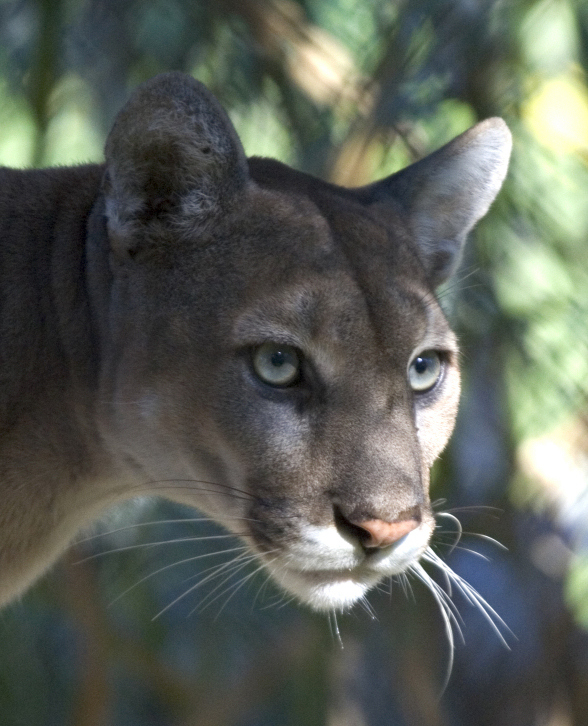
Pumas, also known as cougars, mountain lions, panthers and catamounts, are native to the Americas. Credit: Wikimedia Commons
For readers unfamiliar with the highest echelons of reputable journalism, The Sun is the UK’s foremost bastion of trustworthy reporting, a tabloid par excellence whose editorial staff are known for breaking stories about “crazed werewolves” and immigrants barbecuing the late queen’s swans when they weren’t running topless photos of models on Page 3. The Sun is owned by NewsCorp, the parent company of Fox News.
As for the two pieces of footage, one is the aforementioned blurry mess recorded by a home security camera at night, and shows a few frames of a cat’s behind and a tail as the felid walks out of the frame. The other is a blurry clip the credulous claim depicts a large cat feeding on a sheep. There’s no indication the figure is a felid of any type.
As far as we’re concerned, there are a few possible explanations for the sightings:
They’re former pets
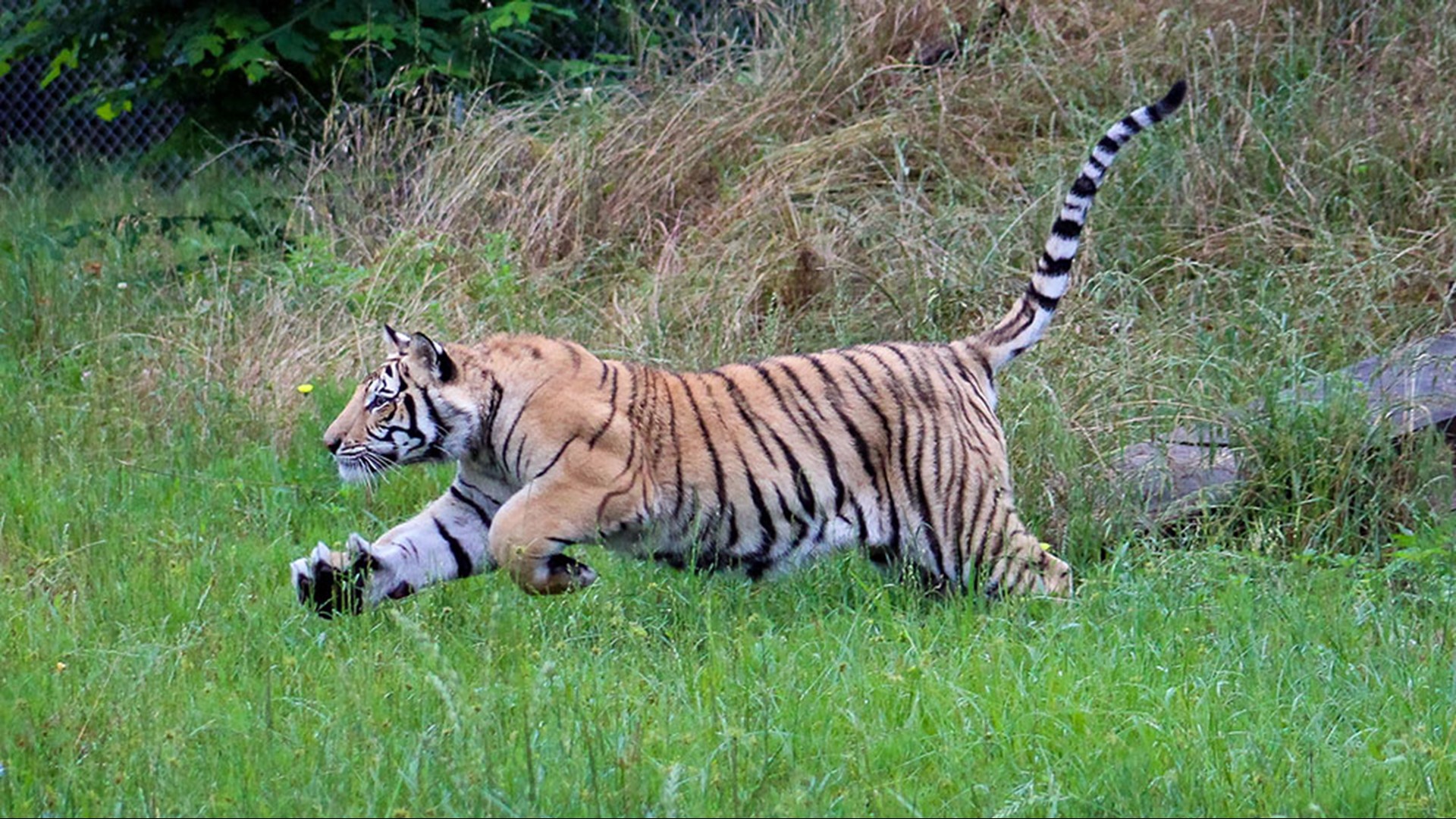
India the tiger was found wandering the suburbs of Houston in 2021. In this photo, he’s enjoying life in his sanctuary’s large enclosure where he’s got plenty of room, stimulation, toys and even his own rock pool.
If there are indeed big cats roaming the British countryside and suburbs, they would have to be former pets of people who acquired them on the illegal wildlife market, broke the law by “importing” them into the UK, then broke several additional laws by keeping them as pets until the cats quickly grew and the owners realized keeping them is untenable.
Such situations aren’t unheard of, obviously, but they can’t account for a dozen big cats on the loose at any one time, much less more than a thousand as Minter claims.
More importantly, big cats who are taken from their mothers as days-old cubs, sold as pets and later dumped are universally confused, terrified and unable to fend for themselves. They end up roaming suburbia in broad daylight, like a nine-month-old tiger named India who was spotted wandering around the outskirts of Houston in 2021, sniffing out potential food in garbage cans because they don’t know how to hunt.
If these phantom big cats were former pets, they’d be spotted, captured and taken to sanctuaries within a matter of days.
They’re small wildcats formerly native to the area, like the Eurasian lynx
The problem is, the Eurasian lynx was extirpated from the UK about 1,400 years ago. There have been debates among conservationists about reintroducing wild populations to the British countryside — and to Ireland — but no concrete plans as of yet. Proponents say the lynx could be beneficial, keeping deer populations level without major human intervention.
Eurasian lynx adults can grow to about the size of medium dogs, so it’s possible they can be mistaken for “big cats” in blurry video, especially when perspective and/or lack of other objects makes it difficult to place their actual size in context. However, as with big cats, any Eurasian lynx spotted in the UK are likely to be former pets.
They’re housecats
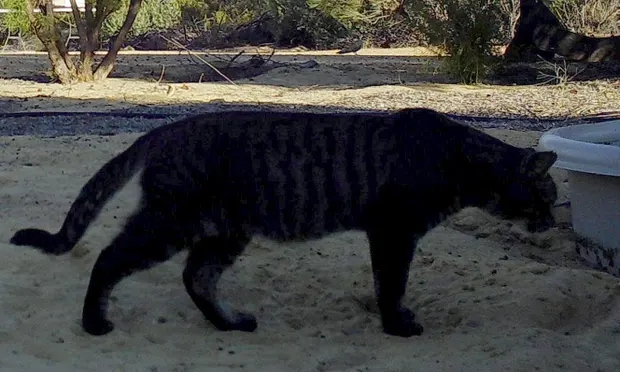
This feral cat, a plain old member of the felis catus species, was repeatedly mistaken for a big cat in western Australia back in 2018.
If witnesses in the UK are mistaking house cats for big cats, they wouldn’t be the first.
Stories abound of little cats prompting “big cat” sightings, from Vancouver (a Savannah cat) to Scranton, Pa. (a missing house cat), to San Jose (a Maine Coon) and even Australia. (A feral cat.)
One wildlife ranger in Australia became so annoyed with fielding frequent big cat reports that he implored people to educate themselves.
“People need to get over the idea the cats are panthers,” wildlife ranger Tim Gilbertson told Australia’s ABC news. “It is just not on. They are big feral cats, at least 50% bigger than a house cat and they are powerful.”
The usual issues are in play here: Fuzzy security camera footage, night sightings, confused witnesses. You’d think there would be more phantom big cat sightings in the US, since pumas can grow to the size of jaguars and could be mistaken for lions, but people who live in areas where pumas range tend to know they’re around and what they look like. They’re also the definition of scaredy cats, reluctant to let humans spot them or get anywhere near them.
Frequently mistaken for a tiger: Buddy the Cat.
Ultimately, witness reports count don’t count for much, and not just because memory is malleable.
Thousands of people have reported seeing Bigfoot, chupacabras, the Jersey Devil and the Loch Ness monster, but those creatures are all firmly in cryptid territory.
There’s Occam’s Razor, and there’s common sense: For a primate species like Bigfoot to exist, for example, there would need to be a breeding population, enough prey for the creatures to feed themselves, and someone somewhere would have found remains at some point. (Bigfoot sightings go back to the days before Columbus set foot on New World shores, but it’s only been in the last century or so that the cryptid has entered the popular imagination via folklore and media.)
Likewise, if there are indeed 1,000 big cats prowling the British countryside, as Minter claims, there would be a breeding population, ubiquitous tracks and the remains of prey animals killed in ways consistent with big cat ambush techniques. Cats of all sizes are ambush hunters and have a distinct way of killing prey which is unlike other animals.
The UK’s big cat sightings should be treated more like the UFO sightings in the US and particularly around Area 51. They start with a kernel of potential truth — the existence of a secret base to test experimental military aircraft, or the possibility that big cats who were former pets have been let loose — which leads people to consider the possibility, then when they see something they can’t easily explain, they reach for the exceptional.
But as Carl Sagan famously said, exceptional claims require exceptional proof, and it’s no accident that things like UFOs, cryptid primates and phantom big cats only appear on the grainiest, blurriest and darkest footage.
My money is on domestic cats mistaken for their much larger cousins. Maybe Buddy’s been taking some transatlantic flights under my nose. I’ll have a little chat with him about it and ask him to kindly stop terrifying our friends across the pond.







 Pain In The Bud