A writer reminds us that feline friendships don’t always come easy, but some of the hardest-won are the most rewarding.
When San Francisco’s KQED, the local public radio affiliate, asked its culture writers to reflect on “one beautiful thing” from 2025, Rae Alexander chose her cat, Kevin.
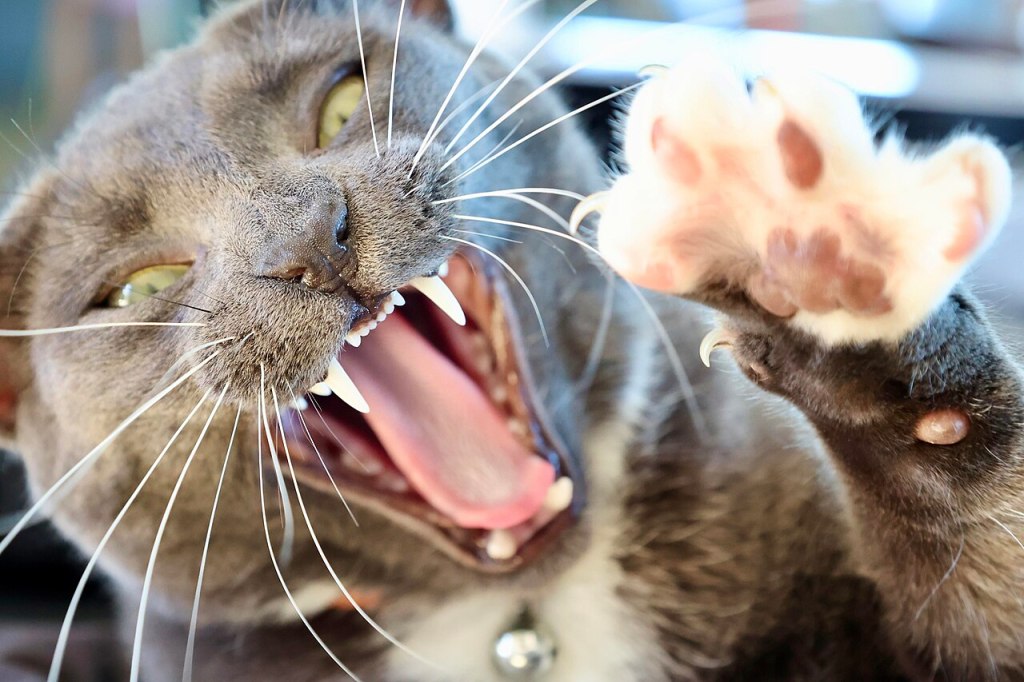
Kevin is “chaos in cat form,” a feline “sociopath” who doesn’t realize how much damage he does with his claws. The tabby, Alexander writes, is “never not screaming at us for food” and pads around as if he owns the place. (That sounds awfully familiar!)
After bringing Kevin’s heavily pregnant mother in from the cold earlier this year, Alexander adopted Kevin’s mother and his “well-behaved sister,” but was repeatedly rebuffed when she tried to get rid of Kevin himself.
Three potential adopters fell through while Kevin was growing out of his kitten stage, drastically reducing his chances of finding a home.
Then something crazy happened: cat and human came to a mutual understanding and the beginnings of trust led to friendship and love. As with any progress in gaining a cat’s trust, it was not a quick process, but Kevin eventually showed another side — a much softer, appreciative version of himself who enjoys cuddling and expresses love despite his quirks.
“As this fraught year draws to a close, I want Kevin to be a pertinent reminder to us all that the little things bumming us out today might just lead to the things that make us happiest tomorrow,” Alexander wrote. “Start putting all those everyday stresses on the stairs. You never know where that might lead in 2026.”
Apologies for going radio silent over the past week. This past Saturday I sat down to write and my computer was dead. As in completely dead — I couldn’t even trick it into loading BIOS or getting a boot screen.
So I said farewell to a machine that had served me well since 2018, that served as my primary platform for writing, producing music and gaming.
Now I’ve got an absolute beast of a machine centered on one of the new Ryzen chipsets, and it takes quite a bit of restraint not to go into nerdy details. I’m still setting things up, especially the music production workflow.
The important thing is, I’m able to properly sit at a desk and write again, and Buddy can properly supervise me from his desktop perch again, so we are now back!
Bud and I wish the best of days to all of our readers who are mothers, as well as sons and daughters spending time with their moms today. And how can we forget all the cat moms out there who put so much care and love into raising their babies?
As the expressions of some of these cat moms make clear, whether human or animal, kiddos and kittens have a way of making sure there’s never a dull moment. But that’s just one awesome thing about moms: no matter how much we might drive them crazy sometimes, they still love us!
And to my own mom, thank you for being there for me no matter what I’ve stressed over or how stupid I’ve been, and thank you for teaching me to strive to be a decent person.
When serial cat killers serve sentences of less than a year due to plea deals and early release for good behavior, how much deterrent value do our laws have? Not much, it seems.
Note, 5/3/2025: We’ve heard from two readers who say the MyNorthWest report contains inaccuracies. We’ve reached out to the police and will follow up with police and courts on Monday to verify the facts and correct potential misinformation. Apologies for the confusion.
Every couple of months, at least in the last year or two, I’ve slowed down on posting, and almost always for the same reason: my cat-related news alerts are seemingly endless streams of depressing stories about people shooting, strangling or dismembering cats.
It never ends, and sometimes it’s so overwhelming that I’m put off from writing for days. At the same time, I am not a believer in the idea that all animal blogs should be saccharine feel-good fests about fluffy kittens and TikTok videos of cats doing silly things.
There’s always a place for celebrating cats, but if they’re in danger, and if the stories point to wider trends that cat lovers should know about, then I think it’s our responsibility to remain educated. Not only so we can guard against threats to our little friends, but also so we can add our voices to the chorus calling for tougher laws and greater accountability.
That’s ultimately what this is about: accountability.
Stories about two cat serial killers in about a week have made it clear that even the strengthened animal protection law — the Preventing Animal Cruelty, or PACT Act — passed in 2019, during the first Trump administration, raising animal cruelty and murder to the level of a felony, are still not enough. They’re not a deterrent, especially when the convicted abusers and killers end up serving a year or less because prisons are overcrowded and the wider law enforcement community still doesn’t take animal-related crime as seriously as other violence.
Antoine Leander Runner Jr. is a serial murderer of cats. The Seattle man was recently released from prison after serving just a year for a felony animal cruelty conviction.
The 43-year-old’s modus operandi was setting up crude, homemade snares and traps to capture and harm felines. He was also known in cat rescue circles, where he posed as a cat lover and took advantage of programs to get free supplies, including “cat food, kennels, collars, leashes, and treats to lure cats and kill them,” according to MyNorthWest, a Seattle news site.
When locals discovered new homemade traps in Runner Jr.’s old haunts and trail cameras picked up images of the man himself stalking wooded areas, neighbors called police and area shelters. The evidence showed Runner Jr. was allegedly visiting cat colonies at night and had picked up right where he left off. One colony cat’s body was discovered on March 31, “disemboweled and publicly displayed.”
“Animal Control confirmed the injuries to the cats were human-caused,” MyNorthWest reported, adding that it appears Runner Jr. was visiting colonies “every night” to hunt cats.
Above images by u/picardhasyourback, posted to the SeattleWA subreddit. Click on the images to see full-size versions.
Runner Jr. was picked up by Seattle police this weekend after a neighbor spotted him in a wooded area and phoned authorities. The convicted cat killer, who had a new bench warrant out for his arrest, was charged with a misdemeanor, but more charges are likely as police investigate his latest alleged attacks on Seattle-area cats.
The Seattle man was originally arrested for killing cats in 2023, but was released early. The Seattle area was also terrorized by a serial cat killer who stalked the area in 2018, mutilating cats so badly that I won’t repeat the details on this blog out of respect for readers.
It should be made clear that Runner Jr. was not connected to the 2018 killings, but police should reconsider those cases as well because if it turns out Runner Jr. is guilty of these latest cat murders, it will be abundantly clear that he is a high recidivist offender who cannot be trusted to leave the animals alone. He should serve a long, unabridged prison sentence and be subject to constant monitoring when he’s released.
Antoine Leander Runner Jr. was arrested this weekend by Seattle police. Credit: Sarah Seiler/Facebook Georgetown Community Discussion Group
What’s the solution here? Increasingly tough criminal penalties for animal abuse and murder? Expensive monitoring equipment to watch over every cat colony? Education and training for law enforcement so violence toward animals is taken as seriously as it should be?
I hate to keep pointing out that people who harm animals are likely to “graduate” to harming humans, as many studies have shown, because it implies that we should only be concerned about animal abuse for its tendency to turn into human abuse. It obscures the fact that animal life is intrinsically valuable, and that cats — and dogs, many bird species, mammals and marine life — are sentient, with their own thoughts and emotions. But if that’s what it takes for people to take this sort of thing seriously, then it’s worth repeating the point.
Requirements for adopting Pepper included a sense of humor and experience caring for birds. He’s now found a home with patient caretakers and another mercurial parrot to hang out with.
It’s too bad cats can’t swear.
While kittens don’t often have problems finding homes due to their overwhelming cuteness and antics, it usually takes a sad story to drum up considerable interest when an adult feline is up for adoption.
As the SPCA of Niagara learned, talkative parrots, especially birds who can swear up a storm, have their pick of homes.
In June, a potty-mouthed parrot named Pepper was surrendered to the shelter, and when the SPCA put the call out — specifying they’d prefer someone with experience caring for birds and a sense of humor — the applications kept rolling in, totaling more than 400.
“His famous line is ‘Do you want me to kick your ass?'” a shelter employee said in an interview last month shortly after announcing Pepper was up for adoption.
Shelter staff asked applicants to include photos of their bird enclosures in addition to the usual pre-adoption questions, eventually narrowing the Pepper Sweepstakes down to 10 potential homes.
This past week, Pepper was finally taken to his new abode in Olean, a small city in western New York. The couple who adopted him are not only experienced with birds, they know all about avian vulgarity. They have a parrot named Shelby who apparently “makes Pepper look like a saint.”
As for Pepper, it looks like he’s getting his bearings before heaping abuse on his new caretakers.
“He hasn’t cursed at them yet, but we know it’s coming,” shelter staff wrote in an update.
In recent decades, research has shown birds can be exceptionally intelligent. Crows, for example, use tools, can differentiate between human faces, and remember which humans have wronged them or treated them well.
While many people assumed parrots merely imitate human language, long term behavioral studies show the birds are able to use words in context and invent novel combinations of words. As with other animals, syntax remains elusive.
The most famous example was Alex the African Gray, who was the subject of research by animal cognition expert Dr. Irene Pepperberg. Alex, who died in 2007 at the age of 31, was able to count and could perform simple calculations. He was talkative, conversant and often told his caretakers how he was feeling, what he wanted, and what he thought of the tests they’d give him. (Like a child, Alex would try to get out of exercises he was bored with by asking for water, saying he was tired and wanted a nap, or just flubbing his answers.)
We are not above crude humor here at PITB, and in the past we’ve written about Ruby, our favorite talking parrot. Ruby lives in the UK with her owner, Nick Chapman, and the pair were among the very earliest Youtube stars thanks to videos of Ruby’s shockingly vulgar, extremely British tirades and Chapman’s infectious laugh.
Warning for those who are offended by bad language or are viewing at work: Ruby is known for liberal use of c-bombs-, t-bombs, f-bombs and just about every other linguistic bomb you can think of, in addition to British slang like “bollocks.” If that’s a problem for you, skip this video.
Eric the Legend, a parrot who lives in Australia, is also a favorite on Youtube for his habit of declaring himself “a fookin’ legend!“
We’re glad Pepper has found a home where his idiosyncratic nature will be cherished, and we hope the future will bring videos of Pepper and Shelby going back and forth. Parrots are social animals, after all, and what fun are insults if you’ve got no one to trade them with?