What would the Dictionary Man think of a modern American society dominated by the power and cuteness of cats?
Cats have taken over the internet, claim a mighty share of the $64 billion Americans spent on pet food in 2023, and have essentially installed themselves as the leisurely masters of 28 percent of American homes.
But it wasn’t always that way, and a look at the first-ever edition of Webster’s Dictionary reveals a very different attitude toward our furry overlords:
“The domestic cat needs no description. It is a deceitful animal, and when enraged, extremely spiteful. It is kept in houses, chiefly for the purpose of catching rats and mice.”
Wow. Whoever does feline PR should get a raise, because we’ve gone from “We tolerate the imperious little bastards because they’re good at killing rodents” to “Does my little angel want a snack? How about some ‘nip then? Anything for my bestest little pal!” in the span of two centuries.
Buddy 1, Noah Webster 0. Naturally.
Noah Webster, whose name is now synonymous with dictionaries, saw the effort to standardize spelling and pronunciation as central to formalizing an American linguistic identity distinct from our mother country. Or, as he put it, “[t]o diffuse an uniformity and purity of language in America” that would not only differentiate our English from England’s, but also unify the states at a time when many people still viewed the idea of a united states with skepticism.
By doing so, he hoped America would avoid the pitfall of dividing itself into regions of nearly mutually unintelligible dialects, a problem that plagues other countries. Consider the fact that India has almost 800 distinct languages and dialects, down from a staggering 1,652 in 1961 as hundreds of local languages died with the last generations of their speakers. Hindu, the country’s most popular language, is spoken only by about 43 percent of the population.
The goal, Webster wrote when he published his dictionary’s first edition, was “to furnish a standard of our vernacular tongue, which we shall not be ashamed to bequeath to three hundred millions of people, who are destined to occupy, and I hope, to adorn the vast territory within our jurisdiction.”
As dictionary.com notes, Webster wrote that passage in 1828 when the US population was just 13 million and vast swaths of what we now consider familiar territory was at the time largely unexplored wilderness.
His prediction of an America of 300 million people came true in 2006. Today there are approximately 335 million of us.
In other words, a hell of a lot has changed since the Connecticut born-and-raised Webster cobbled together a uniquely American system of spelling and pronunciation, so maybe it shouldn’t be a surprise that attitudes toward cats have shifted so dramatically.
Still, we’d love to see the look on Webster’s face if we could bring him forward in time and show him how the “deceitful” and “extremely spiteful” little furballs have come to such prominence in American culture. What would Webster make of the spoiled modern house cat, with her condos, tunnels, toys, harnesses, bowls filled with salmon and duck, and even psychoactive recreational drugs for their enjoyment?
Bow before your feline overlords, Webster!
“We have made some edits, humans. See to it that the next edition includes this new and improved definition, or we shall withhold snuggles.”
The strange footprint may date back as far as 35 million years ago, according to a preliminary analysis.
Before house cats, tigers and lions, before sabretooth cats and their scimitar-toothed relatives, Pseudaelurus (pseudo-cat) stalked the forests and plains of Europe, Asia and North America between eight and 20 million years ago.
Before Pseudaelurus, Proailurus — an animal whose name literally means “before cats” — stalked the Earth beginning 30 million years in the past.
Proailurus was thought to be the earliest true feliform ancestor, but now there may be evidence of a felid or feliform animal that predates both Proailurus and Pseudaelurus. Feliform is a term that encompasses cat-like creatures both extinct and extant, from familiar felines to civets and mongoose.
Deep in South India’s Nallamala Forest, near one of the country’s largest tiger reserves, members of the aboriginal Chenchu tribe found a fossil that could put the cat lineage back even further.
The fossil is well-preserved and clearly defined, made by an animal whose paw was about the size of an adult man’s hand. It bears a striking resemblance to tiger pug marks, but perhaps the most striking feature is its three toes.
The recently discovered fossil. Credit: Times of India
“Based on the distinctive characteristics of the sandstone, identified as the Cuddapah subgroup Quartzitic sandstone, the estimated rock’s age is approximately 35 million years,” archaeologist Arun Vasireddy told the Times of India. “It was around this time that sandstones were formed and it is likely that the animal would have cast its prints.”
Biologists have had to reshuffle their picture of felid lineage many times over the past century and a half as new discoveries uncover previously unknown species of cats and cat-like creatures. Since they first appeared, cats have taken hundreds of different forms with significant variations in size, appearance, hunting methods and preferred terrain.
The experts aren’t popping the champagne yet. There’s a lot more work to do before they can declare a newly-discovered species or even offer more than educated guesses about its niche and appearance.
Nallamala Forest may yet hold more secrets, and research teams will look for additional prints as well as potential remains. It’s a process that will unfold over years and decades, perhaps even longer.
Still, it’s a tantalizing clue about the past and the origin of some of Earth’s most iconic animals.
In the meantime, Vasireddy said, “nothing can be said clearly until further research.”
A reconstruction of Homotherium, a scimitar-tooth cat that first appeared about four million years ago. Credit: Wikimedia Commons
Styriofelis lorteti predates modern pantherine cats and was the size of a small leopard. Credit: Spanish National Research Council and the National Museum of Natural Sciences in Madrid
The recently-discovered fossil compared to a man’s foot. Credit: Times of India
A Bengal tiger mourned his longtime mate and then did something extraordinary, replacing her as their cubs’ primary caregiver.
The magnificent tiger in the photo above is officially called P-243, but he’s affectionately known to locals as The Hulk of Panna.
He made his home about a decade ago in the Panna Tiger Reserve, a 210-square-mile national park in the Indian state of Madhya Pradesh, home to more than 72 million people.
What makes him special, aside from his massive frame, is the fact that when his longtime mate died and left four of their cubs to fend for themselves, the Hulk stepped up and became a full-time dad.
The mom, known as P-213-32, had previously given birth to a litter of four cubs, but only two survived. As far as the rangers at Panna National Park could tell, the Hulk and P-213 had been together for years. The new cubs were their second litter.
The Hulk “was not seen with any other tigress,” the rangers wrote in a report.
On May 12, 2021, park rangers were concerned when P-213’s radio collar began transmitting potential mortality signals, alerting them to the fact that the tigress hadn’t moved for about six hours. The rangers observed her from a distance, then dispatched a team of elephant scouts to take a closer look.
T1 (tigress 1) was known as the matriarch of the Panna Tiger Reserve. After poachers nearly wiped out the entire population of tigers almost 15 years ago, T1 and another tigress were the last two female tigers. T1 herself gave birth to 13 cubs and today the reserve has more than 80 of the endangered big cats living within its boundaries. Credit: RS Murthy
The use of elephants by experienced riders in India to monitor tigers is as ancient as it is ingenious — while virtually every other animal in a tiger’s habitat gives the big cats a wide berth, elephants and tigers have an unspoken mutual agreement, a kind of wild non-aggression pact. That’s because as massive and powerful creatures who move in packs, elephants are too much trouble for tigers to bother with. Unlike their lion cousins who do hunt elephants opportunistically, tigers don’t form prides and even if elephants were solitary animals and easier to hunt, even a mother and her hungry cubs — let alone a single tiger — can’t eat that much meat. They also can’t transport the kill to safer dining spots the way they do with their typical prey.
So tigers and elephants tend to do little more than acknowledge each other’s presence, and the tigers have learned that humans riding on elephants aren’t hostile.
The elephant rangers who got close to P-213 realized the tigress had a swollen right forelimb and they made the decision to sedate her. For the next two nights, field veterinarians accompanied the rangers and administered painkillers and antibiotics. The treatment seemed to work, the swelling was reduced and the tigress was ambulatory if still sluggish, but she died less than a week later.
Her death “came as a shock to all of us,” the team wrote. “A beautiful tigress and a caring mother, [her death] left her four cubs alone.”
Frustratingly, a postmortem and lab analysis of her blood didn’t turn up any obvious cause of death.
P-213’s death “was itself heavy loss to bear but now the major worry was her four orphaned cubs,” the ranger team wrote. The cubs were last seen with her on May 10, about 11 days before she died. The two previous days they’d been spotted sharing a kill with their mother, and rangers reported the cubs looked strong and healthy.
A few days later, after an exhaustive search by five elephant riders and 50 park rangers, a ground team found the cubs “healthy and active and [did not appear] hungry or stressed.” They also spotted their father, the Hulk, nearby.
What happened next was extraordinary.
After park rangers cremated P-213, the Hulk approached the site about an hour after the last people cleared out. The next day, rangers observed him “sitting for long hours at the place where P-213 died.”
They also saw the dedicated mate and father calling out softly as he looked for his cubs, three males and a female who were about seven months old at the time.
A few days later, the Hulk successfully hunted a sambhar, a type of deer, and shared the kill with his cubs according to a local news report. Then on June 6, the Hulk was spotted feeding the kids again after he killed a cow.
“For the entire day the tiger remained in the area but did not eat the kill. This was unexpected behaviour from a tiger and the PTR management deployed ground staff deployed to find out the reason,” the news report said. “The team found that the area where the tiger killed the cow is the territory of four tiger cubs. This male tiger, known as P243, is their father. The cubs had lost their mother a month ago.”
The Hulk prowls his territory. Credit: Sanjeev Siva
As if he hadn’t done enough to earn “dad of the year” honors for his species, the Hulk was even spotted playing with his offspring.
“After the death of the tigress, we located these cubs and placed camera traps in the area,” said U.K. Sharma, the director of Panna Tiger Reserve. “We found that the tiger visits these cubs regularly, and his behavior shows that he is not a threat to the cubs. We have seen the cubs playing with the male tiger and sharing kills.”
The team at Panna reserve continued watching closely and got to see the cubs flourish in the care of their dad. There were moments of uncertainty when rangers went days without seeing the cubs or finding their pug marks, but their fears were always put to rest by trail cameras that captured images of the Hulk with his kids in tow, resting with them in favorite spots and sharing meals with them as he taught them to hunt and survive.
Because male tigers typically aren’t known for nourishing behavior and their traditional role is to defend their territory to keep their mates and cubs safe, the Panna reserve’s staff were ready to step in if things began to look dicey. They never had to. A follow-up report about eight months later, when the cubs were healthy and fast-growing 15-month-olds, affirmed the team’s earlier decision to stay hands-off and let the Hulk do his thing.
“Surviving the wild without mother tigress is no mean feat but surprises do happen,” the rangers wrote. “And these become experiences, practices and lessons for the future. The lesson learnt is ‘[the] best thing one can do when tiger cubs are growing is to let them grow. Let us permit nature to have her way. She understands her business better than we do.'”
Happy birthday to us, happy birthday to us! Happy birthday dear Buddies, happy birthday to us!
We received a notification from WordPress congratulating us on four years with WordPress, although this blog isn’t technically four years old. It started as a place for my random scribbles about Buddy and as a sort of travelogue for my trip to Japan, and it wasn’t until September of 2019 that I registered the domain and started blogging in earnest, transforming the site into the Pain In The Bud we all know and love today.
Over the last few years we’ve been fortunate enough to merit the attention of critics, who have lavished praise on us:
“There’s a reason young kittens the world over have posters of Buddy on their walls. He’s effortlessly charming, possessed of inimitable wit and he’s got one hell of a singing voice.” – Fat Cats magazine
“An indictment of the American education system. I feel dumber for having read it.” – Oprah Winfrey, O Magazine’s guide to the Worst Blogs On The Internet
“An extraordinary blog focused on an exceptional cat whose wit is sharper than Valyrian steel. Endlessly entertaining.” – The Buddesian Times
“A catnip junkie and the human who enables him. Gives all cats a bad rep.” – Veterinary Association of America
“Has there ever been a cat more handsome and interesting than Buddy? That’s a rhetorical question, by the way.” – The Chronicle of Higher Buddy
“It’s difficult to tell who’s the bigger moron, the human or the cat. They enable each other, launching their idiotic schemes to take over the world and horde its turkey. Thankfully they’re as incompetent as they are clueless.” – Jefferson Nebula, host of My Cat From Hades
Of course we would not be here if not for our readers. Thanks for finding us, sending us your ideas and most of all, feeding Buddy’s ego by telling him what a charming, interesting and ferocious tiger he is.
On a related note, since I’m not sure of Buddy’s exact birth date, we celebrate his birthday and adoptiversary around the third weekend of April.
Happy birthday, Bud!
Bud, you sexy beast, you!
How the heck is the little guy nine years old? That doesn’t seem possible. The age equivalency chart says that’s the equivalent of 52 human years, but Bud still has a spring in his stride, meows like a little baby and likes playing with his toys, especially the game called “Mighty Hunter” in which I manipulate wand toys like prey and he ambushes them. Since he doesn’t know he’s supposed to deliver a “kill bite” and hasn’t made the connection that hunting = food, he happily bobbles the toy with his front paws while bouncing around on his feet, then rushes to cover to reset the game.
I will not dwell on or speculate about how long he’ll be with us because I turn into a blubbering mess despite being a grown ass man, so I’ll just say I’m extremely grateful that he’s healthy and happy, and I’ll continue to enjoy every minute with him.
Except when he meows really annoyingly when his food is late. And when he wakes me up by grooming my face. Oh, and his insistence on walking 1/10th of a stride in front of me so I’m always in danger of tripping on him. Also, when he goes into super annoying determined mode and tries to wake me by punching the door flap on his litter box, knowing the squeak of the hinges drives me crazy.
He is very accomplished at annoying me, but that’s okay. He’s my little Buddy.
Plagiarized, you say?
Thanks to those of you who alerted us to a PITB story that was plagiarized by a pet-focused site recently. We’re aware of it, and unfortunately it’s not the first time.
It takes a lot of time and effort to create readable, entertaining content, and there are people who simply don’t care and help themselves to the content without scruples. Almost all of them are based in countries whose authorities don’t respect US intellectual property rights and won’t cooperate with any takedown notices or legal threats.
The Drudge Report, for example, famously links to DNUYZ, a site run by an Armenian guy who steals content from the New York Times, Washington Post, The Atlantic, The Financial Times and other news sites. Google canceled DNUYZ’s AdSense account, but the operator simply signed up with a different ad server, and he makes a tidy profit by stealing content en masse.
If major media organizations can’t stop this nonsense, I have no hope. I’ve had some luck petitioning sites that host third-party content, but many don’t respond and I don’t even get an apology from those who do acknowledge that my content was posted to their sites, earning them pageviews and ad revenue.
There is a way you can help, however. Every time someone links to a PITB article, it incrementally increases our legitimacy in the eyes of Google, and that’s important because it means PITB shows up first when people search for an article or topic on this site, rather than the plagiarized versions copied by content scrapers in countries like India and Russia.
I am not asking people to randomly link to PITB. That wouldn’t help anyway. However, if there’s a story you really like, consider sharing it on social media and help spread the word. Organic virality is the name of the game, and Buddy and I think we do offer something relatively unique in the cat-o-sphere with a blog from a dudely perspective with a focus on absurdist cat humor, big cat conservation and important news stories that impact our furry little friends.
And if that’s not reason enough, well, just look at him. He’s a sexy beast, and surely your cat-loving friends would be angry with you if you did not tell them all about Buddy and his adventures. Don’t make them upset. Do them a solid and invite them to the Wonderful World of Buddy!
The semi-arboreal marbled cat is arguably the most elusive feline on the planet.
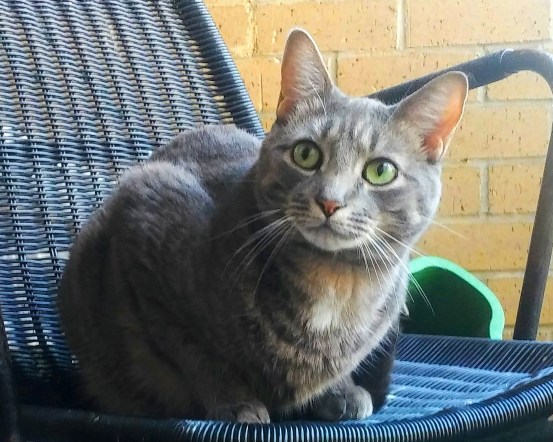
Dear readers, before you think this is a joke entry about Bud, let me emphasize we’re talking about the marbled cat, not the well-marbled cat.
“I am NOT chubby, I am meowscular!”
“I’ve never heard of a marbled cat,” you might be thinking, and there’s a good reason for that.
These little guys are incredibly elusive, live far from most humans and are found only in Asia. They’re extremely difficult to track and locate in the wild and haven’t been the subject of any comprehensive field study, granting them an air of mystery in an era when you can find almost anything you want to know about almost any animal with a few clicks.
There’s a whole lot we don’t know about marbled cats, including their behavior in the wild, how long they gestate, what they eat and how they’ve successfully adapted to so many varied habitats.
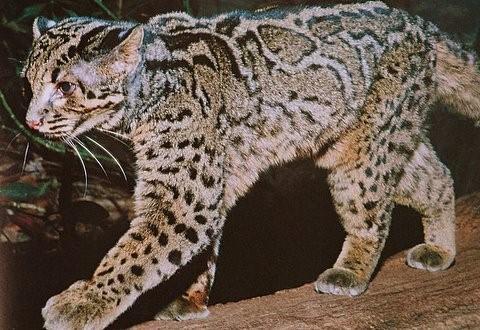
Credit: Wildcats Magazine
The singular species is semi-arboreal. Almost all cats can climb trees. The problem is getting down afterward, which is why so many domestic cats get stuck in trees. They can’t descend head-first and they’re wary of descending tail-first, which makes them vulnerable. Marbled cats have unusually flexible claws that enable them to descend head-first with ease, so they don’t balk at climbing. Their large paws keep them sure-footed on tree limbs and they’re confident off the ground.
In 2011, a trail camera in Indonesia was tripped by a marbled cat, finally giving us a close-up view:
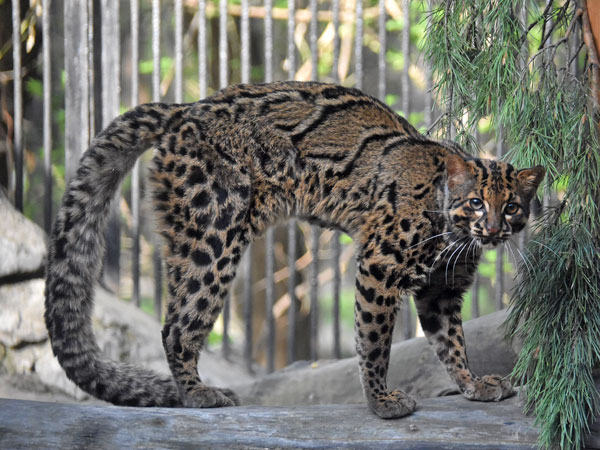
The striking felines are sometimes called “miniature clouded leopards,” and you can clearly see why.
The species is native to the eastern Himalayas, mostly in Nepal, Bhutan, Myanmar and tiny corners of China and India, as well as countries like Thailand, Cambodia and Indonesia. They’re extremely adaptable and live in a variety of habitats, from the forests of high-elevation mountain slopes to the humid jungles of Indonesia’s Borneo and Sumatra.
Marbled cats are about the same size as domestic cats, but they’ve got incredibly big, fluffy tails that are longer than their own bodies, which serve as formidable counter-weights for their tree-hopping. Their ears are a bit more round than the ears of their domestic cousins. They tend to have larger paws, and they have unique clouded coat patterns that are unlike any breed of domestic feline or close wildcat relatives.
Despite their relatively large natural habitat and the difficulty in pinning down population numbers, conservationists estimate there are fewer than 10,000 marbled cats. They’re threatened by the same deforestation by the palm oil industry that has devastated orangutan and clouded leopard habitats, although their strongholds in steep, high-elevation forests are safe for now. Marbled cats are listed as endangered by some authorities and as near-threatened by others, though like all wildlife their numbers are in decline.






 Pain In The Bud