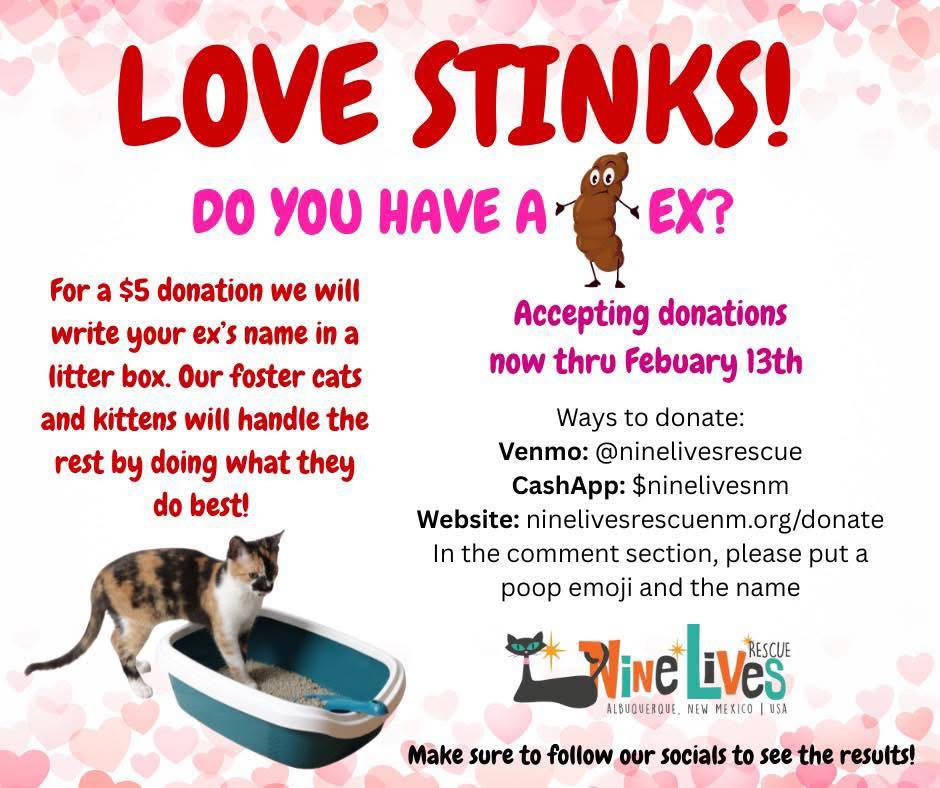
Or if your sense of humor tends toward the scatological, you can donate to put your ex’s name on a litter box.
Like other nonprofits, animal shelters face steep competition when it comes to scoring charitable donations, so the more a shelter can stand out, the better.
For some that means stories about their rescues and pets-in-waiting going viral. For others, it means finding clever ways to use occasions like Valentine’s Day to raise money.
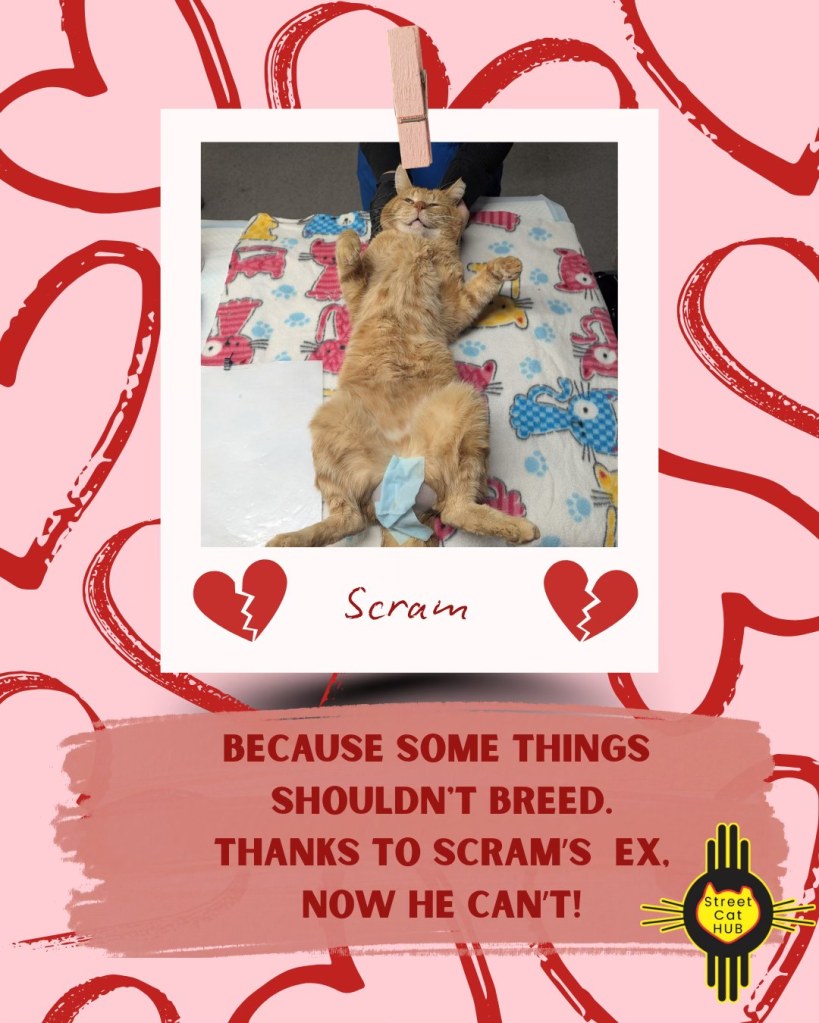
One of the latest fads involves making a donation to pay for spay/neuter surgery for a street or shelter cat — and having the cat named after your ex. As one shelter puts it, “because some things shouldn’t breed.”
Poor Scram has no idea he’s a stand-in for a despised ex.
If the idea of castrating an ex seems a little morbid to you, you’ve still got options.
For just $5, Albuquerque, New Mexico’s Nine Lives Shelter will write your ex’s name on a litter box.
“Our foster cats and kittens will handle the rest by doing what they do best,” the shelter’s staff wrote on Facebook.
Of course, there’s another option for people who prefer a more positive take: donating out of love for cats in general, because despite the encouraging drop in animal euthanasia over the past two decades — the result of relentless campaigns to get pets and street cats spayed/neutered — a few hundred thousand cats are put down every year. Every time a cat is fixed, that number drops, and existing cats have a better chance of finding forever homes.
A Virginia man created National Black Cat Appreciation Day, a celebration of melanistic house panthers, in honor of his late sister, who loved her 20-year-old black cat named Sinbad.
Happy National Black Cat Appreciation Day!
A few years after the death of his 33-year-old sister, June, Wayne Morris wanted to do something in her honor. June adored her black cat, Sinbad, who died at 20 years old, just two months after she passed.
So the Virginia man teamed up with Rikki’s Refuge, a sanctuary where he volunteered, and created National Black Cat Appreciation Day in 2011. Morris chose the day of June’s passing, August 17, in her memory, and that first year marked it by holding a fundraiser for Rikki’s Refuge.
Morris was delighted by black cats as well. He often posted about Norman and Batman, his own melanistic miniature panthers, advocated for the adoption of black felines, and painted whimsical scenes of cats, which were auctioned to raise money for Rikki’s.
Morris often posted about his cats, including Batman, seen here. Credit: Wayne Morris
Wayne Morris founded National Black Cat Day.
Morris also liked to show off his other black cat, Norman. Credit: Wayne Morris
Morris painted scenes involving black cats, which were auctioned off to raise money for feline rescues. Credit: Wayne Morris
Batman. Credit: Wayne Morris
(Above, clockwise from top left: Batman, Wayne Morris, Norman, Batman again, and one of Morris’s paintings.)
Wayne Morris died in 2022, but the day he founded has continued to grow in popularity. In the 14 years since its inaugural celebration, National Black Cat Appreciation Day has spread via fundraisers for shelters across the country, as well as sites within the online catosphere, like this one.
Morris was motivated beyond honoring his sister and raising money for his favorite rescue. Black cats — also affectionately known as voids — have suffered unfortunate reputational damage over the centuries.
Melanistic felines are actually considered good luck in Japan, China and most of Asia, where they can be found in temples and their likenesses are used as maneki neko, the ubiquitous “lucky cats” in homes and businesses. (Black maneki neko are said to ward off evil spirits, diseases and people with bad intentions, while the golden cat statues are associated with wealth and the white neko are thought to bring good health.)
But in much of the western world they’re associated with bad luck, “evil” forces in folklore, and they’ve been invoked in outbursts of moral panic over things like witchcraft.
Big cats can be voids too, like this stunning black jaguar in Scotland’s Edinburgh Zoo. Credit: Wikimedia Commons
A black cat — or a statue of one — was said to be involved in Satanic rituals in Spain by Konrad van Marburg, an inquisitor known for his brutal zealotry. While the effect of that accusation has been exaggerated for years in internet discussions and posts (Pope Gregory IX’s papal bull dealt with a small area of Germany and did not declare that black cats were Satanic), it naturally comes up in superstitions about the animals.
A 2020 study of 8,000 adoptions found black cats were less likely to be adopted and more likely to be euthanized. That study and others found there was “scant evidence” for the dramatic margins suggested by anecdotal accounts circulating online and in some publications, but confirmed the problem is real. Research also suggests that negative perceptions of black cats isn’t correlated to religious preferences, but is tied to general belief in the supernatural.
Interestingly, additional research has hinted at a decidedly more modern and petty reason people may hesitate to adopt black cats: they think voids are more difficult to photograph, which is an issue for people who want to show their pets off online. (We’ve written about that particular hang-up before, and noted it’s possible to take beautiful photographs of voids by being mindful of factors like lighting and contrast between fur color and the background.)
Regardless, the combined effect of the superstitions and negative associations has harmed black-coated felines, and National Black Cat Appreciation Day is also an attempt to push back and show people that black cats are just, well, cats.
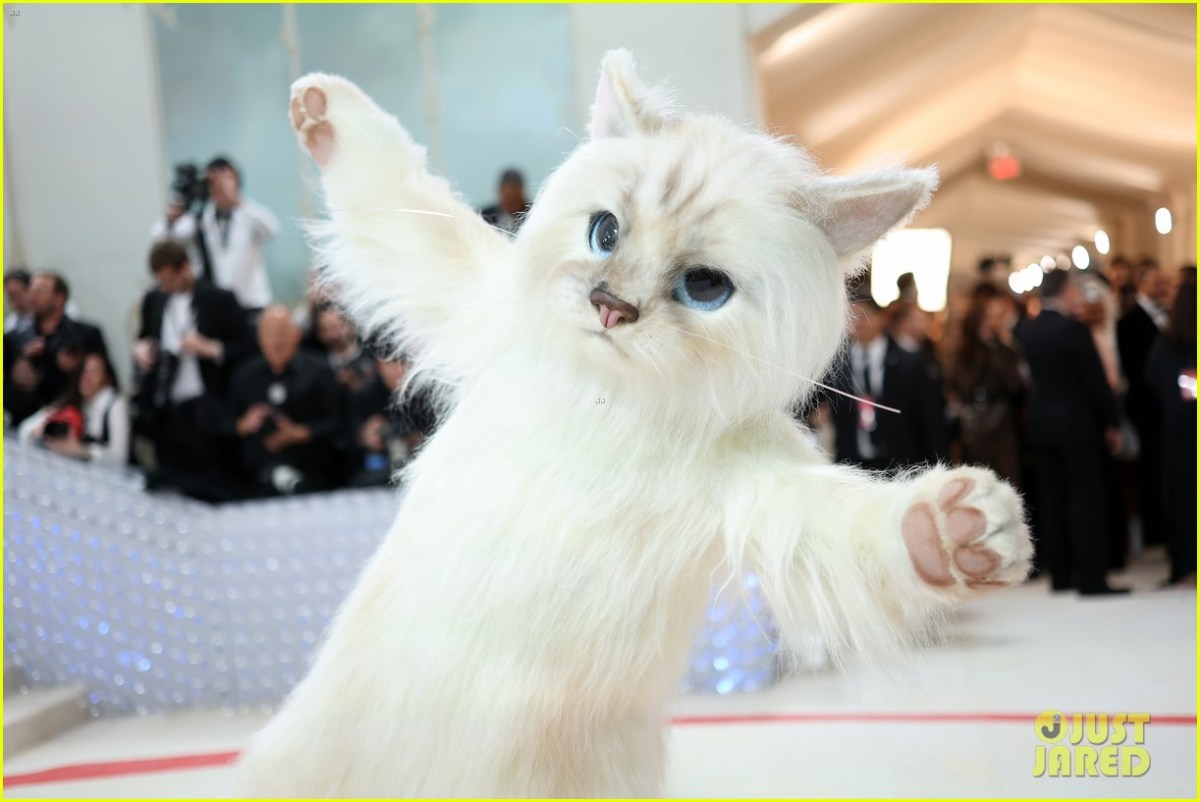
The actor went all out, wearing a full fur suit made to look just like the late Karl Lagerfeld’s beloved Burmese cat.
As we suspected, Choupette the cat didn’t attend Monday night’s Met Gala in honor of her late human, Karl Lagerfeld, but the famous feline was there in spirit.
Rapper Doja Cat paid tribute to the famous Burmese with cat ears and a dress inspired by her fluffy white fur, but it was Jared Leto who stole the show in a full cat suit, complete with a heavy-looking headpiece that looks just like Choupette.
Like all cats, Choupette isn’t big on human parties, with Lagerfeld asserting she’s “not a party girl” when he showed up without her to a New York event honoring Tilda Swinton in 2013, despite the feline being listed as the designer’s plus-one.
Jared Leto in his Choupette costume.
Leto momentarily removed the head piece to wave hello to photographers on the red carpet at Monday night’s Met Gala.
Choupette’s more than 12 years old now, so she’s getting up there for a cat, and it makes sense that her caretaker, Lagerfeld’s former housekeeper, decided the famous kitty would be better off staying home in France rather than taking the long flight and possibly being freaked out as the center of attention at a well-attended, noisy party.
It’s entirely possible that Choupette could have run under a piece of furniture and spent the rest of the night hissing at staff tasked with coaxing her out, so declining the invite was a wise call.
Props to Leto for his hilarious and accurate costume, and for being a good sport. The weather here in New York is about 50 degrees tonight, so it’s not warm, but Leto’s costume still looks stifling.
If you’re into this sort of thing, you can see the rest of the celebrities in their outfits here. There was some blowback prior to the event, and the Washington Post ran an article detailing Lagerfeld’s “problematic” (oh how I hate that word) past, meaning about half a dozen off-color comments he made in almost a half century in the public eye.
A group of young fashion world regulars who are affiliated with the gala sat out this year, saying the act of honoring Lagerfeld was “exclusionary,” which I found hilarious. High fashion and haute couture are by their nature exclusionary, and the Met Gala is perhaps the most exclusive of parties. Tickets are $50,000 apiece, attendance is invitation-only, and the guest list is comprised only of people Vogue editor Anna Wintour considers “fabulous” enough to be in her presence.
There is no such thing as diversity or inclusion in an event like the Met Gala or in the fashion world, so they might as well be honest and own it. Maybe next year they can adopt a Zoolander theme and show the world the fashion world can have a sense of humor and poke fun at itself.
But despite all the absurdity, we can’t help liking Choupette, and Lagerfeld’s story of falling in love with the cuddly kitty late in life after never imagining he’d have a cat, let alone dote on her like a beloved child.
For decades witnesses have claimed they’ve seen big cats prowling the English countryside.
A UK couple say they narrowly avoided hitting a big cat that bolted in front of their car Wednesday morning.
Chris and Marion said they were driving on the A303 in Hampshire, a rural road in southern England surrounded by farmland, fields and wooded stretches, at 7 a.m. when the felid leapt across the road and ran into a nearby field, possibly giving chase to prey. While others suggested it could have been a lynx — which went extinct in the UK more than 1,000 years ago — the witnesses ruled out the possibility, saying the cat was “twice the size of a fox” with a tail that was “thick and solid.”
When they made a Facebook post about the encounter, several others claimed they’ve seen a similar-looking “big cat” moving through Hampshire’s fields. There are several groups dedicated to alleged big cat sightings in the UK on Facebook.
It’s the latest in a surprisingly persistent legend of phantom big cats prowling the British countryside. There are no extant big cats in the UK or in Europe. They exist only on other continents: Lions and leopards in Africa, tigers and leopards in Asia, and jaguars in South America. Among felids that are not true big cats but are often grouped with them, pumas exist only in the Americas and cheetahs are exclusively found in Africa.
Despite that, hundreds of witnesses report seeing feliform animals much larger than well-fed ferals or small wildcats. A similar phenomenon exists in Australia, where for years people have insisted they’ve seen big cats slinking through the bush.
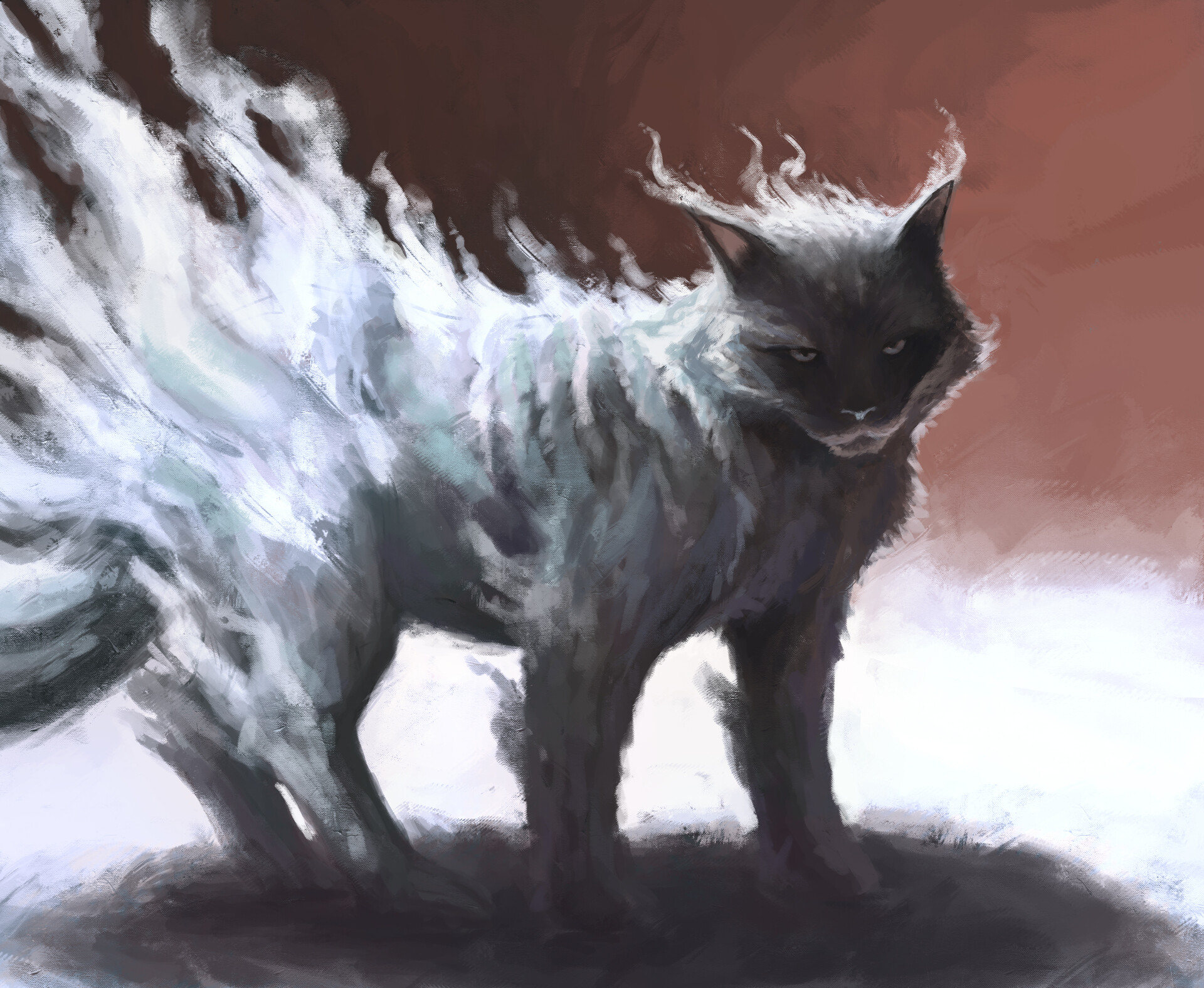
“Ghost Cat” illustration by Ken Jovi Credit: Ken Jovi/Artstation
While it’s possible that people in the British countryside or Australian bush are illegally keeping large felids, and it’s possible that a handful could have escaped over the decades, that’s an unlikely explanation for the sightings for several reasons. While big cats are apex predators, animals who have lived in captivity all their lives and have been given food will not know where to go or how to hunt. In places like Texas, where as many as 5,000 tigers live in backyard enclosures, escaped cats are quickly spotted wandering human neighborhoods, confused and looking for food.
If an escaped tiger or leopard was somehow able to rapidly adjust to the English countryside and fend for itself without being spotted, there would be evidence — pug marks, droppings, claw marks denoting territorial boundaries on trees, the carcasses of prey animals, burglarized pens, farm animals missing and terrorized.
That goes double if, as some suggest, there is a breeding population of panthera genus cats. Even a handful of such animals would consume thousands of pounds of meat each week.
Still, as Wednesday’s alleged sighting proves, rumors of large cats stalking the mists of the English countryside are unlikely to die out any time soon.
A Festivus for the Rest of Us…And Our Cats
Festivus is the celebration that keeps on giving.
The operators of Tail Town Cats, a cat cafe in Pasadena, California, are hosting a Festivus get-together that will double as a showcase for adoptable kitties and a way to help support adoption efforts.
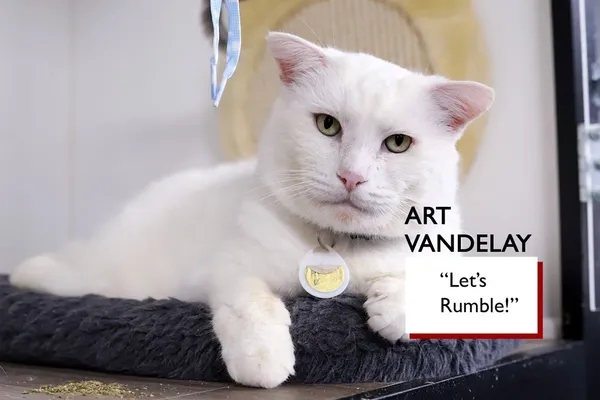
Hosted by a cat named Art Vandelay — who found his forever home through the cafe — the celebration will include a traditional Festivus pole, the Airing of Grievances and Feats of Strength. (Among the grievances listed in advance are general disappointment with the frequency of treats, displeasure at sharing litter boxes, and humans who recycle cardboard boxes instead of giving them to the felines.)
People in the Los Angeles area can attend in person, while others can watch online.
Art Vandelay found his forever home through the cat cafe and will return to host its first-ever Festivus celebration.
Seinfeld fans will recognize Art Vandelay as George Costanza’s most frequently-used alias. Vandelay is alternately described as an importer-exporter or as an architect. As George famously said: “I’ve always wanted to pretend to be an architect.”
As for Festivus, it’s taken on a life of its own 25 years after it was popularized on Seinfeld.
The made-up holiday had its humble origins in the home of writer Daniel O’Keefe, who introduced it to the nation — and immortalized it in the process — by writing it into “The Strike,” a 1997 episode of the sitcom. At the time, Seinfeld was a ratings juggernaut, averaging more than 30 million viewers an episode. Festivus is celebrated annually on Dec. 23.
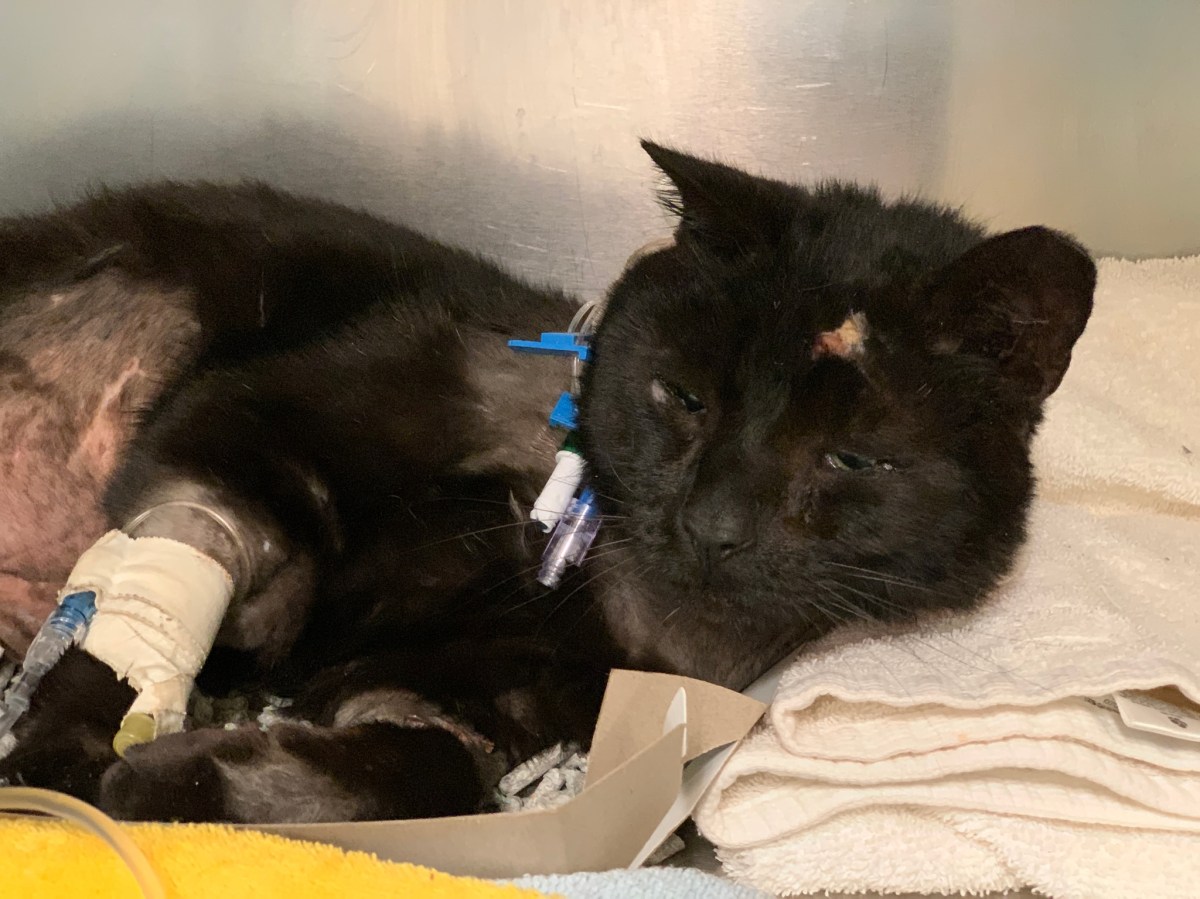
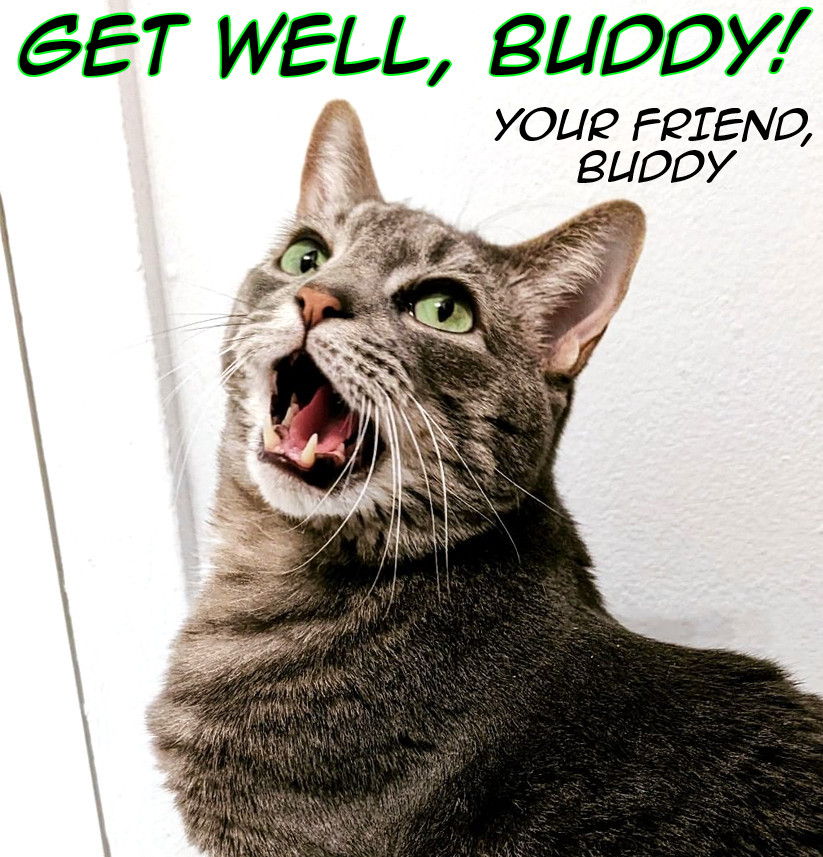
Buddy, the cat who was brutally assaulted when two teenagers sicced their pitbulls on him in Philadelphia last week, is making progress every day.
The little guy began opening his eyes again a few days ago, the Pennsylvania SPCA said, and now they’ve shared a short video of Buddy the Black Cat sitting up, licking his lips and tucking into some yums:
Little Buddy the Cat has been pulling for his fellow Buddy. In the meantime, a lot of people have been asking the SPCA how they can help. Here’s a way to do that and get something in return: A spiffy t-shirt that says “Save Every Buddy” with an original design:





 Pain In The Bud