A shelter operator has received death threats amid confusion over the facts after animal welfare authorities raided a Los Angeles County shelter on Friday.
The initial news headlines were apocalyptic — more than 700 dogs and cats were found in deplorable conditions according to authorities, who said the California property where they executed a search warrant represented the most extreme animal hoarding case in history.
A day later the numbers have been revised down to a still-significant 250 dogs and 66 cats, and the owner of Rock N Pawz shelter in Los Angeles County says she and her facility have been smeared, resulting in a flood of death threats directed at her.
The story is a reminder that facts aren’t always established as quickly as we’d like them to be in the age of 24/7 news and social media, and the advent of photorealistic AI can add to confusion and stir public outrage by distorting the reality of fluid situations.
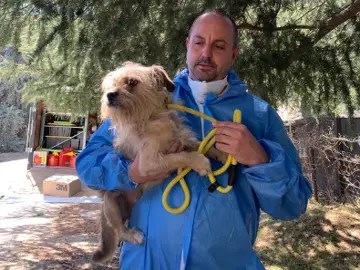
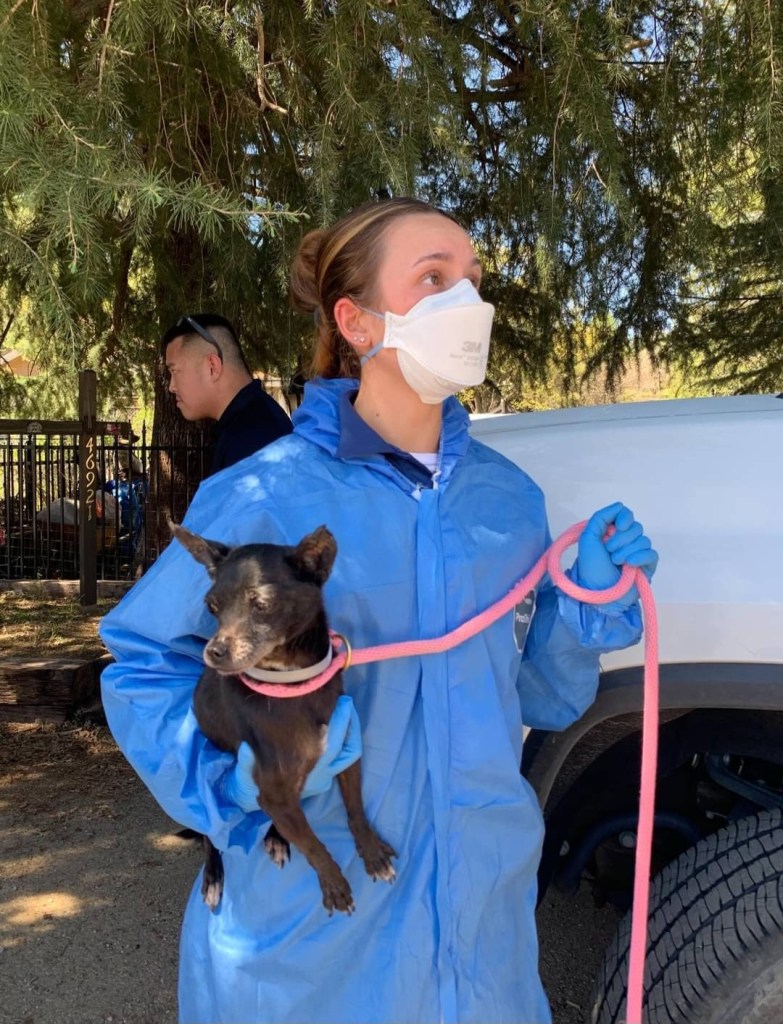
A woman holds a dog found on the Rock N Pawz property. Credit: Los Angeles County Department of Animal Care and Control
What we know for sure is that officers from the Los Angeles County Department of Animal Care and Control executed a search warrant on the property in Lake Hughes, an unincorporated community in the Sierra Pelona Mountains, about an hour’s drive from Los Angeles proper. The investigation was prompted by repeated complaints from neighbors, who said there were overwhelming odors coming from the shelter and claimed there were regular dog fights and incessant loud barking.
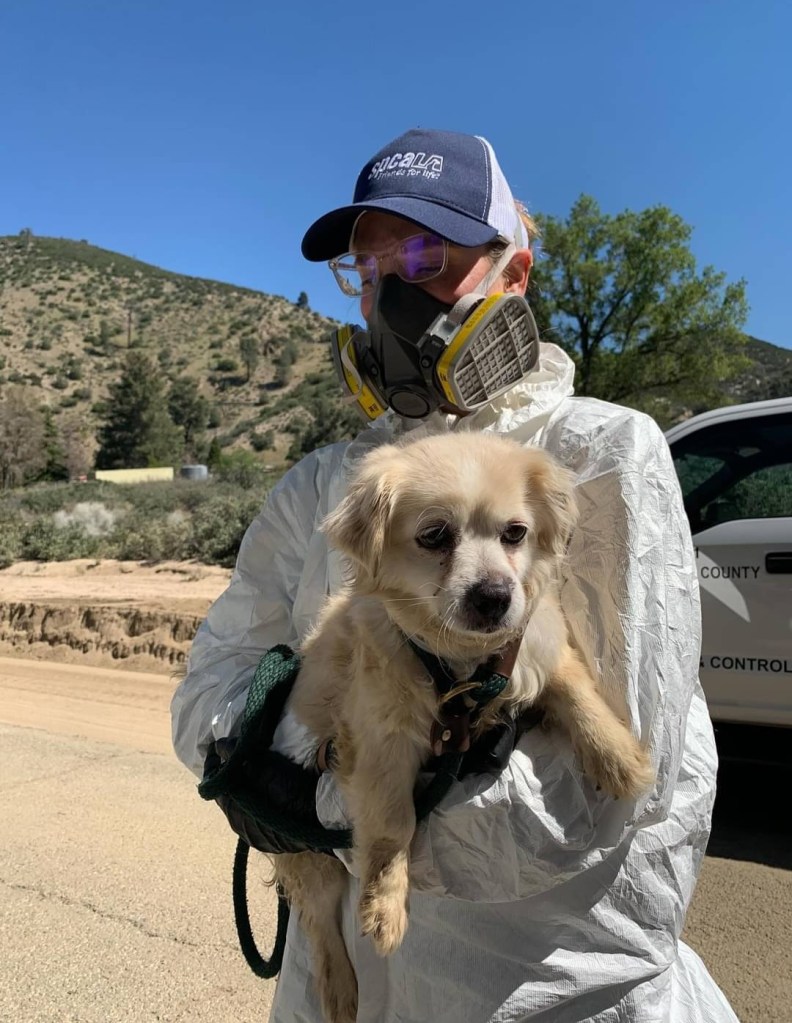
A local news station, KTLA, reported authorities on site were wearing respirators with protective gear, and quoted authorities who said they did not believe it was a case of intentional neglect.
“Sometimes people try to do the right thing, and they may bite off more than they can chew,” the Department of Animal Care’s Sgt. Matthew Davoodzadeh told the station. “They end up ultimately not being able to care for the animals in a proper way.”
Authorities have not filed charges related to the case and there have been no allegations of criminal conduct.
Credit: Los Angeles County Department of Animal Care and Control
The influx of animals has strained nearby shelters while veterinarians examine the 316 dogs and cats taken from the property.
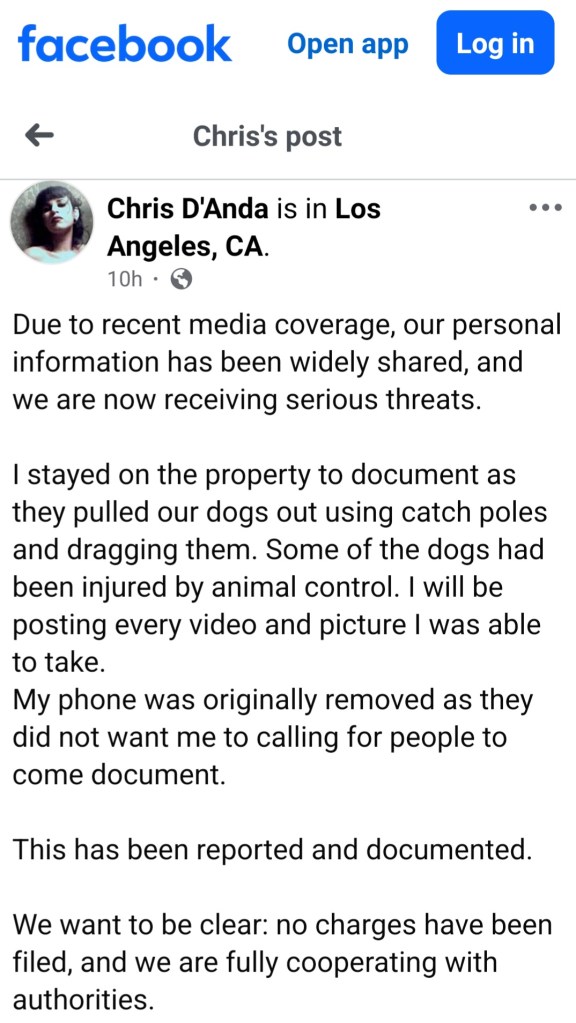
In the meantime, shelter owner Christine D’Anda said descriptions of the property and the conditions of the animals aren’t accurate, and took to social media to complain of harassment and death threats directed at her since news of the search warrant hit the web.
The shelter operator asked people to withhold judgment until the facts are established.
On Facebook, users posted images allegedly taken from the property, while others pushed back, alleging the images are either AI creations or were taken from unrelated news stories.
The shelter’s page indicated active rescue and adoption efforts, including fundraisers and an advertised adoption event last weekend.
D’Anda said she will fight the allegations in the legal system.
“There’s nothing that I can do. I’m a very stoic person,” she said. “I’m very sad about the whole situation, and I can’t wait to go to court.”
The reaction says volumes about our society’s sense of proportionality, our collective understanding of animals, and our ability to politely disagree on topics we feel strongly about.
This hasn’t been a great week for feline PR.
Not only did two celebrities come out with bizarrely forceful anti-cat sentiments, but from their statements, they both “hate” cats because they’ve misinterpreted feline behavior.
The fallout hasn’t been good either, for the actress and rapper involved, or for the more extreme animal lovers who have responded with disproportionate rage.
The first comes from rapper Docheii, who insists cats “genuinely aren’t friendly animals.”
“yall be scratched and beat tf up by your own animals I can’t lmaoooo,” the towering intellect from Florida wrote on social media.
Cats, she asserted, “don’t wanna be domesticated.”
Presumably she got that information from the Pew Center for Feline Public Opinion, and the rest of us simply aren’t privy to the latest opinion polls among cats. And here I thought our furry friends were mostly ambivalent about anything that doesn’t involve napping, playing and eating. (I took an informal poll of Bud. He responded with a simple “Fetch me a snack, will you, human?”)
A promo shot of Doechii, real name Jaylah Ji’mya Hickmon
Regardless, even if there was some way to ascertain how cats feel about a process their ancestors initiated — one that takes thousands of years to result in speciation — it’s irrelevant. The decision was made 10,000 years ago when The First Kitteh was drawn to a human settlement by the promise of rodential prey in abundance.
Modern cats have no more say in the matter than we have in our ancestors slaughtering dodos. It happened. We can’t change the past.
The actress vs the ‘pedigree bitch’
The second bit of anti-feline sentiment comes from Jessie Buckley, an Irish actress who is weirdly proud of forcing her husband to ditch his two pet cats when they began dating. She talks as if she’s been waging a personal war against the species, and her reason for disliking felines also indicates a fundamental misunderstanding of their behavior.
Buckley’s comments were made on a podcast late in 2025, but resurfaced this week and went viral as her Oscar buzz reached its peak. On the podcast, Buckley said one of her husband’s cats was a “pedigree model bitch” who was orchestrating a “coup” against her.
She thinks the cat had it out for her: “I’d come home and there’d just be, like, poo on my pillow.”
This is actually sad, because people who really know cats, who understand why they behave certain ways, will immediately understand that they don’t have accidents out of spite. If the cat was eliminating outside her litter box, there was a legitimate underlying problem causing her a great deal of stress.
She could have been injured, she could have been sick, or she could have been plagued by the cumulative stress brought on by the presence of a hostile woman who ludicrously saw her as competition. Our furry friends are much more perceptive than generally realized, especially when it comes to our emotional states, and Buckley’s hostility would have been immediately apparent.
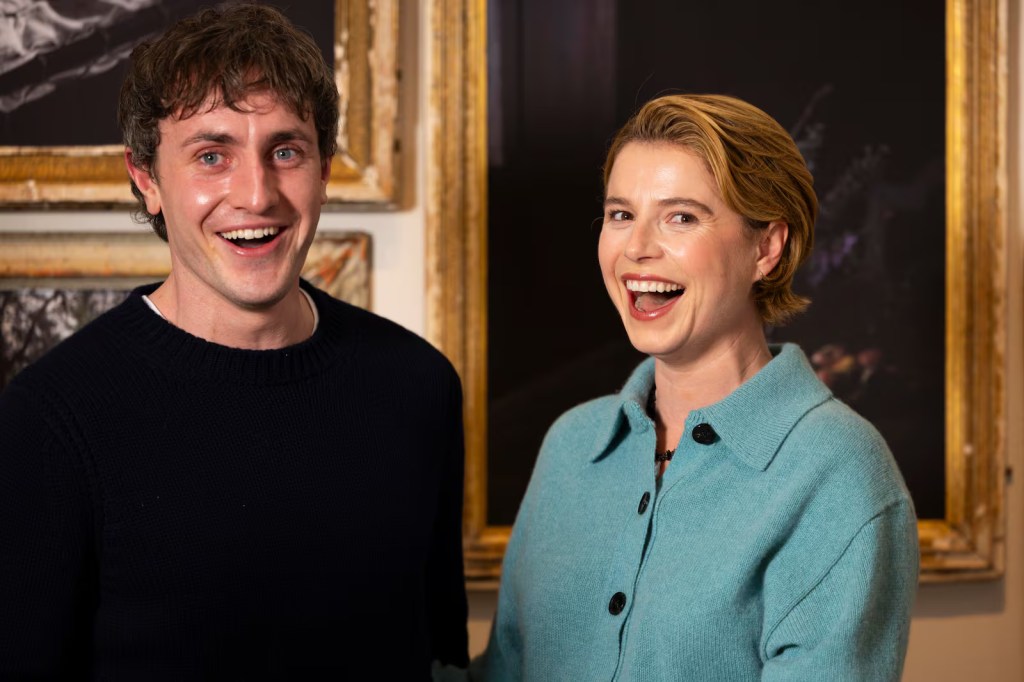
Buckley with co-star Paul Mezcal, who was equally enthusiastic in his intense dislike of felines, telling an interviewer: “Yeah, f— cats!”
Alas, Buckley didn’t reluctantly ask her then-boyfriend to give up his cats. She demanded it, then did a victory lap when he complied, which makes me suspect she was merely taking the whip out for a test drive before further commitment. If he’s willing to abandon two pets, he’s almost certainly going to be a pushover when she begins to prune his friends from his life, starts dressing him the way she likes, maybe even monitors his phone. *shudder*
“It’s me or the cats,” Buckley said she told her husband. “But I won!”
Congratulations, I guess?
The rage of cat lovers
As ludicrous as it seems, the backlash may cost Buckley an Oscar. Personally I don’t keep up with the approximately 200 awards ceremonies actors hold to fete themselves annually, but apparently Buckley turned in a solid performance in a movie called Hamnet.
She was considered the front-runner for an Academy Award. Now critics are openly wondering about her chances.
As always, these sorts of statements reveal a lot more about the people involved than they do about cats. I just wish people understood the species a little better, so maybe attitudes won’t default to anger or hostility if, say, a scared cat scratches a person who corners her, or a kitty with a stomach bug pukes on the carpet.
When a toddler gets sick, we don’t respond by yelling at the kid, blaming him and chasing him off. We make sure he’s okay, give him some medicine or take him to the doctor, and clean up the mess. Cats are essentially furry little toddlers, with the same innocence as children. When we adopt them, we agree to care for them.
Both Buckley and Docheii have been hammered on social media since their comments went viral, and it’s important to address that too. They expressed opinions. That doesn’t make them “pieces of s—,” “worthless human beings,” “scum” or any of the other nasty things some people have been saying.
We can disagree with them without overreacting, even in the age of dehumanizing online conversation.
Maintain yourselves!
And honestly, it makes all of us look bad. The day Walter Palmer returned to work is forever seared into my mind. Palmer was the American dentist who infamously and illegally lured Cecil the lion out of a protected area and killed him to take his head as a trophy in 2015.
Worse, Palmer — who had a history of getting in trouble for breaking the law while hunting — killed Cecil with a bow and arrow in order to claim some meaningless hunting record for himself and bungled the point-blank kill shot his guides had lined up for him. Cecil, who was an iconic lion with a distinct mane, suffered for hours before he died.
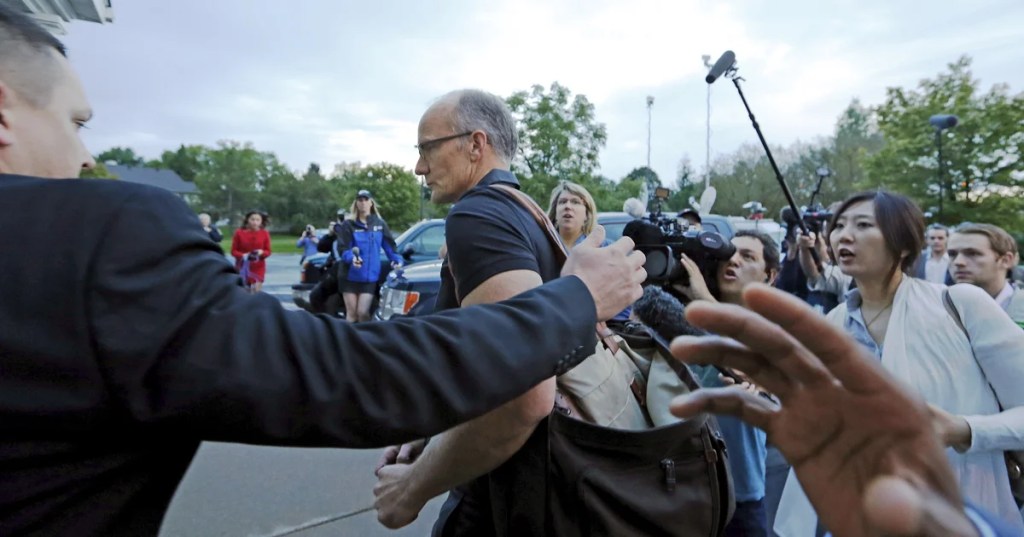
People were understandably angry, and protesters showed up outside Palmer’s office the day he returned to work. Most of them behaved themselves. But as Palmer made his way toward the front door of his dental practice, one of the protesters let loose a blood-curdling scream and shouted “WAAAAALTER PAAAAALMER!“, vowing vengeance for Cecil.
Palmer returning to work while media and protesters crowd him.
That moment of unhinged, unregulated rage overshadowed the good intentions of every person who registered their displeasure calmly and politely — and provided ample ammunition to those who enjoy painting all animal lovers as lunatics.
Buckley and Doechii expressed opinions we don’t like, and that’s their right. The best thing we can do is explain why they’ve misinterpreted feline behavior, and show them that cats really are loving, friendly animals — it just takes a little patience and trust. I say that as the faithful servant of a cat who can be particularly prickly and a complete lovebug, depending on the circumstance.
In the meantime, celebrities who hate cats should probably take a pass on broadcasting their intense dislike and save themselves the resulting headache. Sadly, we no longer have any sense of proportionality when it comes to disagreements, and no one gets a fair shake when things are litigated via social media.
“Can’t find your keys, human? That’s terrible. I don’t know where they are, but perhaps I could recall that information if, say, there were treats involved. Take your time, I’m in no rush even if you are.”
A new study shows dogs and human toddlers are eager to help when their adult caregivers are looking for a missing item, but cats don’t seem to care.
The study, which involved running the same experiment for young children, dogs and cats in their own homes, made it clear cats were fully aware of what was happening and understood their humans were looking for the missing object.
They just didn’t care.
There was one notable exception, of course. If the missing items were important to the cat — a favorite toy, for instance, or a bag of treats — the felines were motivated to help search or direct their humans to the missing objects, the research team from Eötvös Loránd University in Hungary found.
But at all other times, feline observers were content to hang back and watch, even when they understood their humans were getting frustrated.
By contrast, young children and dogs actively tried to help and signaled to adults when they thought they’d found the object.
“Lookin’ for something? No, I’ll just watch, thank you. Warm, warmer…oh! Cold…colder…that direction doesn’t look promising, human.” Credit: Gord Maclean/Pexels
So does this mean cats are jerks? Probably. Are we surprised by the results? Not at all.
We still love our furry friends, who do have their own unique ways of demonstrating they care about their humans beyond seeing them as providers of food, shelter, and safety, as well as playmates, minions and servants.
Besides, testing whether dogs or cats were helpful or not wasn’t the point. As the authors note, “[t]hese three species provide an important comparison because they share a similar anthropogenic environment but differ in their ecological and evolutionary backgrounds.”
In other words, they’re interested in figuring out how evolution plays a part in how species behave in particular situations. Although it’s yet to be conclusively proven for this behavior, a likely reason is because domestic cats are the descendants of a mostly solitary wildcat species, whereas we humans and our canine friends have long evolutionary histories of living in social groups and cooperating with each other.
The study is included in the March 2026 issue of Animal Behavior.
Your cat may mean the world to you, but in American courts she’s no different than a TV or an air fryer.
With a quick resolution to a UK cat theft that made international news, it’s become clear that our friends across the Atlantic are way ahead of us in crafting laws that protect animals.
In the US, the legal system views pets as property. You can see the vestiges of our agricultural past in the way animal-related crimes are categorized. Here in New York, they’re found in Agriculture and Markets law, not the state penal code.
The former was written to handle things like compensation for killed or stolen livestock, not to recognize the emotional damage a thief does to both the person and pet when they’re separated.
Today laws forbidding puppy mills and defining the responsibilities of municipal pounds are lumped in with legislation governing things like farm fencing and how horses may be tested for performance-enhancing drugs ahead of county fairs. It’s archaic, confusing and limits the legal consequences for mistreating pets.
Credit: Breno Cardoso/Pexels
That means the penalties for stealing someone’s beloved dog or cat amount to a slap on the wrist. Your cat may mean the world to you, but in the eyes of the court she’s worth the $175 fee for adoption and shots you paid to a shelter.
That’s also why police enforcement is a crapshoot. If someone makes off with your furry friend, you might get lucky when you find out the local sheriff loves his dogs dearly and makes sure animal-related crime is taken seriously.
Or you might get a desk sergeant who thinks you’re wasting department resources, glowers at you from behind the desk as you submit your report, and leaves it in a pile with other things he believes are beneath the dignity of real police.
It’s easy to blame the police, but their attitudes are impacted by the outdated laws and a society that hasn’t caught up. SPCA law enforcement officers are often treated like Ace Ventura with a badge, and police agencies are reluctant to devote significant resources to cases that will amount to misdemeanor charges, which can be pleaded down further in court.
Credit: Alexandros Chatzidimos/Pexels
Compare that to the West Yorkshire police, who launched an investigation when security camera footage showed an Amazon delivery driver stealing a family’s cat a week ago. Happily the feline has been reunited with her people and is back home, but neither the driver nor the company are off the hook, as the police still have an active investigation.
In the UK, courts take animal-related crimes seriously, and so do the police. That’s because of several important pieces of legislation, starting with the Animal Welfare Sentience Act of 2022.
The law finally frees cats and dogs from any remaining association with property laws. Instead they’re viewed as what they are, sentient creatures who have their own feelings. It also recognizes animals like the octopus, which can be startlingly intelligent.
That opens the door to legislation like the Pet Abduction Prevention Act of 2024, which takes into account the trauma to the human and animal victims. Both dogs and cats are likely to be deeply confused and distressed at being taken from their people, and cats in particular don’t do well when removed from their territory.
When a judge sentences a person for, say, stealing a family’s beloved senior dog, he can take into account the stress both the family and dog endured, and the disruption to their lives. When a couple breaks up and both sides fight over a cat, the judge can base a decision at least in part on what’s best for the kitty.
You can’t do that when a law says the animal in question is no more important than a toaster.
The 2024 law cited more than 2,000 dog abductions and more than 400 cat thefts in 2020, and it has legal teeth — judges have discretion to put convicted pet thieves behind bars for as many as five years.
American lawmakers should take a look at how things are done across the pond. At a time when rancorous politics and divisive ideology stains almost everything, this is an opportunity for legislators of all ideological stripes to work together, earning a win for themselves, and most importantly, for animals.
How do you ensure people will heed warnings to steer clear of nuclear waste storage sites thousands of years in the future? One outlandish proposal involves genetically engineering domestic cats to glow in the presence of radiation.
Imagine you’re a person living five thousand years downstream.
Maybe civilization collapsed and restarted, maybe records were lost, or maybe like Etruscan, Harappan and proto-Elamite, the languages we speak today will be long forgotten.
At any rate, if you discover a forceful warning left by your ancestors from the deep past, would you understand it without translation or cultural context?
And if you’re the one tasked with leaving the message, how would you do it?
The message has to be enduring. It must be recorded in a format that will withstand the tests of time, conquest and natural disasters. The message must be comprehensible without cultural context, because we have no idea how language will shift in the future or whether our descendants will enjoy the knowledge that comes with continuity of records.
Lastly, the message must be both compelling and absolute in its meaning, because its content is vitally important: This site contains nuclear waste. Do not under any circumstances excavate or disturb the contents of this facility. It will lead to sickness, suffering and death.
The traditional trefoil warning sign is unlikely to scare anyone off. The new radiation hazard sign, right, seems unambiguous, but so do warnings on Egyptian tombs.
How do you phrase that in a way our naturally curious species will heed the message?
We certainly didn’t heed the warnings on the tombs of King Tut and other pharaohs. For all we know, humans of the future might believe the hidden chambers deep in Yucca mountain or buried 3,000 feet underground are filled with fabulous treasures and wonders beyond imagination.
They might interpret the warnings as superstition, meant to ward off looters, “grave robbers” and anyone else who might be motivated to break in. They might see the care and effort that went into encasing the objects and conclude there must be something very much worth preserving inside.
Or they might be driven by simple curiosity, as so many human endeavors have been.
A tour group visiting the incomplete Yucca Mountain nuclear waste storage facility. Credit: Daniel Meyer/Wikimedia Commons
Arguments about how to warn the future are at least as old as the Manhattan Project (1942) and the first nuclear power plants (1954 in the USSR, 1958 in the US), but there weren’t serious efforts to come up with a plan until the 1970s, when scientists, historians and other thinkers began to engage in formal efforts to find a long-lasting solution.
Some of the ideas are boring, some are impractical, and some are absurd, like an idea to create a “garden of spikes” atop nuclear material waste sites, to discourage people from settling in the area or excavating.
Unfortunately, one idea that’s still being kicked around is the concept of the radiation cat, or raycat.
Knowledge and language may be lost to history, signage may be destroyed, physical obstacles may be removed. But one constant that has endured, that has seen empires rise and fall, and has existed long before Stonehenge and the pyramids of Giza, is the human relationship with cats.
They’re now valued as companions, but we still use them as mousers on ships, in heavily populated cities, in ancient structures and on farms and vineyards.
They’re embedded so deep into our cultural psyche that it would not be outlandish to think the archaeologists of the future may conclude the internet was constructed primarily to facilitate the exchange of images of cats.
Even the first high-bandwidth deep space transmission was a video of a cat, so in a very real sense, the dawn of a solar system-wide internet was heralded by an ultra high definition clip of an orange tabby named Taters, beamed back to earth from the exploratory spacecraft Psyche, which was 19 million miles away when it transmitted Taters on Dec. 11, 2023.
Consider also that the basic felid body plan — shared by domestic kitties, tigers, pumas, black-footed cats and the 37 other extant species — has barely changed in 30 million years, because cats are extremely successful at what they do.
In other words, cats aren’t going away, and domestic felines have a place in every human society.
So philosophers Françoise Bastide and Paolo Fabbri conceived of the “living warning” in 1984. The idea is to alter the genetic code of felis catus so that the animals glow or change color in the vicinity of nuclear waste, using minuscule levels of radiation as the trigger.
There are natural precedents for this, including bioluminescence and several species of octopus that radically change colors and patterns on their skin to evade predators.
The second component, once the genetic code has been altered, is the creation of folklore: songs, stories and myths that will endure through time, warning people to keep cats close, treat them well, and run like hell if they change color because it means something terrible, something evil beyond imagination, is nearby.
To ensure the folklore of feline Geiger counters endures, an idea by linguist and semiotician Thomas Sebeok would be incorporated. Although empires and states rise and fall, there’s one organization that has survived for 2,000 years preserving a unified message: the Catholic church.
Sebeok proposed an atomic priesthood, an order that would pass the knowledge down through generations, continually seeding culture with stories and songs of glowing felines.
Spent nuclear fuel rods are stored in on-site pools at the facilities where they were used, but pools are meant only as temporary storage solutions. Credit: Wikimedia Commons
If this stuff sounds wacky, that’s because it is. We won’t figure out a way to ensure a message is received and understood thousands of years in the future without considering some off-the-wall plans.
Of course messing with the genetic code of any animal raises serious ethical questions.
We don’t have the right to play God and tinker with the genetic code of extant species. We don’t fully understand the immediate consequences for the health and happiness of cats, and we know almost nothing about the long-term effects on the species.
I’d also argue that we have a special relationship with cats and dogs, one that exceeds any obligations we may feel toward our primate “cousins” or other non-human animals.
Cats and dogs have been living with humans for a combined 40,000 years. They have been molded by us, they are dependent on us, and all that time in human proximity has led to unique changes.
No animals on this planet can match them when it comes to reading human emotions. Our little buddies pick up on our emotional states before we’re consciously aware of them partly because of their robust sensoriums, and partly because as their caretakers, our business is their business.
A clip of a cat named Taters was the first data burst transmitted to Earth using NASA’s upgraded deep space network. Credit: NASA/JPL
We bear a responsibility to both species and the individual animals. It’s not just the fact that without them, our lives would feel less meaningful. It’s the indisputable fact that without them — without dogs who flushed out prey on yhr hunt and guarded small settlements, without cats who prevented mass starvation by hunting down rodents — we would not be here.
Cats and dogs play a major role in the story of the human race. We are indelibly linked. Their DNA is not ours to tinker with, and they are not tools we can repurpose at our convenience.
Thankfully the US Department of Energy has never endorsed the concept of raycats. While there is a website advocating for a raycat program and small groups around the world dedicated to its propagation, the interest is mostly academic.
The Raycat Solution, which maintains a site dedicated to the idea, has a FAQ which says its supporters are serious about its potential usefulness, but for now most experts see it as a thought experiment and reminder that the problem must be dealt with eventually. At some point NIMBY will have to yield to reality, and wherever the US ends up storing nuclear waste, it’ll need to be secured, sealed and marked.
The goal is for the message to endure at least 10,000 years, at which point scientists say the radiation will be minimal.
That’s assuming that the future holds the collapse and rebuilding of human civilization, or at least a technological backslide in which the majority of our species’ knowledge is lost.
We like to think things will be brighter than that and instead of glowing to warn people of danger, cats of the far future will be where they belong — with their human buddies, exploring new frontiers on starships with plenty of comfortable napping spots.
Header image depicts the Alvin Ward Vogtle Nuclear Power Plant in Georgia, the largest nuclear plant in the US. Image via Wikimedia Commons/NRC
[1] The nuclear waste storage facility at Yucca Mountain was initially funded and approved by congress in 2002, then was canceled and de-funded in 2011 after significant pushback from people who live in Nevada, along with their representatives in congress. Plans for the site have changed several times in more than two decades, leaving the US with no central, secure site to store nuclear waste.






 Pain In The Bud