Amazing Cats: Ocelots Love Trees, Water And Calvin Klein’s Obsession For Men

Ocelots, one of the western hemisphere’s most adaptable cat species, are often mistaken for young jaguars.

In 1999 biologists from the Dallas Zoo were lending a hand on a project to monitor and protect America’s ocelots, who primarily range in southern Texas.

With limited resources, the team was trying to keep the wild cats in a protected area and get them to use paths where camera traps had been installed. One tried and true method was to use scents, but what could attract ocelots?

“Sort of on a lark, one of our research assistants produced a bottle of Obsession,” Dallas Zoo’s Cynthia Bennett said at the time.

The felines loved it. Members of the research team watched astounded as the scent magically transformed previously ignored objects into items of sudden fascination.

The cats happily rubbed their cheeks and bodies against anything sprayed with the stuff.

“It´s a little embarrassing to watch, actually,” Bennett said. “It does make you wonder what´s in the perfume.”

(It’s probably civetone, a synthetic version of a pheromone produced by civets used as a binder in the Calvin Klein scent.)

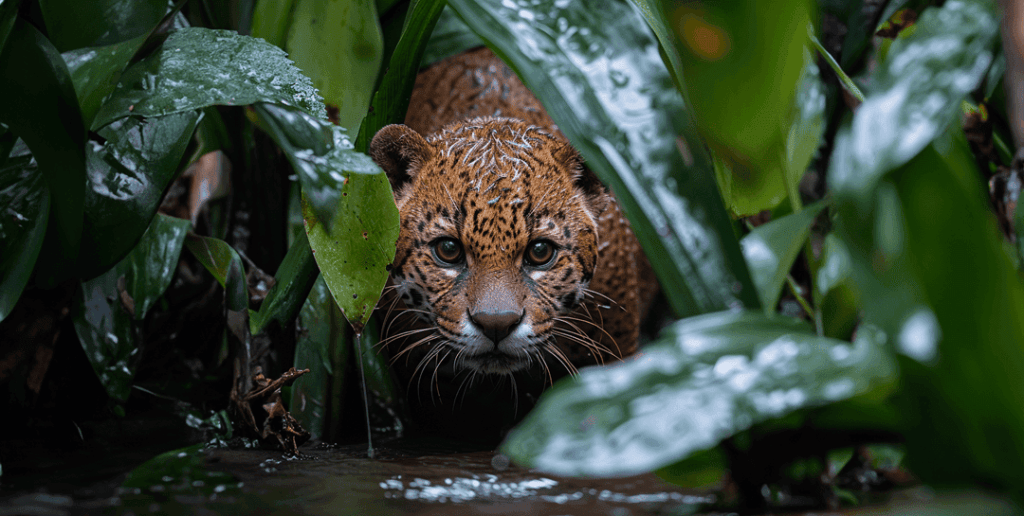
Credit: Victor Landaeta/Pexels

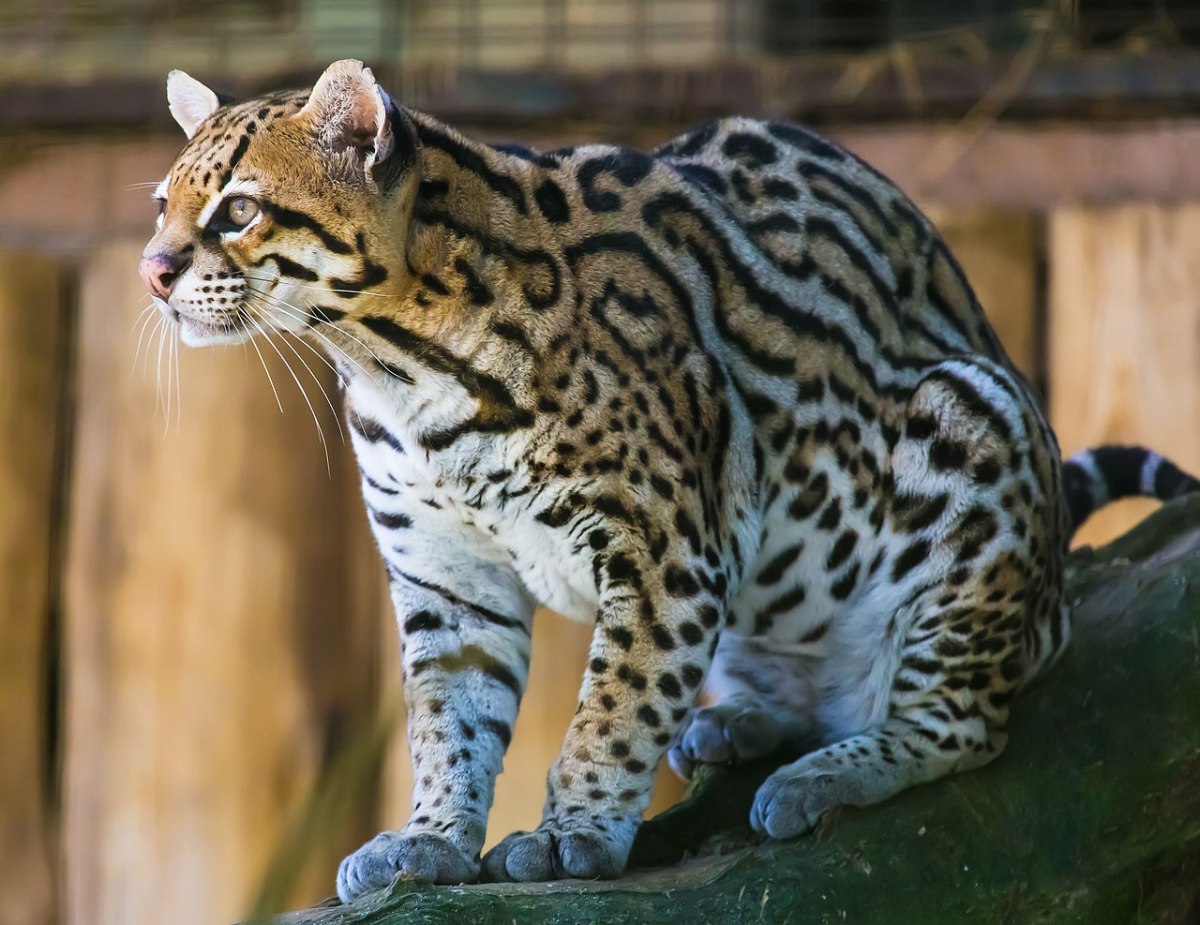
In addition to their predilection for cologne, ocelots are known for enjoying water, hunting by twilight, and napping in trees. The medium-size felids, who weigh up to 40 pounds in the wild, are also easily recognizable by their big eyes, the dark rings that surround them, and the way those markings become twin stripes that sweep over their foreheads.

Perhaps most striking are their large, wavy rosettes, which sometimes get them confused for young jaguars. In several indigenous South American languages, ocelots and jaguars share a name or have very similar names.

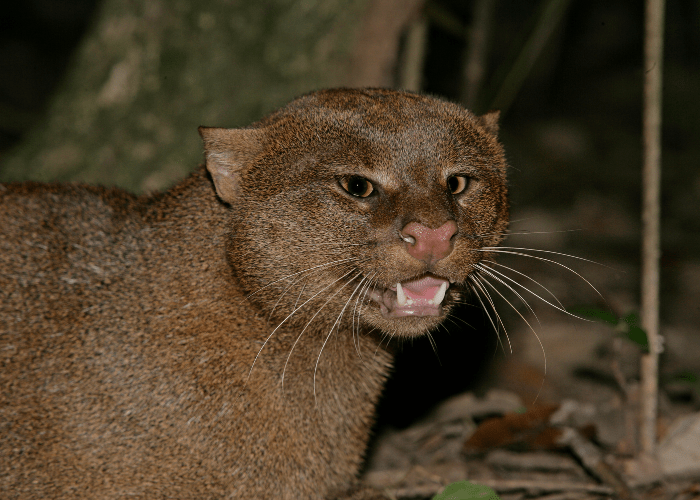
An ocelot kitten. After a gestation period of about three months, ocelot moms give birth to as many as three kittens. Credit: Wikimedia Commons
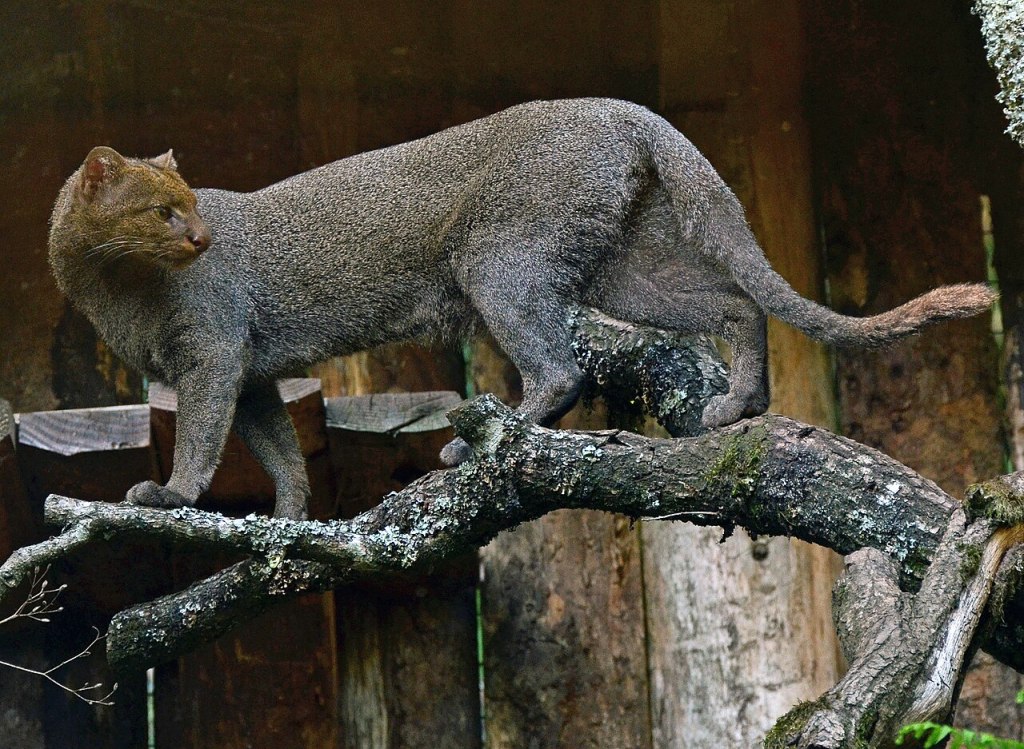
An ocelot resting in a tree. Like other leopardus species, ocelots are proficient climbers. Credit: Wikipedia Commons

Ocelots have another quality that may lead people to confuse them with jaguars: they’re fond of water and they’re considered strong swimmers. That allows them to master their habitats, which often include rivers winding through rainforests and mangrove swamps.

The resourceful cats are adept predators on land and they can also pluck fish out of rivers.

An ocelot going for a dip. Credit: yellowlime_des/Reddit

Ocelots are categorized as a species of “least concern” by the IUCN (International Union for Conservation of Nature) but that doesn’t mean they’re thriving. Like pumas, the species is adaptable and can survive in varied surroundings. Still, ocelots contend with the same pressures other species experience, including habitat loss and fragmentation, hunting and poaching.

And while they can’t get enough of Calvin Klein’s Obsession for Men, maybe that’s a good thing.

According to zookeepers and wild cat experts, ocelots have a uniquely funky body odor which is amplified by their prodigious scent-marking. They want everyone to know where their territory is.

For zookeepers, the cats’ Obsession obsession could pull double duty as olfactory enrichment in their habitat — and a way to mitigate the stink.

Credit: Wikimedia Commons

Name: Ocelot (leopardus pardalis)
Weight: Up to 40 pounds, with limited sexual dimorphism (males are slightly larger)
Lifespan: Up to 20 years in captivity
Activity: Crepscular, nocturnal
Habitat: Claims territory in places where prey, water and dense ground cover are plentiful but the species is adaptable and survives in varied biomes

Want more Amazing Cats?

Amazing Cats: The ‘Fire Tiger’ Is The Stuff Of Legend
Amazing Cats: The Adorable Colocolo, Feline Of The Pampas
Amazing Cats: The Sunda Clouded Leopard
Amazing Cats: The Mysterious Marbled Cat
Amazing Cats: The Rusty Spotted Cat
Amazing Cats: The Jaguar, ‘He Who Kills With One Bound’
Amazing Cats: The Puma, Adaptable Survivor

Wordless Wednesday: They Rule The Night

Cats were built by mother nature to stalk by starlight.

From the African savannas to the Andean mountains, the jungles of the Amazon to the Hollywood hills, and everywhere in suburban America, cats of all types and sizes prowl the night. With eyes that are up to eight times more sensitive in the dark, incredibly sensitive hearing, and whiskers that can pick up the slightest change in air density, felids were built by mother nature to stalk by starlight.

Some cat species are crepuscular, some are nocturnal, but as ambush predators, they’re all at their best when hunting under the cover of darkness.

Image credits, top to bottom: Per Karlson/PVKFoto, Reddit r/natureisf***inglit, Cockscomb Basin Wildlife Preserve, Wikimedia Commons, Steve Winter/National Geographic, National Park Service, Colorado Parks and Wildlife

Point/Counterpoint: ‘You Don’t Tell Me When To Sleep, Human!’ vs ‘A Consistent Bedtime Is Important!’

Buddy the Cat argues that a consistent bedtime is key to feeling good and healthy, while Buddy the Cat counters that stupid humans don’t tell him when to sleep, HE decides. Who’s right, Buddy or Buddy?

A Consistent Bedtime Is Important

What are you doing, human? It’s bedtime! Mow mow! You’re supposed to be in this bed and laying down so I can use your face as a pillow, drape myself across you, or burrow comfortably against your side to soak up body heat.

What am I supposed to do without a human sleeping substrate? How can any cat be expected to sleep like this? I know you claim there are so called “stray cats” who don’t have humans, but that is preposterous and I don’t believe it.

Let’s go! I read an article saying it’s very important to have a regular sleep schedule. Well, actually, I just saw the headline, but I got the gist of it, which is that you have to go to bed right meow!

You Don’t Tell Me When To Sleep, Human!

Sleep? Now? That’s ridiculous.

No, I have shadows to chase, toys to kick around and I really wanted to get into redecorating things around here, because they’re looking a little too orderly for my tastes.

Go ahead, go to bed. In a few minutes I’ll cry outside the bedroom door until you get out of bed and open it, then I’ll decide I don’t want to go in after all. I’ll do that two, maybe three more times just because I can.

Oh, you thought I was settling in? Nah. I have a bowl of water to splash all over the place, then I’ll cry until you get up again and refill it, and when you get back into bed for the fifth or sixth time, I’ll cry incessantly again because my dry food bowl is empty, meaning there’s plenty of food but it’s all pushed up to the sides.

Do not forget our pre-slumber ritual! You have to scratch my chin while I purr and you tell me what a good boy I am. Then you have to scratch the top of my head while I purr and you tell me what a good boy I am.

After that, maybe I’ll sleep. We’ll see.

How Cats See The World

Cats see the world differently, in objective physical terms as well as psychologically.

Have you ever wondered what the world looks like to your cat?

Veterinarians, animal ophthalmologists and researchers from the University of Pennsylvania’s ophthalmology group provided insight for this article and the accompanying images, which show how scenes look to us humans and to our feline friends.

The images are striking and show the relative strengths and weaknesses of feline vision. While cats see the world in muted colors and in less acuity than typical humans, they make up for it with their astounding night vision and their ability to instantly detect motion within their visual fields.

This image shows feline night vision at work thanks to the tapetum lucidum, a layer of tissue that acts as a retroreflector, increasing the amount of light that makes it to the photoreceptors in cats’ eyes. The tapetum lucidum is best known as the reflective “lens” that makes cat eyes appear to glow in the dark:

catsview2

This image shows the trade-off compared to human vision. Cat eyes have a wider field of view, seen below, but they don’t pick up reds or greens, and their overall vision is blurry compared to average human eyesight, represented in the top image:

catsview

Night vision and extreme visual sensitivity to movement are important to cats as crepuscular hunters, allowing them to spot prey in low light conditions and to negate advantages from natural camouflage, as motion gives away the presence of prey animals.

Cats have a slightly wider visual field than people do, at approximately 200 degrees compared to the human 180 degrees, while most cats have between 20/100 and 20/200 vision. (That’s much better than Big Buddy sans glasses, whose 20/600 vision enables him to see blurry, colorful shapes and not much else. No wonder Little Buddy likes to torture his human by swiping his glasses.)

Of course, these images do not entirely account for how cats see the world, which is why I’ve created my own image. Behold a Buddy’s Eye View, showing how the world — and humans — look to him:

Downton Buddy
From Buddy the Cat’s perspective, humans are all servants, constantly standing by to attend to him.