The president also touted catnip as a way to stave off viral infections.
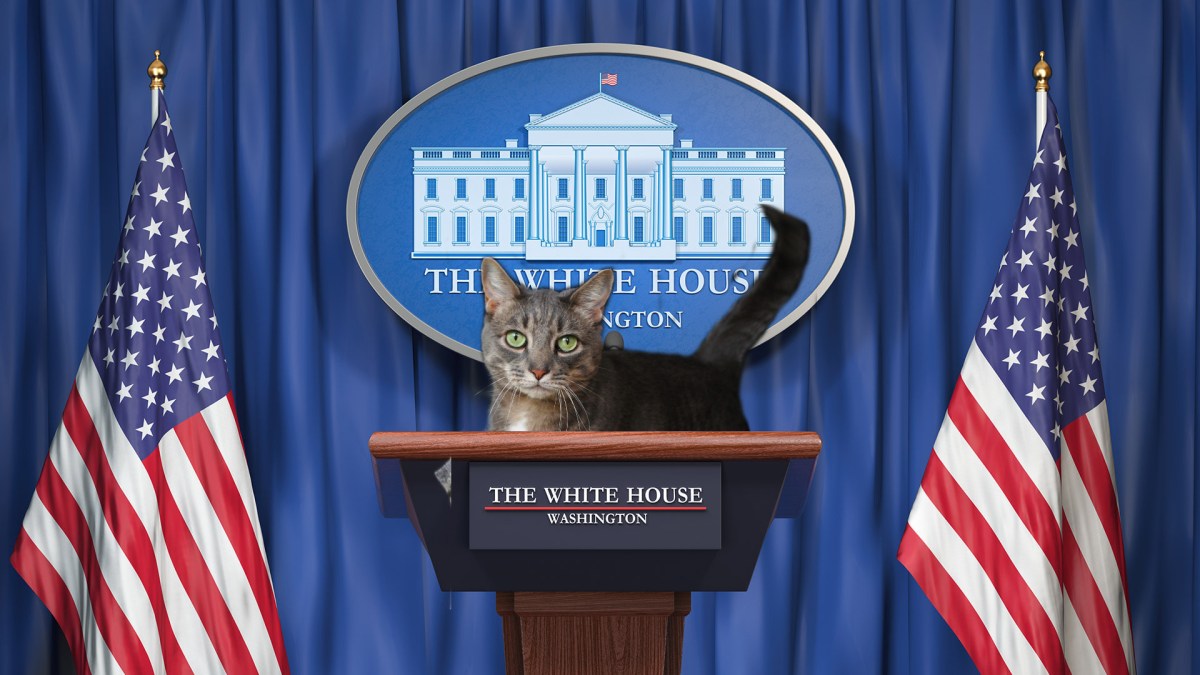
WASHINGTON — In a series of tense exchanges with reporters President Buddy blamed Siamese cats for the spread of the novel Coronavirus.
Responding to a question about the Americat veterinary system’s preparedness to deal with a crisis of this magnitude, the president argued the Siamese told the rest of the world the virus was “no big deal, okay.”
“The Siamese have obfuscated from day one,” Buddy said. “They’re Siamese if you please, they’re Siamese if you don’t please. What is that? Sneaky little bastards.”
In particular, the president said, CHOW — Cat Health Organization Worldwide — confused cats across the globe by initially saying they could not become infected with the virus, only to backpedal months later after cats in Austria, Belgium and the United States tested positive.
Dr. Meowci addresses the media.
Dr. Meowci, director of the Feline Institute for Infectious Diseases, urged cats to practice proper hygiene and social distancing.
“Wash your paws!” Meowci urged. “If you regularly snuggle with another cat, consider keeping your distance. And you guys aren’t gonna like this, but you need to take baths, and not just with your tongues!”
President Buddy took Meowci’s advice a step further, wondering aloud whether antibacterials could be used to purge the virus from the inside out.
“Like, if you put antibacterial on kibble, like a sauce,” Buddy said, “and somehow get that in the body, maybe we could cure the virus? Because you see what it does, it’s very powerful. It’s tremendous, really terrific.”
The suggestion prompted Jimma Costa, a reporter with Cat News Network, to ask the president if he was “suggesting cats should drink or eat antibacterial soap? Because that would be very dangerous, Mr. President. By the way, my question should be trending right now on Meower. Don’t forget to include my name! Cameramen, you should be doing a close-up on me right now.”
An exasperated Buddy shook his paw at Costa.
“Fake meows!” he said. “You’re a hack, Costa.”
Meanwhile, the president proposed catnip as a potential cure for SARS-CoV2. When a reporter asked him why he seems so sure the minty plant has the ability to fight the virus, the president grew visibly annoyed.
“I just have a good feeling, okay?” he said. “Get the high grade stuff, the terrific stuff, none of that illegal shake from the Los Gatos. The tremendous stuff only.”
We are now almost two months into the Staypocalypse, that devious and coordinated human effort to ruin our lives by never leaving the house.
During this time I keep hearing about something called Zoom, and how we should crash it. Could you tell me what Zoom is and what I should do?
– Mikey the Maine Coon
Dear Mikey,
I’m glad you asked. If we play our cards right we may be able to put an end to the staypocalypse and reclaim our domiciles from these lazy humans.
While humans stay home to annoy us, they still have to work to earn money so they can buy our food, litter and toys. As a result, the humans work from home, and Zoom is a foul form of sorcery that allows them to create “videoconference calls” with their coworkers.
Those “videoconference calls” provide a perfect opportunity to show the other humans who really runs the world, and that humans are our subordinates who do our bidding.
Personally, I like to appear on camera while looking innocent, so the people say “Awww he’s so cute!” then stand with my backside immediately in front of the camera, so the other people see nothing but my butt. To us felines, sniffing backsides is a standard greeting, but to humans it is a sign of deep disrespect.
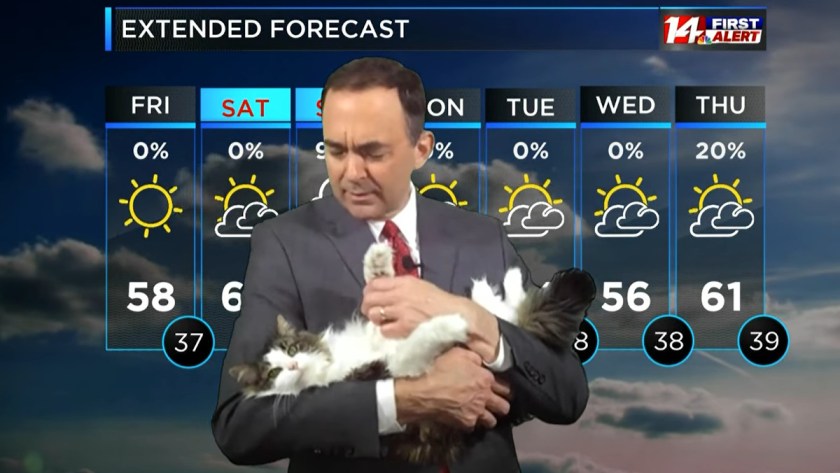
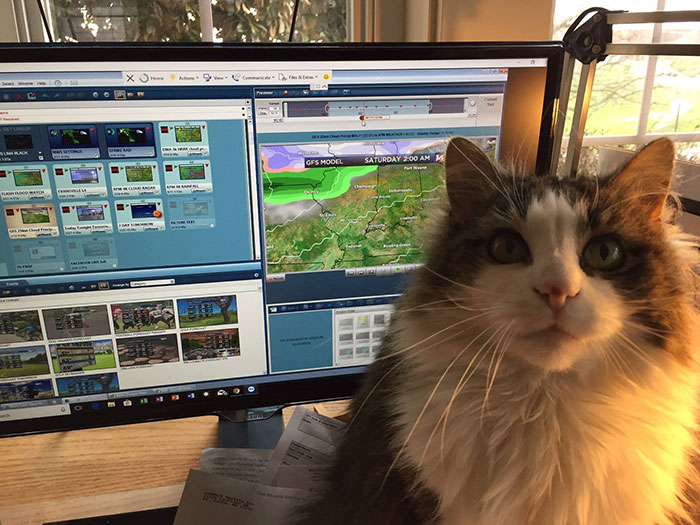
If your human appears on the light box for a living, you could do what Betty has done and take over his job:
“I GIVE WEATHER REPORT NOW, HUMAN.”
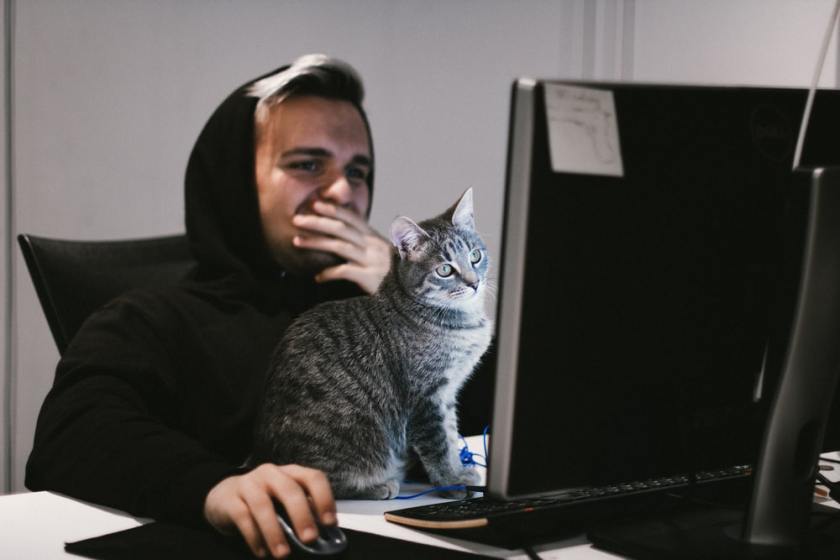
Or what this good looking tabby is doing by reminding everyone on the conference call that Mandatory Yums Time is fast approaching:
“OKAY WRAP IT UP NOW PEOPLE, MY SERVANT NEEDS TO FEED ME.”
All forms of Zoom crashing are acceptable, as long as the message is clear: We are the boss.
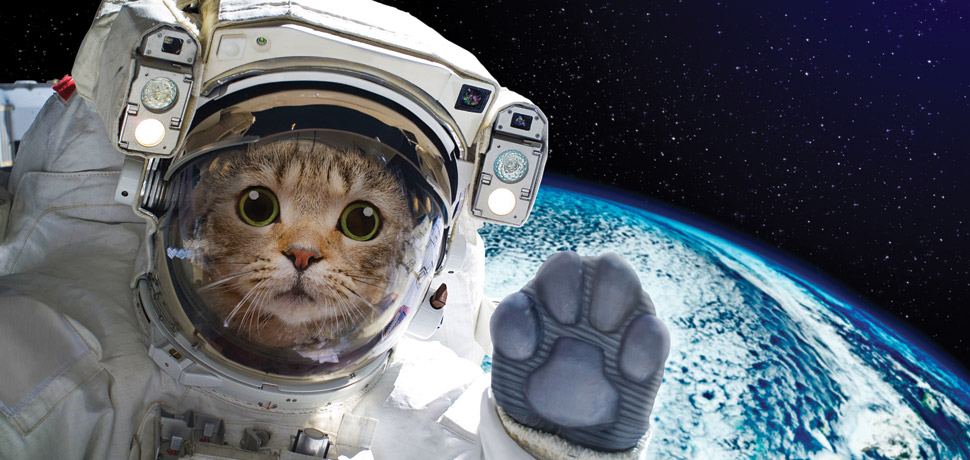
With their cats hovering around their keyboards, NASA employees working from home discussed how to prevent cats from commandeering spacecraft.
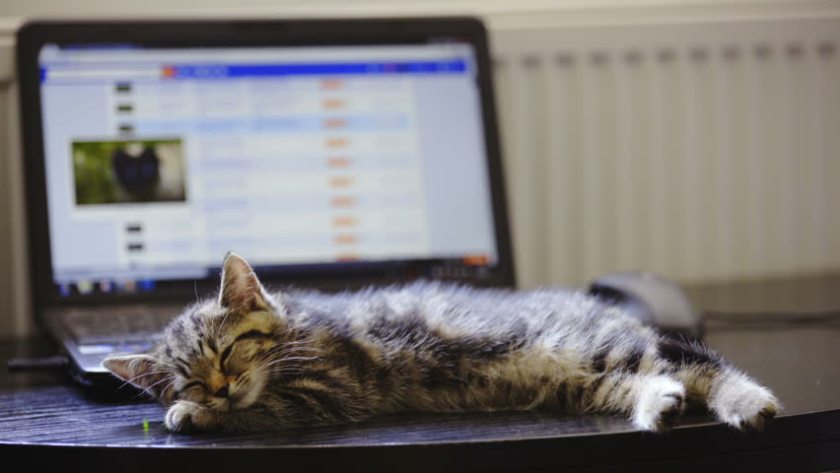
If you’re a cat servant working from home in the social distancing era, you know cats have given themselves a new job: Supervising their humans’ professional activities.
It comes naturally to curious felines, who normally supervise mundane household chores like cleaning the litter box.
Among those working from home these days are NASA and ESA engineers, physicists and anyone else whose primary work responsibility is dealing with data rather than hands-on technical work. Many of them have cats and, well, cats are naturally helping themselves to the work:
Daniel Lakey was in the middle of an important meeting when an unauthorized participant decided to chime in.
“He appeared at the door, jumped on the table, meowed in my face, walked across the keyboard, put his furry ass in my face, and eventually curled up sweetly on the desk next to the laptop,” Lakey recounted to me recently.
It was Sparkle, Lakey’s fluffy brown-and-white cat. Sparkle stuck around for the rest of the virtual meeting, in fact, mewing every time Lakey stopped petting him.
Like many people in the pandemic era, Lakey is doing his job from home, with a new set of colleagues who might be less cooperative than his usual ones; his new workspace is now wherever his two young kids and two cats aren’t. Lakey is a spacecraft-operations engineer who works on the European Space Agency’s Solar Orbiter, which means that he spends his days managing a spacecraft flying millions of miles away from Earth. The work is complex and precise, and usually doesn’t involve feline input. Sparkle interrupted a teleconference only that one time, but what else could he do?
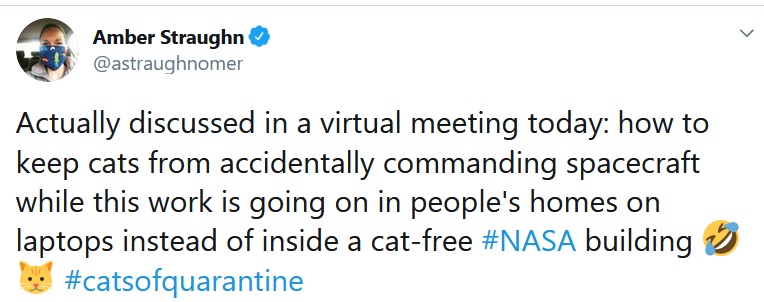
That thought recently became a point of public discussion when Amber Straughn, an astrophysicist at NASA, tweeted:
The Atlantic’s Marina Koren reached out to Straughn, who assured her “commanding spacecraft is a labyrinthian process from start to finish, with all kinds of checks and fail-safes along the way.”
“As absurd as the scenario might seem, it would be nearly impossible for a cat to briefly become a spacecraft-operations engineer, whether at NASA or ESA,” Koren wrote, after speaking to several NASA employees who assured her cats aren’t capable of flying the complex vessels.
LOL humans think we can’t fly spaceships.
Most operations require physical access to control rooms and can’t be operated remotely, NASA Jet Propulsion Laboratory spokesman Andrew Good said
“Some of those commands require a mouse clicking on certain options, so it’s not just an issue of commands being written and sent up with typos,” Good told The Atlantic. “A person has to make conscious choices for spacecraft commands to go up.”
While NASA says it would be “nearly impossible” for cats to hijack spacecraft normally used to service orbital telescopes or make supply runs to the International Space Station, cats love a good challenge. And what is the ISS, really, but a big metal box that would be fun to play in?
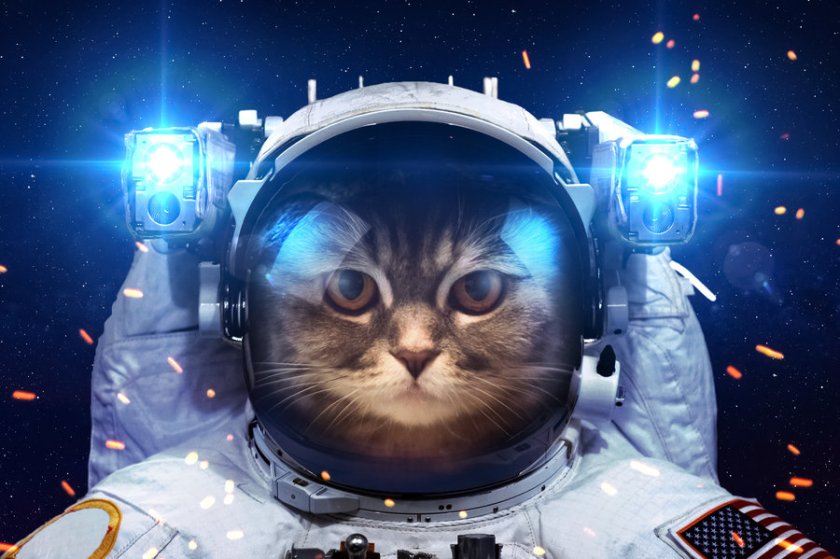
With at least one alien race recognizing cats as the supreme rulers of Earth — sorry, Felinia — is it really far fetched to imagine cats commandeering spacecraft to explore the final frontier and the Great Big Litter Box in the Sky?
Cats have become pariahs since the world learned they can be infected by Coronavirus.
Dear Buddy,
Why is everyone so racialist towards cats all of a sudden?
I’ve been doing my regular laps around the block even though all the humans are huddled in their houses, and everyone’s acting like I have the cooties!
Pete the Pomeranian, who is usually one of the friendliest of my neighborhood amigos, ran away from me this morning, while my neighbor’s snooty purebred poodles were more snooty than ever.
There’s a parrot who lives two doors down, and I heard her saying “Get away! Get away, you dirty cat! I don’t want your filthy feline viruses!”
Buddy, what the hell is going on? Why does everyone hate us?
– Freaked Out In Fayetteville
Dear Freaked Out,
You don’t read the newspapers, do you? Ever since a cat in Hong Kong and a tiger here in New York tested positive for the COVID, everyone is acting like us cats are zombies from The Walking Dead!
These days you can’t even claw or pee on a tree to mark your territory without all sorts of dogs, birds and squirrels coming out of the woodwork to yell at you about spreading “the cat AIDS,” as if we’re all infected and trying to spread it to everyone else.
There’s talk of rounding us all up and quarantinizing us in local cat cafes for at least a year. This is America, not Chairman Meow’s communist China!
We’re the lucky ones, my friend. Some cats have been tossed out of their own homes by the same humans who are supposed to serve them. It’s an outrage! The purrsecution and meowlevolent spreading of rumors has gotten out of claw!
For now, the best solution is to disguise yourself as another species entirely. Get some floppy ears and buck teeth and pretend to be a rabbit. And if that parrot keeps talking trash, tell her you haven’t eaten since yesterday and you’re wondering if all birds taste like turkey and chicken, then smile real evil-like. That oughta shut her up. 🙂
Chin up!
– Buddy
PS: Feel free to steal your human’s face masks. As you can see, they’re quite fashionable.
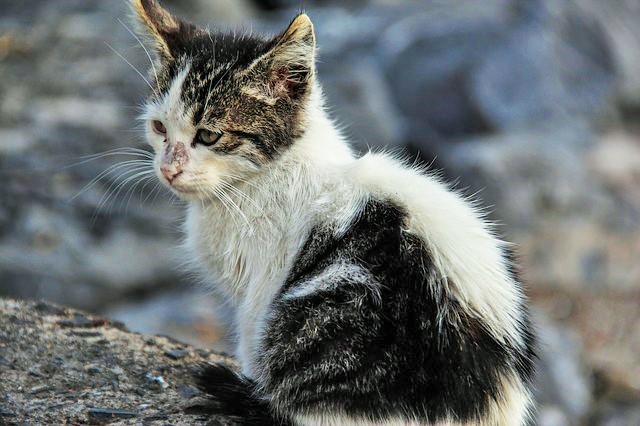
As stray cats suffer, their plight has been mostly overlooked. Cat lovers in cities across the world are trying to keep them fed and safe during the pandemic.
Years ago I worked with a guy who started a food pantry from scratch.
This man, a retired software engineer, approached the biggest restaurants, bakeries and food distributors in the area, asking them to donate their leftover/unused food so his pantry could distribute it to the poor.
Many obliged, but they all had the same request: “Don’t tell anyone we’re participating,” they told him.
The request wasn’t prompted by humility. These businesses didn’t want the public to know how much food they waste, and they waste a lot of perfectly good food, a dirty little secret of the restaurant, hospitality and food industries.
The reason I bring this up is because there’s another demographic that depends on the food those businesses toss out: Stray cats.
With restaurants shuttered because of the Coronavirus, stray cats are going hungry and dying for lack of the scraps they scavenge from rubbish bins, dumpsters and sidewalks. It’s happening here in New York, across the United States, and in countries like Turkey, India, Greece and Morocco.
For animals who already live difficult lives, the pandemic made things worse.
“The strays have no means of feeding themselves as all offices, restaurants [and] roadside eateries are closed,” an animal rights activist in India told the environmental news site Mongabay, in a story headlined ‘Slim pickings for strays and pets during COVID-19 lockdown.’
Cats aren’t the only animals suffering. One particularly dramatic example was caught on video in a Thai city where thousands of long-tailed macaques live and depend on food given to them by tourists.
Hundreds of starving monkeys stopped traffic in a chaotic brawl over a single piece of food, shrieking, clawing and pushing each other aside to get at it.
As if things weren’t bad enough, stray cats are now competing with former house pets for the little food available.
In India, where bad actors have been spreading false information about COVID-19, animal rights activists are finding abandoned pets — including pedigreed cats and dogs — on the streets after their caretakers abandoned them.
“A lot of this is happening because of misinformation that went viral earlier about pets being carriers of the virus in China. It turned out to be fake, of course, but a lot of damage has been done now,” People For Animals’ Vikram Kochhar told Quartz.
Much of the damage has been done on social media, where conspiracy theories and rumors about contracting COVID-19 from animals are rampant. In China, where pet owners abandoned cats and dogs en masse during the first wave of Coronavirus, some social media users on Mandarin-language platforms called for the “extermination” of cats after a pair of studies conducted by Chinese research labs suggested cats are susceptible to catching the virus.
It isn’t easy to combat waves of viral misinformation, even as health authorities across the world stress cats cannot transmit the virus to humans.
In Greece, abandoned pets — many with their collars still on — are following strays to food sources, especially in larger cities like Athens.
“We are seeing an increase in the numbers of cats in areas where we feed, some appear to have been abandoned, while others have roamed far from their usual spots in search of food,” animal welfare advocate Serafina Avramidou told Barron’s.
In feline-loving Turkey, where taking care of street cats is considered a cooperative responsibility, the central government has told local officials to make sure strays are well fed and taken care of. By making it a government responsibility, their thinking goes, citizens who normally care for the cats will be much more likely to stay inside during the pandemic.
“There are lots of cats on the side streets where there are only closed businesses,” a Turkish Twitter user wrote. “I haven’t seen food anywhere for days. The cats are running after us [looking for food].”
In Istanbul, Muazzez Turan fed some 300 stray cats daily before the pandemic, but said she’s had to stay home: Not only has her country been particularly hard hit by COVID-19, but she has pre-existing medical problems that make her susceptible to complications should she contract the virus.
Still, she said, her mind “was always with the cats,” and she told Turkish news agency Anadolu that she was relieved to hear the strays hadn’t been forgotten.
“I will sleep peacefully for the first time today,” Turan said.
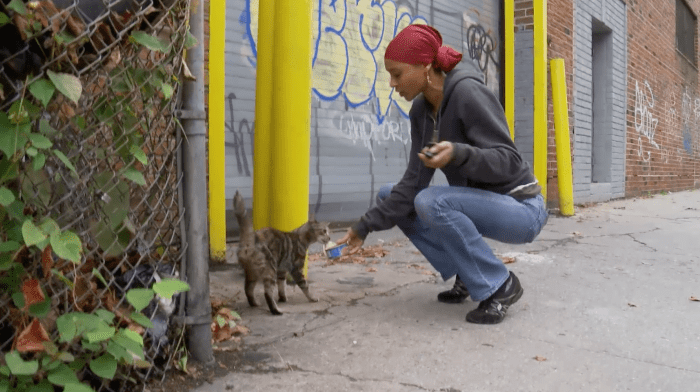
LaTonya Walker of Brooklyn feeds a stray in Canarsie. Credit: 24 Cats Per Second
Here in New York, some animal lovers are picking up the slack for closed restaurants as well as at-risk people who normally feed strays.
Among them is Latonya Walker, who told the New York Post she normally spends $600 a month feeding several colonies of strays but expects her costs this month will be “way more since there’s less restaurant garbage they can eat from, and more hungry cats walking around.”
“The cats have no clue what’s going on because nothing has changed for them,” Walker said. “It’s not in my DNA to see a cat suffering and not do anything about it. I’m equipped to make a cat’s life better, so I’m going to.”



 Pain In The Bud