‘School With Paws’: Cats In Class Help Kids Readjust After Pandemic

The kids are so smitten, many of them come to the school on weekends to care for the cats.

When teacher Evrim Mutluay welcomed her students back to school after a long period of remote learning, she noticed they were different.

The kids, who hadn’t physically been to school for more than a year due to the pandemic, were “colder” and less engaged with their lessons and with each other. Many were either ambivalent or didn’t want to be there.

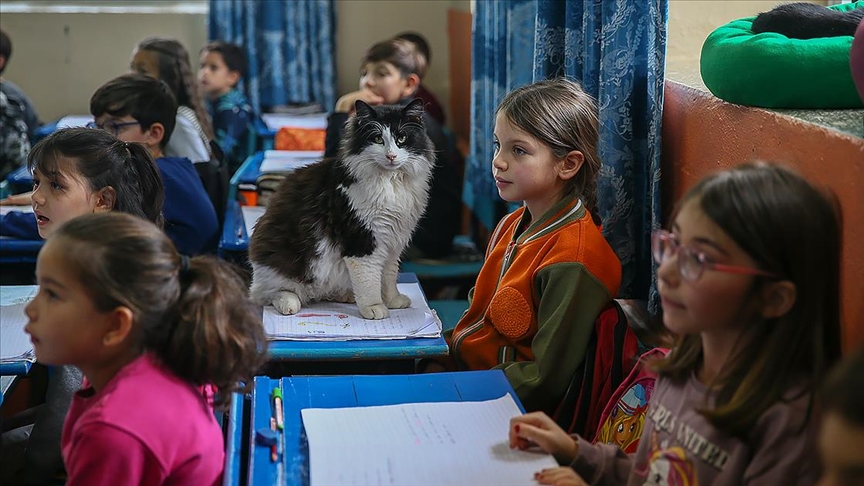
So Mutluay, who teaches at Adagüre Primary School in the rural outskirts of Turkey’s Izmir region, had an idea that might seem radical in most countries, but not in the famously feline-loving nation: She cleaned out an old storage building on school grounds and turned it into a shelter for 12 neighborhood cats.

It was the first step in her “Patili Okul” (“School With Paws”) project aimed at getting kids reinvested in their studies.

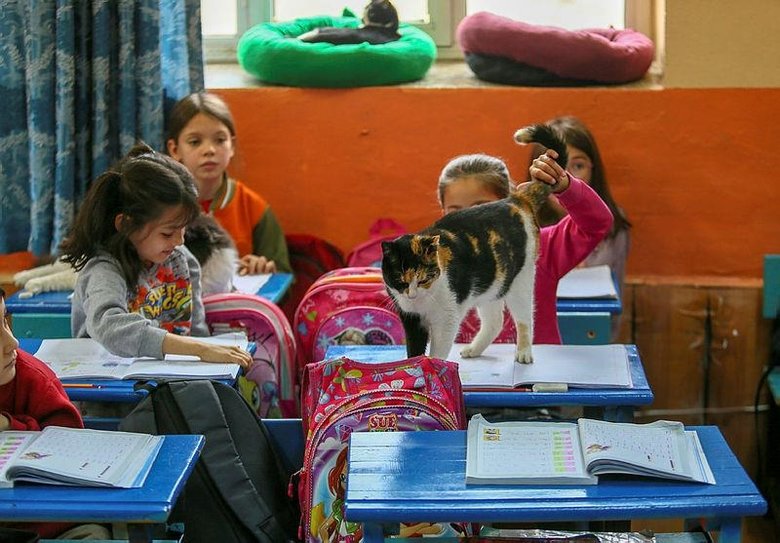
The cats — who have been given names like Alaca (“twilight”), Sun and Panther by the kids — have free run of the school during the day, and Mutluay’s elementary school-age students can not only pet and cuddle with them during class, they help take care of the former strays by cleaning their shelters and feeding them. The students “love the cats so much,” Mutluay said, and the program has “endeared the school to the children.”

School With Paws
A student cuddles a calico cat in class. Credit: Adagüre Primary School

The students have become so invested that many of them now show up on weekends voluntarily to feed and play with the cats.

“It also helps them to develop a sense of responsibility, by caring for others,” Mutluay told Turkey’s Anadolu Agency, a wire service similar to the Associated Press. “In a way, cats and children grow up together.”

The school, which also has a community garden tended by the kids and holds classes outdoors when the weather permits, offers a chance for children to form bonds with the animals.

Mutluay described one student who was so affected by his time stuck at home that he “didn’t even make eye contact” when the school resumed in-person learning. Except for his nascent connection with a cat named Pied, he was distant and seemingly disinterested. When the student’s attendance fell off, Mutluay appealed to that connection to bring him back: “If you don’t come, Pied will cry,” she told him.

School With Paws
Credit: Adagüre Primary School

Student Cemre Şen is one among many of her classmates who have brought stray cats to the school. There are now 30 cats living on the school grounds, including the lost kitten Şen found. She and her fellow students even incorporate the cats and kittens into games they play during recess, she said.

The cats are not kept against their will: If they want to return to their colonies or street life, they are allowed to leave. Most choose to stay, enjoying the affection and attention from the kids and the guarantee of solid meals every day. (The kids feed them before classes begin and after school before heading home.) It’s an arrangement that works in a nation where caring for cats is seen as a community responsibility, as opposed to the network of shelters, rescues and colony managers who care for cats on behalf of a generally indifferent public in countries like the US.

In Turkey, the idea of cats in classrooms isn’t controversial because the little ones are everywhere — they’re allowed to wander in and out of shops, homes and even office buildings at their whim, and the streets of cities like Istanbul are lined with miniature cat houses for neighborhood felines.

The allure of cats in the classroom is so strong, Mutluay’s program has even attracted transfers like newcomer Ata Yıldırım, who switched schools after he read social media posts about the program.

“I have two cats at home,” he said, “and when I saw so many cats here, I convinced my parents to send me here.”

School With Paws
Evrim Mutluay and her students at Adagüre Primary School. Mutluay has been a teacher for 16 years. Credit: Adagüre Primary School

Study: 83% Of All Zoom Participants’ Screens Display Cat Butts

Perhaps cats are reminding people that they rule the world.

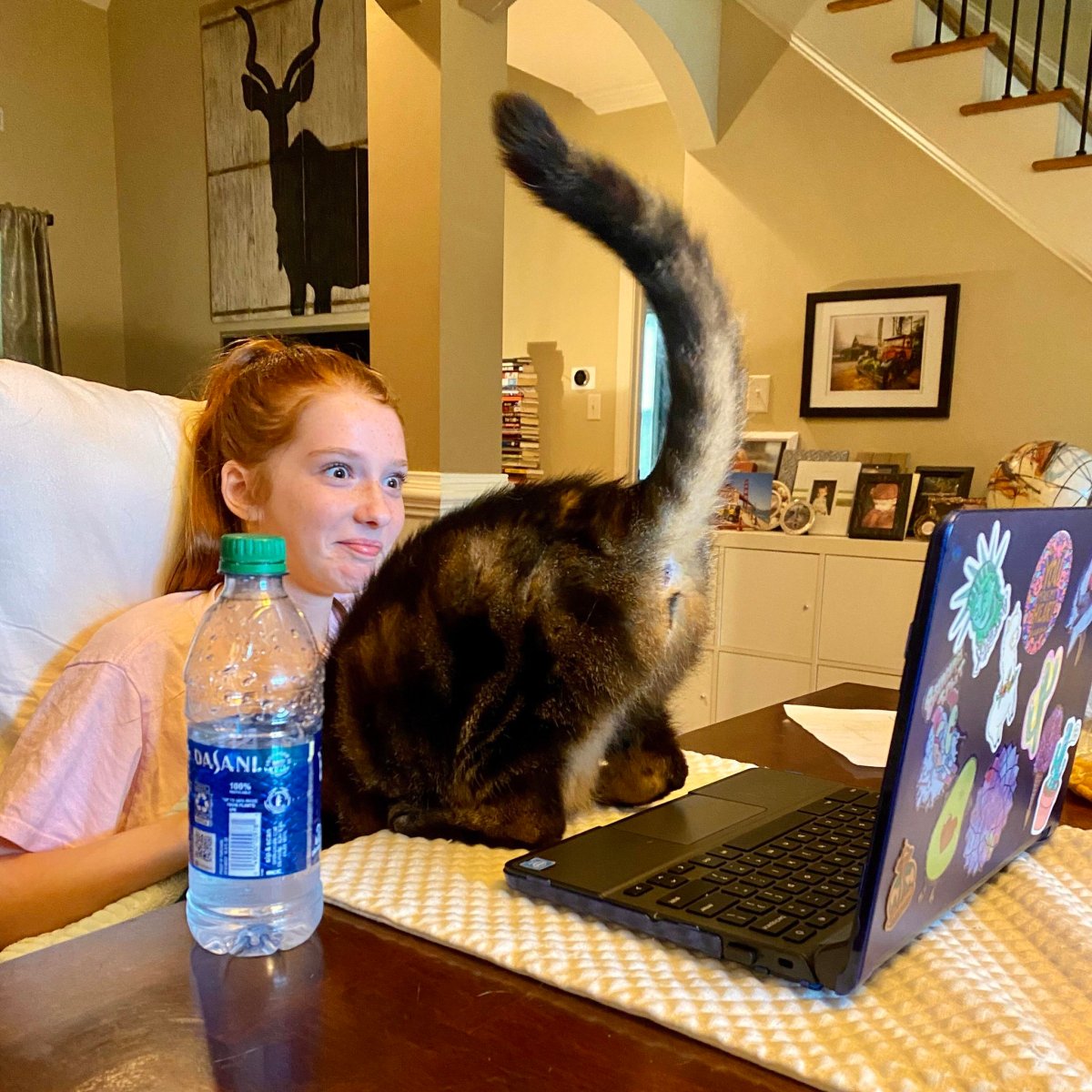
More than four out of every five Zoom feeds are taken up by feline posteriors, a new study has found.

The research, “Felis Catus Rears In Online Meetings” was published this month in the Journal of Cats and Technology.

“With so many people working from home during the pandemic we had a wealth of data, including more than 400,000 hours of recorded Zoom meetings,” said Mo Muntervary, the study’s lead author. “Using a proprietary AI to analyze the data, we found that in approximately 332,000 hours of that footage, the Zoom meeting participants were either partly or completely obscured by the rear ends of their cats.”

Cat

Between March of 2020, when the US and Europe went into lockdown, and July of 2021, virtually every meeting in the information industries was run by participants looking at the behinds of their co-workers’ cats, the study found.

“I can pick my co-workers’ cats’ butts out of a police lineup,” said Yuzu Daimon, 32, a hospitality executive in Tokyo. “If I see a screen dominated by the behind of a chonky tuxedo, I know AI Imajo from creative has joined the meeting. If I see orange and black Bengal butt, I know it’s Hirotaro Tanaka in accounting.”

Some say they prefer the view over the normal dour expressions of colleagues working from home.

“Some of my best creative ideas of the past two years have come from staring at a screen full of cat butts,” said Luisa Rey, a writer for Spyglass Magazine in New York.

url(16)

Conventional wisdom holds that cats park themselves in front of web cameras because they’re trying to draw the attention of their humans, but that may not be the case according to some experts.

“We have to consider the possibility that this is intentional on the part of felines,” said cat behaviorist Selina Kyle. “They may be trying to tell us they’re tired of people infringing on their alone time, when people were in the office before COVID changed everything. They may be looking to annoy us in retaliation for us annoying them, and if this is indeed a battle of annoyingness, then I’m afraid it’s a battle humankind cannot win. We are simply outgunned.”

Buddy Quarantines His Human After Learning Cats Can Get COVID

The effort follows Buddy’s unsuccessful attempt to get vaccinated and plans for airtight domes over his sleeping and eating spots.

NEW YORK — Citing a recent article about the possibility of humans infecting their pet cats with Coronavirus, Buddy the Cat took the extraordinary step of quarantining his human, sources said.

The tabby cat, who is normally infamous for his deep loathing of barriers, had constructed an elaborate series of intra-apartmental checkpoints and procedures designed to keep him separate from his human, Big Buddy.

Under the new procedures, Big Buddy was banned from his own bedroom and had his snuggling privileges revoked.

“I just can’t take the chance, especially not with this Omicron variant infecting everyone,” Buddy said of his decision. “It’s not just about getting sick. Did you know sometimes COVID destroys your sense of taste and smell? It’s true! What life is worth living if you can’t taste every delicious morsel of turkey, if you can’t savor the aroma of dirty socks?”

As of Friday, the cautious cat had placed ads on Craigslist and other local sites.

“Seeking Temporary Servant,” the ad reads. “Must serve my meals, clean my poops, feed me snacks, allow me to sleep on you, and give me massages while telling me what a good boy I am. Applicants must agree I am a very handsome cat, and you will be expected to write a short essay about why you’re excited to serve me. THIS IS NOT AN ENTRY LEVEL POSITION. Experienced cat servants only!!!”

Cat in mask
“Back away, human, and return to your designated quarantine zone!”

The new quarantine measures mark the second time Buddy has taken drastic action in response to fears about COVID. The silver tabby constructed an air tight, clinically sealed dome around his food and water bowls in November after three snow leopards at a Nebraska zoo fell ill and died from the virus.

A second, larger dome meant to encapsulate his human’s his bed was under construction when Buddy was convinced to delay his plans for the holidays in order to spend time with friends and family. Now construction on the bubble has resumed.

Pharmacy techs at CVS refused to vaccinate the domestic shorthair after he showed up for an appointment in early January. A spokesman for the pharmacy chain said the vaccines were not FDA approved for cats, and Buddy isn’t as smart as he thinks he is.

Meanwhile, efforts to get Big Buddy to secure a dose for Buddy have been fruitless.

“I’m not asking much,” Buddy said. “All I want him to do is steal a vaccine from a highly secure area, educate himself on how to inject me, calculate an appropriate dose for my species and body weight, and give me the jab. How hard is that?”

With A Three-Fold Increase in Cat Thefts, UK Chooses Microchip Mandate

With breed cats commanding prices in the thousands, thieves see pet theft as a quick score. Lack of prosecution has made it an almost zero-risk crime in the UK.

Mandates in the wake of COVID-19 haven’t been especially popular with a weary public, but surveys show one proposed directive has almost universal support in the UK: Requiring all cat owners get their pets microchipped.

Cat thefts in the UK have tripled in the last five years, with the pandemic contributing to the increase since early 2020, police say. Authorities say they hope compulsory microchipping — and consolidating the many chip ID databases into one — will help discourage people from stealing while making it easier to reunite felines with their families.

Thieves mostly target pedigreed kitties over moggies, with Bengals as the most commonly-stolen cats, followed by British Shorthairs and Persians, according to police statistics. Thieves try for breed cats because of resale value, police say.

Dog thefts have skyrocketed as well, with thieves targeting Chihuahuas, Jack Russell Terriers and German Shepards, among other popular breeds. The price of breed dogs has ballooned by as much as 89 percent since the beginning of the pandemic, when demand for new pets and a slowdown in breeding created a boom market.

For context, an estimated 3.2 million British families welcomed new pets, mostly cats and dogs, into their homes since the first lockdowns in late winter and spring of 2020, the BBC reported. Like their counterparts here in the States, UK shelters experienced unprecedented adoption rates as people battled loneliness and depression during the initial COVID waves and last year’s long winter when the virus came back with a vengeance.

“The number one reason behind pet theft is because the prices for pets have gone up drastically,” Becky Thwaites, spokeswoman for UK pet charity Blue Cross, told SWLondoner. “This happened exponentially over lockdown, as responsible breeders stopped breeding due to social distancing guidance, but more people were wanting pets.”

Despite the spike in animal thefts, only about one percent of all such crimes have led to an arrest, according to a public information request by a UK animal welfare group. 

Police have been reluctant to pour resources into those cases, partly because the law lacks serious consequences for people who steal animals. While the maximum sentence for stealing a pet is seven years in jail, under current UK law sentences are pegged to the value of the stolen item. (Unlike the US, the UK does not make a distinction between prison and jail.)

But for people who love their cats, it’s not about the monetary value — it’s about sentiment, love and the distress to human and animal when they’re separated.

Abductions instead of thefts

To change that, a new pet theft task force — set up earlier this year to study the growing problem — recommended a change in the law. Instead of treating pet thefts as property thefts, under the proposal they would be treated as abductions, with all the increased charges and consequences that come with the classification.

Treating animal thefts as abductions “acknowledges that animals are far more than just property and will give police an additional tool to bring these sickening individuals to justice,” UK Home Secretary Priti Patel told the BBC.

Advocates say treating pet thefts as abductions makes sense not just as a legal adjustment, but also as a reflection of the way cats and dogs are stolen. While some thieves stalk dog parks and lure pets away with treats, others have taken to more brazen and violent means like taking animals by force and jumping people while they’re walking their dogs.

The change would require owners to have their kittens chipped by 20 weeks and adult cats chipped upon adoption from a shelter or rescue.  Failure to microchip a pet would result in a warning and a three-week grace period. After that, cat owners would face a steep fine of £500, equal to $660 in USD.

Consolidating chip databases

There are about 10.8 million pet cats in the UK, although widespread chipping alone won’t solve the problem of pet thefts and lost pets flooding shelters. There are currently 16 different microchip databases in the UK. They don’t always share information and scans don’t cover each of the databases, so even if a cat is recovered, brought to a shelter and scanned, there’s no guarantee the kitty will be returned home.

The existence of so many non-cooperating databases operated by private companies “can pose a huge barrier to successful reunification of pets” said the British Veterinary Association’s Malcolm Morley.

UK authorities and the animal welfare groups pushing for the change are cognizant of the problem and want to streamline the 16 existing database into one central repository of cat microchip registration. That will take time and will have to include compromise on the part of the various private companies running the existing fractured databases.

“Every day, we see how important microchipping is for cats and for the people who love them,” said Pet Protection’s Jacqui Cuff, “whether it’s reuniting a lost cat with their owner, identifying an injured cat, or helping to ensure an owner can be informed in the sad event that their cat has been hit and killed by a car.”

UPDATE: Airline Investigates Cat Breastfeeding Incident, Flight Attendant Speaks Out

There have been more than 5,000 confrontations involving unruly passengers on airlines in 2021, on pace for more than all other years combined.

When we first heard about an airline passenger grossing out her fellow travelers by breastfeeding her cat, we figured at least kitty was happy with the situation — but apparently not, according to a flight attendant who was involved in the incident.

Instead of purring and kneading in a milk coma, the cat — likely a Sphinx — wanted nothing to do with feeding from the woman’s breast on the flight in late November, flight attendant Ainsley Elizabeth said.

“This woman had one of those, like, hairless cats swaddled up in a blanket so it looked like a baby,” Elizabeth said in a video about the incident. “Her shirt was up and she was trying to get the cat to latch and she wouldn’t put the cat back in the carrier. And the cat was screaming for its life.”

“What does she do at home if she’s doing that in public?” Elizabeth asked. “And then security met the flight just to tell her that she couldn’t do that again, cause it was weird and gross.”

Elizabeth has since deleted the social media account she used to upload the video.

As we noted in our earlier post, the woman was uncooperative when flight attendants asked her to stop, prompting the pilot to send a message ahead to the destination airport via ACARS, short for Aircraft Communications Addressing and Reporting System.

acarscat
An ACARS message sent from Delta Air flight DL1360 to ATL, Hartsfield-Jackson Atlanta International Airport.

The bizarre incident happened aboard a Delta Airlines flight from Syracuse, NY, to Hartsfield-Jackson Atlanta International Airport in Georgia.

Meanwhile, Delta airlines has begun an investigation into the Great Breastfeeding At 40,000 Feet saga, after the incident went viral last week and garnered headlines around the world — including newspapers in the UK, Australia, New Zealand and dozens of non English-speaking nations.

Initially the passenger was reprimanded, but an investigation could result in more serious consequences, like a ban on using the airline.

Airline aisle during flight
In-air confrontations have skyrocketed in 2021, mostly due to disagreements over COVID-19 safety rules such as wearing masks. Credit: Wikimedia Commons

The story comes amid a general surge in violent attacks and tense confrontations aboard passenger jets — and now the FBI is getting involved.

As of Nov. 4, the FAA had logged 5,033 cases involving “unruly passengers,” including 37 that were referred to the FBI for criminal prosecution.

That puts 2021 on track for more cases than all other years combined, according to the Association of Professional Flight Attendants. The majority of those incidents — as many as three out of every four — are related to confrontations over mask policies due to the Coronavirus pandemic.

Teddy Andrews, a long time flight attendant with American Airlines, testified before a congressional committee in September, recalling an incident in which a passenger called him the n-word when Andrews asked the man to wear his mask.

“These days I come to work anticipating disruptive behavior,” Andrews told USA Today. “Our colleagues are anxious, fearful. What is going to happen on the next flight? How will this passenger react if I remind them to wear their mask? Will complying with airline policies set them off? Can I avoid engaging, or would that be an evasion of my duties?”