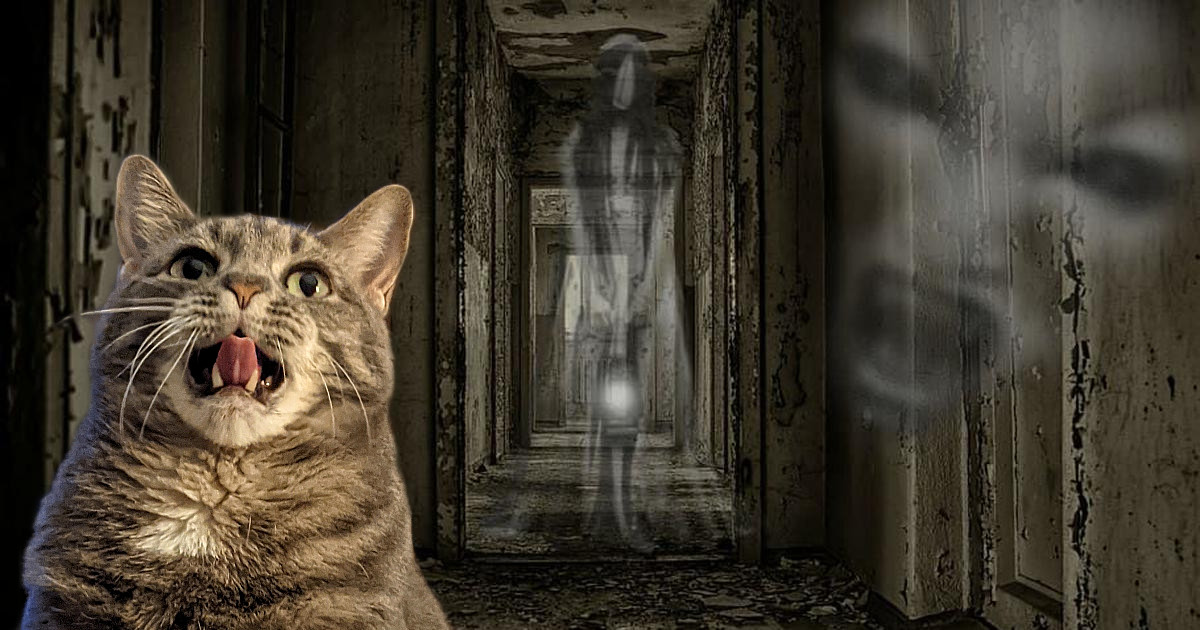
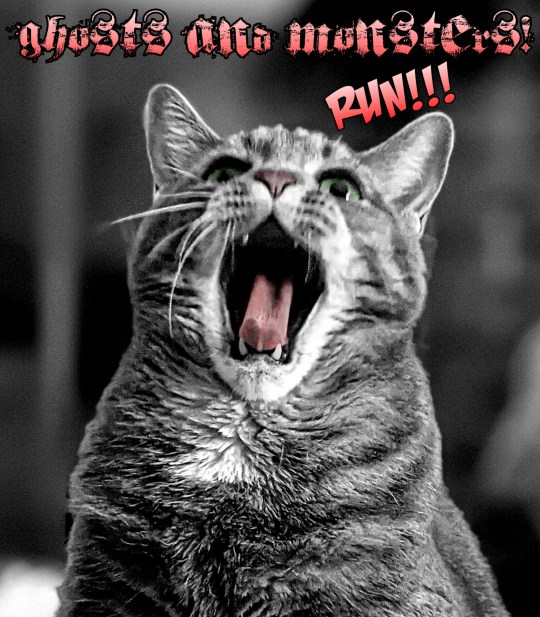
As one of the bravest cats on planet Earth, Buddy is uniquely qualified to advise scaredy cats who get easily freaked out by horror movies.
Dear Buddy,
My human likes to watch horror movies and they’re freaking me out! I can’t even look at mirrors since we watched Oculus, I jump at shadows ever since watching 30 Days of Night, and I wet my favorite napping spot the night we saw The Ring.
But it gets worse! My human spent almost two weeks watching a TV series called The Haunting of Hill House, which was so scary, scarier than vacuum cleaners and filled with terrifying scenes! It had all kinds of monsters and people dying and countless sinister-looking ghosts hidden in the background of every scene.
Buddy, I can’t sleep at night, even with my human. I’m scared of monsters in the closet or under the bed, and ghosts outside the bedroom door. I’m scared they’re gonna get me in my sleep!
Help me, Buddy!
Terrified in Tallahassee
Dear Tallahassee,
You’ve come to the right cat, amigo! Among our kind the name Buddy is synonymous with bravery as well as good looks and charm, and I’m known for keeping my cool in circumstances that would reduce lesser cats to frazzled, freaked-out messes.
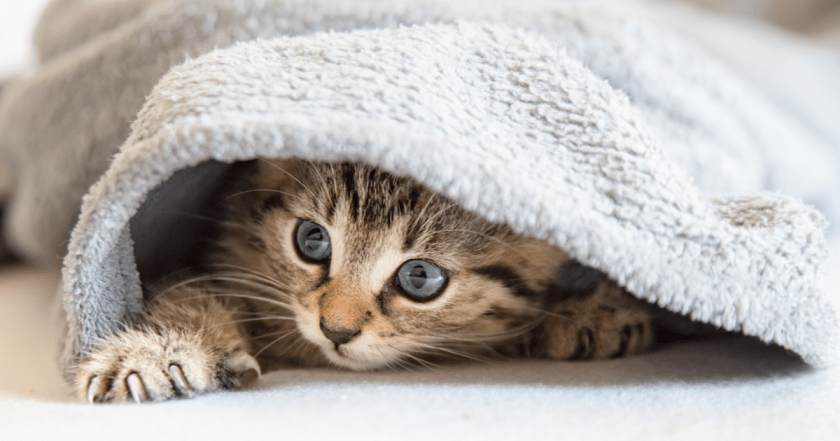
I’m going to let you in on a little secret, one they don’t teach to just any cat or kitten: Get under the blankets!
Blankets: The secret weapon.
You see, blankets are about more than keeping those furless humans warm when they sleep. Blankets have magical properties that repel monsters and ghosts. They’re like shields or magic force fields!
Humans know that if you’re scared and you think there might be monsters in your home, the best solution is to get completely under the blankets, wrap yourself up nice and cozy and rest easy knowing the safety they will afford you until sunrise, when ghosts and monsters have to retreat or die in the sunlight. (Or was that vampires? I get things mixed up sometimes.)
Anyway, being the brave cat I am, I’m totally not scared of anything and I don’t have to hide under blankets. In fact, my human sleeps easy knowing that I’m guarding him. But if I were scared, Tallahassee, I’d dive under some magical blankets and feel my worries melt away.
Your fearless friend,
Buddy
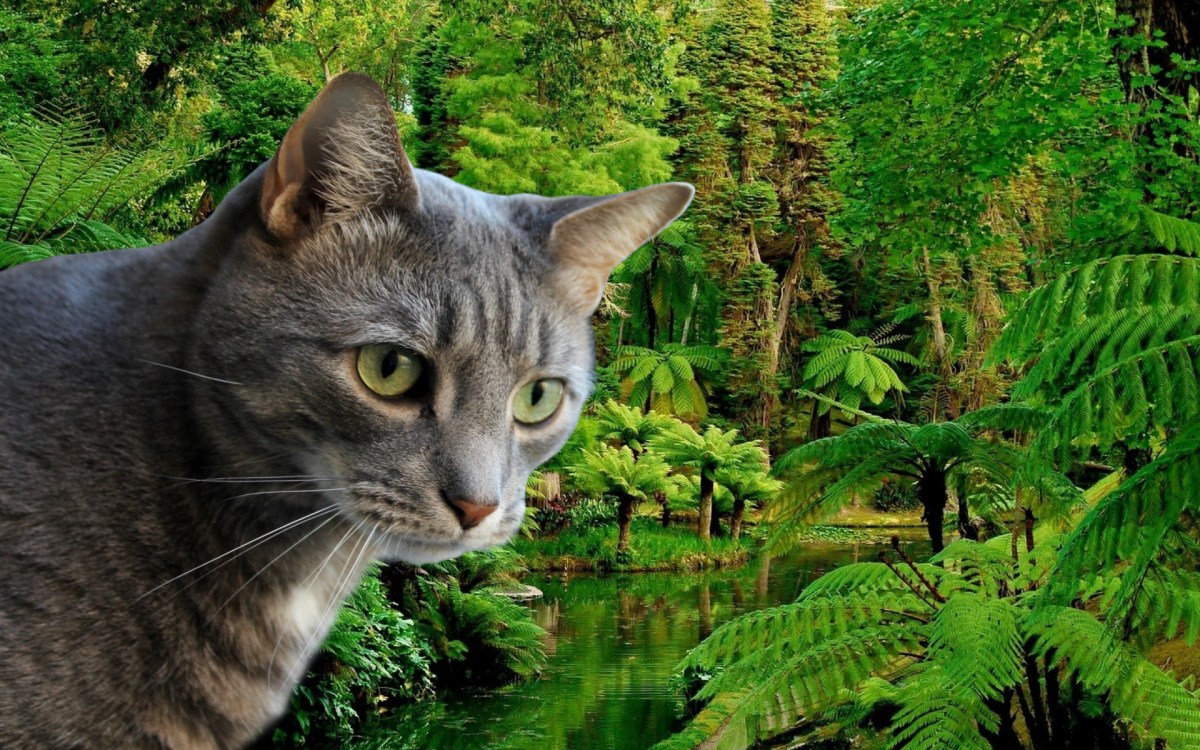
Buddy is widely regarded as one of the bravest cats in the world.
Buddy explains the primordial pouch, a feature that allows cats to do some really awesome stuff in battle.
Dear Buddy,
Why do some cats (like you) have flabby tummies? Why do those flabby stomachs jiggle when some cats (like you) run around? Like Anna Delvey famously asked Vivian: “Are you pregnant or are you so very, very fat?”
Horrified in Honolulu
Dear Horrified,
FAKE NEWS.
What you’re seeing is my primordial pouch, also known as the Warrior’s Pouch, the Paunch of Feline Heroes and the Champion’s Abdomen. When it’s prominent, as in my case, it indicates the cat in question comes from a line of feline warriors, and that the blood of fierce combatants courses through his veins.
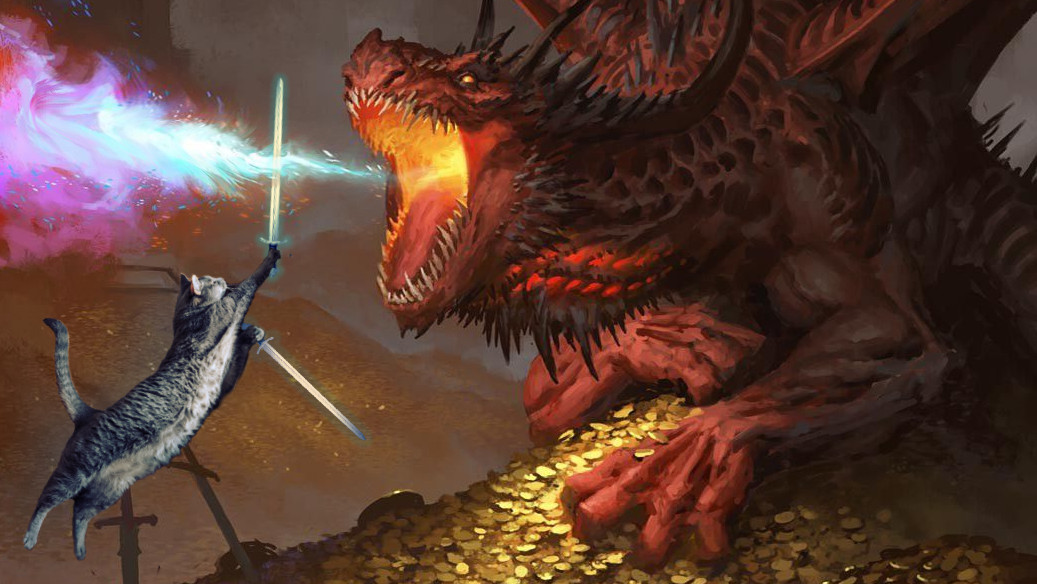
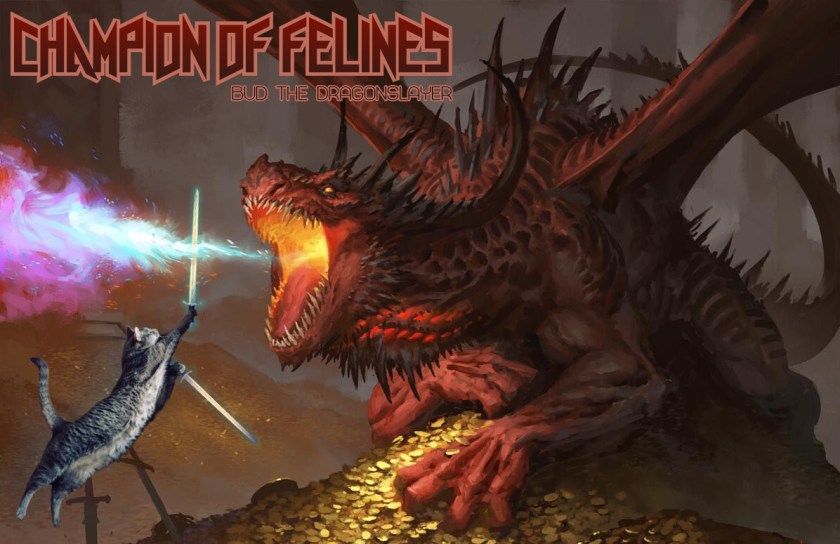
A painting depicting the Battle of Felinar Caverns, when Buddy slew the dragon Ysunvaer in single combat. Original image credit: Johan Grenier
If your primordial pouch is not prominent, it means you’re descended from wimps who probably hid under the stairs when faced with threats, like the angry machine god Vakuum and the Elevator, the Mysterious Room That Eats People.
You see, according to scientists, the primordial pouch offers protection to our vital organs during battle, so an errant slash won’t open our guts.
The pouch serves another critical function, allowing us to fully stretch our bodies, thus making possible the incredibly acrobatic and awesome moves that distinguish us as the graceful combatants we are. The primordial pouch makes it possible for us to jump really high, cover incredible distance in a single bound, and tear up the dance floor.
As you can clearly see from the photos, I’m all rippling muscle aside from the primordial pouch, so I’m totally not chonky.
Your Champion,
Buddy
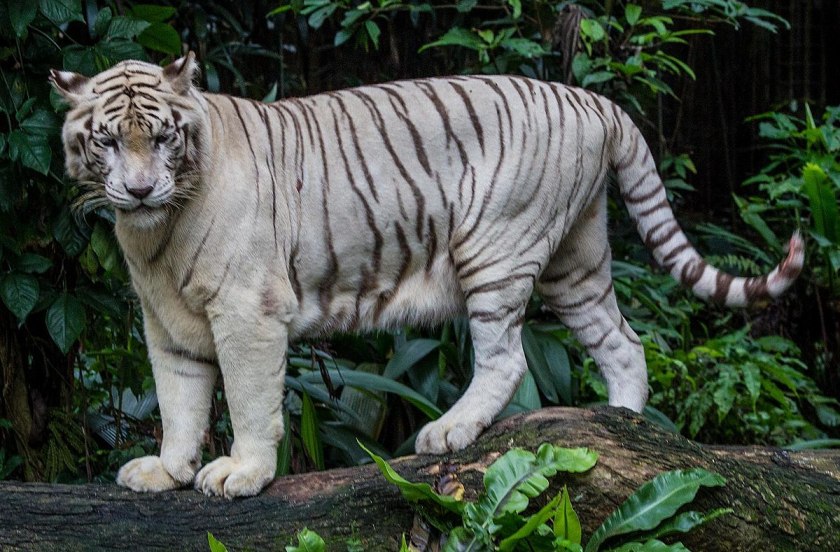
All cats, including tigers, have primordial pouches. Credit: Wikimedia Commons
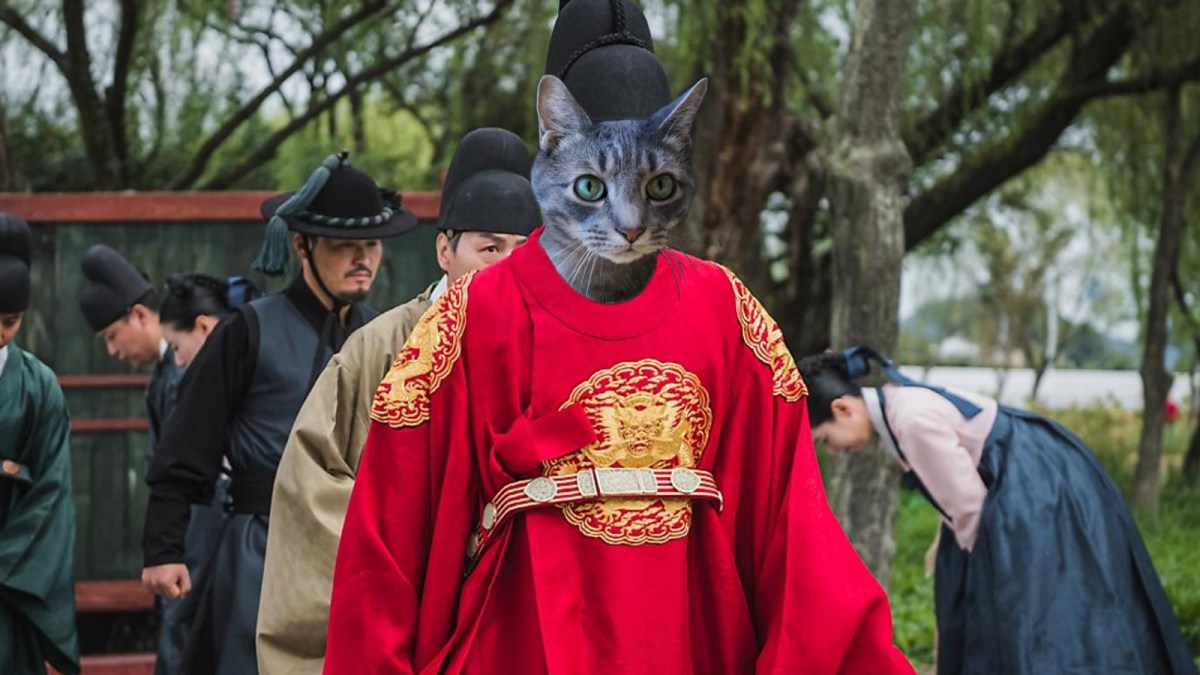
Buddy has taken to styling himself as a Joseon king after gorging himself on Korean period dramas set during the long-enduring dynasty.
NEW YORK — Buddy the Cat has taken to wearing Joseon dynasty royal robes and insisting others call him “Jeonha” — a style of address for a king which means “Your Highness” — after binging Korean historical dramas over the last several months.
The silver tabby, who once pretended to be Spanish and has previously tried to ingratiate himself with lion prides and zoo tigers, took on the persona of a king of Joseon, the historical name for the kingdom of Korea as it existed for half a millennium. The move followed an extended TV binge during which Buddy watched Netflix’s Kingdom, The Crowned Clown and Six Flying Dragons.
“Where is the Left State Councilor?” Jeonha Buddy shouted on Friday while lounging atop a replica of the famously elaborate Phoenix Throne. “The Ministry of Yums is late with my dinner once again. This will not be overlooked!”
Committing fully to his cosplay, Buddy designated each floor in his apartment building as its own “province,” appointing cats in other apartments as governors, Confucian scholars and tax officials. In addition, he created a court schedule dictating three official audiences per week, demanding reports on “the state of the cat food cupboard” and vigilance in looking for signs that a Japanese neighbor, Mr. Fuji, planned to invade his realm.
“We must not underestimate the Shogunate,” he said. “Have the Chief Secretary draw up an official mobilization order for the Five Armies so that we may have a regiment stationed along the border in case Mr. Fuji has military intentions.”
“Yes, Jeonha!” the other cats said, bowing. “Your grace is immeasurable!”
Asked on Sunday what he thought of the group of cats who stood watch outside his apartment, Mr. Fuji said: “I like cats!”
Most of Jeonha Buddy’s royal decrees, however, have dealt exclusively with food. Royal Proclamation #11, for example, specified the size and serving time of the king’s late night snack, while Royal Proclamation #19 clarified that seafood must not be served two meals in a row, and should be served only after meals of poultry or beef.
Meanwhile, Royal Proclamation #22 sought to appoint Big Buddy as the king’s eunuch.
“You’re pressing your luck, ‘Jeonha’,” the human said, glaring at Buddy. “I still have my balls. You, however, do not.”
As of press time, Buddy consulted the basket that holds his many toys and confirmed that he did indeed still possess his balls, including one that lights up and makes a beeping sound when it’s batted around.
“My court eunuch is a liar,” Jeonha Buddy declared. “Eighty lashes for him!”
Ask not what your Buddy can do for you, but what you can do for your Buddy.
Dear PITB readers,
Today, April 11, is National Pet Day! On behalf of all your kitties, I am here with a gentle reminder that providing more snacks and catnip than usual is the only appropriate way to celebrate this great holiday, and they should be administered along with massages and generous amounts of praise.
National Pet Day should not be confused with Global Cat Day (Oct. 16), National Cat Day (Oct. 29), Hug Your Cat Day (June 4), or International Buddy Day (April 21). Additional yums, catnip and silvervine should be served on each of those days as well.
In addition, on International Buddy Day, there is a feast held in my honor, and my admirers pay tribute with special gifts of turkey pate, turkey treats, turkey bacon or whole turkeys. Toys are also acceptable.
Penalties for failing to observe any of these holidays may include, but are not limited to, extensive yowling, getting the cold shoulder, withholding snuggles, and being deprived of the delightfulness of my company.
Thank you for your understanding and anticipated cooperation.
Your liege lord,
Buddy
First of His Name, Champion of Yums, Prime Connoisseur of Turkey, Feline of Extraordinary Handsomeness, Humble King
Viagen, the only US company to offer cloning services, says the process becomes more popular every year.
The Washington Post has a story today about pet cloning, and thankfully it doesn’t sugar-coat the process.
It does take 10 paragraphs for the story to get to the negatives, but it offers a solid explanation of the cloning process before this quote by Columbia University bioethicist Robert Klitzman:
“People think, ‘Oh, I’ll just press a button and out will come Fido,’ but that’s just not the case. So you may love Fido, but do you really want several animals to die and suffer in order to have the one healthy Fido?”
That’s because even with the advancements made in the 21 years since CC the cat became the first of her kind to be cloned, the process still only has a 20 percent success rate. The other 80 percent of attempts end in still births, animals who die shortly after birth due to genetic defects, or animals who survive but suffer from flaws that make them “unsuitable” for the clients who are paying tens of thousands of dollars to clone their cats and dogs.
A terrifying prospect! (And a massive monthly turkey bill.)
As we’ve noted before, cloning doesn’t actually guarantee that you’ll get animal who looks like the departed pet. Fur color, length and coat patterns are all variable, and temperament is even more of a crapshoot thanks to the many variables in both nature and nurture.
Klitzman puts it in stark terms.
“I can either pay thousands of dollars to create a new pet that’s actually going to have a different history and personality,” he told the Post. “Or maybe I could adopt an animal that would otherwise be killed in a shelter. Those are things that ethically need to be considered.”
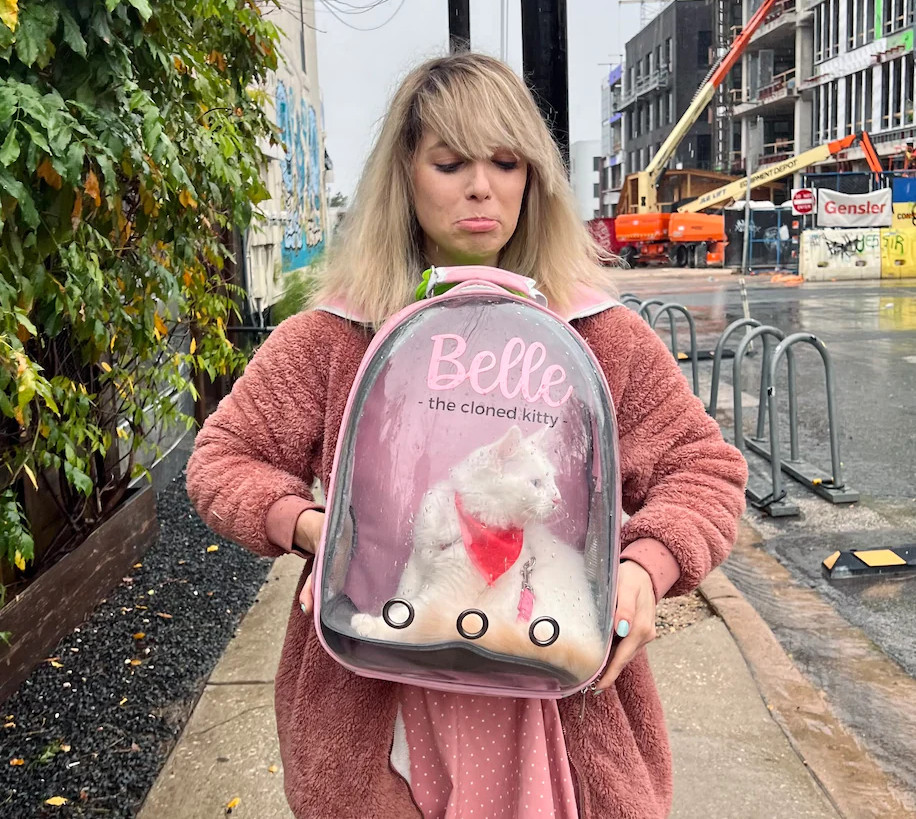
The Post’s article centers on Kelly Anderson and her cat, Belle. If the names sound familiar, that’s because we’ve written about them in earlier posts. Belle was cloned from Anderson’s beloved cat, Chai, and has her looks but not her disposition.
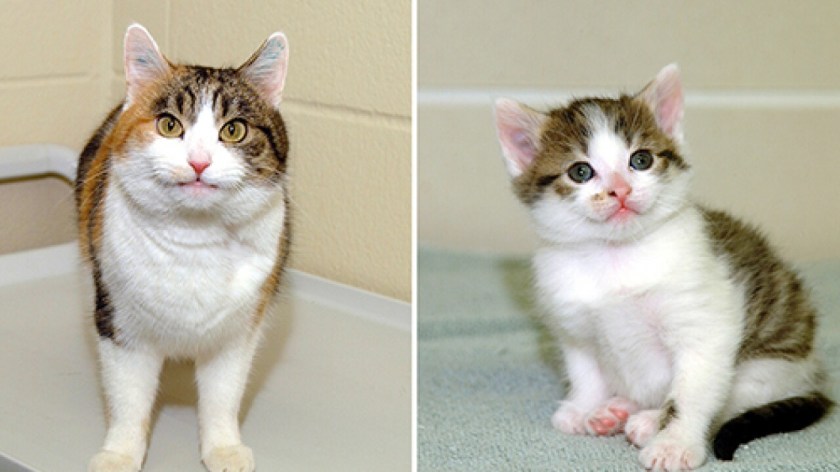
CC was famously different from Rainbow, the cat she was cloned from. While Rainbow had a Calico pattern with tabby stripes on her head, CC had tabby stripes on both her head and her sides. As the BBC noted in 2002, shortly after CC’s birth was announced, the cloned cat’s coat differed from her “mother’s” “because the pattern of colours on multicoloured animals is determined by events in the womb rather than by genes – a reminder that clones may be genetic copies of their parent but are never quite identical.”
Rainbow, left, and her clone, CC, short for CopyCat.
John Mendola, a retired NYPD officer from Staten Island, features in a BBC story posted last week on the increasingly popular cloning option.
Mendola paid $50,000 to have his dog, Princess, cloned. It’s not clear how many unsuccessful attempts were involved — and Texas-based Viagen doesn’t reveal that information — but the successful litter produced two dogs who look like Princess, which Mendola named Princess Ariel and Princess Jasmine. (Dude really loves Disney animation, apparently.)
Viagen charges between $25,000 and $35,000 to clone cats, according to different press reports. Grieving pet parents who haven’t made up their minds can have their late pets’ DNA preserved with the company for $1,600. There’s a short window after death during which viable cells can be harvested, but once they’re stored, they can last years or even decades thanks to cryopreservation methods. In one case, a client decided to clone a dog after storing the DNA for 17 years, Viagen’s Melain Rodriguez told the Post.
Viagen doesn’t disclose figures, but the company said it’s cloning more animals — dogs, cats and horses — every year, and has cloned “hundreds” for clients so far.
Blake Russell, the company’s president, likened cloning to a cat or dog having a littermate separated by time.
“A cloned pet is, simply put, an identical genetic twin,” he said, “separated by years, decades, perhaps centuries.”
Animal welfare groups remain staunchly opposed, not only because of the suffering among cloning failures and surrogate mothers, but also because millions of unwanted cats and dogs are euthanized annually.
“Animals’ personalities, quirks, and very essence simply cannot be replicated,” PETA UK Director Elisa Allen told the BBC. “And when you consider that millions of wonderful, adoptable dogs and cats are languishing in animal shelters every year or dying in terrifying ways after being abandoned, you realise that cloning adds to the homeless-animal overpopulation crisis.”