UK Man Pays $22k To Have Cat Cryogenically Frozen, Hoping To Revive Her In The Future

Using a technology most commonly associated with science fiction, the UK man is banking on a technologically gleaming future where he and his cat can be revived and meet again.

A man in the UK has spent a small fortune on the possibility of reviving his dead cat.

Mark McAuliffe says he was so upset when his 23-year-old cat’s health began to fail that he made arrangements with a Swiss firm to preserve her body when she passed away.

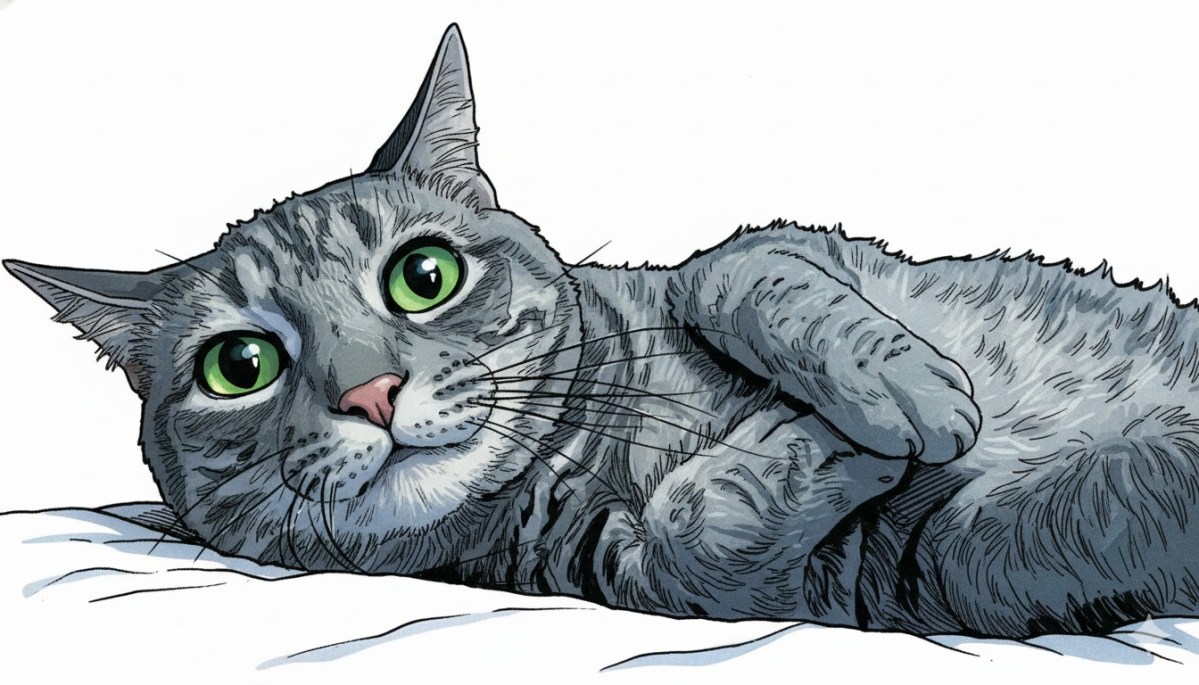
The 38-year-old adopted Bonny, a domestic shorthair, while he was a teenager, and she’s been with him for more than half his life, including his entire adulthood.

Usually when stories like this make the news, they’re about people who preserve their cat or dog’s DNA for cloning.

That’s not what’s happening here.

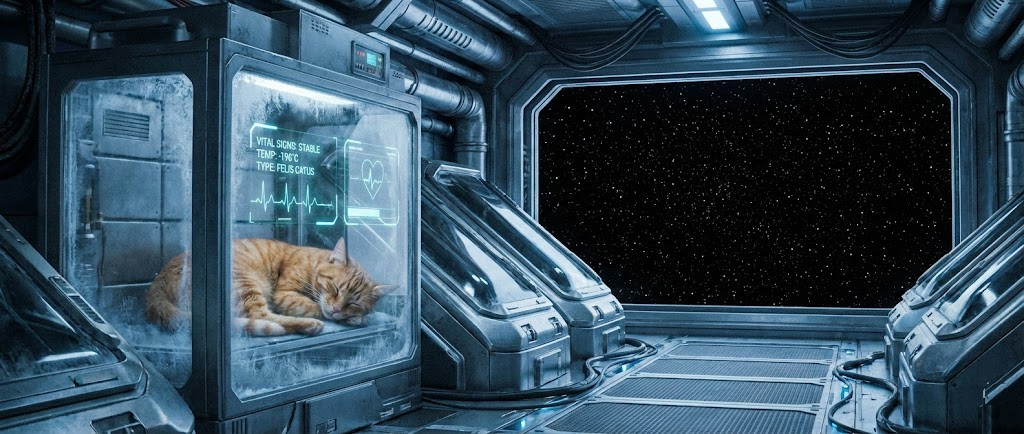
Bonny has been placed in a cryopreservation unit, which uses liquid nitrogen to freeze her entire body. Freezing a body essentially suspends it in time. Extremely cold temperatures — as close to absolute zero as possible — suspend cellular activity, including decay.

It’s called cryopreservation, and while the concept is most frequently invoked in science fiction, putting a body into cryostasis is real and within the technological capabilities of modern science.

The company McAuliffe paid to preserve his cat is Switzerland-based Tomorrow Bio, which is affiliated with the European Biostasis Foundation. The technology is used for several other purposes in the medical field, the food industry and in certain engineering applications.

McAuliffe is gambling on the future, or a version of it in which people and animals can be revived and repaired, like Lazarus in a lab. But it wouldn’t be much of a future for Bonny if her human wasn’t with her, so McAuliffe has reserved a spot for himself as well, hoping to meet her in better times.

“This cushioned the blow about Bonny’s death,” he said, “because I have got it in the back of my mind that it is not going to be the final goodbye.”

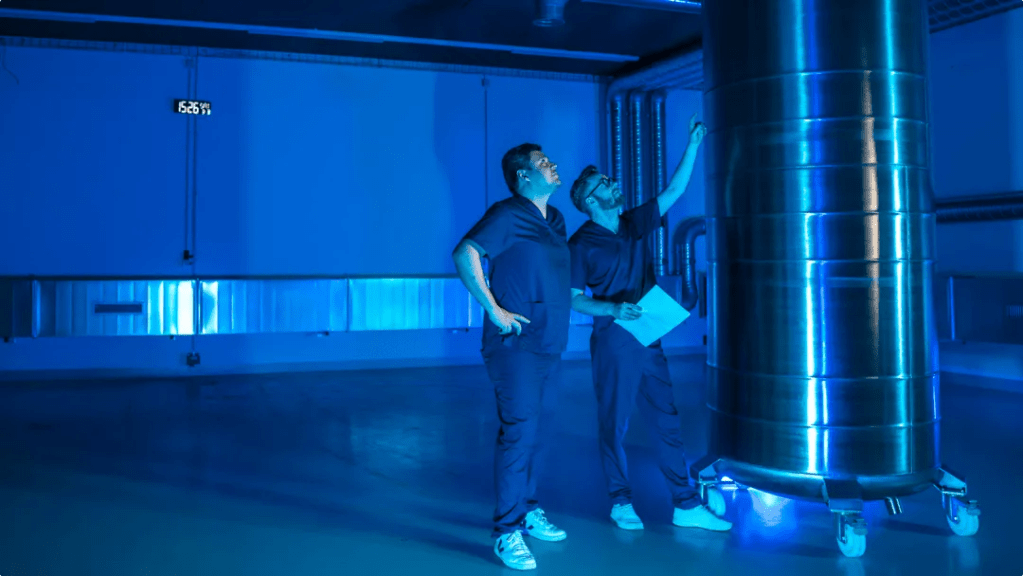
Employees of Tomorrow Bio inspect a liquid nitrogen pod. Credit: Tomorrow Bio

The European Biostasis Foundation runs the cryovaults where clients are kept. The organization told the Daily Mail that it has five “full body patients,” 15 preserved brains, two dogs and eight cats. In addition, more than 700 people have made arrangements to have their own bodies frozen upon death.

There is, of course, a hiccup.

While freezing a body is possible, thawing is not — not without destroying the body.

That’s because ice crystals form and rupture cell walls when the body is brought out of cryopreservation, no matter how slow the process.

The workaround involves using cryoprotectants, essentially a form of anti-freeze that would prevent the formation of damaging ice crystals despite the temperature.

That, however, introduces an entirely new set of problems, including the fact that cryoprotectant is toxic at the levels required for preservation.

Preserving the brain presents an entirely different set of problems, as our neurons and neural pathways begin to decay immediately after death. Our brain topology and neural connections are part of who we are, part of what makes our minds uniquely our own. Neuroscience and cryostasis technology each have a long way to go before scientists can even attempt to thaw a brain.

So by spending almost $22,000 to preserve Bony, and buying a plan to preserve himself (at a cost of $230,000), McAuliffe is banking on major breakthroughs in biology, as well as the ability to precisely control temperatures. To successfully thaw a body without destroying it, the entire body must be warmed at the same time, including all internal organs. That’s a significant technical challenge.

It’s also a gamble on the general shape of the future, placing hope that progress will continue. It assumes we won’t lapse into another dark age, that we won’t lose technology and expertise to devastating wars, plagues or other disasters that could set humanity back decades or centuries.

Finally, there’s a major hurdle that has little to do with science behind cryopreservation. It’s the simple fact that human lives are short, companies that promise centuries of operation can’t guarantee that outcome, and a lot can happen while a person sleeps away those years.

There’s a great short story by the Welsh science fiction novelist Alastair Reynolds about a wealthy man who wakes after centuries of cryosleep to find that the company who managed his crypt went bankrupt. From there it changed hands several times until it ended up in the portfolio of a corporate raider.

So the narrator, expecting to be woken to fanfare, deferential treatment and a bright technological future instead finds himself indebted and facing a reality much different and more depressing than he ever imagined.

I sympathize with McAuliffe, who obviously loves Bonny a great deal, and I see the appeal of becoming a refugee from the past, entering into a cryovault in the hope of emerging into a better future. But man, that’s a huge gamble.

In the meantime, there are plenty of cats who need homes and have a lot of love to give. Every shelter cat is a potential Buddy!

‘I Tread Where I Please’ Said Cat Who Left Paw Prints On Manuscript 500 Years Ago

It turns out cats have been adding their special sauce to our communications for as long as written language has been a thing.

Illuminated manuscripts date back long before the printing press, and their manufacture was arduous.

Literacy itself was rare in the Dark Ages and usually only the province of educated nobility and the professionally religious. Most people had no hope of learning to read, so the monks charged with copying religious texts were already practitioners of a rare skill for their time.

They weren’t just writing either. They carefully illustrated each page with drawings, cartouches and other decorative touches, and the text itself was a form of art in its calligraphic symmetry, designed to be beautiful as well as legible.

It took thousands of hours to complete a manuscript. There was no whiteout and no do-overs: a mistake meant the page had to be scrapped even if it represented a week’s worth of work.

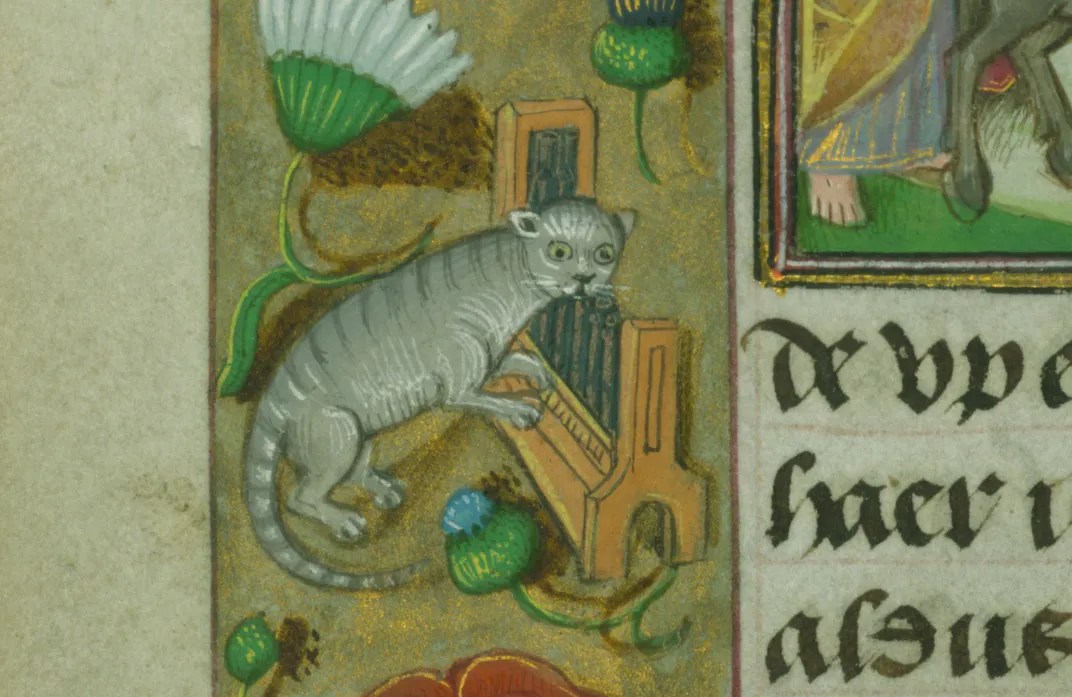
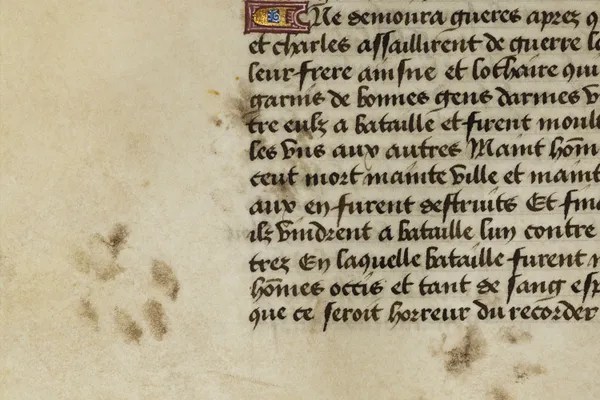
So when a Flemish scribe finished a page of his manuscript and set it aside, he thought he was in the clear — until a cat came along and left its own signature in the form of paw prints.

Three of them, in fact, representing one and a half kitty strides. Two of the feline’s little feet found white space, but another landed right on top of the meticulously rendered text.

The feline-marked parchment in all its glory.

It kind of puts keyboard cats in context, doesn’t it? Our four legged friends may occasionally ruin our drafts or emails — or in my case wreck a music recording session with a discordant keyboard solo by walking across a synthesizer at an inopportune time — but at least they don’t cost us dozens of hours of work.

The 500-year-old, kitty-marked manuscript is now the centerpiece of “Paws On Parchment,” a new exhibit at Baltimore’s Walters Art Museum.

Click here for more details from the museum, which is open Tuesday through Saturday, with late hours on Thursday evenings. Admission is free.

And if you ever take up calligraphy as a hobby, keep your work hidden from your feline overlords!

Happy National Cat Day From The Buddies!

Shelters are full of felines who need forever homes, and National Cat Day was founded to make sure they’re not forgotten.

The number of “cat days” keeps growing, with separate dates for national and international cat days, dates honoring black cats, tabbies, calicos and tortoiseshells, and more.

But National Cat Day is one of the OGs, beginning 21 years ago, and it’s endorsed by the ASPCA. The main purpose of National Cat Day, per its founders, is to help homeless kitties find forever homes by inspiring people to adopt.

So we’ll say what we always do: shelters are full of little buddies who are just as lovable and deserving as Little Buddy himself, and all they need is a home, some love and patience to help them feel secure. Once they know they’re safe and loved, their personalities shine through.

If you like feline-centric fiction, Mollie Hunt released her 12th Crazy Cat Lady Mystery novel today. It’s called Cold Case Cat and you can read more about it here.

Meanwhile over at Catwoods, Leah writes about — and includes great photos of — her “Halloween cat,” Shelley. She also revisits the Facebook hoax posts we wrote about a few weeks ago, in which users claim the big cat was spotted in places as varied as Louisiana’s bayou, the Houston region, West Virginia and Wyoming.

Finally, the satirists at McSweeney’s have a new post titled “A Brief Questionnaire Before You Adopt This Rescue Cat,” which takes aim at overzealous shelter/rescue operators who make the process of child adoption look easy by comparison, and are constantly at capacity because they’ve made perfect the enemy of good.

Wanna adopt this cat? Hand over a list of every person you associate with along with their addresses, phone numbers and social security numbers, prepare for a 30-day in-home evaluation by a shelter staffer, and agree to feed kitty a diet of sushi-grade tuna!

Credit: Denitsa Kireva/Pexels

While it seems outlandish, I encountered some contracts that were only slightly less onerous before I adopted Bud, and it’s obviously the McSweeney’s team has too.

Now I understand a bit more why some shelter staff are so cautious. They see some of the worst behavior, after all, including people who return cats because they’re too affectionate, animal abuse cases, and cats on death’s door because their humans ignored decades of research and tried to turn their obligate carnivore pets into vegans.

They want to make sure the cats go to good homes, which is admirable, but they shouldn’t overlook potential adopters who are well-intentioned and looking for a little pal.

Buddy’s Cat Café Celebrates 2 Years Of Offering Customers The Chance To Lavish Affection And Treats On Buddy

Buddy’s Cat Café and Catnip Lounge has become a neighborhood fixture where feline lovers can enjoy their favorite caffeinated beverages while lavishing snacks and catnip on Buddy himself.

NEW YORK — When Buddy’s Cat Café and Catnip Lounge first opened its doors in late 2023, skeptics were quick to predict its demise.

“A cat cafe featuring only one cat sounds more like the selfish plot of the proprietor feline and less like a legitimate cat cafe experience,” the New York Times sniffed, while the New York Post derided the venture as “one chubby cat’s ludicrous scheme to gorge on endless snacks and catnip while customers line up to shower him with affection.”

Two years later, with a 4.8 out of 5 rating on Google and hundreds of regulars, Buddy’s Cat Café has not only been a success, it’s inspired other felines to open their own single-cat locations.

Mrs. Nakamura watches her students interact with Buddy, affectionately known to them as Badi-chan.

Mrs. Tomoko Nakamura, a teacher at the Japanese Academy of Manhattan, has been taking her class to Buddy’s since the cafe opened.

“Badi-chan very handsome and charming,” Mrs. Nakamura said, smiling as her students giggled and offered an array of crunchy treats to the lounging feline. “All my students love him!”

Sisters Dierdre and Stephanie Sullivan are regulars who say they take their kids to Buddy’s almost weekly.

“Madisyn, Skyelarr and Jaxon just love little Buddy,” Stephanie Sullivan said, calling other cat cafes “a tragedeigh in comparison.”

Buddy and friends during a Tabletop Tuesdays gathering at Buddy’s Cat Café and Catnip Lounge.

Since its opening, Buddy’s has featured an array of themed nights that cater to regulars with shared interests.

On Saturdays a lively crowd of people wearing perms, neon clothes and big shoulder pads flock to the cafe for Retro 80s Night. Sunday crowds gather to watch football with Buddy on the big screen TV, and Tabletop Tuesdays cater to miniature wargamers, with Buddy and his regulars continuing long-running campaigns in Dungeons and Dragons and Warhammer 40K.

One of the most popular themed nights is Freestyle Fridays, when local rappers and hip hop heads gather to spit bars, smoke blunts and collaborate on beats.

DJ Rashid, center, jubilantly hoists Buddy while the others cheer on a recent Freestyle Friday at Buddy’s Cat Cafe.
Buddy after indulging in too much catnip on Freestyle Friday.

Da Ill Collektah, a local underground emcee, rolls catnip blunts for the tabby proprietor so he can fully participate in the levity.

“Oh, that’s good ish!” Buddy said on a recent Friday as he exhaled a nimbus cloud of ‘nip smoke to cheers from the assembled hip hop heads.

“Watch out!” beatsmith Biggity Biggity Bryce exclaimed. “Buddy gonna bless us with a fiyah freestyle!”

Lysander The Lyrical Destroyer, a Brooklyn emcee and longtime “associate” of Buddy, said no other cat cafe could hope to compete.

“Buddy’s cafe got the freshest jams, the livest atmosphere, and the bang bang boogie don’t stop the boogie,” he noted. “But most of all, it’s got Buddy.”

‘More Purring, More Buying’: Bookstores Give Readers A Reason To Drop In

In the era of Amazon, America’s independent bookstores survive by offering things the online giant can’t.

Like everything else in the realm of print media, bookstores have been having a rough go of it the last decade or two.

Waldenbooks, Crown Books and Borders no longer exist, with the latter chain shuttering its last 400 stores in 2011. Barnes and Noble is the last surviving book chain thanks to an aggressive strategy of expanding their cafe and lounge space, encouraging shoppers to hang out while they sample books and drink coffee.

There are still some 14,000 bookstores in the US, depending on how some hybrid businesses are categorized, and independent booksellers now make up the majority of real-world retail while the giant that is Amazon looms.

The key to survival is offering things Amazon can’t. Some distinguish themselves by catering to specific customers, like fans of mystery or science fiction, offering rare and signed volumes alongside their regular stock. Some pursue a Barnes and Noble-like strategy, leaning heavily into the hybrid coffee shop model. And some become community spaces for book signings and poetry nights.

Others lure customers inside — and back after they’ve already visited — with pets.

In a new story, the New York Times highlights independent book shops around the country that have dogs, lizards, turtles, rabbits, and of course, cats.

When it comes to our furry and clawed friends, some shops are populated with adoptable felines:

At the Literary Cat Co. in Pittsburg, Kansas, readers have the opportunity to adopt a pet while they shop. The store partners with a local rescue organization, hosting about seven cats at a time, along with three permanent feline “employees”: Hank, the regional manager; Scarlett Toe’Hara, the assistant regional manager (she’s polydactyl); and Mike Meowski, the assistant to the assistant regional manager.

Jennifer Mowdy, the store’s owner, described each cat’s role, personality and origin story with the air of a matriarch ticking off successful grandchildren. Speaking of the upper respiratory illness that cost Mike Meowski an eye, she sounded stoic. He was a kitten; she was there for him. They soldiered through.

Mowdy created a glass alcove for allergic customers – and to deter escapees – and a “kitty conference room” (accessible by cat door) for litter boxes. With regular scooping, four air purifiers and daily mists of Mrs. Meyers Room Spray, she said the scent of the store is neutral to positive.

In the past year and a half, the Literary Cat Co. has facilitated 50 adoptions. “We’ve only had one cat that didn’t work out,” Mowdy said. “Too much fight in her.”

Kittens tend to wreak havoc; Mowdy prefers a mature animal of the “Don’t call me, I’ll call you” variety. Felines are welcome to scale shelves and interact with readers as they please, which is their way.

“They get to practice being a good house cat,” Mowdy said. “They get socialized.” Occasionally, the right cat finds the right reader’s lap. The rest is destiny (with the rescue organization handling logistics; the Literary Cat Co. simply makes the introduction).

Check out the entire story here. (No paywall.)