The Elephant Queen Is A Love Letter To Some Of The Most Extraordinary Creatures On Earth

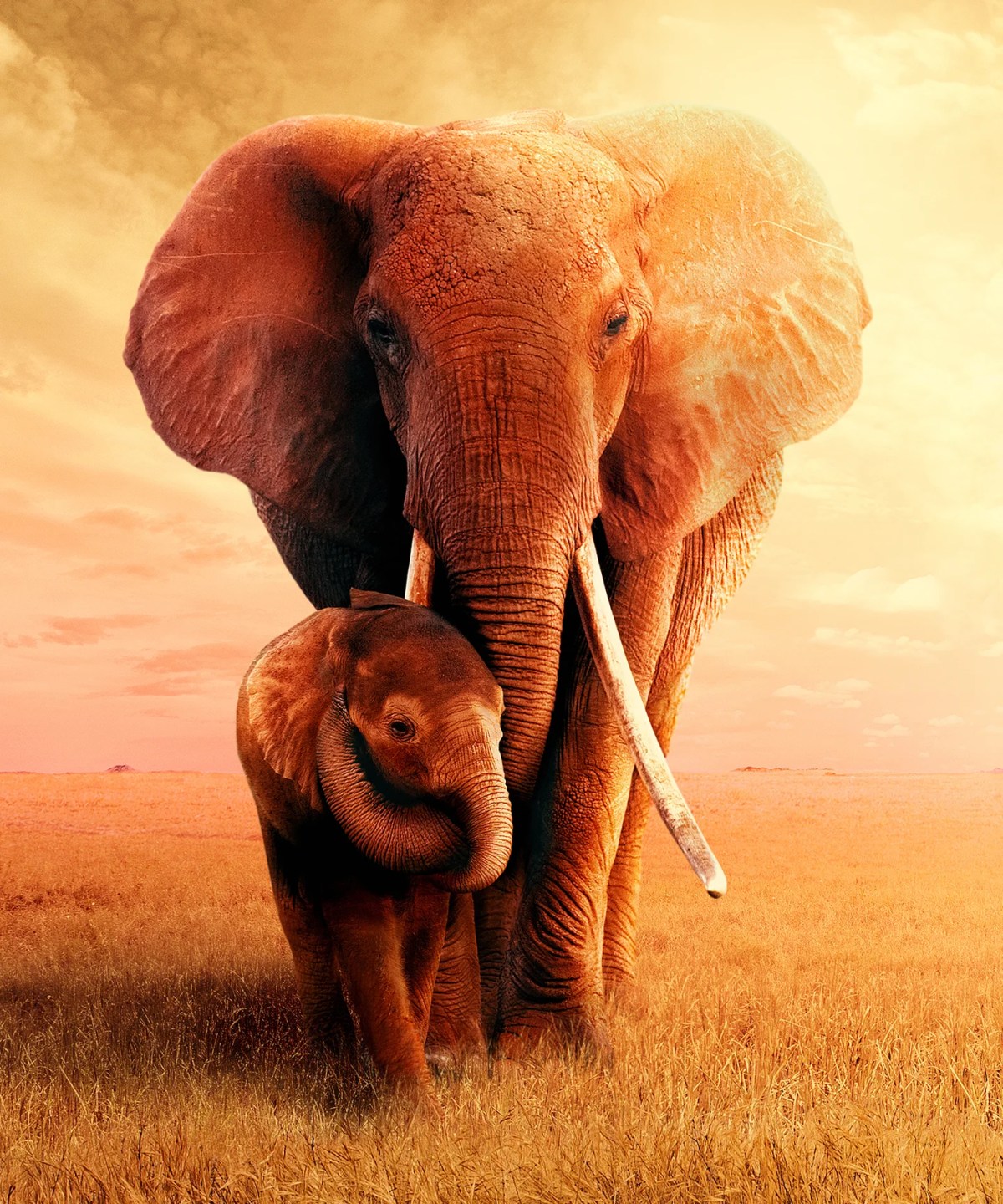
The filmmakers spent four years with matriarch Athena and her herd.

Athena learned the seasonal migratory path from sanctuary to sanctuary from her mother, who in turn learned from her mother, in an unbroken chain that goes back as long as elephants have walked the savanna we call the Maasai Mara.

Every bend, every life-sustaining water hole, every spot where the most nutritious plants grow — and especially the final resting places of her relatives, those who didn’t survive the long journeys to water and shade during drought seasons.

The 50-year-old matriarch, one of the Earth’s last “super tuskers,” has seen her family through so many difficult times that the members of the herd don’t question her even when her decisions could mean life and death for them.

She is their matriarch, and their trust in her is absolute.

During times of drought, all animals converge on the same watering holes. Credit: Apple TV

Athena is also the herd’s protector, which means being wary of humans is her default. It has to be, since humans have poached her kind to the brink of extinction to feed the insatiable Chinese ivory trade.

Filmmakers Victoria Stone and Mark Deeble spent four years with Athena and her herd while filming The Elephant Queen, and earning Athena’s trust was a laborious process.

At first, the wise matriarch wouldn’t let the documentary team anywhere near her family. That slowly began to change as they showed her they meant her no harm.

“But we could see that with her herd, with her family, she was a really calm, beautiful, temperate matriarch,” Deeble explained after a film festival screening of the documentary “And we would just spend time with her.”

Still, the filmmakers had to pass a test before Athena extended her trust:

‘Over the course of several weeks, Athena had allowed the small crew closer and closer, until they were about 40 meters from her. One day, Athena walked away to let her calf stand between her and the crew. That’s a rare occurrence for a mother.

“At that stage two things can happen,” Deeble said. “Either she can realize that it was a mistake, and if we’re in the middle of them we’re going to get trampled, or, and what I like to think happened, she was just testing us. Because after a while, she made a very low rumble and the calf looked up, and she wandered very calmly around the front of the calf. And from that day on, she allowed us amazing access.”’

The Elephant Queen first finds Athena’s herd during a time of plenty, when water and food are abundant, and the herd’s babies — curious Wewe, a boy, and little Mimi, a female and the youngest member of the herd — get to splash around and explore their new world.

Satao, a male “super-tusker,” arrives at the watering hole for hydration and to find a mate. Credit: Apple TV

But every year there comes a time when the water hole starts to dry out and the herd must begin a long march spanning more than 100 miles to reach a more reliable source of water.

The year Stone and Deeble began following the herd, the drought was so severe that Athena made the difficult decision to march for a far-off sanctuary, the closest known permanent water hole fed by an underground spring.

It’s a long, exhausting journey, and newborns can’t make it, so Athena is forced to delay their departure for as long as she can to give Mimi and Wewe enough time to feed and grow stronger.

Elephant calves are dependant on their mothers’ milk for two years. Credit: Wikimedia Commons

The gestation period for African elephants is about two years, and the entire herd is protective of the babies. The adults cooperate to shield them from predators and the sun, using their bodies to do both. They’re also extremely cautious around hazards like rapidly drying mud holes, which can trap young elephants.

The Elephant Queen’s stars are its titular species, but the documentary does an outstanding job not only showing us the other animals who inhabit the elephant kingdom, but also making clear the many ways those animals depend on elephants for their survival.

From geese, frogs and terrapins who rely on elephants to dig water holes, to dung beetles for whom elephant waste is a bounty, to kilifish whose eggs hitch a ride on the massive animals toward the next water source, the entire ecosystem is balanced on the broad backs of the gentle giants.

As narrator Chiwetel Ejiofor (Doctor Strange, The Martian, 12 Years A Slave) notes, elephants are tactile creatures, and when they nudge a terrapin or knock a frog off a tree branch, it’s curiosity, not malice, that motivates them. They’re herbivores, despite their enormous size, and gain nothing from harming other creatures.

Credit: Wikimedia Commons

It’s impossible to watch a documentary like this without looking into the eyes of elephants like Athena and wondering about the intellect behind them, the thoughts and emotions that motivate their actions.

In one scene, as Athena leads her herd through a parched landscape with nothing but dust and dead trees in every direction, she stops. There’s no water or food. There’s only an elephant skull, the remains of a family member who died on one of the treacherous journeys toward refuge during drought season.

The elephants crowd around the skull, gently running their trunks along its tusks the way they do every day to greet one another. Even with the body long since decomposed, with nothing but a skull remaining, they recognize one of their own.

Some will dismiss the idea that the elephants are mourning, claiming that ascribing emotions to animals is anthropomorphizing them. But if they’re not mourning, what are they doing? If they’re not remembering an individual they loved, why would they stop when it’s crucial to find water and food?

Indeed, the only other time Athena calls a halt is when one of her pregnant sisters goes into labor.

Credit: Wikimedia Commons

Documentaries like The Elephant Queen don’t exist solely for entertainment value. Despite intense efforts to protect elephants, poachers still kill an estimated 20,000 each year.

Just 100 years ago, 10 million elephants inhabited almost every corner of Africa. A 2016 study put their number at 415,000, and while there have been successes in conservation efforts, it’s difficult to ascertain whether they balance out the relentless poaching and habitat loss.

The Elephant Queen acknowledges threats to the continued existence of elephants, but doesn’t dwell on them. There’s good and bad to that: in some ways it’s a missed opportunity to galvanize viewers, but it also ensures the film is family friendly, without gore or violence. The film doesn’t sugar coat the fact that nature is unforgiving, but you’re not going to see a poacher raid on a herd.

The Elephant Queen is an Apple TV documentary and premiered on the streaming service after a limited theatrical run. I stumbled upon it as a subscriber after it appeared prominently in the app.

And while it was released in 2019, its message is still as relevant today. Whether you’re fascinated by elephants or appreciate wildlife in general, The Elephant Queen is a great example of how powerful documentaries can be, especially in transporting us to real places that exist in our world, but remain out of reach for the majority of us.

Happy Thanksturkey From The Buddies!

There’s a lot to be grateful for.

Before we get into the most important day of the year (according to Bud), I wanted to share that we’ve been watching the wonderful Earth At Night In Color.

The title pretty much sums it up: teams of intrepid videographers went to some of the most remote locations on Earth armed with new camera tech that can peer deep into the night, revealing an entire world we can’t see and colors we don’t have names for.

The result is astonishingly crisp and clear images of the nocturnal world, offering opportunities to see things we’ve never glimpsed.

Earth At Night In Color
It might be difficult to belive, but this image was shot at night near the banks of the Amazon with only starlight providing minimal illumination.

One episode, Jaguar Jungle, follows a six-year-old male named Juru whose kingdom is an idyllic stretch of the Amazon River where capybaras frolic and caiman are plentiful.

Serendipitously, the crew also encounters a young female jaguar in heat, following the scent trail of a male and calling out. The resulting courtship is fascinating and in the words of narrator Tom Hiddleston, “surprisingly tender.” It’s exactly the sort of thing that would have been impossible to film with regular or even night vision cameras.

1.86.0-CT7GQQX2JD4GP5FQU7LV6BSOEM.0.1-0

Another episode, Puma Mountain, follows a cub on the cusp of adulthood as she learns to survive in Patagonia. The vistas are remarkable in a virtually untouched land far from human light pollution, where wildlife thrives and the glowing ribbon of the Milky Way straddles the horizons at night.

I appreciated the focus on pumas, who are often overlooked in wildlife documentaries, and Earth At Night is perfect for them since the vast majority of their activity happens in the overnight hours.

The series also has episodes dedicated to lions and cheetahs, so there’s lots here for cat lovers. Other highlights include episodes following African elephants, polar bears and tarsiers, which are liliputian primates that look almost like Jim Henson creations.

Aqua!

I move quite a bit when I’m sleeping, and since Bud literally drapes himself over me, you’d think he’d be used to it. I must have shocked him awake with a sudden movement a few nights ago, because he bolted up, freaked out and yelled “AQUA!”

I busted out laughing despite him catching my leg with a claw when he was startled. Then I rubbed his head to let him know all was well, and we went back to sleep dreaming of oceans.

Buddy
“Aqua?!?”

The Great Day of Turkey

Happy Thanksgiving!

It’s good to have a day dedicated to being grateful, and I think that’s especially important in an era of hyper-commercialism, when the accidentally fortunate use Instagram to rub their wealth in other people’s faces, dueling billionaires vie for political influence and the adoration of the public, and most people conflate what they have with who they are.

My family has banned talk of politics this year, which I think is the smart and mature thing to do.

As for Bud, he’ll have to endure most of the day on his own before I come home with his favorite food in the universe.

I hope everyone out there has a great Thanksgiving and gets to spend it with family and/or friends.

In Slow Horses, MI5’s Rejects Become Heroes

TV thrillers don’t get any better than this.

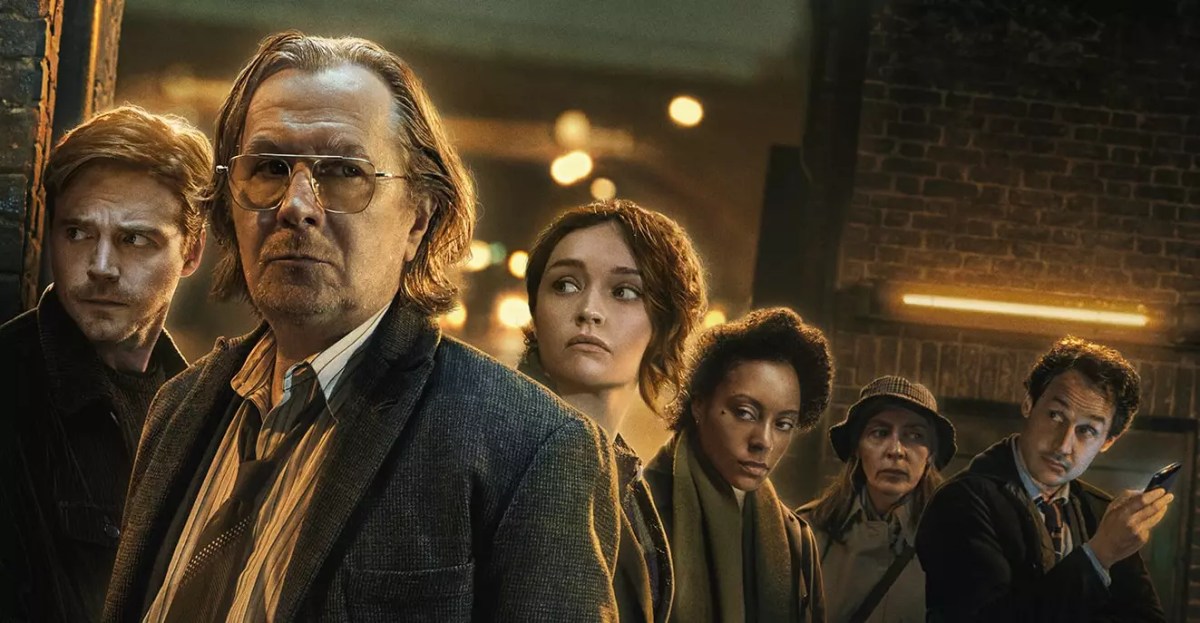
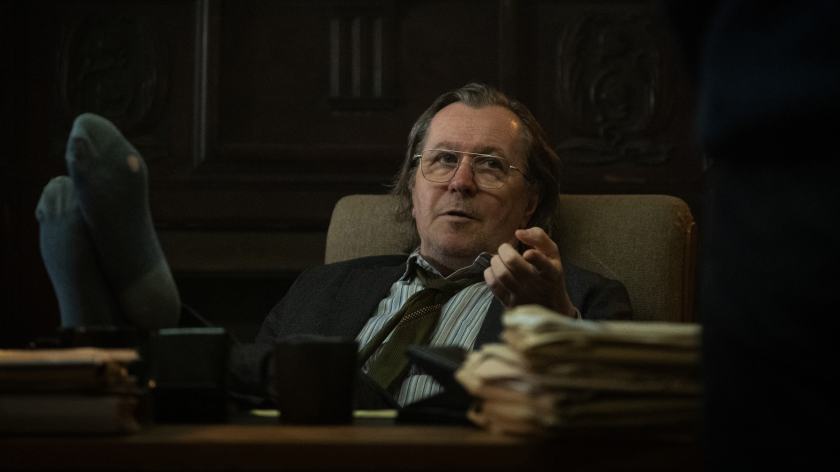
There’s a scene in the first season of Slow Horses when Gary Oldman, in the role of a lifetime as MI5 supervisor Jackson Lamb, gathers his team as they’re being hunted.

“I don’t normally do these kind of speeches,” he says with an exasperated sigh, “but this feels like a big moment and if it all turns to shit, I might not see any of you again.”

He looks each of his agents in the eye, their fear reflected back at him, and sniffs.

“You’re f—ing useless, the lot of you! Working with you has been the lowest point in a disappointing career,” he says before barking at one of the young agents to accompany him and warning the rest not to get themselves killed.

Oldman is spectacular as Lamb, the gaseous, miserable MI5 veteran who captains Slough House, a purgatory where the agency’s worst agents are sent to waste away the remainder of their careers after humiliating themselves, usually in novel and cringe-worthy ways.

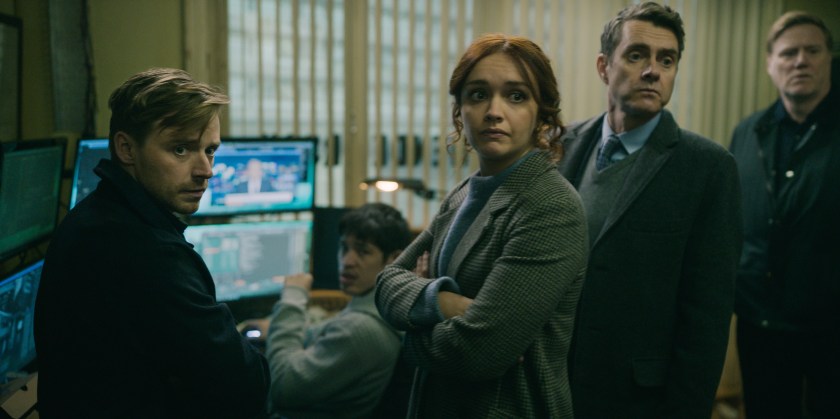
One agent was exiled after forgetting a disc with sensitive information on a train. Another was an alcoholic who didn’t notice her supervisor was feeding information to the Russians for years, while a third was banished to Slough House simply for being an insufferable jerk.

Gary Oldman as Jackson Lamb
Gary Oldman as Jackson Lamb, who oversees the purgatory for disgraced MI5 agents known as Slough House.

Regardless of the reasons, each of the agents at Slough House is determined to get back into the good graces of agency brass by redeeming themselves in service to king and country.

Or, as Mick Jagger puts it in the show’s catchy theme song, they want “to dance with the big boys again.”

To do that they must endure consistently brutal needling from Lamb and navigate the most mundane, least glamorous assignments. If a job is a lose-lose proposition, MI5 hands it over to the rejects of Slough House — the eponymous Slow Horses — figuring their already stained reputations can’t get much worse.

So when a secretive MI5 plot goes off the rails and the agency’s leaders need someone to take the fall, they serve up the Horses.

There’s just one problem: Lamb, for all his misery, disgusting habits and bone-dry British humor, is an exceptional agent with old-school skills, and the Horses themselves aren’t necessarily incompetent. Several were promising young agents of great skill who got railroaded or were collateral damage in political warfare.

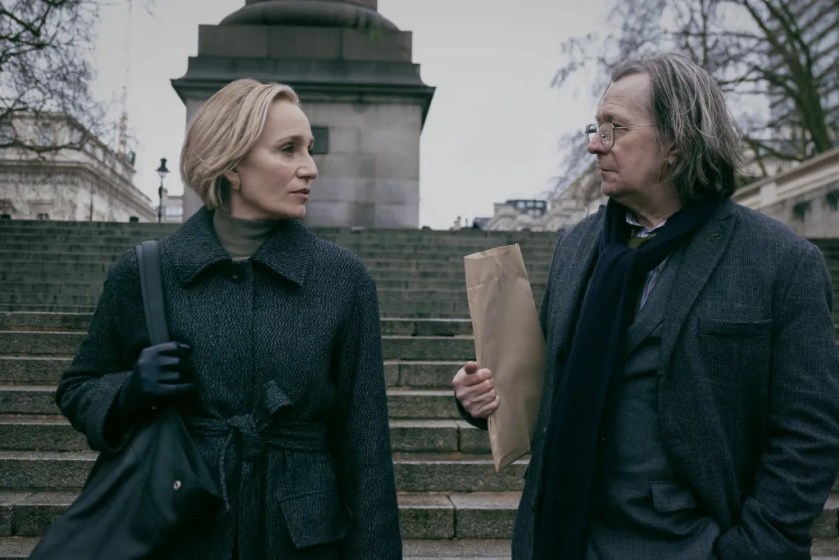
When MI5 second-in-command Diana “Lady Di” Taverner (an icy Kristen Scott Thomas) decides the disgraced agents will be blamed for a major agency blunder, Lamb is aghast and warns her he won’t accept it.

“They’re losers,” he says, “but they’re my losers.”

When we meet them for the first time they’ve already been tagged for sacrifice to the media and public, but don’t know it yet.

And when it turns out that the case has real consequences — a young man will be beheaded on a live stream by extremists if their demands aren’t met — the Slow Horses, led by the acid-tongued Lamb, use every trick at their disposal in an attempt to rescue the innocent victim.

slowhorsesriversid
Jack Lowden as River Cartwright, left, and Olivia Cooke as Sid Barrett, center, disgraced agents of MI5. Credit: Apple TV

Slow Horses, like Luther and similar UK crime dramas, is a different animal than the bland, formulaic cop shows we’re accustomed to on this side of the pond.

Whether it’s Law and Order, the many incarnations of CSI and NCIS or shows like Chicago PD, the audience always knows a few things for sure: The case will be solved and the bad guys apprehended by the end of the hour, the police will be righteous and earnest, and favorite characters will never find themselves in real danger. Mariska Hargitay’s character will live another day to continue on in her third decade fighting crime. Chicago’s tough-talking detective Hank might be rough around the edges and bend a few rules, but he’s fundamentally a good guy on the side of justice.

The Slow Horses have no such pretenses, nor plot armor. They’re deeply flawed people and they’re not immune to bullets or bad luck.

The result humanizes the agents in a way other spy thrillers and crime shows never manage to accomplish with their own characters. When one of the Horses takes a bullet from a Russian agent or risks life and limb to protect the British public, there’s a real sense of tension because the show makes it clear not everyone survives.

The show’s writers also know when to dial it back with moments of genuine humor, separating Slow Horses from contemporary spy thrillers like Homeland, which — with apologies to Claire Danes — always took itself seriously.

Slow Horses: Taverner and Lamb
Kristen Scott Thomas as Diana “Lady Di” Taverner, MI5’s ruthless second-in-command, with Oldman as Jackson Lamb. Credit: Apple TV

As for Jagger, he signed on to write the show’s theme song with composer Daniel Pemberton because he’s a fan of the original Slow Horses novels by Mick Herron. While writing the lyrics, he said, the phrase “strange game” kept coming back to him. That became the title of the theme song and its primary hook. It’s an apt description of what MI5 agents are involved in as operators for a domestic agency that, unlike the American FBI, has the green light to involve itself in extensive subterfuge on home soil.

Slow Horses just finished airing its third season. A fourth has already been filmed and completed, a fifth is in production and a sixth season is currently in the adaptation/writing phase.

A production that runs like a finely tuned engine is appropriate for the series: each season is a taut six episodes, meaning there’s no filler and the tension does not let up on the gas pedal. With eight books and counting, there’s plenty more material to adapt, and if the response so far has been any indication — universal praise by critics and audiences in rare agreement — we’ll get to see every one of them make it to the small screen.

Title: Slow Horses
Network: Streaming (Apple TV)
Format: Series
Release date: April 2022 (season 1), December 2022 (season 2), November 2023 (season 3), TBA 2024 (season 4)

Verdict: All the paws up! When it comes to crime and spy thrillers it doesn’t get any better than this. Slow Horses is tense and humorous in precisely the right proportions, knows when not to take itself too seriously, and benefits from an incredibly talented cast to match its excellent writing. We highly recommend this show.

For All Mankind May Be TV’s Best Show Right Now

For All Mankind shows us the future we could have had and the future that could still be if we celebrate our humanity instead of our differences.

The first few minutes of For All Mankind play out like a documentary for the Apollo moon landing, interspersing archival footage of tense staff in mission control with shots of engineers in horn-rimmed glasses poring over data, backup astronauts raising their glasses in a pub and nervous families sitting in their 1960s living rooms, crowding around televisions.

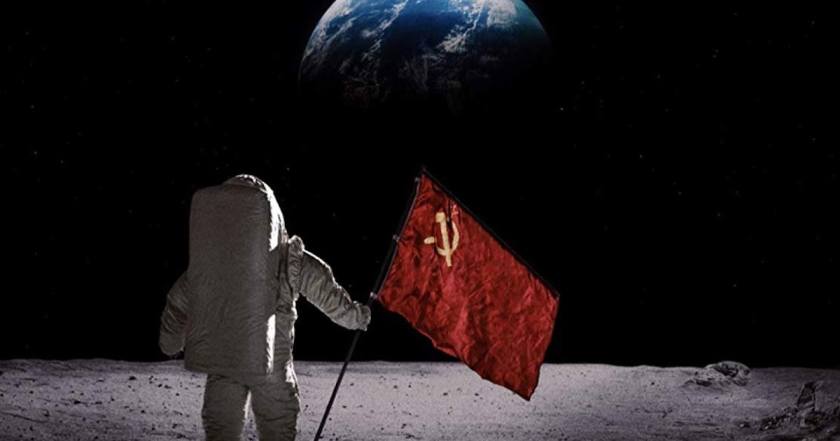
A news anchor cuts in to report he’s getting the live feed from the moon. We see the door of a lander open…and a Soviet cosmonaut strides out, planting the flag of the USSR on the lunar surface and becoming the first human to ever set foot on another world.

fam_sovietlanding

That’s the premise of For All Mankind. In this alternate history series, the fire that killed astronauts Virgil Grissom, Edward White and Roger Chaffee on Apollo I’s launchpad — which indeed happened in real life — led to policy changes and a more cautious culture at America’s space agency, resulting in the US losing the first and most momentous achievement of the space race.

That’s the start of the what-ifs.

What if the Soviets beat us to the moon? What if the rest of the space race was even more competitive than it was in our history, with an America struggling to prove its primacy? What if the US and Soviet Russia continued to pour incredible resources into space exploration? How far would we go? What kind of incredible new technologies would we invent? How would all of it impact American politics, culture, identity and standing in the world?

Could it have led to a better future?

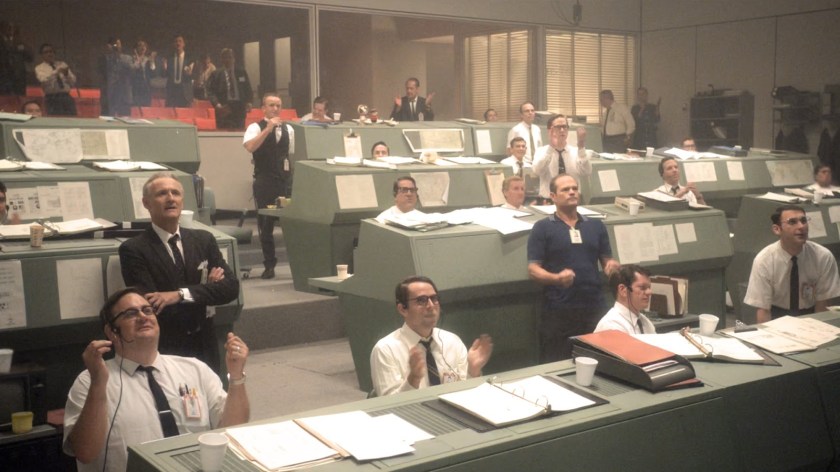
fam_missioncontrol
Werner Von Braun (Colm Feore) and Deke Slayton (Chris Bauer) in NASA mission control in For All Mankind. Von Braun and Slayton were real-life leaders at the space agency and formative figures in the space race.

The answer to that question is hinted at in the series’ title, and while the show is filled with tense moments of international, organizational and personal rivalry, it’s infused with rational optimism instead of the cheesy, manufactured aspiration we’re accustomed to. It’s more like asking: What could the human race achieve if we all worked together? Is that retrofuturistic gleaming vision of the future still possible, and how do we get there?

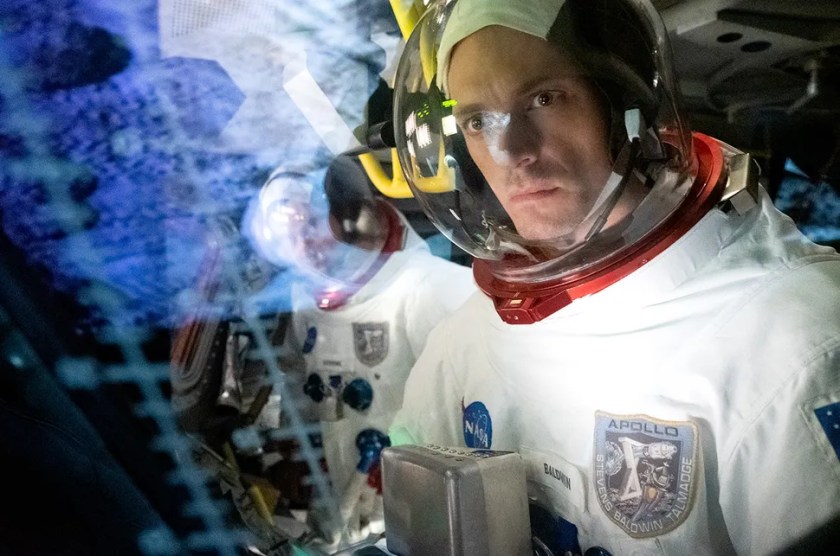
For All Mankind follows Ed Baldwin (Joel Kinnaman) and Gordo Stevens (Michael Dorman), astronauts and best friends whose Apollo mission came within a few thousand feet of landing on the moon just weeks before the Russian landing.

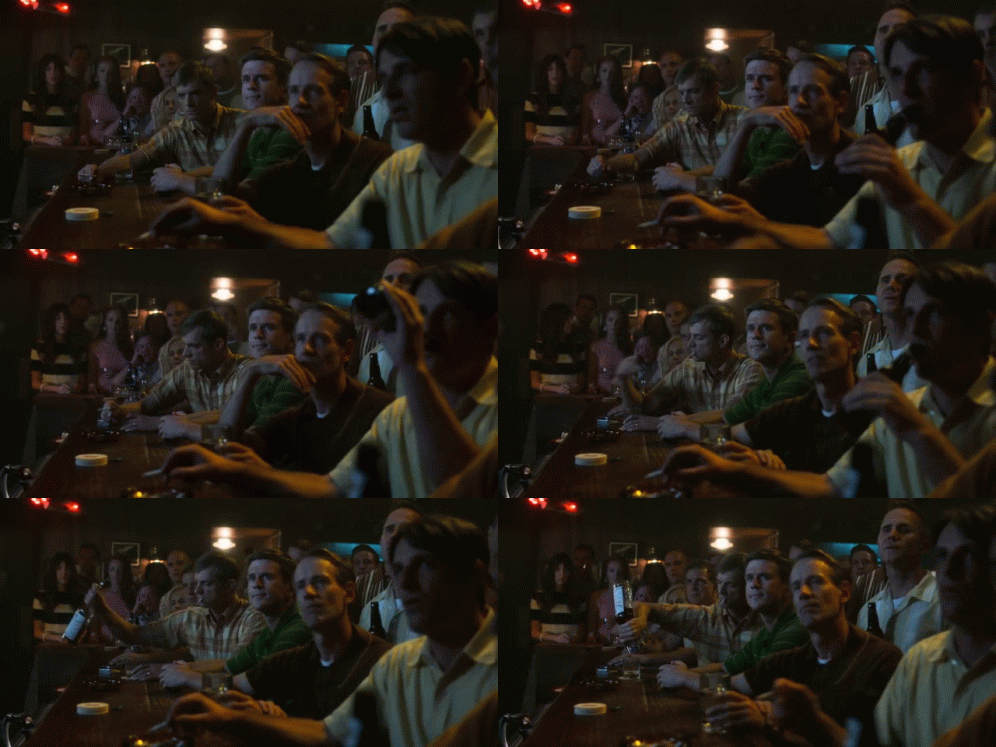
They’re miserable as they sit in a dive bar just off NASA’s campus watching grainy footage of cosmonauts claim their glory, and blame themselves for their failure to land even though it wasn’t in NASA’s cautious mission plan.

for-all-mankind-drink
Astronauts watch the Soviet moon landing from The Outpost, a dive bar frequented by NASA employees.

The scenes that follow look like they could have come from the 1995 blockbuster Apollo 13 as we meet the astronauts, their kids and their nervous wives, the eggheads and flight directors at NASA, and the political players who keep the space agency funded and protected from the wrath of President Richard Nixon.

With the agency rocked by the Soviet achievement and intense political pressure, it embarks on a series of bold new endeavors dictated by the White House. Not only will Americans land on the moon, they will build a permanent base there, and — embarrassed and spurred on by the fact that one of the cosmonauts was female — NASA will for the first time train a new, all-female class of astronaut recruits

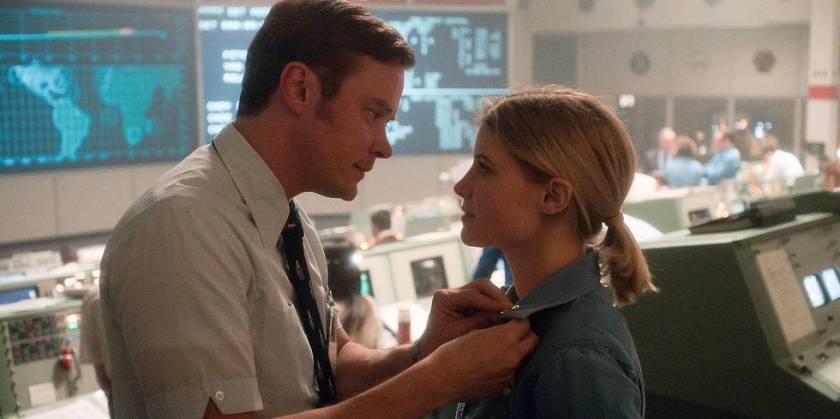
The later group includes hotshot pilot Molly Cobb, “token black girl” Danielle Poole, quiet but determined Ellen Waverly — and Tracy Stevens, astronaut Gordo Stevens’ beautiful wife who is an accomplished pilot in her own right. While the women manage the normal pressure that comes with astronaut training and the high stakes nature of the job, they must also contend with pushback coming from directions they don’t expect — including hostility from some of the wives of current astronauts, who feel their husbands’ jobs will be threatened by women in space.

Gordo and Tracy
A proud Gordo gives his wife her astronaut pin.
Women of For All Mankind
Ellen Waverly, Molly Cobb, Tracy Stevens, Danielle Poole and another recruit are part of NASA’s first class of potential female astronauts.

For All Mankind is a science fiction show, but it’s also a drama and a thriller, putting viewers through the wringer of emotions.

There are funny and amusing moments as the show references celebrities, political figures and musicians from the 1960s onward, grounding the narrative in American culture. The fortunes of some celebrities and politicians change in the show’s alternate history while others stay the same.

In one running storyline — which you’ll only catch if you pay close attention to certain scenes and montages — John Lennon survives the attempt on his life, continues on as the grating, post-Beatles John Lennon most people would like to forget, and becomes just another aging musician cashing in on past glory alongside bandmate Paul McCartney and bands like the Rolling Stones.

The extension of the space race and continuation of US-Soviet rivalry impacts society in profound ways, many of them we may not realize from our historical perspective.

For example, DARPA created the internet because the US government and military wanted a decentralized communications network that could withstand nuclear attacks and remain operational even if major nodes are taken out in nuclear blasts.

That’s why the internet works on such a wide variety of hardware and why, even when major servers go down, our routers are able to move data packets via alternate paths. It’s difficult to imagine a time when the web wasn’t a medium for exchanging photos and videos of cute cats, but the early internet was populated by government officials, Pentagon brass and leading scientists in crucial fields.

In real life, restrictions were taken off the internet when the Soviet threat began to fade, allowing widespread civilian adoption of the technology and early dial-up services like AOL and CompuServe.

That doesn’t happen in For All Mankind’s alternate history as the USSR and communism remains a major threat, resulting in pop culture developing along a different cultural arc than the one we’re accustomed to.

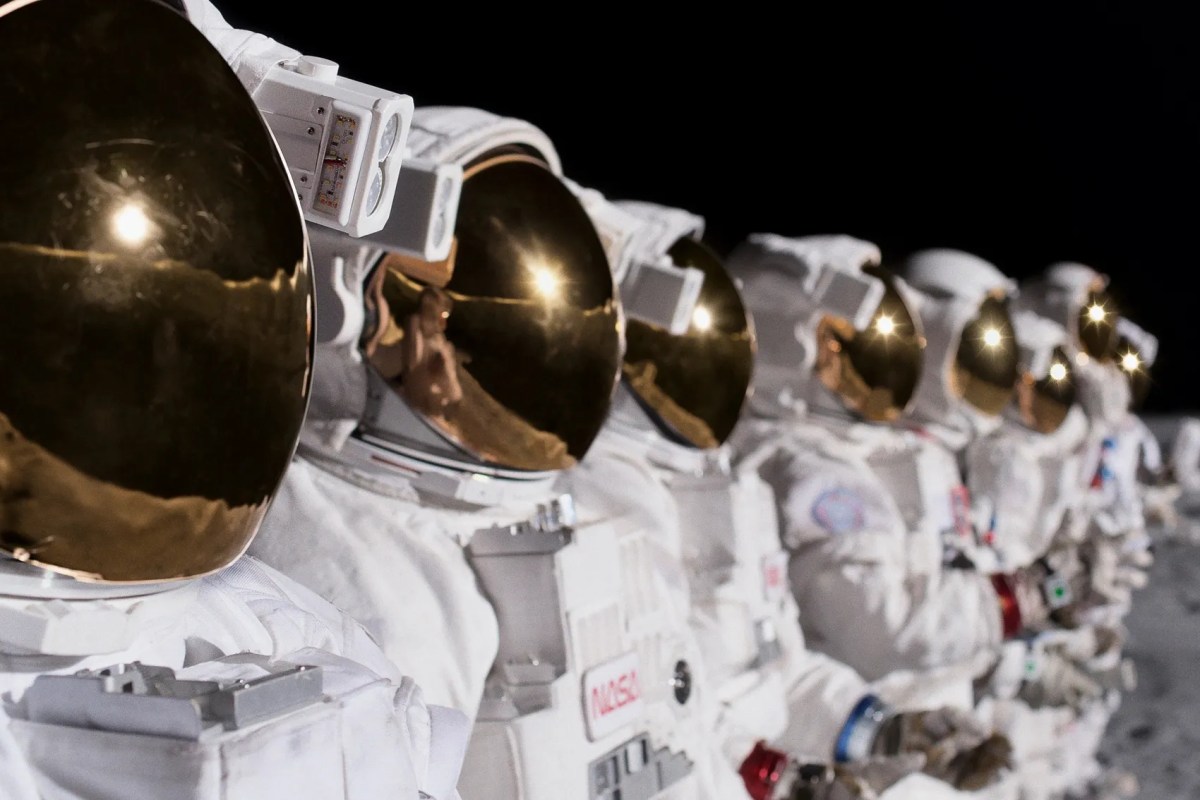
While the pop culture references, sets, cars and costumes help ground For All Mankind historically, the show is at its best when it puts us in mission control and the command modules of high-risk space missions, constantly reminding us of the danger these men and women face while highlighting the commonality of astronauts, cosmonauts and later space explorers from other countries, all of them just human beings millions of miles from their families and everything they’ve ever known.

At the same time, the US and the USSR are playing a game of nuclear brinkmanship and astronauts are in many ways on the front lines as they figure out how to co-exist in unprecedented circumstances and places famously inhospitable to human life.

If astronauts tap a lunar mine too close to Soviet base camp, could that start a war? Are the Soviets spying on communications between NASA and its astronauts on the moon? What happens if someone gets hurt and their blood can’t clot in low/zero gravity?

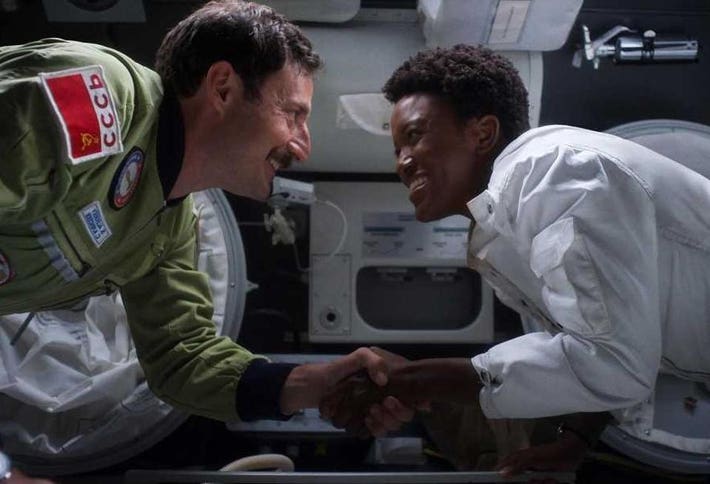
Handshake in space
NASA astronaut Danielle Poole shakes the hand of her Soviet counterpart as their modules dock in space.

Kinnaman, Dorman, Sarah Jones (Tracy Stevens), Sonya Walger (Cobb) et al shine in those scenes as they juggle the pressure of surviving in space with being exemplars of — and diplomats for — their country. Rather than be content painting the Soviets as the traditional bad guys, the show also gives us a close-up look at the people in the USSR’s space program and the pressures they face, particularly Polish actor Piotr Aleksander Adamczyk’s Sergei Nikulov in his relationship with his NASA counterpart, flight director Margo Madison.

In one of the show’s quieter moments, Poole (Krys Marshall) takes two cosmonauts to The Outpost when, during joint training exercises, they request real American cheeseburgers and whiskey. After a few drinks one of the cosmonauts grows somber and tells Poole how he held Laika, the Moscow street dog who was famously blasted into low Earth orbit in her own little module, before scientists were sure enough in the technology to risk human lives.

Although Soviet propaganda feted Laika as a hero and the official story said she survived until re-entry, the cosmonaut tells Poole that Laika died shortly after liftoff, terrified, alone and subjected to unimaginable forces as thousands of pounds of fuel carried her capsule heavenward via brute force.

(The west was no less barbaric: The French famously sent a street cat named Felicette into space while NASA used a young chimp named Ham. In all of those cases the animals were named only after their missions, as mission commanders didn’t want to risk humanizing them in the event of disaster. Had Felicette and Ham both died in space they’d be remembered only by their identification numbers as footnotes in early space history.)

Ed Baldwin NASA commander
Kinnaman grounds the show as Ed Baldwin, one of the second generation of astronauts who take the mantle from men like Neil Armstrong and Buzz Aldrin.

For All Mankind recently began its fourth season and because AppleTV’s marketing and promotion is curiously weak, it remains one of TV’s best-kept secrets. If you haven’t seen the show yet, now’s a great time to jump aboard with so many TV shows on hiatus for the holidays and many others pushed back or canceled in the wake of the parallel strikes that halted production for most of 2023.

For All Mankind

Network: Apple TV

Content rating: TV-MA for bad language, occasional drug and alcohol use and mature themes.

Ratings: 8.1 (IMDB), 93% (Rotten Tomatoes), 4/5 (Common Sense Media)

Seasons: 4 (current)

PITB verdict: 4 Paws!