It turns out cats have been adding their special sauce to our communications for as long as written language has been a thing.
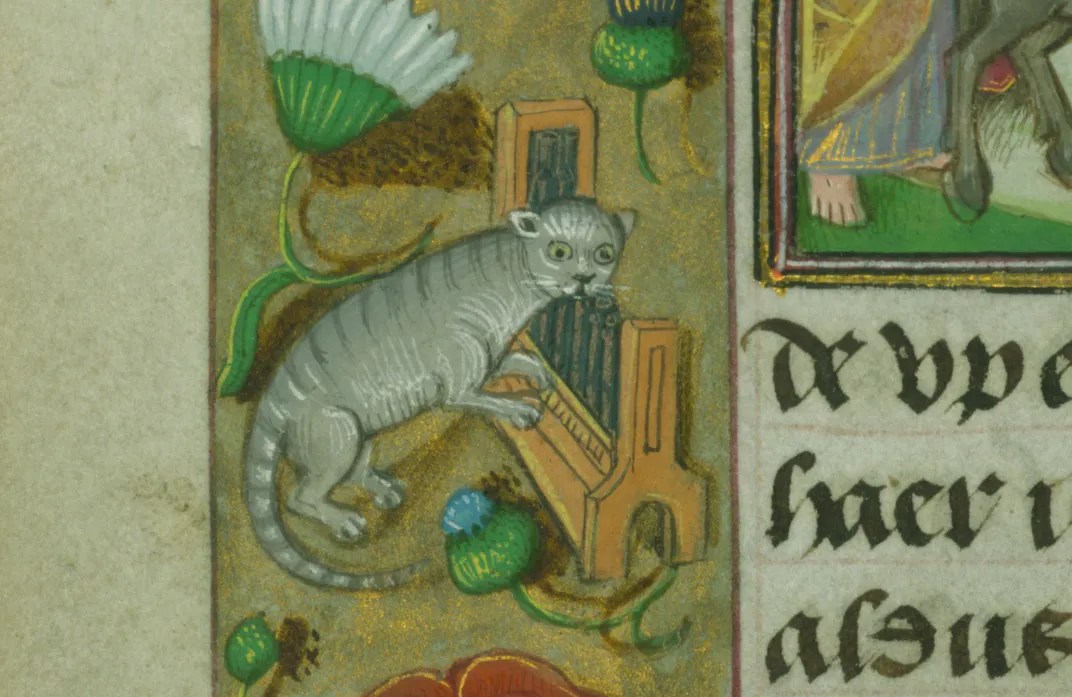
Illuminated manuscripts date back long before the printing press, and their manufacture was arduous.
Literacy itself was rare in the Dark Ages and usually only the province of educated nobility and the professionally religious. Most people had no hope of learning to read, so the monks charged with copying religious texts were already practitioners of a rare skill for their time.
They weren’t just writing either. They carefully illustrated each page with drawings, cartouches and other decorative touches, and the text itself was a form of art in its calligraphic symmetry, designed to be beautiful as well as legible.
It took thousands of hours to complete a manuscript. There was no whiteout and no do-overs: a mistake meant the page had to be scrapped even if it represented a week’s worth of work.
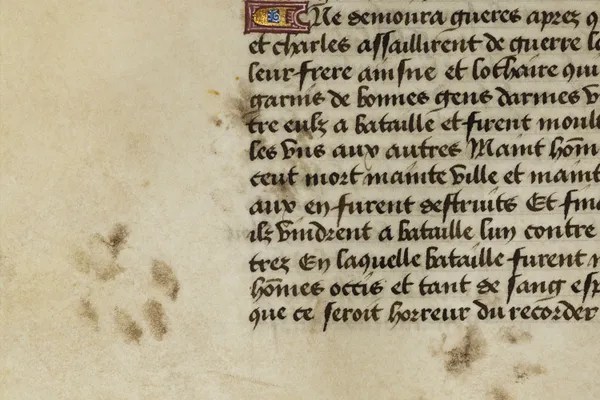
So when a Flemish scribe finished a page of his manuscript and set it aside, he thought he was in the clear — until a cat came along and left its own signature in the form of paw prints.
Three of them, in fact, representing one and a half kitty strides. Two of the feline’s little feet found white space, but another landed right on top of the meticulously rendered text.
The feline-marked parchment in all its glory.
It kind of puts keyboard cats in context, doesn’t it? Our four legged friends may occasionally ruin our drafts or emails — or in my case wreck a music recording session with a discordant keyboard solo by walking across a synthesizer at an inopportune time — but at least they don’t cost us dozens of hours of work.
The 500-year-old, kitty-marked manuscript is now the centerpiece of “Paws On Parchment,” a new exhibit at Baltimore’s Walters Art Museum.
Click here for more details from the museum, which is open Tuesday through Saturday, with late hours on Thursday evenings. Admission is free.
And if you ever take up calligraphy as a hobby, keep your work hidden from your feline overlords!
While the sensational claims have spawned headlines around the world, a closer examination raises more questions.
According to dozens of articles, a pair of new studies throws doubt on the commonly-held view that cats self-domesticated 10,000 years ago by helping themselves to rodents invading human grain stores.
The conventional wisdom for some time has been that house cats are the domesticated ancestors of felis sylvestris lybica, the African wildcat. Their genomes are nearly identical, it’s often difficult even for experts to tell the species apart, and they’re much more tolerant toward humans than the comparatively hostile felis sylvestris, the European wildcat.
But two new papers are raising eyebrows for their fantastic claims that feline domestication was actually human-driven and began about 5,000 years ago in Egypt.
Specifically, the papers claim cats were sacrificed en masse by the cult of Bastet, an Egyptian feline goddess, guiding the species toward domestication in a way that doesn’t quite make sense with what we know of evolution.
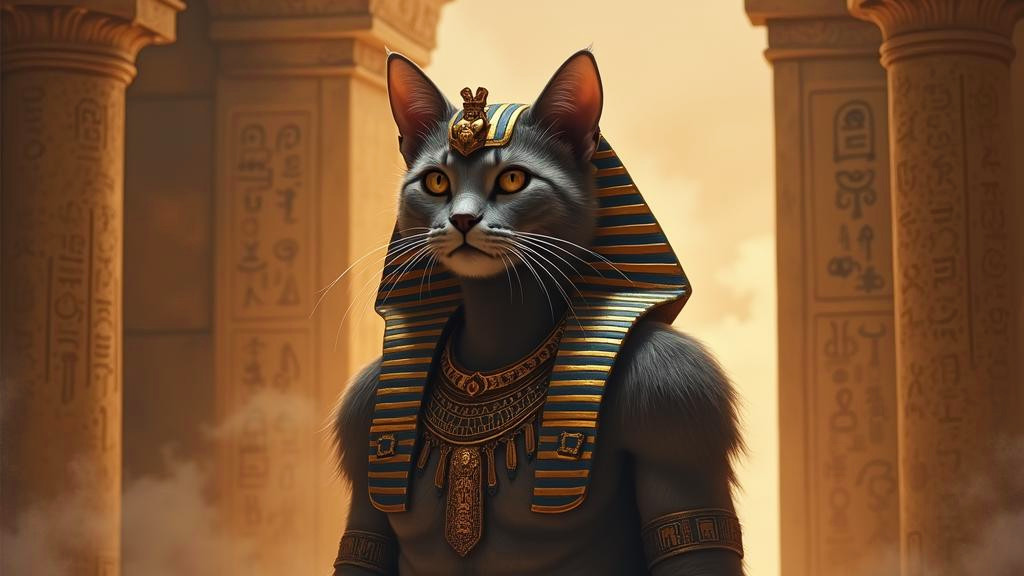
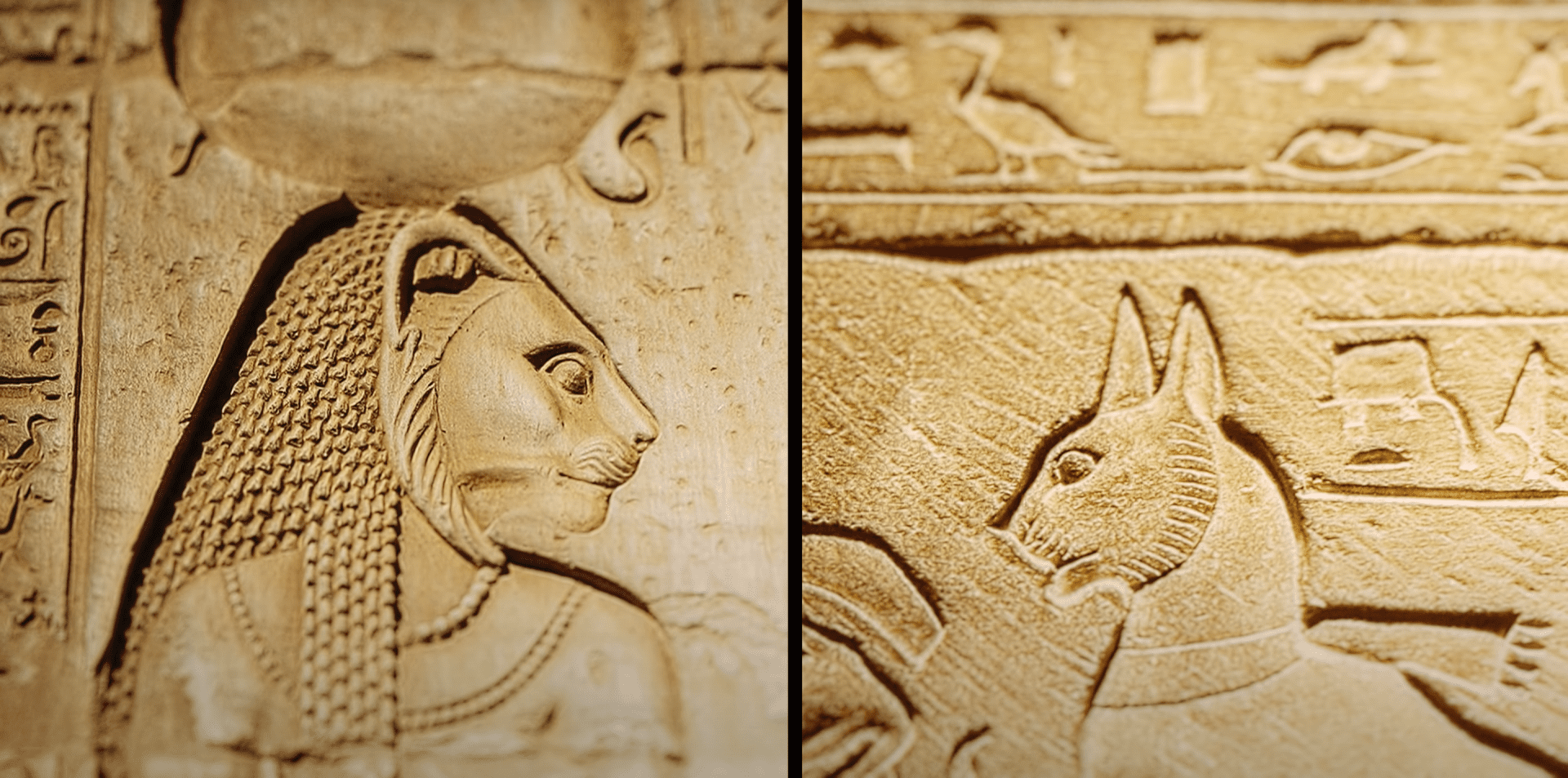
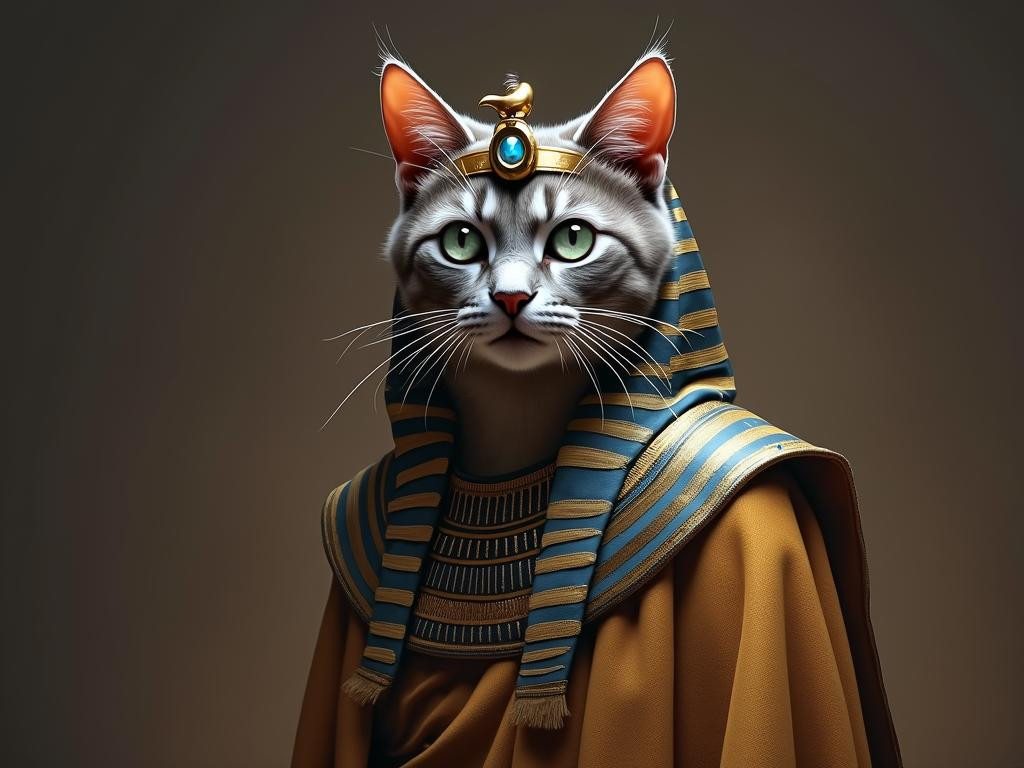
Bastet was originally depicted with the head of a lion, but the imagery around her evolved as she became a more prominent deity in the Egyptian pantheon. Later glyphs depicted her with the head of a domestic cat or African wildcat.
There are two main elements to the new claim:
The earliest grave in which a cat was buried with a human was dated to about 10,000 years ago, and was found in Europe. But an analysis of the cat’s remains indicate it had DNA somewhere between a wild cat and a domestic feline. That, the authors claim, throws into doubt the idea that cats drifted into human settlements, drawn by the presence of rodents.
If domestication was closer to 5,000 years ago, that would coincide with the rise of the cult of Bastet, the Egyptian cat goddess, around 2,800 BC.
Instead of the feel-good, fortuitous sequence of events the scientific community has accepted as the likely genesis of our furry friends, the authors of the new papers claim aggressive and fearful traits were essentially murdered out of the feline population by Bastet cultists who sacrificed cats in large numbers and mummified their corpses.
Neither paper has been peer-reviewed yet, and experts on ancient Egypt, genetics and archeology have already begun pushing back.
The new timeline, they say, doesn’t quite add up, with cat mummies found throughout different periods in Egyptian history, not just during the height of Bastet’s popularity in the Egyptian pantheon. Bastet’s popularity came approximately 700 years later than the authors claim the sacrifices began, and early imagery of the felid goddess depicts her with a lion head. It wasn’t until later centuries that Bastet was represented with the features of a domestic cat.
The powerful Pharaoh Budhotep I, considered an apocryphal king by some, sent a fleet of ships to the Americas to bring back turkey, according to legend. Credit: The Royal Buddinese Archaeological Society
Separate from timeline concerns is the lack of historical evidence. Cats were revered in ancient Egypt, and while there are an abundance of cat mummies — as well as the mummified remains of many other animals — that does not mean the cats were ritually sacrificed.
Indeed, archaeological, hieroglyphic and anthropological evidence all show cats enjoyed elevated status in the Egypt of deep antiquity, long before the nation became a vassal state of the Greeks, then the Romans.
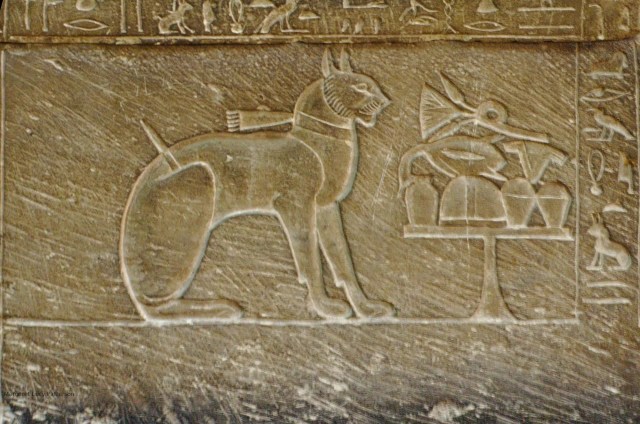
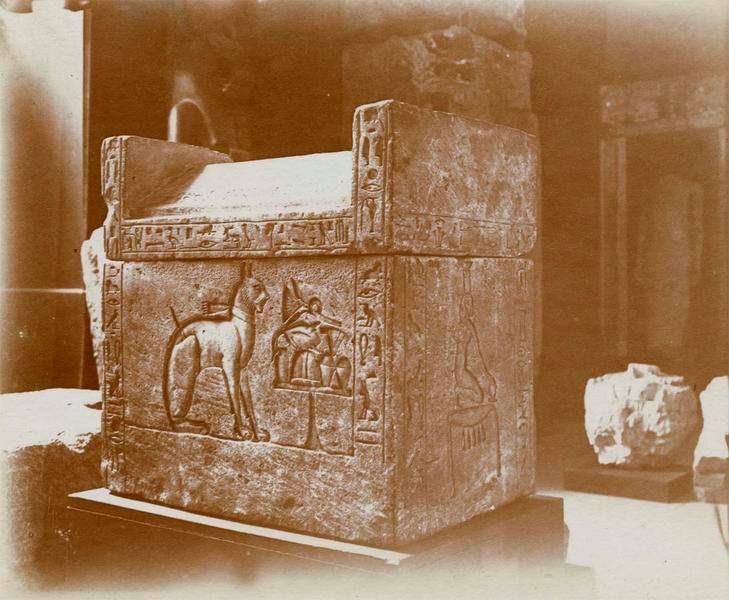
Cats were associated with magic, the divine and royalty, and cats who were the favored pets of Egyptian elites were given elaborate burials. Like Ta-miu, Prince Thutmose’s cat who is known for her grand sarcophagus decorated with images of felines and prayer glyphs meant to guide her to the afterlife.
Cats were sacred companions to the Egyptians
When cats are found buried with humans, the more common explanation is that those cats were the pets and companions of those humans. If the authors of the two new papers want to prove their claim that cats were ritually sacrificed by the tens of thousands — slaughter on a scale that would influence evolution — they’ve got a lot more work ahead of them. (And the burden of proof rests squarely with them, as the originators of the claim.)
Not only does their research attempt to change the origin stories of kitties to an ignominious tale of human barbarity, if we take their assertions at face value, we’re talking about a case of “domestication by slaughter.”
While it may be true that the earliest evidence of companion cats outside of North Africa revealed hybrid DNA, that doesn’t cast doubt on the commonly-accepted view of feline domestication, it strengthens it. Domestication is a process that takes hundreds of years if not more, and it occurs on a species level, so it makes perfect sense that cats found in burial sites from early civilization would be hybrids of domestic and wild. Those felines were of a generation undergoing domestication, but not quite there yet.
A detail from the sarcophagus of Ta-miu, Prince Thutmose’s beloved cat.Ta-miu, Prince Thutmose’s beloved cat, was buried in an elaborately decorated sarcophagus with glyphs and offerings meant to guide her to the afterlife. Thutmose, son of Amenhotep III and Queen Tiye, lived in the 14th century BC.
Killing off docile cats?
Which brings us to another significant problem with the claim: if the ancient worshipers of Bastet were selecting the most docile and easiest-to-handle wildcats for their sacrifice rituals, as claimed, then they would be influencing evolution in the other direction.
In other words, they’d be killing off the cats who have a genetic predisposition toward friendliness, meaning those cats would not reproduce and would not pass their traits down. It would have the opposite effect of what the papers claim.
So despite the credulous stories circulating in the press and on social media, take the assertion with a grain of salt. Something tells me it won’t survive peer review, and this will be a footnote about a wrong turn in the search for more information on the domestication of our furry buddies.
Cats would like human civilization to return to the good old days.
Sheba and a geneticist who specializes in cats are looking for felines descended from ancient Egypt’s royal buddies.
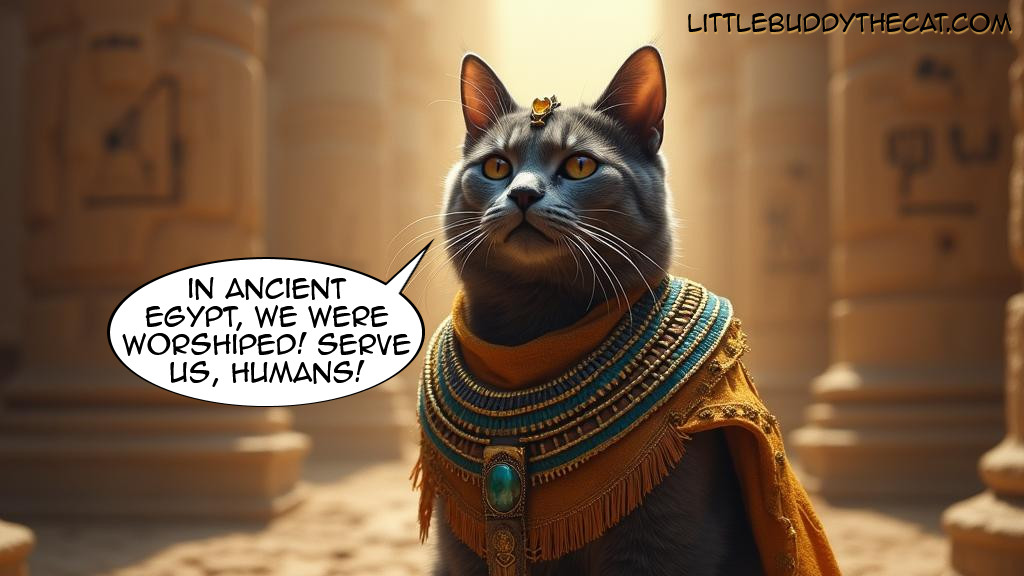
“You may call me Budtum Ra Budhotep Bhufu Amun Buddeses, human. Now serve me!”
Bud’s already enormous ego just got a little bigger after I used Sheba’s Pharaoh Cat Finder to analyze his pharaohness.
The online tool says he’s up to 75 percent pharaoh:
I didn’t do it entirely out of altruism to give the little guy an ego boost. The winner of the Pharaoh Cat contest gets a lifetime supply of Sheba, and Bud’s been eating Sheba for 10 years. We’ve never endorsed any particular cat food here on PITB, partly because every cat is different, some have special nutritional needs and what works for one furry overlord may not work for another.
But as food motivated as he is, Buddy cannot scarf down more than half a can of wet food at a time, and he’s an enormous pain in the Bud when it comes to leftovers, so Sheba’s Perfect Portions saves me from wasting food.
While the online Pharaoh Cat Finder tool looks like it may be RNG combined with clever marketing, there’s a genetic basis for the search. The company is working with Dr. Leslie A. Lyons, a geneticist who specializes in the DNA of our furry little friends at the University of Missouri’s Feline Genetics and Comparative Medicine Lab.
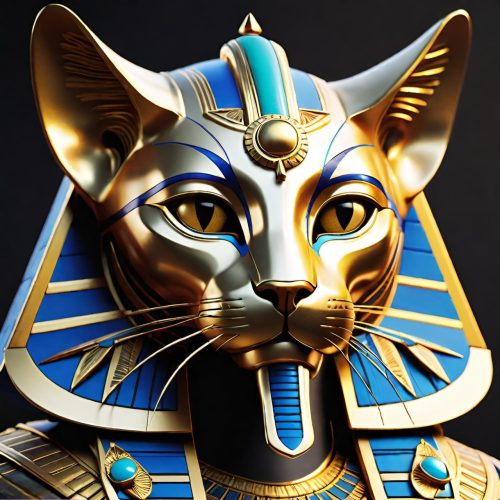
The legendary funerary mask of pharaonic feline Buddankhamun Budstet Ra Budshepsut, Buddy’s royal Egyptian ancestor. Credit: The Grand Museum of Magnificent Feline Stuff
Lyons was part of a research team that extracted DNA from mummified cats buried in ancient Egyptian tombs and sequenced their genetic code.
While the project verified that the Egyptians domesticated cats long before they began mummifying them and affording them revered status, Lyons says a DNA sequence from the ancient felines “has only been found in cats in Egypt and the U.S., unlocking even more questions to be explored.”
“We are looking at mitochondrial DNA only found in these pharaoh cats and a few cats in the U.S. So it’s really hard to find these cats, hence this hunt with Sheba pet food,” she said. “We’re on that quest to find the cats that went from Egypt into the U.S. and are the divine cats of the pharaohs. They should be worshiped like they were.”
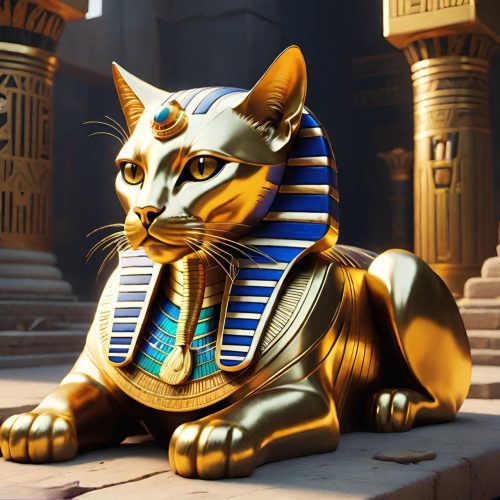
The Temple of Amun Bud is guarded by gold statues of domestic cats instead of sphynxes. Credit: National Gallery of Buddesian Artifacts
I don’t think there’s any doubt that the aptly named Dr. Lyons is on team cat.
So here’s to hoping Bud gets a lifetime supply of Sheba, and Dr. Lyons is successful in her quest to find the elusive pharaoh cat lineage. In the meantime, we should probably start work on an impressive new pyramid here in the US, lest we disappoint our new feline pharaoh.
New to kids and nostalgic to adults, Playland means summer for New Yorkers. PITB visits the National Historic Landmark.
“You know,” I said to my niece, rapping my knuckles against a wooden support beam of Playland’s Dragon Coaster, “they built this thing 100 years ago.”
Her eyes widened. At 10 years old and already wise beyond her years, she smelled a joke at her expense by her constantly wise-cracking uncle. (I once told her and her sister that my cat had a vast collection of Pokémon cards, and that he almost certainly had the ultra-rare cards they coveted. At the time, their young minds didn’t question it and wanted to propose trades with Buddy, but now it comes up every time I tell them something absurd.)
“No it wasn’t!” my niece said as we stood in line to ride the venerable and historic wooden coaster.
My brother chimed in.
“It says it right there,” he said, pointing to a sign above the queue. “This roller coaster was built in 1929, the year the park opened.”
Playland’s ferris wheel and the manicured midway that runs the length of the park, with a giant fountain on one end and a stage for outdoor performances on the other. Credit: PITB
The Dragon Coaster is indeed almost a 100 years old, and to a 10-year-old a century is an incomprehensible amount of time. Mentioning the ride’s age almost backfired on us and we had to assure the kids the ride was safe.
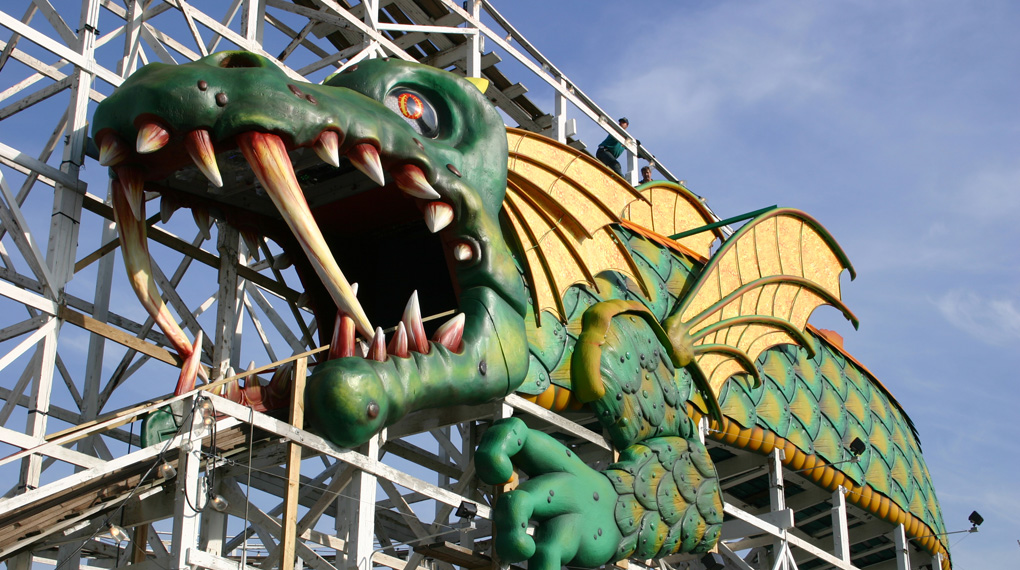
Truth be told, the Dragon Coaster doesn’t look safe. It’s all aging wooden beams, rusting rivets and peeling paint, and the coaster rattles as it allows gravity to do the bulk of the work, with an initial 80-foot drop propelling the cars over 3,400 feet of shuddering track. But it passes inspection every year and it’s a relic of a time when things were built to different standards.
The iconic coaster’s history also extends to pop culture: Tom Hanks rode the Dragon Coaster in the 1988 film, Big, as did Mariah Carey in the video for her 1995 hit Fantasy. In 1987, it was featured prominently in the psychological thriller Fatal Attraction with Glenn Close and Michael Douglas.
A young Tom Hanks on Playland’s boardwalk in Big (1988). The “Zoltar” machine that grants Hanks’ wish in the movie is still in the park and has been moved to the midway.
Mariah Carey riding the Dragon Coaster in the 1995 video for her hit, Fantasy. Carey returned to Playland last summer with her family over the July 4 weekend.
The Dragon Coaster’s front entrance in September of 2024. Credit: PITB
My brother and I rode the Dragon Coaster when we were kids, as did my mom and her friends in their youth. If you grew up in Westchester County, the Bronx or Manhattan, chances are that Playland was a big part of your summers.
I have vague memories of the park from early childhood, fond memories of screaming on rides like the Mind Scrambler in my teenage years, fresher memories of taking my little charges there when I was a summer camp counselor, and new memories formed annually as I bring my brother’s kids.
Taking the kids to the amusement park was one of the things I most looked forward to when I became an uncle, and they’re at the age now where they really love it. Visiting the park brought on waves of nostalgia (“Good Vibrations” by Marky Marky and the Funky Bunch blasted from the PA when we first arrived), the happiness of seeing the kids’ eyes light up with joy, and the realization that even though I get dizzy and my stomach doesn’t appreciate rapid changes in gravity and direction anymore, some rides are still a hell of a lot of fun as an adult.
The medium-size version of three carousels at Playland in Rye, NY, September 2024. Credit: PITB.
We returned this year to find new rides, refurbished shops and lots of construction. Playland is in the middle of yet another refresh, this time to the tune of $150 million, leaving some rides and areas of the park dark to visitors.
Playland was built on 280 acres of prime waterfront real estate on the Long Island Sound and it’s very much a product of its time. Although it has seen its share of retrofits and refurbishment over almost century of existence, there’s no hiding the fact that it was constructed in the 1920s.
The structures — which include an entrance plaza, an ice casino and arcade, a pool, a beachfront boardwalk and a central tower — were built in an Art Deco style, with a consistent limestone, orange and emerald green color scheme.
As a kid my favorite ride was the Mind Scrambler, a blackout ride variation on the classic Scrambler housed within a dome. I remember waiting on line with my friends, hoping we’d get a good song for the ride, which was adorned with lots of neon and blacklights for maximum funkiness and disorientation.
Alas, messing around on a ride like that doesn’t bring good results. In a sequence of events that’s still difficult to believe, a seven-year-old girl was killed when she was thrown from the Mind Scrambler in 2004.
The exterior Mind Scrambler shortly before the darkride was dismantled following a series of deaths.
Three summers later, park management promoted a 21-year-old Playland employee who was working the night the girl was killed, making her the ride’s manager. She died that summer on the same ride. An investigation found she was kneeling backwards in her seat when she was thrown from the Scrambler just 20 seconds in.
The woman’s death prompted the park’s management to shut the ride down, a decision that was later made permanent despite the fact that “user error” was to blame.
Riders on the Dragon Coaster during the Great Depression. Credit: Rye Historical Society
A poster from the 1930s showing a bird’s eye view of Playland in Rye, NY. Note the beaches and the boardwalk below the park and the adjacent suburban neighborhood. Very little about the park’s layout or the neighborhood has changed over the years. Credit: Rye Historical Society
A close second favorite was the Music Express, a straightforward moderate speed ride that was also known for pumping out loud pop hits. I have fond memories of riding the Music Express to everything from the Spin Doctors’ Two Princes and Technotronics’ Move This, to Blues Traveler’s Run Around and Snow’s ludicrous summer hit, Informer.
The Music Express was out of commission last summer, but this time it was back in action.
“We’ve gotta ride this!” I told my nieces. Just when I was thinking it was getting a little intense, it slowed down. That wasn’t so bad, I thought. Then it spun up again, faster than before, this time spinning backwards. I felt like I’d downed a six pack of beer in a half hour when I stumbled off the damn thing.
The Music Express at Rye Playland.
I wisely limited myself to less strenuous rides for the rest of the night, including the bumper cars, Ferris wheel and the Zombie Castle. At seven years old, my younger niece isn’t big enough yet to ride some of the attractions by herself, and that’s when the Funcle steps in. Thankfully she’d had her fill of stomach-churners too.
Above: A classic swing ride at rest, left, and mid-sequence as it twirls riders through the air. Credit: PITB
Playland became a National Historic Landmark in 1987, and is unique among amusement parks in the US — and possibly the world — in that it’s government-owned. That’s because the people who live in the area, a wealthy waterfront enclave, were worried about growing crowds, traffic and “unsavory” people. In the 1920s at the urging of the community, Westchester County purchased the land, folded several smaller waterfront operations into a single park, and began drafting plans for a larger destination in the Art Deco style popular at the time.
While Art Deco is typically associated with structures like the Empire State Building and the Chrysler Building in Manhattan, as well as the Chicago Board of Trade skyscraper, the jazz-age aesthetic is another feature that makes Playland so unique.
The Zombie Castle was built in the 1930s with a different theme, then was refurbished in the late 1960s, perhaps in response to the success of George Romero’s Night of the Living Dead, which was released in 1968. This image shows the Zombie Castle on September 22, 2024. Credit: PITB
Remarkably, many of the attractions are as old as the park itself, including the aforementioned Dragon Coaster, The Whip, and the original carousel. Several of the older rides were designed and manufactured by engineer W.F. Mengels, the “Wizard of Coney Island” who was famous for designing many of that iconic park’s rides.
Taking the kids to Legoland in New York earlier this summer felt like a soulless experience, like paying to sit through a four-hour commercial for eponymous toys. Every ride was tied to a Lego intellectual property, every note of the piped-in music a corporate composition, every ride forcing you to exit via attached gift shops where $300 play sets beckoned to the children.
Even the “waterpark” had a corporate regimen to it: you’re required to book “appointments” ahead of time and get precisely 20 minutes to cool off under sprinklers on a Lego pirate-themed water playground, complete with Lego palm trees and Lego ships while the next group queues in the afternoon sun and watches, willing time to go faster.
Playland may not be as polished, but the experience feels more honest, and there’s no doubt the kids had more fun here. If I were a betting man, I’d wager Playland will still be there when they have kids of their own, while Legoland will be consigned to the dustbin of themed parks that don’t give you a reason to come back.
Coney Island’s version of The Whip designed by W.F. Mengels. Undated but likely in the 1910s.
A sign with original architectural drawings of The Whip from 1928, explaining “free-pivoting joints, combined with centrigual force, generates twists and turns which change with every rotation.”
Kiddyland is a section of the park for the little ones. It has a miniature roller coaster, a tiny carousel, and at least a half dozen other rides for young kids.
A view from the Ferris wheel at Rye Playland (PITB)
The Whip is one of the park’s original rides, built in 1928.
Did you know Buddy the Cat invented the George Foreman Grill and diffused the Cuban missile crisis? Me either!
I was looking through some of my old files the other day when I came upon this forgotten radio broadcast, which provides just a taste of Buddy’s heroics and adventures:
Of course I live with the little guy, so it’s easy to forget how accomplished he actually is. In addition to serving a term as president of the Americats, Buddy has won multiple gold medals at the Olympics, led the New York Yankees to a World Series championship, single-handedly took on the meowfia, and holds the Guinness World Record for most stylishly executed nap.
To me he’s just my Buddy, my fluffy little friend who likes to hang out, meows a lot, and enjoys purring and making biscuits while I rub his head and tell him what a cool dude he is.
Still, it’s nice to know that if I need him to take on evil robots or win a competitive eating contest, he’s got that covered too.




 Pain In The Bud