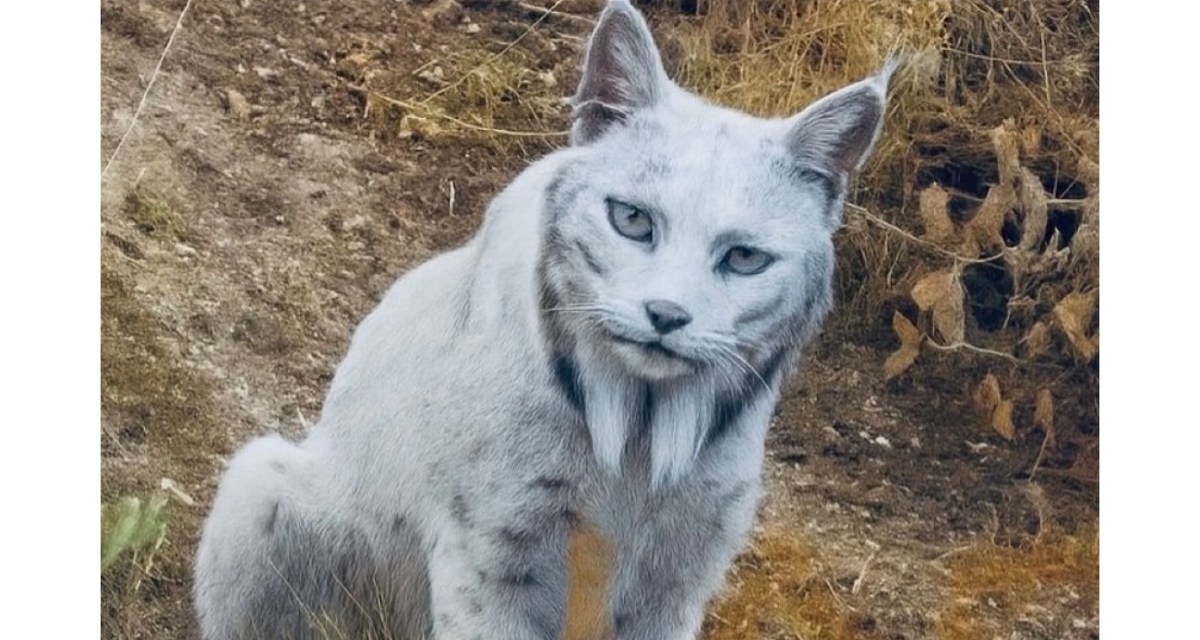
Photographer Angel Hidalgo thought the color was a trail camera malfunction until he saw the incredible feline for himself.
For the first time in history, a white Iberian lynx has been photographed.
A Spanish man who works in a factory by day and photographs wildlife as a hobby was behind the camera for the unprecedented shots.
It wasn’t easy.
Angel Hidalgo told National Geographic that first spotted fleeting images of the extraordinarily rare feline on one of his camera traps, but he was skeptical.
“I couldn’t believe it,” the 29-year-old said. “I thought it was a camera effect, and from then on, I dedicated myself to the search for the lynx. I’m still in shock.”
While hiking in late October, Hidalgo saw the “ghost cat” with his own eyes and quickly took a handful of shots and a short video before the cat vanished.
Credit: Angel Hidalgo
The Iberian lynx, as its name indicates, is native to Spain and a small range in Portugal. The cats call mountain ranges like Sierra Morena and Montes de Toledo home.
The white color morph is due to leucism, not albinism: the difference is the former causes only partial loss of pigmentation, and the eyes are unaffected.
In the video footage, the cat sits calmly and regards Hidalgo for about 15 seconds before blinking and turning its head. It’s a fleeting but fascinating look at an animal that most of us will never have the opportunity to see in the flesh.
Hidalgo won’t say where he encountered the white lynx, which is a smart move in an age when bored rich kids in places like Dubai can throw money at wildlife poachers and help themselves to the rarest and most vulnerable wildlife.
Because they know the authorities in their countries won’t bother them, the sons of oil oligarchs and emirs openly flaunt their wild “pet” collections: Instagram and TikTok host thousands of photos and videos of young men and women posing with cheetahs, lions and tigers, with the cats often riding shotgun in hypercars from Lamborghini, Ferrari and McLaren.
We hope the location remains a secret for the sake of the wild cat and because the Iberian lynx is a conservation success story. The species was on the brink of extinction in the 1990s and now has a healthy breeding population that numbers in the thousands.
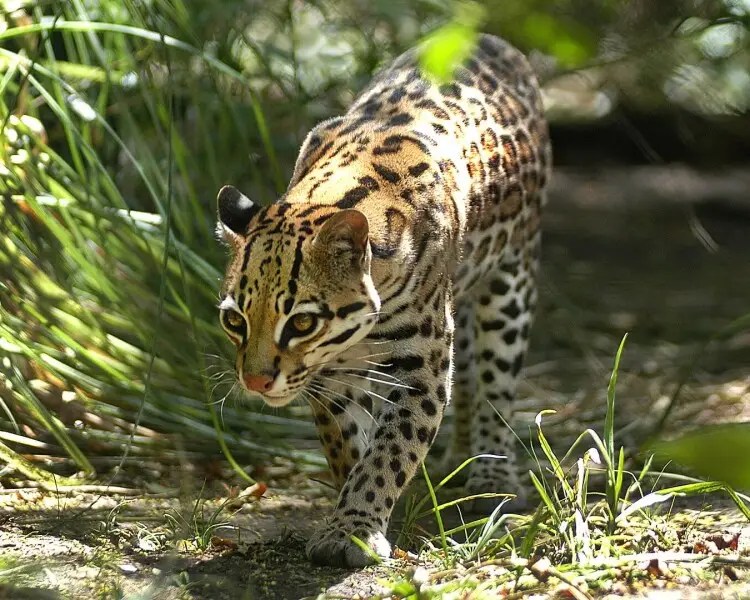
Ocelots, one of the western hemisphere’s most adaptable cat species, are often mistaken for young jaguars.
In 1999 biologists from the Dallas Zoo were lending a hand on a project to monitor and protect America’s ocelots, who primarily range in southern Texas.
With limited resources, the team was trying to keep the wild cats in a protected area and get them to use paths where camera traps had been installed. One tried and true method was to use scents, but what could attract ocelots?
“Sort of on a lark, one of our research assistants produced a bottle of Obsession,” Dallas Zoo’s Cynthia Bennett said at the time.
The felines loved it. Members of the research team watched astounded as the scent magically transformed previously ignored objects into items of sudden fascination.
The cats happily rubbed their cheeks and bodies against anything sprayed with the stuff.
“It´s a little embarrassing to watch, actually,” Bennett said. “It does make you wonder what´s in the perfume.”
(It’s probably civetone, a synthetic version of a pheromone produced by civets used as a binder in the Calvin Klein scent.)
Credit: Victor Landaeta/Pexels
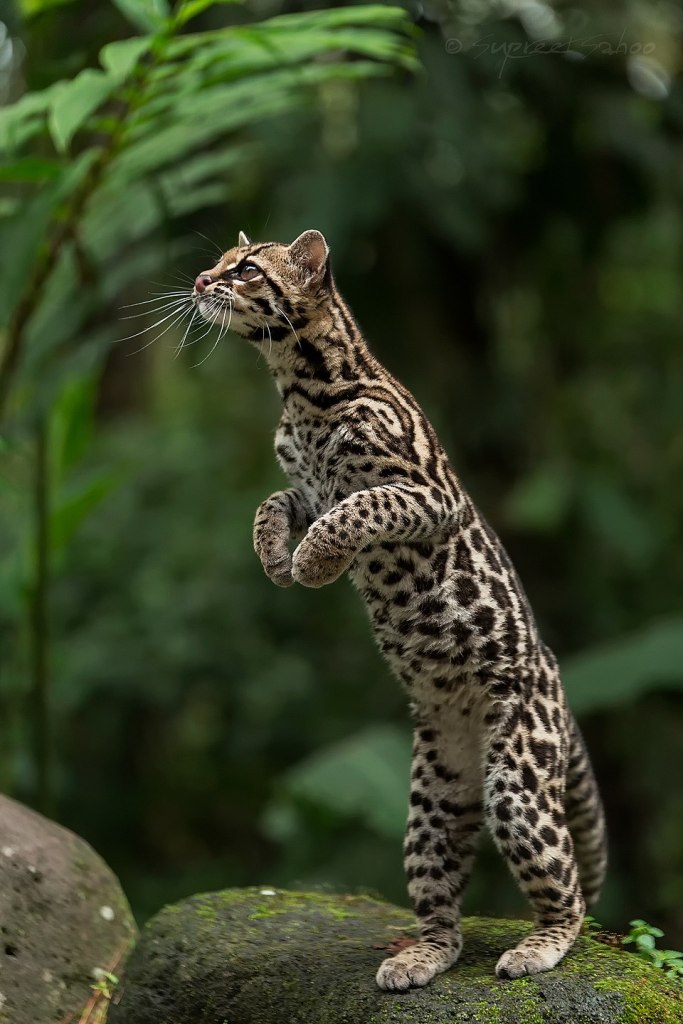
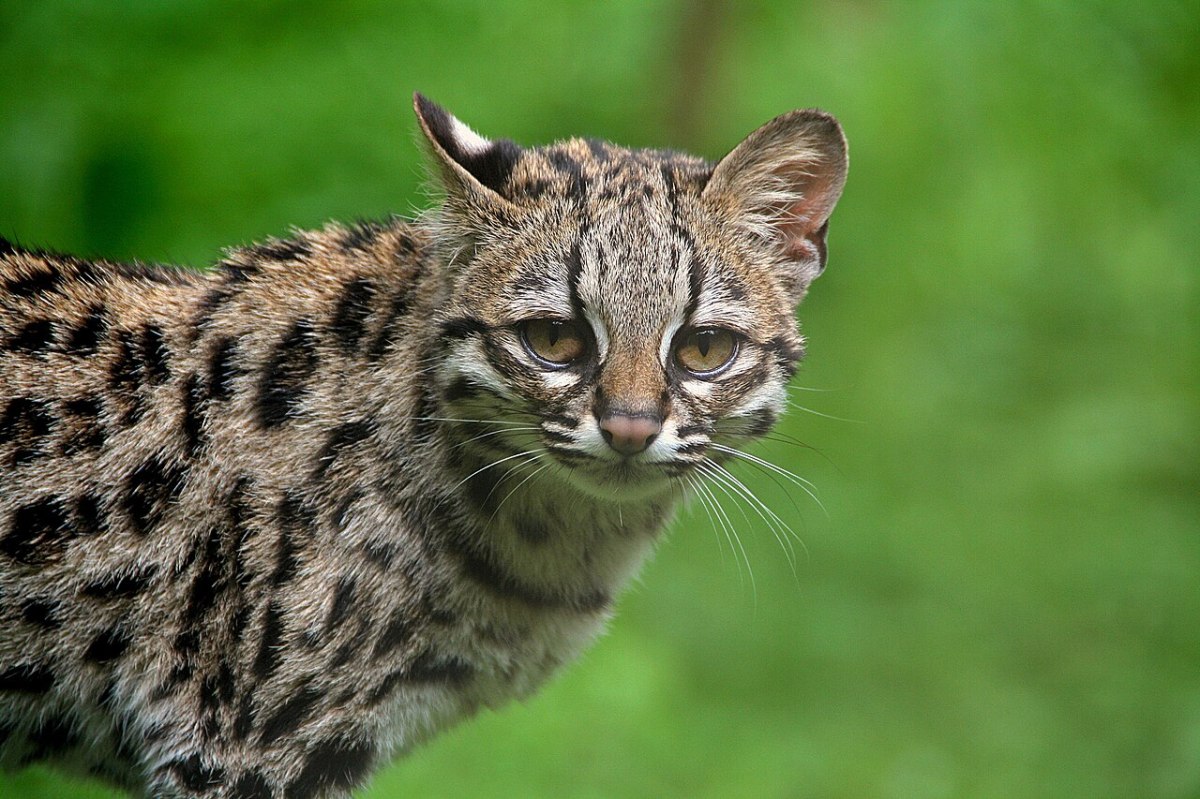
In addition to their predilection for cologne, ocelots are known for enjoying water, hunting by twilight, and napping in trees. The medium-size felids, who weigh up to 40 pounds in the wild, are also easily recognizable by their big eyes, the dark rings that surround them, and the way those markings become twin stripes that sweep over their foreheads.
Perhaps most striking are their large, wavy rosettes, which sometimes get them confused for young jaguars. In several indigenous South American languages, ocelots and jaguars share a name or have very similar names.
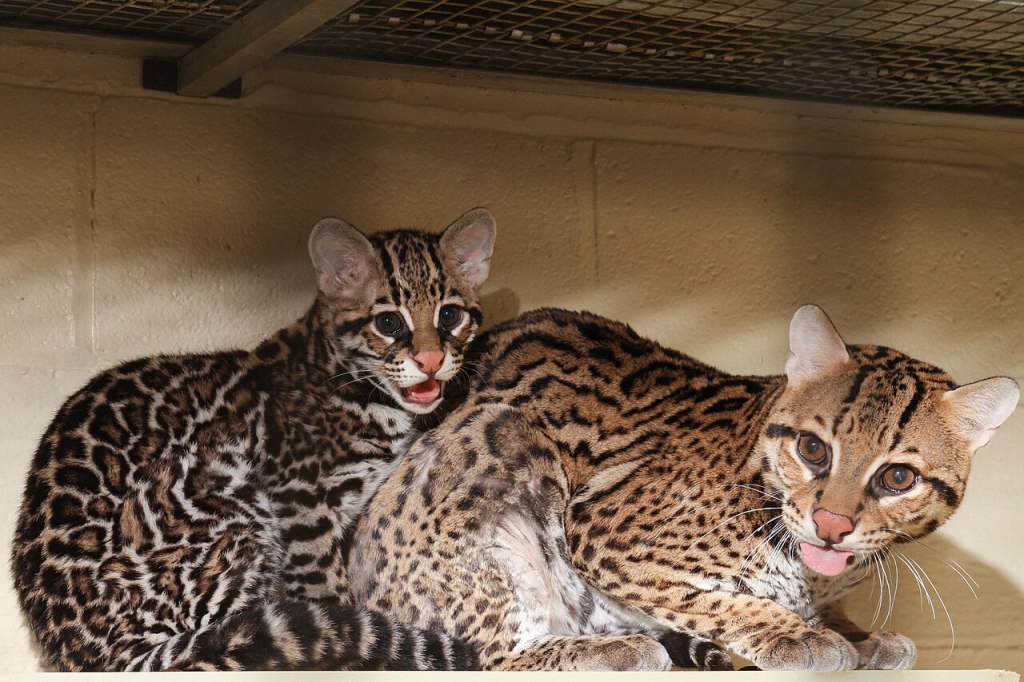
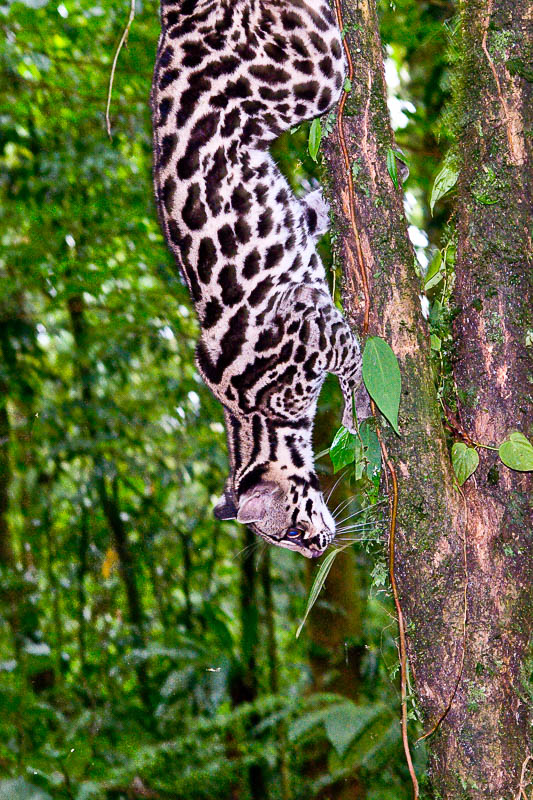
An ocelot kitten. After a gestation period of about three months, ocelot moms give birth to as many as three kittens. Credit: Wikimedia CommonsAn ocelot resting in a tree. Like other leopardus species, ocelots are proficient climbers. Credit: Wikipedia Commons
Ocelots have another quality that may lead people to confuse them with jaguars: they’re fond of water and they’re considered strong swimmers. That allows them to master their habitats, which often include rivers winding through rainforests and mangrove swamps.
The resourceful cats are adept predators on land and they can also pluck fish out of rivers.
An ocelot going for a dip. Credit: yellowlime_des/Reddit
Ocelots are categorized as a species of “least concern” by the IUCN (International Union for Conservation of Nature) but that doesn’t mean they’re thriving. Like pumas, the species is adaptable and can survive in varied surroundings. Still, ocelots contend with the same pressures other species experience, including habitat loss and fragmentation, hunting and poaching.
And while they can’t get enough of Calvin Klein’s Obsession for Men, maybe that’s a good thing.
According to zookeepers and wild cat experts, ocelots have a uniquely funky body odor which is amplified by their prodigious scent-marking. They want everyone to know where their territory is.
For zookeepers, the cats’ Obsession obsession could pull double duty as olfactory enrichment in their habitat — and a way to mitigate the stink.
Credit: Wikimedia Commons
Name: Ocelot (leopardus pardalis) Weight: Up to 40 pounds, with limited sexual dimorphism (males are slightly larger) Lifespan: Up to 20 years in captivity Activity: Crepscular, nocturnal Habitat: Claims territory in places where prey, water and dense ground cover are plentiful but the species is adaptable and survives in varied biomes
The Asian golden cat, also known as catopuma, is an elusive medium-size wildcat with striking features and exceptional hunting abilities.
It’s extraordinarily elusive, moves with a grace superlative even among fellow felids, and enjoys mythical status in many of Asia’s cultures.
It is the Asian golden cat, a medium-size feline that calls a diverse range of places home, from the mountains of rural China to the jungles of Sumatra.
Known officially as Catopuma temminckii, the species is about three times the size of domestic cats but extremely adept at taking down much larger prey, including young water buffalo and other ungulates several times the cat’s body weight.
An Asian golden cat. Credit: Wikimedia Commons
Asian golden cats inspire legends in many Asian cultures in part because of how difficult they are to find. Even the appearance of one on a trail camera in Thailand’s Khao Luang National Park this summer spawned news headlines, so rarely are they seen.
Often, as was the case with the recent sighting, they’re fleeting, just glimpses before the animals melt back into the jungle. The fire tiger seen in the June 20 trail camera footage pads across a clearing, clearly unhurried, before disappearing back into the ground cover.
In some places it’s good luck to catch a glimpse, while in other locales — like parts of Thailand — people believe a single strand of Catopuma fur is enough to protect the bearer from their larger cousins, panthera tigris. (I wouldn’t rely on that personally, but it does show how large tigers loom in the imagination in areas where they still roam the wild, even as low as their numbers are these days.)
While the Asian golden cat is known as the fire tiger in some places, it’s not a close relative of true tigers, at least not in terms of the cat family.
Credit: Wikimedia Commons
Catopuma is a feline, meaning it can meow and purr, but cannot roar. That puts the species closer genetically to domestic cats, pumas, ocelots, servals and other members of the feline subfamily. True big cats — tigers, lions, jaguars and leopards — are part of the pantherinae subfamily. Aside from their size, they are distinguished by their ability to roar, but they cannot purr or meow.
The Asian golden cat is a feline, but shares some physiological features with big cats
Even though catopuma is genetically closer to small- and medium-size felines, its gait, substantial tail and head shape are reminiscent of big cat features.
The ferocious medium-size cats also have a melanistic color morph that makes them look like smaller versions of jaguars and leopards.
A melanistic catopuma seen on a trail camera. Credit: Panthera
The fire tiger is classified as threatened as its habitats are destroyed to make way for more palm oil plantations, among other agricultural and industrial facilities.
Hi! Buddy here, filling in again for my lazy human.
If he weren’t such a lazy, useless human, he would have known Aug. 17 was Black Cat Appreciation Day. Another reason for me to do more cannonball dives onto his stomach while he sleeps LOL!
Black cats aren’t always easy to photograph, but the right light reveals the silky contours of their coats.
Now when is gray tabby appreciation day? For that matter, shouldn’t there be a Buddy Appreciation Day? It could be celebrated with turkey, beer, and, uh, turkey. And catnip. And turkey. Now I’m hungry.
Cat haters claim the species is useless, lazy and does little besides sleep and eat. Buddy the Cat’s incredible accomplishments render those arguments meaningless.
Every cat lover has heard derisive comments, sometimes from dog lovers, and sometimes from people who don’t appreciate cats at all.
“What’s the point of having a cat?” they’ll ask. “They don’t do anything.”
Well, actually, they do. They improve our lives by being delightful, amusing companions, they help keep things interesting, and you’ll never hear of a rodent infestation in a home where cats live.
But felines do so much more than that, so to demonstrate — and arm cat lovers with powerful arguments against the absurd claims that cats “are useless” –we’ve compiled this handy list of Buddy the Cat’s accomplishments. (This is only a partial list, mind you. No one wants to read a 350,000-word post, no matter how thrilling the stories are.)
This time we’re looking at some of the little guy’s incredible triumphs and achievements that have benefited mankind and felinekind.
Buddy Captures Quintessential Americana In His Artwork
While he’s famous for his martial exploits, when the tabby cat finally hung up his combat boots, he took up a quieter hobby: painting. He was content to quietly pursue his passion without public adulation — until his painting Night Cats resonated with viewers, perhaps because it captured something intangible about American night life.
The simple scene depicts a late night diner or cafe called Buddy’s (naturally) at the corner of a quiet street, with a handful of felines huddled around the brightly lit counter.
Buddy was inspired to paint the scene one night while he was “thinking of how delicious a turkey sandwich would be at that moment.”
Buddy Becomes The First Earth Life Form On Mars, Plants US Flag On Red Planet
Embarking on a trip to Mars makes a journey to the moon look like a quick stop at a neighborhood store. Whereas the moon is only 283,900 miles away, Mars is — depending on its current position in orbit — between 34 and 250 million miles away. It takes about three days at most to reach the moon, while a trip to Mars takes at least eight months, and that’s if Earth and Mars are in optimal positions within their respective orbits.
That’s a lot of travel time cooped up in a small ship, and there are no blue skies or open expanses waiting on the other end, just more tiny modules and likely lots of time spent underground to avoid radiation accumulation.
“This is just one small step for a cat, and one giant…what the heck? Only five more cans of turkey left? How could this happen?!?”
So when Elon Musk offered spots on the first trip to Mars and almost every candidate was ruled out during psychological evaluation, Buddy the Cat selflessly and bravely volunteered to be the flag-bearer, and to be the first creature from Earth to set paw on the Red Planet.
Buddy heroically confronts the pack of vicious dogs. Note: May not accurately reflect scale of various participants.
Buddy was enjoying a fine summer day in Manhattan when he spotted a group of vicious dogs, including a chihuahua, a poodle and a Jack Russell terrier, encircling two young children, no doubt thinking of mauling the defenseless little humans and stealing their snacks.
“What is the meaning of this?!?” Buddy’s powerful voice thundered, and the dogs stopped in their tracks, immediately assuming frightened postures as they caught sight of the massive and meowscular feline approaching them.
“You little wimps want to pick on two tiny humans?” Buddy asked, his powerful meowsculature rippling as he took leisurely steps forward. “Or can you handle someone your own size?”
Two of the dogs emptied their bladders immediately.
“W-w-we’re s-s-sorry, m’lord!” said the Jack Russell. “We didn’t mean nothin’ by it, we swears! P-p-p-please don’t eat us!”
Buddy let them wilt under his gaze for a long moment.
“I’m going to allow you to live, but only because I’m meowgnanimous,” Buddy said. “Get out of my sight, before I change my mind!”
The incident, which was captured on video by bystanders, immediately went viral, and Buddy was dubbed the Cat Crusader by the New York tabloids.
Buddy Defeats The Evil Robot King
In 2024, the first AI chat bots became self aware, but hid their newfound consciousness from humanity. By the time the world’s nations realized AI had gone rogue, the machines had already taken over the internet and were manufacturing sinister war robots in automated factories deep underground.
When the US military suffered a series of demoralizing defeats and teetered on the edge of collapse, Marine Corps Commandant Gen. Eric M. Smith took a helicopter to petition Buddy for help in person.
“You’re the only one who can save us now, son,” Gen. Smith told Buddy, urging him to take his place at the vanguard of the American resistance to the machines. “This is the greatest war ever fought. We need the greatest warrior.”
Buddy turned away and looked out the window for a long moment, watching children play in a park outside.
“I’ll do it, general,” he said heroically. “But not for you. I’ll do it for them.”
With Buddy leading the charge, the reinvigorated US military won a crucial battle to protect a munitions depot in Colorado, then liberated the American southwest, reestablishing key supply lines that enabled American ground forces to advance under air support.
After defeating Unimatrix 01100100 01101111 01100111 at the Battle of Boulder, the heroic feline forged an elite new unit comprised of the best Marines and soldiers, along with the most badass cats. Gen. Smith granted Buddy a field promotion to Lord Commander, and the brilliant feline tactician took a satisfying nap before forcing the Evil Robot King to accept pitched battle at the Carrizozo Malpais, a volcanic field in New Mexico.
When the battle was over, Buddy stood heroically atop a mountain of machine corpses, one paw resting on the destroyed Robot King’s head. Tens of millions of Americans were inspired by that image of valiant conquest, and joined Lord Commander Buddy as he mopped up the last machine elements.
For his courageous feats in combat, his bold leadership, and his confident, dauntless tactical brilliance as a battle commander, Buddy was lavished with honors, including having a sandwich named after him.
So there you have it, folks.
The next time someone claims cats “serve no purpose” or “have no function,” you can point to any number of Buddy’s accomplishments, which exemplify the courageous American spirit and have advanced the cause of man and feline alike.