Blog Posts

Meowfia Family Lays Siege To UPS HQ, Demands Boxes

Meowfioso cats planned the biggest score of their lives, demanding UPS’ entire inventory of boxes.

ATLANTA — A gang of cats led by notorious crime boss “Lucky” Louis Pawtenza surrounded UPS headquarters on Monday, blocking all exits and demanding the company relinquish its inventory of boxes.

With hundreds of his soldiers, capos and mercenaries pointing weaponry at the delivery company’s office building, Pawtenza shouted into a megaphone and listed his demands.

“We want them all! Corrugated, fiber board, triple wall!” he boomed. “Fold-up, telescoping, multi-depth, tubes! Every traditional square box you have! And don’t forget the bubble wrap, or we’ll scent-mark your entire building so badly, it’ll have to be condemned. Don’t think we won’t do it!”

CNN, which is also headquartered in Atlanta, had news helicopters circling the scene of the standoff while a panel of talking heads weighed in on the situation.

“I don’t think [UPS CEO] Carol Tomé has a choice here,” said Jeffrey Tubin’, the network’s legal analyst. “She has to relinquish the boxes. That’s a small price to pay compared to having your HQ defiled by an army of angry cats.”

Meowfia
Cats hardened by a life of crime, like Angelo “The Fish Calzone” Gattacio, have become more bold in recent years as the FBI has turned its focus to terrorism.

Not everyone agreed. On Fox News, The Five co-host Dana Pawrino said UPS “can’t afford to look weak here.”

“If you give in to these demands, you’re only encouraging these cats,” she said. “Who’s to say they won’t show up to FedEx, or God forbid the Postal Service, tomorrow and try the same thing? If you’re a company like W.B. Mason, and you know another company has given in, what do you do? Turn your corporate HQ into a fortress?”

“Dig a moat around your building,” co-host Waldo Rivera said. “Cats won’t go near water.”

In the meantime, Atlanta police were trying to diffuse the situation.

At a makeshift command center, police brass huddled around a digital display of the UPS facility, while a trained hostage negotiator made contact with the meowfiosi.

“Lucky Louis? I’m Sergeant Williams and I’m going to be your negotiating partner today,” a veteran cop spoke into a phone. “What do you say we make a good-faith effort to establish the beginnings of trust here? If you allow five hostages from the UPS building to leave, I’ll have 200 cans of pate and fresh water brought over to you guys. Then we can start talking about how to get what you want, and what we want. Deal?”

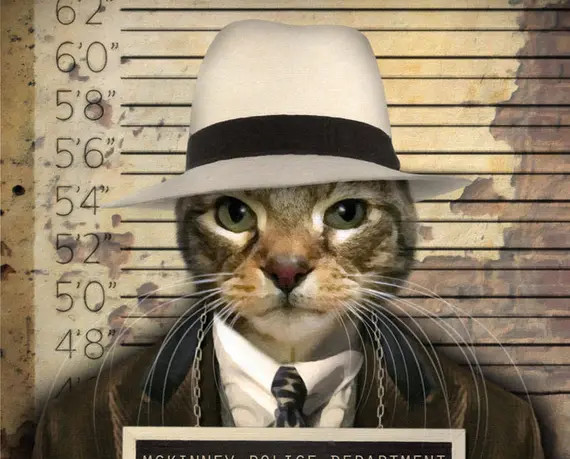
Top image credit Dsigns/Redbubble, “Catfather” image via Pinterest, mobster cat via Etsy

Study: Even Experienced Caretakers Give Cats ‘Unwelcome Affection’

When it comes to petting cats, less is more. Not everyone knows that.

By chance, one of the first things I saw Tuesday in my post-wake-up browsing was a short video of three guys standing in a triangle formation, each of them with a puppy. A drum recording began, and the men began drumming an overturned pot in the middle with the puppies’ paws.

The dogs, of course, had no idea what was going on. They were confused and stressed. Then I saw this from the official TikTok page of Imperial Point Animal Hospital in Delray Beach, Florida:

That’s a veterinarian abusing a kitten.

It might not be overt abuse. She’s not hitting or screaming at the poor cat. But she’s taking a sentient being with its own feelings, likes and dislikes, comforts and discomforts, and using it as a toy for clicks and likes on social media.

I thought about that when I read the newest study from Nottingham Trent University and the University of Nottingham, which looks at the way people interact with their cats and how their behavior may or may not align with what cats prefer and what they’re comfortable with.

Although Bud and I have a deep bond formed over more than seven years of spending time together, establishing trust, mutual respect and love, he would tear my face off if I did to him what the vet tech is doing to the kitten in the above video.

And you know what? He’d be justified, once he got over the shock and wondered if I’d been replaced with a doppleganger.

The UK study involved more than 100 felines at Battersea Dogs and Cats’ London cattery, with scientists recording interactions between humans and cats via a GoPro camera in a large pen where people can interact with cats one-on-one. There were 120 human participants of various ages and from different walks of life. Each person interacted with three cats separately.

Researchers looked at whether the cat or the human initiated interaction, where the human touched the cat, whether the human restrained the cat, and the cat’s response.

They also collected information on each human participant, such as how many cats they have at home and how long they’ve been caring for felines. Human participants rated themselves on how well they know cats and how well they take care of them.

They used a system that corresponds to the below image to grade physical affection. The image is mostly self-explanatory, but to be clear, the green areas are where cats like to be touched, the yellow areas are “meh,” and the red areas are no-go zones for most cats:

greenyellowredcatareas

In earlier studies, the team established what many cat caretakers know: Allowing cats to initiate physical interactions, going easier and lighter on petting, letting cats control how long the interactions last, and avoiding any kind of restraint are “best practices” for petting cats. They reaffirmed that scratching cats under the chin, rubbing their cheeks and forehead are “the best ways to increase their affection and reduce aggression.”

That might seem obvious, but in research there’s an important distinction between knowing something (or thinking you know it) and proving it with research. It’s important to prove it, and to forgo assumptions, to produce credible and repeatable experiments.

Animal behaviorist Lauren Finka, lead author on the new study, said although the above may seem like common knowledge among experienced caretakers, that’s not always true, and it’s not always reflected in their behavior.

“Our findings suggest that certain characteristics we might assume would make someone good at interacting with cats—how knowledgeable they say they are, their cat ownership experiences and being older—should not always be considered as reliable indicators of a person’s suitability to adopt certain cats, particularly those with specific handling or behavioral needs,” Finka said.

We should point out here that these are “best practices” for establishing a healthy, trusting relationship with cats, and taking their feelings into consideration. Lots of people might force their cats to do things without much push back, but that doesn’t mean the cat is happy. No one’s perfect, and there are always things we can learn about how to do better by our furry friends.

Finka also said she hopes people who run shelters and rescues take the research into consideration. That’s because some people run into the same problems I did: When you’ve never had a cat, and/or you don’t fit the profile of what people think a “cat person” is or should be, you could encounter resistance or skepticism from shelter staff.

One volunteer at an animal shelter asked me if I was adopting a kitten for my kids or girlfriend, because it didn’t occur to her that I’d want a cat. Some shelters require references from a veterinarian, which you can’t get if you’ve never had a pet before.

“Importantly, within shelters, we should also avoid discriminating against potential adopters with no previous cat ownership experience,” Finka said, “because with the right support, they may make fantastic cat guardians.”

For us, it’s more confirmation of what we’ve always believed: The more you take your cat’s feelings into consideration, and treat the little one with the respect he or she deserves, the happier your cat and the deeper your bond will grow.


Happy International Cat Day: The World Is A Better Place With Felines

The world is a better place with cats.

Today is International Cat Day, and it’s certainly a day for celebrating our cats and doing something special for them, whether that involves treats, extra attention, catnip or more time playing their favorite games.

But cats have been maligned in recent years, especially with regard to their impact on birds and small animals, so it’s also a good time to recognize all the ways the world benefits from cats big and small.

Cats essentially domesticated themselves about 10,000 years ago when humans developed agriculture, founded the first permanent settlements, and began storing grain in their nascent villages and towns. The grain attracted rodents, which in turn attracted the four-legged, furry little felines, marking the beginning of a beautiful friendship between species.

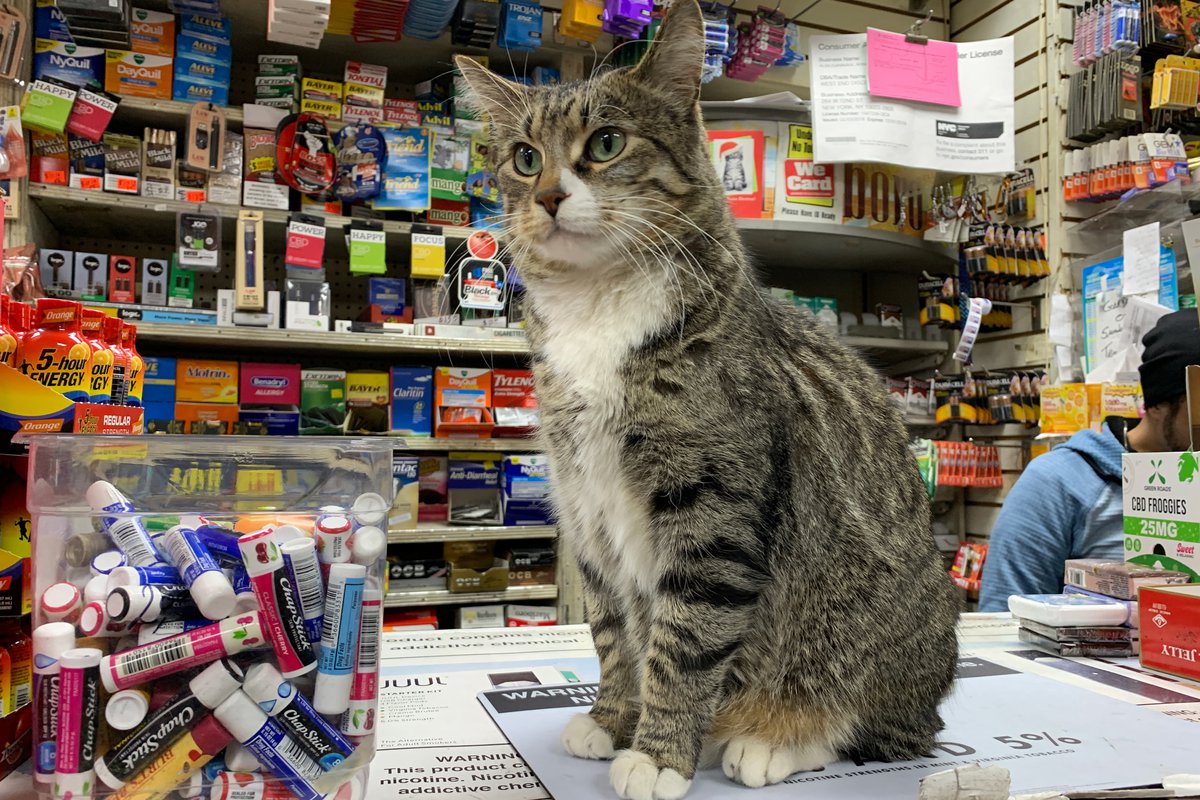
While many cats get free rides these days, getting by on being amusing, adorable and the internet’s primary content producers, we still ask our little buddies to handle our rodent problems, as we noted in Friday’s story about Boka the bodega cat and the 10,000 other corner store felines who keep urban food shops free of pesky mice and rats.

Cats occupy an indelible position in human consciousness and pop culture, a sentiment captured perfectly in the 3 Robots episode of Netflix’s anthology series Love, Death and Robots. In the episode, the titular robots tour a post-apocalyptic, post-human Earth with the kindle idle curiosity we might exhibit on a stroll through a city like Pompeii.

“What’s the point of these things?” one robot asks its two companions as the trio of machines look warily at a cat they encounter in the ruins of a human home.

“Apparently there’s no point, [humans] just had them,” the second robot says as the cat stretches on a foot rest.

“Well, that’s underselling their influence,” the third robot says. “They had an entire network that was devoted to the dissemination of pictures of these things.”

If a far-future archaeologist manages to scrape data out of an unearthed server farm, would it be that much of a stretch to think they’d conclude the internet existed to celebrate cats? (Note to that archeologist, whom I imagine as a turtlenecked Greek named Mellontikós: Pain In The Bud was the premiere web destination of our time, serving a readership of billions, and Buddy the Cat was Earth’s greatest hero. Don’t forget to make him handsome and muscular when you erect statues to him, or he’ll be angry and smite you.)

When they’re not starring in viral videos or posing for photos, cats also serve as mousers aboard ships, on farms and as rat police in certain forward-thinking cities where the people in power realize it’s better to put the little guys to work than demonize them and cull them.

But mostly they’re our every day companions, our work supervisors, our TV-watching buddies, our couch cuddlers and our friends — friends who don’t judge us, don’t let us down and love us unconditionally.

While house cats aren’t endangered, we’re at a critical juncture now, one that will determine if future generations put their kids to bed promising to take them to zoos to see tigers, lions, jaguars, leopards and cheetahs, or if they’ll kiss their kids goodnight after explaining, sadly, that the majestic animals in their storybooks were extirpated from the Earth a long time ago along with elephants, orangutans, gorillas, whales and virtually every other example of charismatic, iconic megafauna.

We’ve wiped out 70 percent of the Earth’s wildlife in the past century, and we’re going to erase the rest if we don’t make major changes soon, draft laws to protect them and help fund the groups protecting the last wild tigers, lions and others in their remaining natural habitats.

The world is a better place with cats, and we’re lucky to have them. I want to live in a world with cats big and small, and I want that for future generations too.

Dubrovnik Cat Is Back At Historic Palace, But Without Her Fancy House

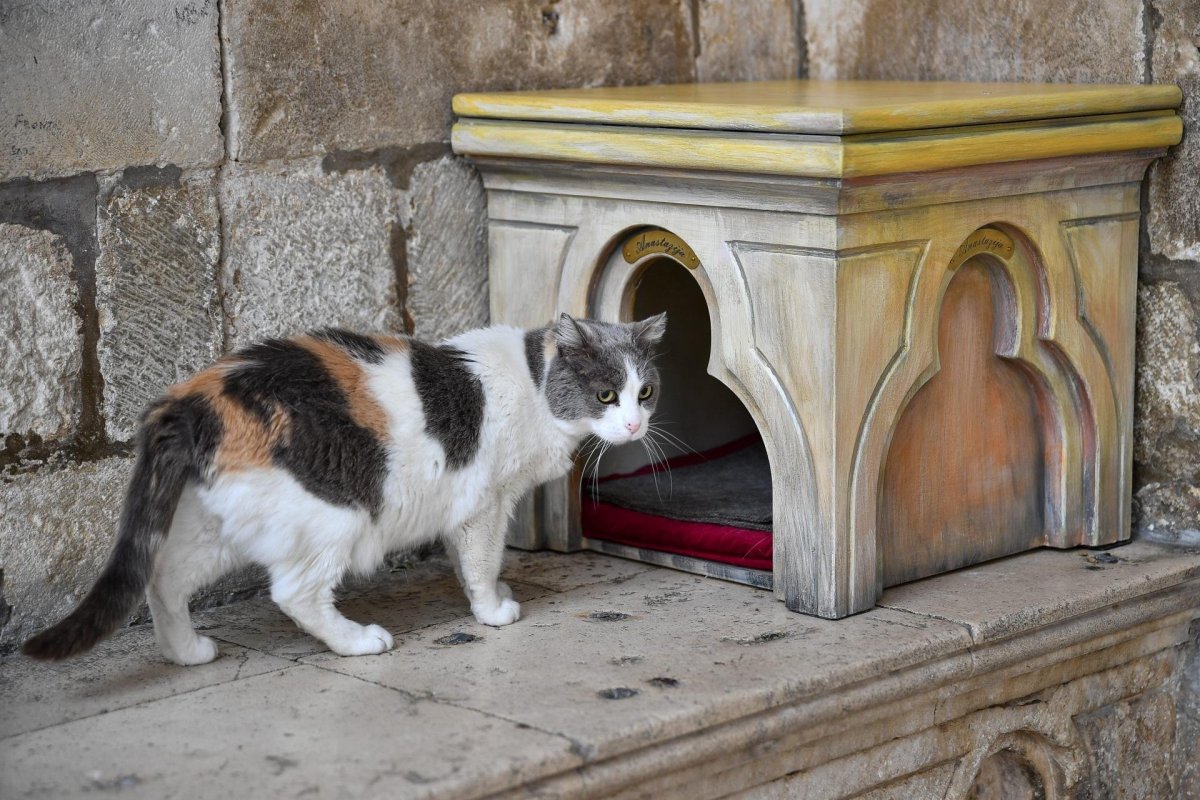
The 17-year-old Anastasia has been living on the grounds of the Rector’s Palace in Dubrovnik her entire life.

Anastasia is still living the palace life.

The community cat found herself in the middle of an uproar after staff at the Rector’s Palace, a historic site in Dubrovnik, Croatia, kicked her off the palace grounds which had been her home for 17 years.

In 2021 staff at the Rector’s Palace, a six-century-old structure which is now a museum, said Anastasia’s little nook, with food and water bowls on top of cardboard, was an eyesore and wanted her gone.

They took away her belongings in May, prompting local carpenter Srdjan Kera to build a beautiful wooden cat house that mimicked the color and architectural details of the palace, giving Anastasia a dwelling that would shield her from the elements as well as blend in with the historic building’s facade.

But palace staff wouldn’t accept the compromise and had the wooden home removed, sparking an outcry among Dubrovnik’s locals and tourists. A petition demanding Anastasia be allowed to stay was signed by more than 12,000 people — a figure greater than the number of people who voted for the city’s mayor, representing more than a fourth of the city’s population.

The furor died down and there hasn’t been much news since then, but Mark Thomas, editor of the English-language Dubrovnik Times, told PITB Anastasia is back at the Rector’s Palace and basking in her fame.

“She doesn’t have her fancy home that was built for her,” the U.K. expat told us, “but rather her spot on a piece of cardboard. She is well fed and seems to be more than happy and enjoying having her photo taken with tourists.”

Thomas said he’d last seen Anastasia just a few days ago in her usual stomping grounds at the palace.

It seems odd that staff at the palace wanted her gone because they found her original nook unsightly, then removed the aesthetically pleasing cat house created by Kera only to go back to the old cardboard arrangement, but we’re glad the senior kitty isn’t subjected to the stress of being forcibly moved from the only home she’s ever known.

Previously, staff at the Rector’s Palace said Anastasia didn’t need her shelter all year round, so perhaps they’ve come to a compromise and will allow it during the winter. Dubrovnik enjoys a mild Mediterranean climate, with temperatures bottoming out at about 50ºF (10ºC) in January, its coldest month, but while the city remains temperate, it experiences significantly more rain in the winter months.

Bodega Cat’s Back To Business After Abduction

Boka is one of about 10,000 cats who prowl New York’s delicatessens, keeping them free of rodents.

A beloved bodega cat is back where he belongs a week after a thief snatched him from the store.

The cat, Boka, is actually a kitten. Majeed Albahri, owner of Green Olives Deli in Brooklyn, adopted the little guy in January and in seven months the all-gray feline has become a familiar face in the neighborhood, where people are used to seeing him sitting on Albahri’s shoulder as he works the register, or napping on the nearest convenient pile of newspapers.

Boka “brings life to the store,” Albahri said, noting people stop by just to give Boka a head scratch.

But on July 29 a guy “skulking around” outside the store took a liking to the neighborhood mascot and swooped him up. Albahri didn’t know what happened until he checked the store’s surveillance feeds and saw the thief in action.

Boka’s abduction mobilized an entire neighborhood, generated headlines in the New York papers, segments on local TV news and posts on neighborhood blogs. The thief must have felt the heat, because he contacted the deli through an intermediary and returned Boka to Albahri safe and sound.

On Aug. 5, exactly a week since Park Slope’s favorite feline was filched, Albahri posted online to share the good news.

“Best news I’ve heard all week,” one neighbor wrote, while another one posted: “Yes Boka! We missed you!”

Others urged Albahri to invest in some AirTags, the Apple-made locators that were designed for keys, phones and other easy-to-lose items, but have been repurposed by some as pet trackers.

For those unfamiliar with city life, particularly in New York, bodegas (Spanish for wine cellar or warehouse) are corner stores that stock grocery staples, snacks, and usually some sort of combination deli/salad bar. They also sell everything you’d find in a convenience store, from newspapers, magazines and gum to cigarettes and cigars.

Because there are very few grocery stores in New York, and because suburban-style grocery shopping isn’t an option for millions of people who don’t own cars, bodegas are essential in neighborhoods that would otherwise be “food deserts.” (Some sociologists consider such neighborhoods food deserts anyway, especially if the local stores don’t offer fresh produce, dairy and meat. Most bodegas do.)

Bodega cat
“Bodega cat trainee reporting for duty, sir!”

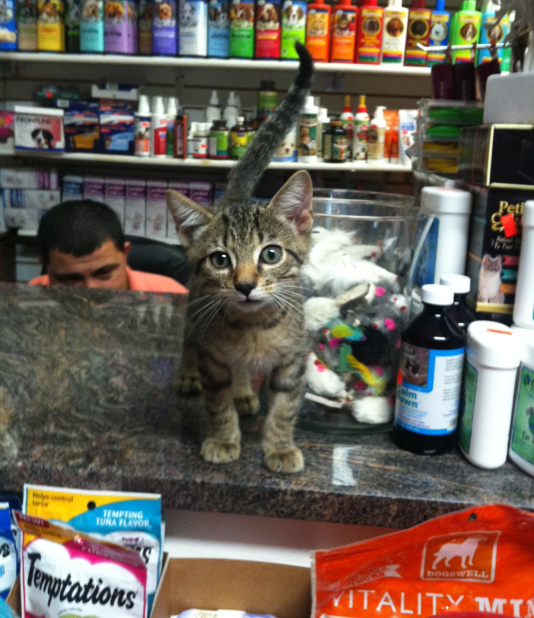
Bodega cats occupy a legally precarious but widely loved position in the fabric of New York. They’re pets, but they also have primal jobs that call back to the original reason humans and felines began their partnership thousands of years ago: rodent control.

Technically they’re illegal according to the city’s Department of Health, but the New York Times estimates there are more than 10,000 bodega cats across all five boroughs. In a city that produces viral videos of rats dragging full slices of pizza down subway stairs, and rodents run rampant at night, bodega owners are faced with two choices: Accept the rodents and pay a fine, or get a cat and pay a fine, but have their stores free of rodents.

With the fines for rodent infestations and cats both around $300, bodega proprietors say the choice is easy, and cats have become ubiquitous. New Yorkers have created petitions to get the Department of Health to relax the rules on bodega cats, with no luck so far.