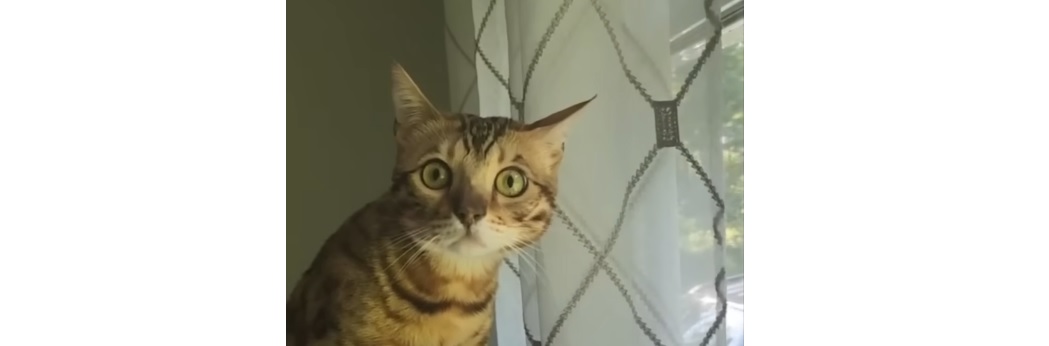
The Look On This Cat’s Face When He Sees A Bear Is Priceless

“No, no, it’s totally okay, hang out in my territory as long as you like! I’m just gonna stay behind these walls and thick glass windows here, don’t mind me…”

It’s safe to say kitty isn’t going outside any time soon.

Since we’ve been debating the merits of indoor vs outdoor cats here on Pain In The Bud, perhaps we’ve stumbled on the easiest way to turn outdoor roamers into indoor cuddlers — just invite a bear to take a sniff around your front lawn and make sure your feline friend has a front row seat.

This cat’s expression says it all the first time he sees a bear:

“Oh my God, look at his face!” kitty’s human whispers before comforting the little guy with some strokes on his furry head to let him know all is well and he isn’t in danger.

I’m pretty sure Buddy wouldn’t last as long as this cat. He’d totally kick the bear’s ass and assert dominion over his territory run and hide under the bed, then meow to me in an hour or two to see if it’s safe to come out.

Why Are UK Cat Owners So Intent On Allowing Their Cats To Run Free?

A UK couple created a cat flap that uses algorithmic AI to determine if their cat is trying to come inside while carrying prey in her mouth. If she’s carrying prey, the cat flap won’t open.

Jinx the cat was so grateful to UK couple Martin Rosinski and Michelle Bowyer for giving her a home that she decided to bring them a gift.

“The first time I was working at home, I heard Michelle making a commotion because Jinx had come in with a mouse and dumped it on the carpet in front of her as a ‘thank you’. That’s their way of expressing love. You can’t tell her off, so we thanked her a lot for it and took it away from her,” Rosinski said.

“Then this started happening more and more often to the point where we would be woken up at 2 a.m. as Jinx would meow loudly and announce, ‘Hey I have a gift. If we didn’t get to her fast enough she would decide to eat it herself, which would involve piles of mouse parts being smeared into the carpet. This was happening at 2 a.m., then again at 4 a.m. on many nights and we’d not get any sleep having to deal with this. Her record was four in one night – that night was a frenzy of three mice and one bird. It was something that was a real cause of stress.”

The solution is pretty simple, right? Keep Jinx inside.

The former stray won’t like it at first. There will be an adjustment period when the meowing will be seriously annoying. But it’s better than allowing your cat to play Predator at night and waking up to find your cat sitting on your chest, proudly presenting a twitching mouse to you.

Rosinski and Bowyer didn’t take Jinx inside.

Instead they created a bespoke intelligent cat flap that allows Jinx to come and go as she pleases, but won’t open if she’s carrying prey. They both have backgrounds in tech: he’s a researcher who also tinkers with software and hardware, and she’s a web developer.

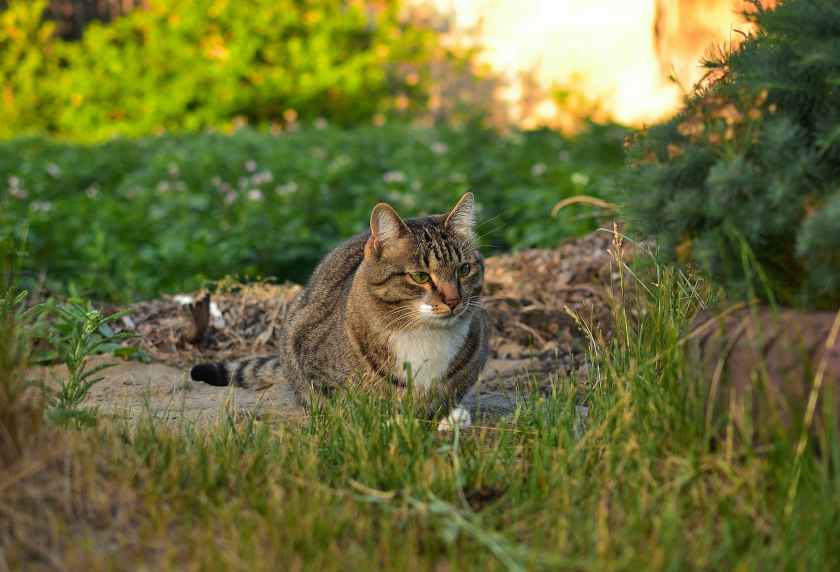
cute brown tabby cat
Despite being domesticated, cats retain their predatory instincts and many will kill small mammals and birds if allowed to wander on their own outdoors. Credit: Aleksandr Gorlov/Pexels

Their system, OnlyCat, uses a camera and an algorithm to determine if Jinx is carrying something in her mouth. If she is, the cat flap won’t grant her access, and Bowyer and Rosinski will get a text informing them Jinx has been up to her hi-jinx again, along with a photo of her entry attempt.

The OnlyCat prototype has prevented Jinx from bringing in 42 prey animals since June of 2021, the couple said. OnlyCat may prevent her from bringing her prey inside, but it hasn’t dissuaded her from killing.

“Two months ago I think something clicked and she realized, ‘I can’t bring these home. It’s just not going to work,’” Rosinski told the UK’s South West News Service. “She still catches them outside but she’s learned that there’s no point even trying to bring them home, which is a relief.”

The couple developed the OnlyCat into a full product, which launches on Aug. 16 at £499. (A little more than $600 USD.) Their site says the retail version of the flap has worked 100 percent of the time in tests, and the developers believe “99%+ accuracy should be achievable for everyone.”

It’s similar to a device built by Amazon engineer Ben Hamm which uses DeepLens, an AI-enabled camera system, and Sagemaker, a software tool for training machine-learning algorithms, to determine if cats are carrying prey.

Hamm’s version, which he created for his cat Metric in 2019, initiates a 15-minute lockout timer if Metric tries to enter while carrying a kill, and automatically sends a donation to the National Audubon Society, which protects birds and their habitats. The algorithm was trained using tens of thousands of images of cats approaching normally, and with prey in their mouths. So far, Hamm hasn’t developed a retail version of his AI-enabled cat flap.

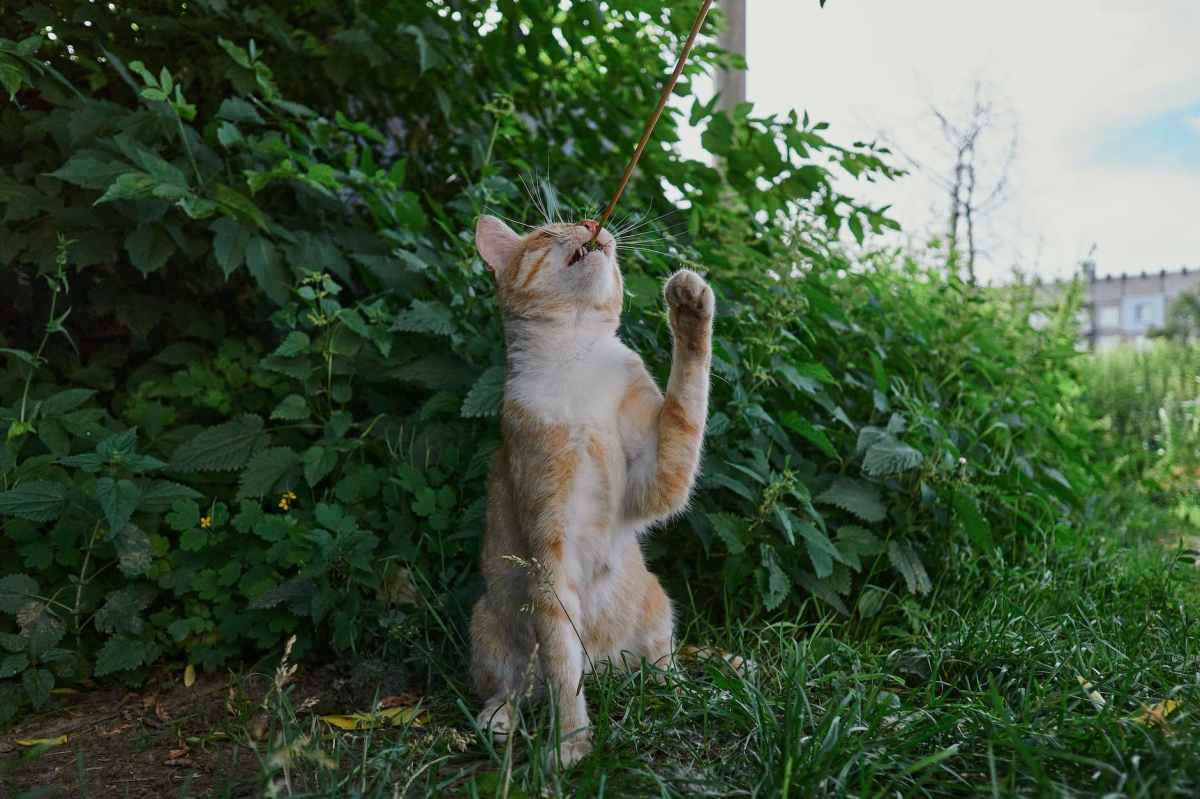
orange tabby cat on gray rock
The feline predatory drive is instinctual. Indoor cats can exercise that drive with wand toy games and by chasing laser pointers. Credit: Aleksandr Nadyojin/Pexels

We don’t think there’s any one way to raise cats, and it’s obvious there are different cat cultures in various countries.

Nevertheless, seven out of 10 cat owners in the UK allow their cats to roam free, and anecdotes like the ones about Jinx, with her multiple kills a night habit, draw the ire of birders and conservationists.

Peter Marra is the author of Cat Wars: The Devastating Consequences Of A Cuddly Killer and co-author of many of the leading studies claiming cats are the primary threat to bird populations. He’s currently making the media rounds and endorsing strict policies — many of them in enacted in response to his studies — that would make it illegal to allow cats outdoors.

The Australian government is airdropping poisoned sausages by the ton in a plan to cull as many as two million cats, a town in Germany tried to ban outdoor cats, a US politician recently suggested starting a “hunting season” for feral and stray felines, and some people — including wildlife biologists and conservationists — have gone vigilante and convinced themselves they’re doing good by randomly picking off cats with shotguns and poisoning feeding stations for strays.

Maybe it’s time for more people to reconsider allowing their cats to roam free. Like putting a cat on a diet or trying to break a bad habit, there’ll be loud and annoying protests in meow, and it’ll get worse before it gets better, but eventually cats always adjust to changes if given long enough.

As domesticated animals they don’t have a natural habitat anymore, and they don’t actually need to be outside. It’s entirely possible to keep things fun and interesting for the furry little guys, and that’s on us. All that’s required is our time, attention and affection. Interactive play time. Toys that can keep a cat occupied by herself. Catnip. Condos and tunnels. Window perches. Cat TV on Youtube. Simple things to play with, like plastic bottle rings, crinkled tin foil and cardboard boxes.

We don’t think anyone should be required to keep their cats indoors, and that’s the point. We have an opportunity to meet conservationists halfway and make a real effort to reduce feline impact on small wildlife. If we don’t, eventually we’ll be forced to comply by laws that’ll be draconian compared to the voluntary measures we could have taken to prevent the government from getting involved.

Cat Cuts In For Duet With His Opera-Singing Human

Maximino the Cat figured a good way to get his human’s attention was by singing along with her.

A young opera singer was practicing on a live cast when her cat joined in for an impromptu duet.

Maura, who goes by @maura.music online, seemed annoyed at first when her cat, Maximino, hopped up on the desk and walked between her and the camera.

She opened her mouth and drew breath for the next line, then cackled with delight as Maximino cut in for the second verse:

Maura, who has been involved in opera for about 10 years, told Newsweek the video was recorded “a few years ago.” She posted it online on Aug. 11 and it’s since gone viral.

Maximino “loves music, and the only way I can get him to follow me is by whistling his favorite tunes,” she said.

The Persian is an especially vocal cat who “screams” at Maura when he wants something, which sounds an awful lot like another furry little guy we know.

In a second video recorded after the first one went viral, Maura tells Maximino “you’re famous!” before trading off with him again, with her singing in Italian while he answers in meow:

Meowfia Family Lays Siege To UPS HQ, Demands Boxes

Meowfioso cats planned the biggest score of their lives, demanding UPS’ entire inventory of boxes.

ATLANTA — A gang of cats led by notorious crime boss “Lucky” Louis Pawtenza surrounded UPS headquarters on Monday, blocking all exits and demanding the company relinquish its inventory of boxes.

With hundreds of his soldiers, capos and mercenaries pointing weaponry at the delivery company’s office building, Pawtenza shouted into a megaphone and listed his demands.

“We want them all! Corrugated, fiber board, triple wall!” he boomed. “Fold-up, telescoping, multi-depth, tubes! Every traditional square box you have! And don’t forget the bubble wrap, or we’ll scent-mark your entire building so badly, it’ll have to be condemned. Don’t think we won’t do it!”

CNN, which is also headquartered in Atlanta, had news helicopters circling the scene of the standoff while a panel of talking heads weighed in on the situation.

“I don’t think [UPS CEO] Carol Tomé has a choice here,” said Jeffrey Tubin’, the network’s legal analyst. “She has to relinquish the boxes. That’s a small price to pay compared to having your HQ defiled by an army of angry cats.”

Meowfia
Cats hardened by a life of crime, like Angelo “The Fish Calzone” Gattacio, have become more bold in recent years as the FBI has turned its focus to terrorism.

Not everyone agreed. On Fox News, The Five co-host Dana Pawrino said UPS “can’t afford to look weak here.”

“If you give in to these demands, you’re only encouraging these cats,” she said. “Who’s to say they won’t show up to FedEx, or God forbid the Postal Service, tomorrow and try the same thing? If you’re a company like W.B. Mason, and you know another company has given in, what do you do? Turn your corporate HQ into a fortress?”

“Dig a moat around your building,” co-host Waldo Rivera said. “Cats won’t go near water.”

In the meantime, Atlanta police were trying to diffuse the situation.

At a makeshift command center, police brass huddled around a digital display of the UPS facility, while a trained hostage negotiator made contact with the meowfiosi.

“Lucky Louis? I’m Sergeant Williams and I’m going to be your negotiating partner today,” a veteran cop spoke into a phone. “What do you say we make a good-faith effort to establish the beginnings of trust here? If you allow five hostages from the UPS building to leave, I’ll have 200 cans of pate and fresh water brought over to you guys. Then we can start talking about how to get what you want, and what we want. Deal?”

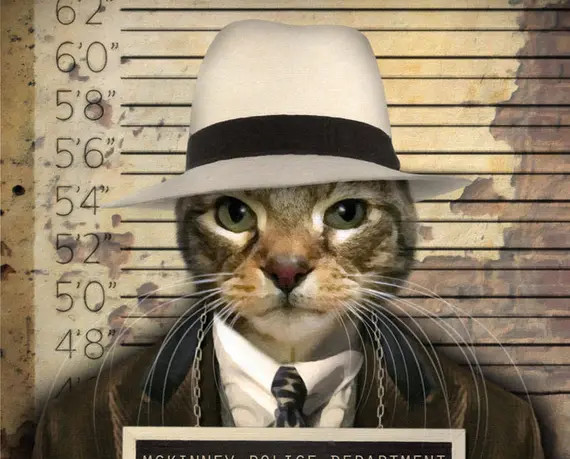
Top image credit Dsigns/Redbubble, “Catfather” image via Pinterest, mobster cat via Etsy

Study: Even Experienced Caretakers Give Cats ‘Unwelcome Affection’

When it comes to petting cats, less is more. Not everyone knows that.

By chance, one of the first things I saw Tuesday in my post-wake-up browsing was a short video of three guys standing in a triangle formation, each of them with a puppy. A drum recording began, and the men began drumming an overturned pot in the middle with the puppies’ paws.

The dogs, of course, had no idea what was going on. They were confused and stressed. Then I saw this from the official TikTok page of Imperial Point Animal Hospital in Delray Beach, Florida:

That’s a veterinarian abusing a kitten.

It might not be overt abuse. She’s not hitting or screaming at the poor cat. But she’s taking a sentient being with its own feelings, likes and dislikes, comforts and discomforts, and using it as a toy for clicks and likes on social media.

I thought about that when I read the newest study from Nottingham Trent University and the University of Nottingham, which looks at the way people interact with their cats and how their behavior may or may not align with what cats prefer and what they’re comfortable with.

Although Bud and I have a deep bond formed over more than seven years of spending time together, establishing trust, mutual respect and love, he would tear my face off if I did to him what the vet tech is doing to the kitten in the above video.

And you know what? He’d be justified, once he got over the shock and wondered if I’d been replaced with a doppleganger.

The UK study involved more than 100 felines at Battersea Dogs and Cats’ London cattery, with scientists recording interactions between humans and cats via a GoPro camera in a large pen where people can interact with cats one-on-one. There were 120 human participants of various ages and from different walks of life. Each person interacted with three cats separately.

Researchers looked at whether the cat or the human initiated interaction, where the human touched the cat, whether the human restrained the cat, and the cat’s response.

They also collected information on each human participant, such as how many cats they have at home and how long they’ve been caring for felines. Human participants rated themselves on how well they know cats and how well they take care of them.

They used a system that corresponds to the below image to grade physical affection. The image is mostly self-explanatory, but to be clear, the green areas are where cats like to be touched, the yellow areas are “meh,” and the red areas are no-go zones for most cats:

greenyellowredcatareas

In earlier studies, the team established what many cat caretakers know: Allowing cats to initiate physical interactions, going easier and lighter on petting, letting cats control how long the interactions last, and avoiding any kind of restraint are “best practices” for petting cats. They reaffirmed that scratching cats under the chin, rubbing their cheeks and forehead are “the best ways to increase their affection and reduce aggression.”

That might seem obvious, but in research there’s an important distinction between knowing something (or thinking you know it) and proving it with research. It’s important to prove it, and to forgo assumptions, to produce credible and repeatable experiments.

Animal behaviorist Lauren Finka, lead author on the new study, said although the above may seem like common knowledge among experienced caretakers, that’s not always true, and it’s not always reflected in their behavior.

“Our findings suggest that certain characteristics we might assume would make someone good at interacting with cats—how knowledgeable they say they are, their cat ownership experiences and being older—should not always be considered as reliable indicators of a person’s suitability to adopt certain cats, particularly those with specific handling or behavioral needs,” Finka said.

We should point out here that these are “best practices” for establishing a healthy, trusting relationship with cats, and taking their feelings into consideration. Lots of people might force their cats to do things without much push back, but that doesn’t mean the cat is happy. No one’s perfect, and there are always things we can learn about how to do better by our furry friends.

Finka also said she hopes people who run shelters and rescues take the research into consideration. That’s because some people run into the same problems I did: When you’ve never had a cat, and/or you don’t fit the profile of what people think a “cat person” is or should be, you could encounter resistance or skepticism from shelter staff.

One volunteer at an animal shelter asked me if I was adopting a kitten for my kids or girlfriend, because it didn’t occur to her that I’d want a cat. Some shelters require references from a veterinarian, which you can’t get if you’ve never had a pet before.

“Importantly, within shelters, we should also avoid discriminating against potential adopters with no previous cat ownership experience,” Finka said, “because with the right support, they may make fantastic cat guardians.”

For us, it’s more confirmation of what we’ve always believed: The more you take your cat’s feelings into consideration, and treat the little one with the respect he or she deserves, the happier your cat and the deeper your bond will grow.