A woman taunts her cat with ultra-processed snacks, then laughs at his disgusted reaction when he gets a taste. The “cute” video has gone viral.
From the bowels of TikTok comes the latest “cute” video of an attention monger abusing her cat, this time by feeding him Flamin’ Hot Cheetos.
The user opened the bag in front of Butters the cat, waved the Cheetos in his face, held them up to his nose, then feebly protested “These are my snacks! It’s spicy!” after getting the little dude interested.
She allowed Butters to eat Cheetos from her hand and lick her fingers, and his reaction is about what you’d expect from an obligate carnivore who just ate ultra-processed food made from cheap corn filler, chili powder, cayenne pepper, and cancer-causing artificial food dyes. He’s disgusted and uncomfortable.
“You can’t have these! Let me wave them in your face and taunt you, so you know you can’t have them! Haha, isn’t that clever?”
The difference is, Butters can’t guzzle milk or water to wash the taste away, so he settles for angrily swatting at his human while she laughs at him.
The woman thought her video was so clever, she’s shared it online and is enjoying the cheap dopamine hit that comes with accumulating internet points, aka likes.
Here’s a question for people who make social media “content” at the expense of their pets: how many likes are worth destroying the trust between you and your cat(s)?
I’m sure some people think I’m a scold, but all it takes is one clown to start a viral trend, and then all of a sudden you have thousands of people, all of them desperate for validation from strangers on the internet, foisting Flamin’ Hot Cheetos and Takis on their unsuspecting cats. As a general rule, the dumbest and most abusive trends go viral.
Cats aren’t equipped to use human language and there’s nothing wrong with that. Our feline friends already go to great lengths to communicate in ways we can comprehend. The least we can do is meet them halfway.
I would love it if my cat could talk to me.
Sure, he never shuts up, but if he could speak English I’d know why he meows at the same spot at the same time every morning, or what he wants on the occasions when he’s still meowing insistently at me despite the fact that his bowls are full, his box is clean, he’s had his play time, and every possible need and want of his — that I can fathom — has been met.
Most of all, I’d really like to know he understands I’ll be back soon when I go away for a few days, and my (mostly ignored) pleas for him not to attack his long-suffering, way-too-kind sitter.
Alas, Bud cannot speak. No non-human animal has ever demonstrated even basic proficiency in human language. People will point to examples like Koko the Gorilla and Nim Chimpsky, but there’s a reason why funding dried up for that kind of experiment.
It doesn’t work. It never did.
The scientists who end up taking on dual roles as researchers and parents to the animals invariably serve as interpreters, get too close to their subjects and swear that a gorilla pounding shiny buttons for “food tree food submarine” means the ape wants to have a picnic next to the ocean, or “car fly house car star” means she wants to ride a Tesla Roadster to Mars and start a colony with Elon Musk.
Koko, Nim, Chantek and the other apes who were the subjects of decades-long attempts to humanize them — and teach them language in the process — were ultimately not much different than Clever Hans the horse, who was reading subconscious nonverbal cues from his owner and convinced tens of thousands of people that he could do math and understand spoken language.
Hans had scores of experts fooled until the German psychologist Oskar Pfungst figured out how the horse was coming up with the correct answers.
Regardless of which famous example we’re talking about, no animal has ever mastered syntax, and the best that could be said of their proficiency with language, or lack of it, is that they learned they’d get attention and food when they pounded on a talking board or approximated a word in sign language.
Even if non-human primates were able to learn a handful of words by frequently reinforced association with an object, there has never been any evidence that they are actually using the words as language rather than simply understanding “Pushing the button that makes this sound means I get a treat!” (And yes, there is a profound difference. The former reveals the presence of cognitive processes while the latter is a conditioned response.)
Despite decades of intense effort, no animal has ever demonstrated the ability to use human language. At best an animal bangs on a few buttons and people are left to speculate on the intent. Maybe Fluffy likes the way a certain word sounds. Maybe it’s just fun to hammer on buttons the way it’s fun to pop bubble wrap. Most likely, these cats and dogs know that using a talking board is a guaranteed way to get attention, a treat and a head scratch from their caretakers.
Influencers and their talking boards
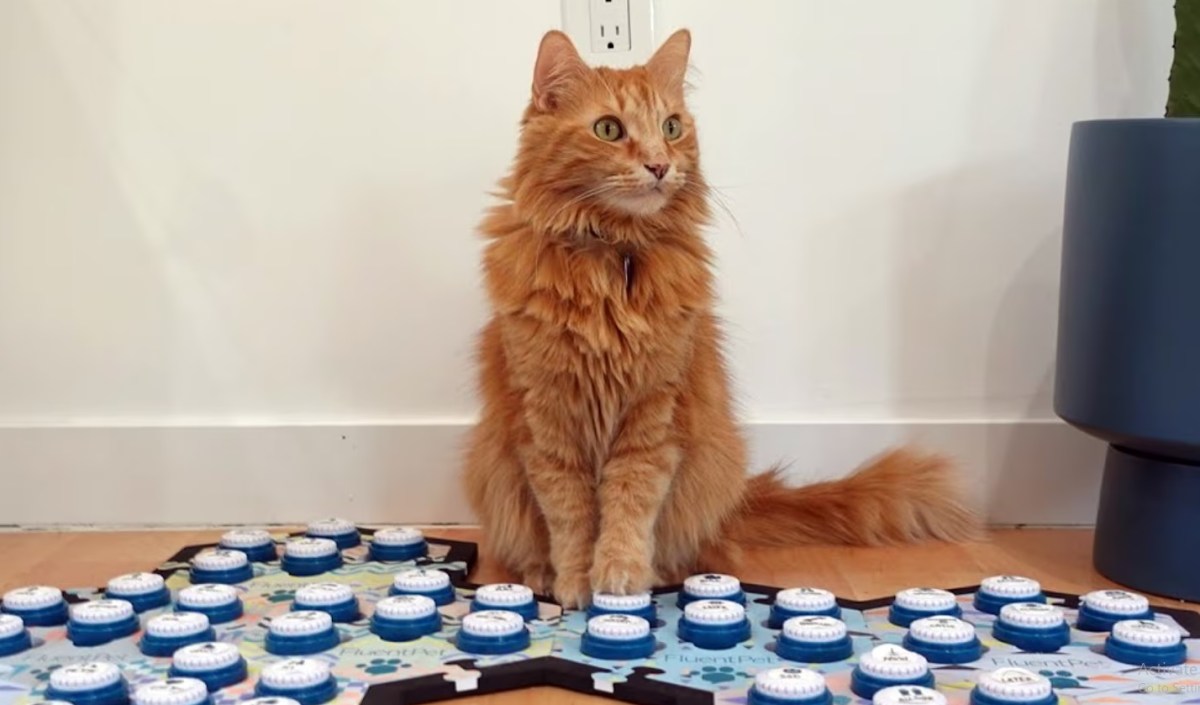
TikTok, which spawns inane trends with the reliability of an atomic clock, has provided a platform for people who insist their cats and dogs can talk. Using “talking boards” — elaborate set-ups in which words are assigned to their own buttons — they “teach” their cats how to express themselves in English and provide proof in the form of heavily edited, out-of-context clips that require the same sort of creative interpretation pioneered by Penny Patterson, Koko’s caretaker.
Seriously?
I just watched a video in which a woman claims her cat, named after Justin Bieber, was describing an encounter with a coyote by stomping on buttons for “stranger,” “Justin,” “Mike,” and “stranger.”
The woman says she thought Justin was asleep at the time, but now she believes the orange tabby saw the coyote outside and was still stressing about it well into the next day.
While she’s repeating Justin’s “words” back to him, two of her other cats come by and step all over the talking board. I guess whatever they had to say wasn’t important.
Justin’s talking board has 42 buttons, which stresses credulity well beyond the breaking point. More than half of the buttons are used for abstract concepts.
But forget all that for a moment and ask yourself how our own efforts to decode the meow have been going.
Despite our status as intelligent, sapient animals, despite the powerful AI algorithms at our disposal, despite the benefit of being able to digitally record and analyze every utterance, we haven’t come close to a reliable method for interpreting feline vocalizations.
Likewise with dolphins, whale song, corvid calls and the sounds made by other animals at the top of the cognition pyramid.
Mostly, we’re learning we’ve underestimated the complexity of our non-human companions’ inner lives, especially when it comes to the kind of multi-modal communication humans also engage in, but only subconsciously. We say what we want with our mouths, while our eyes, facial expressions and body language say what we’re actually thinking.
Likewise, the meow is an unnatural way for cats to communicate, and it contains only a fraction of the information cats are putting out there. It’s just that we can’t reliably read feline facial expressions, let alone tail, whisker and posture. (Studies have shown most of us, even when we live with cats, don’t get measurably better at this. In fact, we’re often no better than people with limited feline experience, but we think we’re better.)
Putting the burden on our furry friends
If we can’t crack a simple and limited system of vocalizations, aren’t we putting unrealistic expectations on cats? The average person has a vocabulary of tens of thousands of words, yet somehow we expect cats can latch on to an arbitrary number of them, approximate mastery of syntax that has eluded even our closest cousins, and bridge a cognition gap we haven’t been able to bridge ourselves.
It’s all too much.
I’ve had Buddy since he was eight or nine weeks old, and in more than nine years I still don’t know why he makes this praying motion. We may be best buds, but some things just don’t translate.
There’s a simple truth at the heart of this: Cats did not evolve to speak or parse human language, and that’s perfectly fine.
The little ones already meet us more than halfway because they understand we are hopelessly incompetent at reading tail, whisker or body language, and they understand we communicate with vocalizations.
By forgoing their natural methods of communication in favor of ours, cats are already taking on most of the burden in interspecies communication. Asking them to do more than that, to learn many dozens of words and the rudimentary rules of language, seems like laziness, wishful thinking or insanity on our part. Pretending that certain cats are successful is an exercise in the same kind of cynical opportunism that fuels every other desperate attempt by people trying to turn their pets into influencers. People do it because the reward is money and attention.
Worse, it contributes to the spread of misinformation. TikTok’s talking board videos routinely net millions of views, converting a credulous audience into an army of true believers who are convinced that, with just a little effort, their feline pal can shoot the shit with them.
If people want to construct elaborate talking boards in their homes and pretend their cats are expressing themselves in English, who am I to object? It’s not the smartest use of time, but have at it. What I won’t do is participate in the delusion that felines are a few buttons away from being able conversation partners, nor will I pretend these efforts have any relationship to science.
So to the journalists who keep writing credulous stories about these supposedly talking animals: please familiarize yourself with the example of Clever Hans, and please, I beg you to stop promoting these videos as if they’re anything more than wishful thinking. You are doing your readers a disservice for the sake of a few clicks.
Note: Jackson Galaxy isn’t a fan either, saying he’s “got some serious problems” with the talking board trend. Calling it “problematic,” he points out that cats are not only partially domesticated and the only animal species in history to take that step without human prompting, but humans have never selectively bred cats for specific behaviors or to bring out intelligence traits as we have with canines. (Think of sheep dogs or retrievers, who are the products of thousands of years of breeding for well-defined tasks.) There simply hasn’t been a need to breed cats for behavioral traits since the thing humans traditionally valued most about them — their ability to reliably eradicate rodents and protect human foodstuffs — is innate. No one had to teach cats how to hunt or breed them for the task. It’s only in the last two hundred years or so that certain human societies began breeding cats, and they did so for aesthetic attributes like coat patterns. Galaxy also notes that animals do not express emotions the same way humans do. Like monkeys, who “smile” when they’re terrified, felines express joy, anger and fear with their tails, whiskers, ears and body language. It’s not in their nature to tell us they’re happy or scared by padding up to a contraption and hammering on a button.
Top image of “Justin Bieber” the cat credit Sarah Baker.
Plus: The awesome and terrifying cats and proto-cats of prehistory!
OMG, you guys! No cap, you gotta totally check out this adorbz video of a sweet widdle kitty witty becoming best fwiends with this mountain lion!
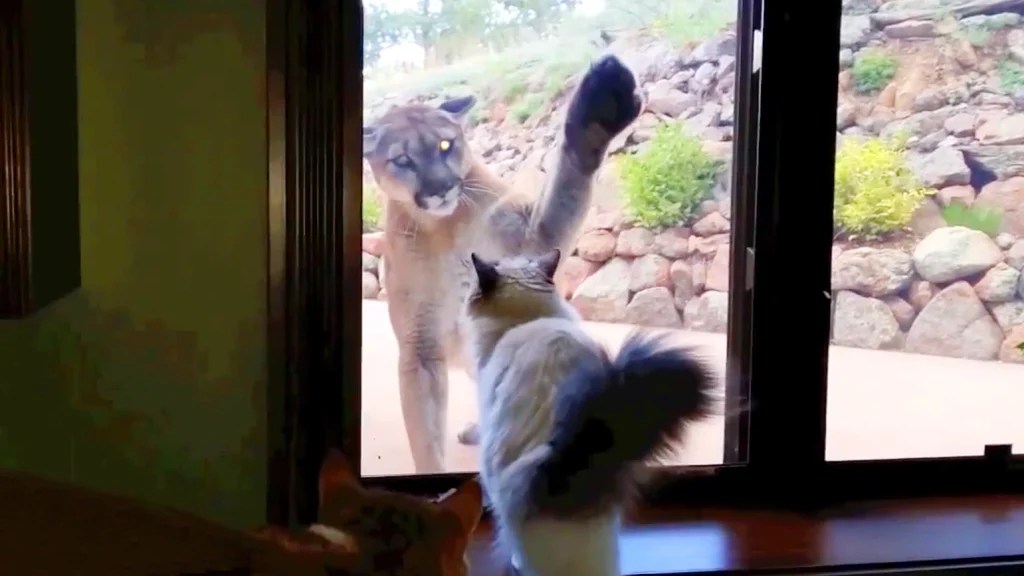
Phoebe the cat sees this cute AF puma near the back door of her home, curiously looking inside. It’s love at first sight as kitty and kitty see each other! Per Parade Pets:
“[T]he kitty in this TikTok video is completely fascinated by the big kitty outside her window. There’s no getting her away from her new friend!
On Sunday, August 25, @cricketandstrawfl shared this footage of her Tuxedo Cat posted up at the back door in their house, where a cougar was hanging out. It goes without saying that the cougar in question was many times bigger than Phoebe, but that didn’t seem to scare her at all.
It seemed like the cougar was pretty curious, too. He didn’t appear to be aggressive; instead, he was staring at Phoebe and gently pawing at the glass, trying to figure out who the tiny cat in the window was.”
OMG-hee! Look at the big kitty gently pawing at the door! He wants to give the little kitty a huggy-wuggy!
SO ADORBZ! The puma pawing at the door wasn’t testing its strength to see if he could snag a quick meal, those were totes signals of love! Teehee!
Felid predators of pre-history: They will eat you
If you’re in need of a palate cleanser after all that sugar, the BBC’s Discover Wildlife has a rundown of prehistoric cats and their particularly fascinating proto-cat ancestors, some of whom looked more classically cat-like than several species of true cats. Isn’t convergent evolution cool?
There’s the famous smilodon, the saber-toothed cat, xenosmilus, the so-called shark-toothed cat, and homotherium, the scimitar-toothed cat. Outdoing each other with increasingly sword-like teeth was apparently a big thing in the felid world back then.
There’s also the cave lion, the last of the UK’s big cats, and miracinonyx, the American cheetah, but did you know that simbakubwa, the “great lion” of Africa, topped out at almost 3,000 pounds?
Simbakubwa was massive, making modern lions look almost like house cats in comparison.
Dinictis looked like a cat, behaved like a cat and hunted like a cat, but was not part of the felidae family. Credit: Wikimedia Commons
Simbakubwa and dinictis were examples of “false cats.” That is to say, they were not part of the felid lineage, but closely resembled cats in body plan and behavior through convergent evolution. Nature found a niche, and several different species filled it for a time.
Dinictis in particular looks strikingly like modern big cats, which makes it even more surprising to learn it’s not part of the genetic lineage of the felid line.
Finally — or firstly — there’s proailurus, the first cat or “dawn cat,” from which all true felidae species can trace their lineage. Appearing almost 31 million years ago proailurus enjoyed napping, climbing trees and eating Temptations. Okay, we made that last part up. But still. If proailurus were around today, it would probably go just as crazy for the kitty crack as our house panthers do.
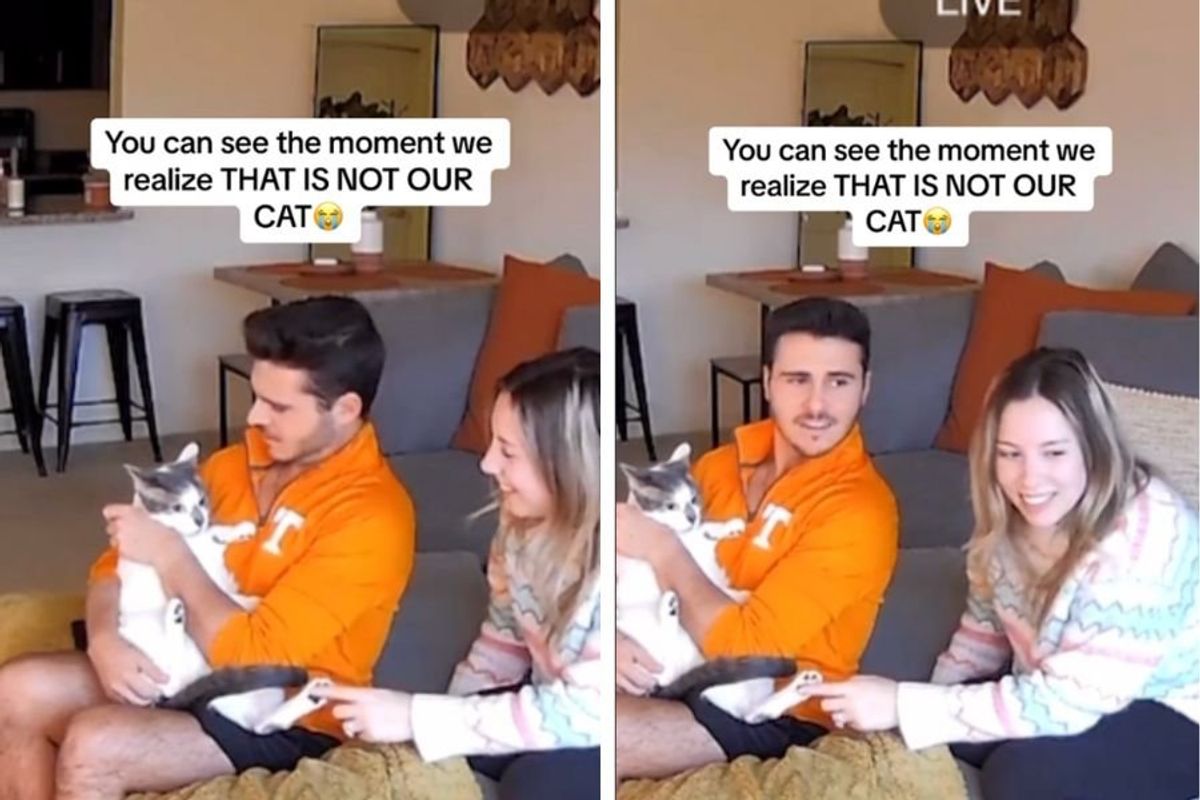
A man and woman on TikTok claim they took in a stray, believing it was their own identical-looking cat.
Back in 2021 we were fascinated by the story of a Redditor who thought he found his missing cat after three weeks, only for his actual cat to come walking through the door a week later.
The cats did look remarkably similar, and it’s conceivable that the Redditor was so happy to have his cat back that he didn’t realize there were very small differences.
Now a couple on TikTok claims something similar has happened to them, although it should be taken with a grain of salt. They claim they brought a cat inside, believing it was their feline overlord, only to begin cuddling him the exact moment they realized their actual cat was outside looking in, appearing none too happy about the situation.
Of course to take the story at face value you’d also have to believe that the entire incident happened to be captured on video by an unnamed third person who happened to be filming them at that moment, and happened to have their camera in portrait mode for maximum TikTok compatibility.
The TikTokers
I’m not linking to the account or the Upworthy story that takes it at face value because I’m not a fan of clickbait or content scrapers, but it did remind me of the interesting 2021 story and my reaction to it.
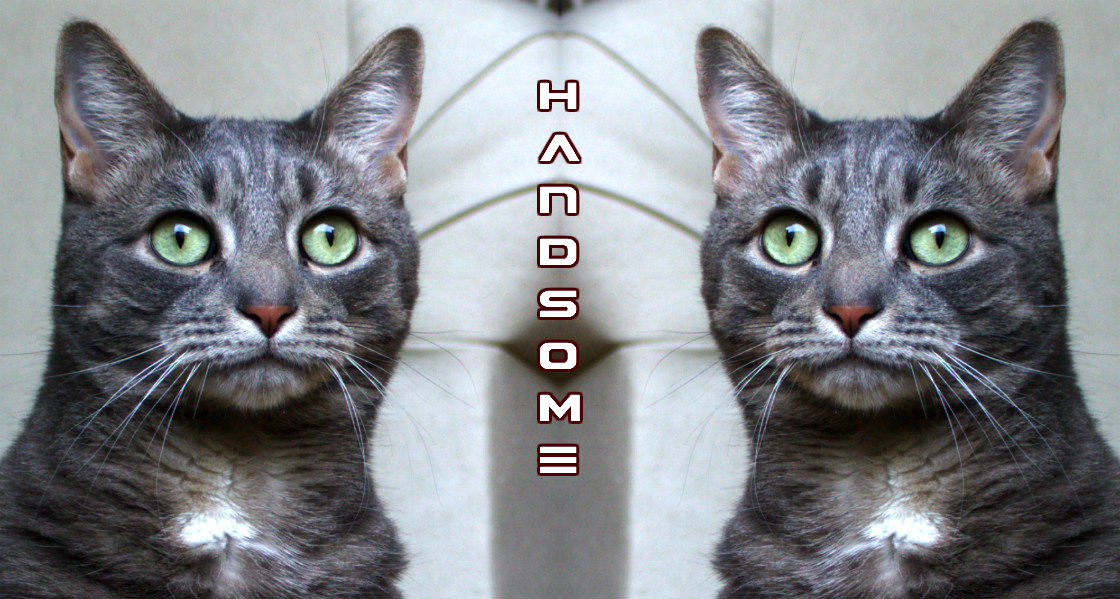
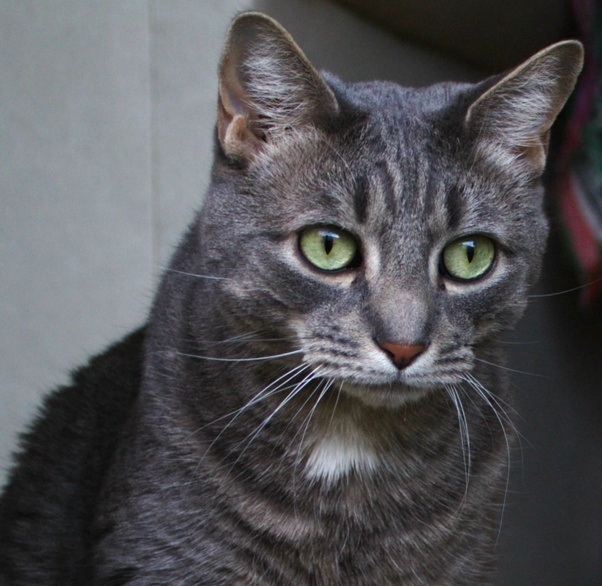
At the time I noted three of Bud’s unique physical characteristics: his bright green eyes framed by dark “guyliner,” the unique tuft of white fur on his chest and perhaps his most obvious distinguishing feature, his pronounced muzzle. You can see it in this photo thanks to the angle:
A Buddy like no other.
But most of all, Buddy’s personality is utterly unique. I could probably search to the ends of the Earth and hell would freeze over before finding a gray tabby cat with the same physical features, the same tyrannical Elmo voice and the same imperious personality.
I cannot fathom mistaking another cat for Bud because I can’t imagine another cat with all of the above qualities who also narrates his own activities in real time like a play-by-play announcer who sounds like a disco-funk vocalist singing in falsetto.
“Jumping off the couch now…funky! I can see the bottom of my bowl, dude, and that is decidedly un-funktacular! I’m gonna do a few laps around the living room at 27mph while filling you in on my latest theories about the multiverse, okay? Prepare to get funky! So I think there are — ooh, I found a crunchy treat I must have missed earlier! Nomnomnom! — anyway, I was doing some calculations and I believe if we extend out to 11 dimensions, we solve some of the incompatibilities I was telling you about earlier. In simple terms, all particles in our universe are like vibrations on a tiny rubber band, physics is the harmonies on the string, chemistry is the melodies we play on vibrating strings, the universe is a symphony of strings, and the mind of God is cosmic music resonating in 11-dimensional hyperspace! Bring me catnip! I need catnip! Can’t you see I’m on the verge of another breakthrough here?”
Buddy: Catnip aficionado, play-by-play announcer and theoretical physicist. Also, beefcake.
I’ve described Bud as a lunatic, and that’s one reason I love him. He’s crazy in the best way, unpredictable, amusing and never boring.
Could you ever mistake another cat for your own? What makes YOUR cat unique?
The promise of a revolutionary new method of claw trimming is all hype, sadly.
I was hyped when I saw the headline.
“Cat Owners Rejoice,” the Newsweek headline blares. “Science Can Make Trimming Claws Less Stressful.”
Well if cat owners are rejoicing, it’s gotta be amazing, yeah?
I imagined cat affionados feting the creator of some miraculous new device that keeps cats comfortably restrained and relaxed, or maybe celebrating the discovery of some previously-unknown sound frequency that lulls felines into such a state of carefree bliss that they purr contentedly while we carefully clip their claws.
What I didn’t expect was a “protocol” that amounts to: Touch your cat’s leg. If he doesn’t try to murder you, touch your cat’s paw. If he still doesn’t murder you, trim a single claw. Repeat steps the next time your cat is in an agreeable mood.
That’s it. That’s the revolutionary new method that “science” made for us, according to Newsweek. “Science” must be proud of itself!
With this wonderful new method I should be able to trim one of Bud’s paws by 2067.
Obviously this is not science. It’s a method, not research. It’s well-intentioned and designed to keep cats comfortable, and those are noble goals, but calling it “science” is misleading, just like every other dumb headline that asserts “science says” or something is true “according to science,” as if science is an omniscient entity lounging on pillows, being fed candied figs by worshipful attendants and occasionally dispensing little nuggets of wisdom for our tiny little brains to absorb.
“The designated hitter rule shall henceforth be abolished,” Science says betwixt pulls from a hookah. “Fifty years of conclusive OPS plus FIP and OAVG data dictate it must be so.”
Come to think of it, that probably is what most Americans think science is. The other half think it’s Anthony “I Am Soyence” Fauci.
Where were we? Ah yes, cat claws!
The truth is I’ve give up on trimming Bud’s claws. If I notice a really long one I’ll try to trim it, but otherwise I leave the job to him and his 4-foot scratching post.
Maybe that makes me a bad caretaker, but I challenge anyone who’d stick me with that label to try trimming Buddy’s claws.
The little dude goes from chill and relaxed to demonic in a millisecond. He yowls, he thrashes, he flails with claws out and tries to bite any flesh he can reach, no matter how careful I am to try at the “right” time, how gentle I handle him, how careful I am to avoid the quick.
Bribe him with treats? Hah! He will stop yowling and thrashing about with murderous intent just long enough to gobble down the yums, then return to being a whirlwind of claws and teeth without skipping a beat.
And you should hear him. It sounds like I’m torturing Elmo, for crying out loud.
Thankfully he doesn’t hold a grudge and if I give up on trimming, he’ll be ready to plop down into my lap within minutes.
It’s generally understood that all that ghastly claw trimming nonsense is behind us, and we shall speak no more of it.
Speaking of ghastly business, the below video started auto-playing while I was on the throne and filling the idle time by searching for cat-related news:









 Pain In The Bud