Shelters in Ukraine are running out of food, while the country’s stray cats and dogs are particularly vulnerable as war rages around them.
If you’ve got a cat who doesn’t handle the Fourth of July well and gets freaked out by the annual fireworks, imagine that multiplied by about a thousand, with no respite.
Then imagine that, instead of reassurance from calm humans who know the explosions are just part of a celebration, the cats and dogs of cities like Kiev pick up on the anxiety of the people around them, sensing their fear, reading their body language.
War takes a terrible toll on humanity, a fact that’s been well-documented for centuries, but much less has been written about the suffering and fate of animals in the crossfire of forces they can’t comprehend. (One outstanding take on animals in war is 2006’s Pride of Baghdad, a heartbreaking account of four lions who escaped Baghdad Zoo as US bombs rained down on the Iraqi capital. While Pride of Baghdad is a fictionalized account of what happened to those lions, the story is sadly, infuriatingly true and remains one of the lesser-known accounts among the tens of thousands of stories told about the toll of that war.)
In Ukraine, where the Russian military has taken control of the local airspace and destroyed the country’s airports, people are taking their pets and what possessions they can as they try to escape by land via routes to the border that are backed up by 15 miles or more.
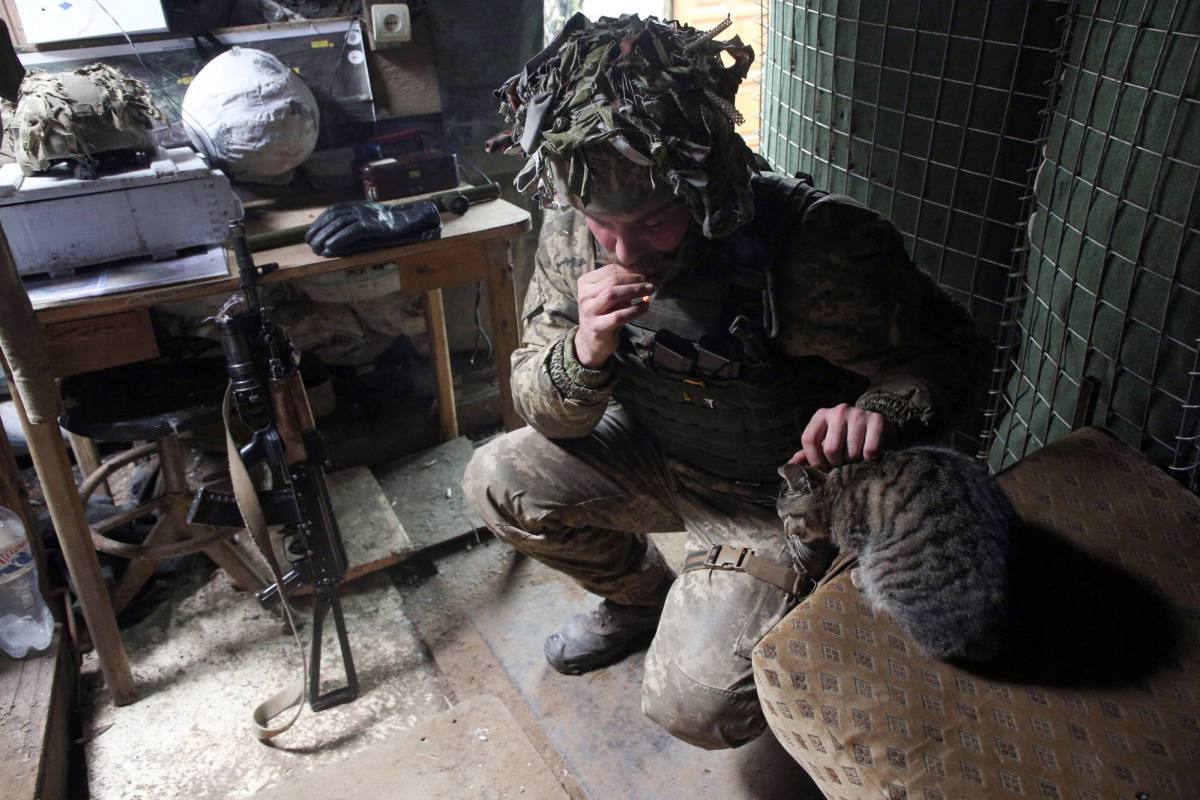
A soldier holds a cat in Mariupol, southeastern Ukraine. Credit: Aleksey Filippov
Meanwhile, as all men of fighting age have been called to stay, stray dogs have been a comfort to Ukrainians on the front line. The soldiers feed the dogs, and the hyper-vigilant dogs alert the soldiers to any unusual activity they pick up on.
“She immediately barks or growls if the enemy is planning an attack. It’s safer and calmer with her – no wonder they say that a dog is man’s best friend,” a 21-year-old Ukrainian soldier named Mykyta told Agency France-Presse as he gave an affectionate pet to a dog adopted by his unit.
Stray cats are cozying up to the soldiers as well. Dmytro, a 29-year-old soldier, said a black cat he named Chernukha has kept him company and helped him cope.
“You come back to the post, lie down on the bed, and here comes Chernukha,” Dmytro told AFP. Chernukha “lies on your stomach and looks at you as if she wants to be petted. It’s a sedative.”
Like many Ukrainians, staff and volunteers who man the country’s shelters have remained defiant and refused to leave. In Kiev, staff at Best Friends shelter are rationing food and trying to locate more.
“It is very difficult and scary for [the animals] and for us. Due to the fighting, suppliers of food for animals are not working,” a shelter staffer told Newsweek. “We need help now with animal food and its transportation to the shelter. We will also be grateful for the financial support.”
Getting food is already difficult and will become more so as Russian troops push further into the capital and civilians hunker down in homes, basements and bomb shelters.
Nastya Aboliesheva, who works for Kiev-based Happy Paw shelter, said “no one is willing to risk their lives to deliver what is needed.”
“Our work now remains important and necessary, because animals do not understand what is happening and also need food and treatment….the main thing that people can help now is not to throw their animals at random, but to be near them or to evacuate with the animals,” she said. “We very much hope that local authorities in Kyiv and other cities will allow people to take animals in boxes to bomb shelters.”
Top image: A Ukrainian soldier petting a cat. Credit: AFP
Feline leaders were outraged after the world tennis number one managed to insult cats, chair umpires and Australians on Friday.
NEW YORK — Buddy the Cat declared men’s tennis number one Daniil Medvedev “a lanky human” after the latter called a chair umpire “a small cat” during a match on Friday.
Medvedev, who is known for his outbursts on the court, suffered a meltdown during his semifinal victory at the Australian Open. The Russian yelled at the chair umpire for allegedly allowing his opponent, Stefanos Tsitsipas, to receive coaching from the stands, which is a no-no in professional tennis.
After the umpire hit Medvedev with a warning, the top-ranked men’s player launched a minute-long tirade.
“Bro, are you mad?” Medvedev yelled to the umpire. “For what? And his father can talk every point? Bro, are you stupid? His father can talk every point!”
When the umpire made it clear he wasn’t sympathetic to Medvedev’s complaints, the frustrated Russian dissed him.
“If you don’t give him a warning, you are — how can I say it? — a small cat!” he said, gesticulating wildly.
It was the second time in as many matches that Medvedev had resorted to insults. Asked why Australian fans booed him during his quarterfinal match against Nick Kyrgios, Medvedev told an interviewer it was because the fans “probably have a low IQ.”
Above: Medvedev’s meltdown and offensive anti-feline insults
Buddy the Cat assembled a hasty press conference within a few hours. Flanked by the Rev. Al Sharpclaw and other feline community leaders, Buddy accused Medvedev of “blatant antifelinism.”
“There is nothing wrong with being a small cat,” the silver tabby said, pounding his paw on a table for effect. “In fact, Medvedev unknowingly paid the umpire a compliment. But that doesn’t change the fact that he intended it as an insult.”
Buddy, Sharpclaw and other leaders demanded the WTA sanction Medvedev and mandate his participation in species tolerance classes.
In the meantime, the 25-year-old Medvedev has advanced to the Australian Open men’s final, where he’ll face 36-year-old Rafael Nadal on Sunday.
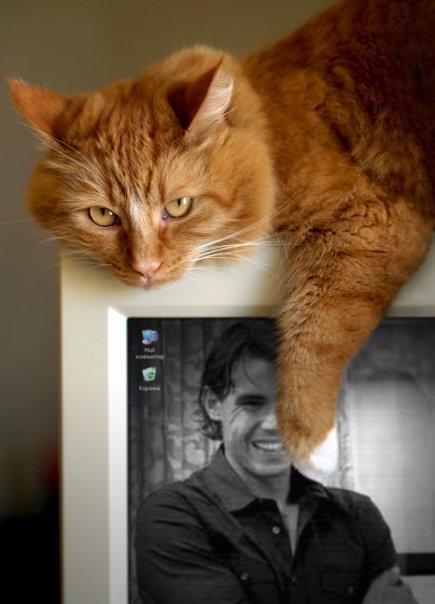
The Mallorcan not only has 20 major titles under his belt, he’s also held in high esteem by the world’s felines, who see a kindred spirit in Nadal’s obsessive-compulsive behavior and tendency to erupt into short bursts of energy expenditure. It’s also long been rumored that Nadal loves boxes.
Fellow tennis star Sebastian Korda named his cat after Nadal. No one has named a cat after Medvedev.
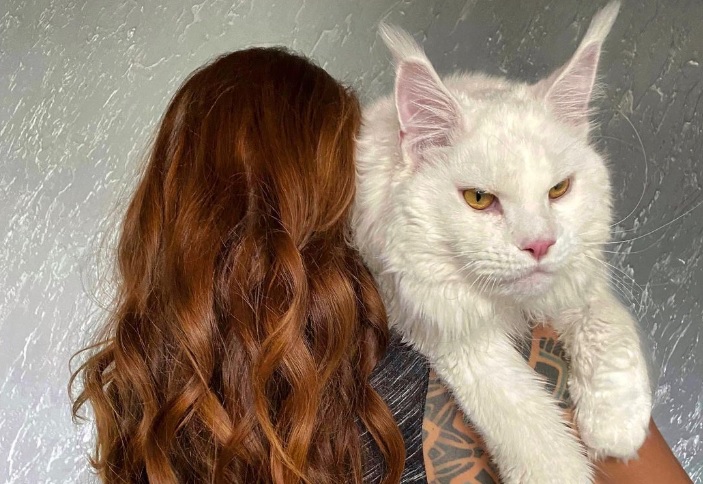
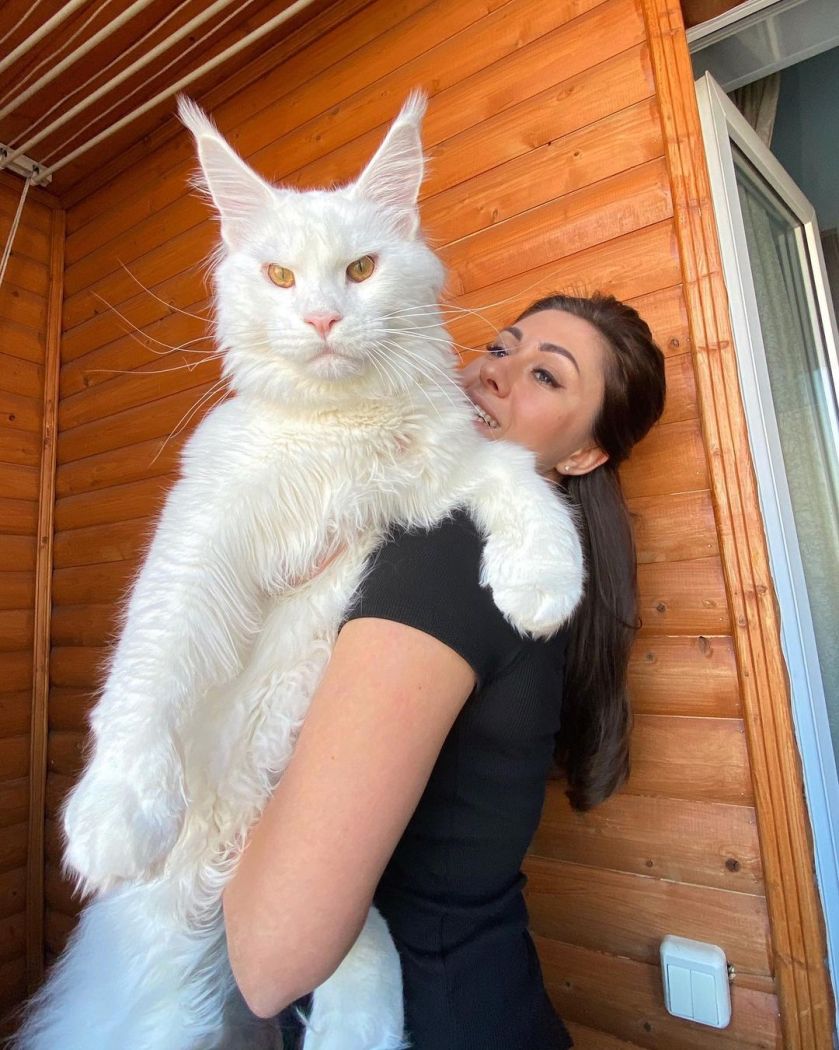
Maine Coon Kefir looks like he could eat three Buddies for breakfast.
It’s not easy having a huge cat.
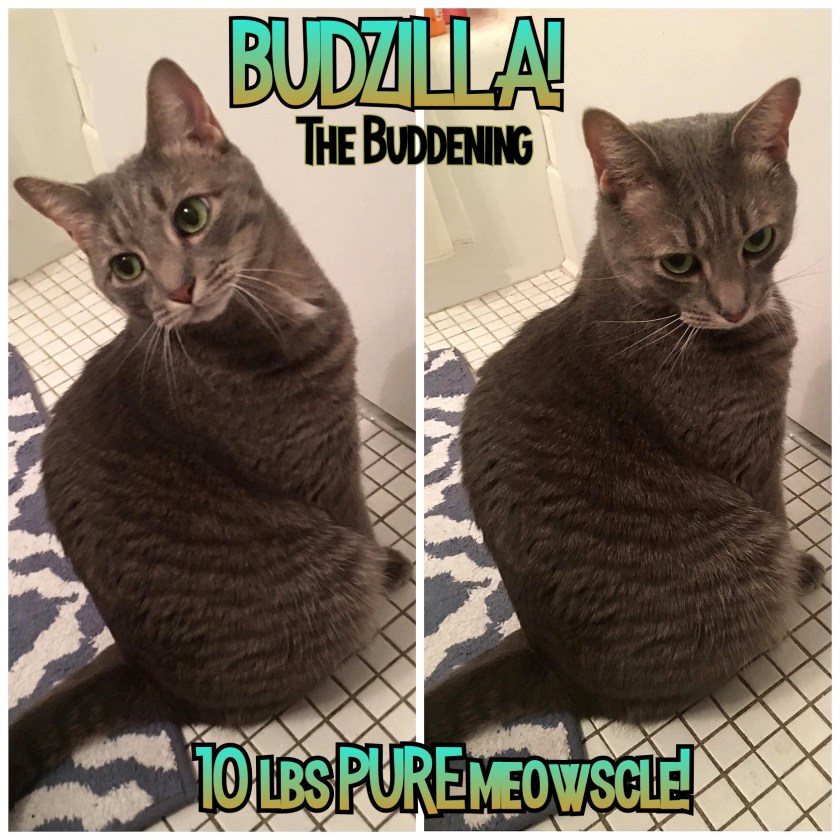
As readers of PITB know, I have first-hand experience with taking care of a massive beast of a cat, with Buddy weighing in at a jaw-dropping 10 pounds, most of it pure meowscle of course.
That means I can sympathize with Russian one-percenter Yulia Minina, who bought a Maine Coon kitten less than two years ago only to see him balloon into an almost 30-pound behemoth — and he’s still growing!
Visitors often mistake Kefir for a large dog at first, Minina said, but the Maine Coon is the kind of gentle giant typical of his species and acts more like “a very affectionate and modest child.”
“When friends and acquaintances come to the house, all the attention is on him and he willingly allows himself to be stroked,” Minina told the UK’s South West News Service.
The scary part? Kefir isn’t done growing. Credit: Yulia Minina/Instagram
While most cats are just about their full size after a year, Maine Coons can continue to grow until after their second birthdays. (There’s no evidence that they continue to grow until they’re 5 years old despite claims online, mostly from breeder sites.) That means Kefir, who already looks like a robust lynx, could end up challenging domestic cat size records if he enjoys another growth spurt.
Kefir is just starting to go viral within the past day or two, and as his Instagram follower count (7,288 as of this post) continues to tick up, so do the enquiries from people who want to buy the big guy.
“To everyone who wants to buy my cat, I answer: NOT FOR SALE!” Minina wrote in an Instagram post on Monday. “But I can give all the information about the breeder that many have asked! At the moment, 3 gorgeous snow-white blue eyes are available in the nursery age 1 month. I think you don’t need to praise their beautiful and big parents, you already know everything!”
No word yet if Minina gets a commission on successful referrals to the breeder.
In the meantime, Buddy can rest easy knowing that even if another cat rivals his huge and intimidating presence, he’s all the way in Stary Oskol, a safe 4,873 miles away.
The similarly massive Buddy, who rivals the size of a football. Credit: The Buddy Society for Preservation of Buddy Photographs
Natalia Zhdanova heard the cries of a kitten in her backyard and found a sick, malnourished baby cat who was barely a week old. She nursed him back to health, and now he’s flourishing.
Meet Fedya, Instragram’s newest feline star.
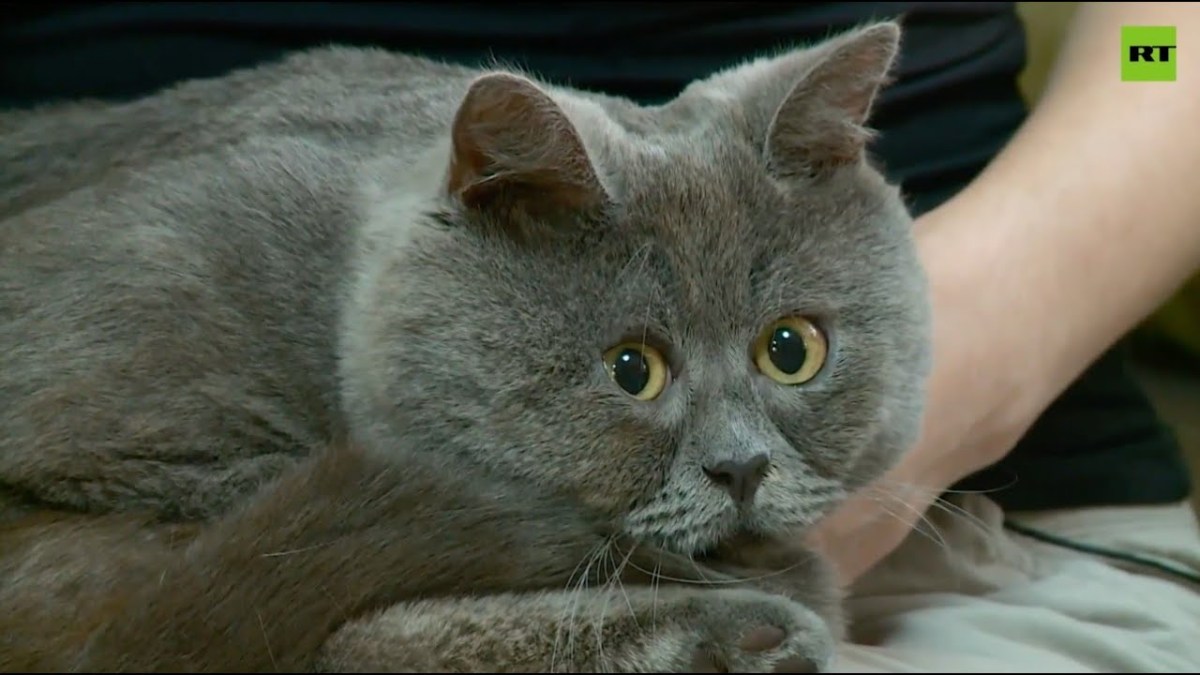
The playful cat with a permanently surprised look on his face was just a week old when he was separated from his mom last year. Natalia Zhdanova heard his cries and found him alone, hungry and sick in her backyard in Rostov, Russia.
With help from her neighbor’s cat, Handsome, Zhdanova nursed Fedya back to health, and now the little guy is up to a healthy weight and thriving at 18 months old.
“He was very weak and was dying,” Zhdanova told the UK’s SWNS wire. “Handsome cleaned and licked Fedya and became like a father figure to him.”
The two cats are now “the best of friends,” and Zhdanova said Fedya “purrs very loudly” for her and Handsome.
“He is a very sweet, gentle, playful, and intelligent cat,” she said.
You can see more photos and videos of Kedya on Instagram @fedja_kot, where he’s accumulated more than 36,000 followers.
The Cat Man of Aleppo has survived bombs, chemical gas, a siege and a risky flight to Turkey as he’s cared for people and cats suffering in Syria’s civil war.
Human beings have lived in the city known as Aleppo for more than 4,000 years, making it one of the oldest continually-inhabited settlements in human history.
But as the raging civil war in Syria expanded and bombs began to fall on the country’s largest city, there was an unprecedented mass exodus — reducing Aleppo’s population from 4.6 million in 2010 to less than 600,000 by 2014.
Mohammad Alaa Aljaleel was one of the stubborn few who stayed. His wife and children fled to safety in Turkey in 2015, but anchored by his commitment to people who couldn’t leave, Aljaleel stayed behind to continue driving his ambulance and feeding a growing population of abandoned cats.
At first friends and acquaintances turned to Aljaleel to take their cats as they prepared to flee the crumbling city, knowing he was fond of felines and would care for them as his own.
Others heard about the “cat man of Aleppo,” and soon Aljaleel’s home became a sanctuary for former pets from all over the city, which was becoming a ghost town.
With few remaining people to feed them — and food sources like restaurant dumpsters drying up — hungry stray cats started showing up too.
“Since everyone has left the country, including my own friends, these cats have become my friends here,” Aljaleel said in 2016, as a BBC camera crew filmed him among the hundreds of cats in his care.
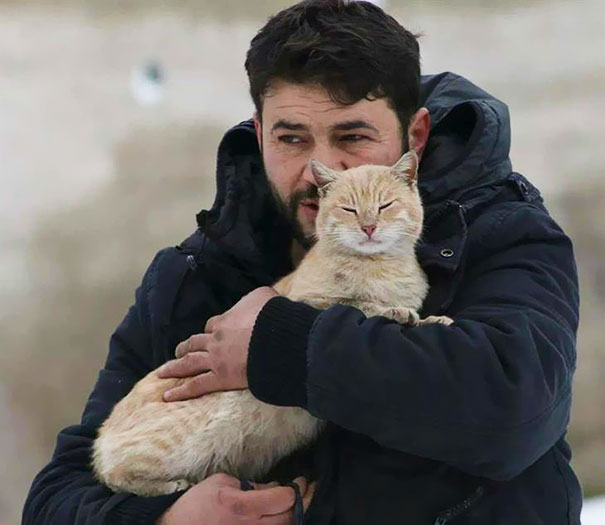
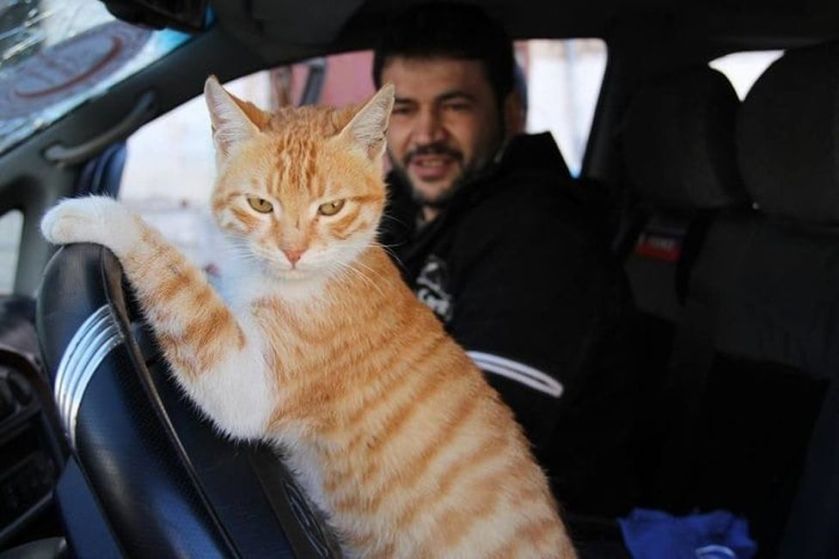
Aljaleel, the Cat Man of Aleppo, hugs a tabby in his care.
One day a car pulled up and a little girl stepped out, cradling a cat.
Her parents “knew there was a cat sanctuary here,” Aljaleel told the BBC at the time. “The girl had brought the cat up since she was a kitten. She cried as she handed her over to me, and they left the country.”
For many people leaving the city in search of refuge in Europe or elsewhere in Syria, the decision to leave a beloved pet was agonizing.
But entrusting a cat to Aljaleel and his makeshift sanctuary — where the animal would be fed and well cared for — was much more palatable than making it to the border of an EU country only for a border guard or customs official to refuse the cat entry, forcing families to choose between pet and safety.
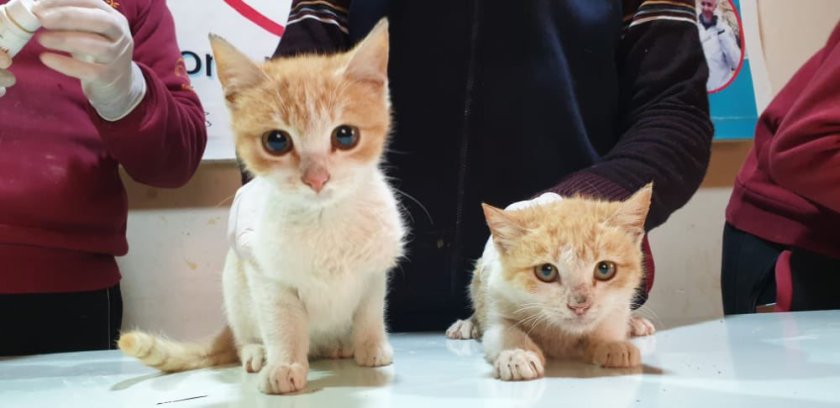
Kittens who were brought to Ernesto’s Sanctuary with their mother.
For people like the little girl, knowing their cats were in Aljaleel’s sanctuary meant maintaining a tie to home and hope that they could return.
“I’ve been taking photos of the cat and sending them to her in Turkey. She begs me, ‘Send me photos of her. I miss her. Please promise to return my cat to me when I get back.'”
That was in 2016. Almost five years later it looks like the young girl won’t be returning to Syria, and her cat is likely dead.
After Aljaleel’s makeshift cat sanctuary swelled to include more than 200 cats, things took a turn for the worse.
The Syrian government and rebel forces dug in, calling on allies for support and resources. ISIS and Iranian-backed insurgents entered the fray, seeing opportunity to advance their own interests amid the chaos.
So too did Russia and the United States. Both countries treated the conflict as a proxy war, with Russia backing Assad and his Syrian government forces, while the US and its allies threw their support behind an opposition that grew out of the Arab Spring in 2011.
The US and Russia provided the combatants with training and weapons systems, increasing the destructive firepower at the command of the belligerents. Both countries sought to advance their geopolitical ambitions in the region when they entered the conflict.
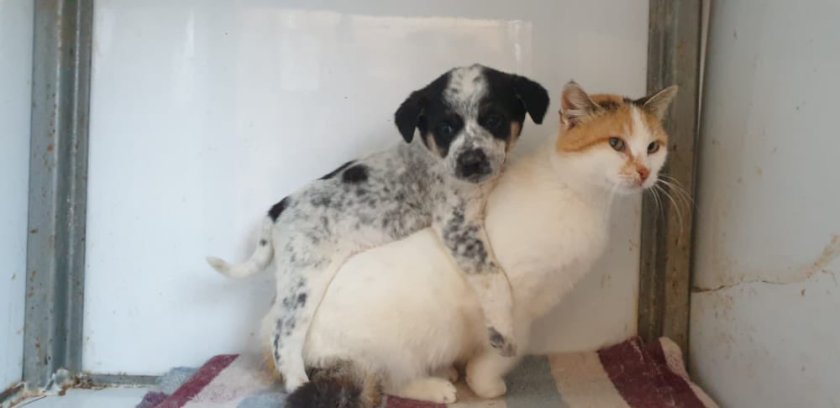
Not just cats: Alina and Samira are best friends and are inseparable. Credit: Ernesto’s Paradise
In internal memos justifying intervention in Syria, the US State Department predicted the civil war would flare out in months. Instead, the war has now lasted more than a decade, and in a move The Guardian called “a bloody end to [former President Barack] Obama’s reign,” in 2016 the US dropped 26,171 bombs on countries in the Middle East, with Syria absorbing the lion’s share.
Perhaps it was one of those bombs — or a bomb from Russia, or one of Syrian dictator Bashar al Assad’s own warheads — that obliterated Aljaleel’s sanctuary. It’s unlikely anyone will ever know. But one thing all sides agree on is that the chlorine gas was courtesy of Assad, who has not hesitated to use chemical weapons against his own people in the bloody war.
Weeks after Aljaleel was featured in a BBC short about the impact of the war, Aljaleel “watched helplessly as his cat sanctuary was first bombed, then gassed during the intense final stages of the siege of Aleppo,” per the BBC.
Some 180 of the 200 or so cats who found refuge with Aljaleel were killed by the bomb and the chlorine gas, and the stubborn man who dug in his heels and cared for Aleppo’s cats while everyone else fled finally gave up on his city.
Aljaleel and his cats survived the power outages, the destruction of the water works, the food shortages and a military siege of the city, but now the Cat Man of Aleppo was just a cat man in an ambulance.
He packed the few surviving cats, his meager possessions and a few sick, injured or elderly people into an ambulance and joined a convoy of civilians escaping the crumbling city. It was a tense and perilous journey, as those who fled knew Assad had no reservations about targeting his own people if it served his goals.
After seeing his family and recovering in Turkey, and with the help of an Italian benefactor and a growing community of supporters on social media, Aljaleel took his cats and his friends to a rural area in Syria, far from targets of opportunity, where he purchased a plot of land, put down roots and began his sanctuary anew.
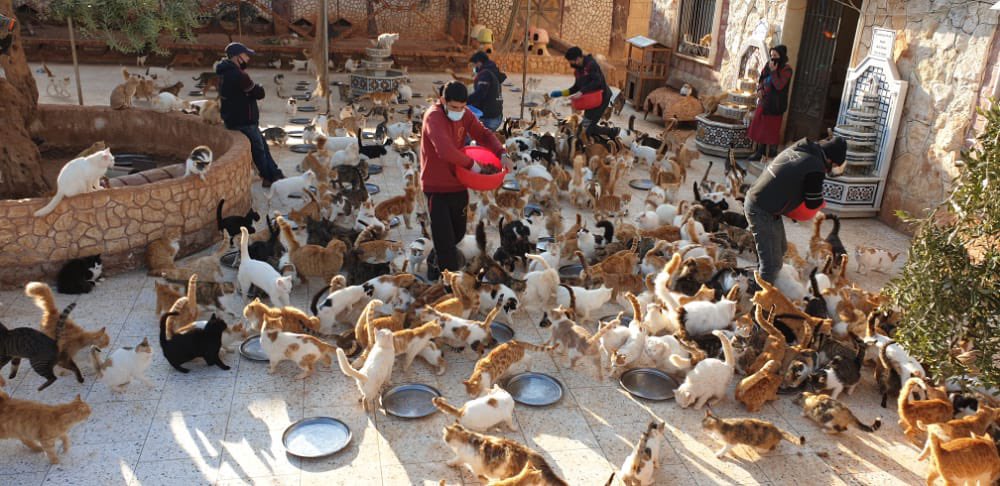
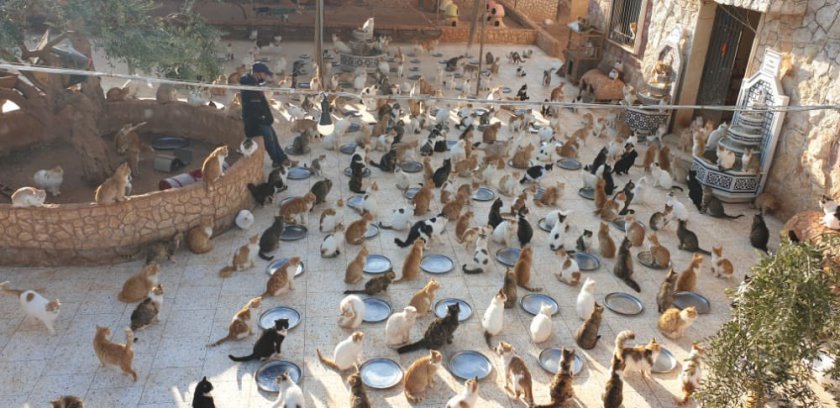
Even in war, cats know when it’s time to eat. The kitties of Ernesto’s Paradise wait by the more than 100 plates set out for them, eager for meal time. Credit: Ernesto’s Sanctuary.
That sanctuary is called Ernesto’s Paradise, named after Aljaleel’s own cat.
Ernesto’s Paradise is home to several hundred cats, plus four monkeys, horses, rabbits and dogs. There’s a playground for kids and — after a long search to find a veterinarian who hadn’t fled — Ernesto’s finally has a doctor in the house too.
The civil war in Syria has created perhaps the worst refugee crises in modern history, with millions fleeing to Europe and elsewhere in search of sanctuary.
The war had claimed 387,118 souls as of December 2020, according to the UK-based Syrian Observatory for Human Rights. Another 205,300 were missing and presumed dead, according to SOHR. In addition, more than 88,000 people have been tortured to death in Assad’s prisons, while thousands more were taken by ISIS and other terrorist groups operating in the country.
But “children and animals are the big losers” in war, Aljaleel told the BBC, and that’s why he chose to return.
“I’ve always felt it’s my duty and my pleasure to help people and animals whenever they need help,” he said. “I believe that whoever does this will be the happiest person in the world, besides being lucky in his life.”
You can follow and support Aljaleel’s work via Twitter, Facebook and by visiting his sanctuary’s official site. Direct donations to the sanctuary can be sent here.





 Pain In The Bud