Humans Are An Alien Invasive Species, New Study By Feline Science Institute Finds

Humans are an invasive species who are spectacularly adept at destroying life, a new study has found.

Homo sapiens are an invasive species who do irreparable harm to the environment and other animals on an unprecedented scale, a new study by the Feline Science Institute has found.

The results prompted feline scientists to add homo sapiens, commonly known as humans, to a database of destructive and invasive animals maintained by the Academy of Scientific Studies.

Cat scientists have only just glimpsed the breadth of human-initiated impact on other animals, Dr. Oreo P. Yums, lead author of the newest research paper, told reporters.

“We found humans are astonishingly, almost indescribably destructive,” Yums said. “For instance, although they fret about birds, humans kill more than a billion of them a year just with their skyscrapers, which birds are prone to fly into due to their mirrored surfaces. Add in wind turbines, cell towers, power lines, habitat loss and slow die-offs due to chemicals, and by conservative estimates we’re talking about billions of birds killed by humans every year without even tallying active measures like hunting.”

Humans have killed off an estimated 70 percent of the world’s wildlife in the last 50 years alone and show no sign of stopping. Oceans are overfished, animals like pangolins and big cats are ruthlessly hunted to extinction to feed demand within the Chinese traditional medicine market, and human addiction to palm oil means the “two-legged demon monsters don’t even have sympathy for their fellow primates,” mewologist Charles Clawin said.

“In Borneo and Sumatra there are entire schools, filled to capacity, for critically endangered orangutan babies who were orphaned by human contractors clearing ancient jungles to make room for more palm oil plantations,” he said. “Often, the humans use industrial equipment to tear down trees while the orangutans are still in them. Other times, they dispatch the mothers with pistols, not realizing there are babies clinging to them.”

In Africa, where the elephant population has plummeted in the last century, more than 110,000 elephants have been slaughtered in the past 10 years alone for their tusks. The elongated incisors are used to make jewelry and piano keys, and items made from ivory have become a status symbol in China, where growing middle and upper classes seek to show off their wealth with luxuries.

In 2019, Chinese businesswoman Yang Felan, dubbed the “Ivory Queen,” was arrested and charged with smuggling $2.5 million worth of tusks from Tanzania to her home country. Yang, “a key link between poachers in East Africa and buyers in China for more than a decade,” was a respected businesswoman, investor, restaurateur and vice chairwoman of the China-Africa Business Council.

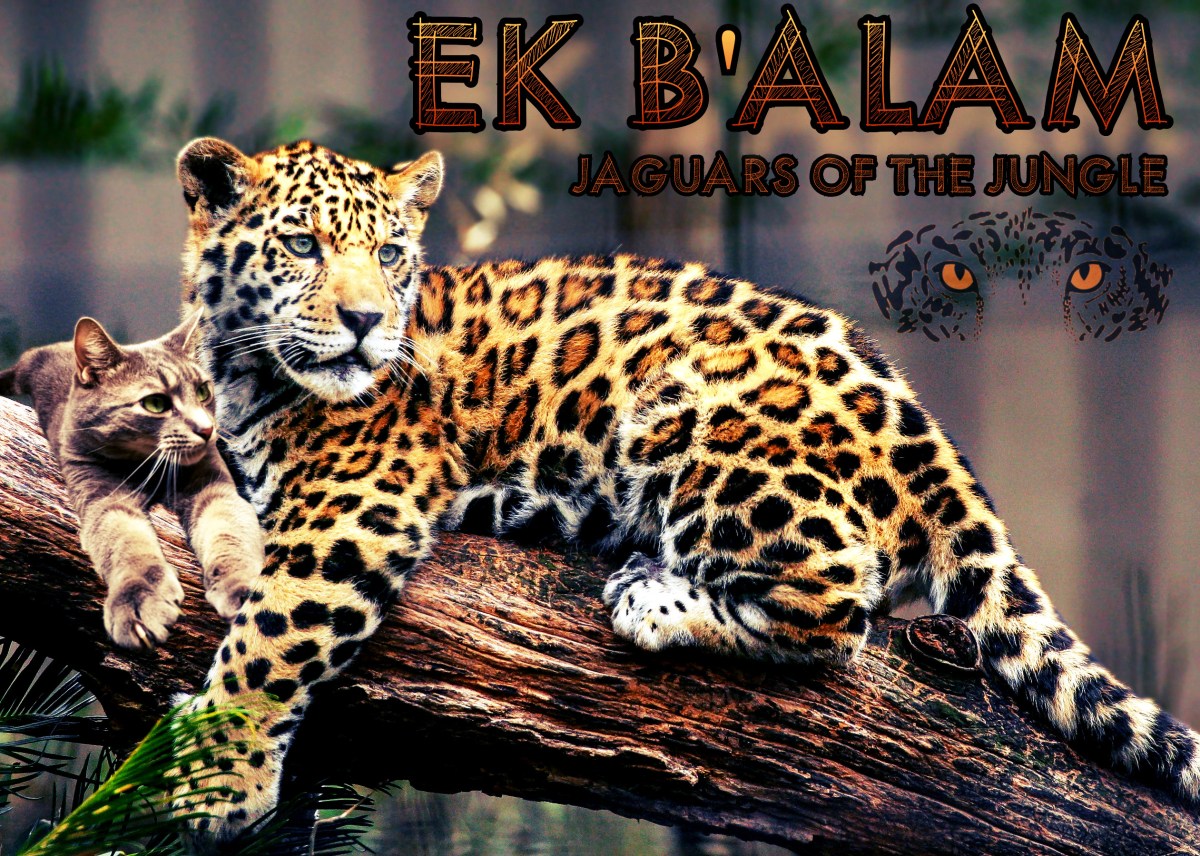
“Poachers continue to slaughter elephants and our big cat brothers and sisters,” said Luna Meowson, who tracks the illegal wildlife market for the University of Nappington. “Having extirpated tigers from virtually their entire range, poachers are turning to South America, where jaguar poaching increased 200 fold between 2015 and 2020. It never stops.”
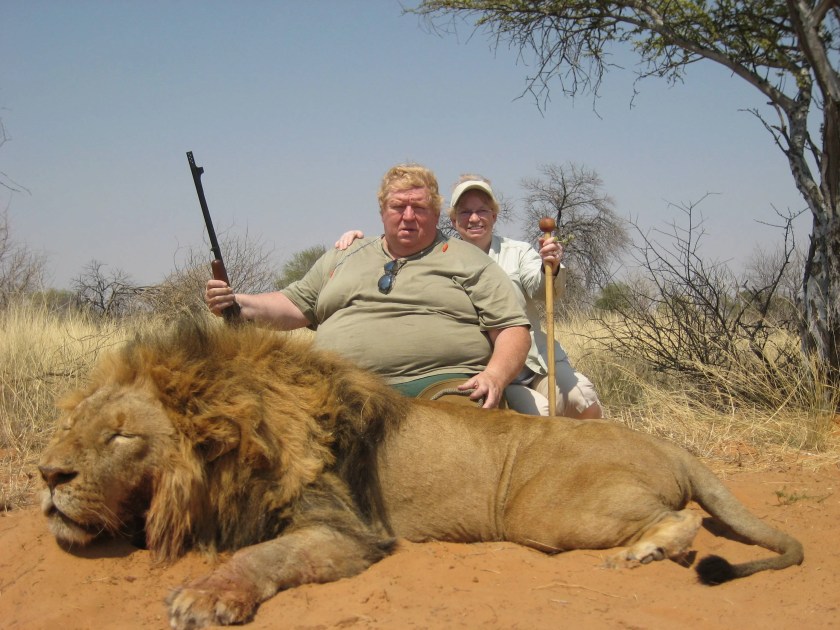
Big Bruce the Lion Slayer
A human hunter poses victoriously after heroically slaying a lion (panthera leo) from atop his trusty steed, a mobility scooter, after a team of guides drove him around the bush in an air-conditioned SUV, then lured the animal directly into his line of sight. A female of the species, presumably his mate, looks on proudly.

Although the earliest details remain murky, fossil records show Homo sapiens first emerged in Africa about 200,000 years ago. The invasive species, which has a gestation period of about nine months, began rapidly breeding and immediately went to war with fellow members of the genus Homo.

After wiping out two-legged rivals including Homo neanderthalensis, Homo altaiensis, Homo denisova and Homo bodoensis, the victorious Homo sapiens set their eyes on other species. Throughout their history they’ve also proven remarkably adept at murdering themselves and continue to hone their skills.

“Those OG humans, they had to really work at slaughtering other species and extirpating wildlife,” said Chonkmatic the Magnificent, King of North American cats. “They didn’t have attack helicopters, stealth bombers, tanks, carrier battle groups, daisy cutters, artillery, mortars, phosphorous, napalm, biological weapons, or even small arms like rifles. In those days a pimply kid from Oklahoma sitting in an air-conditioned base in Virginia couldn’t wipe out an entire city 5,000 miles away by pressing a button ordering a drone to drop a nuke. They had to put some sweat into violence, you know?”

522616
Breakthroughs in recent centuries have led to innovative and more convenient ways for Homo sapiens to author mass destruction and render entire sections of the Earth lifeless.

The species, known for its aptitude for tool-making in addition to eating ultra-processed foods and staring at screens, began with simple tools of destruction like the Mark I Spear, early bows and even torches. Over the centuries they innovated, coming up with clever and inventive new ways to inflict pain and end life until the advent of electricity, the industrial era and the brutally destructive war machines of modern times.

Human scientists have tried to obscure their species’ impact on wildlife and the planet by declaring species like felis catus “invasive” and “alien,” but even if cats are “guilty of grabbing a forbidden snack every now and then,” they don’t have the coordination, technology or will to carve up habitats, render entire swaths of the Earth uninhabitable with nuclear fallout, create Everest-size mountains of garbage, or effortlessly drive millions of species to extinction, Clawin said.

“They’re so good at it, they don’t even have to try,” he noted, pointing out human accidents or incidents of negligence like oil spills and chemical run-off into rivers. “We tend to think of humans out there with shotguns and rifles, cackling maniacally as they shoot anything that moves. And, sure, they do that, especially in places like Texas where the sight of any animal always prompts the question ‘Should we shoot it?’ But our research shows they can wipe out entire categories of fauna in their sleep. It’s remarkable.”

Additional reading: Polish institute classifies cats as alien invasive species

Does Your Cat Know Your Name? Study Says Maybe

If your cat doesn’t know your name, it’s nothing personal. You’re just a human, after all.

I’m pretty sure Buddy does not know my name, and why should he?

He doesn’t hear my name spoken often, and in his mind I’m probably “Big Dumb Benevolent Human And Butler,” or BDBHAB. That’s a mouthful, even in meow, thus the much easier-to-say “Big Buddy.”

But a new study from Japan claims cats “possibly” know the names of their humans.

First, the parameters of the study would have eliminated the Buddies from the start: the research team from Kyoto University enlisted only cats who lived with at least two other felines. This is because they also wanted to find out if cats knew the names of their furry roommates as well.

The 48 cats who participated in the study lived in regular homes or cat cafes. The team played a recording of their human calling the name of one of their buddies, while a monitor showed an image of a cat. Sometimes the names and the images matched, and sometimes they didn’t.

The cats took longer looks at the images when the feline image shown didn’t match the name they heard, which the researchers said was indicative of surprise.

Separately, 26 cats were run through a similar experiment. In that scenario, the researchers played an audio clip of the cat’s human’s name and showed an image of either the human caretaker, or a cat. Like they did with the first experiment, cats looked longer when the images didn’t match the names, expressing apparent puzzlement.

What's your name, dude?
“I’m a Buddy, you’re a Buddy. We’re all Buddies.”

In case you’re wondering, it does seem to matter if a cat grows up in a home rather than a cat cafe. When the name and face matched, researchers called that a “congruent condition.”

“Half of the trials were in a congruent condition where the name and face matched, and half were in an incongruent (mismatch) condition,” they wrote. “Results of Exp.1 showed that household cats paid attention to the monitor for longer in the incongruent condition, suggesting an expectancy violation effect; however, café cats did not.”

The reasons are fairly straightforward. In a home setting, cats almost always interact with their human family members, while felines in cafes interact with different employees on different shifts, and with customers, who might be regulars or strangers. Either way, the cats living in homes are much more likely to hear their own names and the names of their feline roommates.

“The latter probably have more opportunities to observe interactions between the owner and each of the other cohabitating cats, which might facilitate learning of the face–name relationship,” the team wrote.

The Kyoto team pointed out that many wild animals, particularly mammals and birds, make sounds that correspond to animals, objects or abstract ideas. Monkeys and birds, for example, use a range of different calls to communicate to each other when they’ve found food or spotted a predator heading their way.

The stakes are much lower in a home setting, but evolutionary traits can still serve cats and dogs well. One reason pets may be keen to recognize the names of their furry roommates, the research team speculated, is competition. After all, Socks would want to know if Oreo is getting more treats or head scritches.

Can Cats Feel Jealousy?

While the answer is obvious to cat servants, proving feline jealousy in a study is a different ballgame entirely.

Bud isn’t fond of my smartphone.

Like many other humans I spend too much time looking at the damn thing, and that’s not good even though I have the excuse that I use my phone as a reader and my presence on social media ranges from extremely limited to nonexistent.

When His Grace has decided I’ve looked at the screen long enough and it’s Buddy Time, he’ll pad up and slap the phone out of my hands, or if I’m laying down he’ll climb on top of me, nudge the phone out of the way and sit on my chest so he has my full attention.

“No glowing rectangle!” he’s saying. “It’s Buddy Time! Now scratch my chin and rub the top of my head as I purr!”

Naturally I comply, and before long Buddy is leaning in, pressing the top of his head against my forehead, which is his way of saying: “I love you, slow dumb human! You have many flaws and you don’t give me enough snacks, but you’re my Big Buddy!”

Of course, intuitively knowing Buddy is jealous of — or annoyed by — my phone is different than proving it in a well-designed, repeatable experiment.

Psychology Today’s Jessica Wu writes about just such an effort by a team of researchers out of Japan.

Before I offer my criticism of the study, let me first say I have respect for the team at Kyoto University. They’re one of a handful of research teams around the world that routinely produce studies into cat behavior and cognition, and it’s clear that they view it as an important and crucial area of research. That’s significant, because even though we’ve seen something of a renaissance in cat-related studies over the past half-decade or so, many scientists still think cats are nearly impossible to work with.

The team at Kyoto also understands the territorial nature of cats makes it difficult to study them in a lab environment, so they go the extra mile and enlist people who are willing to let them into their homes to study their little tigers.

That’s what the Kyoto team did for their 2020 study on jealousy, splitting their research between typical homes and cat cafes. (Fifty two cats in total participated.) All the cats observed in the study had been living in their homes or cafes for at least six months.

Researchers took a method that’s been used to study human babies and dogs, and adapted it for felines. They brought in a plush cat and a pillow with a corresponding color and texture.

Then they asked the participants to spend time petting the plush cat and the pillow in front of their furry overlords while team members carefully watched the kitties for their reaction. Each experiment was then repeated with a stranger petting the plush and the pillow to gauge whether cats behaved differently when observing someone they aren’t emotionally attached to.

The team found the cats “reacted more intensely” to the plush cats than the pillows, but there wasn’t any marked difference in how they reacted when they watched their humans versus strangers.

Crucially, the cats didn’t show signs that they were upset, like human babies have in such experiments, and they didn’t try to physically separate their humans from the plushies, as many dogs did in their version of the experiment.

jealous-cat
“How dare you hand out yums and not include me!” Credit: icanhazcheezburger

The results indicate cats didn’t express jealousy in the experiment, but the Kyoto team are pros, noting that it’s just one study with one approach.

“We consider the existence of some cognitive bases for jealousy to emerge in cats, and the potential effect of cats’ living environment on the nature of their attachment to their owner,” they wrote. “More ecologically valid procedures are required for further study of these issues.”

It’s my non-expert, non-scientific opinion that researchers would get better results using actual cats instead of proxies. That introduces a new set of problems and an experiment involving rival cats won’t be easy, but science isn’t supposed to be easy, and if we really want to understand how cats think, we have to get as close as possible to mimicking real circumstances.

Plush Cat in Kyoto study
The plush cat used in the Kyoto study. Perhaps the cats involved in the research felt the humans were insulting their intelligence. Credit: Kyoto University

It would also help to expand the scope of the experiment. How much can researchers really glean from a fleeting interaction? Jealousy isn’t something that just bubbles up and disappears. It happens within an emotional context. It’s a secondary emotion that sprouts from elements of primary emotions like fear, anger and confusion.

Scientists are very careful about anthropomorphizing animals, for obvious reasons, but sometimes they’re guilty of over-correcting as well and denying the obvious, which is why the prevailing scientific opinion for almost half a century, until 1959, was that animals don’t have emotions or cognition.

In the meantime, Buddy will continue to make sure Buddy Time is equal to, or greater than, glowing rectangle time.

Study: Cat Brains Have Gotten Smaller

Thankfully for our furry friends, smaller brains don’t necessarily correlate to lower intelligence. It’s more about the complexity of neural connections.

Cats have gotten a good deal out of domestication: They’re safer, warmer and protected from almost all threats. They know where their next meal is coming from, and won’t hesitate to meow our ears off if dinner is late.

But one tradeoff doesn’t immediately appear beneficial: Domestic cats have smaller brains than the species they’ve evolved from, African and Eurasian wildcats.

“[D]omestic cats indeed, have smaller cranial volumes (implying smaller brains) relative to both European wildcats (Felis silvestris) and the wild ancestors of domestic cats, the African wildcats (Felis lybica),” the research team wrote.

Wild cats have the largest brains on average, followed by wild-domestic hybrids and domestic cats with the smallest brains of the three.

That’s another strong indicator that domestication is the determining factor in feline brain size, although the researchers point out that they are comparing domestic cats to current wildcats, and not the ancient population of wildcats from which domestic cats evolved beginning some 10,000 years ago with the dawn of agriculture and permanent human settlements.

Wildcats with friendlier and bolder dispositions were the first to approach human settlements, drawn by the rodents who were themselves feasting on human grain supplies. Humans realized that the cats were taking care of their rodent problems but weren’t interested in eating the grain, and a beautiful partnership was born.

superhandsomebuddy1
“I have a yuge, yuge brain, the best brain. It’s tremendous.”

Smaller brains do not necessarily correlate to lower intelligence, however, and cats aren’t the only species whose brains became smaller after they were domesticated. Dog brains are about 30 percent smaller than the brains of gray wolves, but dogs have adapted spectacularly to living with humans and reading human behavioral cues.

“The dog is successful not because of the size of its whole brain per se, but because domestication has led to subtle brain changes with a stunning result: the ability to live in the world of people,” a Smithsonian Magazine article points out, noting dogs are also adept at getting people to do all sorts of things for them.

If brain size alone resulted in higher levels of intelligence, whales and elephants would rule the Earth.

Instead “the complexity of cellular and molecular organization of neural connections, or synapses, is what truly determines a brain’s computational capacity,” neuroscientist Kendra Lechtenberg wrote.

The researchers weren’t interested in drawing any major conclusions about feline cognition with the study. They’re more interested in the phenomena of “domestication syndrome,” which causes changes both physical (floppy ears, coat color variation, shorter muzzles) and behavioral. (Less aggression, playfulness.)

The jury’s still out on why exactly those traits emerge, but some studies have attributed it to differences in embryonic development. Unlike many other domestic animals, cats don’t look much different than their wild felis lybica and felis sylvestris counterparts.

The cat study was published on Jan. 26 to Royal Science Open Science, a peer-reviewed open-access journal. The research team was comprised of biologists from the University of Vienna and data curators from the National Museum of Scotland.

Buddy Condemns Scientists Who Claim Cats Are Psychopaths

The lead author of a UK study claims it’s “likely that all cats have an element of psychopathy.” Buddy the Cat disagrees.

NEW YORK — Buddy the Cat condemned British scientists who pegged cats as psychopaths in a new study, saying he’d like to “introduce them to my claws,” if not for the fact that he’s too charming to do something so uncouth.

“I was offended when I read that study, frankly,” Buddy said, pausing to spit out the bones of a mouse he’d just killed and sip from his bird blood cocktail. “The very idea is preposterous.”

Psychologistsfrom the University of Liverpool and Liverpool John Moores University developed a questionnaire that asks cat owners servants to rate their felines’ behavior based on 46 different behavioral statements.

Examples of the statements include: “My cat torments their prey rather than killing it straight away”, “my cat vocalises loudly (e.g meows, yowls) for no apparent reason”, and “my cat is very excitable (e.g goes into ‘overdrive’ and becomes uncoordinated).”

Respondents were asked to rate, on a 5-point scale, how closely each statement applied to their cat(s).

“Asking our servants to respond to the survey was the first mistake they made,” Buddy continued, using a claw to dig bits of mouse from between his teeth. “I mean, do you ask Beethoven’s gardener to evaluate the master’s symphonies? Would you ask the overnight office cleaning crew at Apple to gauge the brilliance of Steve Jobs? Would you ask Brian Scalabrine to weigh in on the transcendent talent of Michael Jordan? Of course not. So why would you ask my human to evaluate me? Why would you think such a simple creature could hope to understand the cathedral that is my mind?”

“And furthermore, why should I care? Does the lion concern himself with the opinions of sheep? I’m officially a jaguar, by the way. I don’t know if you knew that. Yeah. They welcomed me into their mystic community and call me Kinich Bajo, which means ‘god of wisdom.'”

Personality traits like delusions of grandeur, charm, lack of empathy and narcissism are typically associated with psychopaths, experts say. A psychopath might, for example, imagine he’s a large, muscular cat when in fact he’s 10 pounds soaking wet.

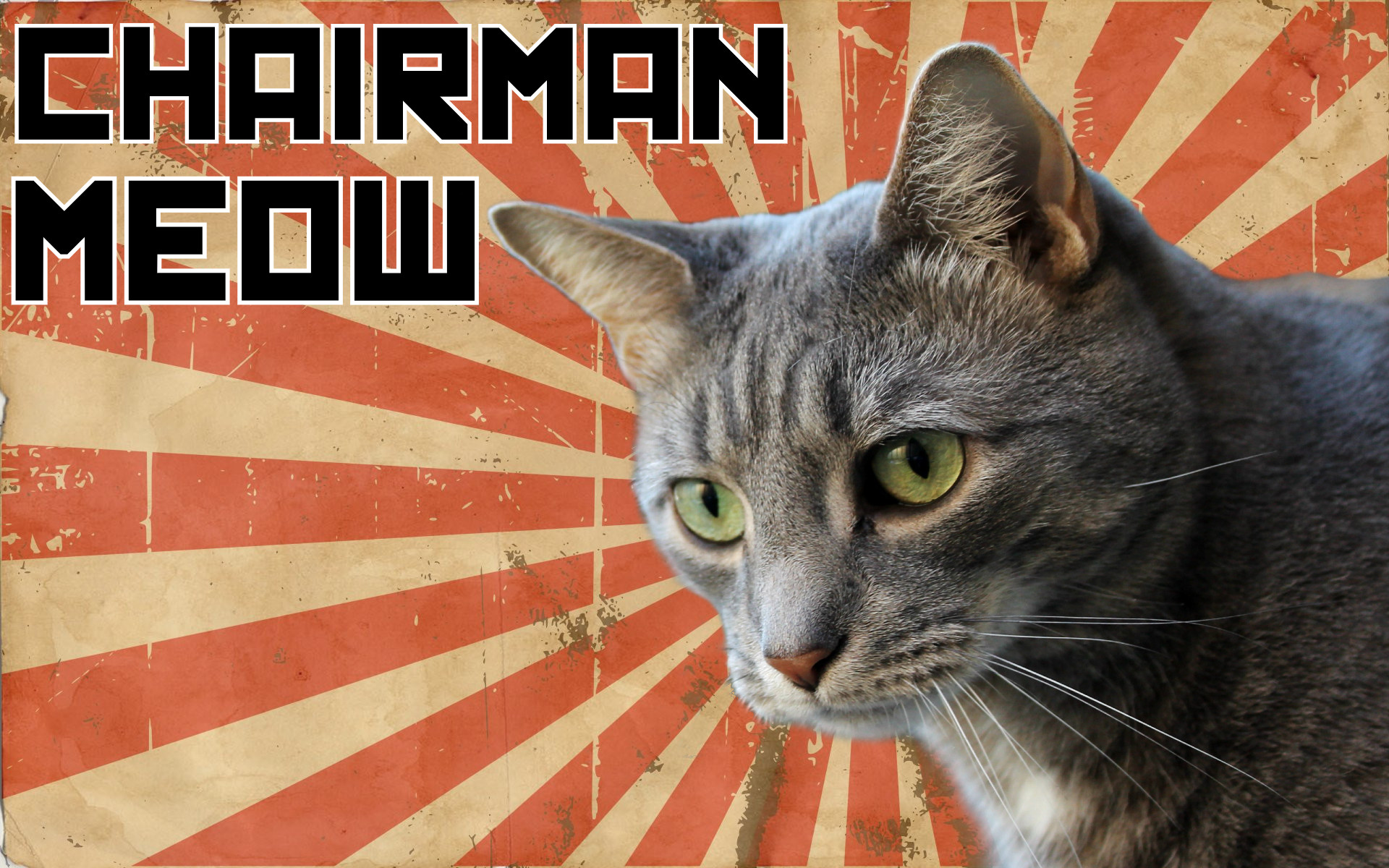
chairmanmeow3
Buddy imagines himself as a powerful authoritarian leader

The degree of psychopathy varies widely among felines, lead author Rebecca Evans said.

“We believe that like any other personality trait, psychopathy is on a continuum, where some cats will score more highly than others,” Evans said. “It is likely that all cats have an element of psychopathy as it would have once been helpful for their ancestors in terms of acquiring resources, for example food, territory and mating opportunities.”