At Almost 700lbs, Hercules The Tiger Is A Symbol Of His Species’ Comeback

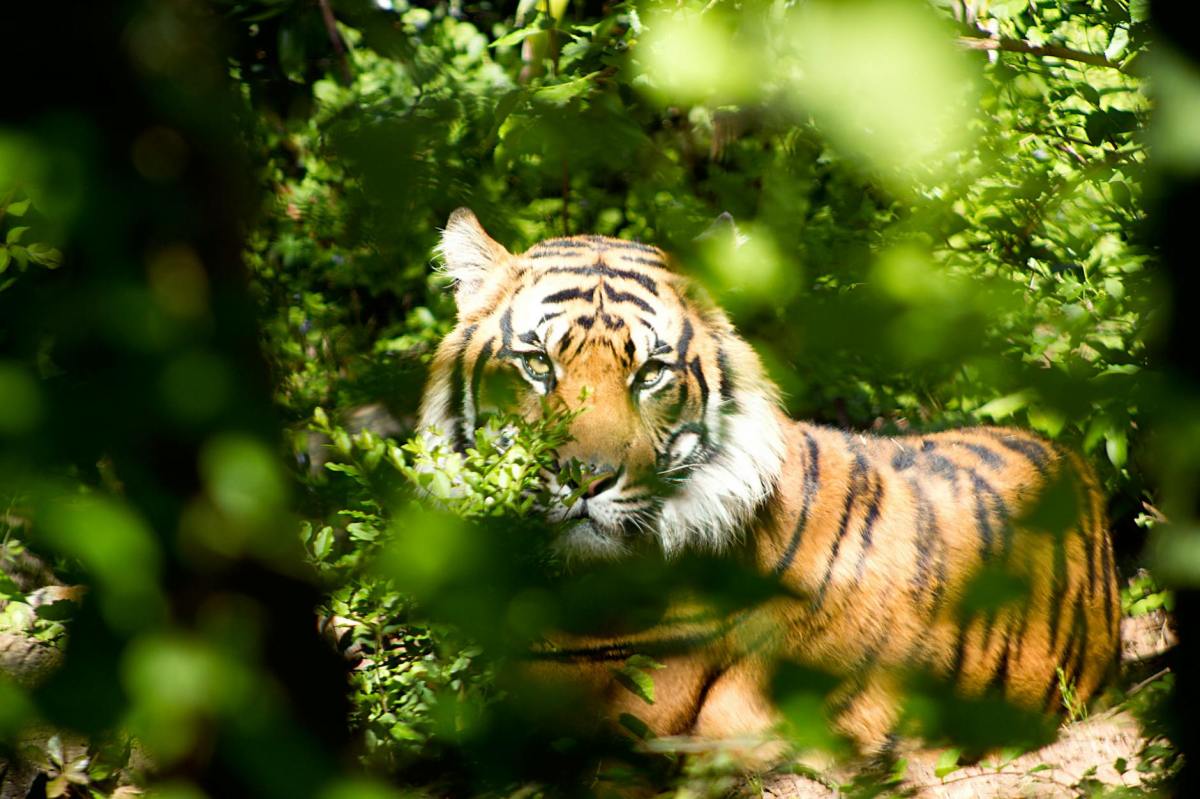
The huge Bengal may be the biggest tiger in India, and has already become a draw for tourists visiting from other parts of the country.

Hercules looks like a heavyweight boxer reincarnated as a tiger.

The massive apex predator was virtually unknown outside of India’s Kumaon district until this week, when a tourist posted a short video of the nearly 700-pound animal lumbering out of the brush and into clear view as he crossed a dirt path between rural villages.

The Bengal, who may be the biggest cat in India, is majestic. His gait is leisurely, as if he knows that anyone or anything he may encounter will clear a path the moment they see him. His fur doesn’t hide the rippling muscle underneath, and as he spots a group of tourists with cameras aimed at him, he bares his teeth momentarily, then pretends as if they don’t exist as he takes his sweet time crossing the path.

“In my entire career, I have never seen such a giant tiger,” Prakesh Arya, a divisional forest officer, told the New Indian Express.

For conservationists, tourists and the government of India, whose national animal is the Bengal, Hercules’ existence is proof that Project Tiger is on the right track. The project is a national effort to save the iconic species, grow its population, and protect it from poachers.

Hercules’ territory includes Ramnagar, a town in northern India known as they gateway to Jim Corbett National Park. The preserve is named after the renowned tiger hunter who took down the Demon of Champawat, a tigress who had killed at least 435 people during a decade-long rein of terror.

Corbett, who described tigers as “large-hearted gentlemen” who were unfairly maligned, was known for his prowess in hunting down man-eating tigers and leopards, but later in life he turned to conservation, realizing that Earth’s biggest cats were in danger of extinction if drastic efforts weren’t taken to save them. That was a century ago.

Now India devotes significant resources to their protection and well-being, with an entire corps of dedicated professional rangers and anti-poaching teams tracking the animals and constantly patrolling the vast country’s 58 tiger preserves, which cover 82,836.44 square kilometers.

A large tiger cools off in water on a hot day. Credit: Warren Garst/Wikimedia Commons, Colorado State University Library

For tigers like Hercules, having large contiguous ranges gives them the chance to live the way nature intended. Experts say the abundance of prey in the reserves, especially in the region Hercules calls home, has resulted in larger, more robust cats of the type that were once a memory.

“This is a clear symbol of the rich biodiversity and the success of our management efforts in this forest area,” Arya said.

In turn, the presence of the iconic cats has revitalized tourism. Tourists who have seen Hercules described the experience as “overwhelming.”

“Seeing ‘Hercules’ was an unforgettable experience,” Priya Sharma, a tourist from Delhi, told the Express.


‘Best Video Of A Lynx We’ve Ever Captured’: Wild Cat Shows Off For Camera

The trail camera is operated by a team studying the behavior of wolves, but this felid became the main character for a short while, posing majestically right in front of the lens.

Happy Monday! We’re starting the week off in style with an amazing video courtesy of the Voyageurs Wolf Project.

As its name implies, the project is a collaboration between wildlife biologists, ecologists and academics to learn more about wolves, specifically how they survive in the summer months.

While there’s a wealth of research on the behavior of wolves during winter, the pack animals go their separate ways in the warm weather to raise newborn cubs and hunt smaller prey.

Because it’s much more difficult to track individual wolves under the cover of heavy brush compared to following entire packs in the snow, the project relies on a combination of GPS collars and trail cameras. The latter pick up all sorts of wildlife in the Minnesota wilderness, which is how the Voyageurs Wolf Project captured this clear, close-up footage of a stunning medium size wild cat:

That’s lynx canadensis, better known as the Canadian lynx, and the footage is so perfect it’s as if the wild cat said “Ah, a trail camera! I’m gonna sit right here and let the humans see how beautiful and regal I am!”

From its pronounced ear tufts to its snow-soft fur and dark stump of a tail, this lynx is a fantastic example of its species. Canadian lynx are well adapted to the demands of their environs in Canada and the northern US, with heavy coats and soft, wide feet that allow it to traverse snowy landscapes quickly and silently.

They’re famously elusive and difficult to track in the wild, but maybe all we have to do is give the lynx a chance to strut its stuff.

Top image credit Carlos Delgado/Wikimedia Commons.

Larry The Downing Street Cat Outlasts Another PM, Plus: The Reason For The Loaf

Loafing Larry’s outlasted Liz and Liz’s lettuce. Lucky lad!

No. 10 Downing Street in London is supposed to be the official residence and office of the UK’s prime minister, but we think it should be called Larry’s House.

Larry, the official mouser in chief since 2011, has now outlasted four prime ministers: David Cameron, Theresa May, Boris Johnson, and the short-tenured Liz Truss, who lasted just 44 days. (And became the butt of jokes when The Daily Star set up a live webcast of a head of iceberg lettuce, betting that Truss’s time as PM would be over by the time the lettuce wilted. The lettuce won.)

Now Larry, the de facto leader of the UK, will be served by a fifth prime minister. There’s also a chance he’ll see his fifth prime ministerial term, if not officially a fifth prime minister, if Johnson manages to return to power. Apparently there’s a real chance of that happening.

Why the loaf?

Buddy Loafing
How dare you suggest Buddy is chubby!

If you’ve ever wondered why your cat likes to lay in the famous loaf position, Jackson Galaxy has weighed in on the matter. (There’s a British theme here too. For some reason Galaxy, real name Richard Kirschner, uses a British accent to explain loafing behavior, and it’s…not good.)

“The first thing that we want to look at is the position itself; we’ve got paws tucked under the whole body resting basically on arms,” Galaxy says in a video. “This look right here is decidedly cat. Because what this is saying is I’m not going anywhere.”

Cats loaf to conserve body heat while remaining in a position that allows them to quickly get up if need be. Galaxy cautions, however, that a “half loaf” position could indicate your cat isn’t feeling too hot, health-wise.

If a cat is half-loafing, he says, that could mean she’s not getting completely comfortable because she feels vulnerable, and for evolutionary reasons (cats are both predator and prey) cats in pain feel particularly vulnerable. Most predators go for the easy kill, which is why cats go to great lengths to disguise pain and discomfort, as opposed to us humans, who whine and complain and make sure everyone knows how lousy we feel.

Bud Attentive Loafing
Meowscles coiled, ready to unleash feline fury!

Got A Rat Problem? Get A Cat To…Befriend It And Groom It?

If you can’t beat ’em, join ’em?

Cats and humans began their grand partnership some 10,000 years ago, when kitties handled humans’ pesky rodent problem and people repaid the felines with food, shelter and companionship.

Now the deal’s off, apparently.

Yesterday a Reddit user shared a video titled “When you get a cat hoping it will help you get rid of the big rat in your yard.”

The video shows the user’s new cat, a tortoiseshell/calico, “solving” the rat problem by befriending the rodent, playing with it and even grooming it.

The video has amassed almost 86,000 upvotes in 24 hours.

The odd friendship between feline and rodent is not without precedent. Studies have shown that cats are not effective rodent hunters in urban settings where rats have gone unchallenged for so long that they rival or exceed the size of most members of Felis catus.

In certain neighborhoods of New York City, for example, researchers observed cats essentially ignoring massive rats and in some cases eating trash side by side with them. The largest rats, apparently aware of the truce, are equally unconcerned by the presence of the cats. Other rats were more cautious around kitties.

The scene reminded me of the time my brother wanted me to bring Bud over to handle his rat problem. At the time he was living on 88th St. in Manhattan, less than a block from Gracie Mansion. His apartment had an unusual perk for Manhattan living — it was a spacious ground floor flat that opened up into a private, fenced-in backyard with grass and a few trees.

Mighty Bud
Tremble before him! Buddy the Mighty Slayer of Rodents!

In fact, it was one of the first places I took Buddy after adopting him. He was just a kitten, maybe 14 weeks old, and I brought him with me on a warm summer day when my brother had a few friends over for a barbecue.

Buddy made fast friends with my brother’s Chihuahua-terrier mix, Cosmo, and spent the day playing with his doggie cousin, frolicking in the grass and chasing bugs around the yard. Then he got a treat: Steak from the grill, chopped into tiny Buddy-size pieces.

Having a backyard in Manhattan was awesome, but there was a downside. At night the yard was like a stretch of highway for marauding rats who ran across it in numbers with impunity, probably en route to raiding the garbage bins of a bodega on the corner of 88th. The rats were so emboldened and so numerous, you could hear them scurrying across the yard at night.

My brother proposed bringing Buddy over and letting him loose in the yard after dark, letting his claws and predatorial instincts thin the rodential herd.

I declined, using the excuse that Bud could pick up diseases from going to war with the rats. That was true, but I’m sure it wouldn’t have come to that: At the first sign of those rats, Buddy would have run screaming!

(We don’t acknowledge that around him, of course. Officially, Buddy was not set loose upon the Manhattan rats because it would be grossly unfair to unleash such a meowscular, brave and battle-hardened feline warrior upon them.)

It’s one thing if Buddy won’t kill rats. He’s a wimp. But as the Reddit video illustrates, we are apparently closing the chapter on 10,000 glorious years of human-feline partnership, and officially entering the Era of Zero Reciprocity.

We do everything for our cats, and in return they nap, eat and allow us to serve them. From their point of view, it’s a fine deal.

Meowscular Buddy!
Just look at those meowscular guns and vicious claws!