The palm oil and logging industries have killed so many orangutan mothers, there are now more than a dozen major orangutan orphanages in Borneo and Sumatra. The pressure on orangutans, with whom we share 97% of our DNA, shows no signs of abating.
Orangutans are critically endangered, and the biggest threat to their continued existence comes from the agricultural sector, which has razed 55 percent of the species’ habitat in recent decades.
Jarang, a baby orangutan born in 2023. Credit: Blackpool Zoo
Logging companies clearing irreplaceable, old-growth jungle to claim more land for palm oil plantations have no compunction when it comes to flattening jungles despite the presence of orangutans hiding in the trees. The loggers often shoot the large apes on sight, leaving terrified, traumatized babies still clinging to their dead mothers, or taking them to sell as pets.
Of those left to die, the lucky babies are rescued before they starve and are brought to one of the many orangutan orphanages in Borneo and Sumatra, where they attend “school” to learn how to do everything from climb to forage. It takes at least eight years to teach them how to survive on their own, which is about the time it takes orangutan mothers to do the same job in the wild.
The unlucky babies end up as local pets, sold off to entertainment troupes or shipped off to places like Dubai, where wealthy clients will pay a premium for them.
Caretakers must start by teaching rescued orphans the most basic things, like how to climb and move through the jungle Credit: Borneo Orangutan Survival FoundationLogos, an orphaned baby orangutan who was rescued in 2023 by the Jakarta Animal Aid Network (JAAN) Credit: International Animal Welfare Fund (IAWF)Baby Galaksi (Indonesian for galaxy), was found wandering the jungle without his mother in 2021 by a villager in Borneo. He’s now in a “school” that teaches orphaned orangutans how to do everything from evading predators to discerning edible fruit from harmful and poisonous varieties. Credit: Samboja Lestari Orangutan Rehabilitation Centre
So what is palm oil, and why are countries in Asia bulldozing ancient jungles and forests to clear room and make more plantations?
Per the WWF:
“Palm oil has been and continues to be a major driver of deforestation of some of the world’s most biodiverse forests, destroying the habitat of already endangered species like the Orangutan, pygmy elephant and Sumatran rhino. This forest loss coupled with conversion of carbon rich peat soils are throwing out millions of tonnes of greenhouse gases into the atmosphere and contributing to climate change. There also remains some exploitation of workers and child labour. These are serious issues that the whole palm oil sector needs to step up to address because it doesn’t have to be this way.
…
Palm oil is in nearly everything – it’s in close to 50% of the packaged products we find in supermarkets, everything from pizza, doughnuts and chocolate, to deodorant, shampoo, toothpaste and lipstick.”
Palm oil is in constant demand, and it’s an easy to grow, incredibly efficient crop. Indonesia and Malaysia, the only two countries in the world where orangutans exist, produce 85 percent of the world’s palm oil.
Images of orangutan babies in wheelbarrows are common on social media, but usually stripped of context. Orphanages use the wheelbarrows to bring infants and toddlers to and from “school” every day. Credit: International Animal RescueAsoka was found crying in the jungle by a fisherman in Borneo. He was brought to an orphanage in Borneo. Credit: International Animal Rescue’s rehabilitation Centre in Ketapang, West Kalimantan
We share 97 percent of our DNA with orangutans, making the species our second-closest cousins from a genetic standpoint. Some studies claim orangutans are our closest relatives based on our phenotypical similarities.
Orphaned orangutans attending “school” to learn how to survive in the wild. Credit: Borneo Orangutan Survival FoundationA baby at an orangutan orphanage is fed by a caretaker. Credit: Borneo Orangutan Survival Foundation
Want to read more and learn how to help?
Here are some links to get you started. PITB is a big fan of the Jakarta Animal Aid Network, which successfully pushed Jakarta’s municipal government to ban the incredibly cruel “topeng monyet” monkey street shows:
The plan would allow bodega owners to certify their cats, eliminate city fines for keeping them, and help find homes for working felines if their stores shut down
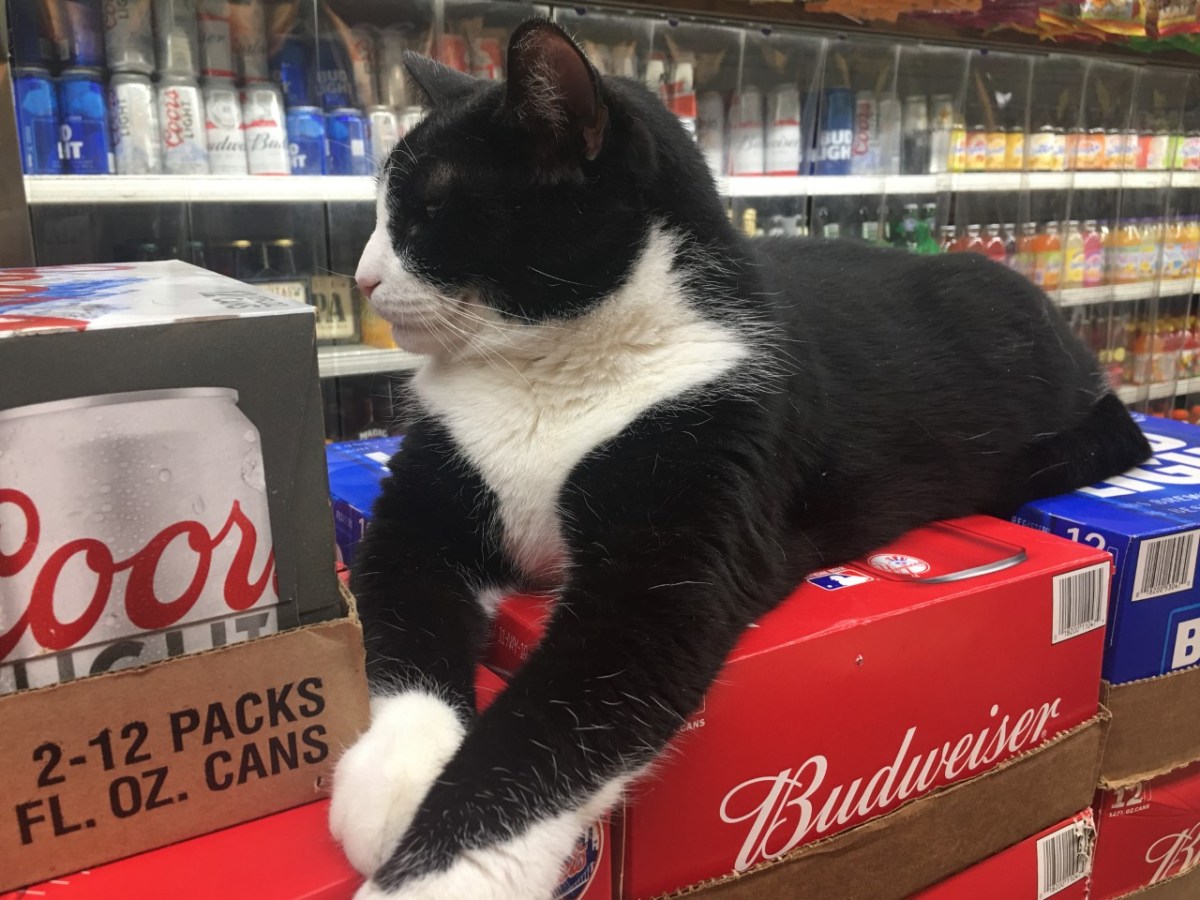
Cats have been a fixture in New York City’s bodegas for decades, but technically they’re illegal.
The fact that they’re so widespread, and owners of the small groceries/delis don’t try to hide them, underscores the absurdity of the situation. The fine for keeping a cat in a bodega in New York is $200 for the first offense, capping out at $300, but the fine for a rodent infestation starts at $300 and can rise to as much as $2,000 for repeat offenses. That’s in addition to the cost of bringing in pest control to get rid of the rats, which can easily add hundreds or more to an expensive problem.
So given the option between a maximum $300 fine with a clean, rodent-free shop, and potentially crippling fines — plus infestation — for rodents, thousands of bodega owners opt for the former. It’s a no-brainer.
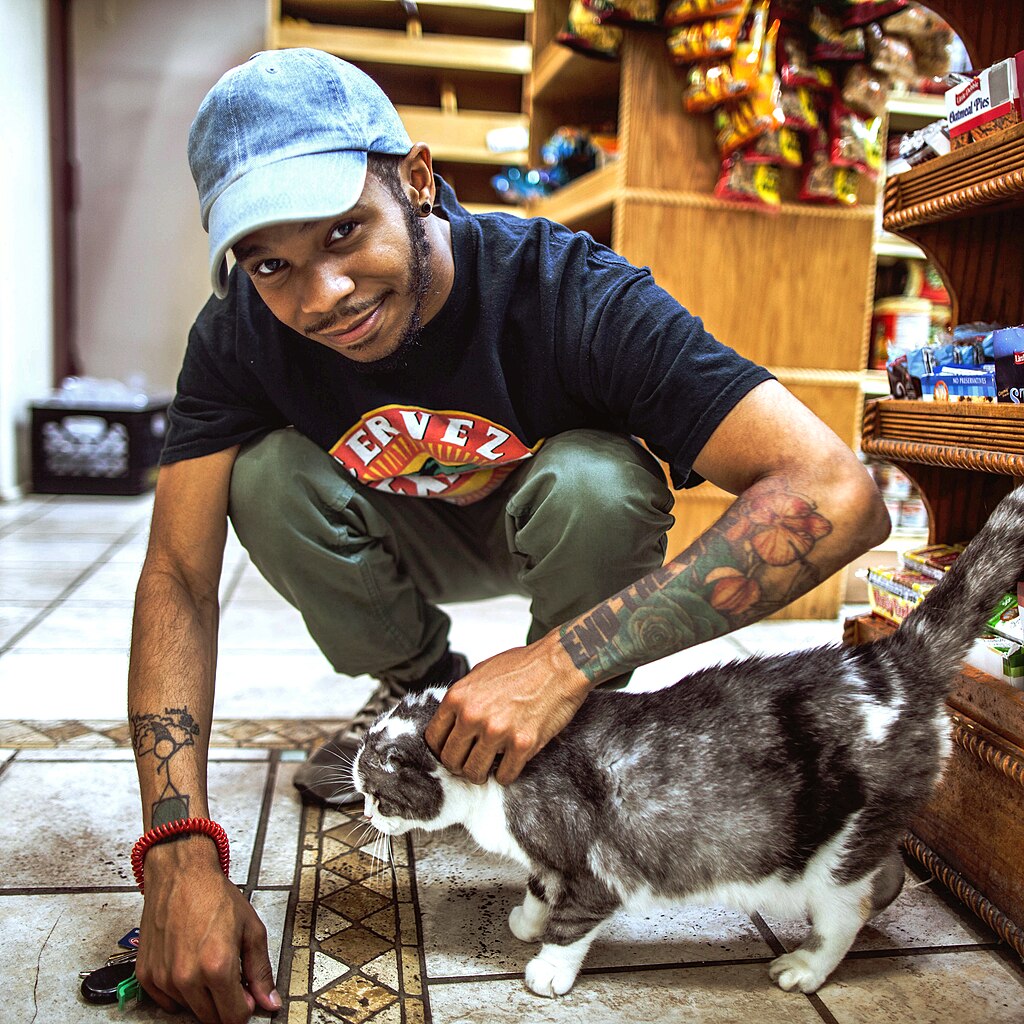
Kota, a bodega cat from Brooklyn. Credit: Wikimedia Commons
The cats are also favorites of customers, and bodega owners don’t hesitate to talk to media when their cats go missing, nor do they turn down Dan Rimada, who runs the extremely popular @bodegacatsofnewyork Instagram page.
Now Rimada is the man behind a petition that seeks to eliminate fines for the store-dwelling felines, establish a voluntary shop cat certification, and help bodega owners get veterinary care for their little helpers.
Rimada proposes soliciting seed money from city government as well as deep-pocketed donors in the pet food industry — “think Purina, Chewy, PetCo” — to establish a veterinary care fund for the city’s working cats.
“Through years of hands-on experience, I’ve witnessed both the charm of well-cared-for bodega cats and the harsh reality of neglect when standards aren’t met,” Rimada wrote in the petition, which has almost 5,000 signatures as of Feb. 28. “In conversations with rescue organizations and experts in public policy, business, and technology, we’ve designed a realistic, community-driven solution.”
Credit: @bodegacats_/Twitter
The fund would help cover the costs of care, with additional “micro-loans” available for emergencies.
Rimada envisions it as a triple win for the shop owners, rescuers who will be compensated for their time, and most importantly, the cats. If city leaders are willing to engage, Rimada says he hopes to conduct a year-long pilot program to see what works and what would need tweaks, with input from rescuers, veterinarians and the people who care for the cats.
The petition and resulting plan was inspired by cases like that of Kobe, a Hell’s Kitchen bodega cat who almost died of a urinary infection when the owners of the bodega balked at paying veterinary bills.
A historian casts doubt on tales of widespread cat purging, tracing the origin of the claims to a novel published in the 1990s.
The Washington Post has a new guide for taking better photos of cats and dogs with some solid advice for people using smartphones as well as more traditional cameras.
The article is in front of the paywall so you don’t need a subscription to view it, and it emphasizes a few major points I’ve often written about when people ask me how I’ve been able to get certain shots of Bud:
Always let your cat get used to the camera, whether she sniffs it, head butts it or just wants to see it up close. Let her check it out and lose interest and then it becomes just another thing, allowing you to begin capturing more candid-style photos.
Bribe ’em: Your cat’s a model and deserves compensation. A few treats will keep him hanging around and happy as you snap away.
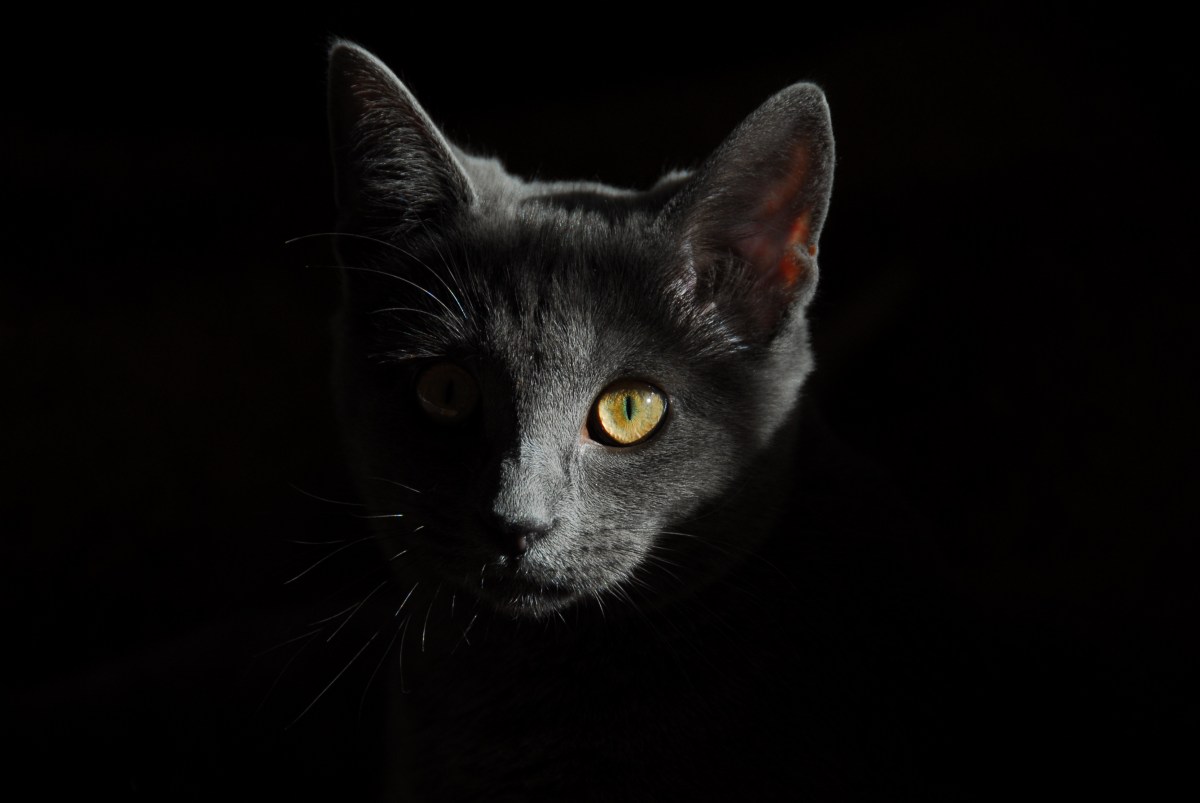
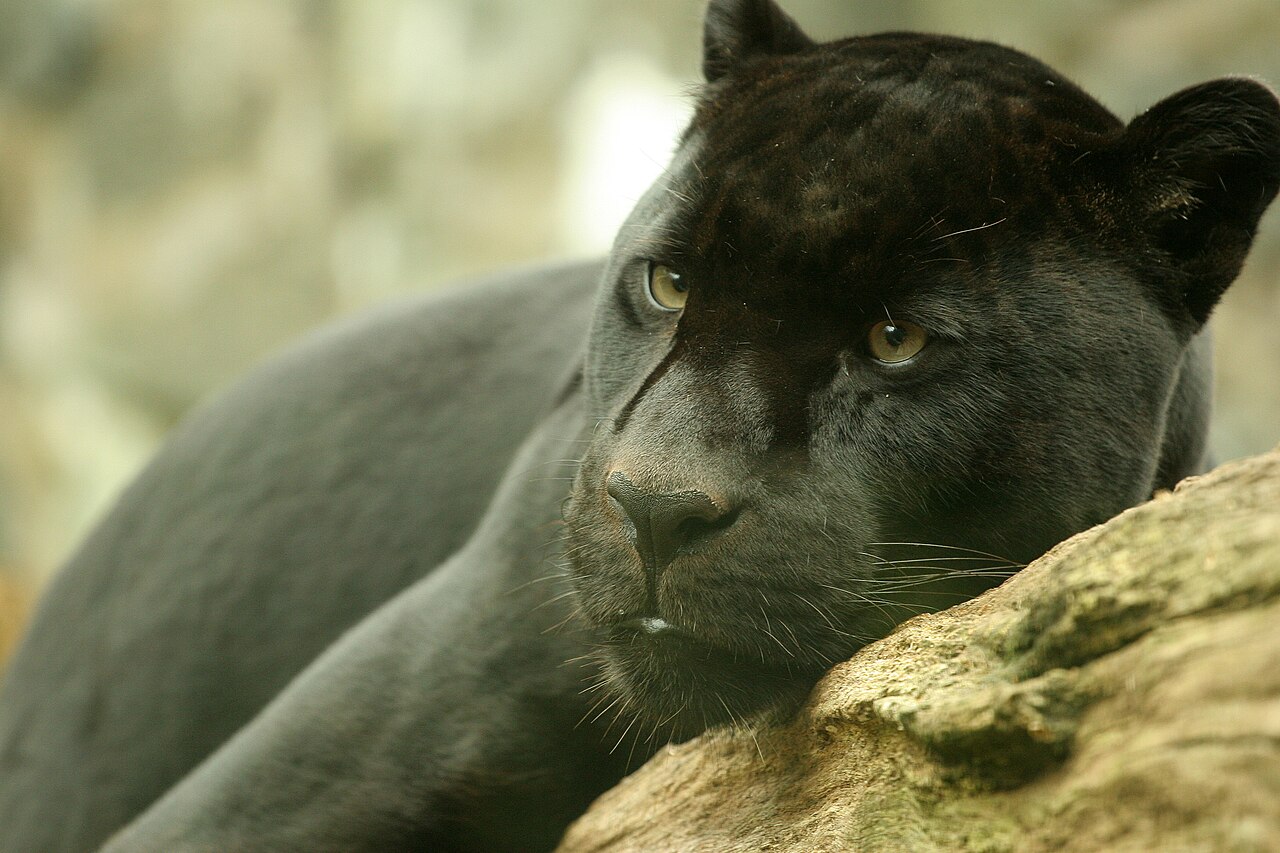
Pay attention to the lighting, especially if you’re shooting a black cat or a kitty with a darker coat pattern. Unless you’re going for a silhouette or a sunrise behind your furry friend, keep your cat facing to the right or left of the primary light source so you’re getting light and shadow to put those feline features in relief. It’s also worth taking a close look at how professional photographers shoot melanistic jaguars and leopards, carefully using light to highlight their features. In the right conditions their rosettes are still visible, they’re just slightly different shades of black. While house cats don’t have rosettes, the same attention to light and detail can help pick out the contours of their beautiful coats.
Under the right light conditions, the contours, spots and rosettes of a black jaguar are visible in beautiful detail. Credit: Edin Zoo/Wikimedia Commons
Did People Really Slaughter Cats During The Plague?
It’s often claimed that Europeans murdered felines en masse during the waves of Black Plague that devastated Europe during the Dark Ages, visiting countless cruelties on cats while inadvertently amplifying the spread by nearly wiping out disease-carrying rodents’ most effective predators.
In a new post that closely examines documents and evidence from burial sites of the era, Snopes concludes there was much less cat-killing than claimed, and the claims of widespread purging at the hands of pandemic-weary zealots have their roots in a 90s novel, which was then circulated on the web as fact.
Sites where as many as 79 sets of cat bones from the era were found show clear signs that the animals were slaughtered for their fur, and a singular slaughter in 1730s Paris often cited as proof is not only a few centuries off but was also motivated by class hatred, not fears of the plague.
While the papal bull Vox In Rama was real, and a famously zealous inquisitor really did make the preposterous claim that Satanists had a ritual that involved literally kissing the asses of black cats, the pope never called on anyone to kill felines and there’s no evidence that people took it upon themselves to do so. There was plenty of other unbelievable superstitious idiocy that led to the deaths of animals at the time, including the practice of putting animals on trial for alleged crimes, but Europeans weren’t rampaging through towns and killing cats.
Snopes quotes Welsh historian Mike Dash, who says the modern claims of widespread cat-killing are “almost certainly a modern internet-based fabrication.”
One software engineer went to incredible lengths to monitor her cat’s bathroom habits.
When Alan Turing, the father of artificial intelligence, posed the heady question “Can machines think?”, he inspired generations of computer scientists, philosophers, physicists and regular people to imagine the emergence of silicon-based consciousness, with humanity taking the godlike step of creating a new form of life.
And when science fiction writer Philip K. Dick wrote his seminal 1968 novel, “Do Androids Dream of Electric Sheep?” — the story that would eventually become Ridley Scott’s 1982 classic Bladerunner — he wondered what makes us human, and whether an artificial being could possess a soul.
It’s safe to say neither of those techno-prophets were thinking of fledgling AI algorithms, representing the first small steps toward true machine-substrate intelligence, announcing themselves and their usefulness to the world by helping us watch felis catus take a shit.
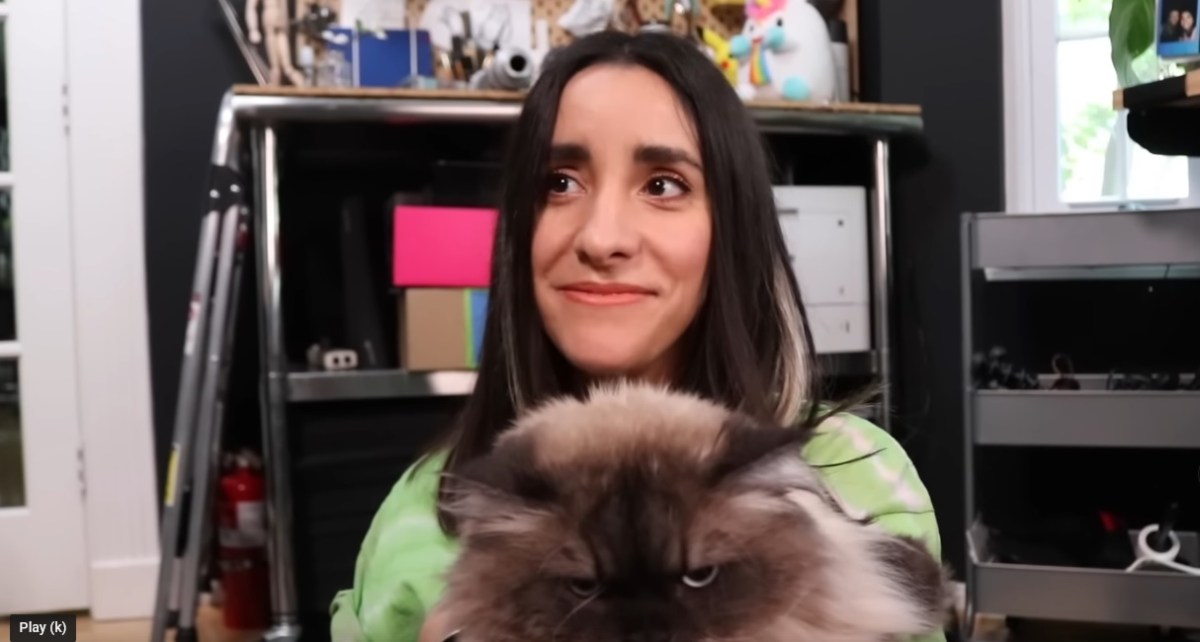
And yet that’s what the inventors of the LuluPet litter box designed an AI to do, and it’s what software engineer and Youtuber Estefannie did for her cat, Teddy, who’s got a bit of a plastic-eating problem.
“The veterinarian couldn’t tell me how much plastic he ate, and it would cost me over $3,000 [to find out]. So I didn’t do it,” Estefannie explains in a new video. “Instead, the vet gave me the option of watching him go to the bathroom. If he poops and there’s no plastic in his intestines, then he won’t die, and he might actually love me back.”
Estefannie casually described how she wrote a python script, set up a camera and motion sensor, and rigged it to take photos of Teddy doing his business. But, she explained, there was “a tiny problem”: Luna the Cat, aka her cat’s cat.
“This is Luna, this is technically not my cat, this is Teddy-Bear’s cat, and she uses the same litter box as Teddy,” she explained.
For that, she’d need more than a script. She’d have to build a machine learning algorithm to gorge itself on data, cataloguing tens of thousands of photos of Teddy and Luna along with sensory information from the litter box itself, to learn to reliably determine which cat was using the loo.
So Estefannie decided it was a good opportunity to “completely remodel” Teddy’s “bathroom,” including a compartment that would hide the bespoke system monitoring his bowel movements. The system includes sensors, cameras and lights to capture still images of Teddy dropping deuces in infrared, and a live thermal imaging feed of the little guy doing his business. (Teddy’s luxurious new bedroom turned out to be too dark for conventional cameras, thus the pivot to infrared.)
From there, Estefannie manually calculated how long Teddy’s number ones and twos took, and cross-referenced that information with photo timestamps to help determine the exact nature of Teddy’s calls of nature.
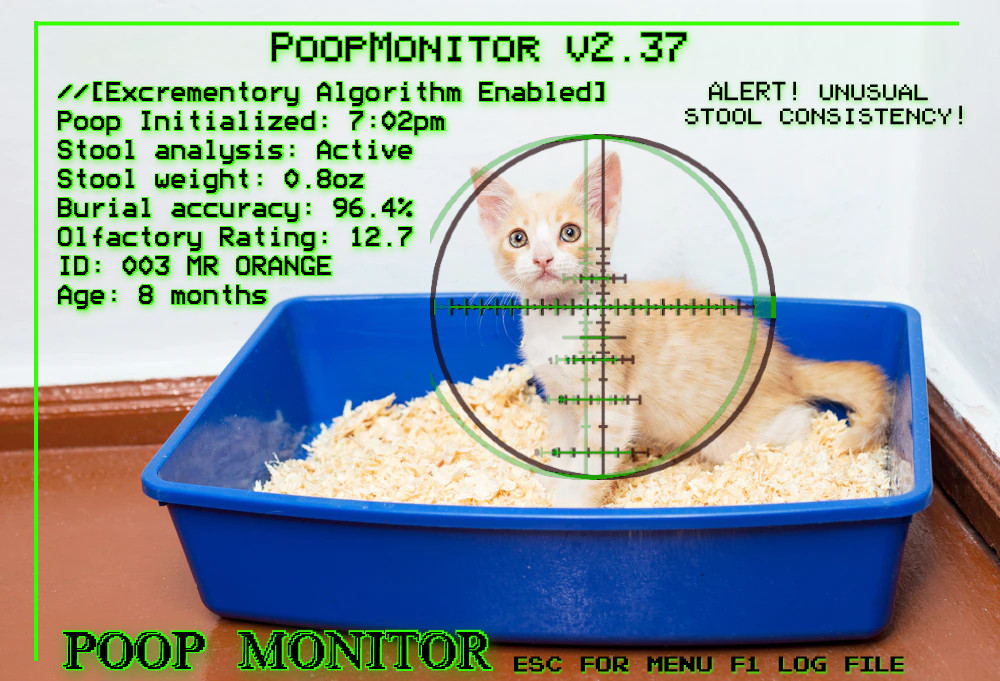
The future! (Note: This is our cheesy photoshopped interpretation, not Estefannie’s actual stool monitoring interface.)
When all the data is collected, Estefannie’s custom scripts sends it to an external server, which analyzes the images from each of Teddy’s bathroom visits and renders a verdict on what he’s doing in there.
Finally, Estefannie gets an alert on her smartphone when one of the cats steps into the litterbox, allowing her the option of watching a live feed and, uh, logging all the particulars. The software determines if a number two was successful, and keeps detailed records so Teddy’s human servant can see aberrations over time.
“So now I definitely know when Teddy-Bear is not pooping and needs to go to the hospital,” she said.
I am not making this up.
For her part, Estefannie says she’s not worried about a technological singularity scenario in which angry or insulted machines, newly conscious, exact revenge on humans who made them do unsavory tasks.
“Did I make an AI whose only purpose in life is to watch my cats poop?” Estefannie asked, barely keeping a straight face. “Mmmhmm. Will it come after me when the machines rise? No! Ewww!”
The Electric Life of Louis Wain tells the story of one of Victorian England’s most revered artists who was known almost exclusively for his humorous cat illustrations.
Movie: The Electrical Life of Louis Wain Director: Will Sharpe Genre: Biopic, drama Medium: Amazon Original (streaming and in theaters)
Louis Wain was an artist in the employ of The Illustrated London News, one of the most popular newspapers in Victorian England, when advances in photography and printing made it possible for newspapers to regularly include photographs in their pages.
Demoted from staff illustrator to contributor, Wain’s professional skills seemed destined for obsolescence when he and his wife, Emily, returned to their cottage one rainy afternoon in 1886 and heard the distressed mews of a kitten. They found an adorable tuxedo cat soaked and shivering in their garden, brought him inside and were instantly smitten.
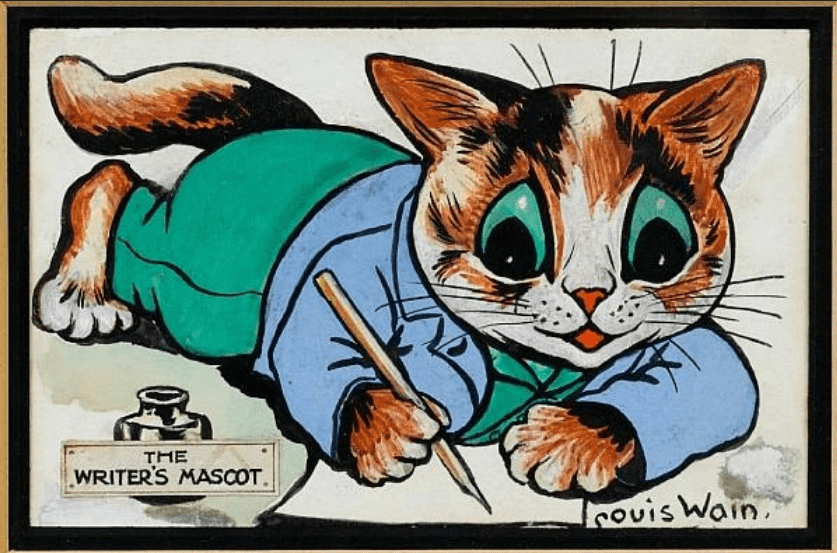
They named the baby Peter, and in the months that followed Wain made the growing kitten the subject of most of his idle drawings, sketching him in various situations and with increasingly anthropomorphic features. Wain’s cat sketches were only intended for his wife, but when Sir William Ingram, editor at The Illustrated News, saw the whimsical cat drawings he commissioned Wain to fill two pages with cats as a special feature for the paper’s Christmas edition.
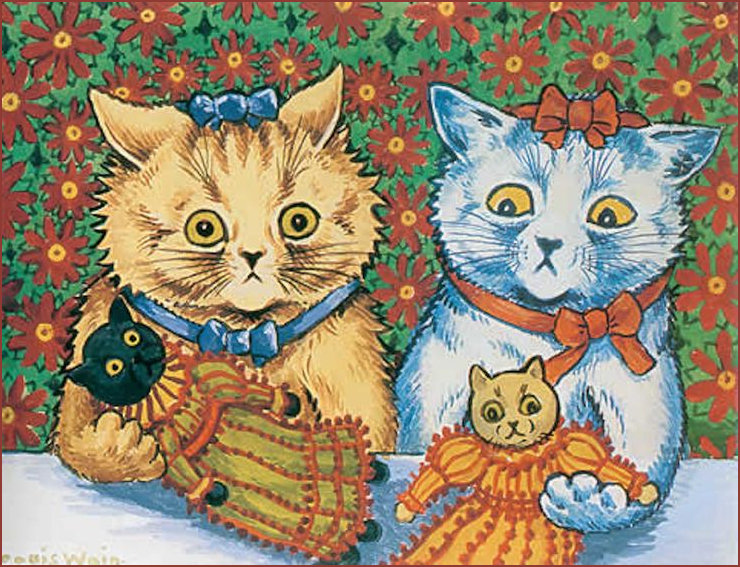
Wain’s cats were a huge hit with readers, marking the beginning of a second, much more successful career as a pet portraitist and one of Victorian England’s most beloved artists. Wain gave his cats human expressions, had them do human things, and put them in contemporary clothing to the delight of newspaper readers and, later, book publishers who sold many thousands of copies of illustrated books featuring nothing but Wain’s anthropomorphic cats.
A pair of young female cats play with cat dolls.
The Electrical Life of Louis Wain weaves a narrative from its subject’s professional life and his lesser-known private life. A polymath, philosopher, amateur boxer and author of some particular ideas about cats and electricity, Wain (played by the always-excellent Benedict Cumberbatch) was an eccentric and not particularly happy with his life until his family hired Emily Richardson (Claire Foy) as governess — a home teacher — for Wain’s younger sisters.
Despite the fact that Emily was a decade his senior and such relationships were looked down upon in Victorian England, Wain and Emily married, made it clear they didn’t care what others thought about them, and learned to enjoy life in each other’s company. With the addition of little Peter, the Wains were a happy family.
Louis Wain did not, however, have an easy life. Three years into their blissful marriage, Emily was diagnosed with terminal breast cancer. Her illness, the subsequent mental deterioration of one of Wain’s younger sisters, and Wain’s own eventual struggles with mental illness cast long shadows over his outlook and his work.
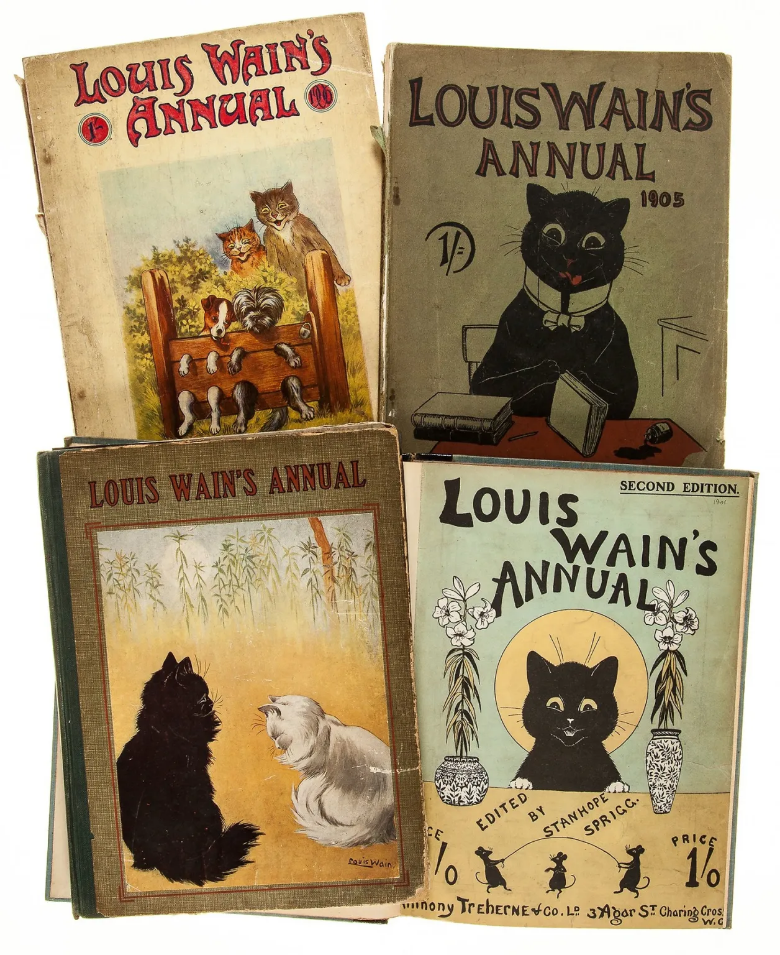
Wain’s cat drawings were so popular, they were sold in stand-alone books in addition to filling the pages of widely-read publications in Victorian England.
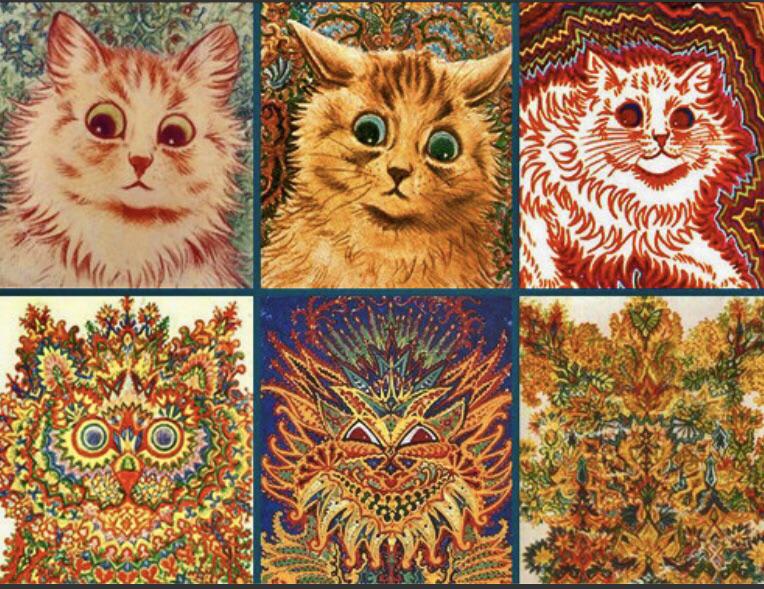
Today, psychologists, art critics and scholars of the man’s career still debate whether — and to what degree — his mental state was reflected in his artwork as his cats took on increasingly psychedelic and abstract qualities. What began as simple kitten sketches morphed into whimsical scenes of expressive cats and eventually trippy images that wouldn’t have looked out of place as album art in the late 1960s and 1970s.
Did Wain truly suffer from severe mental illness, or was he a casualty of a society that banished its “undesirables” to asylums and “lunatic houses”? Was Wain on the autism spectrum? Did the increasingly psychedelic bent of his drawings stem from medications he was given at a time when mental illness was poorly understood and poorly treated?
It depends on what you see in the illustrations. For a man so revered by the public, Wain was remarkably casual about his output — a quality Cumberbatch displays admirably throughout the film — and he didn’t bother to date his drawings. He was prolific, completing many hundreds of cat images throughout his career, in addition to the journalistic images and livestock renderings of his early career, when he was a newspaperman.
Wain’s cat illustrations took on more psychedelic qualities as the years passed.
What is absolutely clear is that Wain saw something in cats that others didn’t see until he showed it to them with his pencils. He was credited with a major shift in attitude toward cats and the normalization of keeping cats as pets rather than as mousers. Although cats enjoyed companion animal status in various other cultures earlier in human history, the idea of keeping a feline as a pet was novel in Victorian England.
The shift in public attitude was treated humorously — as much of the subject matter is — by the film, with a bewildered Wain accepting the presidency of the Cat Society of England at a fete in his honor, then explaining his theory that tabby markings were the result of electricity flowing through fur.
The subject of electricity comes up again and again in the film, bringing to mind Tesla and another famous British eccentric, Alan Turing, who was also played by Cumberbatch in the 2014 biopic The Imitation Game. Not coincidentally, both movies show that service to crown and country mattered little when British eccentrics were deemed too odd to tolerate. Like Wain, Turing — a war hero who famously cracked the legendary German Enigma cryptography machine — found himself on the wrong side of the UK’s mental institutions when he was convicted of indecency in 1952 after admitting to police, during an interview in an unrelated investigation, that he’d once had a relationship with another man.
Turing was subsequently placed on synthetic estrogen and drugs prescribed to “cure” his mental condition, which had the opposite effect: Turing, a shadow of his former self, his genius blunted by chemicals, committed suicide by eating an apple he’d laced with cyanide in 1954.
The Electrical Life of Louis Wain finds humor in both the light and dark moments of its subject’s life, and it’s a credit to the film’s writers, director and actors that lighthearted moments don’t spoil the more serious narrative themes. For his part, Wain was a man who endured a lot of suffering in his life, and if there’s a lesson to be learned here, it’s that no matter what life throws at us, spending time with cats makes things more bearable.



![Screenshot 2021-11-07 at 06-19-42 2_1890c_Louis_Wain_CatsNightmare_IllustrationChronicles_1500 jpg (WEBP Image, 1123 × 1536[...]](https://i0.wp.com/littlebuddythecat.com/wp-content/uploads/2021/11/screenshot-2021-11-07-at-06-19-42-2_1890c_louis_wain_catsnightmare_illustrationchronicles_1500-jpg-webp-image-1123-c397-1536....png?w=169&h=231&ssl=1 "Screenshot 2021-11-07 at 06-19-42 2_1890c_Louis_Wain_CatsNightmare_IllustrationChronicles_1500 jpg (WEBP Image, 1123 × 1536[...]")


 Pain In The Bud